
如何配置 SCEP 以实现安全的 BYOD 和 802.1X 网络身份验证
本指南为配置 SCEP 以部署基于证书的 802.1X 网络身份验证提供了全面的技术参考。内容涵盖了从共享密码到 EAP-TLS 的架构转变、移动设备管理(MDM)集成,以及在企业环境中实现安全 BYOD 访问的严格网络分段。
收听本指南
查看播客转录

执行摘要
对于在企业环境中工作的 IT 经理和网络架构师而言,管理 BYOD(自带设备)WiFi 访问已从一项便利功能转变为至关重要的安全考量。依靠预共享密钥或基础 Captive Portal 来提供员工 WiFi 既是安全漏洞,也是运维瓶颈。现代网络架构要求使用 EAP-TLS 进行 802.1X 身份验证,以确保每个设备在访问网络之前都经过加密验证。
本指南提供了一个务实的、与厂商无关的框架,用于使用简单证书注册协议(SCEP)部署安全的 BYOD WiFi。我们详细介绍了保护现代企业边缘所需的精确配置,重点是实施 802.1X 身份验证、利用移动设备管理(MDM)确保合规性,以及执行严格的网络分段。通过将这些技术控制措施与业务成果相结合,IT 决策者可以部署在维护运营效率的同时保护数据完整性的解决方案。
技术深挖:SCEP 与 802.1X 架构
安全 BYOD WiFi 的基础在于放弃共享密码,转而采用基于身份的访问控制。
802.1X 标准与 EAP-TLS
IEEE 802.1X 标准是企业 WiFi 安全不容妥协的基线。它提供基于端口的网络访问控制(PNAC),确保设备在经过明确身份验证之前无法在网络上进行通信。对于 BYOD 部署,EAP-TLS(传输层安全)是黄金标准。EAP-TLS 依赖于客户端 X.509 证书,消除了凭据窃取和中间人攻击的风险。
SCEP(简单证书注册协议)
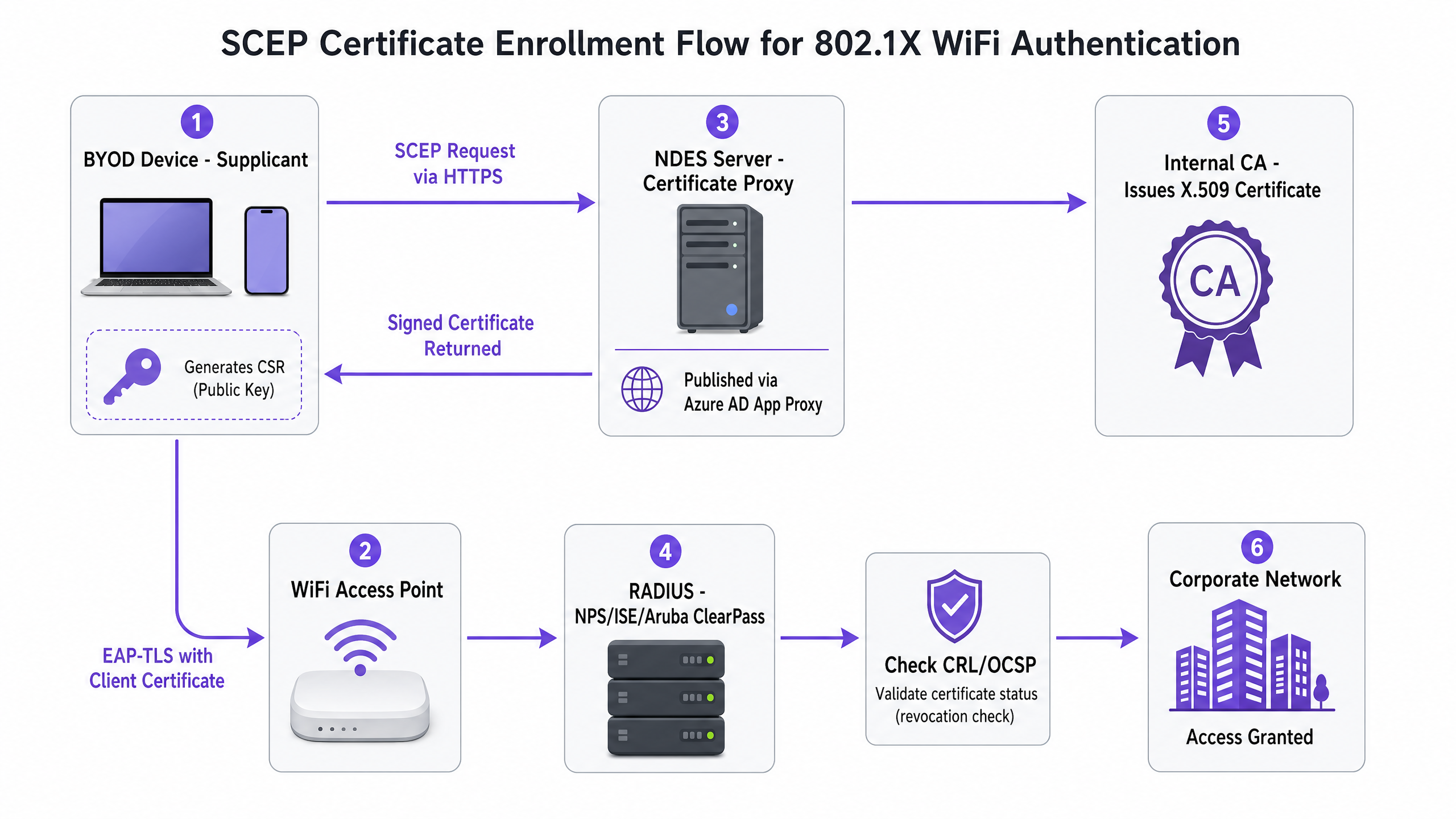
为了大规模部署这些证书,SCEP 实现了公钥基础设施(PKI)中证书颁发和管理的自动化。在 SCEP 工作流中,MDM 服务指示终端生成自己的私钥/公钥对。设备然后创建证书签名请求(CSR),并通过网络设备注册服务(NDES)服务器将其发送到您的证书颁发机构(CA)。
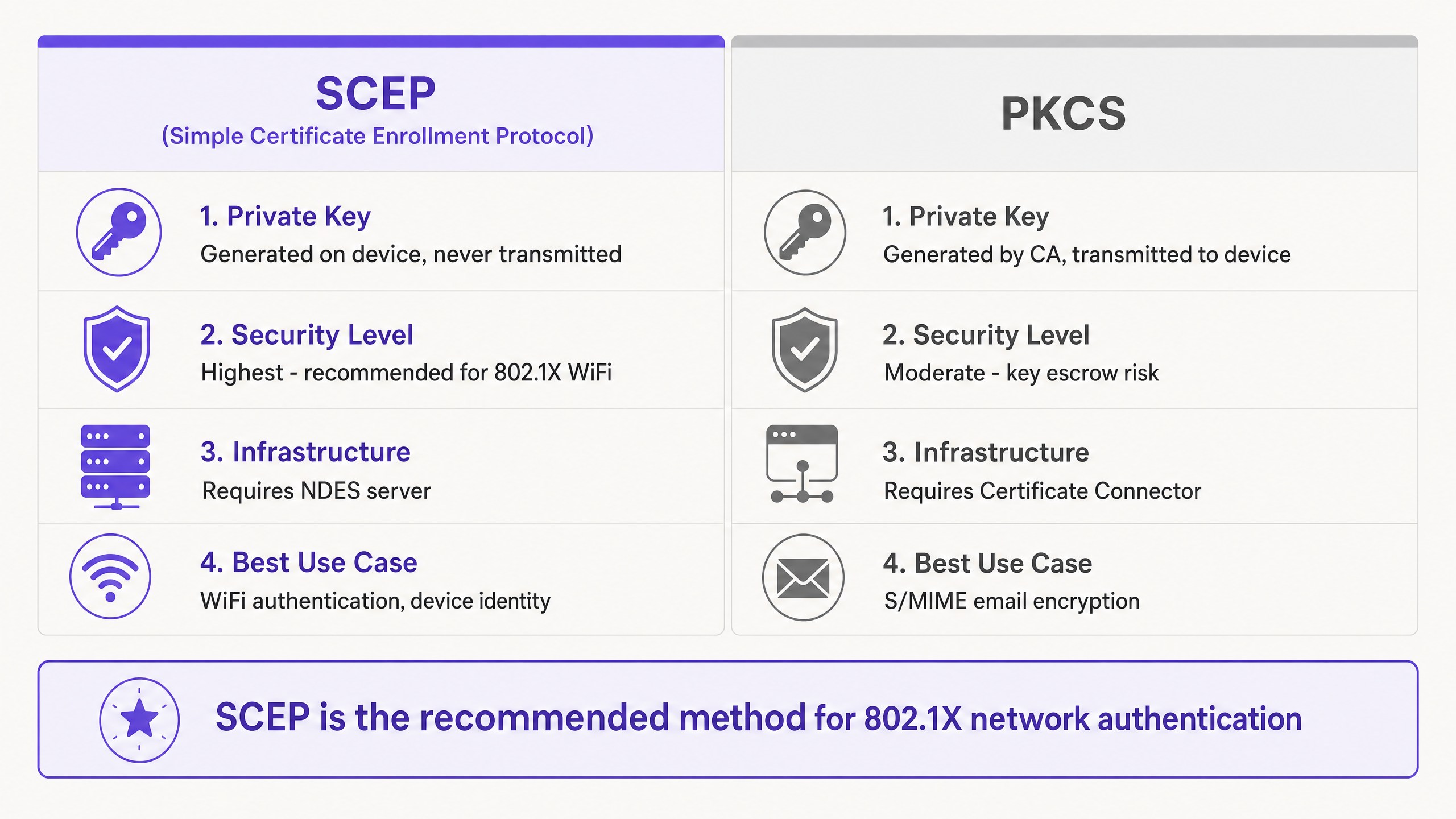
SCEP 的关键安全优势在于私钥永远不会离开设备。它在本地生成并存储在设备的安全区域中(例如 Windows 上的 TPM 或 iOS 上的 Secure Enclave)。
实施指南:部署顺序
成功为 802.1X 配置 SCEP 需要严格遵守特定的部署顺序。Intune 配置文件依赖关系规定,在配置身份验证之前必须先建立信任。
步骤 1:部署受信任的根证书配置文件
在任何设备可以请求客户端证书或信任您的 RADIUS 服务器之前,它必须信任颁发证书的证书颁发机构。将您的根 CA 证书导出为 .cer 文件,并将此配置文件部署到您的目标设备组。
步骤 2:配置 SCEP 证书配置文件
配置 SCEP 配置文件以指示设备如何获取其客户端证书。将此配置文件链接到步骤 1 中创建的受信任根证书配置文件,并提供 NDES 服务器的外部 URL。
步骤 3:部署 802.1X WiFi 配置文件
最后一步是推送将证书与网络 SSID 绑定的 WiFi 配置。将安全类型设置为 WPA2-Enterprise 或 WPA3-Enterprise,将 EAP 类型设置为 EAP-TLS,并选择步骤 2 中创建的 SCEP 证书配置文件作为客户端身份验证证书。
最佳实践与网络分段
在实施 SCEP 证书部署时,请遵循以下与厂商无关的最佳实践,以确保合规性和可靠性。
严格的三区架构
扁平网络是极易受到攻击的网络。实施严格的分段:
- 企业区:托管的、公司拥有的设备,拥有对内部资源的完全访问权限。
- BYOD 区:员工拥有的设备,具有互联网访问权限,且对特定内部应用程序的访问受限。
- 访客区:仅具有互联网访问权限且启用了客户端隔离的访客设备。
NDES 服务器部署
使用 Microsoft Entra ID 应用程序代理发布 NDES URL。这提供了安全的远程访问,而无需打开入站防火墙端口,并允许您将条件访问策略应用于注册流程。
WPA3-Enterprise 与 OpenRoaming
从 WPA2 过渡到 WPA3-Enterprise,以受益于强制性保护管理帧(PMF)。为了在不同场所之间实现无缝、安全的连接,请考虑实施 OpenRoaming。在 Connect 许可下,Purple 可作为 OpenRoaming 的免费身份提供商,无需手动引导即可简化安全访问。
故障排除与风险缓解
即使经过精心规划,证书部署也可能会遇到问题。
组目标定位不匹配
如果将 SCEP 配置文件分配给用户组,而将 WiFi 配置文件分配给设备组,则 MDM 无法解析该依赖关系。确保受信任的根、SCEP 和 WiFi 配置文件都部署到...作为同一组运行。
RADIUS 和 CRL 检查
如果设备证书被吊销,RADIUS 服务器必须立即获悉。配置您的网络策略服务器 (NPS) 或 RADIUS 服务器以强制执行严格的证书吊销列表 (CRL) 检查。确保您的 CRL 分发点 (CDP) 具有高可用性。
投资回报率 (ROI) 与业务影响
过渡到 SCEP 802.1X 证书部署可在安全和运营方面带来可衡量的回报。
- 减少服务台工单:基于密码的 WiFi 会产生大量的支持工单。基于证书的身份验证对用户是无感的,通常可减少 70% 与 WiFi 相关的服务台工单量。
- 增强安全态势:EAP-TLS 消除了凭据窃取的风险。这对于遵守 PCI DSS 和 GDPR 等框架至关重要,特别是在医疗保健和零售环境中。
- 无缝入网:将 SCEP 与现有的 MDM 工作流集成,可确保从第一天起就提供统一、零接触的配置体验。
如需阅读有关相关主题的更多信息,请参阅 访客 WiFi 、 WiFi 分析 以及我们的 企业 WiFi 安全:2026 年完整指南 。
关键定义
SCEP (Simple Certificate Enrollment Protocol)
A protocol that allows devices to request digital certificates from a Certificate Authority, where the private key is generated and stored securely on the device itself.
The recommended method for deploying WiFi authentication certificates due to its high security and scalability.
EAP-TLS (Extensible Authentication Protocol - Transport Layer Security)
The most secure 802.1X authentication method, requiring both the server and the client to present valid digital certificates.
The target authentication protocol that the MDM WiFi and certificate profiles are designed to enable.
802.1X
An IEEE standard for port-based Network Access Control (PNAC) that provides an authentication mechanism to devices wishing to attach to a LAN or WLAN.
The foundational framework that prevents unauthenticated devices from passing traffic on the enterprise network.
NDES (Network Device Enrollment Service)
A Microsoft Windows Server role that acts as a bridge, allowing devices without domain credentials to obtain certificates via SCEP.
A required infrastructure component when implementing on-premises SCEP certificate deployment.
PKCS (Public Key Cryptography Standards)
A set of standards where both the public and private keys are generated by the Certificate Authority and then securely delivered to the endpoint.
Often used for S/MIME email encryption, but less ideal for WiFi due to the network transmission of the private key.
CRL (Certificate Revocation List)
A list published by the Certificate Authority containing the serial numbers of certificates that have been revoked prior to their scheduled expiration date.
RADIUS servers must check this list to ensure compromised or lost devices are denied network access.
RADIUS (Remote Authentication Dial-In User Service)
A networking protocol that provides centralized Authentication, Authorization, and Accounting (AAA) management for users who connect and use a network service.
The server that validates the client certificate during the EAP-TLS handshake.
VLAN (Virtual Local Area Network)
A logical subnetwork that groups a collection of devices from different physical LANs.
Used to enforce strict network segmentation between Corporate, BYOD, and Guest devices.
应用实例
A 400-room hotel needs to secure its staff WiFi network for 150 employees bringing their own smartphones, replacing an old WPA2-PSK network.
The hotel deploys a cloud-based MDM (like Microsoft Intune). They broadcast a provisioning SSID that directs users to a captive portal. The portal prompts users to enroll their device in the MDM. Once enrolled, the MDM pushes a Trusted Root profile, a SCEP profile, and an 802.1X WiFi profile. The device silently generates a key pair, requests a certificate via the SCEP URL, and connects to the secure BYOD SSID using EAP-TLS. The provisioning SSID is then forgotten.
A retail chain with 50 locations is experiencing mass authentication failures after migrating from PEAP to EAP-TLS using SCEP.
The IT team audits the RADIUS server logs and discovers that the CRL Distribution Point (CDP) is unreachable from the RADIUS server. Because strict CRL checking is enabled, the RADIUS server rejects all connection attempts when it cannot verify the revocation status. The team resolves this by publishing the CRL to a highly available internal web server and updating the CDP extension in the CA template.
练习题
Q1. You are deploying Intune WiFi profiles for 802.1X. The devices receive the SCEP certificate successfully, but the WiFi profile fails to apply. What is the most likely cause?
提示:Consider how Intune resolves dependencies between profiles.
查看标准答案
The most likely cause is a group targeting mismatch. The Trusted Root, SCEP, and WiFi profiles must all be assigned to the exact same Azure AD group (either all Users or all Devices). If assignments differ, Intune cannot resolve the dependency chain.
Q2. A hospital IT director wants to use PKCS instead of SCEP for their BYOD WiFi deployment because it requires less on-premises infrastructure. What security risk should you highlight?
提示:Think about where the private key is generated.
查看标准答案
You should highlight that with PKCS, the private key is generated centrally by the CA and transmitted over the network to the device. For network authentication, SCEP is strongly recommended because the private key is generated locally on the device and never leaves the secure enclave.
Q3. During an EAP-TLS handshake, the client device rejects the connection to the RADIUS server, preventing a potential evil twin attack. Which configuration setting enables this protection?
提示:What does the client check during mutual authentication?
查看标准答案
Enforcing server certificate validation on the client supplicant enables this protection. The MDM-deployed WiFi profile must specify the trusted CA and the expected RADIUS server name, ensuring the device only connects to the legitimate corporate RADIUS server.
继续阅读本系列
在企业级网络控制器中配置 Captive Portal 重定向
本权威指南详细介绍了在企业级网络控制器上实现 Captive Portal 重定向所需的技术架构和特定厂商的配置步骤。它为 IT 团队在配置围墙花园(walled gardens)、集成 RADIUS 身份验证以及确保符合 GDPR 和 PCI DSS 规范方面提供了可操作的指导。
企业级访客 WiFi 设置指南:VLAN 隔离、安全与 Captive Portal
本指南为企业级访客 WiFi 部署提供了技术蓝图,重点关注 VLAN 隔离、安全协议和 Captive Portal 架构。它详细介绍了如何在复杂的场所中安全地隔离流量、强制执行加密标准并捕获第一方数据。
企业级 SCEP 设置指南:面向高等教育和大型网络的基于证书的 Wi-Fi 身份验证
本指南为使用 SCEP 部署基于证书的 WiFi 身份验证提供了全面的技术蓝图。内容涵盖了从预共享密钥到 EAP-TLS 的架构转型、跨 MDM 平台的部署顺序,以及针对大型网络的关键风险缓解策略。