

2026 में सर्वश्रेष्ठ Captive Portal सॉफ्टवेयर: एक तुलनात्मक मार्गदर्शिका
यह मार्गदर्शिका 2026 में उपलब्ध प्रमुख Captive Portal सॉफ्टवेयर प्लेटफॉर्मों की एक आधिकारिक, विक्रेता-तटस्थ तुलना प्रदान करती है, जिसका मूल्यांकन सुविधाओं, अनुपालन स्थिति, एकीकरण की गहराई और परिनियोजन की कुल लागत के आधार पर किया गया है। यह उन IT प्रबंधकों, नेटवर्क आर्किटेक्ट्स और CTOs के लिए लिखी गई है जो होटल, रिटेल चेन, स्टेडियम, कॉन्फ्रेंस सेंटर और सार्वजनिक क्षेत्र के संगठनों में कार्यरत हैं और जिन्हें इस तिमाही में खरीद या आर्किटेक्चर संबंधी निर्णय लेने की आवश्यकता है। यह मार्गदर्शिका तकनीकी आर्किटेक्चर, वास्तविक-विश्व कार्यान्वयन परिदृश्यों और एक संरचित चयन फ्रेमवर्क को कवर करती है ताकि टीमों को अपनी नेटवर्क एक्सेस कंट्रोल रणनीति को मापने योग्य व्यावसायिक परिणामों के साथ संरेखित करने में मदद मिल सके।
🎧 Listen to this Guide
View Transcript
कार्यकारी सारांश
Captive Portal सॉफ्टवेयर नेटवर्क एक्सेस कंट्रोल और फर्स्ट-पार्टी डेटा कैप्चर के चौराहे पर स्थित है। 2026 में, बाजार साधारण स्प्लैश पेजों से काफी आगे बढ़ गया है: प्रमुख प्लेटफॉर्म अब क्लाउड-आधारित परिनियोजन, GDPR-अनुरूप सहमति प्रबंधन, गहन CRM एकीकरण और वास्तविक समय स्थान एनालिटिक्स प्रदान करते हैं। स्थल संचालकों और IT टीमों के लिए, सही चुनाव तीन प्राथमिक कारकों पर निर्भर करता है — आपके नेटवर्क परिवेश का पैमाना और जटिलता, आपकी अनुपालन बाध्यताएं, और वह सीमा जिस तक आपका संगठन अतिथि WiFi डेटा का मुद्रीकरण करना चाहता है।
यह मार्गदर्शिका एंटरप्राइज़ और मिड-मार्केट सेगमेंट में सबसे व्यापक रूप से तैनात छह Captive Portal समाधानों का मूल्यांकन करती है: Purple, Cisco Meraki, Cloud4Wi, IronWiFi, Cloudi-Fi, और Beambox। प्रत्येक प्लेटफॉर्म का प्रमाणीकरण क्षमता, मल्टी-साइट प्रबंधन, एनालिटिक्स की गहराई, एकीकरण पारिस्थितिकी तंत्र और अनुपालन तत्परता के आधार पर मूल्यांकन किया जाता है। हॉस्पिटैलिटी , रिटेल , हेल्थकेयर , और ट्रांसपोर्ट में संगठनों के लिए, हम प्रत्येक प्लेटफॉर्म को उस वर्टिकल की विशिष्ट परिचालन आवश्यकताओं के अनुसार मैप करते हैं। यह मार्गदर्शिका एक संरचित विक्रेता चयन फ्रेमवर्क और दो विस्तृत कार्यान्वयन केस स्टडीज के साथ समाप्त होती है।
CTO के लिए निचोड़: यदि एनालिटिक्स और मार्केटिंग ROI आपके प्राथमिक लक्ष्य हैं, तो Purple इस क्षेत्र में अग्रणी है। यदि आप पहले से ही Cisco इकोसिस्टम में हैं, तो Meraki सबसे आसान रास्ता है। एक ही अनुपालन दायरे के तहत संयुक्त अतिथि और कर्मचारी एक्सेस प्रबंधन के लिए, IronWiFi सबसे मजबूत दावेदार है।
Captive Portal सॉफ्टवेयर क्या है?
एक Captive Portal एक नेटवर्क एक्सेस कंट्रोल तंत्र है जो कनेक्ट होने वाले डिवाइस के प्रारंभिक HTTP या HTTPS अनुरोध को रोकता है और उसे एक होस्टेड स्प्लैश पेज पर रीडायरेक्ट करता है। उपयोगकर्ता को एक परिभाषित कार्रवाई पूरी करनी होगी — सेवा की शर्तों को स्वीकार करना, एक ईमेल पता सबमिट करना, सोशल लॉगिन के माध्यम से प्रमाणित करना, या एक वाउचर कोड दर्ज करना — इससे पहले कि नेटवर्क पूर्ण इंटरनेट एक्सेस प्रदान करे। अंतर्निहित प्रोटोकॉल व्यवहार RFC 8952 में मानकीकृत है, जो Captive Portal API को परिभाषित करता है और सुनिश्चित करता है कि आधुनिक ऑपरेटिंग सिस्टम पोर्टल का सही ढंग से पता लगा सकें और उसे प्रदर्शित कर सकें।
प्रोटोकॉल स्तर पर अवरोधन, रीडायरेक्ट और प्रमाणीकरण प्रवाह कैसे काम करता है, इसकी विस्तृत तकनीकी जानकारी के लिए, हमारी मार्गदर्शिका देखें: Captive Portal कैसे काम करता है? तकनीकी गहन विश्लेषण ।
बुनियादी ढांचे के स्तर पर, Captive Portal सॉफ्टवेयर तीन परिनियोजन मॉडलों में से एक में संचालित होता है। एक क्लाउड-होस्टेड मॉडल में, स्प्लैश पेज और प्रमाणीकरण तर्क विक्रेता के क्लाउड इन्फ्रास्ट्रक्चर से परोसे जाते हैं, जिसमें एक्सेस पॉइंट या कंट्रोलर अप्रमाणित क्लाइंट्स को होस्टेड URL पर रीडायरेक्ट करता है। एक ऑन-प्रिमाइसेस मॉडल में, एक समर्पित गेटवे उपकरण या वर्चुअल मशीन एक्सेस पॉइंट लेयर और अपस्ट्रीम राउटर के बीच स्थित होती है, जो सभी रीडायरेक्ट और प्रमाणीकरण ट्रैफिक को स्थानीय रूप से संभालती है। एक कंट्रोलर-एकीकृत मॉडल में, Captive Portal वायरलेस LAN कंट्रोलर (जैसे Cisco Meraki या Aruba) की एक मूल विशेषता होती है, जिससे एक अलग प्लेटफॉर्म की आवश्यकता समाप्त हो जाती है।
परिनियोजन मॉडल के चुनाव का विलंबता, लचीलापन, अनुपालन डेटा निवास और स्वामित्व की कुल लागत पर सीधा प्रभाव पड़ता है।
तकनीकी आर्किटेक्चर
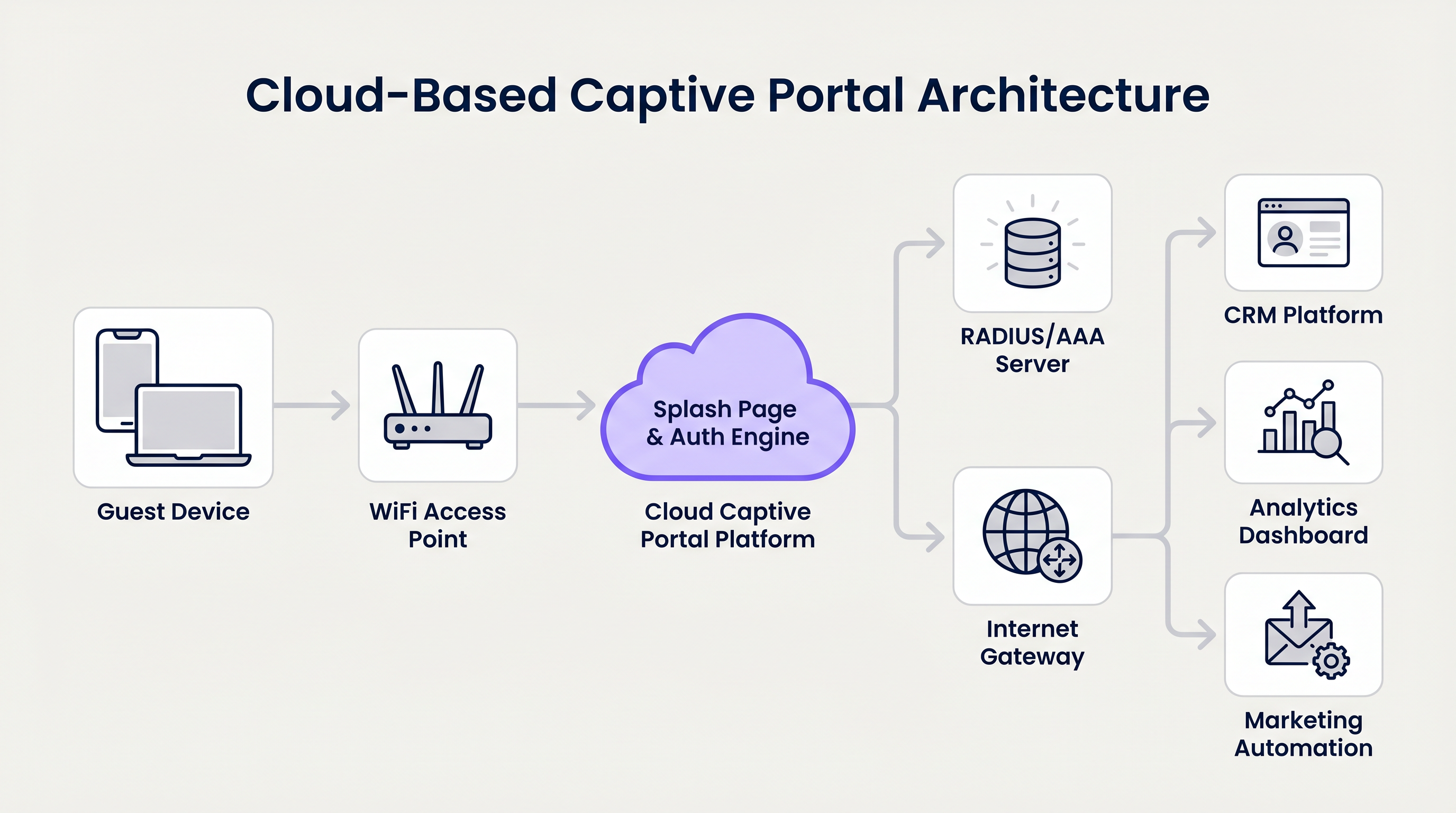
एक आधुनिक क्लाउड-आधारित Captive Portal सेवा के आर्किटेक्चर में कई अलग-अलग परतें शामिल होती हैं। एज पर, WiFi एक्सेस पॉइंट एक या अधिक SSIDs प्रसारित करते हैं। अप्रमाणित क्लाइंट्स को एक प्रतिबंधित VLAN में रखा जाता है जिसमें DNS और HTTP/HTTPS एक्सेस केवल Captive Portal प्लेटफॉर्म की IP रेंज तक होता है — इसे वॉल्ड गार्डन कहते हैं। जब क्लाइंट का ऑपरेटिंग सिस्टम या ब्राउज़र इंटरनेट तक पहुंचने का प्रयास करता है, तो एक्सेस पॉइंट या कंट्रोलर अनुरोध को रोकता है और पोर्टल के स्प्लैश पेज URL पर एक HTTP 302 रीडायरेक्ट जारी करता है।
स्प्लैश पेज और प्रमाणीकरण इंजन — विक्रेता के क्लाउड में होस्ट किया गया — ब्रांडेड लॉगिन इंटरफ़ेस प्रस्तुत करता है। सफल प्रमाणीकरण (सोशल OAuth, ईमेल सबमिशन, SMS OTP, या वाउचर सत्यापन) पर, प्लेटफॉर्म एक RADIUS एक्सेस-एक्सेप्ट संदेश या एक API कॉल के माध्यम से एक्सेस पॉइंट या कंट्रोलर को एक प्राधिकरण सिग्नल भेजता है, जो एकीकरण विधि पर निर्भर करता है। क्लाइंट को फिर प्रमाणित VLAN में ले जाया जाता है और इंटरनेट एक्सेस प्रदान किया जाता है।
प्रमाणीकरण इंजन के डाउनस्ट्रीम में, प्लेटफॉर्म कैप्चर किए गए पहचान डेटा — ईमेल पते, सोशल प्रोफाइल विशेषताएँ, सहमति रिकॉर्ड — को एकीकृत प्रणालियों में धकेलता है: CRM प्लेटफॉर्म (Salesforce, HubSpot, Mailchimp), मार्केटिंग ऑटोमेशन उपकरण, और एनालिटिक्स डैशबोर्ड। एंटरप्राइज़ परिनियोजन के लिए, यह एकीकरण आमतौर पर REST API या वेबहुक के माध्यम से संभाला जाता है, जिसमें पोर्टल के एडमिन कंसोल में फील्ड-लेवल मैपिंग कॉन्फ़िगर की जाती है।
RADIUS प्रोटोकॉल (RFC 2865 में परिभाषित) Captive Portal प्लेटफॉर्म और नेटवर्क इन्फ्रास्ट्रक्चर के बीच प्रमाणीकरण निर्णयों को संप्रेषित करने का प्रमुख तरीका बना हुआ है। जो प्लेटफॉर्म IEEE 802.1X (पोर्ट-आधारित नेटवर्क एक्सेस कंट्रोल) का भी समर्थन करते हैं, वे स्टाफ उपकरणों के लिए WPA-एंटरप्राइज़ प्रमाणीकरण को संभालने के लिए उसी बुनियादी ढांचे का विस्तार कर सकते हैं, जिससे एक अलग RADIUS सर्वर की आवश्यकता समाप्त हो जाती है।
प्लेटफॉर्म तुलना
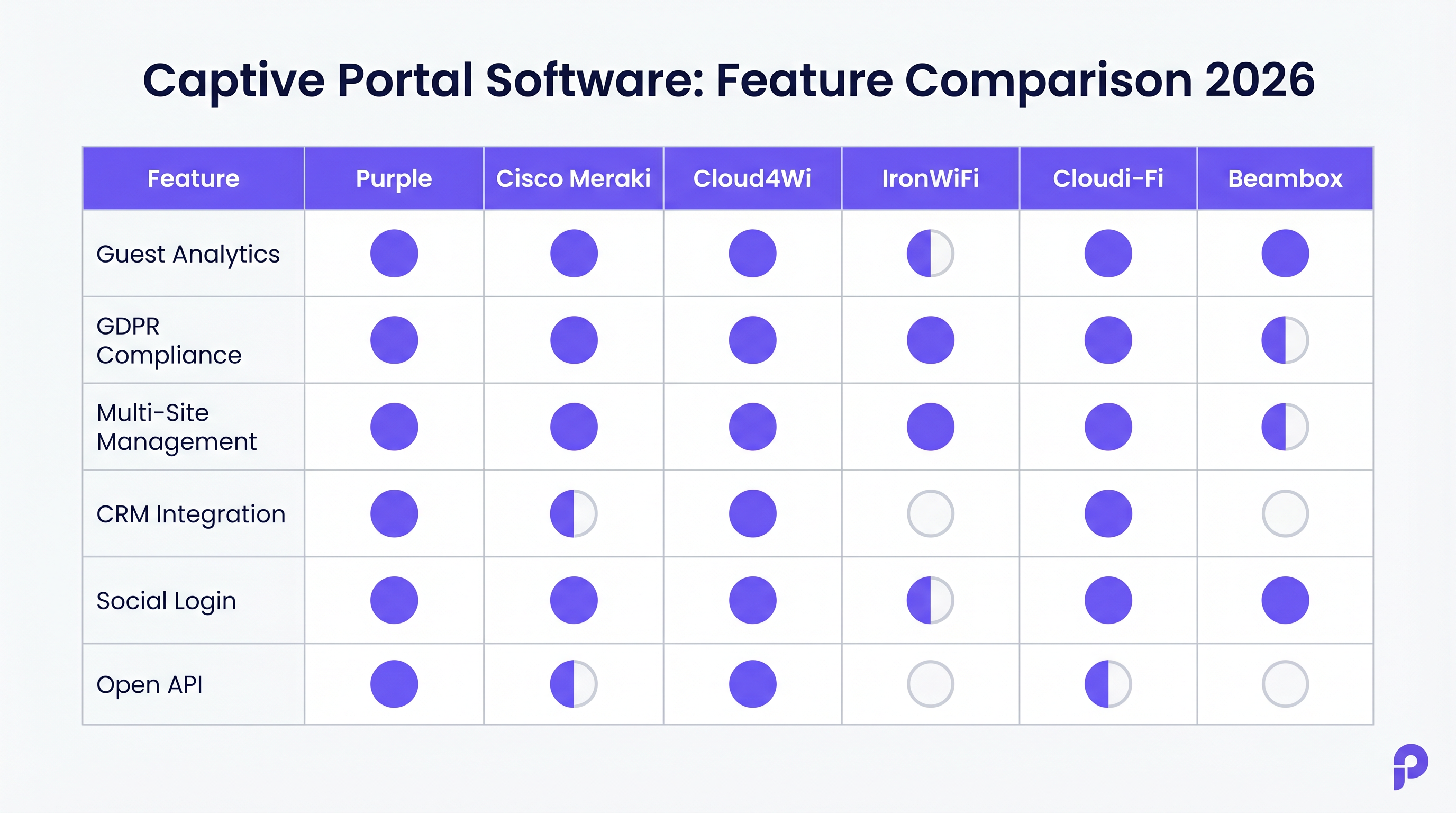
नीचे दी गई तालिका इस मार्गदर्शिका में मूल्यांकन किए गए छह प्लेटफॉर्मों के प्रमुख अंतरों को सारांशित करती है।
| प्लेटफॉर्म | परिनियोजन मॉडल | सर्वश्रेष्ठ वर्टिकल | एनालिटिक्स की गहराई | GDPR/अनुपालन | मल्टी-साइट | ओपन API | सांकेतिक मूल्य निर्धारण |
|---|---|---|---|---|---|---|---|
| Purple | Cloud SaaS | हॉस्पिटैलिटी, रिटेल, स्टेडियम, ट्रांसपोर्ट | एडवांस्ड (फुटफॉल, ड्वेल, हीटमैप) | फुल (ऑडिट ट्रेल, कंसेंट मैनेजमेंट) | हाँ (केंद्रीकृत) | हाँ (REST) | कस्टम / प्रति वेन्यू |
| Cisco Meraki | कंट्रोलर-इंटीग्रेटेड | एंटरप्राइज, हेल्थकेयर, एजुकेशन | मध्यम | मजबूत (Cisco कंप्लायंस स्टैक) | हाँ (Meraki डैशबोर्ड) | आंशिक | प्रीमियम (हार्डवेयर + लाइसेंस) |
| Cloud4Wi | Cloud SaaS | मल्टी-साइट रिटेल, एंटरप्राइज | एडवांस्ड | फुल | हाँ | हाँ | कस्टम / एंटरप्राइज |
| IronWiFi | Cloud SaaS | एंटरप्राइज, हेल्थकेयर, एजुकेशन | मध्यम | फुल (SOC 2, GDPR, HIPAA) | हाँ | सीमित | प्रति-स्थान SaaS |
| Cloudi-Fi | Cloud SaaS | एंटरप्राइज, ट्रांसपोर्ट, एजुकेशन | एडवांस्ड | फुल | हाँ | आंशिक | कस्टम / एंटरप्राइज |
| Beambox | Cloud SaaS | SMB, हॉस्पिटैलिटी, F&B | बेसिक | आंशिक | सीमित | नहीं | प्रति-स्थान SaaS |
Purple
Purple का गेस्ट WiFi प्लेटफॉर्म इस तुलना में सबसे विश्लेषणात्मक रूप से सक्षम समाधान है। इसका कैप्टिव पोर्टल एक व्यापक WiFi एनालिटिक्स इंजन का प्रवेश द्वार है जो फुटफॉल पैटर्न, ड्वेल टाइम, ज़ोन-लेवल हीट मैप्स और बार-बार आने वाले विज़िट की फ्रीक्वेंसी को ट्रैक करता है। बड़े वेन्यू — शॉपिंग सेंटर, स्टेडियम, एयरपोर्ट और होटल चेन के लिए — यह WiFi नेटवर्क को एक लागत केंद्र से ऑपरेशनल इंटेलिजेंस के स्रोत में बदल देता है।
Purple सभी मानक प्रमाणीकरण विधियों (Google, Facebook और Apple के माध्यम से सोशल लॉगिन; ईमेल कैप्चर; SMS OTP; क्लिक-थ्रू) का समर्थन करता है और पूर्ण व्हाइट-लेबलिंग के साथ एक ड्रैग-एंड-ड्रॉप स्प्लैश पेज बिल्डर प्रदान करता है। GDPR सहमति कैप्चर ऑनबोर्डिंग फ्लो में निर्मित है, जिसमें प्रति उपयोगकर्ता रिकॉर्ड के लिए एक पूर्ण ऑडिट ट्रेल संग्रहीत होता है। यह प्लेटफॉर्म Salesforce, HubSpot, Mailchimp और दर्जनों अन्य मार्केटिंग टूल के साथ REST API और प्री-बिल्ट कनेक्टर्स के माध्यम से मूल रूप से एकीकृत होता है।
गेस्ट और स्टाफ WiFi दोनों का प्रबंधन करने वाले संगठनों के लिए, Purple Microsoft Entra ID, Google Workspace और Okta के साथ एकीकृत होता है, जिससे कॉन्ट्रैक्टरों और अस्थायी कर्मचारियों के लिए मैन्युअल क्रेडेंशियल प्रबंधन की आवश्यकता के बिना समय-सीमित या भूमिका-आधारित एक्सेस सक्षम होता है।
Cisco Meraki
Meraki की कैप्टिव पोर्टल क्षमता Meraki डैशबोर्ड में एम्बेडेड है और उन संगठनों के लिए स्वाभाविक विकल्प है जो पहले से ही Meraki एक्सेस पॉइंट और स्विच संचालित कर रहे हैं। यह क्लिक-थ्रू, साइन-ऑन स्प्लैश पेज और बिलिंग इंटीग्रेशन का समर्थन करता है। RADIUS प्रमाणीकरण मूल रूप से संभाला जाता है, और यह प्लेटफॉर्म उन्नत नीति प्रवर्तन और 802.1X के लिए Cisco ISE के साथ एकीकृत होता है।
प्राथमिक बाधा इकोसिस्टम लॉक-इन है: Meraki का कैप्टिव पोर्टल Meraki हार्डवेयर से कसकर जुड़ा हुआ है, और लाइसेंसिंग मॉडल (प्रति-डिवाइस, वार्षिक) इसे प्रति-स्थान के आधार पर अधिक महंगे विकल्पों में से एक बनाता है। एनालिटिक्स मध्यम हैं — बुनियादी रिपोर्टिंग के लिए पर्याप्त हैं लेकिन वेन्यू इंटेलिजेंस उपयोग के मामलों के लिए Purple या Cloud4Wi से तुलनीय नहीं हैं।
Cloud4Wi
Cloud4Wi मल्टी-साइट रिटेल और एंटरप्राइज डिप्लॉयमेंट के लिए एक मजबूत दावेदार है जहाँ सैकड़ों स्थानों पर केंद्रीकृत प्रबंधन और सुसंगत ब्रांड अनुभव प्राथमिक आवश्यकताएं हैं। इसकी एनालिटिक्स क्षमताएं Purple के समान हैं, जिसमें विस्तृत विज़िटर जर्नी मैपिंग और प्रमुख रिटेल एनालिटिक्स प्लेटफॉर्म के साथ इंटीग्रेशन शामिल है। प्लेटफॉर्म का एंटरप्राइज प्राइसिंग बाजार में इसकी शीर्ष स्थिति को दर्शाता है।
IronWiFi
IronWiFi की विशिष्ट स्थिति एक ही प्लेटफॉर्म में कैप्टिव पोर्टल और क्लाउड RADIUS का संयोजन है। IT टीमों के लिए जिन्हें स्टाफ डिवाइस के लिए WPA-Enterprise (802.1X) के साथ गेस्ट WiFi का प्रबंधन करने की आवश्यकता है, यह एक अलग RADIUS सर्वर चलाने की आवश्यकता को समाप्त करता है। यह प्लेटफॉर्म SOC 2 टाइप II प्रमाणित और HIPAA-रेडी है, जो इसे इस तुलना में सबसे मजबूत कंप्लायंस स्टोरी बनाता है। यह 200 से अधिक एक्सेस पॉइंट वेंडरों के साथ संगत है, जो विषम हार्डवेयर एस्टेट वाले संगठनों के लिए एक महत्वपूर्ण लाभ है।
Cloudi-Fi
Cloudi-Fi एंटरप्राइज और सार्वजनिक-क्षेत्र के संगठनों को लक्षित करता है जिनकी ऑनबोर्डिंग आवश्यकताएं जटिल हैं — एक ही प्लेटफॉर्म से BYOD प्रबंधन, गेस्ट एक्सेस और IoT डिवाइस सेगमेंटेशन। इसकी क्लाउड-नेटिव आर्किटेक्चर डिस्ट्रीब्यूटेड साइट्स पर केंद्रीकृत नीति प्रबंधन का समर्थन करती है, और इसकी एनालिटिक्स लेयर Cloud4Wi के समान विज़िटर व्यवहार डेटा प्रदान करती है।
Beambox
Beambox इस तुलना में सबसे सुलभ एंट्री पॉइंट है। इसे हॉस्पिटैलिटी और फूड एंड बेवरेज में सिंगल-साइट या छोटे मल्टी-साइट डिप्लॉयमेंट के लिए डिज़ाइन किया गया है, जिसमें एक सरल सेटअप प्रक्रिया, सोशल लॉगिन और बेसिक ईमेल मार्केटिंग इंटीग्रेशन शामिल है। यह VLAN प्रबंधन, 802.1X इंटीग्रेशन, या कठोर कंप्लायंस ऑडिटिंग की आवश्यकता वाले एंटरप्राइज डिप्लॉयमेंट के लिए उपयुक्त नहीं है।
वेंडर चयन फ्रेमवर्क
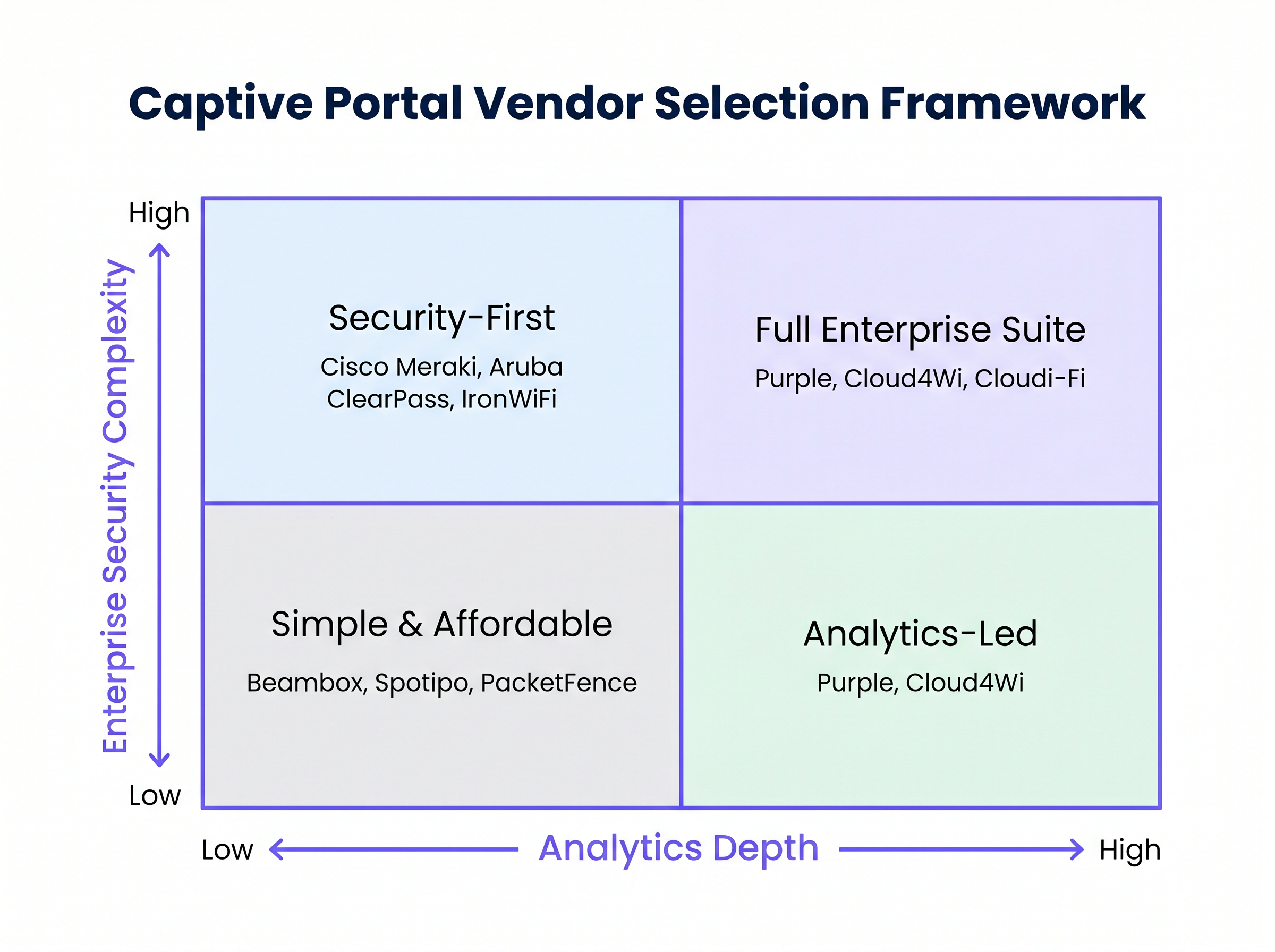
ऊपर दिया गया 2x2 मैट्रिक्स प्लेटफॉर्म को दो अक्षों पर प्लॉट करता है: एनालिटिक्स डेप्थ (क्षैतिज) और एंटरप्राइज सिक्योरिटी कॉम्प्लेक्सिटी (ऊर्ध्वाधर)। यह फ्रेमवर्क IT और ऑपरेशंस टीमों को वेंडरों से जुड़ने से पहले उनकी प्राथमिक आवश्यकताओं से मेल खाने वाले क्वाड्रेंट की शीघ्रता से पहचान करने में मदद करता है।
फुल एंटरप्राइज सूट क्वाड्रेंट (उच्च एनालिटिक्स, उच्च सुरक्षा) में आने वाले संगठनों को Purple, Cloud4Wi और Cloudi-Fi का मूल्यांकन करना चाहिए। सिक्योरिटी-फर्स्ट क्वाड्रेंट (उच्च सुरक्षा, कम एनालिटिक्स प्राथमिकता) में आने वालों को Cisco Meraki, Aruba ClearPass और IronWiFi पर ध्यान केंद्रित करना चाहिए। एनालिटिक्स-लेड क्वाड्रेंट (उच्च एनालिटिक्स, कम सुरक्षा कॉम्प्लेक्सिटी) पर Purple और Cloud4Wi का प्रभुत्व है। सिंपल एंड अफोर्डेबल क्वाड्रेंट को Beambox, Spotipo और PacketFence जैसे ओपन-सोर्स विकल्प सेवा प्रदान करते हैं।
कार्यान्वयन गाइड
कैप्टिव पोर्टल समाधान को डिप्लॉय करना प्लेटफॉर्म की परवाह किए बिना एक सुसंगत अनुक्रम का पालन करता है। नीचे दिए गए चरण क्लाउड-आधारित कैप्टिव पोर्टल डिप्लॉयमेंट के लिए वेंडर-न्यूट्रल सर्वोत्तम अभ्यास का प्रतिनिधित्व करते हैं।
चरण 1 — नेटवर्क आर्किटेक्चर रिव्यू। किसी भी सॉफ्टवेयर कॉन्फ़िगरेशन से पहले, अपनी मौजूदा नेटवर्क टोपोलॉजी का मैप करें। VLAN संरचना, एक्सेस पॉइंट वेंडर और फर्मवेयर संस्करण, और tअपस्ट्रीम राउटर या फ़ायरवॉल। पुष्टि करें कि आपके एक्सेस पॉइंट RADIUS CoA (प्राधिकरण में परिवर्तन) का समर्थन करते हैं यदि आपको प्रमाणीकरण के बाद गतिशील नीति प्रवर्तन की आवश्यकता है।
चरण 2 — SSID और VLAN डिज़ाइन। एक समर्पित गेस्ट SSID बनाएँ, जिसे एक अलग VLAN के माध्यम से आपके कॉर्पोरेट नेटवर्क से अलग किया गया हो। VLAN को कॉन्फ़िगर करें ताकि यह केवल Captive Portal प्लेटफ़ॉर्म की IP श्रेणियों (वॉलड गार्डन) पर DNS और HTTP/HTTPS ट्रैफ़िक की अनुमति दे। अप्रमाणित क्लाइंट्स से आने वाले अन्य सभी ट्रैफ़िक को फ़ायरवॉल पर ड्रॉप कर दिया जाना चाहिए।
चरण 3 — प्लेटफ़ॉर्म कॉन्फ़िगरेशन। अपने RADIUS साझा रहस्य और अपने एक्सेस पॉइंट कंट्रोलर के IP पते या होस्टनेम के साथ Captive Portal प्लेटफ़ॉर्म को कॉन्फ़िगर करें। प्लेटफ़ॉर्म के एडिटर का उपयोग करके स्प्लैश पेज बनाएँ, जिसमें आपकी ब्रांड एसेट्स, आवश्यक प्रमाणीकरण विधि और आपकी गोपनीयता नीति के लिंक के साथ GDPR सहमति चेकबॉक्स शामिल हो।
चरण 4 — एकीकरण सेटअप। अपने CRM या मार्केटिंग ऑटोमेशन प्लेटफ़ॉर्म पर डेटा पुश को कॉन्फ़िगर करें। लॉगिन पर कैप्चर किए गए फ़ील्ड (ईमेल, नाम, सहमति स्थिति) को अपने CRM में संबंधित फ़ील्ड से मैप करें। यदि वास्तविक समय डेटा सिंक की आवश्यकता है, तो नए पंजीकरणों के लिए वेबहुक सूचनाएँ सेट करें।
चरण 5 — अनुपालन सत्यापन। गो-लाइव होने से पहले, सत्यापित करें कि सहमति कैप्चर तंत्र GDPR अनुच्छेद 7 की आवश्यकताओं को पूरा करता है: सहमति स्वतंत्र रूप से दी गई, विशिष्ट, सूचित और स्पष्ट होनी चाहिए। प्लेटफ़ॉर्म को प्रत्येक सहमति घटना का टाइमस्टैंप रिकॉर्ड संग्रहीत करना होगा। पुष्टि करें कि Captive Portal विक्रेता के साथ आपका डेटा प्रोसेसिंग एग्रीमेंट (DPA) मौजूद है।
चरण 6 — पायलट और लोड परीक्षण। एकल साइट या एक्सेस पॉइंट के एक सबसेट पर डिप्लॉय करें। अपेक्षित पीक लोड पर समवर्ती कनेक्शनों का अनुकरण करें (जैसे iperf3 या एक समर्पित WiFi लोड परीक्षण उपकरण का उपयोग करें)। सत्यापित करें कि पीक लोड पर प्रमाणीकरण विलंबता 3 सेकंड से कम रहती है, और RADIUS सर्वर 500ms के भीतर प्रतिक्रिया देता है।
चरण 7 — रोलआउट और निगरानी। शेष साइटों पर रोल आउट करें। RADIUS प्रमाणीकरण विफलताओं, पोर्टल उपलब्धता और डेटा पुश त्रुटियों के लिए अलर्टिंग कॉन्फ़िगर करें। यह सुनिश्चित करने के लिए एनालिटिक्स डेटा के लिए मासिक समीक्षा चक्र स्थापित करें कि निवेश मापने योग्य व्यावसायिक परिणाम उत्पन्न कर रहा है।
केस स्टडीज़
केस स्टडी 1: 350 कमरों वाली होटल चेन — हॉस्पिटैलिटी WiFi परिवर्तन
इंग्लैंड और स्कॉटलैंड में 12 संपत्तियों का संचालन करने वाला एक यूके-आधारित होटल समूह एक पुरानी ऑन-प्रिमाइसेस Captive Portal समाधान चला रहा था जो कोई एनालिटिक्स प्रदान नहीं करता था और कागजी फ़ॉर्म के माध्यम से मैन्युअल GDPR सहमति लॉगिंग की आवश्यकता थी। IT टीम 12 अलग-अलग पोर्टल कॉन्फ़िगरेशन का प्रबंधन कर रही थी जिसमें कोई केंद्रीकृत दृश्यता नहीं थी।
समूह ने सभी 12 संपत्तियों में Purple को डिप्लॉय किया, Captive Portal को RADIUS के माध्यम से अपने मौजूदा अरूबा एक्सेस पॉइंट इंफ्रास्ट्रक्चर के साथ एकीकृत किया। स्प्लैश पेज को ईमेल कैप्चर और स्पष्ट GDPR सहमति के साथ कॉन्फ़िगर किया गया था, जिसमें डेटा स्वचालित रूप से Salesforce पर पुश किया गया था। डिप्लॉयमेंट के 90 दिनों के भीतर, समूह ने पूर्ण सहमति रिकॉर्ड के साथ 28,000 से अधिक सत्यापित अतिथि ईमेल पते कैप्चर किए थे। मार्केटिंग टीम ने एक पोस्ट-स्टे री-एंगेजमेंट अभियान चलाया जिसने सीधी बुकिंग में 12% की वृद्धि की, जिससे OTA कमीशन लागत में सालाना अनुमानित £180,000 की कमी आई। IT टीम ने पोर्टल प्रबंधन ओवरहेड को प्रति सप्ताह लगभग 8 घंटे से घटाकर 1 घंटे से भी कम कर दिया, जिसमें सभी 12 साइटों को एक ही डैशबोर्ड से प्रबंधित किया गया।
होटल वातावरण में गेस्ट WiFi डिप्लॉय करने के बारे में अधिक जानकारी के लिए, हमारा हॉस्पिटैलिटी उद्योग पृष्ठ देखें।
केस स्टडी 2: 45-स्टोर रिटेल चेन — फुटफॉल एनालिटिक्स और CRM एकीकरण
यूके और आयरलैंड में 45 स्टोर संचालित करने वाले एक मिड-मार्केट फैशन रिटेलर को इन-स्टोर ग्राहक व्यवहार को समझने की आवश्यकता थी — विशेष रूप से, विभिन्न ज़ोन में ठहरने का समय रूपांतरण दरों से कैसे संबंधित था। उनके मौजूदा गेस्ट WiFi ने बुनियादी कनेक्शन गणनाओं से परे कोई एनालिटिक्स प्रदान नहीं किया।
रिटेलर ने सभी 45 स्टोरों में Cloud4Wi को डिप्लॉय किया, जिसमें Purple को एक विकल्प के रूप में मूल्यांकन किया गया। Cloud4Wi को रिटेलर के मौजूदा Salesforce CRM के साथ इसके मूल एकीकरण और इसकी ज़ोन-स्तरीय एनालिटिक्स क्षमता के आधार पर चुना गया था। Captive Portal को घर्षण को कम करने और ऑप्ट-इन दरों को अधिकतम करने के लिए सोशल लॉगिन (Google और Apple) के साथ कॉन्फ़िगर किया गया था। छह महीनों के भीतर, रिटेलर ने ज़ोन स्तर पर ठहरने के समय के डेटा को बिक्री रूपांतरण डेटा से मैप किया था, जिसमें तीन कम प्रदर्शन करने वाले स्टोर लेआउट की पहचान की गई थी। एनालिटिक्स डेटा के आधार पर उन लेआउट को पुन: कॉन्फ़िगर करने से प्रभावित ज़ोन में रूपांतरण दर में 8% की मापने योग्य वृद्धि हुई।
रिटेल-विशिष्ट डिप्लॉयमेंट विचारों के लिए, हमारा रिटेल उद्योग पृष्ठ देखें।
सर्वोत्तम अभ्यास
निम्नलिखित सिफारिशें एंटरप्राइज़ वातावरण में Captive Portal डिप्लॉयमेंट के लिए विक्रेता-तटस्थ सर्वोत्तम अभ्यास को दर्शाती हैं।
प्रमाणीकरण प्रवाह को एक ही स्क्रीन पर रखें। लॉगिन प्रक्रिया में प्रत्येक अतिरिक्त फ़ील्ड या चरण ऑप्ट-इन दरों को कम करता है। अनुसंधान लगातार दर्शाता है कि ईमेल पते और सहमति चेकबॉक्स से अधिक की आवश्यकता होने पर पूर्णता दर 20-40% तक कम हो जाती है। यदि आपको अतिरिक्त डेटा की आवश्यकता है, तो प्रारंभिक कनेक्शन के बाद इसे धीरे-धीरे एकत्र करें।
अपने नेटवर्क को पहले दिन से ही सही ढंग से सेगमेंट करें। गेस्ट WiFi को कॉर्पोरेट इंफ्रास्ट्रक्चर से अलग किया जाना चाहिए। यह केवल एक सुरक्षा आवश्यकता नहीं है — यदि आपका कॉर्पोरेट नेटवर्क भुगतान कार्ड डेटा को संभालता है तो यह एक PCI DSS अनुपालन आवश्यकता है। एक समर्पित VLAN का उपयोग करें, और सुनिश्चित करें कि आपके फ़ायरवॉल नियम गेस्ट सेगमेंट से किसी भी पार्श्व आंदोलन को रोकते हैं।
GDPR-अनुरूप सहमति ऑडिट ट्रेल बनाए रखें। GDPR अनुच्छेद 7 के तहत, आपको यह प्रदर्शित करने में सक्षम होना चाहिए कि सहमति प्राप्त की गई थी। आपके Captive Portal प्लेटफ़ॉर्म को प्रत्येक सहमति घटना का टाइमस्टैंप रिकॉर्ड संग्रहीत करना होगा, जिसमें उस समय प्रस्तुत गोपनीयता नीति का संस्करण भी शामिल हो। Purple और IronWiFi जैसे प्लेटफ़ॉर्म इसे मूल रूप से संभालते हैं; सरल प्लेटफ़ॉर्म पर, आपको इसे अलग से लागू करने की आवश्यकता हो सकती है।
RADIUS फ़ेलओवर का परीक्षण करें। यदि आपके Captive Portal प्लेटफ़ॉर्म की RADIUS सेवा अनुपलब्ध है, तो कनेक्ट होने वाले क्लाइंट्स का क्या होता है? सुनिश्चित करें कि आपकी एक्सेस पॉइंट कॉन्फ़िगरेशन एक फ़ॉलबैक व्यवहार को परिभाषित करती है — या तो सभी एक्सेस को अस्वीकार करें (फेल-क्लोज्ड) या प्रदान करें बिना प्रमाणीकरण के एक्सेस (फेल-ओपन)। अधिकांश एंटरप्राइज़ परिवेशों के लिए, फेल-क्लोज्ड सही डिफ़ॉल्ट है।
अपनी वॉल्ड गार्डन कॉन्फ़िगरेशन की नियमित रूप से समीक्षा करें। सोशल लॉगिन प्रोवाइडर (Google, Facebook, Apple) समय-समय पर अपने OAuth फ़्लो द्वारा उपयोग की जाने वाली IP रेंज और डोमेन बदलते रहते हैं। यदि ये आपके वॉल्ड गार्डन में शामिल नहीं हैं, तो उपयोगकर्ताओं के लिए सोशल लॉगिन चुपचाप विफल हो जाएगा। वॉल्ड गार्डन एंट्रीज़ के लिए एक त्रैमासिक समीक्षा प्रक्रिया स्थापित करें।
समस्या निवारण और जोखिम न्यूनीकरण
कैप्टिव पोर्टल डिप्लॉयमेंट में सबसे सामान्य विफलता मोड और उनके न्यूनीकरण इस प्रकार हैं।
iOS या Android डिवाइस पर पोर्टल दिखाई नहीं दे रहा है। आधुनिक मोबाइल ऑपरेटिंग सिस्टम एक Captive Network Assistant (CNA) का उपयोग करते हैं जो एक ज्ञात URL पर प्रोब रिक्वेस्ट करके Captive Portal का पता लगाता है। यदि प्रोब सफल होता है (यानी, डिवाइस को 302 रीडायरेक्ट की अपेक्षा करते समय 200 प्रतिक्रिया मिलती है), तो CNA ट्रिगर नहीं होगा। सुनिश्चित करें कि आपकी वॉल्ड गार्डन कॉन्फ़िगरेशन Apple और Google प्रोब URL को सही ढंग से इंटरसेप्ट करती है। यह भी सत्यापित करें कि आपकी DNS कॉन्फ़िगरेशन सभी अप्रमाणित क्लाइंट से क्वेरी को पोर्टल के IP पर रीडायरेक्ट कर रही है।
HTTPS इंटरसेप्शन समस्याएँ। आधुनिक ब्राउज़र कई डोमेन पर HSTS (HTTP Strict Transport Security) लागू करते हैं, जो Captive Portal स्प्लैश पेज पर HTTP रीडायरेक्ट को रोकता है। सुनिश्चित करें कि आपका Captive Portal प्लेटफ़ॉर्म अपने स्प्लैश पेज डोमेन पर एक वैध SSL प्रमाणपत्र का उपयोग करता है, और प्रारंभिक रीडायरेक्ट एक HTTP URL पर है जिसे प्लेटफ़ॉर्म बाद में HTTPS में अपग्रेड करता है। सीधे HTTPS ट्रैफ़िक को इंटरसेप्ट करने का प्रयास करने से ब्राउज़र सुरक्षा चेतावनी ट्रिगर होंगी।
RADIUS प्रमाणीकरण टाइमआउट। यदि RADIUS सर्वर आपके एक्सेस पॉइंट से भौगोलिक रूप से दूर है, तो प्रमाणीकरण विलंबता स्वीकार्य सीमा से अधिक हो सकती है। क्लाउड-आधारित RADIUS के लिए, सत्यापित करें कि विक्रेता का आपके क्षेत्र में एक पॉइंट ऑफ़ प्रेजेंस है। ऑन-प्रिमाइसेस डिप्लॉयमेंट के लिए, सुनिश्चित करें कि RADIUS सर्वर एक्सेस पॉइंट कंट्रोलर के समान LAN सेगमेंट पर है।
GDPR सहमति डेटा CRM में सिंक नहीं हो रहा है। वेबहुक डिलीवरी विफलताएँ एक सामान्य एकीकरण समस्या है। प्राप्तकर्ता छोर पर एक डेड-लेटर क्यू या रिट्राई मैकेनिज्म लागू करें, और विफल वेबहुक डिलीवरी के लिए अलर्टिंग कॉन्फ़िगर करें। यह सत्यापित करने के लिए CRM एकीकरण का मासिक ऑडिट करें कि सहमति रिकॉर्ड सही ढंग से लिखे जा रहे हैं।
ROI और व्यावसायिक प्रभाव
Captive Portal सॉफ़्टवेयर निवेश का व्यावसायिक मामला तीन मूल्य धाराओं पर आधारित है: फर्स्ट-पार्टी डेटा अधिग्रहण, अनुपालन जोखिम न्यूनीकरण, और परिचालन दक्षता।
थर्ड-पार्टी कुकी के अप्रचलन से डिजिटल विज्ञापन की प्रभावशीलता कम होने के कारण फर्स्ट-पार्टी डेटा तेजी से मूल्यवान होता जा रहा है। एक Captive Portal जो बड़े पैमाने पर सत्यापित, सहमति प्राप्त ईमेल पते कैप्चर करता है, वह मापने योग्य ROI के साथ एक सीधा मार्केटिंग चैनल प्रदान करता है। उद्योग के बेंचमार्क बताते हैं कि एक उच्च-फुटफॉल वाले स्थान पर एक अच्छी तरह से कॉन्फ़िगर किया गया Captive Portal लॉगिन फ़्लो के घर्षण के आधार पर, कनेक्ट होने वाले उपयोगकर्ताओं के 15-30% को ऑप्ट-इन मार्केटिंग संपर्क के रूप में कैप्चर कर सकता है।
अनुपालन जोखिम न्यूनीकरण को मापना कठिन है लेकिन यह महत्वपूर्ण है। अपर्याप्त सहमति प्रबंधन के लिए GDPR जुर्माना वैश्विक वार्षिक टर्नओवर के 4% तक पहुंच सकता है। £100 मिलियन के वार्षिक राजस्व वाली एक खुदरा श्रृंखला के लिए, यह £4 मिलियन का संभावित जोखिम दर्शाता है। बिल्ट-इन सहमति प्रबंधन और ऑडिट ट्रेल्स वाला एक Captive Portal प्लेटफ़ॉर्म इस जोखिम को सीधे कम करता है।
परिचालन दक्षता लाभ मल्टी-साइट डिप्लॉयमेंट में सबसे अधिक दिखाई देते हैं। पोर्टल कॉन्फ़िगरेशन, उपयोगकर्ता नीतियों और एनालिटिक्स रिपोर्टिंग का केंद्रीकृत प्रबंधन प्रति-साइट IT ओवरहेड को काफी कम करता है। ऊपर दिए गए होटल केस स्टडी ने 12 साइटों पर प्रति सप्ताह 8 घंटे से घटाकर 1 घंटे से भी कम समय की कमी प्रदर्शित की — जो लगभग 0.2 FTE के बराबर वार्षिक बचत है।
Purple के प्लेटफ़ॉर्म द्वारा गेस्ट WiFi डिप्लॉयमेंट में मापने योग्य ROI कैसे प्रदान किया जाता है, इसकी विस्तृत जानकारी के लिए, Guest WiFi और WiFi Analytics उत्पाद पृष्ठ देखें।
संबंधित पठन
अपनी Captive Portal डिप्लॉयमेंट के साथ व्यापक नेटवर्क आर्किटेक्चर निर्णयों का मूल्यांकन करने वाली टीमों के लिए, निम्नलिखित संसाधन प्रासंगिक हैं: The Core SD-WAN Benefits for Modern Businesses बताता है कि कैसे SD-WAN मल्टी-साइट नेटवर्क प्रबंधन को सरल बना सकता है और वितरित एस्टेट में केंद्रीकृत Captive Portal समाधानों को डिप्लॉय करने की जटिलता को कम कर सकता है।
Key Terms & Definitions
Captive Portal
A network access control mechanism that intercepts a connecting device's HTTP/HTTPS requests and redirects them to a hosted splash page, requiring the user to complete an authentication action before internet access is granted. Standardised in RFC 8952.
IT teams encounter this when configuring guest WiFi for any public-facing venue. The captive portal is the technical mechanism that enables both access control and data capture.
RADIUS (Remote Authentication Dial-In User Service)
A networking protocol defined in RFC 2865 that provides centralised Authentication, Authorisation, and Accounting (AAA) for network access. In captive portal deployments, the portal platform sends a RADIUS Access-Accept or Access-Reject message to the access point to grant or deny internet access.
Network architects encounter RADIUS when integrating a captive portal platform with access point controllers. The RADIUS shared secret and server IP address must be configured on both the portal platform and the access point controller.
Walled Garden
A set of IP addresses, domains, or URLs that unauthenticated clients are permitted to reach before completing the captive portal login flow. Typically includes the portal platform's own IP ranges, social login provider OAuth domains, and any content the operator wants to make freely accessible.
IT teams must configure the walled garden correctly to ensure that the captive portal login flow (including social OAuth) functions correctly. Incorrect walled garden configuration is the most common cause of social login failures.
IEEE 802.1X
An IEEE standard for port-based network access control that provides an authentication mechanism for devices wishing to attach to a LAN or WLAN. In WiFi deployments, 802.1X is used for WPA-Enterprise authentication, requiring each device to authenticate with a RADIUS server using EAP credentials.
Relevant when an organisation needs to manage both guest WiFi (captive portal) and secure staff WiFi (WPA-Enterprise) on the same infrastructure. Platforms like IronWiFi support both use cases from a single cloud RADIUS service.
GDPR Consent Audit Trail
A timestamped record of each instance in which a user provided consent for data collection and marketing communications, including the version of the privacy policy presented, the user identifier, and the IP address of the connecting device. Required under GDPR Article 7.
IT and legal teams must verify that their captive portal platform stores this data correctly before deployment. Inadequate consent records are a primary finding in GDPR enforcement actions against venue operators.
Splash Page
The branded web page presented to a connecting user by the captive portal system. Contains the authentication mechanism (login form, social login buttons, click-through), terms of service, privacy policy link, and GDPR consent checkbox.
Marketing teams typically own the design of the splash page; IT teams own the technical configuration. Alignment between both teams on the fields captured and the consent language is essential before deployment.
VLAN (Virtual Local Area Network)
A logical network segment created within a physical network infrastructure, used to isolate traffic between different user groups. In captive portal deployments, guest devices are placed in a dedicated guest VLAN, isolated from corporate and IoT VLANs.
Correct VLAN design is a prerequisite for any captive portal deployment. Guest VLAN isolation is a PCI DSS requirement for any venue where the corporate network handles payment card data.
RADIUS CoA (Change of Authorisation)
An extension to the RADIUS protocol (RFC 5176) that allows a RADIUS server to dynamically modify an active user session — for example, to change VLAN assignment, apply bandwidth limits, or disconnect a user — without requiring re-authentication.
Required for captive portal deployments where dynamic policy enforcement is needed post-authentication, such as applying different bandwidth tiers based on the user's subscription level or session duration.
OAuth 2.0 Social Login
An authorisation framework that allows users to authenticate with a captive portal using their existing Google, Facebook, or Apple account credentials, without creating a separate account. The portal receives a verified email address and basic profile data from the identity provider.
Social login is the highest-converting authentication method for captive portals in consumer-facing venues, as it eliminates the need for users to remember or type a password. It requires the identity provider's OAuth domains to be included in the walled garden.
PCI DSS (Payment Card Industry Data Security Standard)
A set of security standards designed to ensure that all companies that accept, process, store, or transmit credit card information maintain a secure environment. In the context of captive portals, PCI DSS requires that guest WiFi networks are fully isolated from any network segment that handles payment card data.
Relevant for any retail, hospitality, or venue operator that processes card payments on-site. Network segmentation between the guest WiFi VLAN and the payment network is a mandatory PCI DSS control.
Case Studies
A 350-room hotel group operating 12 properties needs to replace a legacy on-premises captive portal with a cloud-based solution. They need GDPR-compliant consent capture, CRM integration with Salesforce, and centralised management across all sites. Their existing infrastructure is Aruba access points running ArubaOS 8.x. What platform and deployment architecture should they use?
Deploy Purple as the cloud-based captive portal service, integrated with the existing Aruba infrastructure via RADIUS. Configuration steps: (1) Create a dedicated guest SSID on each Aruba controller, assigned to a guest VLAN isolated from the corporate network. (2) Configure the Aruba controller to redirect unauthenticated clients to Purple's hosted splash page URL, with the walled garden including Purple's IP ranges and the OAuth domains for social login providers. (3) In Purple's admin console, configure the RADIUS shared secret and the Aruba controller's IP address. (4) Build the splash page with email capture, GDPR consent checkbox, and a link to the hotel's privacy policy. (5) Configure the Salesforce integration in Purple, mapping email, first name, last name, and consent status to the corresponding Salesforce Lead fields. (6) Set up a webhook to notify the CRM of new registrations in real time. (7) Test the full flow on a single property before rolling out to the remaining 11. (8) Configure Purple's multi-site dashboard to provide centralised visibility across all 12 properties.
A 45-store fashion retailer needs to understand zone-level dwell time and its correlation with sales conversion. They have a heterogeneous access point estate (mix of Cisco Meraki and Ubiquiti UniFi across different stores) and an existing Salesforce CRM. They want to minimise login friction to maximise opt-in rates. Which captive portal platform should they deploy, and how should they handle the mixed hardware estate?
Deploy Purple or Cloud4Wi — both support the required analytics depth and Salesforce integration. For a mixed Meraki/UniFi estate: (1) For Meraki stores, configure the captive portal as an external splash page in the Meraki dashboard, pointing to the chosen platform's hosted URL. Meraki supports external splash pages natively via its API. (2) For UniFi stores, configure the UniFi controller's guest portal to redirect to the external splash page URL. UniFi supports external portal redirection in the guest network settings. (3) Configure social login (Google and Apple) as the primary authentication method to minimise friction — this reduces the login flow to a single tap on most mobile devices. (4) Ensure the walled garden on both controller types includes the OAuth domains for Google and Apple. (5) Map the captured social profile data (email, name) to Salesforce via the platform's native connector. (6) Use the platform's zone analytics feature to define zones within each store layout, correlating WiFi probe data with zone boundaries. (7) Export zone dwell time data monthly and join it with Salesforce sales data at the store level to identify conversion correlations.
A regional NHS trust needs to deploy guest WiFi across three hospital sites. The requirements are: HIPAA-equivalent compliance (NHS DSP Toolkit), strict network segmentation between guest and clinical VLANs, support for 802.1X for staff devices, and GDPR consent capture for patients. The existing infrastructure is a mix of Cisco and Aruba access points.
Deploy IronWiFi, which is the only platform in this comparison that natively combines captive portal for guests with cloud RADIUS for 802.1X staff authentication. Configuration: (1) Create three SSIDs per site: guest (captive portal), staff (WPA-Enterprise/802.1X), and IoT (MAC authentication). (2) Configure IronWiFi's cloud RADIUS as the authentication server for the staff SSID, integrating with the trust's Active Directory via LDAP or SAML. (3) Configure the guest SSID to redirect to IronWiFi's captive portal, with email capture and GDPR consent. (4) Ensure the guest VLAN has no routing to clinical VLANs — enforce this at the firewall, not just the VLAN configuration. (5) Configure IronWiFi's compliance reporting to generate monthly audit logs for DSP Toolkit evidence. (6) Test RADIUS failover to ensure that if the cloud RADIUS service is unavailable, staff devices fail closed (no access) rather than fail open.
Scenario Analysis
Q1. A conference centre hosting 50 events per year, with peak concurrent WiFi users of 3,000, needs to deploy a captive portal solution. The primary requirements are: branded splash page per event sponsor, GDPR consent capture, and basic analytics on session counts and peak usage. The existing infrastructure is Cisco Meraki. Should they use Meraki's built-in captive portal, or deploy a third-party platform?
💡 Hint:Consider the per-event branding requirement and the analytics depth needed. Meraki's built-in portal supports external splash pages — this is a key capability to evaluate.
Show Recommended Approach
The per-event sponsor branding requirement is the deciding factor. Meraki's built-in captive portal supports a single splash page configuration per SSID, which makes dynamic per-event branding operationally complex. A third-party platform like Purple or Cloud4Wi, configured as an external splash page in Meraki, allows the events team to switch splash page templates per event without IT intervention. The analytics requirement (session counts, peak usage) is basic and can be met by either Meraki's built-in reporting or the third-party platform. The recommended approach is to deploy Purple as an external splash page on the existing Meraki infrastructure, using Purple's template management to handle per-event branding. This preserves the existing Meraki investment while adding the operational flexibility required for a multi-event venue.
Q2. An IT manager at a 200-bed private hospital is evaluating captive portal software for patient guest WiFi. The hospital's legal team has flagged that the current setup — a simple click-through portal with no consent record — creates GDPR exposure. The hospital also needs to ensure that patient devices cannot reach clinical systems. Which platform should they deploy, and what are the three most critical configuration steps?
💡 Hint:GDPR compliance and network segmentation are the two non-negotiable requirements. Consider which platforms have the strongest compliance posture and how VLAN isolation should be configured.
Show Recommended Approach
Deploy IronWiFi for its HIPAA-ready compliance posture and SOC 2 Type II certification, which provides the strongest audit evidence for the legal team. The three most critical configuration steps are: (1) VLAN isolation — create a dedicated patient guest VLAN with firewall rules that explicitly deny all routing to clinical VLANs. This must be enforced at the firewall, not just via VLAN tagging. (2) GDPR consent capture — configure the splash page with an explicit, unchecked consent checkbox linked to the hospital's privacy policy. IronWiFi stores a timestamped consent record per user, which satisfies the GDPR Article 7 audit trail requirement. (3) RADIUS fail-closed — configure the access point to deny access if the RADIUS server is unreachable, preventing unauthenticated devices from gaining network access during a cloud outage.
Q3. A retail chain with 80 stores is currently using Beambox for guest WiFi. The marketing director wants to implement post-visit email campaigns triggered by in-store WiFi connection events, with personalisation based on visit frequency and dwell time. The IT director is concerned about the cost and complexity of migrating 80 stores. How should they approach the platform migration decision?
💡 Hint:Evaluate whether Beambox can meet the marketing requirements before assuming migration is necessary. If migration is required, consider the phased approach and the total cost of ownership comparison.
Show Recommended Approach
First, assess whether Beambox can meet the requirements: Beambox supports basic email marketing integration but does not provide dwell time analytics or visit frequency segmentation at the level required for personalised post-visit campaigns. Migration is therefore necessary. The recommended approach is a phased migration: (1) Select Purple or Cloud4Wi as the target platform — both support dwell time analytics, visit frequency segmentation, and direct integration with major email marketing platforms. (2) Pilot the new platform in 5-10 stores before committing to a full rollout. (3) Negotiate a parallel-run period with Beambox to avoid data gaps during migration. (4) Map the total cost of ownership: the new platform's per-location SaaS cost versus the projected revenue uplift from personalised campaigns. Industry benchmarks suggest that triggered post-visit email campaigns with visit-frequency personalisation generate 3-5x higher open rates than generic broadcast campaigns, providing a clear ROI justification for the migration cost.




