

WiFi 7 MLO Explained: Multi-Link Operation for Seamless Roaming
This technical reference guide provides a comprehensive deep-dive into WiFi 7 Multi-Link Operation (MLO) for enterprise network architects and IT leaders. It demystifies the three MLO operating modes (eMLSR, NSTR, and STR), explains how MLO supersedes legacy band steering, and delivers actionable deployment guidance backed by real-world trial data from the Wireless Broadband Alliance. Venue operators in hospitality, retail, and large public spaces will find concrete implementation strategies and ROI evidence to support WiFi 7 investment decisions.
🎧 Listen to this Guide
View Transcript

Executive Summary
For enterprise IT leaders and network architects, the transition to IEEE 802.11be (WiFi 7) introduces a paradigm shift in wireless connectivity. The cornerstone of this standard is Multi-Link Operation (MLO), a mandatory feature for Wi-Fi CERTIFIED 7 devices that fundamentally alters how access points and clients interact across the radio frequency spectrum. Unlike legacy band steering, which relies on network-driven reassociations that disrupt traffic, MLO enables simultaneous, client-coordinated multi-band connections.
Recent enterprise field trials conducted by the Wireless Broadband Alliance demonstrated the profound impact of MLO in high-density environments. Testing in live office environments revealed up to 116% improvement in uplink throughput under severe co-channel interference, alongside a 66% reduction in uplink latency. For operations directors managing stadiums, conference centres, and large retail footprints, MLO translates directly into resilient connectivity for mission-critical applications. This guide demystifies the technical architecture of MLO, dissects the three primary operating modes, and provides actionable implementation strategies for modern enterprise deployments.
Technical Deep-Dive: The Architecture of Multi-Link Operation
The fundamental innovation of WiFi 7 MLO is the creation of a Multi-Link Device (MLD) architecture that abstracts the physical radio links from the logical network connection. In previous generations, including WiFi 6E, a client device could only associate with a single band (2.4 GHz, 5 GHz, or 6 GHz) at any given moment. If interference degraded that link, the client or access point had to initiate a full reassociation to a different band — a process that typically incurs over 100 milliseconds of latency and inevitable packet loss.
With 802.11be MLO, the MAC layer is bifurcated into an Upper MAC (U-MAC) and a Lower MAC (L-MAC). The U-MAC handles the overarching security association, encryption, and sequence numbering, while the L-MAC manages the physical channel access and beaconing for each individual radio link. This architecture allows a single logical connection to span multiple physical bands simultaneously. The client and access point negotiate these capabilities during the initial association phase, establishing a primary MLD MAC address alongside specific per-link MAC addresses.
The Three Modes of MLO
While marketing materials often present MLO as a monolithic feature, the IEEE 802.11be standard defines three distinct operating modes. Understanding these modes is critical for network architects evaluating hardware capabilities and planning deployment timelines.
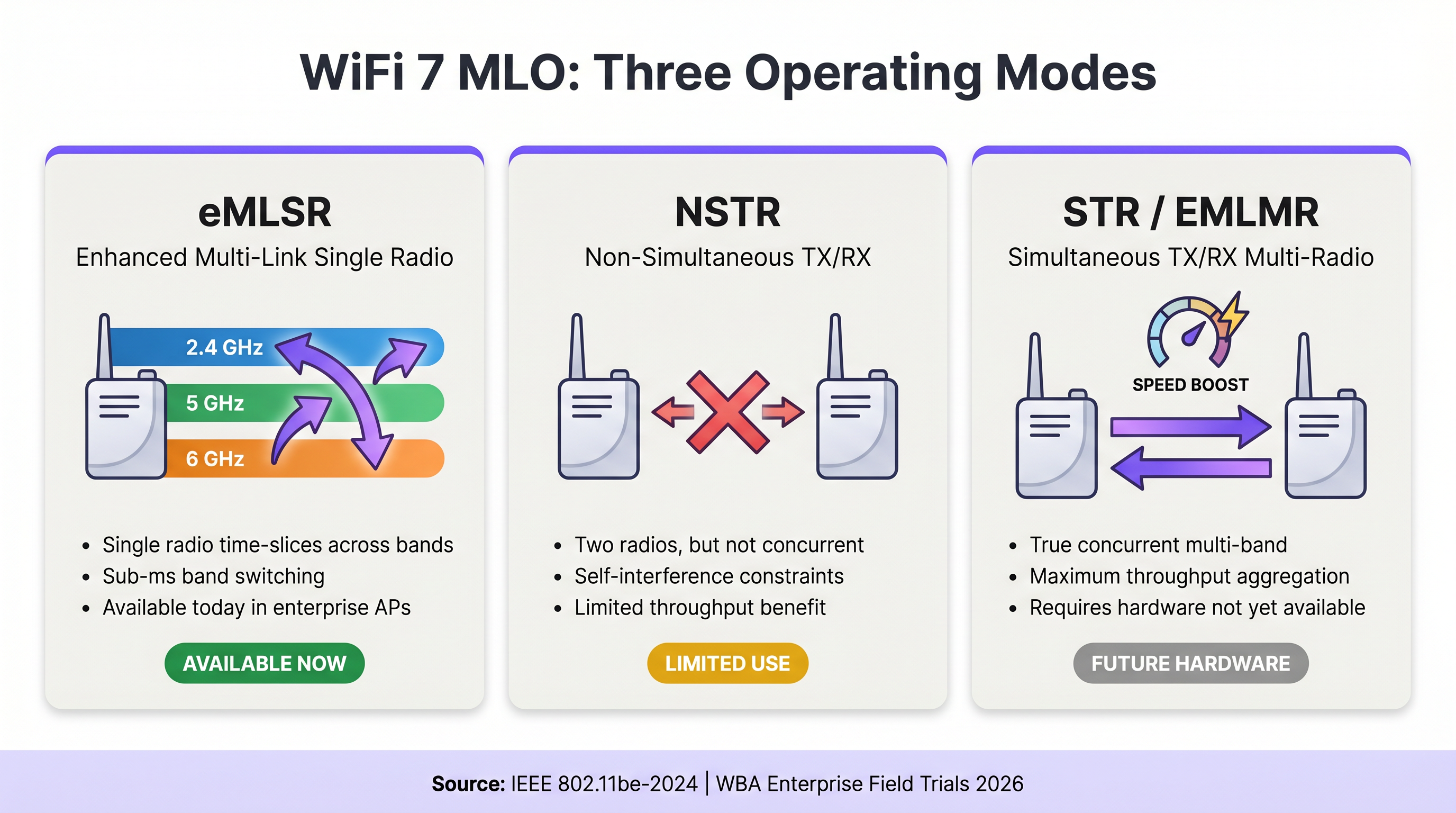
1. Enhanced Multi-Link Single Radio (eMLSR)
Enhanced Multi-Link Single Radio is the foundational MLO implementation available in current enterprise access points and client devices. In this mode, the client device utilises a single radio that rapidly time-slices across multiple bands. Crucially, the device maintains separate receive chains, allowing it to listen to the 5 GHz and 6 GHz bands concurrently. When an opportunity to transmit or receive arises, it dynamically switches its primary radio to the optimal band.
While eMLSR does not provide true simultaneous transmission and reception, it offers sub-millisecond band switching. This represents a massive leap over legacy band steering, providing near-seamless failover and significantly reducing latency in congested environments. For enterprise deployments in 2025 and 2026, eMLSR is the practical reality delivering the bulk of MLO's immediate benefits. The Wireless Broadband Alliance's Phase 2 enterprise field trials confirmed that eMLSR delivers up to 75% downlink and 116% uplink throughput improvement under co-channel interference, alongside up to 44% reduction in downlink latency for real-time traffic.
2. Non-Simultaneous Transmit and Receive (NSTR)
Non-Simultaneous Transmit and Receive utilises multiple physical radios but restricts them from operating concurrently due to self-interference constraints. If a device transmits on the 5 GHz band, the resulting radio frequency noise prevents it from reliably receiving data on the 6 GHz band simultaneously. NSTR is largely viewed as an intermediate step with limited real-world utility compared to the dynamic agility of eMLSR or the ultimate goal of true simultaneous operation.
3. Simultaneous Transmit and Receive (STR / EMLMR)
The pinnacle of the Multi-Link Operation specification is Simultaneous Transmit and Receive, which enables Enhanced Multi-Link Multi-Radio (EMLMR). This mode allows a device to transmit and receive data across multiple bands concurrently, aggregating throughput and delivering the theoretical maximum performance of WiFi 7. Achieving STR requires highly advanced hardware capable of sub-microsecond timing alignment and sophisticated Spectrum Resource Scheduling (SRS) to mitigate self-interference. As of early 2026, no consumer or enterprise hardware fully implements true STR, making it a future capability rather than a current deployment consideration.
Implementation Guide: MLO vs. Legacy Band Steering
For network engineers planning WiFi 7 rollouts, the most immediate operational change is the obsolescence of traditional band steering. Historically, enterprise wireless LAN controllers used band steering to force dual-band clients onto the less congested 5 GHz spectrum by ignoring their probe requests on 2.4 GHz. This network-centric approach was inherently disruptive, as the client device remained unaware of the steering logic and experienced dropped connections during the forced transition.
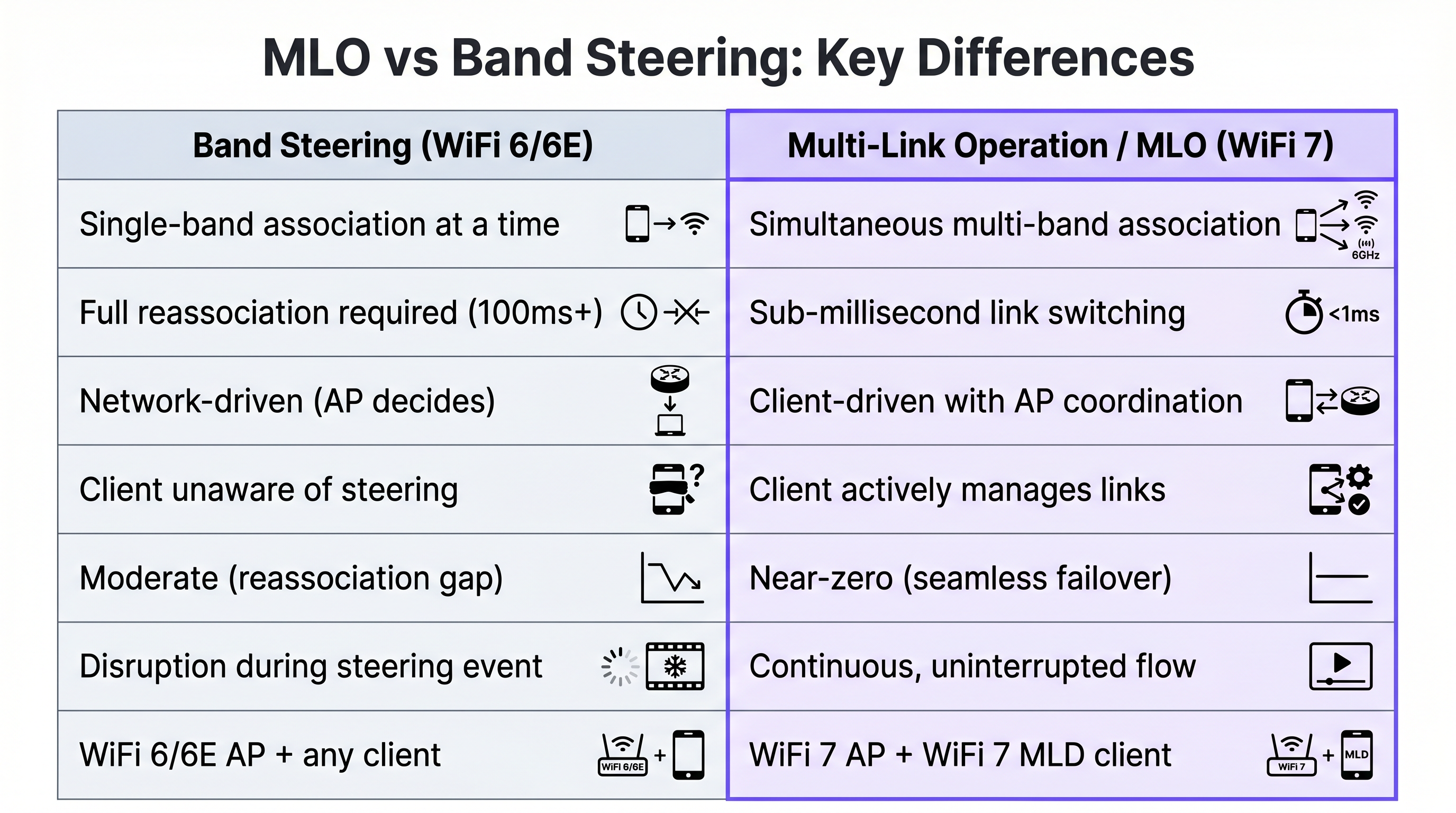
MLO replaces this paradigm with a client-driven, AP-coordinated approach. Because the client maintains simultaneous awareness of multiple links, it can seamlessly shift traffic based on real-time channel conditions without breaking the underlying logical connection. This is particularly vital for Guest WiFi deployments in high-density venues where roaming and interference are constant challenges. For Transport hubs such as airports and rail terminals, where passengers move rapidly through coverage zones, the elimination of reassociation delays directly improves the quality of mobile check-in and wayfinding applications.
Deployment Readiness and Ecosystem
The success of an MLO deployment is entirely dependent on the client ecosystem. A WiFi 7 access point can only leverage MLO when communicating with a WiFi 7 MLD-capable client. Legacy WiFi 6 and 6E devices will connect normally but will not benefit from multi-link capabilities.
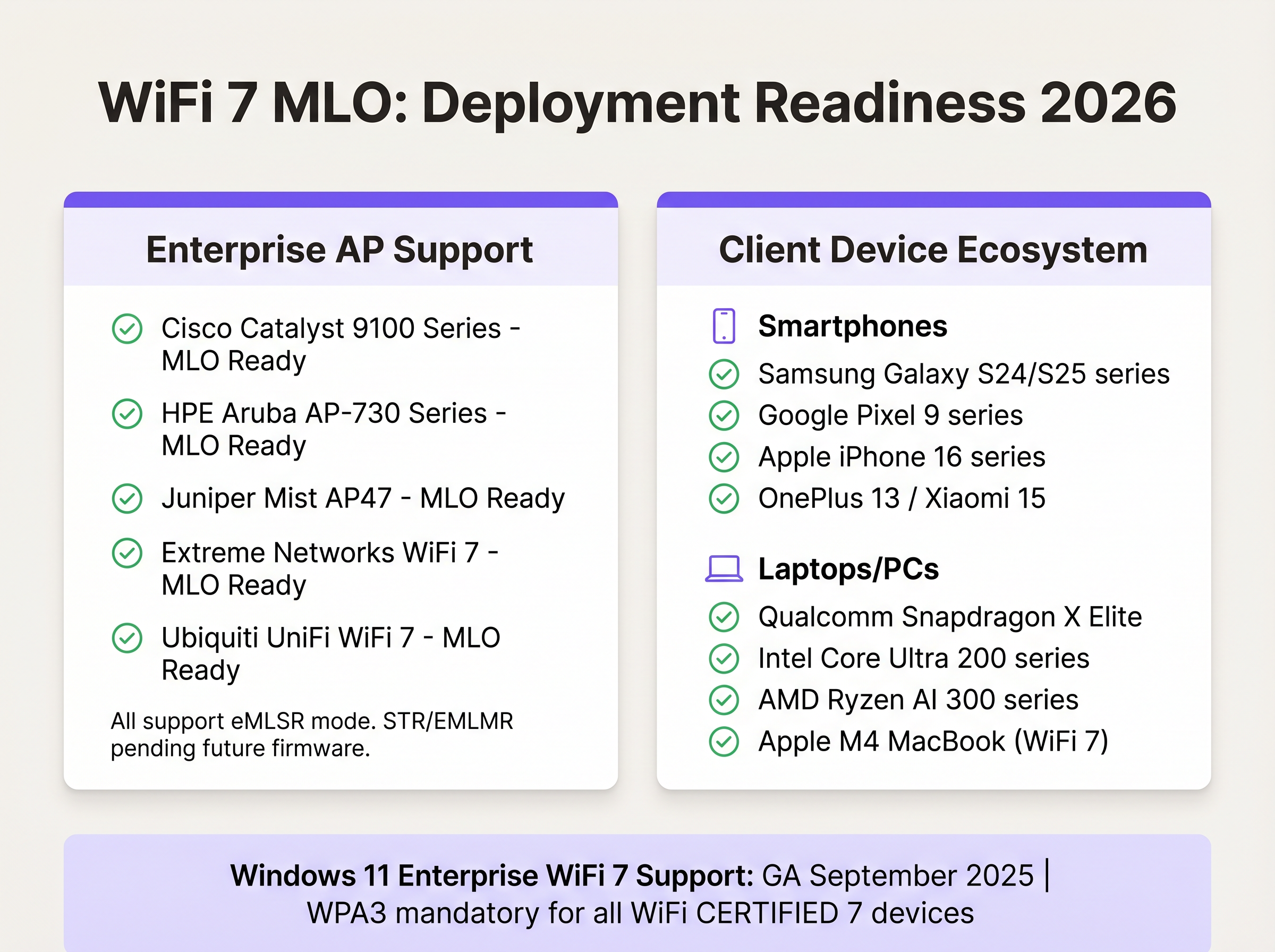
As of 2026, the enterprise ecosystem is rapidly maturing. Major access point vendors, including Cisco, HPE Aruba, and Juniper Mist, offer robust WiFi 7 hardware supporting eMLSR. On the client side, flagship smartphones such as the Samsung Galaxy S24/S25 series and Apple iPhone 16 series, alongside laptops powered by Qualcomm Snapdragon X Elite and Intel Core Ultra processors, provide native MLO support. Furthermore, the general availability of Windows 11 Enterprise WiFi 7 support in September 2025 has unblocked widespread corporate adoption.
| Vendor | Platform | MLO Mode | Status |
|---|---|---|---|
| Cisco | Catalyst 9100 Series | eMLSR | Available |
| HPE Aruba | AP-730 Series | eMLSR | Available |
| Juniper Mist | AP47 | eMLSR | Available |
| Extreme Networks | WiFi 7 APs | eMLSR | Available |
| Ubiquiti | UniFi WiFi 7 | eMLSR | Available |
| All vendors | STR / EMLMR | True Simultaneous | Future Firmware |
Best Practices for Enterprise Rollouts
When designing a WiFi 7 network, architects must adapt their RF planning to maximise MLO benefits. The traditional approach of aggressively segregating bands by SSID is no longer optimal and is actively harmful to MLO performance.
Unified SSID Configuration. To enable MLO, access points must broadcast a unified SSID across all participating bands (typically 5 GHz and 6 GHz, and optionally 2.4 GHz). Splitting SSIDs by frequency (e.g., 'Corp-5G' and 'Corp-6G') fundamentally breaks MLO functionality, as the client must perceive the bands as a single logical entity. This unified approach aligns well with modern Guest WiFi architectures where seamless onboarding is paramount.
Mandatory WPA3 Enforcement. The Wi-Fi Alliance mandates WPA3 security for all Wi-Fi CERTIFIED 7 devices. Furthermore, MLO requires Protected Management Frames (PMF) to secure the complex negotiation and link management processes. Network administrators must ensure that RADIUS servers and identity providers are fully compliant with WPA3-Enterprise requirements before initiating a WiFi 7 migration. For detailed compliance strategies, refer to our ISO 27001 Guest WiFi: A Compliance Primer . Organisations operating under PCI DSS or GDPR obligations should note that WPA3's enhanced cryptographic requirements (including GCMP-256 and SAE-GDH) provide a stronger compliance baseline than WPA2.
Traffic Identifier (TID) Mapping. Advanced enterprise deployments should leverage TID-to-link mapping (T2LM). This feature allows the access point to assign specific categories of traffic to designated links. For example, latency-sensitive voice and video traffic can be mapped exclusively to the clean 6 GHz band, while bulk data transfers are relegated to the 5 GHz band. This granular control is essential for Healthcare environments where telemetry data must be prioritised over patient entertainment traffic. In Retail environments, point-of-sale transaction traffic can be isolated from general guest browsing for both performance and security reasons.
DNS Filtering Integration. When deploying unified MLO SSIDs for guest access, DNS filtering becomes even more critical as a single SSID now serves a broader range of devices across all bands. Refer to our guide on DNS Filtering for Guest WiFi: Blocking Malware and Inappropriate Content for implementation guidance that complements a WiFi 7 rollout.
Troubleshooting & Risk Mitigation
Despite its advantages, MLO introduces new complexities in network troubleshooting. The primary risk involves asymmetric link quality, where a client maintains a connection on a severely degraded band because the secondary band appears superficially stable.
Asymmetric Power Levels. If the transmit power of the 6 GHz radio is significantly lower than the 5 GHz radio, clients may experience 'sticky' behaviour, refusing to utilise the 6 GHz link effectively. Network engineers must carefully balance cell sizes across bands during the RF design phase.
Legacy Client Starvation. In mixed environments, legacy WiFi 6 clients may struggle to contend for airtime against aggressive WiFi 7 MLD clients that can rapidly hop between bands. Implementing strict airtime fairness policies is crucial during the transition period. This is a particularly acute concern in Hospitality environments where a mix of guest devices spans multiple WiFi generations.
Captive Portal Interruptions. In Retail and Hospitality environments, aggressive link switching can sometimes trigger false re-authentications on poorly configured captive portals. Ensuring the network infrastructure properly resolves ARPs using the MLD MAC address rather than the per-link MAC addresses resolves this issue. Purple's Guest WiFi platform handles MLD MAC abstraction natively, preventing this class of onboarding failure.
Analytics Visibility. Traditional WiFi Analytics platforms that track clients by MAC address may encounter challenges in MLO environments where per-link MAC addresses differ from the MLD MAC. Ensure your analytics infrastructure is updated to correlate MLD MAC addresses for accurate client tracking, dwell time analysis, and footfall reporting.
ROI & Business Impact
The return on investment for a WiFi 7 migration is driven by operational efficiency and user experience rather than raw speed. For a stadium or conference centre, the ability to support thousands of concurrent connections without catastrophic latency spikes directly impacts revenue generation, from mobile concessions ordering to interactive fan experiences.
By eliminating the disruptive reassociations inherent in band steering, MLO dramatically reduces helpdesk tickets related to 'dropped connections' or 'poor roaming'. The WBA Phase 2 field trials demonstrated that eMLSR maintains performance when interference occurs, avoiding the performance drops seen in non-MLO devices — a critical differentiator in dense venue environments.
Furthermore, the enhanced reliability of the wireless network accelerates the adoption of IoT infrastructure, supporting initiatives like Wayfinding and environmental Sensors without requiring dedicated overlay networks. As demonstrated in recent large-scale deployments, such as the LAFC stadium rollout — the first MLS venue to deploy WiFi 7 — MLO provides the resilient foundation required for the next decade of enterprise mobility.
For SD-WAN architects integrating WiFi 7 as the last-mile access layer, MLO's reliability improvements are directly complementary to the WAN-level redundancy discussed in The Core SD-WAN Benefits for Modern Businesses . The combination of multi-path WAN and multi-link WiFi creates a genuinely resilient end-to-end architecture.
| Metric | Legacy WiFi 6 (Band Steering) | WiFi 7 MLO (eMLSR) | Improvement |
|---|---|---|---|
| Band switching latency | 100–300 ms | < 1 ms | ~200x faster |
| Uplink throughput under interference | Baseline | +116% | WBA Field Trial |
| Downlink throughput under interference | Baseline | +75% | WBA Field Trial |
| Uplink latency (real-time traffic) | Baseline | -66% | WBA Field Trial |
| Packet loss during band switch | Moderate | Near-zero | Seamless failover |
References
[1] IEEE Standards Association. "IEEE 802.11be-2024: Extremely High Throughput (EHT)." 2024. [2] Wireless Broadband Alliance. "Phase 2 Wi-Fi 7 MLO Enterprise Field Trials Report." March 2026. [3] HPE Aruba Networking. "Wi-Fi 7 Features and Benefits Technical Documentation." December 2025. [4] RTINGS. "The Disappointing Truth About Wi-Fi 7: The Dream Of Multi-Link Operation Isn't Yet Here." February 2026. [5] Microsoft. "Introducing Wi-Fi 7 for enterprise connectivity — Windows IT Pro Blog." September 2025. [6] Forbes. "What Every CIO Can Learn From MLS's First Wi-Fi 7 Stadium." March 2026.
Key Terms & Definitions
Multi-Link Operation (MLO)
A mandatory WiFi 7 (IEEE 802.11be) feature enabling Multi-Link Devices to simultaneously associate and communicate across multiple frequency bands (2.4, 5, and 6 GHz) via a single logical connection, providing seamless failover and reduced latency.
The foundational technology that replaces legacy band steering. IT teams encounter this term when evaluating WiFi 7 hardware specifications and when planning SSID architecture for new deployments.
Multi-Link Device (MLD)
Any network node — client device or access point — capable of supporting Multi-Link Operation. An MLD abstracts multiple physical radios into a single MAC-layer entity with one MLD MAC address and multiple per-link MAC addresses.
When auditing network readiness for MLO, IT teams must verify that both the access points and the end-user endpoints are certified MLDs. Legacy WiFi 6 devices are not MLDs and cannot participate in MLO.
Enhanced Multi-Link Single Radio (eMLSR)
An MLO operating mode where a device maintains separate receive chains to listen to multiple bands simultaneously, then rapidly time-slices its single radio to transmit or receive on the optimal band. Switching occurs in sub-millisecond timeframes.
The primary MLO mode implemented in 2025/2026 enterprise hardware. Network architects should specify eMLSR support explicitly in procurement requirements.
Simultaneous Transmit and Receive (STR / EMLMR)
An advanced MLO mode enabling a device to transmit on one band while concurrently receiving on another, maximising aggregate throughput. Requires sub-microsecond hardware timing alignment not yet available in shipping enterprise equipment.
A future-state capability. IT leaders should be cautious of vendor marketing that implies STR is available today; it is not present in any shipping enterprise access point as of early 2026.
TID-to-Link Mapping (T2LM)
A WiFi 7 protocol feature allowing the network to assign specific Traffic Identifiers (TIDs) — such as voice, video, or background data — to dedicated physical frequency bands, enabling policy-driven traffic prioritisation.
Used by network architects to isolate mission-critical latency-sensitive applications from bulk data transfers. Particularly valuable in healthcare, industrial, and financial trading environments.
Upper MAC (U-MAC)
The logical portion of the MLD architecture responsible for overarching connection state, security association (PMKSA), encryption, and sequence numbering across all physical links.
Ensures that when a client switches between bands, it does not need to renegotiate security keys or restart the session, enabling truly seamless roaming.
Lower MAC (L-MAC)
The physical portion of the MLD architecture responsible for channel access, beaconing, RTS/CTS control frames, and hardware-level transmission for a specific frequency band.
Manages the raw radio frequency contention independently for each band, allowing the U-MAC to remain abstracted from localised interference events.
Protected Management Frames (PMF)
An IEEE 802.11w security mechanism that encrypts network management traffic, preventing deauthentication attacks, spoofing, and man-in-the-middle attacks on the management plane.
Mandatory for all WiFi 7 deployments and a prerequisite for MLO. Legacy clients lacking PMF support will be unable to join modern secure MLO networks, requiring careful transition planning.
Case Studies
A 400-room luxury hotel is upgrading to WiFi 7 to support smart room IoT (lighting, HVAC) and high-bandwidth guest streaming. The current WiFi 6 network suffers from dropped VoIP calls when staff roam between floors, caused by aggressive band steering. How should the network architect configure the new WiFi 7 infrastructure to resolve this?
The architect should deploy WiFi 7 access points supporting eMLSR across all corridors and high-density areas, with particular attention to coverage overlap in stairwells and lift lobbies where roaming events are most frequent. The critical configuration change is consolidating all frequency bands under a single, unified SSID — for example, 'Hotel_Staff_Secure' — broadcasting on both 5 GHz and 6 GHz. Splitting SSIDs by frequency band must be explicitly avoided, as it prevents the client's Upper MAC from establishing a multi-link association and reverts the network to legacy single-band behaviour. WPA3-Enterprise with Protected Management Frames set to mandatory should be enforced. Finally, TID-to-link mapping should be configured on the wireless LAN controller to map voice traffic (TID 6 and 7) strictly to the 6 GHz band, ensuring pristine VoIP performance for staff devices while allowing guest streaming traffic to dynamically utilise either 5 GHz or 6 GHz based on real-time availability.
A large retail distribution warehouse is deploying autonomous guided vehicles (AGVs) that require sub-20ms latency to prevent safety shutdowns. The warehouse has significant metallic racking that causes severe multipath interference and rapid signal degradation. Why is WiFi 7 MLO a better solution than legacy WiFi 6 for this specific challenge, and what specific mode should be specified in the procurement requirements?
The procurement specification should require WiFi 7 access points and client modules supporting eMLSR mode. Legacy WiFi 6 relies on single-band association: when an AGV moves behind a metallic rack and loses its 5 GHz signal, it must initiate a full reassociation to the 2.4 GHz band. This process takes 100–300 milliseconds, exceeding the 20ms safety threshold and causing the AGV to trigger an emergency stop. With WiFi 7 MLO in eMLSR mode, the AGV client maintains simultaneous logical associations across multiple bands. It actively listens to both 5 GHz and 2.4 GHz concurrently. When the 5 GHz signal degrades due to the metallic racking, the AGV switches its transmission to the 2.4 GHz link in less than 1 millisecond — comfortably within the 20ms safety requirement. The procurement specification should also require TID-to-link mapping support to allow the safety-critical telemetry stream to be pinned to the most reliable available band at all times.
Scenario Analysis
Q1. Your university campus is migrating to WiFi 7. The current network uses separate SSIDs: 'Campus-Legacy' (2.4 GHz) and 'Campus-Fast' (5 GHz and 6 GHz). The IT director wants to maximise the benefits of Multi-Link Operation for new student laptops with WiFi 7 chipsets. How should you configure the SSIDs on the new WiFi 7 access points, and why?
💡 Hint:Consider how MLO's Upper MAC abstracts physical links into a single logical connection, and what SSID configuration is required for that abstraction to function.
Show Recommended Approach
You must consolidate the networks into a single, unified SSID — for example, 'Campus-Secure' — broadcast across all available bands (2.4, 5, and 6 GHz). Splitting SSIDs by frequency prevents the client's Upper MAC from establishing a multi-link association, completely disabling MLO functionality and forcing the device back into legacy single-band operation. The unified SSID allows the client to negotiate multi-link capabilities with the AP during association, enabling seamless band switching and the full reliability benefits of eMLSR.
Q2. A hospital IT director is evaluating two WiFi 7 access points for a ward deployment. Vendor A heavily markets 'Simultaneous Transmit and Receive (STR) for maximum throughput.' Vendor B emphasises 'Optimised eMLSR for sub-millisecond failover and proven reliability.' The hospital's primary requirement is ensuring continuous, uninterrupted connectivity for mobile telemetry carts carrying patient monitoring equipment. Which vendor's approach is more relevant for a 2026 deployment, and what question should the IT director ask Vendor A?
💡 Hint:Evaluate the current state of hardware capabilities versus marketing claims, and align the technology choice with the specific use case requirement.
Show Recommended Approach
Vendor B's focus on eMLSR is more relevant and realistic for a 2026 deployment. As of early 2026, true STR requires hardware synchronisation capabilities not yet available in shipping enterprise equipment. Furthermore, the hospital's primary need is reliability — continuous connectivity for telemetry — not raw throughput. eMLSR provides the rapid, sub-millisecond band switching necessary to maintain resilient connections as carts roam through wards. The IT director should ask Vendor A: 'Does your hardware implement EMLMR, SRS, and STR-MLMR as defined in IEEE 802.11be, and can you provide beacon frame captures confirming these capabilities are advertised to clients?' If the vendor cannot provide this evidence, the STR marketing claim is likely aspirational rather than functional.
Q3. During a pilot deployment of WiFi 7 in a retail environment, engineers notice that legacy WiFi 6 barcode scanners are experiencing increased latency and dropped packets, while new WiFi 7 tablets perform flawlessly. The WiFi 7 APs are configured correctly with unified SSIDs and WPA3. What is the likely cause of the legacy device degradation, and what configuration change should be implemented?
💡 Hint:Consider how advanced clients utilising multiple bands and rapid link switching might impact the airtime available for older, single-band devices in a shared RF environment.
Show Recommended Approach
The likely cause is airtime starvation. WiFi 7 MLD clients using eMLSR can rapidly hop between bands to find clear spectrum, consuming available airtime aggressively. In a mixed environment, legacy WiFi 6 barcode scanners — which operate on a single band and use older contention mechanisms — struggle to compete for transmission opportunities. The solution is to implement strict airtime fairness policies on the wireless LAN controller. This ensures that legacy devices receive a guaranteed percentage of radio resources, preventing the WiFi 7 clients from monopolising the available airtime during the transition period. Long-term, the organisation should plan to replace the legacy scanners with WiFi 7 MLD-capable hardware.
Key Takeaways
- ✓Multi-Link Operation (MLO) is the defining feature of WiFi 7, enabling simultaneous multi-band associations that eliminate the disruptive reassociations of legacy band steering.
- ✓Enhanced Multi-Link Single Radio (eMLSR) is the primary operating mode delivering real-world benefits in 2026 enterprise deployments; true Simultaneous Transmit and Receive (STR) remains a future hardware capability.
- ✓WBA enterprise field trials confirm eMLSR delivers up to 116% uplink throughput improvement and 66% latency reduction under co-channel interference.
- ✓Successful MLO deployment requires a unified SSID across all participating bands; splitting SSIDs by frequency completely disables MLO functionality.
- ✓WPA3 and Protected Management Frames (PMF) are mandatory security prerequisites for any WiFi 7 migration and must be validated at the RADIUS and identity provider level before deployment.
- ✓In mixed WiFi 6 and WiFi 7 environments, airtime fairness policies must be implemented to prevent WiFi 7 MLD clients from starving legacy devices of radio resources.
- ✓MLO's reliability improvements directly enable IoT, wayfinding, and sensor infrastructure in high-density venues, delivering measurable ROI beyond raw wireless throughput.




