In one of our earlier blogs, The Psychology of Social Media , we looked at how we may or may not be showing our true selves when posting online. The total pieces of content shared per month on Facebook currently stands at 70 billion , and the average number of tweets per day is at a staggering 190 million. It's no wonder that we are influenced by what others seem to be doing.
There are many different types of social media posts to watch out for
Social media sites sometimes provide an opportunity to write about an amazing experience a person has just had, while simultaneously changing the world in a day. There are also the fairly amusing 'one-up' sharers who comment constantly to prove they are superior to everyone else.
Other differences occur between Extrovert and Introvert posters. Extroverts love to share as much as they can, often with large groups of people. They enjoy being the centre of attention. Introverts are more likely to favour quality over quantity and tend to think more before they post.
What kind of sharer are you?
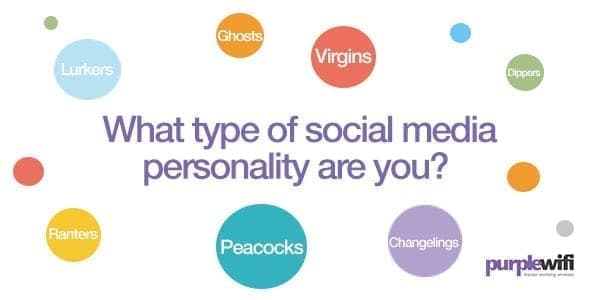
Michael Sebastian shared an interesting infographic about social media personalities created by the bank First Direct:
1) Virgins are new to the social media game, but they will evolve over time into one of the other types of sharers.
2) Ghosts do have a profile... but an anonymous one. They share very little information about themselves, enable every privacy setting possible, and have not a picture in sight!
3) Lurkers fear they are not interesting enough. They may post something but then take it down immediately. They are the observers of others online.
4) Deniers say that social media doesn't affect their lives... but would become anxious if told they had to deactivate their accounts.
5) Dippers access their pages infrequently but nevertheless maintain a profile, just in case!
6) Changelings completely change their 'real' personalities on social networks to be something they are not. Anyone who knows them in real life will quickly realise this alter ego couldn't be further from the truth. One amusing interpretation is by a mother who doesn't believe the posts of changelings and suggests the real meaning behind stereotypical Facebook posts.
7) Approval Seekers constantly check for 'likes', retweets, and endorsements to make themselves feel popular.
8) Quizzers love to ask questions in order to provoke a response and start a conversation.
9) Ranters are usually meek in real life, but they become highly opinionated online.
10) The Informers love to share all their latest updates with us, trying to be the first to know everything and share something interesting to get lots of 'wows'.
11) Peacocks aspire to gain more followers than friends to show how popular they are, accepting every 'friend request' and 'follow'. Online success means getting the MOST likes and retweets.
12) The Ultras are obsessed with social media, checking their news feeds more often than they speak: while out for meals, at the bus stop, before they sleep, and even in the middle of the night.
Other people's lives are so 'fantastic'
So, could social media posts be making us jealous? Are we going to gauge how happy other people's lives are from the 'Extrovert Informers'?
The grass is not always greener!
If we were to believe everything portrayed on Facebook and think we had to keep up, we would surely find it difficult to cope. Thanks to the 'Informers' and 'Peacocks' posting about their amazing holiday destinations, their perfect relationships with EVERYONE, and reporting success in all they do, a dose of the Green-Eyed Monster can be the result.
Jealousy could be good for you
Jealousy is often viewed negatively, but it's important to remember that social media is an environment where people create a carefully projected 'perfect' image of themselves. It is reassuring to know that everyone gets jealous at one time or another, and a little bit of it could actually be beneficial . In times gone by, jealousy has reduced the chance of desertion by one's mate and kept families together. Seeing what other people are doing can encourage you to try out new things: strive for that better job, move houses, or travel more.
Fear of missing out
FOMO, as it has become known, is a phenomenon that social media has brought to the fore. It is a grave fear that we are going to miss out on some sort of social event that will later be posted on our social media timelines. FOMO is a real anxiety, or an obsession in extreme cases. It is more common in people who report wanting to be loved more than they feel they are.
If you think you might have FOMO, then listen up! Tim Otis says that 'when we have access and visibility to what others are doing at every second of the day, it can (and does) create feelings of being lesser than someone else'.
Tim's advice: Put things into perspective and realise that you are doing things that other people aren't. Realise that life isn't actually that glamorous; people usually just post the great moments and pick the best picture from many to create a great image. Be content to have a healthy relationship with social media, appreciate the things you do have, and use it to better yourself:
'Use people's posts to motivate you, not demotivate you'.