
At its core, a managed SD-WAN service is about bringing in a third-party expert to handle the design, rollout, monitoring, and ongoing management of your entire wide-area network. Think of it as turning a complex, capital-heavy networking puzzle into a predictable, hands-off operational cost. This frees up your internal IT team to work on strategic projects instead of getting overwhelmed by day-to-day network firefighting.
Understanding SD-WAN Managed Services

To really understand what sd-wan managed services bring to the table, let’s use a simple analogy. Your old company network (the WAN) is like a city map with just a few expensive, private toll roads – your MPLS circuits. Traffic gets jammed easily, and building a new road is a painfully slow and costly affair.
Software-Defined WAN (SD-WAN) is like installing a super-smart GPS across your entire business. This system watches traffic in real-time and always finds the best route for your data, whether that’s a high-speed fibre line, a cost-effective broadband connection, or a robust 4G/5G link. It knows a crucial video call requires the fast lane and routes it there to avoid any disruptions.
So, where do the “managed services” come in? Your managed service provider (MSP) is your dedicated, 24/7 team of expert traffic controllers. They don’t just install the GPS; they actively monitor the systems, handle all maintenance, address incidents promptly, and constantly optimise the rules to ensure your data flows smoothly and securely. It’s a partnership that transforms a powerful but complex technology into a simple, reliable utility for your business.
Core Components of a Managed Service
A managed SD-WAN solution isn't just about outsourcing. It’s a complete service package built on a few key pillars designed to lift the technical burden off your team's shoulders.
The brain of the operation is the centralised control panel, often called an orchestrator. This software platform gives the provider a complete bird's-eye view of your network, from the headquarters right down to the smallest pop-up store.
From this one screen, they can:
- Deploy new sites with zero-touch provisioning, significantly reducing setup times.
- Deploy network-wide security policies instantly.
- Monitor the health and performance of every single link.
- Generate detailed reports on application usage and network uptime.
Another key piece is dynamic path selection. This is the smart GPS in action. The provider sets up rules that automatically steer traffic based on what it is. For example, a Microsoft Teams call gets priority over a non-urgent data backup, ensuring crystal-clear communication without requiring manual intervention. For a deeper dive, this SD-WAN Managed Services: A UK Business Transformation Guide offers valuable insights.
By abstracting away the underlying complexity of circuit management and policy configuration, a managed service allows businesses to consume enterprise-grade networking as a service, paying for outcomes instead of managing hardware.
From Firefighting to Strategic Focus
Ultimately, bringing on an SD-WAN managed services partner is about changing what your IT team focuses on. Instead of their days being consumed by troubleshooting unreliable connections, resolving latency issues, or managing contracts with carriers, they regain their time.
That means more time to improve the core applications that run the business, harden your cybersecurity defences, or explore new digital projects that drive real impact. The MSP handles the routine tasks of keeping operations running, providing proactive diagnostics and resolutions so your team can focus on growth. It’s a fundamental shift from a reactive, break-fix model to a proactive, innovation-first one.
The Business Case for Outsourcing Your SD-WAN
Deciding to hand over the keys to your network is a huge strategic choice, not just a technical one. For many organisations, the move to SD-WAN managed services is driven by a powerful business case that goes far beyond a simple technology upgrade. It’s about refocusing your resources, moving faster, and gaining a competitive edge.
The old way of building and managing a wide-area network in-house is riddled with challenges. It demands a massive upfront investment in hardware, consumes budget with ongoing software licences, and, critically, requires a team of highly specialised (and expensive) network engineers. This DIY model is becoming increasingly difficult to justify.
A managed service model completely flips this script. It transforms a hefty capital expenditure (CapEx) into a predictable operational expenditure (OpEx). Instead of buying and depreciating assets, you’re essentially consuming networking as a utility, paying a consistent monthly fee for a guaranteed result.
Driving Down Costs and Boosting Performance
One of the most compelling reasons to outsource is the direct impact on your bottom line. A huge slice of traditional network budgets is often swallowed by expensive, inflexible MPLS circuits. An expert provider can intelligently mix these private lines with high-performance, cost-effective broadband and 5G connections.
This hybrid approach doesn’t just slash circuit costs; it delivers a dramatic boost to application performance. Imagine your sales team relies on Salesforce and your finance department lives in Microsoft 365. An SD-WAN provider can set up policies that automatically prioritise this critical traffic, sending it over the fastest, most reliable link at any given moment. The result? Fewer slowdowns, less frustration, and more productive employees.
The core value is simple: a managed service gives you access to a level of specialised expertise and round-the-clock monitoring that’s far too costly and complex for most companies to build and maintain on their own.
Managed service providers (MSPs) have been pivotal in speeding up SD-WAN adoption across the UK, especially for mid-sized businesses that don’t have deep in-house networking teams. Outsourcing the implementation and day-to-day monitoring lets UK companies cut capital spending while gaining access to advanced performance analytics. To give you a real-world example, one UK bank saw 60% faster digital banking performance, 99.95% network uptime, and a 40% reduction in operational costs after rolling out a managed SD-WAN solution. You can find more details on these findings and the UK market in this comparison of SD-WAN vendors and service providers .
Gaining Unmatched Business Agility
Beyond the immediate financial wins, outsourcing your SD-WAN delivers incredible business agility. In the past, opening a new branch office could be a months-long headache, involving ordering new circuits and dealing with complex on-site configuration.
With a managed service, that timeline shrinks from months to days. The provider can ship a pre-configured device straight to the new location. Once it's plugged in, it uses zero-touch provisioning to automatically connect to the network and pull down all the correct policies. This speed means your business can react to market opportunities faster than ever. For businesses looking to streamline these complex rollouts, understanding the role of professional services in network deployment can offer valuable insights into achieving rapid deployment.
This agility also extends to supporting a modern, distributed workforce. Whether you're enabling remote work or setting up temporary "pop-up" sites, a managed service provides the secure, reliable connectivity needed to keep your team productive from anywhere. It transforms the network from a business bottleneck into a true business enabler.
Choosing Your SD-WAN Service Model
Picking a partner for your SD-WAN managed services can feel a bit like navigating a maze. The market is packed with providers, and they're definitely not all the same. The real trick is finding a partnership that aligns with your team's expertise, your budget, and where you want to take the business. This isn't just about the tech; it's about finding the right team to trust with the very heart of your network.
You’ll find everyone from massive telecoms companies to smaller, more nimble Managed Service Providers (MSPs) in the mix. Each one offers a slightly different approach, with its own set of strengths and weaknesses. Getting a handle on these differences is the first step to making a smart choice that will pay off for years.
Decoding the Provider Landscape
The main players in the SD-WAN game tend to fall into a few distinct camps. Telcos, for example, often wrap SD-WAN services into a bundle with their own internet connections. This gives you a single point of contact for both connectivity and management, which simplifies operations significantly. The downside? It might lock you into their network, limiting your freedom to use other internet providers.
On the flip side, you have vendor-agnostic MSPs who offer ultimate flexibility. They aren't locked into one specific technology or carrier, so they can develop a truly customised solution, integrating the best components for your exact needs. This is an excellent approach for businesses with complex multi-site setups or those seeking optimal performance and cost-efficiency across different carriers.
Finally, there are the pure-play SD-WAN specialists. These specialists focus entirely on one particular platform, whether it’s Meraki , Fortinet , or VeloCloud. Their deep, focused expertise can be a significant advantage if you are already committed to a specific vendor’s ecosystem.
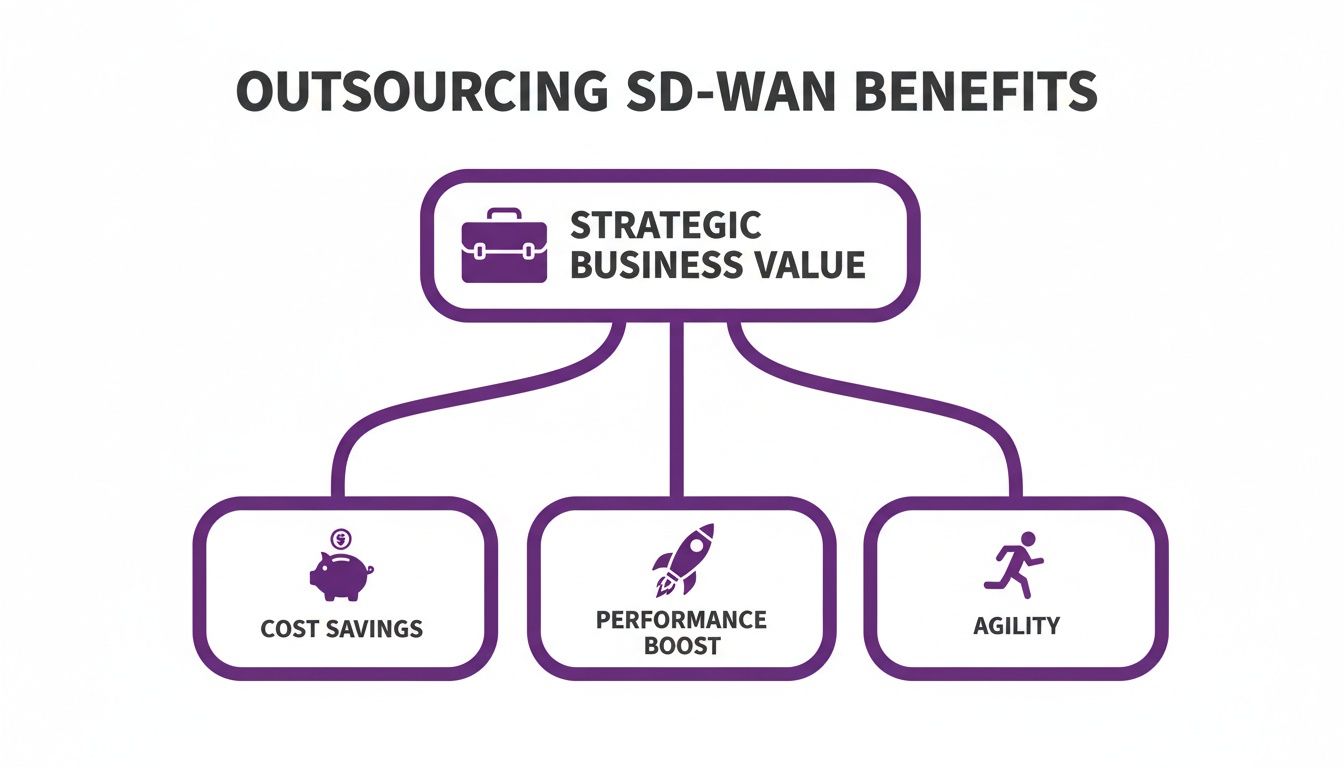
It all boils down to creating real strategic value, driven by real-world gains in cost savings, network performance, and business agility.
Fully-Managed vs Co-Managed Models
Once you've got a feel for the types of providers out there, the next big question is about how much control you want to keep. This is where you need to decide between a fully-managed or co-managed service. The right answer really depends on the skills and bandwidth of your internal IT team.
A fully-managed model is the "set it and forget it" option. The provider handles everything, from the initial design and rollout to 24/7 monitoring, troubleshooting, and making ongoing changes. It’s the perfect choice for businesses with lean IT teams who need to be focused on strategic projects, rather than firefighting network issues.
The co-managed model offers a collaborative partnership, blending the provider's 24/7 support and infrastructure management with your team's desire for policy control and visibility. It’s the best of both worlds for skilled IT teams.
In contrast, a co-managed model is a true partnership. The provider takes on the heavy lifting—managing the core hardware, providing around-the-clock monitoring, and handling the underlying platform—but your own IT team keeps access to the controls. This lets your people make specific policy tweaks, dive into performance data, and adjust application rules on the fly. It's an ideal setup for businesses with solid in-house network talent who just want to offload routine operational tasks.
To make the provider landscape a bit clearer, we've put together a table breaking down the key players you'll meet.
Comparison of SD-WAN Managed Service Provider Types
This table compares the key characteristics of different types of SD-WAN providers to help businesses choose the right partner.
Choosing the right provider is all about striking the right balance. By weighing these provider types and management styles against your own resources and goals, you'll find a partner that doesn't just upgrade your network, but actually helps your business grow.
Integrating Security Into Your SD-WAN Strategy

In a traditional network, security and connectivity were treated like separate problems. First, you would establish the digital infrastructure, and only then add security measures. In a world of cloud applications and distributed teams, that approach is no longer viable. Modern networks demand that security is woven directly into the fabric of the connection itself.
This is where today’s sd-wan managed services truly shine. They've moved far beyond merely directing traffic. A modern managed SD-WAN now serves as the very foundation of an advanced security architecture, steering businesses away from outdated models toward a more intelligent and effective defence.
The old method of "backhauling" traffic was a classic example of this inefficiency. To keep things secure, all internet-bound traffic from branch offices had to be painfully routed all the way back to a central data centre, just to be inspected by a firewall. This created frustrating latency, crippled cloud app performance, and created a major bottleneck for the entire network.
Embracing SASE for a Modern Defence
A huge step forward in this space has been the move to Secure Access Service Edge (SASE). It’s a framework that merges networking and security tools into a single, cloud-delivered service. Instead of forcing all traffic through one central firewall, SASE pushes security enforcement out to the network edge—closer to your users and devices.
Think of it this way: rather than making everyone in a city drive to a single central checkpoint, you place intelligent security guards at the entrance of every building. It's infinitely more efficient and secure. A managed SD-WAN provider puts this into practice by building a full stack of security services directly into the network.
These integrated security functions often include:
- Next-Generation Firewall (NGFW) to inspect traffic and block malicious activity.
- Secure Web Gateway (SWG) to shield users from online threats and enforce acceptable use policies.
- Zero-Trust Network Access (ZTNA), which works on the simple principle of "never trust, always verify," granting access based on who the user is and what device they're using.
- Cloud Access Security Broker (CASB) to give you visibility and control over how cloud applications are being used.
By embedding these tools, a managed provider eliminates the need for backhauling. A branch office can connect directly to the internet to use apps like Microsoft 365, with all the necessary security checks applied right at the source. This significantly enhances performance while simultaneously strengthening security.
Centralising Policy and Simplifying Management
One of the major challenges with traditional network security was inconsistency. Each site might have slightly different firewall rules, creating security holes and a management nightmare. A managed SD-WAN provider solves this by centralising all security policy management.
From one console, your provider can define and roll out consistent security policies across every single location, from headquarters to the smallest retail pop-up. This guarantees every user and device is protected by the same robust rules, no matter where they are.
By converging networking and security into one managed service, you not only improve your defensive posture but also simplify operations. You have one partner, one point of contact, and one unified view of your entire network and security landscape.
Adding Identity for Granular Control
The next frontier in network security is bringing user identity into the mix. Knowing what is on your network is important, but knowing who is on your network changes everything. This is where combining your SD-WAN with an identity-based networking platform creates an incredibly powerful layer of control.
Imagine a network that automatically knows the difference between an employee, a contractor, and a guest. When an employee connects, the network recognises their corporate credentials and instantly gives them secure access to company resources. When a guest connects, they are seamlessly directed to a guest WiFi portal for internet-only access, completely walled off from the corporate network.
This synergy between intelligent networking and user identity creates a passwordless, secure, and insightful environment. By automatically assigning the right access policies based on who is connecting, you eliminate manual configuration, significantly reduce security risks, and deliver a frictionless experience for everyone. Platforms that focus on user identity can provide a wealth of information about network usage, so it's essential to understand the provider's commitment to data protection. You can learn more about how leading platforms handle data and security to ensure compliance and user privacy .
A Practical Checklist for Vetting SD-WAN Providers
Choosing a partner for your sd-wan managed services is one of the most important network decisions you’ll make. It’s easy to get lost in slick sales presentations, but cutting through the noise to understand the real substance of a provider's offer requires a structured approach.
This checklist is your due diligence toolkit. It’s designed to arm you with the critical questions needed to systematically evaluate potential partners. We’ll move beyond surface-level features and probe into the core areas that make or break a long-term partnership: performance guarantees, security depth, operational support, and transparency.
Uptime and Performance Guarantees
Before you sign on the dotted line, you need absolute clarity on what the provider actually promises. Vague assurances about reliability are insufficient; you need concrete, contractually guaranteed metrics.
The starting point is always their Service Level Agreement (SLA). This document is the foundation of your relationship and needs to be scrutinised. Don't be afraid to ask direct, detailed questions about what happens when things inevitably go wrong.
Key questions to ask include:
- What specific metrics are covered in your SLA? Look for guarantees around network uptime, latency (delay), jitter (latency variation), and packet loss. These should be clearly defined for different types of circuits.
- How do you measure and report on SLA performance? Ask for a demo of their reporting portal. You need to see exactly what data you'll have access to.
- What are the service credits or penalties if you fail to meet the SLA? Understand the remediation process and how you’ll be compensated for performance dips.
A strong SLA is a clear sign of a provider's confidence in their own infrastructure and operational discipline. You can learn more by reading our guide on the importance of robust Service Level Agreements .
Security Architecture and Compliance
In modern networking, security isn’t an add-on; it has to be integrated into the very core of the solution. A provider’s approach to security tells you a lot about their technical maturity and their commitment to protecting your business.
You need to understand how their security services are integrated, managed, and updated. Just as important, you have to ensure their capabilities align with your organisation's specific compliance requirements and overall risk tolerance.
A provider's security model should offer defence-in-depth, covering everything from the branch edge to cloud connections. This includes not just technology, but also the people and processes that monitor and respond to threats 24/7.
Evaluate their security posture with these questions:
- What security features are included as standard? Ask about their integrated next-generation firewall (NGFW), intrusion prevention systems (IPS), and secure web gateway capabilities.
- How do you manage threat intelligence and security patching? A proactive partner will have a clear, documented process for keeping all network elements updated against emerging threats.
- Which compliance certifications do you hold? For industries like finance or healthcare, certifications such as ISO 27001 or PCI DSS are often non-negotiable.
Onboarding and Ongoing Support
Finally, the best technology in the world is only as good as the team supporting it. The transition to a new provider and the quality of their ongoing support are absolutely critical for success. The onboarding process should be a streamlined project, rather than a chaotic process.
Equally important is knowing who you’ll call when an issue arises. Being stuck in an impersonal ticketing system is a common frustration, so clarify their support structure right from the start.
- What does your typical migration and onboarding process look like? Request a detailed project plan that outlines timelines and key milestones.
- What level of visibility will we have through the management portal? Can you view real-time analytics and make policy changes yourself in a co-managed model?
- Who is our dedicated point of contact for technical support and strategic reviews? Find out if you will have an assigned account manager or a named technical lead you can build a relationship with.
Why the UK Is a Leader in Managed SD-WAN

The UK has carved out a serious reputation as a European hub for network transformation, with businesses up and down the country adopting sd-wan managed services. This is not merely a coincidence. It is a direct response to a unique combination of market pressures and technological demands that are part of daily operations for UK businesses.
A massive part of the story is the UK’s early and deep dive into cloud services. Whether it’s finance firms in the City of London or national retail chains, companies here rely heavily on platforms like Microsoft 365 and Salesforce. Traditional networks that route all traffic back to a central data centre simply cannot keep up with the direct-to-cloud speeds these applications require to perform optimally.
Managed SD-WAN cuts right through that problem. It intelligently steers traffic along the best path, ensuring the user experience is exceptional—an essential requirement for maintaining productivity and a competitive edge.
Market Momentum and Key Drivers
The numbers back up the UK's leadership role. The market for managed SD-WAN has seen incredible momentum, hitting a value of USD 1.64 billion in 2025 and is on track to reach USD 2.12 billion in 2026. This isn't just growth; it's a clear signal that the market recognises the value here, with the UK now holding 30.9% of the European market share. You can get a closer look at the data in this managed SD-WAN services market report .
So, what is driving this impressive adoption? It comes down to a few key factors:
- A Sharp Focus on Cybersecurity: UK businesses are navigating tight regulations and a relentless barrage of cyber threats. Managed SD-WAN with built-in security gives them the central command and control they need to properly protect distributed offices and remote staff.
- Complex Connectivity Needs: The UK's mix of dense city centres and more remote industrial parks presents complex connectivity challenges. A flexible, transport-agnostic SD-WAN solution is perfectly designed to address these specific issues.
- Industry-Specific Demands: Different sectors have different needs. Finance, for example, demands ultra-low latency for its trading platforms. Retail needs networks that can spin up a pop-up shop in a day and handle real-time inventory. A managed service can be tailored for these specific requirements.
For UK decision-makers, the message is crystal clear: a network upgrade is no longer just an IT project, it’s a core business strategy. The move towards managed services shows a real desire to become more agile and tap into specialist expertise, without the burden of managing it all in-house.
By outsourcing network management, UK companies gain access to specialised engineers and 24/7 monitoring, freeing them up to focus on what they do best. It's a strategic move that helps them adapt to whatever comes next, from supporting a hybrid workforce to launching new digital services, all with a network that’s ready for the challenge. The UK's leadership position is proof that this forward-thinking approach works.
Your SD-WAN Questions, Answered
Transitioning to a new network architecture naturally raises a few questions. When evaluating managed SD-WAN services, decision-makers typically focus on the same key topics: flexibility, deployment speed, and, of course, security. Obtaining clear answers is essential to making an informed decision that aligns with your business needs.
Let’s address some of the most common questions we receive from IT professionals and business leaders. Consider this the practical perspective—how a managed solution operates on a day-to-day basis and what you should expect from a provider.
Can I Keep My Existing Internet Circuits?
Absolutely. In fact, this is one of the primary strengths of SD-WAN. It is designed to be transport-independent, meaning a proficient managed service provider can architect a solution that integrates and intelligently manages traffic across all your existing connections.
You can keep using your existing assets, including:
- High-speed fibre and broadband internet.
- Reliable 4G/5G mobile connections for backup or even primary use in some locations.
- Even your legacy MPLS circuits can be integrated into a modern hybrid network.
This "bring your own carrier" model gives you ultimate flexibility. It allows your provider to fine-tune the network for the best possible balance of cost and performance, selecting the optimal path for every single application.
How Long Does Deployment Usually Take?
Timelines can vary depending on the number of sites and the complexity of your infrastructure, but a significant advantage of opting for a managed service is the accelerated deployment speed. An in-house project can easily extend over several months, often delayed by hardware procurement, complex configurations, and prolonged testing cycles.
A managed provider streamlines this entire process. They manage the logistics, pre-configure the hardware using zero-touch provisioning, and oversee the complete testing phase from start to finish. This means they can frequently bring your initial sites online within weeks rather than months, accelerating your return on investment.
For an optimal balance, consider a "co-managed" model. Your provider handles 24/7 monitoring and core infrastructure, while your internal team retains access to a management portal to adjust policies and monitor performance analytics.
Is SD-WAN Secure Enough for Sensitive Data?
Yes, provided it is implemented with a security-first approach. Modern SD-WAN platforms do more than just route traffic; they are engineered with robust, built-in security features. This includes end-to-end encryption for all traffic, integrated next-generation firewalls (NGFW), and secure web gateways to protect users from online threats.
When these tools are part of a wider Secure Access Service Edge (SASE) framework, the security you get is often far stronger than a traditional WAN could ever offer. This unified approach ensures that robust, consistent security policies follow every user and device, whether they are at the headquarters or working remotely. It is fully capable of securing sensitive financial or healthcare data.
Transform your network with Purple, an identity-based platform that replaces insecure shared passwords with seamless, secure, and passwordless access for guests and staff. Learn more at https://www.purple.ai
Crafted with the Outrank app