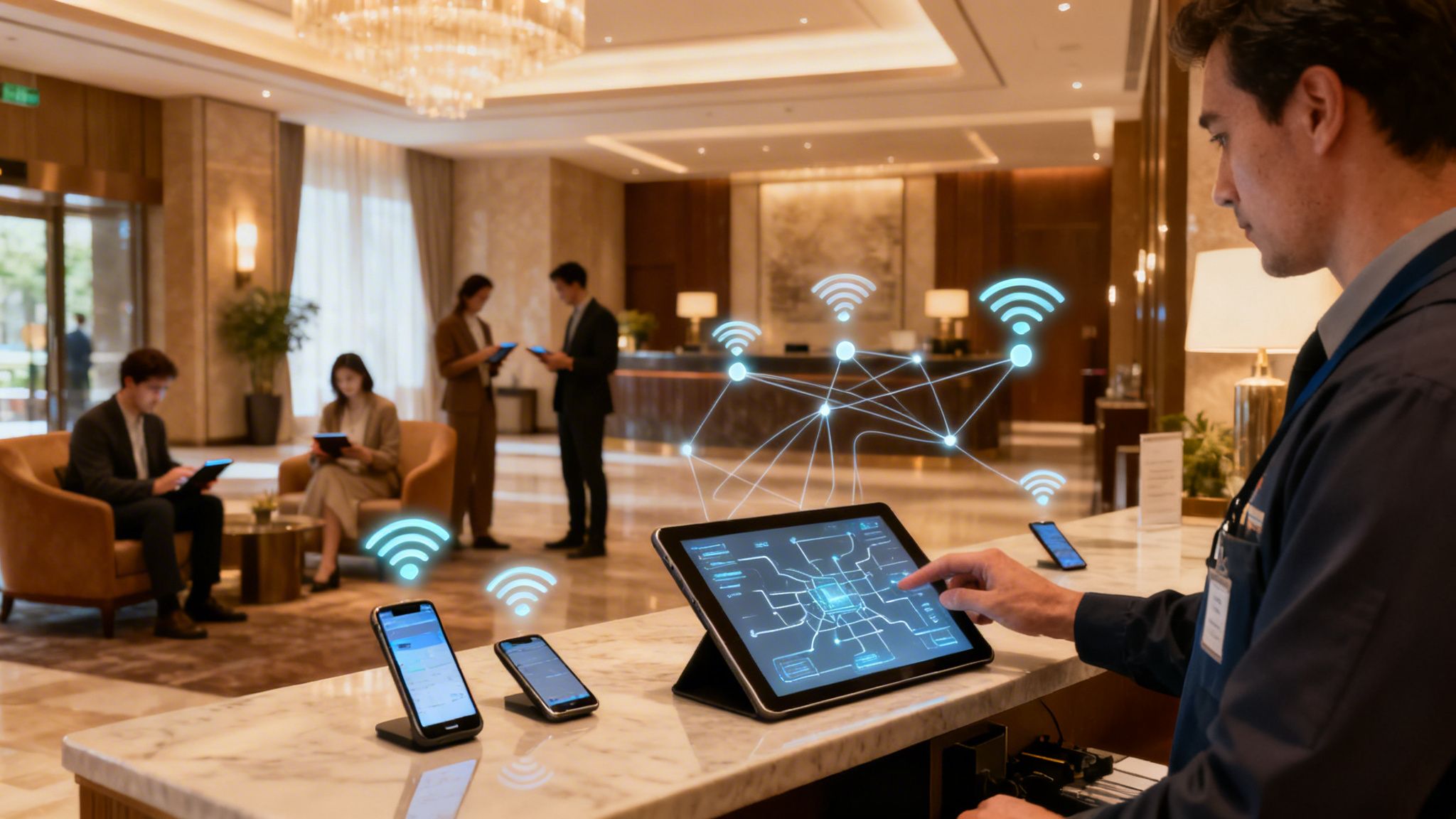
So what is Hotspot 2.0, how does it relate to Passpoint and Next Generation Hotspot (NGH), and what is all the fuss about?
Confused? You would be forgiven if you were, and you would be in good company.
Firstly, I will explain how they are related. Hotspot 2.0 is an initiative driven by the Wi-Fi Alliance and is broadly based on the 802.11u standard. Passpoint is the certification from the Wi-Fi Alliance that states a piece of equipment works with Hotspot 2.0. Next Generation Hotspot takes the process beyond the equipment, covering authentication back to operators, service providers, and carriers.
Ultimately, for the end user, it means a better experience, whatever we call the combined elements of Hotspot 2.0 and NGH.
https://www.youtube.com/watch?v=-AucVGLz5dU&t=28s
I believe there is good reason for all the fuss about these topics, which will truly change the public Wi-Fi landscape and experience. It is also going to create an entirely new market around data offload and onload.
Consider the current experience of a typical user looking to use public Wi-Fi. First, they open their settings, turn on their Wi-Fi, and look for available networks. Depending on their location, there could be a vast number to choose from. They look for networks without the lock symbol and wonder what is on the other side.
If they had more answers at this stage, it would significantly help them choose whether to connect:
- Is there an agreement with my mobile operator?
- Will I have to pay?
- Do I need to register?
- Is the network congested?
- Is the internet working—will I be able to get online?
- What speeds can I expect?
Once they finally decide to connect, they will most likely have to open a browser and navigate to a non-secure site, at which point they will arrive at the splash or landing page. If they are fortunate enough to be at a Social Wi-Fi Hotspot , then registering will be simple. If not, they must prepare to fill out a form and perhaps even provide a credit card. Finally, they are online. Simple?
It is surprising how many people struggle to get through this process, with users giving up at various stages. What is even more frustrating and confusing is that on your next visit, if the hotspot provider does not offer seamless login to Wi-Fi , it will still appear as though you are connected. You will assume you are connected to Wi-Fi because the symbol is displayed on your device, but the reality is that you will likely have to log in again. Seamless!
That is all going to change with Hotspot 2.0 and NGH. Using realms and EAP Authentication, you could walk into a public Wi-Fi area without even taking your device out of your pocket or bag, while background decisions are made regarding the best network to join. Your device will even evaluate whether it is worth connecting based on the speeds of WiFi versus 3G/4G and the congestion levels of each.
This assumes there is a roaming agreement in place. This could be between your mobile operator, the hardware manufacturer, the broadband provider, or another party. This is an area that will become highly interesting over the next few years.
If a roaming agreement is not in place, users will still be able to view available networks with greater detail, allowing them to make a more informed decision before connecting. The process will be significantly smoother, with no need to open browsers and enter URLs.
The three key drivers for this technology taking hold are:
1) Wi-Fi equipment supporting the technology (which is currently in full swing).
2) Devices supporting the technology (this received a massive boost with support in iOS 7 ).
3) The final piece of the jigsaw is software ( like ours ) bringing all of this together.
The future is bright, more connected, and, hopefully for those of us in the industry, just around the corner.