

Captive Portals: বাস্তবায়ন, কাস্টমাইজেশন এবং নিরাপত্তার একটি পূর্ণাঙ্গ গাইড
This guide provides IT managers, network architects, and CTOs with a definitive technical reference for deploying, customising, and securing captive wifi portals across enterprise venues including hotels, retail chains, stadiums, and public-sector facilities. It covers authentication architectures, GDPR and PCI DSS compliance obligations, threat mitigation strategies, and the advanced analytics capabilities available through Purple's enterprise WiFi intelligence platform. Organisations that implement captive portals correctly transform a basic connectivity utility into a measurable business intelligence and revenue-generation asset.
🎧 Listen to this Guide
View Transcript

এক্সিকিউটিভ সামারি
একটি Captive WiFi Portal হলো একটি নিয়ন্ত্রিত গেটওয়ে যার মাধ্যমে আপনার নেটওয়ার্কে অ্যাক্সেস করার আগে প্রতিটি গেস্ট ডিভাইসকে অবশ্যই যেতে হবে। এই বিনিয়োগ মূল্যায়নকারী CTO-এর জন্য বিজনেস কেসটি একদম সোজা: একটি সুপরিকল্পিত Captive Portal একইসাথে GDPR এবং খাত-ভিত্তিক নিয়মকানুনের অধীনে আপনার আইনি বাধ্যবাধকতা পূরণ করে, বেনামী নেটওয়ার্ক অ্যাক্সেস দূর করে এবং প্রতিটি Wi-Fi লগইনকে একটি কাঠামোগত ফার্স্ট-পার্টি ডেটা ইভেন্টে রূপান্তরিত করে যা আপনার CRM, মার্কেটিং অটোমেশন এবং অপারেশনাল অ্যানালিটিক্স স্ট্যাককে সমৃদ্ধ করে।
২০২৩ থেকে ২০২৪ সালের মধ্যে যুক্তরাজ্যের Captive Portal মার্কেট ০.৮৮ বিলিয়ন পাউন্ড থেকে বেড়ে ১.০১ বিলিয়ন পাউন্ডে দাঁড়িয়েছে, যা হসপিটালিটি এবং রিটেইল খাতের গ্রহণের ফলে ১৫.৩% চক্রবৃদ্ধি বার্ষিক প্রবৃদ্ধির হারকে প্রতিফলিত করে। ব্রাসেলস সাউথ শার্লেরোই এয়ারপোর্ট Purple-এর প্ল্যাটফর্ম স্থাপনের পর ৮৪২% রিটার্ন অন ইনভেস্টমেন্ট (ROI) রিপোর্ট করেছে, যেখানে এন্টারপ্রাইজ গ্রাহকরা সেন্ট্রালাইজড ক্লাউড ম্যানেজমেন্টের মাধ্যমে অন-সাইট আইটি ইঞ্জিনিয়ার ভিজিট ৯০% হ্রাসের কথা ধারাবাহিকভাবে জানিয়েছেন।
এই গাইডে Captive Portal-এর টেকনিক্যাল আর্কিটেকচার, তিনটি প্রাথমিক অথেন্টিকেশন মডেল এবং তাদের সুবিধা-অসুবিধা, সবচেয়ে সাধারণ অ্যাটাক ভেক্টরগুলোর বিরুদ্ধে সিকিউরিটি হার্ডেনিং, GDPR এবং PCI DSS কমপ্লায়েন্সের প্রয়োজনীয়তা এবং অ্যাডভান্সড কাস্টমাইজেশন ও অ্যানালিটিক্স সক্ষমতা নিয়ে আলোচনা করা হয়েছে, যা একটি এন্টারপ্রাইজ-গ্রেড ডিপ্লয়মেন্টকে সাধারণ লগইন পেজ থেকে আলাদা করে।
টেকনিক্যাল ডিপ-ডাইভ
একটি Captive WiFi Portal কীভাবে কাজ করে
মূলত, Captive Portal হলো একটি নেটওয়ার্ক অ্যাক্সেস কন্ট্রোল মেকানিজম যা আনঅথেনটিকেটেড ট্রাফিককে বাধা দেয় এবং এটিকে একটি ওয়েব-ভিত্তিক অথেন্টিকেশন পেজে রিডাইরেক্ট করে। এই মেকানিজমটি নিম্নরূপ কাজ করে। যখন কোনো ডিভাইস একটি গেস্ট SSID-এর সাথে যুক্ত হয়, তখন অ্যাক্সেস পয়েন্ট DHCP-এর মাধ্যমে একটি IP অ্যাড্রেস অ্যাসাইন করে এবং ডিভাইসটিকে একটি নিয়ন্ত্রিত ফায়ারওয়াল স্টেটে রাখে। DNS রেজোলিউশন স্বাভাবিকভাবেই কাজ করে — এটি এভাবেই ডিজাইন করা, কারণ পোর্টাল রিডাইরেক্ট এর ওপর নির্ভরশীল — তবে সমস্ত আউটবাউন্ড HTTP এবং HTTPS ট্রাফিক গেটওয়ে দ্বারা বাধাপ্রাপ্ত হয় এবং পোর্টাল URL-এ একটি HTTP 302 রিডাইরেক্টের সম্মুখীন হয়।
আধুনিক অপারেটিং সিস্টেমগুলোতে বিল্ট-ইন Captive Network Assistant (CNA) ডিটেকশন অন্তর্ভুক্ত থাকে। iOS captive.apple.com প্রোব করে, Android connectivitycheck.gstatic.com প্রোব করে এবং Windows www.msftconnecttest.com-এ কোয়েরি করার জন্য Network Location Awareness ব্যবহার করে। যখন এই প্রোবগুলো অপ্রত্যাশিত রেসপন্স প্রদান করে, তখন OS স্বয়ংক্রিয়ভাবে পোর্টালটি প্রদর্শনকারী একটি লাইটওয়েট ব্রাউজার উইন্ডো চালু করে। এই কারণেই ব্যবহারকারীরা ব্রাউজার টাইমআউটের পরিবর্তে প্রায় তাৎক্ষণিক একটি পপ-আপ দেখতে পান।
চার-ধাপের অথেন্টিকেশন ফ্লো নিচে দেওয়া হলো:
- অ্যাসোসিয়েশন এবং DHCP: ডিভাইসটি SSID-এর সাথে কানেক্ট হয় এবং একটি IP অ্যাড্রেস গ্রহণ করে। গেটওয়ে সেশনটিকে আনঅথেনটিকেটেড হিসেবে চিহ্নিত করে।
- ইন্টারসেপশন এবং রিডাইরেক্ট: গেটওয়ে প্রথম HTTP রিকোয়েস্টটিকে বাধা দেয় এবং পোর্টাল URL-এ একটি 302 রিডাইরেক্ট ইস্যু করে। HTTPS রিকোয়েস্টের ক্ষেত্রে, গেটওয়েকে অবশ্যই ইন্টারসেপ্ট করা ডোমেইনের জন্য একটি বৈধ TLS সার্টিফিকেট উপস্থাপন করতে হবে (যা ব্রাউজার ওয়ার্নিং ট্রিগার করে) অথবা সম্পূর্ণভাবে HTTPS ইন্টারসেপশন এড়াতে CNA মেকানিজমের ওপর নির্ভর করতে হবে।
- অথেন্টিকেশন অ্যাকশন: ব্যবহারকারী পোর্টাল পেজে প্রয়োজনীয় কাজ সম্পন্ন করেন — যেমন AUP গ্রহণ করা, ক্রেডেনশিয়াল সাবমিট করা, অথবা ভাউচার কোড এন্টার করা।
- সেশন অথোরাইজেশন: পোর্টাল কন্ট্রোলার গেটওয়েকে নোটিফাই করে যে ডিভাইসের MAC অ্যাড্রেস (বা সেশন টোকেন) এখন অথোরাইজড। ফায়ারওয়াল রুল আপডেট করা হয় এবং কনফিগার করা সেশনের সময়কালের জন্য সম্পূর্ণ ইন্টারনেট অ্যাক্সেস প্রদান করা হয়।
অথেন্টিকেশন মডেল: একটি টেকনিক্যাল তুলনা
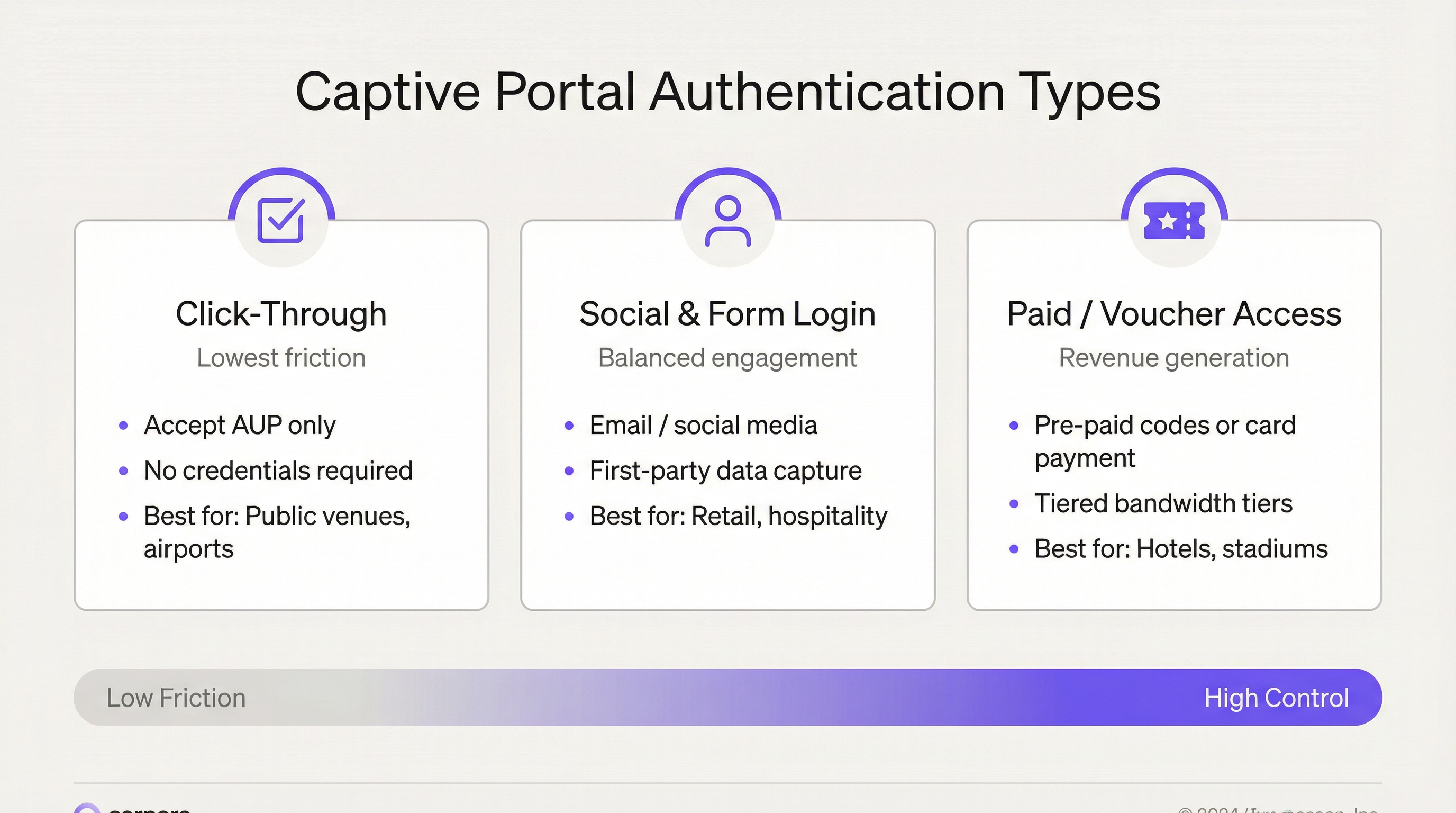
অথেন্টিকেশন মডেল নির্বাচন করা হলো Captive Portal ডিপ্লয়মেন্টের সবচেয়ে গুরুত্বপূর্ণ সিদ্ধান্ত। এটি আপনার ডেটার মান, কমপ্লায়েন্সের অবস্থা এবং ইউজার এক্সপেরিয়েন্স মেট্রিক্স নির্ধারণ করে।
| অথেন্টিকেশন মডেল | টেকনিক্যাল মেকানিজম | ক্যাপচার করা ডেটা | কমপ্লায়েন্স জটিলতা | সবচেয়ে উপযুক্ত |
|---|---|---|---|---|
| ক্লিক-থ্রু (শুধুমাত্র AUP) | সিঙ্গেল চেকবক্স; MAC-ভিত্তিক সেশন অথোরাইজেশন | ডিভাইসের MAC, টাইমস্ট্যাম্প, সেশনের সময়কাল | কম — কোনো ব্যক্তিগত ডেটা সংগ্রহ করা হয় না | পাবলিক সেক্টর, ট্রান্সপোর্ট হাব, লাইব্রেরি |
| ইমেইল / ফর্ম রেজিস্ট্রেশন | ফর্ম সাবমিশন; সার্ভার-সাইড ভ্যালিডেশন; সেশন টোকেন ইস্যু করা হয় | ইমেইল, নাম, ডেমোগ্রাফিক্স, অপ্ট-ইন স্ট্যাটাস | মাঝারি — GDPR কনসেন্ট ফ্লো প্রয়োজন | হসপিটালিটি, রিটেইল, কর্পোরেট ক্যাম্পাস |
| সোশ্যাল লগইন (OAuth 2.0) | Facebook, Google, LinkedIn-এর মাধ্যমে OAuth 2.0 অথোরাইজেশন ফ্লো | সোশ্যাল প্রোফাইল ডেটা (প্ল্যাটফর্মের বিধিনিষেধ সাপেক্ষে) | মাঝারি-উচ্চ — থার্ড-পার্টি ডেটা প্রসেসিং এগ্রিমেন্ট | হসপিটালিটি, ইভেন্ট, রিটেইল |
| ভাউচার / পেইড অ্যাক্সেস | প্রি-জেনারেটেড কোড বা পেমেন্ট গেটওয়ে ইন্টিগ্রেশন | ইমেইল (রসিদের জন্য), পেমেন্ট রেফারেন্স | মাঝারি — অন-নেটওয়ার্কে কার্ড পেমেন্ট হলে PCI DSS স্কোপ | হোটেল, স্টেডিয়াম, কনফারেন্স সেন্টার |
| PMS / রুম নম্বর অথেন্টিকেশন | প্রপার্টি ম্যানেজমেন্ট সিস্টেম API-এর সাথে ইন্টিগ্রেশন | PMS রেকর্ড থেকে গেস্টের পরিচয় | কম — হোটেল বুকিংয়ের অধীনে ডেটা আগে থেকেই সংরক্ষিত থাকে | হোটেল, রিসোর্ট |
সোশ্যাল লগইন মডেলটি বিশেষ মনোযোগের দাবি রাখে। Facebook এবং Google-এর মাধ্যমে OAuth 2.0 ফ্লো একটি বাধাহীন ইউজার এক্সপেরিয়েন্স এবং সমৃদ্ধ ডেমোগ্রাফিক ডেটা প্রদান করে, তবে প্ল্যাটফর্ম API-এর পরিবর্তনগুলো থার্ড-পার্টি অ্যাপ্লিকেশনগুলোর জন্য অ্যাক্সেসযোগ্য ডেটা ফিল্ডগুলোকে ক্রমশ সীমিত করেছে। নেটওয়ার্ক আর্কিটেক্টদের এমন ডেটা পাইপলাইন তৈরি করা উচিত নয় যা সোশ্যাল প্রোফাইল ফিল্ডগুলোর ওপর নির্ভর করে, কারণ সেগুলো বাতিল হয়ে যেতে পারে। সুস্পষ্ট কনসেন্টসহ ইমেইল ক্যাপচার করা এখনও সবচেয়ে টেকসই ফার্স্ট-পার্টি ডেটা স্ট্র্যাটেজি।
নেটওয়ার্ক আর্কিটেকচার এবং সেগমেন্টেশন
Captive Portal ডিপ্লয়মেন্টে সঠিক নেটওয়ার্ক সেগমেন্টেশন হলো সবচেয়ে গুরুত্বপূর্ণ সিকিউরিটি কন্ট্রোল। গেস্ট নেটওয়ার্ককে অবশ্যই কর্পোরেট LAN, যেকোনো PCI-স্কোপড কার্ডহোল্ডার ডেটা এনভায়রনমেন্ট এবং যেকোনো অপারেশনাল টেকনোলজি নেটওয়ার্ক থেকে আর্কিটেকচারালি আইসোলেটেড বা বিচ্ছিন্ন রাখতে হবে। প্রস্তাবিত আর্কিটেকচারটি নিচে দেওয়া হলো:
- ডেডিকেটেড গেস্ট SSID যা একটি ডেডিকেটেড VLAN-এর (যেমন, VLAN 100) সাথে ম্যাপ করা থাকে এবং কর্পোরেট VLAN-গুলোর সাথে এর কোনো Layer 2 অ্যাডজাসেন্সি থাকে না।
- অ্যাক্সেস পয়েন্ট লেভেলে ইন্টার-ক্লায়েন্ট আইসোলেশন এনফোর্স করা হয়, যা গেস্ট ডিভাইসগুলোকে একে অপরের সাথে যোগাযোগ করতে বাধা দেয়।
- সমস্ত গেস্ট ট্রাফিকের জন্য DMZ রাউটিং, যেখানে ইন্টারনেট ইগ্রেসের আগে স্টেটফুল ফায়ারওয়াল ইন্সপেকশন করা হয়।
- DMZ-এ অবস্থিত Captive Portal কন্ট্রোলার (হার্ডওয়্যার, ভার্চুয়াল, বা ক্লাউড-ম্যানেজড), যা রিডাইরেক্ট লজিক, সেশন ম্যানেজমেন্ট এবং পলিসি এনফোর্সমেন্ট পরিচালনা করে।
- গেস্ট VLAN-এর জন্য আলাদা DNS রিভলভার, যেখানে DNSSEC ভ্যালিডেশন এনাবল করা থাকে।
মাল্টি-সাইট এন্টারপ্রাইজ ডিপ্লয়মেন্টের ক্ষেত্রে, Purple-এর মতো ক্লাউড-ম্যানেজড প্ল্যাটফর্মগুলো শত শত ভেন্যু জুড়ে এই আর্কিটেকচারকে সেন্ট্রালাইজ করে। একটি পলিসি পরিবর্তন — যেমন AUP টেক্সট আপডেট করা, নতুন সোশ্যাল লগইন প্রোভাইডার যোগ করা, বা ব্যান্ডউইথ টিয়ার পরিবর্তন করা — একবার পুশ করলেই তা কয়েক মিনিটের মধ্যে বিশ্বব্যাপী কার্যকর হয়, যা পার-সাইট কনফিগারেশনের বাড়তি ঝামেলা দূর করে এবং স্কেলিংয়ের ক্ষেত্রে কন্ট্রোলার-ভিত্তিক ডিপ্লয়মেন্টের অপারেশনাল খরচ কমায়。
ইমপ্লিমেন্টেশন গাইড
ফেজ ১: রিকোয়ারমেন্টস এবং কমপ্লায়েন্স স্কোপিং
যেকোনো টেকনিক্যাল কনফিগারেশন শুরু করার আগে, আপনার কমপ্লায়েন্স বাধ্যবাধকতাগুলো নির্ধারণ করুন। ইইউ এবং যুক্তরাজ্যের অপারেশনের জন্য, GDPR আর্টিকেল ৬ অনুযায়ী ব্যক্তিগত ডেটা প্রসেস করার জন্য একটি আইনি ভিত্তি প্রয়োজন। Captive Portal ডিপ্লয়মেন্টের ক্ষেত্রে, এটি সাধারণত কনসেন্ট (আর্টিকেল ৬(১)(এ)) বা লেজিটিমেট ইন্টারেস্টস (আর্টিকেল ৬(১)(এফ)) হয়ে থাকে। মার্কেটিং ডেটার জন্য কনসেন্ট হলো সবচেয়ে পরিচ্ছন্ন ভিত্তি; সিকিউরিটি লগিংয়ের ক্ষেত্রে লেজিটিমেট ইন্টারেস্টস প্রযোজ্য হতে পারে। আর্টিকেল ৩০-এর অধীনে আপনার Record of Processing Activities (ROPA)-এ প্রতিটি ডেটা ক্যাটাগরির জন্য আপনার আইনি ভিত্তি ডকুমেন্ট করুন।
যদি আপনার ভেন্যু এমন কোনো নেটওয়ার্কে কার্ড পেমেন্ট প্রসেস করে যা আপনার গেস্ট Wi-Fi-এর সাথে ইনফ্রাস্ট্রাকচার শেয়ার করে — এমনকি শেয়ার্ড আপলিংক সুইচের মাধ্যমেও — তবে আপনাকে অবশ্যই আপনার PCI DSS স্কোপ মূল্যায়ন করতে হবে। সবচেয়ে নিরাপদ পদ্ধতি হলো সম্পূর্ণ নেটওয়ার্ক আইসোলেশন: গেস্ট Wi-Fi একটি পৃথক ফিজিক্যাল বা লজিক্যালি আইসোলেটেড নেটওয়ার্কে থাকবে, যেখান থেকে কার্ডহোল্ডার ডেটা এনভায়রনমেন্টে যাওয়ার কোনো পথ থাকবে না।
ফেজ ২: নেটওয়ার্ক ডিজাইন এবং ইনফ্রাস্ট্রাকচার
একটি ডেডিকেটেড VLAN-এ আপনার গেস্ট SSID ডিপ্লয় করুন। এই VLAN-টিকে আপনার আপলিংক সুইচে ট্রাঙ্ক করুন এবং এগিয়ে যাওয়ার আগে ট্রাঙ্ক কনফিগারেশন ভেরিফাই করুন — একটি মিসকনফিগার করা ট্রাঙ্ক হলো কর্পোরেট নেটওয়ার্কে গেস্টদের ভুলবশত উপস্থিত হওয়ার সবচেয়ে সাধারণ কারণ। হাই-টার্নওভার এনভায়রনমেন্টে দক্ষতার সাথে IP অ্যাড্রেসগুলো পুনরুদ্ধার করতে একটি শর্ট লিজ টাইম (১-৪ ঘণ্টা) সহ গেস্ট VLAN-এর জন্য DHCP কনফিগার করুন।
আপনার Captive Portal ডিপ্লয়মেন্ট মডেল নির্বাচন করুন: কন্ট্রোলার-ভিত্তিক (অন-প্রিমিসেস হার্ডওয়্যার বা ভার্চুয়াল অ্যাপ্লায়েন্স) অথবা ক্লাউড-ম্যানেজড (SaaS প্ল্যাটফর্ম)। পাঁচটির বেশি সাইট থাকা প্রতিষ্ঠানগুলোর জন্য, অপারেশনাল দক্ষতার স্বার্থে ক্লাউড-ম্যানেজড মডেল দৃঢ়ভাবে সুপারিশ করা হয়। Purple-এর প্ল্যাটফর্ম Cisco Meraki, Aruba, Ruckus এবং Ubiquiti সহ ৪০০টিরও বেশি হার্ডওয়্যার ইন্টিগ্রেশন সাপোর্ট করে, যা বিদ্যমান অ্যাক্সেস পয়েন্ট ইনফ্রাস্ট্রাকচার পরিবর্তন না করেই ডিপ্লয়মেন্ট সক্ষম করে।
ফেজ ৩: পোর্টাল কনফিগারেশন এবং ব্র্যান্ডিং
Purple-এর প্ল্যাটফর্মের মাধ্যমে, স্প্ল্যাশ পেজ কাস্টমাইজেশন একটি ড্র্যাগ-অ্যান্ড-ড্রপ এডিটরের সাহায্যে করা যায়, যা পিক্সেল-পারফেক্ট ব্র্যান্ড অ্যালাইনমেন্টের প্রয়োজন এমন প্রতিষ্ঠানগুলোর জন্য সম্পূর্ণ HTML/CSS ওভাররাইড সাপোর্ট করে। মূল কনফিগারেশন উপাদানগুলোর মধ্যে রয়েছে:
- ব্র্যান্ড অ্যাসেটস: লোগো, কালার প্যালেট, ব্যাকগ্রাউন্ড ইমেজ এবং ফন্ট নির্বাচন।
- ল্যাঙ্গুয়েজ লোকালাইজেশন: Purple ২৫টিরও বেশি ভাষায় স্বয়ংক্রিয় ডিভাইস ল্যাঙ্গুয়েজ ডিটেকশন সাপোর্ট করে, যা ম্যানুয়াল নির্বাচন ছাড়াই ব্যবহারকারীর ডিভাইসের ভাষায় পোর্টালটি উপস্থাপন করে।
- অথেন্টিকেশন ফ্লো: আপনার নির্বাচিত অথেন্টিকেশন মেথড(গুলো) কনফিগার করুন। একইসাথে একাধিক মেথড অফার করা যেতে পারে — উদাহরণস্বরূপ, ইমেইল রেজিস্ট্রেশন এবং ক্লিক-থ্রু — যেখানে রেজিস্ট্রেশন করতে অনিচ্ছুক ব্যবহারকারীদের জন্য ফলব্যাক হিসেবে ক্লিক-থ্রু অপশনটি উপলব্ধ থাকে।
- কনসেন্ট ম্যানেজমেন্ট: AUP গ্রহণ (অ্যাক্সেসের জন্য প্রয়োজনীয়) এবং মার্কেটিং অপ্ট-ইন (ঐচ্ছিক)-এর জন্য আলাদা, স্বাধীনভাবে ঐচ্ছিক চেকবক্স কনফিগার করুন। নিশ্চিত করুন যে মার্কেটিং চেকবক্সটি ডিফল্টভাবে আনচেক করা আছে। পোর্টাল পেজ থেকে আপনার প্রাইভেসি পলিসির লিংক যুক্ত করুন।
- পোস্ট-অথেন্টিকেশন রিডাইরেক্ট: একটি অর্থবহ রিডাইরেক্ট URL কনফিগার করুন — যেমন আপনার লয়্যালটি প্রোগ্রাম, একটি প্রমোশনাল ল্যান্ডিং পেজ, অথবা আপনার ভেন্যু অ্যাপ ডাউনলোডের পেজ।
- সেশন প্যারামিটারস: আপনার ভেন্যুর ধরন অনুযায়ী উপযুক্ত সেশনের সময়কাল সেট করুন। হোটেলগুলো সাধারণত ২৪ ঘণ্টার সেশন ব্যবহার করে; হাই-টার্নওভার রিটেইল ৪-৮ ঘণ্টা ব্যবহার করতে পারে; ইভেন্টগুলো ইভেন্টের সময়কাল অনুযায়ী সেশন ব্যবহার করতে পারে।
ফেজ ৪: সিকিউরিটি হার্ডেনিং
গো-লাইভের আগে নিচের সিকিউরিটি কন্ট্রোলগুলো প্রয়োগ করুন:
- একটি বিশ্বস্ত CA থেকে প্রাপ্ত বৈধ TLS সার্টিফিকেটসহ পোর্টালটিকে একচেটিয়াভাবে HTTPS-এর মাধ্যমে ডিপ্লয় করুন। Let's Encrypt বা আপনার CA-এর ACME প্রোটোকল সাপোর্ট ব্যবহার করে স্বয়ংক্রিয়ভাবে সার্টিফিকেট রিনিউ করুন। ম্যানুয়াল ব্যাকস্টপ হিসেবে মেয়াদ শেষ হওয়ার ৩০ দিন আগে একটি ক্যালেন্ডার রিমাইন্ডার সেট করুন।
- গেস্ট SSID-তে 802.11w Management Frame Protection এনাবল করুন। এটি WPA3-এর অধীনে বাধ্যতামূলক এবং ইভিল টুইন (evil twin) পরিস্থিতিতে ব্যবহৃত ডিঅথেন্টিকেশন অ্যাটাকগুলো প্রশমিত করে।
- আপনার গেস্ট SSID নামের সাথে মিলে যাওয়া রোগ (rogue) SSID-গুলোর বিষয়ে সতর্ক করতে ওয়্যারলেস ইনট্রুশন ডিটেকশন কনফিগার করুন।
- ব্যান্ডউইথ মনোপোলাইজেশন রোধ করতে এবং পৃথক ডিভাইস থেকে ডিনায়াল-অফ-সার্ভিস প্রশমিত করতে অ্যাক্সেস পয়েন্ট লেভেলে পার-ইউজার রেট লিমিটিং এনাবল করুন।
- সেশন টাইমআউট এবং আইডল টাইমআউট পলিসি কনফিগার করুন। ৩০-৬০ মিনিটের একটি আইডল টাইমআউট ভেন্যু ছেড়ে যাওয়া ডিভাইসগুলো থেকে গেটওয়ে সেশন পুনরুদ্ধার করে।
ফেজ ৫: টেস্টিং এবং গো-লাইভ
গো-লাইভের আগে নিচের ডিভাইস/OS কম্বিনেশনগুলোতে সম্পূর্ণ অথেন্টিকেশন ফ্লো টেস্ট করুন: iOS Safari (লেটেস্ট), Android Chrome (লেটেস্ট), Windows 11 Edge, macOS Safari এবং Android Firefox। যাচাই করুন যে iOS এবং Android-এ CNA পপ-আপ সঠিকভাবে ট্রিগার করে কিনা। সার্টিফিকেটের বৈধতা টেস্ট করুন — ব্রাউজারে সরাসরি পোর্টাল URL-এ নেভিগেট করুন এবং নিশ্চিত করুন যে কোনো সার্টিফিকেট ওয়ার্নিং নেই। পোস্ট-অথেন্টিকেশন রিডাইরেক্ট টেস্ট করুন। প্রযোজ্য হলে ব্যান্ডউইথ টিয়ার এনফোর্সমেন্ট টেস্ট করুন। টেস্টের ফলাফলগুলো ডকুমেন্ট করুন।
বেস্ট প্র্যাকটিস
সিকিউরিটি বেস্ট প্র্যাকটিস
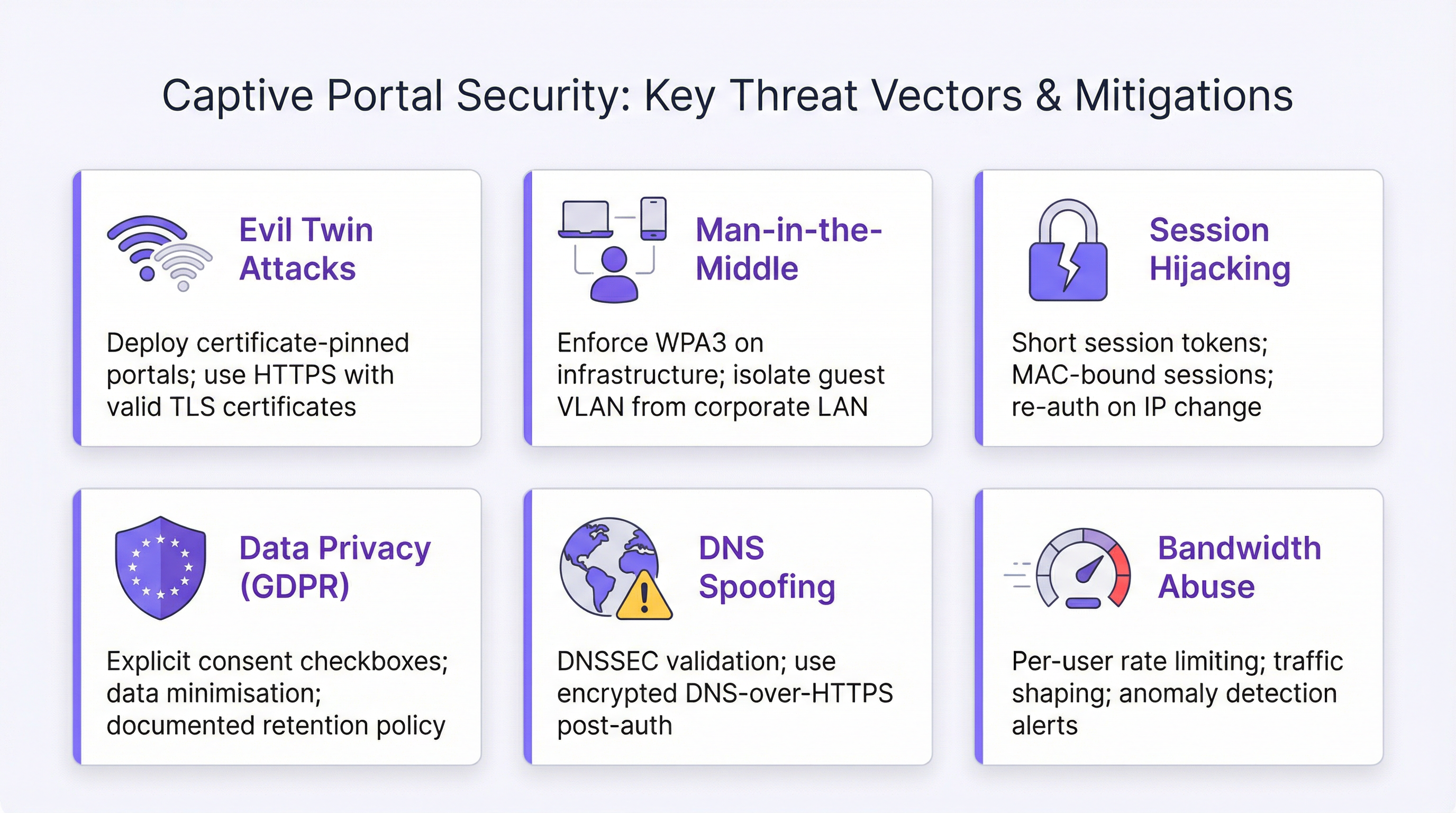
Captive WiFi Portal-এর সাথে যুক্ত সবচেয়ে উল্লেখযোগ্য সিকিউরিটি ঝুঁকিগুলো হলো ইভিল টুইন অ্যাটাক, ম্যান-ইন-দ্য-মিডল ইন্টারসেপশন, সেশন হাইজ্যাকিং এবং DNS স্পুফিং। প্রতিটির জন্যই একটি নির্দিষ্ট প্রশমন কৌশল বা মিটিগেশন স্ট্র্যাটেজি রয়েছে।
ইভিল টুইন অ্যাটাক বৈধ TLS সার্টিফিকেটসহ HTTPS এনফোর্সমেন্ট, 802.11w Management Frame Protection এবং ওয়্যারলেস IDS মনিটরিংয়ের মাধ্যমে প্রশমিত করা হয়। কোনো রোগ (rogue) AP-এর সাথে কানেক্ট করা একজন ব্যবহারকারী একটি সার্টিফিকেট ওয়ার্নিং পাবেন যদি অ্যাটাকার আপনার পোর্টাল ডোমেইনের জন্য একটি বৈধ সার্টিফিকেট পেতে ব্যর্থ হয় — যা তারা পারবে না, ধরে নিচ্ছি আপনার ডোমেইনটি সঠিকভাবে নিয়ন্ত্রিত।
ম্যান-ইন-দ্য-মিডল ইন্টারসেপশন কঠোর VLAN সেগমেন্টেশন, ইন্টার-ক্লায়েন্ট আইসোলেশন এবং একটি স্টেটফুল ফায়ারওয়ালের মাধ্যমে সমস্ত গেস্ট ট্রাফিক রাউটিং করার মাধ্যমে সমাধান করা হয়। পোস্ট-অথেন্টিকেশনের পর, ব্যবহারকারীদের HTTPS-এর মাধ্যমে সাইটগুলোতে কানেক্ট করতে উৎসাহিত করুন — পোস্ট-অথেন্টিকেশন ল্যান্ডিং পেজে একটি নোট দেওয়াই যথেষ্ট।
সেশন হাইজ্যাকিং প্রশমিত করার জন্য একমাত্র অথোরাইজেশন আইডেন্টিফায়ার হিসেবে MAC অ্যাড্রেসের পরিবর্তে সেশন টোকেন ব্যবহার করা, উপযুক্ত সেশনের সময়কাল সেট করা এবং IP অ্যাড্রেস পরিবর্তনের ক্ষেত্রে রি-অথেন্টিকেশন ট্রিগার ইমপ্লিমেন্ট করা হয়। মনে রাখবেন যে MAC অ্যাড্রেস র্যান্ডমাইজেশন — যা iOS 14+, Android 10+ এবং Windows 10+-এ ডিফল্টভাবে এনাবল থাকে — এর মানে হলো MAC-ভিত্তিক সেশন পারসিস্টেন্স আর নির্ভরযোগ্য নয়। অথেনটিকেটেড আইডেন্টিটির সাথে যুক্ত সেশন টোকেনগুলোই হলো সঠিক পদ্ধতি।
DNS স্পুফিং আপনার গেস্ট DNS রিভলভারগুলোতে DNSSEC ভ্যালিডেশনের মাধ্যমে এবং পোস্ট-অথেন্টিকেশনের পর গেস্ট ট্রাফিকের জন্য DNS-over-HTTPS উৎসাহিত বা এনফোর্স করার মাধ্যমে সমাধান করা হয়।
GDPR কমপ্লায়েন্স চেকলিস্ট
যুক্তরাজ্য এবং ইইউ জুরিসডিকশনে GDPR-কমপ্লায়েন্ট Captive Portal পরিচালনার জন্য নিচের কন্ট্রোলগুলো প্রয়োজন:
- কনসেন্ট চেকবক্সগুলো ডিফল্টভাবে আনচেক করা থাকতে হবে।
- AUP গ্রহণ এবং মার্কেটিং অপ্ট-ইনের জন্য আলাদা, স্বাধীনভাবে ঐচ্ছিক চেকবক্স।
- কী ডেটা সংগ্রহ করা হচ্ছে এবং কেন, তার স্পষ্ট ও সহজ ভাষায় বর্ণনা।
- পোর্টাল পেজে প্রাইভেসি পলিসির লিংক।
- ডকুমেন্টেড ডেটা রিটেনশন এবং ডিলিশন পলিসি।
- সমস্ত থার্ড-পার্টি প্রসেসরের (CRM প্ল্যাটফর্ম, অ্যানালিটিক্স টুলস) সাথে Data Processing Agreement।
- Captive Portal ডেটা সংগ্রহ কভার করে এমন Record of Processing Activities (ROPA) এন্ট্রি।
- ৩০ দিনের মধ্যে Subject Access Request-এর রেসপন্স করার প্রক্রিয়া।
- অনুরোধের ভিত্তিতে ডেটা ডিলিট করার প্রক্রিয়া।
অপারেশনাল বেস্ট প্র্যাকটিস
এন্টারপ্রাইজ Captive Portal ডিপ্লয়মেন্টে সবচেয়ে সাধারণ অপারেশনাল ব্যর্থতা হলো "সেট অ্যান্ড ফরগেট" প্যাটার্ন: পোর্টালটি ডিপ্লয় করা হয়, এটি কাজ করে এবং কোনো কিছু নষ্ট না হওয়া পর্যন্ত এটি আর কোনো মনোযোগ পায় না। একটি ত্রৈমাসিক অপারেশনাল রিভিউ ইমপ্লিমেন্ট করুন যার মধ্যে থাকবে: TLS সার্টিফিকেটের মেয়াদ শেষ হওয়ার তারিখ, সোশ্যাল লগইন API কি-এর বৈধতা, প্রাইভেসি পলিসি লিংকের ইন্টিগ্রিটি, AUP টেক্সটের প্রাসঙ্গিকতা (বিশেষ করে রেগুলেটরি পরিবর্তনের পর) এবং সমস্ত সাপোর্টেড OS/ব্রাউজার কম্বিনেশন জুড়ে অথেন্টিকেশন ফ্লো টেস্টিং।
ট্রাবলশুটিং এবং রিস্ক মিটিগেশন
সাধারণ ফেইলিওর মোড
| ফেইলিওর মোড | লক্ষণ | মূল কারণ | সমাধান |
|---|---|---|---|
| iOS-এ পোর্টাল দেখা যাচ্ছে না | ডিভাইস কানেক্ট হয় কিন্তু কোনো CNA পপ-আপ আসে না | ফায়ারওয়াল দ্বারা Apple প্রোব ব্লক করা হয়েছে | captive.apple.com-এ আউটবাউন্ড HTTP অ্যালাউ করুন; নিশ্চিত করুন যে DNS সঠিকভাবে কাজ করছে |
| পোর্টালে সার্টিফিকেট ওয়ার্নিং | ব্রাউজার "Not Secure" ওয়ার্নিং দেখায় | মেয়াদোত্তীর্ণ বা সেলফ-সাইন্ড TLS সার্টিফিকেট | সার্টিফিকেট রিনিউ করুন; অটো-রিনিউয়াল কনফিগার করুন |
| রিডাইরেক্ট লুপ | ব্যবহারকারী ইনফিনিট রিডাইরেক্টে আটকে থাকেন | মিসকনফিগার করা পোস্ট-অথেন্টিকেশন রিডাইরেক্ট URL বা ফায়ারওয়াল রুল আপডেট করা হয়নি | ফায়ারওয়াল সেশন অথোরাইজেশন ভেরিফাই করুন; রিডাইরেক্ট URL কনফিগারেশন চেক করুন |
| সোশ্যাল লগইন ফেইলিওর | OAuth ফ্লো এরর রিটার্ন করে | API কি-এর মেয়াদ শেষ বা প্ল্যাটফর্ম পারমিশন পরিবর্তন | API কি রি-জেনারেট করুন; পারমিশন পরিবর্তনের জন্য প্ল্যাটফর্ম ডেভেলপার কনসোল রিভিউ করুন |
| কর্পোরেট নেটওয়ার্কে গেস্ট | কর্পোরেট VLAN-এ গেস্ট ডিভাইস দেখা যাচ্ছে | VLAN ট্রাঙ্ক মিসকনফিগারেশন | আপলিংক সুইচে VLAN ট্রাঙ্ক ভেরিফাই করুন; SSID-থেকে-VLAN ম্যাপিং নিশ্চিত করুন |
| MAC র্যান্ডমাইজেশন সেশন ব্রেক করে | রিকানেক্ট করার সময় ব্যবহারকারীদের আবার লগইন করতে বলা হয় | র্যান্ডমাইজড MAC-এর কারণে MAC-ভিত্তিক সেশন পারসিস্টেন্স ব্যর্থ হয় | টোকেন-ভিত্তিক সেশন ম্যানেজমেন্টে স্যুইচ করুন; সেশনের সময়কাল বাড়ান |
| ব্যান্ডউইথ টিয়ার এনফোর্স করা হয়নি | প্রিমিয়াম ব্যবহারকারীরা ফ্রি ব্যবহারকারীদের সমান থ্রুপুট পান | AP লেভেলে QoS পলিসি প্রয়োগ করা হয়নি | শুধুমাত্র গেটওয়েতে নয়, অ্যাক্সেস পয়েন্টেও পার-ইউজার রেট লিমিটিং কনফিগার করুন |
রিস্ক রেজিস্টার
এন্টারপ্রাইজ রিস্ক ম্যানেজমেন্টের উদ্দেশ্যে, Captive Portal ডিপ্লয়মেন্টের সাথে যুক্ত মূল ঝুঁকিগুলো এবং তাদের প্রশমন কৌশলগুলো নিচে দেওয়া হলো। GDPR নন-কমপ্লায়েন্স (সম্ভাবনা: মাঝারি, প্রভাব: উচ্চ) ডকুমেন্টেড কনসেন্ট ফ্লো, ROPA এন্ট্রি এবং ত্রৈমাসিক কমপ্লায়েন্স রিভিউয়ের মাধ্যমে প্রশমিত করা হয়। TLS সার্টিফিকেটের মেয়াদ শেষ হওয়া (সম্ভাবনা: মাঝারি, প্রভাব: উচ্চ — পোর্টাল অ্যাক্সেসযোগ্য থাকে না) স্বয়ংক্রিয় সার্টিফিকেট রিনিউয়াল এবং ক্যালেন্ডার-ভিত্তিক মনিটরিংয়ের মাধ্যমে প্রশমিত করা হয়। ইভিল টুইন অ্যাটাক (সম্ভাবনা: কম, প্রভাব: উচ্চ) 802.11w, WIDS মনিটরিং এবং HTTPS এনফোর্সমেন্টের মাধ্যমে প্রশমিত করা হয়। গেস্ট নেটওয়ার্কের মাধ্যমে ডেটা ব্রিচ (সম্ভাবনা: কম, প্রভাব: খুব উচ্চ) কঠোর VLAN সেগমেন্টেশন এবং ফায়ারওয়াল পলিসির মাধ্যমে প্রশমিত করা হয়।
ROI এবং বিজনেস ইমপ্যাক্ট

রিটার্ন অন ইনভেস্টমেন্ট (ROI) পরিমাপ করা
একটি Captive WiFi Portal ডিপ্লয়মেন্টের ROI তিনটি মাত্রায় পরিমাপ করা হয়: সরাসরি রেভিনিউ জেনারেশন, অপারেশনাল খরচ হ্রাস এবং মার্কেটিং ও ডেটা ভ্যালু।
সরাসরি রেভিনিউ জেনারেশন মূলত সেই ভেন্যুগুলোর ক্ষেত্রে প্রযোজ্য যারা টিয়ার্ড অ্যাক্সেস অফার করে — যেমন হোটেল, স্টেডিয়াম এবং কনফারেন্স সেন্টার যারা প্রিমিয়াম ব্যান্ডউইথ প্যাকেজ বিক্রি করে। একটি ২০০-রুমের হোটেল যদি তাদের ৩০% গেস্টের কাছ থেকে প্রিমিয়াম Wi-Fi-এর জন্য প্রতিদিন ৫ পাউন্ড চার্জ করে, তবে তারা এমন একটি ডিপ্লয়মেন্ট থেকে বার্ষিক প্রায় ১১০,০০০ পাউন্ড ইনক্রিমেন্টাল রেভিনিউ জেনারেট করে, যার খরচ এই আয়ের একটি ভগ্নাংশ মাত্র।
অপারেশনাল খরচ হ্রাস সেন্ট্রালাইজড ম্যানেজমেন্ট দ্বারা পরিচালিত হয়। Purple-এর এন্টারপ্রাইজ গ্রাহকরা কন্ট্রোলার-ভিত্তিক থেকে ক্লাউড-ম্যানেজড ডিপ্লয়মেন্টে মাইগ্রেট করার পর অন-সাইট আইটি ইঞ্জিনিয়ার ভিজিট ৯০% হ্রাসের কথা জানিয়েছেন। ২০০টি লোকেশন থাকা একটি রিটেইল চেইনের জন্য, প্রতি ভিজিটে ১৫০ পাউন্ড খরচে প্রতি সাইটে বছরে মাত্র দুটি ইঞ্জিনিয়ার ভিজিট বাদ দিলেও তা বার্ষিক ৬০,০০০ পাউন্ড সাশ্রয় করে।
মার্কেটিং এবং ডেটা ভ্যালু হলো কৌশলগতভাবে সবচেয়ে তাৎপর্যপূর্ণ মাত্রা। একটি Captive Portal যা মার্কেটিং কনসেন্টসহ ইমেইল অ্যাড্রেস ক্যাপচার করে, তা এমন একটি ফার্স্ট-পার্টি ডেটা অ্যাসেট তৈরি করে যা ক্রমশ মূল্যবান হয়ে উঠছে, কারণ থার্ড-পার্টি কুকি বাতিল হওয়ার ফলে বিকল্প ডেটা সোর্সগুলো হারিয়ে যাচ্ছে। Purple-এর প্ল্যাটফর্ম ৪০০টিরও বেশি CRM এবং মার্কেটিং অটোমেশন কানেক্টরের সাথে ইন্টিগ্রেট করে, যা ক্যাপচার করা ডেটাকে সরাসরি Salesforce, HubSpot, Mailchimp এবং সমতুল্য প্ল্যাটফর্মগুলোতে প্রবাহিত হতে সক্ষম করে। অ্যানালিটিক্স লেয়ার — ফুটফল হিটম্যাপ, ডুয়েল টাইম অ্যানালিটিক্স, রিপিট ভিজিটর আইডেন্টিফিকেশন এবং পিক আওয়ার রিপোর্টিং — এমন অপারেশনাল ইন্টেলিজেন্স প্রদান করে যা স্টাফিং, স্টোর লেআউট এবং প্রমোশনাল টাইমিংয়ের সিদ্ধান্ত নিতে সাহায্য করে।
কি পারফরম্যান্স ইন্ডিকেটরস (KPI)
| KPI | সংজ্ঞা | টার্গেট বেঞ্চমার্ক |
|---|---|---|
| পোর্টাল অ্যাডপশন রেট | কানেক্টেড ডিভাইসগুলোর % যা অথেন্টিকেশন সম্পন্ন করে | হসপিটালিটির জন্য >৬০%; রিটেইলের জন্য >৪০% |
| ডেটা ক্যাপচার রেট | অথেনটিকেটেড সেশনগুলোর % যা ইমেইল অ্যাড্রেস প্রদান করে | ফর্ম-ভিত্তিক পোর্টালগুলোর জন্য >৫০% |
| মার্কেটিং অপ্ট-ইন রেট | অথেনটিকেটেড সেশনগুলোর % যা মার্কেটিংয়ে সম্মতি দেয় | হসপিটালিটির জন্য ২০-৩৫% সাধারণ |
| সেশন ডিউরেশন | পোস্ট-অথেন্টিকেশনের পর একটি ডিভাইস গড়ে যে সময় কানেক্টেড থাকে | ভেন্যু-নির্ভর; সময়ের সাথে সাথে ট্রেন্ড ট্র্যাক করুন |
| রিপিট ভিজিটর রেট | পূর্বে দেখা আইডেন্টিটিগুলো থেকে আসা অথেনটিকেটেড সেশনগুলোর % | লয়্যালটি নির্দেশ করে; রিটেইলের জন্য টার্গেট >৩০% |
| পোর্টাল আপটাইম | পোর্টালটি উপলব্ধ এবং কার্যকর থাকার সময়ের % | >৯৯.৯% SLA টার্গেট |
| TLS সার্টিফিকেটের বাকি দিন | সার্টিফিকেটের মেয়াদ শেষ হওয়া পর্যন্ত দিন | অ্যালার্ট থ্রেশহোল্ড: <৩০ দিন |
কেস স্টাডি: ব্রাসেলস সাউথ শার্লেরোই এয়ারপোর্ট
ব্রাসেলস সাউথ শার্লেরোই এয়ারপোর্ট তাদের টার্মিনাল জুড়ে গেস্ট Wi-Fi ম্যানেজ করার জন্য Purple-এর Captive Portal প্ল্যাটফর্ম ডিপ্লয় করেছে। এই ডিপ্লয়মেন্ট প্রতি ইভেন্টে ২৫% ফ্যান কানেকশন রেট অর্জন করেছে, প্রথম ২৪ মাসে ৯.২ মিলিয়ন কাস্টমার ভিজিট ক্যাপচার করেছে এবং ৮৪২% রিটার্ন অন ইনভেস্টমেন্ট (ROI) প্রদান করেছে। পোর্টালটির সার্ভে ইন্টিগ্রেশন রিয়েল-টাইম প্যাসেঞ্জার স্যাটিসফ্যাকশন ডেটা সংগ্রহ করতে সক্ষম করেছে, যা ব্যয়বহুল ম্যানুয়াল সার্ভে প্রক্রিয়াগুলোকে প্রতিস্থাপন করেছে এবং ভেন্যু ম্যানেজমেন্টকে অ্যাকশনেবল অপারেশনাল ইন্টেলিজেন্স প্রদান করেছে。
কেস স্টাডি: যুক্তরাজ্যের শীর্ষস্থানীয় রিটেইল চেইন
১৫০টিরও বেশি লোকেশনে পরিচালিত যুক্তরাজ্যের একটি শীর্ষস্থানীয় রিটেইল চেইন গেস্ট Wi-Fi ম্যানেজমেন্ট এবং অ্যানালিটিক্সকে একীভূত করতে Purple-এর প্ল্যাটফর্ম ডিপ্লয় করেছে। ডিপ্লয়মেন্টের আগে, ইন-স্টোর ডুয়েল টাইম, ফুটফল প্যাটার্ন, বা Wi-Fi ব্যবহার এবং কেনাকাটার আচরণের মধ্যে সম্পর্কের বিষয়ে চেইনটির কোনো ধারণা ছিল না। ডিপ্লয়মেন্টের পর, অ্যানালিটিক্স লেয়ার চিহ্নিত করেছে যে ক্যাফে এরিয়াতে গড় ডুয়েল টাইমের চেয়ে বেশি সময় কাটানো স্টোরগুলোতে গড় ট্রানজ্যাকশন ভ্যালু ২৩% বেশি ছিল। এই ইনসাইটটি একটি স্টোর লেআউট রিডিজাইন প্রোগ্রামকে চালিত করেছে যা দুই কোয়ার্টারের মধ্যে পরিমাপযোগ্য রেভিনিউ বৃদ্ধি করেছে। সেন্ট্রালাইজড ম্যানেজমেন্ট সক্ষমতা পার-সাইট কনফিগারেশন ম্যানেজমেন্ট দূর করে আইটি অপারেশনাল ওভারহেড কমিয়েছে, যেখানে ইঞ্জিনিয়ার ভিজিট ৯০% হ্রাস পাওয়ার ফলে পুরো এস্টেট জুড়ে উল্লেখযোগ্য বার্ষিক খরচ সাশ্রয় হয়েছে।
Key Terms & Definitions
Captive WiFi Portal
A network access control mechanism that intercepts unauthenticated HTTP/HTTPS traffic from newly connected devices and redirects it to a web-based landing page. The user must complete a defined action — accepting terms, submitting credentials, or making a payment — before the network gateway grants full internet access. The portal creates a 'walled garden' that controls the initial network access event.
IT teams encounter this term when specifying guest Wi-Fi requirements, evaluating network access control solutions, or auditing existing deployments. It is the foundational concept for all guest connectivity management in hospitality, retail, events, and public-sector environments.
Captive Network Assistant (CNA)
A built-in OS mechanism that detects the presence of a captive portal and automatically launches a lightweight browser window to display the portal page. iOS probes captive.apple.com, Android probes connectivitycheck.gstatic.com, and Windows uses Network Location Awareness. When these probes return unexpected responses, the CNA triggers automatically.
Network architects must ensure their firewall and DNS configuration does not inadvertently block CNA probes, as this prevents the portal from appearing automatically on user devices — the most common cause of 'portal not showing' support tickets.
VLAN (Virtual Local Area Network)
A logical network segmentation technique that isolates traffic at Layer 2 of the OSI model. In captive portal deployments, the guest SSID is mapped to a dedicated VLAN that is architecturally isolated from corporate VLANs, preventing guest traffic from reaching internal systems.
VLAN configuration is the foundational security control in any captive portal deployment. Misconfigured VLAN trunking — where the guest VLAN is not properly isolated from corporate VLANs — is the most common and most serious security failure mode in enterprise guest Wi-Fi deployments.
OAuth 2.0
An open authorisation framework (RFC 6749) that enables third-party applications to obtain limited access to user accounts on platforms such as Facebook, Google, and LinkedIn. In captive portal deployments, OAuth 2.0 is used to implement social login — the user authorises the portal to access their social profile, providing identity verification without requiring a separate account.
IT teams evaluating social login authentication must understand that OAuth 2.0 introduces a dependency on third-party API availability and is subject to platform policy changes that may restrict the data fields accessible to the portal application. Social platform API changes have historically reduced the demographic data available via social login without advance notice.
IEEE 802.11w (Management Frame Protection)
An IEEE 802.11 amendment that provides cryptographic protection for management frames — the control messages that govern Wi-Fi association, disassociation, and authentication. Without 802.11w, management frames can be spoofed by attackers to force device disconnection (deauthentication attacks), a technique used in evil twin attacks. 802.11w is mandatory under WPA3.
Network architects deploying captive portals in high-risk environments (airports, financial institutions, healthcare) should enable 802.11w on guest SSIDs where supported by the access point hardware. It significantly raises the bar for evil twin attacks by preventing the deauthentication frames that force devices to reconnect to a rogue AP.
GDPR Article 30 (Record of Processing Activities)
A GDPR requirement for organisations processing personal data to maintain a documented record of all data processing activities, including the categories of data processed, the purposes of processing, data retention periods, and details of any third-party processors. Captive portal deployments that collect personal data (email addresses, social profile data) must have a corresponding ROPA entry.
IT managers are frequently responsible for ensuring that new data collection systems — including captive portals — are documented in the organisation's ROPA before go-live. Failure to maintain an accurate ROPA is a GDPR compliance gap that can result in ICO enforcement action, particularly following a data breach.
PCI DSS (Payment Card Industry Data Security Standard)
A set of security standards established by the PCI Security Standards Council to protect cardholder data. For captive portal deployments in retail environments, PCI DSS requires complete network isolation between the guest Wi-Fi network and any system that stores, processes, or transmits cardholder data (the Cardholder Data Environment, or CDE).
Retail IT teams must assess PCI DSS scope when deploying guest Wi-Fi. If the guest Wi-Fi network shares any infrastructure — switches, uplinks, or firewalls — with the PCI-scoped network, the guest network may be brought into PCI scope, significantly increasing compliance obligations and audit costs.
MAC Address Randomisation
A privacy feature enabled by default on iOS 14+, Android 10+, and Windows 10+ that generates a random MAC address for each Wi-Fi network a device connects to, rather than using the device's hardware MAC address. This prevents cross-network tracking of devices by their MAC address.
MAC address randomisation directly impacts captive portal session management and analytics. Any system that uses MAC addresses as stable device identifiers for repeat visitor detection, session persistence, or security policy enforcement will produce incorrect results on modern devices. The correct approach is to use authenticated identity (email, social profile ID) as the stable identifier.
Walled Garden
A network configuration in which unauthenticated devices have access only to a restricted set of IP addresses and URLs — typically the captive portal itself and any resources required for the portal to function (CDN assets, OAuth endpoints) — while all other internet traffic is blocked until authentication is complete.
IT teams configuring captive portals must carefully define the walled garden whitelist. Common omissions include: the portal's CDN asset URLs (causing the portal page to render without styling), Apple's CNA probe URL (causing the portal not to appear on iOS), and OAuth provider endpoints (causing social login to fail). A well-documented walled garden configuration is essential for reliable portal operation.
DSCP (Differentiated Services Code Point)
A field in the IP packet header used to classify and manage network traffic for Quality of Service (QoS) purposes. In captive portal deployments with tiered bandwidth, DSCP marking is used to classify traffic from premium-tier users so that QoS policies at the access point and gateway can enforce differentiated throughput limits.
IT teams implementing paid bandwidth tiers must configure DSCP marking and corresponding QoS policies at the access point level, not only at the gateway. Gateway-only QoS policies may not differentiate traffic correctly when multiple users share the same access point, resulting in premium users receiving the same throughput as free-tier users.
Case Studies
A 350-room international hotel needs to deploy a captive wifi portal that authenticates guests using their room number and surname, captures email addresses for the loyalty programme, complies with GDPR, and provides tiered bandwidth (free standard / paid premium at £8/day). The hotel uses Opera PMS and Cisco Meraki access points. What is the recommended deployment architecture and configuration?
The recommended deployment uses Purple's enterprise platform integrated with Cisco Meraki via the Meraki API. Step 1: Configure a dedicated guest SSID on Meraki mapped to VLAN 200, with client isolation enabled and a separate DHCP scope (e.g., 10.200.0.0/22 providing up to 1,022 addresses for a 350-room hotel with multiple devices per guest). Step 2: Configure Purple as the captive portal controller, pointing the Meraki splash page URL to Purple's hosted portal endpoint. Step 3: Enable the Opera PMS integration in Purple's connector library. Configure the authentication flow to present a room number and surname form as the primary authentication method, with email address capture as a mandatory second step post-PMS validation. Step 4: Configure the GDPR consent flow: AUP acceptance checkbox (required, unchecked by default) and marketing opt-in checkbox (optional, unchecked by default) with a link to the hotel's privacy policy. Step 5: Configure two bandwidth tiers in Purple — Standard (5 Mbps down / 2 Mbps up) and Premium (25 Mbps down / 10 Mbps up). Integrate with a payment gateway (Stripe is supported) for the Premium tier purchase flow. Configure Meraki QoS policies using DSCP marking to enforce tier differentiation at the AP level. Step 6: Set session duration to 24 hours with a 60-minute idle timeout. Step 7: Configure post-authentication redirect to the hotel's loyalty programme enrolment page. Step 8: Enable Purple's analytics dashboard and configure a CRM connector to push captured email addresses and opt-in status to the hotel's CRM platform. Test on iOS Safari, Android Chrome, and Windows Edge before go-live.
A national retail chain with 180 stores wants to deploy a unified captive wifi portal programme. Requirements: email capture with marketing consent, footfall analytics by store, GDPR compliance, integration with Salesforce Marketing Cloud, and no replacement of existing Aruba access points. The IT team has three engineers for the entire estate. How should this be structured?
This is a cloud-managed deployment scenario where on-premises infrastructure is non-negotiable. Step 1: Audit existing Aruba infrastructure for firmware versions and confirm compatibility with Purple's Aruba integration (Purple supports Aruba Instant and Aruba Central deployments). Step 2: Configure a standardised guest SSID template in Purple — one configuration that will be pushed to all 180 stores. Define VLAN assignment, DHCP parameters, and firewall policy in the template. Step 3: Design the portal template: brand assets, email registration form with separate AUP and marketing opt-in checkboxes, and a post-auth redirect to the chain's loyalty app download page. Configure the portal in 25+ languages to support stores in international markets if applicable. Step 4: Configure the Salesforce Marketing Cloud connector in Purple. Map captured fields (email, first name, opt-in status, store ID, visit timestamp) to the corresponding Salesforce objects. Ensure a Data Processing Agreement is in place with Salesforce. Step 5: Enable Purple's footfall analytics. Configure store-level dashboards showing daily unique visitors, peak hours, dwell time, and repeat visitor rate. Set up automated weekly reports delivered to store managers and a consolidated estate-level report for the IT and marketing leadership teams. Step 6: Roll out in waves — pilot with 10 stores, validate data flows and Salesforce integration, then deploy remaining 170 stores. With cloud management, each store deployment requires only VLAN configuration on the local switch and SSID assignment on existing APs — typically 30–45 minutes per site for a trained engineer. Step 7: Document all data flows in the ROPA. Establish a quarterly operational review process.
A 60,000-capacity stadium is deploying captive wifi for matchday use. Expected peak concurrent users: 18,000. Requirements: fast authentication (under 10 seconds), event-duration sessions, sponsor branding on the portal, data capture for the club's CRM, and integration with the club's ticketing system for fan verification. What are the key technical considerations and recommended architecture?
High-density stadium deployments require specific architectural decisions that differ from hospitality or retail scenarios. Step 1: Capacity planning. With 18,000 concurrent users, the DHCP scope must accommodate at least 25,000 addresses (allowing for churn). Use a /17 or /16 subnet for the guest VLAN. Configure DHCP lease times of 4 hours (event duration) rather than the default 24 hours to prevent address exhaustion across multiple events. Step 2: Authentication performance. Click-through with email capture is the recommended model for stadium deployments — social login OAuth flows introduce latency and depend on external API availability, which is a risk in high-concurrency scenarios. Configure the portal to be served from a CDN-backed endpoint to minimise latency under load. Step 3: Ticketing system integration. Configure a custom authentication field for ticket barcode or booking reference, validated against the ticketing system API. This provides fan identity verification and links Wi-Fi sessions to ticketing records, enabling post-event CRM segmentation by stand, ticket tier, and attendance frequency. Step 4: Sponsor branding. Purple's platform supports interstitial video and branded splash pages. Configure a sponsor-branded portal with the club's primary and secondary sponsors' assets. Rotate sponsor branding by event type if required. Step 5: Session management. Set session duration to match event duration (typically 3–4 hours) with no idle timeout — fans moving around the stadium should not be re-prompted. Step 6: Analytics. Configure Purple's real-time dashboard for the venue operations team, showing live concurrent connections by zone, authentication rate, and bandwidth utilisation.
Scenario Analysis
Q1. A conference centre hosts 50 events per year, ranging from 200-person seminars to 3,000-person trade shows. The venue's IT team has proposed a single captive portal configuration for all events, using click-through authentication with a generic venue-branded splash page. The sales team wants event-specific sponsor branding and delegate data capture for each event organiser. How would you resolve this conflict, and what is the recommended architecture?
💡 Hint:Consider whether a single portal configuration can serve both the IT team's operational simplicity requirement and the sales team's per-event customisation requirement. Evaluate whether Purple's platform supports per-event portal configurations managed from a central account.
Show Recommended Approach
The conflict is resolvable without choosing between operational simplicity and commercial flexibility. The recommended architecture uses Purple's multi-portal capability, where a single platform account manages multiple portal configurations — one per event or event type — all deployed to the same physical access point infrastructure. The IT team maintains a single platform to manage, while the sales team (or event organisers, via delegated access) can configure event-specific branding, authentication flows, and data capture fields for each event. The recommended authentication model for conference events is email registration with marketing opt-in, not click-through — event organisers have a legitimate commercial interest in capturing delegate contact data, and click-through provides no value for post-event follow-up. Configure a base portal template with the venue's brand framework, then allow per-event customisation of sponsor logos, colour accents, and post-auth redirect URLs. Set session duration to event duration (typically 8-10 hours for a full-day event). Configure data export per event so each organiser receives only their delegates' data, not a combined dataset from all events — this is both a GDPR requirement (data minimisation) and a commercial necessity. The GDPR consent flow must be configured so that the marketing opt-in clearly identifies the event organiser as the data controller, not the venue — or alternatively, the venue acts as data processor under a Data Processing Agreement with each event organiser.
Q2. Your organisation's security audit has flagged that the existing captive portal deployment uses a self-signed TLS certificate, has no inter-client isolation configured, and the guest VLAN is on the same /16 subnet as the corporate network (different VLANs, but same IP range with no firewall between them). Prioritise the remediation actions and explain your reasoning.
💡 Hint:Assess each finding by its potential impact and exploitability. Consider which finding represents an active risk to corporate data versus which represents a user experience or compliance issue.
Show Recommended Approach
Prioritise remediation in the following order. Priority 1 (Immediate): The absence of a firewall between the guest VLAN and the corporate network is a critical vulnerability. Even with VLAN separation, if there is no stateful firewall enforcing policy between the VLANs, a guest device that obtains or guesses a corporate IP address can potentially reach corporate systems. This is an active data breach risk. Remediation: implement a stateful firewall rule set that explicitly denies all traffic from the guest VLAN to the corporate VLAN, with logging enabled. This must be done before any other remediation. Priority 2 (Within 48 hours): Enable inter-client isolation on the guest SSID. Without it, guest devices can communicate directly with each other at Layer 2, enabling ARP poisoning, traffic interception between guests, and lateral movement within the guest network. Priority 3 (Within one week): Replace the self-signed TLS certificate with a certificate from a trusted CA. A self-signed certificate triggers browser warnings that train users to ignore certificate errors — a conditioning that makes them vulnerable to future MITM attacks. Use Let's Encrypt for automated, free certificate issuance and renewal. The self-signed certificate is a compliance and user experience issue rather than an active data breach risk, which is why it is Priority 3 rather than Priority 1 — but it must be remediated within the same change window if possible.
Q3. A 500-store UK retail chain is preparing for a GDPR audit. The DPO has identified that the captive portal has been collecting email addresses and marketing opt-ins for three years, but the consent flow has a pre-checked marketing opt-in checkbox. The DPO estimates that approximately 2.3 million email records in the CRM may have been collected under invalid consent. What are the immediate actions required, and how should the organisation remediate the historical data issue?
💡 Hint:Consider both the forward-looking remediation (fixing the consent flow) and the backward-looking remediation (handling the 2.3 million potentially invalid consent records). Reference GDPR Article 7 on conditions for consent and the ICO's guidance on consent.
Show Recommended Approach
Immediate actions: First, fix the portal consent flow today. Remove the pre-checked marketing opt-in checkbox and replace it with an unchecked checkbox. This stops the ongoing collection of invalid consent and is the highest-priority action. Second, document the change with a timestamp and retain evidence for the audit. Third, notify the DPO and legal counsel — this is a reportable compliance gap that should be disclosed proactively to the ICO rather than discovered during audit. For the historical 2.3 million records: GDPR Article 7(1) requires that the controller be able to demonstrate that consent was given. A pre-checked checkbox does not constitute valid consent under GDPR Recital 32, which explicitly states that silence, pre-ticked boxes or inactivity should not constitute consent. The organisation has three options for the historical records. Option 1 (Recommended): Send a re-consent campaign to the 2.3 million contacts, clearly explaining that their marketing consent is being re-confirmed, providing an easy opt-out, and stating that contacts who do not actively re-confirm will be removed from marketing lists within 30 days. This is the cleanest remediation and demonstrates good faith to the ICO. Option 2: Suppress all 2.3 million records from marketing use immediately, retaining them only for the purposes for which valid consent exists. Option 3: Delete all records collected under invalid consent. The re-consent campaign (Option 1) is recommended as it preserves commercial value while demonstrating active remediation. Document the entire remediation process for the audit.
Key Takeaways
- ✓A captive wifi portal is simultaneously a network access control mechanism, a GDPR compliance instrument, a first-party data collection tool, and — when deployed on a platform like Purple — a business intelligence gateway that delivers measurable ROI through footfall analytics, CRM integration, and operational insights.
- ✓Network segmentation is the foundational security control: the guest VLAN must be completely isolated from the corporate LAN and any PCI-scoped environment, with a stateful firewall enforcing the boundary. This must be verified before any portal configuration begins.
- ✓Authentication model selection drives everything downstream — click-through for public-sector access provision, form/social login for hospitality and retail data capture, paid/voucher for revenue generation. Changing the model post-deployment requires reconfiguring consent flows and data pipelines.
- ✓GDPR compliance requires separate, independently optional, unchecked-by-default checkboxes for AUP acceptance and marketing opt-in. Bundling these or pre-checking the marketing box is a violation that has attracted ICO enforcement action.
- ✓MAC address randomisation — enabled by default on iOS 14+, Android 10+, and Windows 10+ — makes MAC-based session management and repeat visitor analytics unreliable. Use authenticated identity (email, social profile ID) as the stable identifier for cross-session analytics.
- ✓The 'set and forget' portal is the most common enterprise failure mode. Implement a quarterly operational review covering TLS certificate expiry, social login API key validity, privacy policy link integrity, and end-to-end authentication flow testing on iOS and Android.
- ✓Cloud-managed platforms become operationally mandatory above five sites. For estates of 20+ venues, the per-site configuration overhead of controller-based deployments typically exceeds the annual platform subscription cost of cloud-managed alternatives within the first year.




