

Estimote Beacons: Ein umfassender Leitfaden für Einrichtung, Konfiguration und Anwendungsfälle
This guide provides a comprehensive technical reference for IT managers and network architects on deploying Estimote beacons. It covers setup, configuration, and advanced use cases like wayfinding, proximity marketing, and asset tracking, offering actionable guidance for achieving measurable ROI in enterprise environments.
🎧 Listen to this Guide
View Transcript

Executive Summary
Für CTOs, IT-Direktoren und Netzwerkarchitekten stellen Bluetooth Low Energy (BLE) Beacons eine ausgereifte, skalierbare Technologie dar, um die physische und digitale Welt zu verbinden. Estimote, ein führender Hardware-Anbieter, bietet ein robustes Ökosystem von Beacons, die eine präzise Indoor-Positionierung, standortbasierte Interaktionen und das Tracking hochwertiger Assets ermöglichen. Dieser Leitfaden dient als technische Referenz für die Bereitstellung von Estimote Beacons in Unternehmensumgebungen wie dem Gastgewerbe, dem Einzelhandel und großen Veranstaltungsorten. Wir analysieren die zugrunde liegende Technologie, stellen herstellerneutrale Implementierungs-Blueprints bereit und untersuchen den ROI von Beacon-gesteuerten Initiativen. Das zentrale Wertversprechen von Estimote Beacons liegt in ihrem stromsparenden, langlebigen Betrieb und einem flexiblen Software Development Kit (SDK), das sich nahtlos in bestehende mobile Anwendungen und Analyseplattformen wie Purple integrieren lässt. Eine korrekt architektonisch geplante Beacon-Bereitstellung kann erhebliche geschäftliche Auswirkungen haben – von der Verbesserung des Gästeerlebnisses und der Steigerung von Zusatzeinnahmen bis hin zur Optimierung betrieblicher Abläufe und der Reduzierung von Asset-Verlusten. Dieses Dokument bietet die strategische und taktische Anleitung, die erforderlich ist, um von einem Proof-of-Concept zu einem umfassenden, sicheren und konformen Enterprise-Rollout zu gelangen.
Technischer Deep-Dive
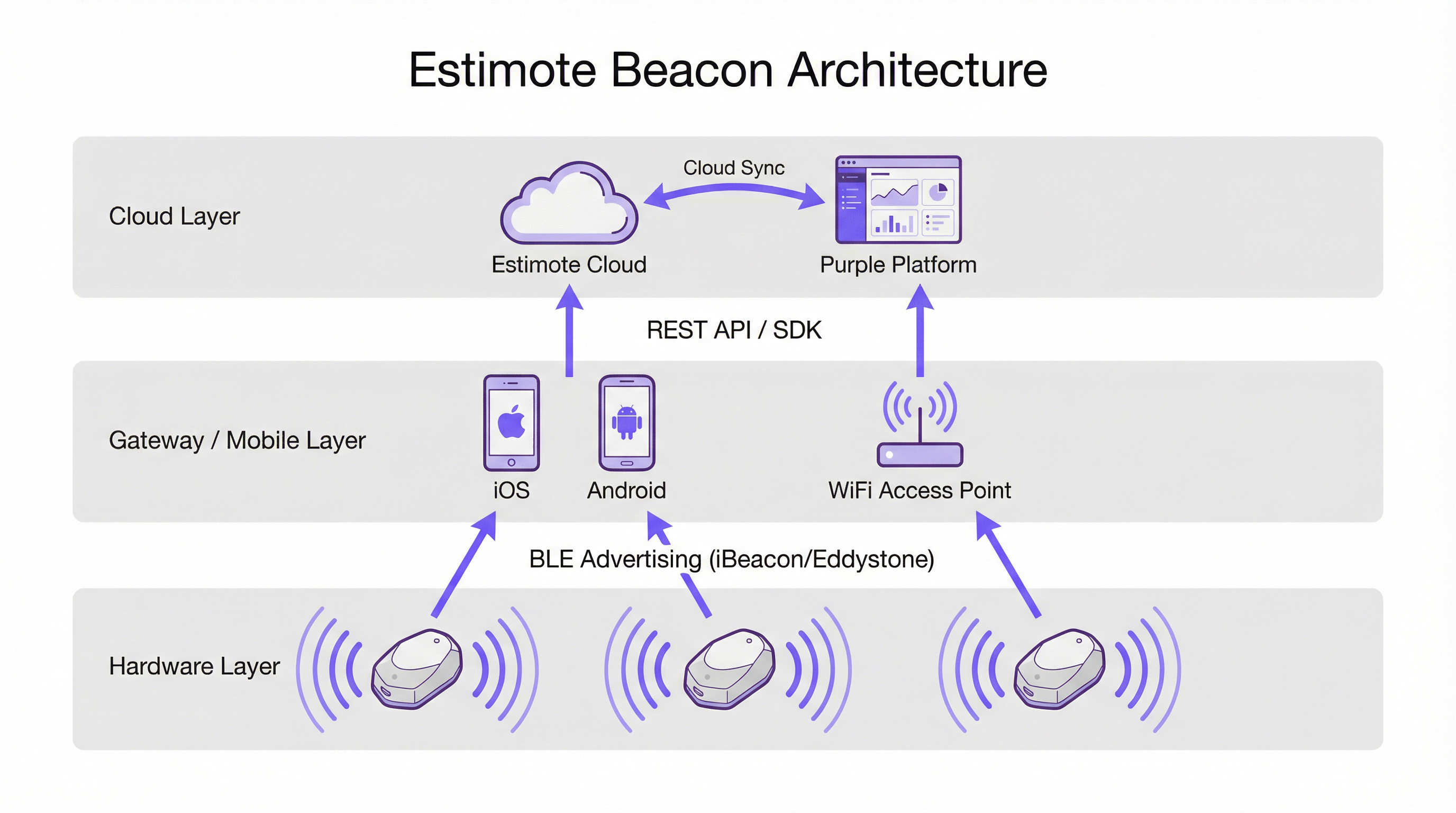
Im Kern ist ein Estimote Beacon ein kleiner, batteriebetriebener Computer, der ein Bluetooth Low Energy (BLE)-Signal sendet. Dieser Prozess, bekannt als „Undirected Advertising“, ermöglicht es jedem BLE-fähigen Gerät, wie z. B. einem Smartphone, die Präsenz des Beacons ohne Pairing oder direkte Verbindung zu erkennen. Der Beacon überträgt in regelmäßigen Abständen ein kleines Datenpaket, das eine Kennung enthält, die von einer mobilen Anwendung erkannt und verarbeitet werden kann. Dieses One-to-Many-Kommunikationsmodell ist äußerst effizient und bildet die Grundlage aller Beacon-basierten Proximity-Lösungen.
Protokolle: iBeacon und Eddystone
Zwei primäre Protokolle regeln die Beacon-Kommunikation: Apples iBeacon und Googles Eddystone. Ein Estimote Beacon kann eines oder beide senden.
- iBeacon: Überträgt eine eindeutige Kennung, die aus drei Teilen besteht: einer UUID (Universally Unique Identifier), einem Major-Wert und einem Minor-Wert. Diese hierarchische Struktur ist ideal für die Abbildung physischer Räume. Beispielsweise kann eine UUID eine gesamte Organisation repräsentieren, ein Major-Wert einen bestimmten Veranstaltungsort oder ein Stockwerk und ein Minor-Wert einen einzelnen Beacon identifizieren.
- Eddystone: Ein Open-Source-Protokoll von Google, das mehr Flexibilität bietet. Es definiert mehrere Frame-Typen, darunter Eddystone-UID (ähnlich der iBeacon-Kennung), Eddystone-URL (sendet eine Webadresse) und Eddystone-EID (eine verschlüsselte, temporäre Kennung, die sich regelmäßig ändert und so Sicherheit und Datenschutz verbessert).
Hardware und Leistung
Die aktuelle Generation der Proximity Beacons von Estimote arbeitet mit Bluetooth 5.0 und bietet eine theoretische maximale Reichweite von bis zu 100 Metern. Für die praktische Indoor-Navigation wird die Sendeleistung jedoch auf deutlich kürzere Reichweiten konfiguriert, um die Genauigkeit zu gewährleisten und Signalüberschneidungen zwischen Stockwerken zu vermeiden. Betrieben mit zwei Standard-AA-Batterien können diese Beacons eine Lebensdauer von 3 bis 5 Jahren erreichen, abhängig vom Advertising-Intervall und den Einstellungen der Sendeleistung. Diese lange Betriebsdauer ist ein entscheidender Faktor zur Senkung der Gesamtbetriebskosten (TCO) bei großflächigen Bereitstellungen.
Die Estimote-Produktfamilie
Estimote bietet eine Reihe von Hardware an, die auf spezifische Anwendungsfälle zugeschnitten ist:
| Produktlinie | Hauptmerkmale & Anwendungsfälle |
|---|---|
| Proximity Beacons | Das Standard-Arbeitstier für Navigation und Proximity-Marketing. |
| LTE Beacons | Integrierter Mobilfunk (LTE-M/NB-IoT) und GPS für das Asset-Tracking im Innen- und Außenbereich ohne Smartphone als Vermittler. |
| UWB Tags | Nutzt Ultra-Breitband-Technologie für zentimetergenaue Positionierung, ideal für hochpräzises Asset-Tracking und Kollisionsvermeidung. |
| Mirror Beacons | Verbindet sich mit digitalen Displays, um Inhalte anzuzeigen, die durch in der Nähe befindliche Beacons oder Benutzer ausgelöst werden. |
Implementierungsleitfaden
Eine erfolgreiche Beacon-Bereitstellung hängt von sorgfältiger Planung und disziplinierter Ausführung ab. Die folgenden Schritte bieten einen herstellerneutralen Blueprint für IT-Teams.
Schritt 1: Standortanalyse und Beacon-Platzierung
Bevor Hardware installiert wird, ist eine gründliche Standortanalyse zwingend erforderlich. Physische Hindernisse wie Betonpfeiler, Metallregale und Aufzugsschächte dämpfen BLE-Signale erheblich. Verwenden Sie ein Tool wie IndoorAtlas, um die Signalausbreitung zu kartieren und optimale Beacon-Standorte zu identifizieren.
Best Practices für die Platzierung:
- Höhe: Montieren Sie Beacons in einer Höhe von 2,5 bis 3 Metern über dem Boden, um Manipulationen zu vermeiden und Signalblockaden zu minimieren.
- Schlüsselstandorte: Platzieren Sie Beacons an allen Aufzugsanlagen, Ein-/Ausgängen, Übergangspunkten zwischen Stockwerken und wichtigen Flurkreuzungen.
- Reichweitenkonfiguration: Dies ist der kritischste Konfigurationsschritt. Eine falsch konfigurierte Sendeleistung ist die Hauptursache für schlechte Leistung.
- Eingänge & Aufzüge: Stellen Sie die Reichweite auf ca. 15 Meter (-12dBm) ein.
- Lange Flure: Stellen Sie die Reichweite auf ca. 30 Meter (-4dBm) ein.
- Offene Atrien/Glaswände: Reduzieren Sie die Reichweite auf ca. 7 Meter (-20dBm), um Signalüberschneidungen zwischen Stockwerken zu verhindern.
Schritt 2: Beacon-Konfiguration
Disziplin bei der Konfiguration verhindert spätere Probleme bei der Fehlerbehebung. Alle Beacons innerhalb einer Bereitstellung sollten ein gemeinsames Konfigurationsprofil aufweisen.
Konfigurationsparameter:
- UUID: Weisen Sie Ihrer gesamten Organisation eine einzige, eindeutige UUID zu.
- Major/Minor: Verwenden Sie den Major-Wert, um die Stockwerksnummer anzugeben (z. B. 1 für das 1. Obergeschoss, 99 für das Untergeschoss). Verwenden Sie den Minor-Wert als eindeutige fortlaufende Nummer für jeden Beacon auf diesem Stockwerk.
- Advertising-Intervall: Für die Navigation wird ein Intervall von 300-500 ms empfohlen. Ein Intervall von 300 ms bietet ein reaktionsschnelles Benutzererlebnis bei überschaubaren Auswirkungen auf die Batterielebensdauer.
- Pakettypen: Deaktivieren Sie alle Advertising-Pakete, die für Ihren Anwendungsfall nicht erforderlich sind (z. B. Deaktivierung Estimote-spezifischer Pakete, wenn Sie nur iBeacon für eine Purple-Bereitstellung verwenden).
Schritt 3: Flottenmanagement
Für jede Bereitstellung, die mehr als ein paar Dutzend Beacons umfasst, ist eine manuelle Konfiguration nicht skalierbar. Nutzen Sie die Estimote Cloud und ihr Bulk Updater-Tool, um Konfigurationsänderungen auf Hunderte oder Tausende von Geräten gleichzeitig anzuwenden. Etablieren Sie einen Prozess zur Überwachung der Batterielebensdauer (verfügbar über das Estimote SDK und die Cloud API) und zur Anwendung von Firmware-Updates, die häufig kritische Sicherheitspatches und Leistungsverbesserungen enthalten.
Best Practices
- Alles dokumentieren: Beschriften Sie jeden Beacon vor der Installation physisch mit seinen Major- und Minor-Werten. Führen Sie eine entsprechende digitale Karte, die Beacon-IDs mit ihren genauen physischen Standorten verknüpft.
- Sicherheit priorisieren: Verwenden Sie für sensible Anwendungen das Eddystone-EID-Protokoll mit seinen rotierenden, verschlüsselten Kennungen. Dies verhindert, dass böswillige Akteure Ihre Beacons fälschen (Spoofing) oder Benutzer ohne Autorisierung verfolgen.
- Compliance sicherstellen (GDPR/PCI DSS): Beacon-Bereitstellungen, die personenbezogene Daten verarbeiten, fallen in den Geltungsbereich der GDPR. Stellen Sie sicher, dass Sie über einen expliziten Opt-in-Zustimmungsmechanismus in Ihrer mobilen Anwendung verfügen. In Einzelhandelsumgebungen müssen Sie sicherstellen, dass Ihre Beacon-Infrastruktur und die zugehörigen Anwendungen die PCI DSS-Compliance nicht durch unsachgemäße Handhabung von Zahlungskartendaten gefährden.
- Integration mit Analytics: Der wahre ROI einer Beacon-Bereitstellung wird durch Daten realisiert. Integrieren Sie Beacon-Standortdaten in eine Analyseplattform wie Purple, um Verweilzeiten zu messen, Laufwege zu analysieren und die Auswirkungen von Proximity-Marketing-Kampagnen zu quantifizieren.
Fehlerbehebung & Risikominderung
- Ungenauige Stockwerkserkennung: Dies wird fast immer durch Signalüberschneidungen verursacht. Die primäre Gegenmaßnahme besteht darin, die Sendeleistung (Reichweite) von Beacons in offenen Bereichen und in der Nähe von Stockwerksübergängen zu reduzieren. Eine ordnungsgemäße Standortanalyse ist die beste Präventivmaßnahme.
- Schlechte Standortgenauigkeit: Wenn der „blaue Punkt“ verzögert ist oder springt, verringern Sie das Advertising-Intervall (z. B. von 500 ms auf 300 ms), um der mobilen App häufigere Standortaktualisierungen bereitzustellen. Überprüfen Sie außerdem die Platzierung und Dichte der Beacons anhand der Standortanalyse.
- Batterieentladung: Wenn sich die Batterien schneller als die prognostizierten 3-5 Jahre entladen, überprüfen Sie die Beacon-Konfiguration. Ein zu aggressives Advertising-Intervall (z. B. 100 ms) oder eine übermäßig hohe Sendeleistung sind die häufigsten Ursachen.
ROI & Geschäftliche Auswirkungen
Der Business Case für Estimote Beacons basiert auf messbaren Verbesserungen des Kundenerlebnisses und der betrieblichen Effizienz.
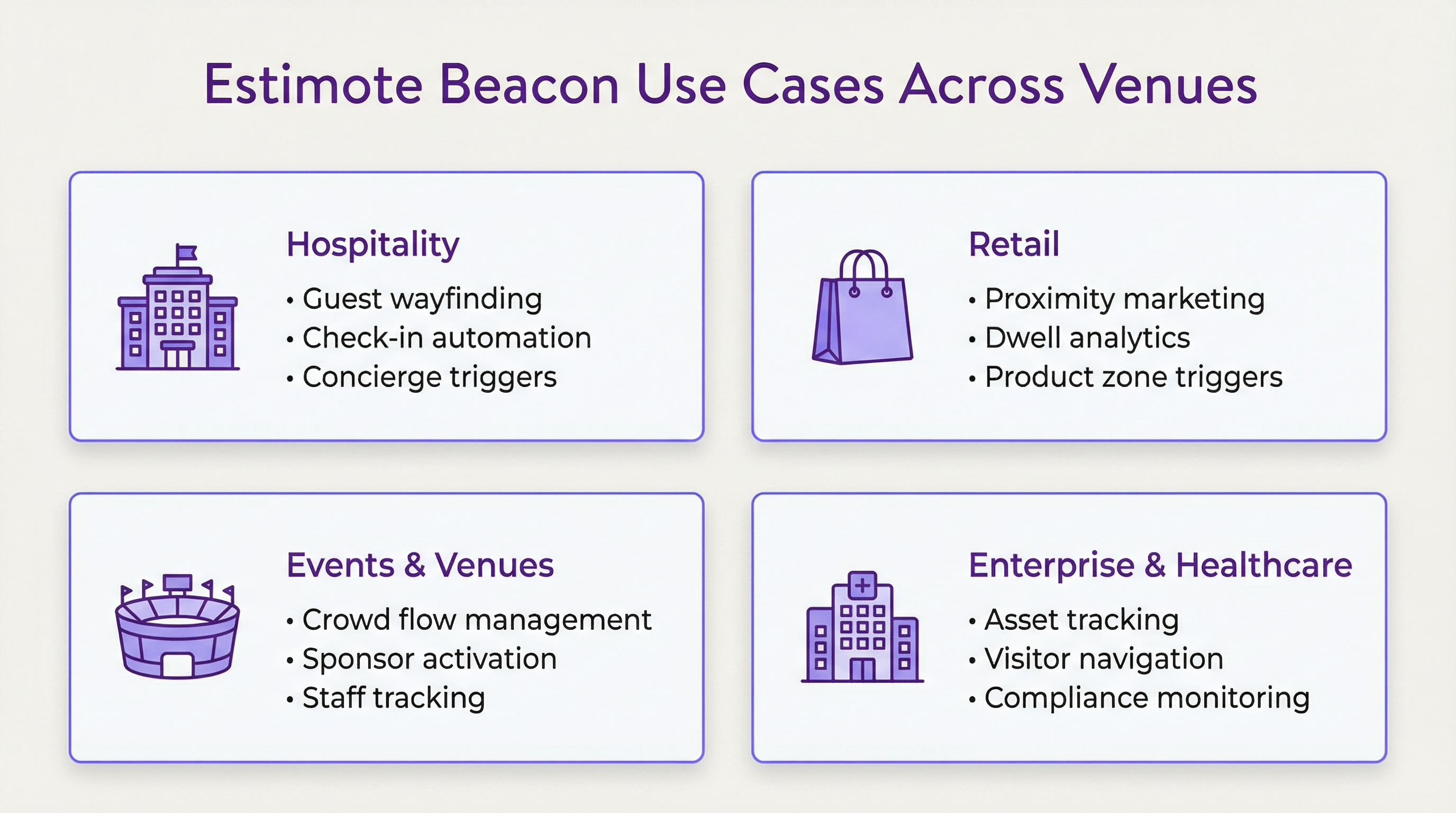
- Gastgewerbe: Ein Hotel kann Beacons nutzen, um einen nahtlosen mobilen Check-in zu ermöglichen, eine Turn-by-Turn-Navigation zum Zimmer des Gastes bereitzustellen und gezielte Angebote für Spa-Dienstleistungen oder Restaurantreservierungen zu senden, wenn ein Gast vorbeigeht. Der ROI misst sich in gestiegenen Werten für die Gästezufriedenheit (NPS), höheren Zusatzeinnahmen und verbesserter Mitarbeitereffizienz.
- Einzelhandel: Ein Einzelhändler kann die Customer Journeys im Geschäft analysieren, die Verweilzeit in bestimmten Abteilungen messen und personalisierte Werbeaktionen auslösen, wenn ein Mitglied des Treueprogramms eine Zone mit hochwertigen Produkten betritt. Der ROI misst sich in größeren Warenkörben, verbesserten Konversionsraten und einem höheren Customer Lifetime Value.
- Große Veranstaltungsorte (Stadien/Flughäfen): Beacons unterstützen die Navigation zu Sitzplätzen oder Gates, erleichtern das Management von Besucherströmen und ermöglichen standortbasierte Sponsorenaktivierungen. Der ROI misst sich in reduzierter Überfüllung, einem verbesserten Fan-/Reiseerlebnis und neuen Einnahmequellen durch standortbezogene Werbung.
Key Terms & Definitions
Bluetooth Low Energy (BLE)
A power-efficient variant of the Bluetooth wireless standard, designed for Internet of Things (IoT) devices to communicate small amounts of data over short distances. Its low power consumption is what enables beacons to operate for years on small batteries.
IT teams will encounter BLE as the fundamental communication technology for all modern beacons. Understanding its range and power characteristics is crucial for designing a sustainable deployment.
iBeacon
Apple's protocol for BLE advertising. It structures the beacon's broadcast around a three-tiered identifier: UUID, Major, and Minor. It is the most widely supported protocol for indoor navigation on iOS devices.
This is a non-negotiable standard to support for any public-facing venue. If you want to provide wayfinding for iPhone users, your beacons must be broadcasting iBeacon packets.
Eddystone
Google's open-source alternative to iBeacon. It is more flexible, with multiple frame types including Eddystone-EID, which uses ephemeral (short-lived) identifiers to enhance security and privacy.
For enterprise deployments concerned with security or wanting to avoid vendor lock-in, Eddystone provides a powerful and flexible option. Eddystone-EID is a key feature for mitigating tracking and spoofing risks.
UUID (Universally Unique Identifier)
A 128-bit number used to identify information in computer systems. In the context of iBeacon, it serves as the top-level identifier for an organization or a specific app.
The UUID acts as a unique namespace for your beacon deployment. All beacons in your organization should be configured with the same UUID to ensure your app does not respond to beacons from other nearby businesses.
Advertising Interval
The frequency at which a beacon broadcasts its advertising packet. A shorter interval (e.g., 100ms) results in more responsive location updates but consumes more battery. A longer interval (e.g., 1000ms) conserves battery but can feel sluggish.
This is a critical trade-off that network architects must balance. For active wayfinding, 300-500ms is the sweet spot. For passive asset tracking, the interval can be much longer.
Transmission Power (Tx Power)
The signal strength of the beacon's broadcast, measured in dBm. This setting directly controls the beacon's range. A higher Tx Power (e.g., +4dBm) means longer range, while a lower Tx Power (e.g., -20dBm) means shorter range.
This is the primary tool for tuning a beacon network. Correctly setting Tx Power is the key to preventing signal bleed and ensuring accurate positioning. It is more important than physical beacon density in many cases.
Signal Bleed
The phenomenon where a beacon's signal is detected in an unintended area, most commonly on the floor above or below its actual location. It is the primary cause of inaccurate floor detection in wayfinding applications.
IT teams must actively design against signal bleed, especially in buildings with atriums or thin floors. The main mitigation strategy is to reduce the transmission power of beacons in problematic areas.
Ultra-Wideband (UWB)
A short-range radio technology that can measure location with very high precision (down to a few centimeters). It works by measuring the time-of-flight of radio signals between a tag and multiple anchors.
When an IT team is tasked with a use case that requires 'inch-level' or 'sub-meter' accuracy, such as tool tracking in manufacturing or collision avoidance, BLE is not sufficient. UWB is the appropriate technology for these high-precision requirements.
Case Studies
A 500-room luxury hotel in a dense urban environment wants to implement 'blue dot' wayfinding for guests from the lobby to their rooms, elevators, and amenities (pool, restaurant). The hotel has a large, three-story glass atrium at its center. What is the recommended Estimote beacon deployment strategy?
- Hardware Selection: Standard Estimote Proximity Beacons are sufficient for this use case.
- Site Survey: Conduct a mandatory site survey focusing on the glass atrium. Use a signal mapping tool to visualize BLE signal propagation and identify potential for inter-floor signal bleed.
- Beacon Placement & Configuration:
- Guest Corridors: Place one beacon every 50-75 feet, mounted 8-10 feet high. Configure with a -8dBm transmit power (approx. 100ft range) and a 400ms advertising interval.
- Elevator Banks: Place one beacon at each elevator bank on every floor. Configure with a -12dBm transmit power (approx.50ft range) to ensure the signal is localized to the waiting area.
- Atrium: This is the critical zone. Place beacons around the perimeter of the atrium on each floor. Configure them with a significantly lower transmit power, such as -20dBm (approx. 22ft range), to prevent signals from reaching the floors above and below. The advertising interval can be increased to 600ms as fine-grained accuracy is less critical in this open space.
- Naming Convention: Use the hotel's unique UUID. Set Major to the floor number (e.g., 1, 2, 3...). Assign sequential Minor values for each beacon on that floor. Physically label each beacon.
- Fleet Management: Use the Estimote Cloud to bulk-configure all beacons and monitor battery life post-deployment.
A retail chain with 200 stores wants to track high-value assets (e.g., portable payment terminals, specialized scanning equipment) that move between the stockroom and the sales floor. The assets sometimes leave the store for sidewalk sales events. What is the optimal Estimote solution?
- Hardware Selection: The ideal solution is the Estimote LTE Beacon. Its integrated cellular connectivity and GPS make it perfect for tracking assets both indoors and outdoors, without relying on the store's Wi-Fi or nearby smartphones.
- Deployment: Attach one LTE Beacon to each high-value asset. No complex beacon infrastructure is required within the store itself.
- Cloud Configuration: In the Estimote Cloud, configure the LTE Beacons to report their location at a set interval (e.g., every 5 minutes when stationary, every 1 minute when in motion). Set up geofences for each store location.
- Application Integration: Use the Estimote Cloud API to pull location data for each asset into the retailer's central inventory management system. Configure API-triggered alerts for specific events:
- An alert is sent to the store manager if an asset's battery level drops below 20%.
- An alert is sent if an asset leaves the store's geofence outside of a scheduled sidewalk sale event.
- ROI Measurement: The ROI is calculated by the reduction in lost or stolen assets, the decrease in time spent by staff searching for equipment, and the improved availability of revenue-generating devices like payment terminals.
Scenario Analysis
Q1. Your stadium client wants to use beacons to track the real-time location of mobile food and beverage carts to optimize stock levels and deployment. The carts move throughout the stadium, including outdoor plaza areas. Which Estimote product is the best fit and why?
💡 Hint:Consider the need for tracking both indoors and outdoors, without relying on the stadium's public Wi-Fi or guest smartphones.
Show Recommended Approach
The Estimote LTE Beacon is the best fit. Its built-in cellular (LTE-M) and GPS capabilities allow it to report its location independently from anywhere in the stadium, whether inside the concourse or outside in the plaza. Standard proximity beacons would not work reliably as they depend on a nearby smartphone with a specific app to relay their location, and UWB would be overkill and too complex for this wide-area tracking use case.
Q2. A hospital is deploying beacons for patient wayfinding. During testing, they find that when patients are in the central atrium, the app frequently switches between showing them on the 2nd and 3rd floors. What are the two most likely causes and the primary solution?
💡 Hint:Think about how BLE signals behave in large, open, multi-story spaces.
Show Recommended Approach
The two most likely causes are: 1) The transmission power (range) of the beacons around the atrium is set too high. 2) The beacons are placed in locations that allow for a clear, unobstructed line of sight between floors. The primary solution is to significantly reduce the transmission power of the beacons located in and around the atrium to a very short range (e.g., -20dBm) to create a tight signal bubble on each floor and prevent this inter-floor 'signal bleed'.
Q3. A retail CTO is concerned about the privacy implications of a beacon deployment under GDPR. They ask if beacons are "tracking our customers' phones." How would you accurately describe the data flow to reassure them?
💡 Hint:Focus on where the 'intelligence' lies in the system and the role of user consent.
Show Recommended Approach
You should clarify that the beacons themselves do not track anyone. They are simple, one-way broadcast devices, like a lighthouse. They have no knowledge of who is nearby. The tracking event occurs at the application layer, on the customer's own phone, and only if they have explicitly opted-in and granted the app location permissions. The app detects the beacon's signal and then reports the phone's proximity to that beacon to the cloud. The entire process is user-initiated and consent-driven, which is a key principle of GDPR. Furthermore, using protocols like Eddystone-EID can encrypt the beacon's identifier, adding another layer of privacy.
Key Takeaways
- ✓Estimote beacons are low-power, battery-operated devices that broadcast BLE signals to enable indoor positioning and proximity-based actions.
- ✓Successful deployment requires a thorough site survey to plan beacon placement and prevent signal bleed, especially in open, multi-story areas.
- ✓Configuration discipline is key: use a consistent UUID, logical Major/Minor assignments, and an appropriate advertising interval (300-500ms for wayfinding).
- ✓For indoor/outdoor asset tracking, Estimote LTE Beacons with integrated cellular/GPS are the optimal solution, removing dependency on smartphones.
- ✓For high-precision (inch-level) tracking, Ultra-Wideband (UWB) tags are the appropriate technology, not standard BLE beacons.
- ✓Compliance with GDPR requires an explicit opt-in consent model within the mobile application; the beacons themselves do not store or process personal data.
- ✓The ROI of a beacon deployment is realized by integrating location data with analytics platforms to measure improvements in customer experience, operational efficiency, and revenue.




