

MAC-Adressen-Randomisierung: Ein tiefer Einblick in die Verbesserung des Datenschutzes und deren Auswirkungen auf das Netzwerkmanagement
This guide provides a comprehensive technical overview of MAC address randomization, a critical privacy feature now default on iOS, Android, and Windows devices. It details the direct impact on enterprise WiFi network management — from broken MAC-based authentication and inflated analytics to security monitoring gaps — and offers actionable, identity-driven strategies for IT leaders in hospitality, retail, stadiums, and public-sector organisations to adapt their infrastructure. By shifting from hardware-based to credential-based network management, organisations can simultaneously enhance security, achieve privacy compliance, and unlock richer customer insights.
🎧 Listen to this Guide
View Transcript

Executive Summary
Die MAC-Adressen-Randomisierung ist eine datenschutzfördernde Technologie, die nun standardmäßig unter iOS 14+, Android 10+ und Windows 10 aktiviert ist und darauf abzielt, das langfristige Tracking von Geräten über WiFi-Netzwerke hinweg zu verhindern. Durch das Senden einer temporären, zufälligen Hardware-Adresse anstelle der permanenten, werkseitig zugewiesenen Kennung schützen moderne Geräte die Privatsphäre der Nutzer, was jedoch auf Kosten der Unterbrechung veralteter Netzwerkmanagement-Workflows geht. Für Unternehmensbetreiber in den Bereichen Gastgewerbe, Einzelhandel, Veranstaltungen und im öffentlichen Sektor entstehen dadurch drei unmittelbare betriebliche Herausforderungen: MAC-basierte Zugangskontrollsysteme erkennen wiederkehrende Geräte nicht mehr; Sicherheitsüberwachungsprotokolle werden schwerer zu interpretieren, da Geräte ihre Identitäten wechseln; und WiFi-Analyseplattformen melden stark überhöhte Zahlen eindeutiger Besucher, was Daten zu Besucherfrequenz und Verweildauer unzuverlässig macht. Die strategische Antwort besteht nicht darin, diese Technologie zu bekämpfen, sondern eine fortschrittlichere, identitätszentrierte Architektur zu übernehmen. Die Bereitstellung von IEEE 802.1X mit WPA3-Enterprise für Unternehmensnetzwerke und moderner Captive Portals mit Identitätsintegration für Gastnetzwerke löst alle drei Herausforderungen gleichzeitig. Dieser Leitfaden bietet die technische Tiefe und praktische Implementierungsanleitung, die erforderlich sind, um diesen Übergang in diesem Quartal zu planen und durchzuführen.
Technischer Deep-Dive
Das Verständnis der MAC-Adressen-Randomisierung erfordert einen klaren Blick auf ihren Zweck, ihre Mechanik und die Standards, die ihre Implementierung regeln. Ihr primäres Ziel ist es, die Fähigkeit von Netzwerkbeobachtern zu verringern, ein langfristiges Profil der Bewegungen und Gewohnheiten eines Nutzers zu erstellen, indem dessen Aktivitäten mit einer einzigen, dauerhaften Gerätekennung verknüpft werden.
Die Mechanik der Randomisierung
Das Betriebssystem eines Geräts generiert in einem von zwei Szenarien eine zufällige MAC-Adresse: entweder beim Scannen nach Netzwerken in der Nähe (Probe Requests) oder bei der Verbindung mit einem bestimmten Netzwerk (Association). Die Implementierung variiert zwischen den Betriebssystemen, aber das Grundprinzip ist über alle großen Plattformen hinweg konsistent.
Während der Netzwerkerkennung sendet das Gerät Probe Requests unter Verwendung einer temporären Adresse aus. Wenn es sich entscheidet, eine Verbindung zu einem Netzwerk herzustellen, verwendet es möglicherweise eine neue, für diese Verbindung spezifische zufällige Adresse. Die Häufigkeit des Wechsels ist eine Schlüsselvariable. Moderne Implementierungen – einschließlich iOS 14+ und Android 10+ – erstellen für jedes gespeicherte WiFi-Netzwerk (SSID) eine eindeutige, dauerhafte zufällige MAC-Adresse. Das Gerät verwendet bei wiederholten Verbindungen durchgehend dieselbe zufällige Adresse für ein bestimmtes Netzwerk, jedoch eine völlig andere zufällige Adresse für jedes andere Netzwerk. Dies bietet ein stabiles Verbindungserlebnis in vertrauenswürdigen Netzwerken und verhindert gleichzeitig eine standortübergreifende Korrelation.
Die entscheidende Implikation für Netzwerkadministratoren ist, dass ein Gerät zwar im Laufe der Zeit innerhalb eines einzelnen Standorts stabil erscheinen mag, es jedoch keine Garantie für Dauerhaftigkeit gibt. Eine Adressrotation kann durch einen Geräte-Reset, das Löschen eines Netzwerkprofils oder ein OS-Update ausgelöst werden. Jedes System, das eine MAC-Adresse als permanente, zuverlässige Kennung behandelt, geht von einer falschen Annahme aus.
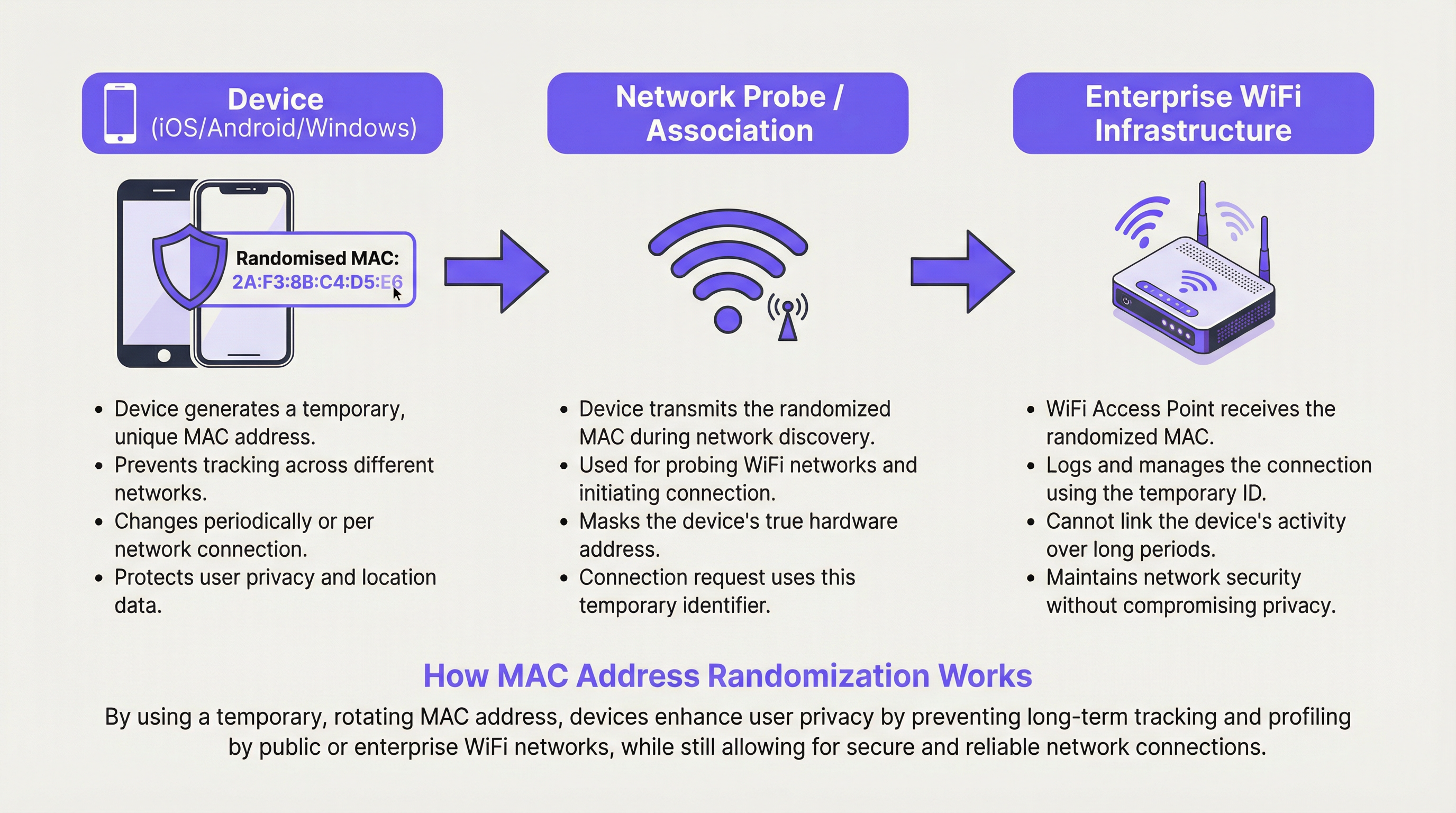
Arten der MAC-Adressen-Randomisierung
Es gibt zwei primäre Formen der MAC-Adressen-Randomisierung, die Netzwerkarchitekten verstehen müssen. Probe Request Randomization war die anfängliche Implementierung, bei der Geräte nur beim Scannen nach Netzwerken eine zufällige MAC verwenden, aber bei der Verbindung ihre echte MAC preisgeben. Dies schützt weiterhin die Privatsphäre für nicht verbindende Geräte, ist jedoch weniger effektiv, sobald eine Verbindung hergestellt ist. Association Randomization ist der robustere und mittlerweile standardmäßige Ansatz, bei dem eine zufällige MAC für die tatsächliche Verbindung zu einem Access Point verwendet wird. Dies ist die Form, die die größten Auswirkungen auf das Enterprise-Netzwerkmanagement hat, da sie alle verbundenen Geräte betrifft.
Die Unterscheidung zwischen Per-SSID- und Per-Connection-Randomisierung ist ebenfalls operativ wichtig. Per-SSID-Randomisierung (der aktuelle Standard bei iOS und Android) bedeutet, dass dieselbe zufällige Adresse für denselben Netzwerknamen wiederverwendet wird, was eine gewisse Stabilität bietet. Die Per-Connection-Randomisierung, die einige datenschutzorientierte Konfigurationen oder zukünftige OS-Versionen übernehmen könnten, würde bei jeder einzelnen Verbindung eine neue Adresse generieren, was jede Form der Sitzungskontinuität ohne eine Identitätsebene unmöglich macht.
OS-spezifische Implementierung
| Betriebssystem | Standardverhalten | Verwaltungspfad | Hinweise |
|---|---|---|---|
| iOS 14+ | Standardmäßig pro SSID aktiviert | Einstellungen > Wi-Fi > (i) > Private Wi-Fi-Adresse | Für jedes Netzwerk wird eine eindeutige zufällige MAC generiert. Rotiert, wenn über einen bestimmten Zeitraum keine Verbindung besteht. |
| Android 10+ | Standardmäßig pro SSID aktiviert | Einstellungen > Netzwerk > Wi-Fi > Erweitert > Datenschutz | Das Verhalten kann je nach Gerätehersteller (OEM) variieren. |
| Windows 10/11 | Standardmäßig deaktiviert | Einstellungen > Netzwerk > Wi-Fi > Bekannte Netzwerke verwalten > Eigenschaften | Kann pro Netzwerk auf Ein, Aus oder Täglich ändern gesetzt werden. |
| macOS (Ventura+) | Standardmäßig pro SSID aktiviert | Systemeinstellungen > Wi-Fi > Details > Wi-Fi-Adresse rotieren | Entspricht dem Verhalten von iOS. |
Implementierungsleitfaden
Die Anpassung an die MAC-Adressen-Randomisierung ist ein strukturierter Prozess. Die folgenden Schritte bieten ein herstellerneutrales Bereitstellungs-Framework für Unternehmensumgebungen.
Schritt 1: Durchführung eines MAC-Abhängigkeits-Audits. Bevor Sie Änderungen vornehmen, identifizieren Sie jedes System in Ihrer Umgebung, das eine MAC-Adresse als primäre Kennung verwendet. Dazu gehören Firewall-Regeln, DHCP-Reservierungen, Access Control Lists (ACLs), Netzwerküberwachungstools und Analyseplattformen. Dokumentieren Sie jede Abhängigkeit und klassifizieren Sie sie entweder als Sicherheitskontrolle, operatives Tool oder Analyse-Input. Dieses Audit bildet die Grundlage für Ihre Remediation-Roadmap.
Schritt 2: Außerbetriebnahme MAC-basierter Sicherheitskontrollen. Jede Sicherheitsregel, die den Zugriff ausschließlich auf Basis einer MAC-Adresse gewährt oder verweigert, muss ersetzt werden. Dies ist nicht optional; es ist eine sicherheitstechnische Notwendigkeit. MAC-Adressen sind kein zuverlässiger Authentifizierungsfaktor. Ersetzen Sie diese Regeln durch IEEE 802.1X-Authentifizierung, bei der Geräte einem RADIUS-Server überprüfbare Anmeldeinformationen vorlegen müssen. Dies ist die einzige Methode, die sowohl Sicherheit als auch Widerstandsfähigkeit gegenüber MAC-Randomisierung bietet.
Schritt 3: Bereitstellung von WPA3-Enterprise. Stellen Sie sicher, dass Ihre Wireless-Infrastruktur WPA3 unterstützt. Die meisten nach 2020 hergestellten Access Points sind WPA3-fähig, überprüfen Sie jedoch, ob Ihre Firmware aktuell ist. WPA3-Enterprise bietet Simultaneous Authentication of Equals (SAE) und erfüllt in seinem 192-Bit-Modus die Sicherheitsanforderungen sensibler Umgebungen, einschließlich solcher, die PCI DSS und Sicherheits-Frameworks des öffentlichen Sektors unterliegen.
Schritt 4: Modernisierung Ihres Gastnetzwerk-Portals. Ersetzen Sie jede einfache Splash-Page durch ein identitätsgesteuertes Captive Portal. Das Portal sollte mindestens eine der folgenden Optionen bieten: E-Mail-Registrierung mit Verifizierung, Social Login (OAuth), Integration von Treueprogrammen oder einen Pre-Shared-Zugangscode. Jede dieser Optionen bietet eine stabile Benutzerkennung, die über Sitzungen und Änderungen der Geräteadresse hinweg bestehen bleibt. Stellen Sie sicher, dass das Portal und seine Datenerfassungspraktiken vollständig GDPR-konform sind und über explizite Zustimmungsmechanismen verfügen.
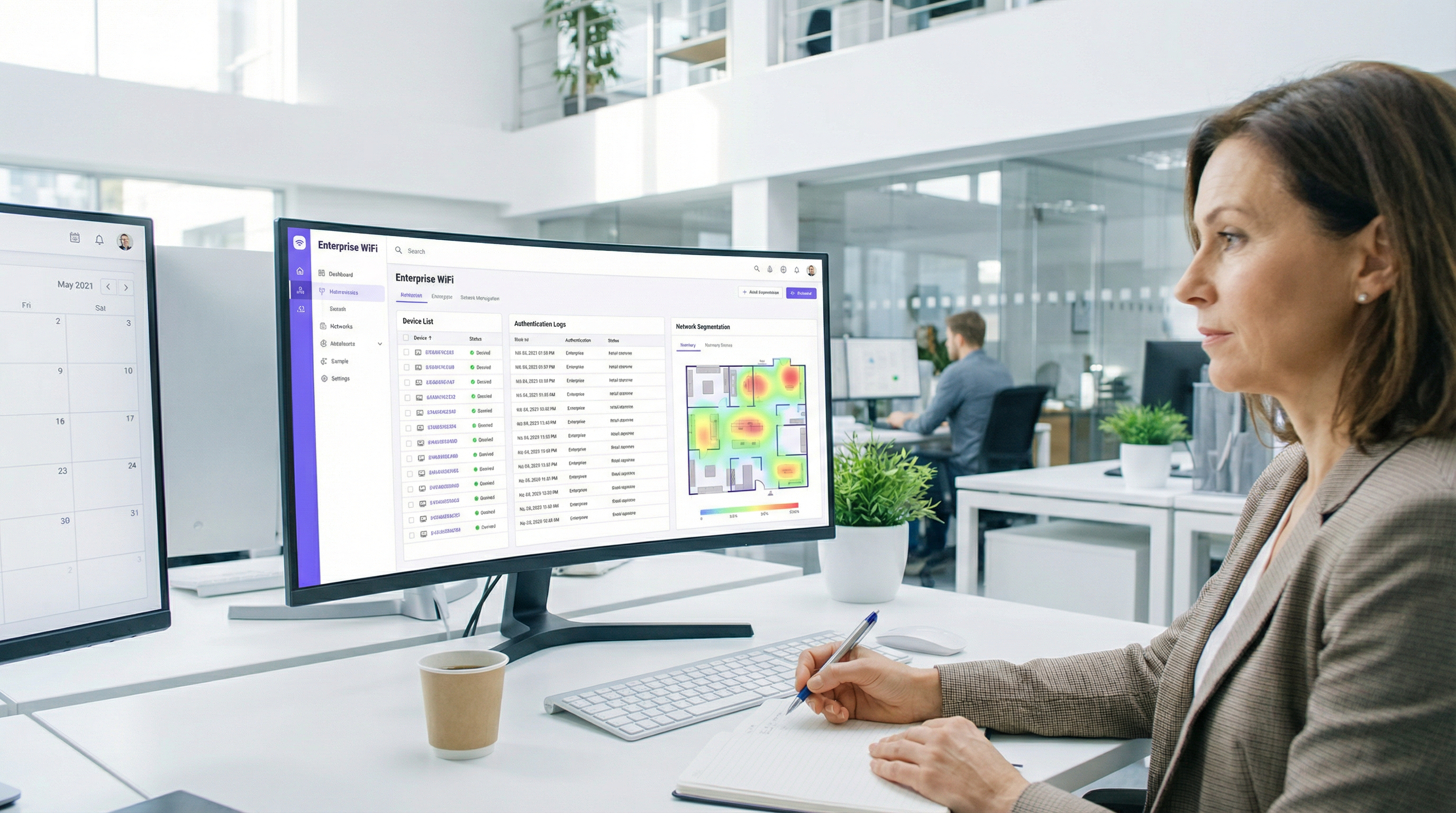
Schritt 5: Upgrade Ihrer Analyseplattform. Setzen Sie sich mit Ihrem WiFi-Analyseanbieter in Verbindung und fragen Sie ihn direkt, wie seine Plattform mit der MAC-Randomisierung umgeht. Eine moderne Plattform sollte sich auf sitzungsbasierte Analysen, authentifizierte Benutzerflüsse und probabilistisches Geräte-Clustering konzentrieren, anstatt auf reine MAC-Adressenzählungen. Etablieren Sie neue Basis-Metriken für die Besucherzählung, die der Änderung in der Methodik Rechnung tragen.
Best Practices
Die folgenden Best Practices spiegeln aktuelle Branchenstandards und herstellerneutrale Leitlinien für den Betrieb von Enterprise-WiFi im Zeitalter der MAC-Adressen-Randomisierung wider.
Einführung einer Identity-First-Architektur. Das übergeordnete Prinzip besteht darin, die Benutzer- und Geräteidentität als eine auf Anmeldeinformationen basierende Behauptung und nicht als Hardware-Beobachtung zu behandeln. Jede Zugriffsentscheidung, jedes Analyseereignis und jeder Sicherheits-Log-Eintrag sollte nach Möglichkeit an einer verifizierten Identität verankert sein. Dies steht im Einklang mit den Prinzipien des Zero Trust Network Access (ZTNA), die davon ausgehen, dass kein Gerät allein aufgrund seiner Hardware-Attribute von Natur aus vertrauenswürdig ist.
Implementierung von 802.1X mit zertifikatsbasierter Authentifizierung für verwaltete Geräte. Stellen Sie für unternehmenseigene Geräte Gerätezertifikate über Ihre Mobile Device Management (MDM)-Plattform bereit. Dies ermöglicht es dem Gerät, sich automatisch und sicher mithilfe eines Zertifikats im Netzwerk zu authentifizieren, was ein nahtloses Benutzererlebnis bei gleichzeitig hoher Sicherheit bietet. Dies ist die robusteste Implementierung von 802.1X und wird für Umgebungen empfohlen, die Compliance-Frameworks unterliegen.
Verwendung von VLAN-Zuweisung über RADIUS zur Netzwerksegmentierung. Anstatt MAC-basierte ACLs für die Segmentierung zu verwenden, konfigurieren Sie Ihren RADIUS-Server so, dass er Geräte basierend auf ihrer authentifizierten Identität bestimmten VLANs zuweist. Ein Gastnutzer erhält das Gast-VLAN; ein Unternehmensgerät erhält das Unternehmens-VLAN; ein POS-Terminal erhält das Zahlungs-VLAN. Dies ist dynamisch, skalierbar und immun gegen MAC-Randomisierung.
Ausrichtung an GDPR und den Prinzipien der Datenminimierung. Unter der GDPR gilt eine MAC-Adresse, die mit einer Person verknüpft werden kann, als personenbezogenes Datum. Der Wechsel zu einem identitätsbasierten Management, bei dem die Datenerfassung explizit und einwilligungsbasiert erfolgt, ist nicht nur eine technische Verbesserung – es ist eine Compliance-Verbesserung. Stellen Sie sicher, dass Ihre Richtlinien zur Vorratsdatenspeicherung für Netzwerkprotokolle und Analysedaten im Lichte dieser Prinzipien überprüft werden.
Fehlerbehebung & Risikominderung
Im Folgenden sind die häufigsten Fehlermodi aufgeführt, die während und nach dem Übergang weg vom MAC-basierten Netzwerkmanagement auftreten.
Fehlermodus 1: Geräte werden wiederholt blockiert oder zur erneuten Authentifizierung gezwungen. Die Grundursache ist fast immer eine verbleibende MAC-basierte ACL oder ein Sicherheitssystem, das nicht vollständig migriert wurde. Führen Sie eine gründliche Überprüfung aller Firewall- und Netzwerkzugriffsrichtlinien durch. Verwenden Sie Ihre Netzwerkmanagement-Plattform, um alle Regeln zu identifizieren, die auf bestimmte MAC-Adressen verweisen, und ersetzen Sie diese durch identitätsbasierte Äquivalente.
Fehlermodus 2: Analysedaten zeigen einen massiven Anstieg eindeutiger Geräte. Dies ist das direkte Ergebnis einer Analyseplattform, die MAC-Adressen als primäre eindeutige Kennung verwendet. Die sofortige Maßnahme besteht darin, alle vor dem Audit gesammelten historischen Daten als unzuverlässig für absolute Zählungen zu markieren. Etablieren Sie für die Zukunft neue Baselines unter Verwendung Ihrer aktualisierten, identitätsbewussten Analyseplattform. Konzentrieren Sie das Reporting auf Trends und Metriken authentifizierter Benutzer anstelle von reinen Gerätezählungen.
Fehlermodus 3: Roaming-Probleme an großen Standorten. In Umgebungen mit vielen Access Points kann ein Gerät seine zufällige MAC-Adresse ändern, wenn es von einem Access Point (BSSID) zu einem anderen wechselt, insbesondere wenn das Gerät jede BSSID als separates Netzwerk behandelt. Dies kann zu Sitzungsabbrüchen und Aufforderungen zur erneuten Authentifizierung führen. Die Abhilfemaßnahme besteht darin, sicherzustellen, dass Ihre Wireless-Infrastruktur ordnungsgemäßes 802.11r (Fast BSS Transition) verwendet und dass alle Access Points unter derselben SSID als eine einzige Mobilitätsdomäne konfiguriert sind, wodurch die Auslöser für eine Adressrotation minimiert werden.
Fehlermodus 4: Erschöpfung des DHCP-Pools. In Umgebungen, in denen DHCP-Leases lang und der Pool klein ist, kann ein hohes Aufkommen an Geräten, die sich mit neuen zufälligen MACs verbinden, die verfügbaren IP-Adressen erschöpfen. Mildern Sie dies ab, indem Sie die DHCP-Lease-Zeiten für Gastnetzwerke überprüfen und verkürzen und sicherstellen, dass Ihr DHCP-Pool für gleichzeitige Spitzenverbindungen und nicht für eindeutige Geräte im Laufe der Zeit angemessen dimensioniert ist.
ROI & Geschäftsauswirkungen
Die Anpassung an die MAC-Adressen-Randomisierung ist eine Investition mit einer klaren und messbaren Rendite über mehrere Dimensionen hinweg.
Sicherheits-ROI. Der Ersatz von MAC-Whitelisting durch 802.1X-Authentifizierung beseitigt eine Klasse von Schwachstellen, die häufig ausgenutzt wird. MAC-Spoofing – bei dem ein Angreifer eine als gut bekannte MAC-Adresse klont, um Zugangskontrollen zu umgehen – ist trivial einfach und weithin dokumentiert. Der Wechsel zu einer auf Anmeldeinformationen basierenden Authentifizierung beseitigt diesen Angriffsvektor vollständig. Die Kosten einer einzigen Netzwerkverletzung, einschließlich Incident Response, behördlicher Meldung und Reputationsschäden, übersteigen die Kosten für eine Aktualisierung der Netzwerkinfrastruktur bei weitem.
Compliance-ROI. Für Organisationen, die GDPR, PCI DSS oder Sicherheits-Frameworks des öffentlichen Sektors unterliegen, unterstützt der Wechsel zu einem identitätsbasierten Netzwerkmanagement direkt die Compliance-Ziele. Dem Prinzip der Datenminimierung der GDPR wird entsprochen, indem nur die benötigten Daten mit ausdrücklicher Zustimmung erfasst werden. PCI DSS erfordert eine robuste Netzwerksegmentierung, die mit MAC-basierten Kontrollen nicht zuverlässig erreicht werden kann. Die Vermeidung einer einzigen erheblichen Geldstrafe unter einem der beiden Frameworks bietet eine überzeugende finanzielle Rechtfertigung für die Investition.
Analyse- und Umsatz-ROI. Der Übergang zu einem identitätsgesteuerten Gastportal schafft einen direkten Kanal für die Kundenbindung und Datenerfassung. Organisationen, die in Treueprogramme integrierte WiFi-Portale implementiert haben, berichten von messbaren Verbesserungen beim Wachstum von E-Mail-Listen, bei den Raten wiederkehrender Besuche und bei der Genauigkeit von Customer-Journey-Analysen. Für eine Einzelhandelskette oder Hotelgruppe hat die Fähigkeit, wiederkehrende Kunden über einen zugestimmten Datenkanal genau zu identifizieren und anzusprechen, direkte Auswirkungen auf den Umsatz. Der Wechsel vom Tracking anonymer Geräte zur Einbindung bekannter Kunden ist eine grundlegende Verbesserung der Datenqualität und der Business-Intelligence-Fähigkeiten.
Key Terms & Definitions
MAC Address (Media Access Control Address)
A unique, 48-bit hardware identifier assigned to a network interface controller (NIC) by the manufacturer. It is used as a network address for communications within a network segment and is structured as six pairs of hexadecimal digits (e.g., 00:1A:2B:3C:4D:5E).
Traditionally used by IT teams as a stable, unique identifier for devices on a WiFi network. Its reliability as a persistent identifier has been fundamentally undermined by MAC randomization, making it unsuitable as a primary key for security, access control, or analytics.
MAC Address Randomization
A privacy feature implemented in modern operating systems (iOS 14+, Android 10+, Windows 10+) where the device temporarily replaces its real, factory-assigned MAC address with a randomly generated one when connecting to or scanning for WiFi networks.
The central challenge for enterprise network managers. It prevents tracking of a device across different WiFi networks and over time, but disrupts legacy systems that depend on a stable MAC address for authentication, logging, and analytics.
IEEE 802.1X
An IEEE standard for port-based Network Access Control (PNAC). It provides an authentication mechanism requiring devices to present verifiable credentials to a RADIUS server before being granted access to a LAN or WLAN.
The gold-standard replacement for MAC-based access control. By authenticating the user or device via credentials rather than hardware attributes, it provides security that is entirely immune to MAC randomization. Essential for any enterprise network refresh.
WPA3-Enterprise
The latest generation of WiFi security protocol for enterprise environments, building on IEEE 802.1X. It offers enhanced encryption (up to 192-bit in its highest security mode) and protection against offline dictionary attacks and key reinstallation attacks.
The recommended security standard for corporate WiFi networks. Deploying WPA3-Enterprise alongside 802.1X is the definitive technical response to the security challenges posed by MAC randomization.
RADIUS (Remote Authentication Dial-In User Service)
A networking protocol that provides centralised Authentication, Authorisation, and Accounting (AAA) management for users who connect and use a network service.
The server-side component of an 802.1X deployment. When a device attempts to connect, the access point forwards the authentication request to the RADIUS server, which validates the credential and instructs the access point to grant or deny access — and optionally assign the device to a specific VLAN.
Captive Portal
A web page that a user of a public-access network is required to view and interact with before network access is granted. Portals are used for authentication, terms of service acceptance, payment, or marketing data collection.
For guest networks, the captive portal is the primary mechanism for establishing user identity in a post-MAC-randomization environment. A well-designed portal with a loyalty or social login integration provides a stable user identifier that replaces the MAC address for analytics and session management.
SSID (Service Set Identifier)
The public name of a WiFi network, broadcast by access points and visible to devices scanning for available connections.
Modern devices generate a unique, persistent randomized MAC address for each different SSID they connect to. This means a device will appear with a different MAC address on your 'Corporate' network versus your 'Guest' network, a critical detail for network segmentation and analytics.
GDPR (General Data Protection Regulation)
EU Regulation 2016/679, which governs the processing of personal data of individuals within the European Union. It requires a lawful basis for data processing, mandates data minimisation, and grants individuals rights over their data.
A static MAC address that can be linked to an individual is considered personal data under GDPR. Network managers must ensure that any system collecting or processing MAC addresses — or the new identity-based alternatives — has a documented lawful basis and appropriate data retention policies.
Zero Trust Network Access (ZTNA)
A security framework that requires all users and devices to be authenticated, authorised, and continuously validated before being granted access to applications and data, regardless of whether they are inside or outside the network perimeter.
MAC randomization is, in a sense, forcing enterprise networks toward Zero Trust principles by removing the ability to implicitly trust a device based on its hardware address. Adopting a ZTNA framework provides a coherent strategic context for the technical changes required.
Case Studies
A 200-room luxury hotel wants to provide a seamless, 'just-works' WiFi experience for returning guests, allowing them to connect automatically without a portal on subsequent visits. Their current system relies on MAC whitelisting for registered guests, which is now failing due to MAC randomization, generating a high volume of front-desk support calls.
The recommended solution is to deploy a WPA3-Enterprise network with 802.1X authentication, integrated with the hotel's Property Management System (PMS).
Infrastructure Upgrade: Verify all access points are WPA3-Enterprise certified and update firmware. Deploy or upgrade a RADIUS server (e.g., FreeRADIUS, Cisco ISE, or a cloud-hosted equivalent).
PMS Integration: Configure the PMS to automatically generate a unique, time-limited WiFi credential (username and a strong random password) for each guest at check-in. This credential is tied to their reservation and expires at check-out.
Guest Onboarding: At first connection, the guest is directed to a simple, branded captive portal where they enter their room number and last name to retrieve their credential. The device is then configured to trust the network's certificate and save the 802.1X profile.
Seamless Re-connection: On all subsequent connections during their stay — whether returning to the room, moving through the lobby, or using the restaurant WiFi — the device uses its saved 802.1X profile to authenticate seamlessly and securely in the background, with no user interaction required. The randomized MAC address is entirely irrelevant, as authentication is based on the credential.
Loyalty Integration (Phase 2): For returning guests across multiple stays, integrate the portal with the hotel's loyalty programme. Loyalty members can authenticate with their loyalty credentials, enabling the hotel to recognise them as returning guests and offer personalised welcome experiences.
A large retail chain with 150 stores uses WiFi analytics to measure footfall, dwell time in different departments, and queue lengths at checkout to optimise staffing and store layout. Since iOS 14 rolled out, their analytics platform is reporting inaccurate data, showing apparent unique visitor counts that are three to four times higher than actual footfall, and 'returning visitor' rates have dropped to near zero.
The retailer should transition to a multi-layered analytics strategy that de-emphasises MAC addresses as the primary identifier.
Upgrade Analytics Platform: Engage the current analytics vendor to understand their roadmap for MAC randomization. If the platform does not have a credible solution, evaluate alternatives that are designed for the post-randomization era. Modern platforms focus on session-based analysis and use probabilistic algorithms to estimate unique visitors, clearly distinguishing between 'devices seen' and 'estimated unique visitors'.
Implement an Identity Layer: Redesign the guest WiFi portal to offer a compelling reason for customers to log in. Options include a discount voucher on first login, access to a store loyalty account, or entry into a prize draw. Each login provides a stable identifier (email address, loyalty ID) that can be used to accurately track repeat visits across sessions and dates.
Augment with Non-WiFi Sensors: Deploy privacy-respecting IR beam counters or video analytics (people-counting only, no facial recognition) at store entrances and key department thresholds. This provides a ground-truth for absolute footfall counts, which can be used to calibrate and validate the WiFi analytics data.
Redefine KPIs: Work with the analytics team to redefine the key performance indicators. Shift from 'unique devices' to 'authenticated sessions', 'loyalty member visits', and 'estimated footfall' (from sensor data). Establish new baselines from the point of the platform upgrade and treat all historical MAC-based data as directionally useful but not absolutely accurate.
Scenario Analysis
Q1. You are the network architect for a multi-site conference centre. An event organiser wants to offer tiered WiFi access: a free, basic service for all attendees, and a paid, high-speed service for VIPs. Your current system uses MAC-based firewall rules to assign bandwidth tiers. How would you design a new solution that is resilient to MAC randomization and can scale across multiple simultaneous events?
💡 Hint:Consider how you can differentiate users at the point of authentication using a credential or payment token, and how RADIUS can dynamically assign network policies based on that identity.
Show Recommended Approach
The recommended design uses a single SSID with a captive portal that routes users to different authentication paths, with RADIUS handling dynamic policy assignment. The portal presents two options: 'Free Access' and 'VIP/Paid Access'. For the free tier, users accept terms and conditions and optionally provide an email address. The portal authenticates them to the RADIUS server, which assigns them to a VLAN with a bandwidth policy capped at, for example, 5 Mbps. For the VIP tier, users either enter a pre-purchased access code (distributed with their VIP ticket) or complete a payment via an integrated gateway. Upon successful validation, the RADIUS server assigns them to a separate VLAN with a high-speed policy. This design is entirely credential-driven, scales to any number of simultaneous events by issuing different access codes per event, and is completely immune to MAC randomization because no access decision is based on the device's hardware address.
Q2. A stadium is experiencing widespread connectivity complaints during a major event. The network logs show thousands of 802.11 authentication failures from devices with MAC addresses not present in the access control list. The security policy, implemented five years ago, blocks any MAC address not seen on the network in the previous 90 days. What is the root cause, what is the immediate remediation, and what is the long-term architectural fix?
💡 Hint:Consider the behaviour of devices belonging to fans who attend infrequently, and the fundamental incompatibility between time-based MAC whitelisting and address randomization.
Show Recommended Approach
Root cause: The 90-day MAC whitelist is fundamentally incompatible with MAC address randomization. A fan who attended a match more than 90 days ago will connect with a new randomized MAC address. The security system sees this as an unknown device and blocks it. For a stadium with infrequent events, the vast majority of fans will fall outside the 90-day window, causing mass authentication failures. Immediate remediation: Disable the MAC-based ACL immediately. It is causing a denial-of-service for legitimate users and providing negligible security value, as MAC spoofing trivially bypasses it. Replace it with an open network or a simple captive portal with terms-of-service acceptance to restore connectivity for the event. Long-term fix: Design a proper guest network architecture. For a public venue like a stadium, a captive portal with social login or ticketing system integration is the appropriate solution. This provides a user identity, enables analytics, and supports future loyalty and engagement programmes, without any dependence on MAC addresses.
Q3. Your retail chain's marketing team wants to run a 'welcome back' campaign, offering a personalised discount to customers who have visited a store more than three times in the past month. They want to deliver this offer via the guest WiFi portal. Explain why a MAC-address-based tracking system will fail to deliver this, and design an alternative technical architecture that will work reliably.
💡 Hint:Focus on what constitutes a reliable, persistent customer identifier versus a mutable hardware attribute, and how the captive portal can bridge the gap between an anonymous device and a known customer.
Show Recommended Approach
A MAC-based system will fail because the device's randomized MAC address will likely differ between visits, making each visit appear to be from a new, unknown device. It would be impossible to build a reliable visit history or identify returning customers. The alternative architecture is an identity-based loyalty WiFi programme. Implementation: 1) Customers register once via the captive portal, providing an email address or phone number, or linking their existing loyalty account. 2) On each subsequent visit, they log in to the WiFi using their loyalty credentials (a simple username/password or a one-tap social login). 3) The system records a 'visit event' against the stable loyalty ID, not the MAC address. 4) When the visit count for a specific loyalty ID reaches three within a rolling 30-day window, the portal's post-authentication landing page automatically displays the personalised discount offer. This architecture is accurate, consent-based, GDPR-compliant, and provides the marketing team with a rich, reliable dataset for campaign analysis and customer journey mapping.
Key Takeaways
- ✓MAC address randomization is the default setting on virtually all modern smartphones and laptops, making it the baseline assumption for any enterprise WiFi deployment.
- ✓Legacy MAC-based security controls (whitelists, ACLs) are now both ineffective and operationally disruptive — they must be replaced with IEEE 802.1X and WPA3-Enterprise.
- ✓WiFi analytics platforms that use MAC addresses as unique identifiers will report severely inflated visitor counts and near-zero returning visitor rates — a platform upgrade or reconfiguration is essential.
- ✓The strategic response is to shift from identity-by-hardware to identity-by-credential: authenticate users, not devices.
- ✓Modern captive portals with loyalty, social, or email login integrations provide a stable user identifier that is more accurate, more valuable, and more GDPR-compliant than MAC tracking.
- ✓Adapting to MAC randomization is not just a technical fix — it is an opportunity to build a more secure, compliant, and customer-centric network architecture.
- ✓Conduct a MAC dependency audit this quarter: identify every system that relies on a static MAC address and classify it for immediate replacement or upgrade.




