

Metropolitan Area Networks (MANs): Ein Deep Dive in Technologien, Anwendungen und Zukunftstrends
This guide provides a comprehensive technical reference on Metropolitan Area Networks (MANs) for IT leaders and network architects. It covers core technologies, deployment strategies, and business considerations for implementing high-performance, city-scale networks. The content is tailored for decision-makers in hospitality, retail, events, and public-sector organisations.
🎧 Listen to this Guide
View Transcript

Executive Summary
Ein Metropolitan Area Network (MAN) ist eine kritische Infrastrukturkomponente für jedes Unternehmen, das über mehrere Standorte innerhalb einer einzigen geografischen Region hinweg operiert. Durch die Vernetzung verteilter Local Area Networks (LANs) schafft ein MAN eine einheitliche, hochleistungsfähige Netzwerkstruktur, die Latenzzeiten verringert, die Bandbreitenkosten zwischen den Standorten senkt und ein zentralisiertes Management sowie Sicherheit ermöglicht. Für CTOs und IT-Direktoren in Hotelketten, Einzelhandels-Franchises und großen Veranstaltungsorten ist ein gut durchdachtes MAN die Grundlage, um ein konsistentes, hochwertiges Verbindungserlebnis zu bieten, datenintensive Cloud-Anwendungen zu unterstützen und für zukünftige Anforderungen wie IoT und 5G zu skalieren. Dieser Leitfaden bietet einen herstellerneutralen, technischen Deep Dive in MAN-Architekturen, Bereitstellungsmodelle und operative Best Practices. Er geht über die akademische Theorie hinaus und bietet umsetzbare Anleitungen für die Planung, Implementierung und Optimierung eines MAN, um messbaren geschäftlichen Mehrwert zu schaffen, die Sicherheitslage zu verbessern und einen positiven Return on Investment sicherzustellen.
Technischer Deep Dive
Ein MAN schließt die Lücke zwischen dem Local und Wide Area Network und erstreckt sich typischerweise über ein geografisches Gebiet von 5 bis 50 Kilometern. Seine Hauptfunktion besteht darin, Hochgeschwindigkeitsverbindungen mit geringer Latenz zwischen verschiedenen Standorten wie Unternehmensbüros, Rechenzentren und öffentlichen Veranstaltungsorten bereitzustellen. Die Architektur ist in der Regel hierarchisch aufgebaut und umfasst drei unterschiedliche Schichten.
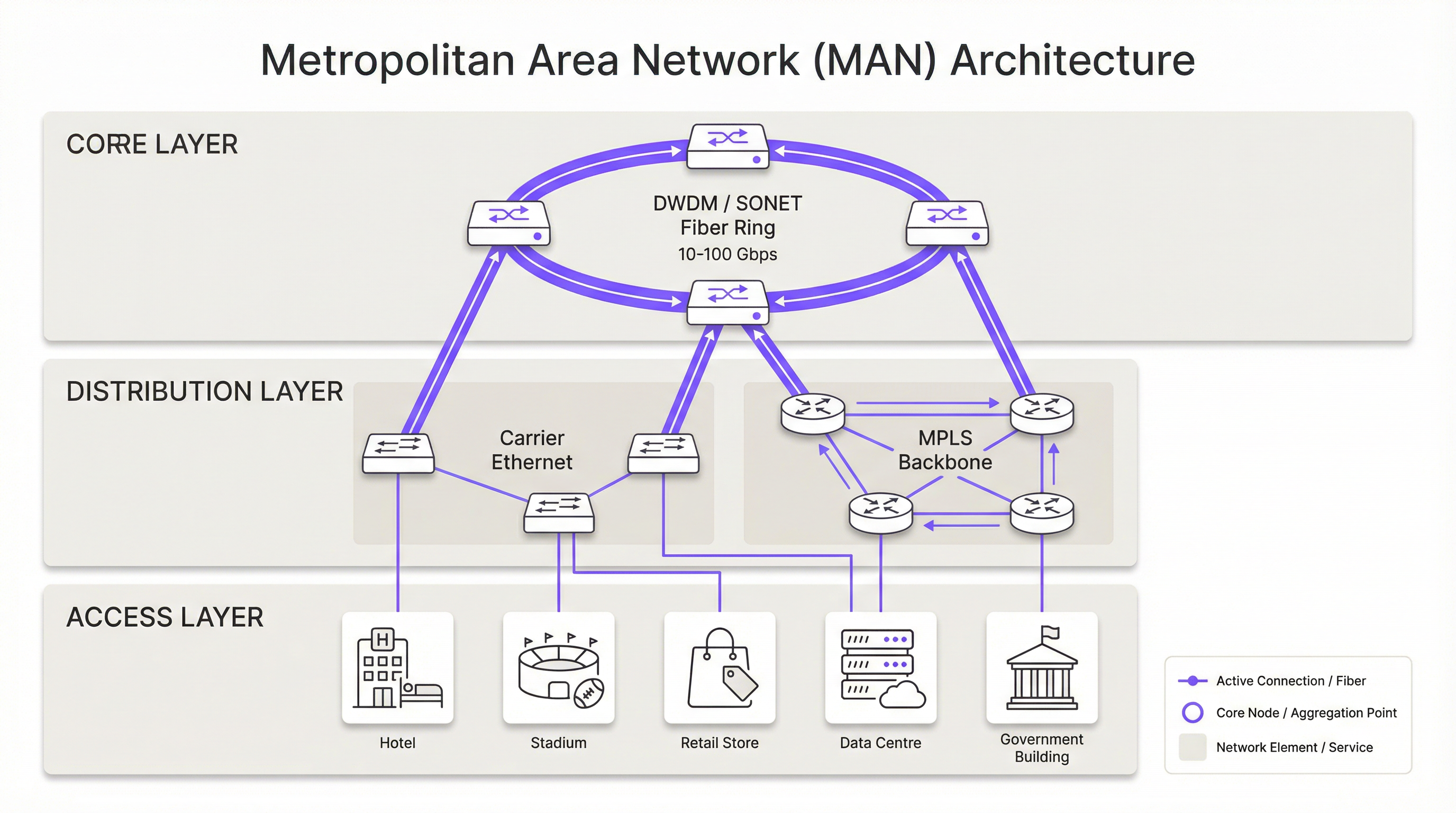
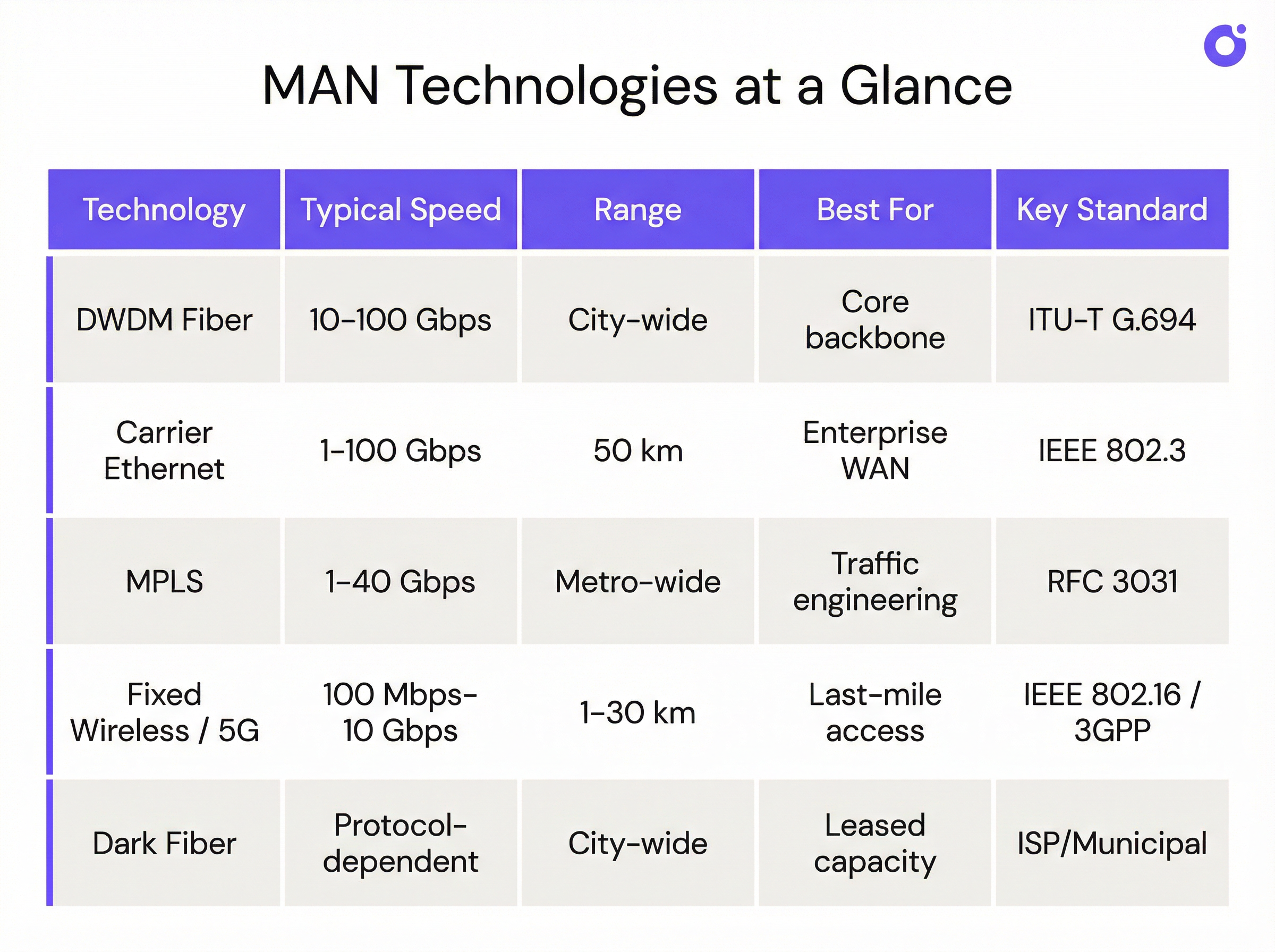
1. Core-Schicht: Dies ist der Hochgeschwindigkeits-Backbone des Netzwerks, der fast ausschließlich auf einem redundanten Glasfaserring aufbaut. Technologien wie Dense Wavelength Division Multiplexing (DWDM) und Synchronous Optical Networking (SONET) ermöglichen mehrere Datenströme über ein einziges Glasfaserpaar, mit typischen Bandbreiten von 10 Gbit/s bis 100 Gbit/s und darüber hinaus. Die Ringtopologie, die oft durch den Standard IEEE 802.17 Resilient Packet Ring (RPR) geregelt wird, gewährleistet eine hohe Verfügbarkeit mit Failover-Zeiten von unter 50 ms, wodurch der Core widerstandsfähig gegenüber Ausfällen einzelner Knoten oder Verbindungen wird.
2. Distributionsschicht: Diese mittlere Schicht aggregiert den Datenverkehr aus der Access-Schicht und verbindet ihn mit dem Core. Zu den Schlüsseltechnologien gehören hier Carrier Ethernet und Multiprotocol Label Switching (MPLS). MPLS ist besonders wichtig für MANs auf Enterprise-Niveau, da es Traffic Engineering, Quality of Service (QoS)-Garantien und die Erstellung sicherer, privater Layer-2- oder Layer-3-VPNs ermöglicht. Dies ermöglicht es Unternehmen, den Datenverkehr über die gemeinsam genutzte Infrastruktur hinweg zu segmentieren – beispielsweise durch die Trennung von Unternehmensdaten und öffentlichem Gäste-WiFi.
3. Access-Schicht: Dies ist die „letzte Meile“, die einzelne Gebäude und Veranstaltungsorte mit der Distributionsschicht verbindet. Während Glasfaser aufgrund ihrer Leistung und Zuverlässigkeit das bevorzugte Medium bleibt, nutzt diese Schicht oft einen Mix aus Technologien, basierend auf Kosten und Praktikabilität. Fixed Wireless Access (FWA) über Richtfunkstrecken und zunehmend auch 5G-Mobilfunktechnologie bieten robuste Hochgeschwindigkeitsalternativen, wenn die Verlegung von Glasfaser zu teuer ist.
Implementierungsleitfaden
Die Bereitstellung eines MAN ist ein bedeutendes Unterfangen, das eine sorgfältige Planung erfordert. Der Prozess lässt sich in vier Schlüsselphasen unterteilen.
Phase 1: Machbarkeit und Entwicklung des Business Cases. Beginnen Sie mit der Überprüfung Ihrer bestehenden Konnektivitätskosten zwischen den Standorten und der Leistungseinschränkungen. Identifizieren Sie die wichtigsten geschäftlichen Treiber für ein MAN – möchten Sie die Leistung von Cloud-Anwendungen verbessern, Daten-Backups zentralisieren oder einen neuen stadtweiten Gäste-Service einführen? Modellieren Sie die Total Cost of Ownership (TCO) eines MAN und vergleichen Sie ein Ausbaumodell (Leasing von Dark Fiber) mit einem Managed Service eines Carriers. Für die meisten Unternehmen mit mehr als fünf Standorten in einer Metropolregion bietet ein Ausbaumodell über einen Zeitraum von 7-10 Jahren einen überlegenen ROI.
Phase 2: Technologieauswahl und herstellerneutrales Design. Erstellen Sie basierend auf Ihren Geschäftsanforderungen ein High-Level-Design. Spezifizieren Sie offene, standardbasierte Technologien (z. B. Carrier Ethernet, MPLS), um einen Vendor Lock-in zu vermeiden. Ihr Design muss die Drei-Schichten-Architektur, vorgeschlagene Routing-Protokolle (wie OSPF und BGP) sowie einen umfassenden Sicherheitsplan detailliert beschreiben, der IEEE 802.1X, VLAN-Segmentierung und Verschlüsselungsstrategien wie MACsec umfasst.
Phase 3: Beschaffung und physische Bereitstellung. Diese Phase ist oft die anspruchsvollste, da sie die Einholung von Wegerechten und Tiefbauarbeiten für die Glasfaserverlegung umfasst. Geben Sie RFPs (Ausschreibungen) basierend auf Ihrem herstellerneutralen Design heraus. Wenn Sie Dark Fiber leasen, stellen Sie sicher, dass das Service Level Agreement (SLA) die Glasfasereigenschaften und die Mean-Time-To-Repair (MTTR) spezifiziert. Führen Sie bei drahtlosen Verbindungen eine gründliche HF-Messung durch, um mögliche Interferenzen zu identifizieren.
Phase 4: Inbetriebnahme und operative Übergabe. Sobald die physische Infrastruktur vorhanden ist, wird das Netzwerk in Betrieb genommen. Dies umfasst die Konfiguration aller Netzwerkelemente, das Testen von Failover- und Redundanzmechanismen sowie die Validierung der Leistung anhand der Designspezifikationen. Schließlich wird das Netzwerk an das Network Operations Centre (NOC)-Team übergeben, ausgestattet mit den erforderlichen Monitoring- und Management-Tools.
Best Practices
- Design für Redundanz: Ein MAN muss ausfallsicher sein. Der Core sollte über diverse Glasfaserpfade verfügen, die Distributionsschicht sollte Dual-Homed-Verbindungen zum Core aufweisen und kritische Access-Standorte sollten einen sekundären Failover-Pfad haben (z. B. Glasfaser primär, 5G FWA sekundär).
- Logische Segmentierung des Datenverkehrs: Verwenden Sie VLANs (IEEE 802.1Q) und MPLS-VPNs, um logisch getrennte Netzwerke für verschiedene Arten von Datenverkehr (z. B. Corporate, Gast, IoT, VoIP) zu erstellen. Dies ist eine grundlegende Anforderung für die Sicherheit und die Einhaltung von Standards wie PCI DSS und GDPR.
- Zentralisiertes Netzwerk-Monitoring: Implementieren Sie ein robustes Network Monitoring System (NMS), das eine zentrale Übersicht (Single Pane of Glass) für das gesamte MAN bietet. Das System sollte die Verbindungsauslastung, Latenz, Paketverluste und den Gerätezustand in Echtzeit überwachen, mit KI-gesteuerter Alarmierung, um eine proaktive Wartung zu ermöglichen.
- Priorisierung der Sicherheit: Implementieren Sie eine portbasierte Zugriffskontrolle mit IEEE 802.1X an allen kabelgebundenen Ports. Für drahtlose Segmente ist WPA3-Enterprise zwingend erforderlich. Verschlüsseln Sie sensiblen Datenverkehr bei der Übertragung mit IPsec oder MACsec. Führen Sie regelmäßig Schwachstellenbewertungen und Penetrationstests durch.
Fehlerbehebung & Risikominderung
| Häufige Fehlerquelle | Minderungsstrategie | Schritte zur Fehlerbehebung |
|---|---|---|
| Glasfaserbruch | Verwenden Sie eine redundante Ringtopologie mit diversen physischen Pfaden. Stellen Sie sicher, dass das Carrier-SLA eine strenge MTTR enthält. | Verwenden Sie ein Optical Time-Domain Reflectometer (OTDR), um die genaue Position des Bruchs zu lokalisieren. Leiten Sie den Datenverkehr über den sekundären Pfad um. |
| Konfigurationsfehler | Implementieren Sie einen strengen Change-Management-Prozess mit Peer-Review. Nutzen Sie Netzwerkautomatisierungs-Tools mit Validierung vor der Bereitstellung. | Führen Sie ein Rollback auf die letzte als funktionierend bekannte Konfiguration durch. Verwenden Sie Netzwerk-Monitoring-Tools, um den Fehler mit der jüngsten Änderung zu korrelieren. |
| DDoS-Angriff | Schließen Sie einen Vertrag mit einem cloudbasierten DDoS-Mitigation-Service ab, der bösartigen Datenverkehr bereinigen kann, bevor er Ihren Netzwerkrand erreicht. | Identifizieren Sie den Angriffsvektor und das Ziel mithilfe einer NetFlow-Analyse. Beauftragen Sie den DDoS-Mitigation-Anbieter mit der Anwendung von Filterregeln. |
| Stromausfall am Knoten | Statten Sie alle Core- und Distributionsknoten mit unterbrechungsfreien Stromversorgungen (USV) und bei kritischen Knoten mit Notstromaggregaten aus. | Überprüfen Sie den Stromstatus am betroffenen Knoten. Überwachen Sie die USV- und Generatorprotokolle. |
ROI & Geschäftliche Auswirkungen
Die Berechnung des Return on Investment für ein MAN umfasst mehr als nur den Vergleich von Konnektivitätskosten. Die geschäftlichen Auswirkungen sind vielschichtig. Direkte Kosteneinsparungen ergeben sich aus der Konsolidierung mehrerer teurer Internetverbindungen und Standleitungen zu einem einzigen, effizienteren Backbone. Produktivitätssteigerungen werden durch geringere Latenzzeiten erzielt, was die Leistung von cloudbasierten Anwendungen, VoIP und Videokonferenzen verbessert. Verbesserte Sicherheit und Compliance verringern das Risiko kostspieliger Datenschutzverletzungen und behördlicher Geldstrafen. Schließlich ist ein MAN eine Plattform für Innovationen; es bietet die skalierbare, hochleistungsfähige Grundlage, die für Smart-Building-Initiativen, groß angelegte IoT-Bereitstellungen und Gästeerlebnisse der nächsten Generation erforderlich ist. Quantifizieren Sie bei der Erstellung des Business Cases jeden dieser Vorteile, um ein ganzheitliches Bild des Projektwerts zu vermitteln.

Key Terms & Definitions
Dark Fiber
Fiber optic cable that has been physically installed but is not currently in use. Organisations can lease dark fiber from carriers or municipalities to build their own private networks.
When an IT team decides to build its own MAN instead of buying a managed service, leasing dark fiber is often the most cost-effective way to create the physical backbone, offering maximum control over the network.
Carrier Ethernet
A set of standards-based services defined by the MEF (Metro Ethernet Forum) that deliver Ethernet services over MAN and WAN networks. It provides scalability and reliability comparable to older SONET/SDH technologies.
For network architects, specifying Carrier Ethernet for MAN services ensures interoperability between different vendors and provides a familiar, flexible, and cost-effective transport technology for enterprise connectivity.
MPLS (Multiprotocol Label Switching)
A network routing technique that directs data from one node to the next based on short path labels rather than long network addresses, avoiding complex lookups in a routing table.
CTOs and network architects leverage MPLS to create secure VPNs between sites and to engineer traffic flows, ensuring that high-priority applications like VoIP get the bandwidth and low latency they need, even on a congested network.
DWDM (Dense Wavelength Division Multiplexing)
A fiber-optic technology that increases bandwidth by allowing multiple data streams to be sent simultaneously over a single fiber optic cable, with each stream using a different wavelength (color) of light.
In a MAN core, DWDM is the key to achieving massive scalability. It allows network operators to add capacity to their fiber backbone without the enormous expense of laying more cables.
IEEE 802.1X
An IEEE standard for Port-Based Network Access Control (PNAC). It provides an authentication mechanism to devices wishing to attach to a LAN or WLAN.
For IT security managers, implementing 802.1X is a fundamental step in securing the network edge. It ensures that only authorized and authenticated users and devices can gain access to the wired or wireless network.
Resilient Packet Ring (RPR)
An IEEE 802.17 standard protocol designed for the transport of data traffic over optical fiber ring networks. It provides high-speed data transfer and fast (sub-50ms) recovery from link or node failures.
When designing the core of a MAN, architects specify RPR to build in carrier-grade resiliency, ensuring that a single fiber cut or equipment failure doesn't cause a catastrophic network outage.
PCI DSS
The Payment Card Industry Data Security Standard is a set of security standards designed to ensure that all companies that accept, process, store or transmit credit card information maintain a secure environment.
For any retail or hospitality business, ensuring the MAN segment that carries payment data is compliant with PCI DSS is non-negotiable. This involves strict network segmentation, access control, and monitoring to protect cardholder data.
GDPR (General Data Protection Regulation)
A regulation in EU law on data protection and privacy for all individuals within the European Union and the European Economic Area. It also addresses the transfer of personal data outside the EU and EEA areas.
When providing public or guest WiFi over a MAN, venue operators must ensure their systems comply with GDPR. This involves obtaining explicit user consent, anonymising personal data like MAC addresses for analytics, and managing data retention policies.
Case Studies
A hotel group with 10 properties spread across a major city needs to replace its expensive, slow, and separately managed internet connections at each site. The goal is to improve guest WiFi performance, centralise data backup to a private data centre, and deploy a new VoIP phone system across all locations.
The recommended solution is to deploy a private MAN using leased dark fiber. A 10 Gbps resilient fiber ring would form the core, connecting three regional distribution nodes. Each hotel would connect to its nearest distribution node via a 1 Gbps Carrier Ethernet circuit. MPLS Layer 3 VPNs would be configured to create three separate virtual networks: one for guest WiFi traffic, one for corporate/VoIP traffic, and one for the data backup service. This segmentation ensures that a surge in guest internet usage does not impact the quality of VoIP calls or the performance of critical business systems. IEEE 802.1X would be enforced on the corporate network, and the guest WiFi would be secured with WPA3 and integrated with a cloud-based analytics platform for GDPR compliance.
A 70,000-seat stadium needs to provide high-density WiFi for fans, support broadcast media operations, and connect its own retail and ticketing systems. The existing connectivity is unreliable and cannot handle the load on event days.
The stadium would act as the central hub of a campus-area MAN. The solution involves two diverse 40 Gbps fiber connections from the stadium's data centre to two different carrier hotels in the city, forming a high-availability connection to the internet and cloud services. Within the stadium, a hierarchical network of aggregation and access switches connects over 1,500 high-density WiFi 6E access points. Network segmentation is critical: a VLAN/MPLS segment is created for public fan WiFi, another for broadcast media with guaranteed bandwidth, a third for PCI DSS-compliant retail and ticketing systems, and a fourth for building management and security systems. A dedicated on-site NOC with real-time analytics monitors the network performance, especially during events, to proactively manage load and interference.
Scenario Analysis
Q1. Your organisation is opening a new branch office in a location where fiber is not available for six months, but there is strong 5G coverage. How would you integrate this site into your existing MPLS-based MAN in the interim?
💡 Hint:Consider how SD-WAN can use multiple transport types and how to secure traffic over the public internet.
Show Recommended Approach
The recommended approach is to deploy an SD-WAN appliance at the new branch. The SD-WAN appliance would use the 5G connection as its primary transport path. It would form a secure IPsec tunnel back to the SD-WAN headend in the corporate data centre, allowing the branch office to securely connect to the MPLS MAN. Application-aware routing policies would be configured to prioritise critical traffic over the 5G link. When the fiber circuit becomes available, it can be added as a second transport path, and the SD-WAN can be configured to use it as the primary path, keeping the 5G link as a high-performance backup.
Q2. A large conference centre connected to your MAN is hosting a major tech event. The event organiser wants a private, isolated, high-bandwidth network for their keynote presentations and live streams, completely separate from the public attendee WiFi. How would you provision this?
💡 Hint:Think about logical segmentation. How can you create a dedicated virtual network over the shared physical infrastructure?
Show Recommended Approach
The most robust solution is to provision a dedicated Layer 2 VPN (VPLS) or Layer 3 VPN (VRF) for the event organiser using the MAN's MPLS capabilities. This creates a completely separate virtual network for their traffic from the conference centre back to a dedicated internet breakout or to their own corporate network. A specific VLAN would be configured on the conference centre's switches for the event organiser's use, which would then be mapped to the dedicated MPLS VPN. QoS policies would be applied to guarantee the required bandwidth for their live streaming activities, ensuring it is not impacted by the thousands of attendees using the public WiFi network.
Q3. You are seeing intermittent packet loss and high latency to a retail store that is connected to your MAN via a fixed wireless link. What are the first three things you should investigate?
💡 Hint:Think about the unique failure modes of wireless technologies compared to fiber.
Show Recommended Approach
- RF Interference: Fixed wireless links are susceptible to interference from other wireless sources (e.g., other nearby networks, radar systems). The first step is to use the wireless bridge's management interface or a separate spectrum analyser to check for interference on the operating channel. If interference is detected, changing the channel to a cleaner frequency may resolve the issue. 2. Line of Sight Obstruction: Unlike fiber, wireless links require a clear line of sight between the two antennas. A physical obstruction that has appeared since installation (e.g., a new building, tree growth, a crane) can degrade the signal. A visual inspection, followed by checking the received signal strength indicator (RSSI) against its baseline from installation, is crucial. 3. Weather Conditions: Heavy rain, snow, or fog can attenuate microwave signals, a phenomenon known as "rain fade." Correlate the periods of high latency and packet loss with historical weather data. If the link is not engineered with enough fade margin for the climate, the only solutions are to upgrade to larger antennas or a higher-power radio system.
Key Takeaways
- ✓A MAN connects multiple LANs across a city or large campus, creating a single, unified network.
- ✓Core technologies include fiber optics (DWDM, SONET), Carrier Ethernet, and MPLS for traffic engineering.
- ✓A three-layer architecture (Core, Distribution, Access) is the standard design pattern.
- ✓Leasing dark fiber is often the most cost-effective way to build a private MAN for multi-site organisations.
- ✓Network segmentation using VLANs and MPLS is critical for security and compliance (PCI DSS, GDPR).
- ✓Redundancy through ring topologies and diverse paths is essential for high availability.
- ✓Future trends include deeper integration with 5G for backhaul and the use of SD-WAN as a control overlay.




