

Webhooks vs. API-Polling für WiFi-Daten: Was sollten Sie nutzen?
This guide provides a definitive technical comparison between webhooks and API polling for retrieving WiFi intelligence data. It offers actionable guidance for IT managers, architects, and developers to help them select the optimal data integration pattern for real-time responsiveness, operational efficiency, and scalable deployments in enterprise environments.
🎧 Listen to this Guide
View Transcript

Executive Summary
Für IT-Leiter und Betreiber von Veranstaltungsorten ist die gewählte Methode zum Abrufen von Daten aus einer WiFi-Intelligence-Plattform wie Purple eine grundlegende architektonische Entscheidung mit erheblichen betrieblichen Auswirkungen. Die beiden primären Muster, API-Polling und Webhooks, bieten einen starken Kompromiss zwischen einfacher Implementierung und Echtzeitleistung. API-Polling, ein client-initiiertes Pull-Modell, fragt eine API in festen Intervallen wiederholt nach neuen Daten ab. Obwohl es einfach bereitzustellen ist, ist es ressourcenintensiv, führt zu inhärenter Datenlatenz und skaliert schlecht. Im Gegensatz dazu verwenden Webhooks ein server-initiiertes, ereignisgesteuertes Push-Modell. Sie liefern Daten-Payloads an einen vordefinierten Endpunkt in dem Moment, in dem ein bestimmtes Ereignis eintritt – wie z. B. wenn sich ein Gast mit dem Netzwerk verbindet. Dieser Ansatz liefert echte Echtzeitdaten, gewährleistet eine hohe Ressourceneffizienz und bietet eine überlegene Skalierbarkeit. Für jede Anwendung, die ein sofortiges, kontextbezogenes Engagement erfordert – von der Auslösung von Marketing-Automatisierungen bis hin zum Versand von Betriebsbenachrichtigungen – sind Webhooks die architektonisch überlegene Wahl. Dieser Leitfaden bietet einen technischen Deep-Dive in beide Muster, herstellerneutrale Implementierungsrichtlinien und reale Fallstudien, um Architekten und Entwicklern zu helfen, eine fundierte Entscheidung zu treffen, die mit ihren Geschäftszielen für ROI, Durchsatz und Risikominderung übereinstimmt.
Technischer Deep-Dive
Das Verständnis der grundlegenden Unterschiede zwischen API-Polling und Webhooks ist entscheidend für die Entwicklung robuster und effizienter Systeme, die WiFi-Daten nutzen. Dieser Abschnitt untersucht die Architektur, Leistungsmerkmale und Sicherheitsauswirkungen beider Muster.
Was ist API-Polling?
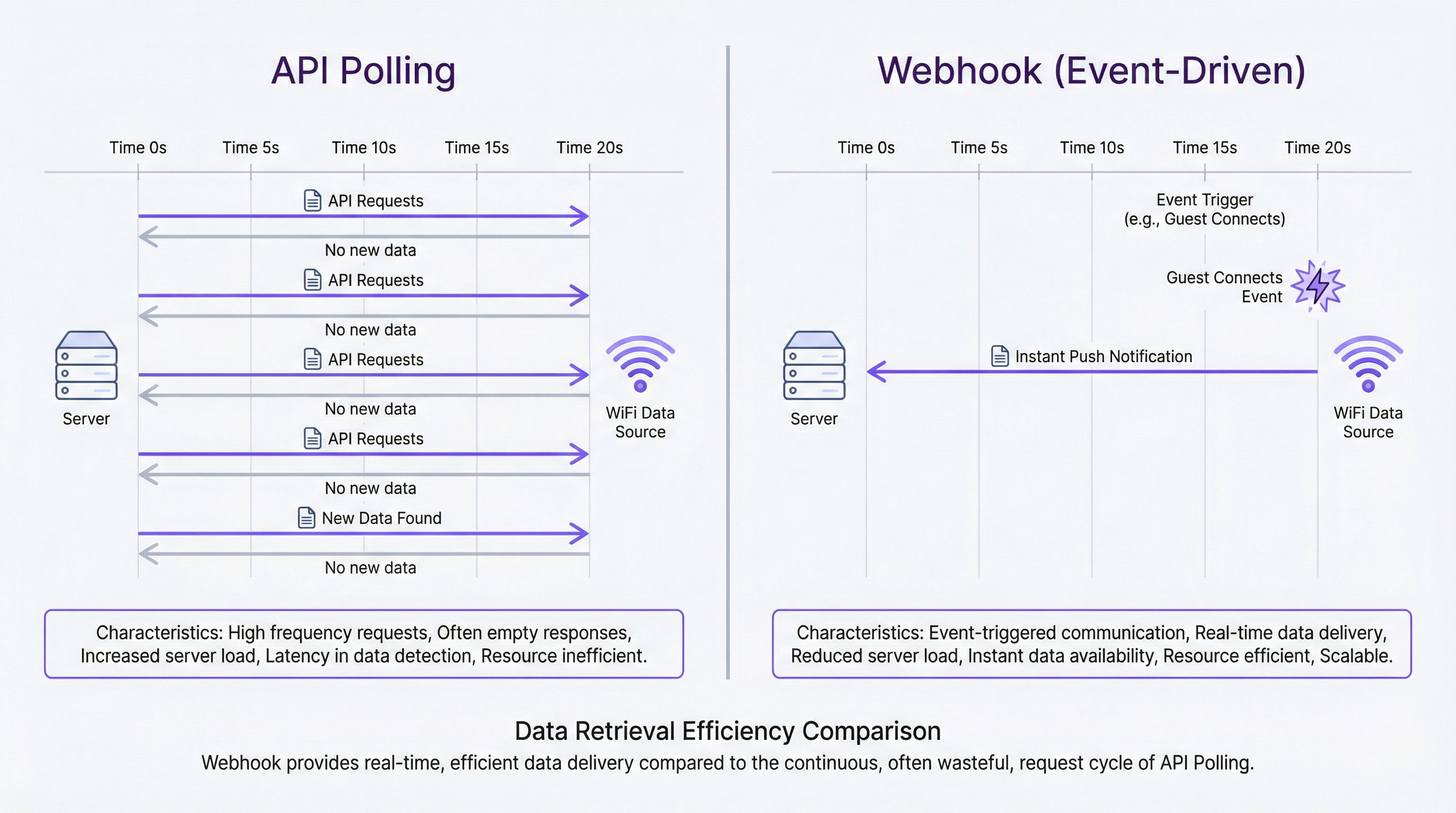
API-Polling ist ein synchroner, Pull-basierter Mechanismus, bei dem eine Client-Anwendung wiederholte HTTP-Anfragen an eine Server-API in einer vorgegebenen Häufigkeit stellt, um auf neue Daten zu prüfen. Es basiert auf einem einfachen Request-Response-Zyklus: Der Client fragt „Gibt es neue Informationen?“ und der Server antwortet.
Eigenschaften:
- Client-initiiert: Der Client ist für die Initiierung der gesamten Kommunikation verantwortlich.
- Festes Intervall: Anfragen erfolgen in regelmäßigen Abständen (z. B. alle 60 Sekunden).
- Synchron: Der Client wartet auf eine Antwort, bevor er fortfährt oder die nächste Anfrage stellt.
Vorteile:
- Einfachheit: Die Implementierung ist oft unkompliziert und erfordert lediglich ein einfaches Skript oder eine geplante Aufgabe, um HTTP-GET-Anfragen zu stellen.
- Vorhersehbare Auslastung: Die Belastung des Client-Systems ist konstant und leicht zu prognostizieren.
Nachteile:
- Ineffizienz: Die überwiegende Mehrheit der Abfragen liefert keine neuen Daten, was unnötige Bandbreite und Verarbeitungszyklen auf Client- und Serverseite verbraucht. Dies ist eine erhebliche Verschwendungsquelle in groß angelegten Bereitstellungen.
- Latenz: Daten sind nie wirklich in Echtzeit. Die „Aktualität“ der Daten ist bestenfalls durch das Polling-Intervall begrenzt. Bei einem Intervall von 5 Minuten können Daten bis zu 4 Minuten und 59 Sekunden alt sein, was für zeitkritische Anwendungen inakzeptabel ist.
- Skalierbarkeitsprobleme: Mit zunehmender Anzahl von Clients oder der Polling-Frequenz steigt die Belastung der Server-API linear an, was potenziell zu Leistungseinbußen oder Rate-Limiting führt.
Was sind Webhooks?
Webhooks sind ein asynchroner, Push-basierter Mechanismus für die Server-zu-Server-Kommunikation. Anstatt dass der Client wiederholt nach Daten fragt, sendet – oder pusht – der Server automatisch einen Daten-Payload an eine festgelegte Client-URL (den „Webhook-Endpunkt“), sobald ein bestimmtes Ereignis eintritt. Dies wird oft als „Reverse API“ oder ereignisgesteuerte Architektur bezeichnet.
Eigenschaften:
- Server-initiiert (ereignisgesteuert): Die Kommunikation wird durch ein Ereignis auf dem Server ausgelöst (z. B.
guest_connects,user_leaves_venue). - Echtzeit: Daten werden fast augenblicklich nach Eintritt des Ereignisses geliefert.
- Asynchron: Der Client empfängt Daten passiv, ohne eine Anfrage initiieren zu müssen.
Vorteile:
- Effizienz: Kommunikation findet nur statt, wenn neue Daten vorliegen, was überflüssige Anfragen eliminiert und die Server- sowie Netzwerkbelastung drastisch reduziert.
- Echtzeitdaten: Webhooks sind der Branchenstandard für die Bereitstellung von Echtzeitdaten und ermöglichen sofortige Aktionen und kontextbezogene Workflows.
- Skalierbarkeit: Die Architektur ist hochgradig skalierbar, da der Server nur dann Ressourcen aufwendet, wenn ein Ereignis ausgelöst wird, anstatt kontinuierlich Abfragen von Tausenden von Clients zu verarbeiten.
Nachteile:
- Implementierungskomplexität: Die anfängliche Einrichtung ist aufwendiger. Sie erfordert die Erstellung eines stabilen, öffentlich zugänglichen HTTP-Endpunkts auf Client-Seite, um die eingehenden POST-Anfragen vom Server zu empfangen.
- Zuverlässigkeitsmanagement: Die Client-Anwendung muss so konzipiert sein, dass sie eingehende Daten zuverlässig verarbeitet, einschließlich der Bewältigung potenzieller Ausfallzeiten und Verarbeitungsspitzen.
Architektonischer Vergleich
| Funktion | API-Polling | Webhooks (ereignisgesteuert) |
|---|---|---|
| Datenfluss | Pull (Client-initiiert) | Push (Server-initiiert) |
| Datenaktualität | Verzögert (durch Polling-Intervall) | Echtzeit |
| Effizienz | Niedrig (viele leere Anfragen) | Hoch (Kommunikation nur bei Ereignis) |
| Serverauslastung | Hoch und konstant | Niedrig und sporadisch (bei Ereignis) |
| Client-Auslastung | Hoch (konstante Anfragen) | Niedrig (hört passiv zu) |
| Skalierbarkeit | Schlecht | Hervorragend |
| Implementierung | Einfache Ersteinrichtung | Erfordert einen öffentlichen Endpunkt |
Sicherheitsaspekte
Beide Muster erfordern robuste Sicherheitsmaßnahmen, insbesondere beim Umgang mit personenbezogenen Daten (PII), die Vorschriften wie der GDPR unterliegen. [1]
Für Webhooks: Sicherheit steht an erster Stelle. Der empfangende Endpunkt MUSS über HTTPS (TLS-Verschlüsselung) gesichert sein, um Daten bei der Übertragung zu schützen. Um Spoofing-Angriffe zu verhindern, bei denen ein böswilliger Akteur gefälschte Daten an Ihren Endpunkt sendet, müssen Payloads zudem verifiziert werden. Die Plattform von Purple fügt in Übereinstimmung mit branchenüblichen Best Practices eine eindeutige Signatur in den HTTP-Header
X-Purple-Signaturejeder Webhook-Anfrage ein. Diese Signatur ist ein Hash (HMAC-SHA256) des Payload-Bodys, der mit einem geheimen Schlüssel erstellt wird, der zwischen Ihrer Anwendung und Purple geteilt wird. Ihr Endpunkt muss denselben Hash berechnen und überprüfen, ob er mit der Signatur im Header übereinstimmt, bevor die Daten verarbeitet werden. Dies stellt sicher, dass die Daten sowohl authentisch sind (von Purple stammen) als auch nicht manipuliert wurden.Für API-Polling: Das primäre Sicherheitsanliegen ist die Verwaltung des API-Schlüssels. Dieser Schlüssel muss sicher gespeichert und darf niemals in clientseitigem Code offengelegt werden. Die gesamte API-Kommunikation muss ebenfalls über HTTPS erfolgen. Der Zugriff sollte protokolliert und auf anomale Aktivitäten überwacht werden, die auf einen kompromittierten Schlüssel hinweisen könnten.
Implementierungsleitfaden
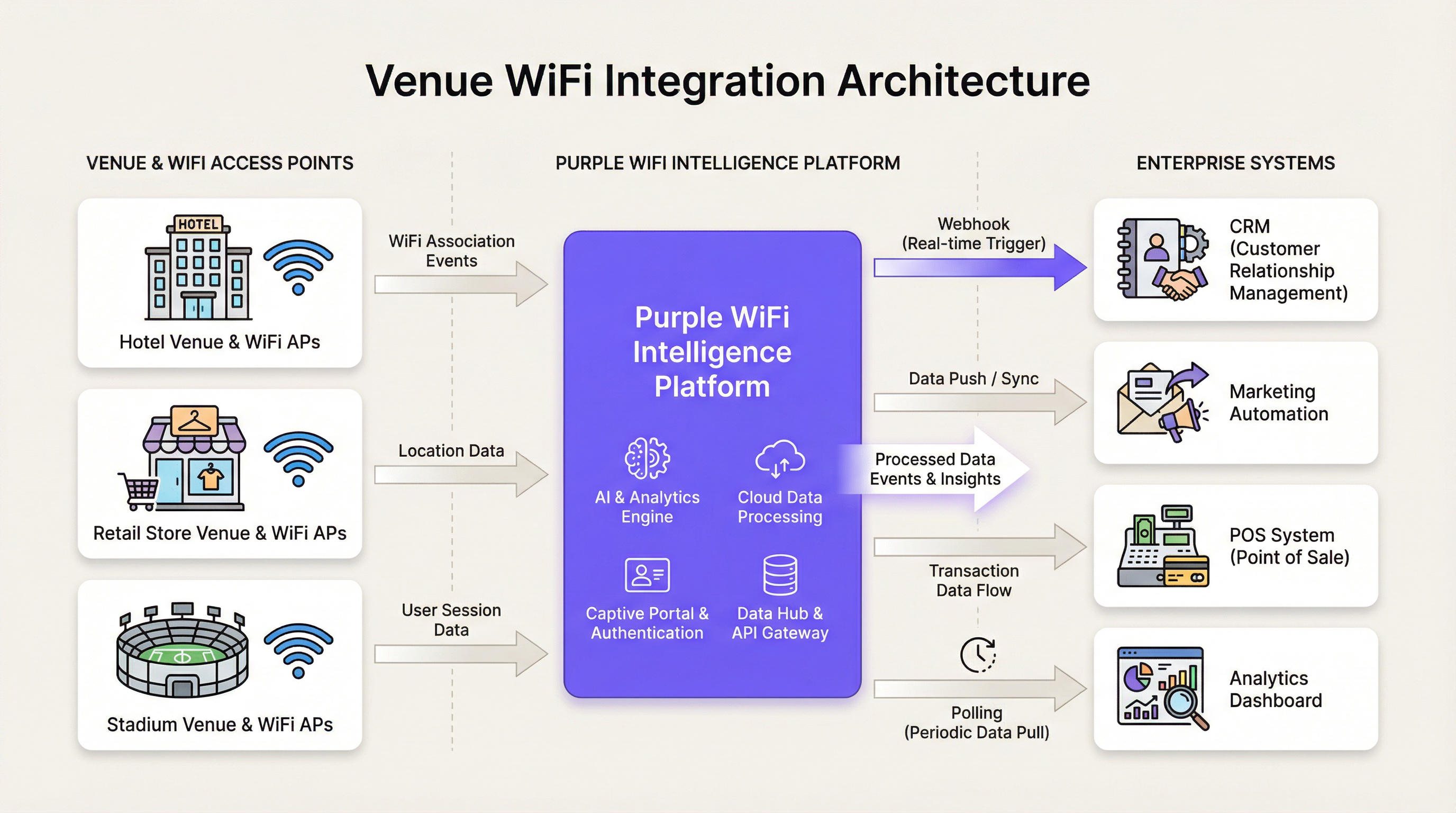
Die Wahl des richtigen Musters hängt vollständig von den geschäftlichen Anforderungen der Integration ab. Ein gemischter Ansatz ist in komplexen Unternehmensarchitekturen üblich.
Wann API-Polling sinnvoll ist
Trotz seiner Ineffizienzen ist API-Polling eine praktikable Wahl für spezifische, unkritische Anwendungsfälle:
- Batch-Reporting: Erstellung nächtlicher oder wöchentlicher Berichte über die aggregierte WiFi-Nutzung, bei denen eine Datenverzögerung von mehreren Stunden akzeptabel ist.
- Interne Dashboards: Befüllung eines unkritischen internen Dashboards mit Trenddaten, die keine sekundengenaue Präzision erfordern.
- Legacy-Systeme: Integration mit älteren Systemen, die keinen öffentlichen Endpunkt zum Empfang von Webhooks bereitstellen können.
- Infrastruktureinschränkungen: In Hochsicherheitsumgebungen, in denen eingehender Datenverkehr von externen Diensten durch Richtlinien stark eingeschränkt ist.
Wann Webhooks sinnvoll sind
Webhooks sind die definitive Wahl für jede moderne Echtzeitanwendung. Nutzen Sie sie immer dann, wenn eine sofortige, automatisierte Reaktion auf ein WiFi-Ereignis geschäftlichen Mehrwert schaffen kann.
- Echtzeit-Marketing: Auslösen einer Willkommens-E-Mail, einer SMS mit einem Gutschein oder einer Push-Benachrichtigung an eine Treue-App in dem Moment, in dem sich ein Gast in einem Hotel oder Einzelhandelsgeschäft mit dem WiFi verbindet.
- Betriebsbenachrichtigungen: Senden einer sofortigen Warnung an das Personal über Slack oder eine spezielle App, wenn ein bestimmtes Ereignis eintritt, wie z. B. die Ankunft eines VIP-Gastes, das Überschreiten eines Verweildauer-Schwellenwerts in einer bestimmten Zone oder der Ausfall von Netzwerk-Hardware.
- CRM-Integration: Sofortige Erstellung oder Aktualisierung eines Kundendatensatzes in einem CRM wie Salesforce oder HubSpot, wenn sich ein neuer Gast im Captive Portal registriert.
- Betrieb von Veranstaltungsorten: Nutzung von Echtzeitdaten zur Gerätedichte, um den Besucherstrom in einem Stadion zu steuern, die HLK-Anlagen in einem Konferenzzentrum anzupassen oder Reinigungspersonal in stark frequentierte Bereiche zu entsenden.
Implementierung der Webhooks von Purple: Ein konzeptioneller Leitfaden
- Erstellen Sie Ihren Endpunkt: Entwickeln Sie eine stabile, öffentliche URL auf Ihrem Server, die HTTP-POST-Anfragen akzeptieren kann. Dies kann eine serverlose Funktion (z. B. AWS Lambda, Google Cloud Function) oder eine dedizierte Route in Ihrer Webanwendung sein.
- Registrieren Sie den Endpunkt in Purple: Navigieren Sie im Purple-Portal zum Bereich Webhooks und fügen Sie Ihre Endpunkt-URL hinzu. Sie erhalten einen geheimen Schlüssel zur Signaturüberprüfung.
- Verarbeiten Sie eingehende Daten: Wenn ein Ereignis eintritt, sendet Purple einen JSON-Payload an Ihren Endpunkt. Ihr Endpunkt sollte so programmiert sein, dass er:
a. Den Empfang sofort bestätigt: Antworten Sie so schnell wie möglich mit einem
200 OK-Statuscode, um Purple mitzuteilen, dass die Daten empfangen wurden. Dies verhindert Timeouts und erneute Versuche. b. Die Signatur verifiziert: Berechnen Sie vor der Verarbeitung die HMAC-SHA256-Signatur des rohen Anfrage-Bodys mit Ihrem geheimen Schlüssel und vergleichen Sie diese mit dem Wert imX-Purple-Signature-Header. Wenn sie nicht übereinstimmen, verwerfen Sie die Anfrage. c. Asynchron verarbeitet: Verlagern Sie die eigentliche Geschäftslogik (z. B. das Senden einer E-Mail, das Aktualisieren einer Datenbank) in eine Hintergrund-Job-Warteschlange (z. B. RabbitMQ, Redis Queue). Dies stellt sicher, dass Ihr Endpunkt reaktionsfähig bleibt und hohe Ereignisvolumina verarbeiten kann, ohne blockiert zu werden.
Best Practices
Die Einhaltung branchenüblicher Best Practices ist unerlässlich für den Aufbau zuverlässiger und sicherer Integrationen.
Webhook Best Practices
- Idempotenz: Gestalten Sie Ihre Verarbeitungslogik so, dass doppelte Ereignisse reibungslos verarbeitet werden. Netzwerkprobleme können manchmal dazu führen, dass ein Webhook mehr als einmal zugestellt wird. Ein idempotentes System stellt sicher, dass die mehrfache Verarbeitung desselben Ereignisses nicht zu doppelten Daten oder Aktionen führt.
- Asynchrone Verarbeitung: Führen Sie niemals komplexe oder zeitaufwendige Logik direkt im Request-Handler aus. Bestätigen und in die Warteschlange einreihen.
- Payload-Validierung: Überprüfen Sie immer die Webhook-Signatur. Dies ist ein kritischer Sicherheitsschritt.
- Monitoring und Protokollierung: Implementieren Sie eine umfassende Protokollierung, um eingehende Webhooks und das Ergebnis ihrer Verarbeitung zu verfolgen. Richten Sie ein Monitoring ein, das Sie warnt, wenn Ihr Endpunkt ausfällt oder sich die Antwortzeiten verschlechtern.
- Graceful Failure & Retries: Während das System von Purple einen Wiederholungsmechanismus enthält, sollte Ihr eigenes System widerstandsfähig gegenüber Ausfällen in nachgelagerten Diensten sein (z. B. wenn eine Datenbank oder eine Drittanbieter-API vorübergehend nicht verfügbar ist).
API-Polling Best Practices
- Wählen Sie eine angemessene Häufigkeit: Fragen Sie nicht häufiger als nötig ab. Übermäßiges Polling bringt abnehmende Erträge und erhöht das Risiko eines Rate-Limitings. Beachten Sie den
Retry-After-Header, wenn Sie eine429 Too Many Requests-Antwort erhalten. - Verwenden Sie bedingte Anfragen: Nutzen Sie, sofern unterstützt, Header wie
If-Modified-SinceoderETag, um das erneute Herunterladen unveränderter Daten zu vermeiden. - Implementieren Sie eine Backoff-Strategie: Wenn ein API-Aufruf fehlschlägt, implementieren Sie eine exponentielle Backoff-Strategie für Wiederholungsversuche, um eine Überlastung des Servers zu vermeiden.
- Sichern Sie API-Schlüssel: Speichern Sie API-Schlüssel sicher mithilfe eines Secrets-Management-Dienstes. Programmieren Sie diese niemals fest in Ihre Anwendung ein und übergeben Sie sie nicht an die Versionskontrolle.
Fehlerbehebung & Risikominderung
- Häufige Fehlerquelle (Webhooks): Endpunkt-Ausfallzeit. Wenn Ihr Endpunkt ausfällt, verpassen Sie Ereignisse. Minderung: Verwenden Sie eine hochverfügbare Architektur für Ihren Endpunkt (z. B. serverlose Funktionen, Load-Balancing-Server). Verlassen Sie sich bei kurzen Ausfällen auf den integrierten Wiederholungsmechanismus von Purple und implementieren Sie ein robustes Monitoring, um sofort über Ausfallzeiten informiert zu werden.
- Häufige Fehlerquelle (Webhooks): Verarbeitungsspitzen. Ein plötzlicher Anstieg von Ereignissen (z. B. eine große Menschenmenge, die sich zu Beginn einer Veranstaltung verbindet) kann Ihre Verarbeitungswarteschlange überlasten. Minderung: Stellen Sie sicher, dass Ihre Hintergrundverarbeitungsinfrastruktur automatisch skalieren kann, um Nachfragespitzen zu bewältigen.
- Häufige Fehlerquelle (API-Polling): Rate Limiting. Aggressives Polling führt dazu, dass Ihre Anwendung einem Rate-Limiting unterzogen wird, was Ihren Datenfluss effektiv unterbricht. Minderung: Führen Sie Abfragen in einem angemessenen, respektvollen Intervall durch und implementieren Sie eine exponentielle Backoff-Strategie.
- Häufige Fehlerquelle (Beide): Ungültige Daten. Eine Änderung des Datenformats oder ein unerwarteter Wert kann Ihre Verarbeitungslogik unterbrechen. Minderung: Implementieren Sie defensive Programmierpraktiken. Validieren Sie eingehende Daten anhand eines Schemas und behandeln Sie Validierungsfehler reibungslos, indem Sie sie zur Untersuchung protokollieren, ohne den gesamten Prozess zum Absturz zu bringen.
ROI & Geschäftliche Auswirkungen
Die Wahl zwischen Webhooks und Polling hat direkte Auswirkungen auf die Gesamtbetriebskosten (TCO) und den Return on Investment (ROI).
- Kosten-Nutzen-Analyse: Während Polling möglicherweise etwas geringere anfängliche Entwicklungskosten aufweist, sind die Betriebskosten aufgrund verschwendeter Serverressourcen und Bandbreite deutlich höher. Webhooks führen mit ihrer ereignisgesteuerten Effizienz bei Skalierung zu wesentlich niedrigeren TCO. Die Infrastrukturkosten für die Verarbeitung von Millionen leerer Abfragen pro Tag übersteigen die Kosten für die Entwicklung eines zuverlässigen Webhook-Endpunkts bei weitem.
- Erfolgsmessung: Der Erfolg einer Echtzeit-Datenintegration wird an ihren geschäftlichen Auswirkungen gemessen. Für ein Hotel könnte dies eine Steigerung der Zimmerservice-Bestellungen um 15 % sein, angetrieben durch Webhook-gesteuerte Willkommensangebote. Für einen Einzelhändler könnte es eine messbare Steigerung des Customer Lifetime Value für VIPs sein, die einen personalisierten Service im Geschäft erhalten. Für einen Veranstaltungsort könnte es eine Reduzierung von Betriebsstörungen durch proaktives Crowd-Management sein.
- Erwartete Ergebnisse: Die Bereitstellung einer Webhook-basierten Architektur positioniert Ihr Unternehmen so, dass es agiler und reaktionsfähiger wird. Sie verlagert Ihre Abläufe von einer reaktiven Haltung (Analyse dessen, was gestern passiert ist) zu einer proaktiven Echtzeit-Haltung (Reaktion auf das, was genau jetzt passiert). Diese Fähigkeit ist ein wichtiges Unterscheidungsmerkmal bei der Bereitstellung herausragender Kundenerlebnisse und der Erreichung operativer Exzellenz.
Referenzen
[1] General Data Protection Regulation (GDPR). (2016). Official Journal of the European Union. https://eur-lex.europa.eu/eli/reg/2016/679/oj
Key Terms & Definitions
Webhook
A mechanism for enabling server-to-server communication in real-time. It allows a server to automatically push data to a client as soon as an event occurs, rather than the client repeatedly polling for it.
IT teams use webhooks to receive instant notifications from platforms like Purple, enabling event-driven workflows such as sending a welcome email the moment a guest connects to WiFi.
API Polling
A data retrieval method where a client application makes requests to a server at a fixed interval to check for new data. It is a client-initiated "pull" model.
A developer might use API polling to update an internal dashboard with new WiFi analytics every 15 minutes, where real-time data is not a critical business requirement.
Endpoint
A publicly accessible URL on a client's server that is designed to receive and process incoming data from a webhook.
When configuring a webhook in Purple, the network architect must provide a stable and secure endpoint URL where the platform should send event data.
Payload
The actual data, typically formatted as JSON, that is sent from the server to the webhook endpoint when an event is triggered.
For a `guest_connects` event, the payload would contain information about the guest, their device, and the location, which a marketing automation tool can then use for personalization.
Idempotency
A principle in computing where an operation, if performed multiple times, has the same effect as if it were performed only once. In the context of webhooks, it means processing a duplicate event will not result in duplicate outcomes.
To achieve idempotency, a developer ensures their endpoint checks if an event ID has already been processed before taking action, preventing a single WiFi connection from triggering two welcome emails.
Asynchronous Processing
A processing model where a task is executed in the background, separate from the main application thread. For webhooks, it means acknowledging the request instantly and then handling the payload in a separate queue.
An IT team implements asynchronous processing to ensure their webhook endpoint can handle thousands of simultaneous WiFi connection events during a stadium concert without timing out.
HMAC (Hash-based Message Authentication Code)
A cryptographic hash that uses a secret key to verify both the data integrity and the authenticity of a message.
For compliance with data security standards like PCI DSS, a network architect must ensure their webhook endpoint validates the HMAC signature on all incoming payloads to prevent fraudulent data injection.
Rate Limiting
An API management technique used to control the amount of incoming traffic to a server. If a client exceeds a certain number of requests in a given time frame, the server will temporarily block them.
An operations director finds their hourly analytics report is failing because their aggressive API polling strategy caused the Purple platform to enforce rate limiting. They must adjust their polling interval to be less frequent.
Case Studies
A 500-room airport hotel wants to automatically send a welcome email with a restaurant voucher to guests the moment they first connect to the hotel WiFi. The goal is to drive dinner reservations on the day of arrival. The hotel uses Salesforce Marketing Cloud.
This is a classic real-time engagement scenario, making webhooks the only viable solution.
- Create a Journey API Endpoint in Salesforce: Within Salesforce Marketing Cloud, create a new Journey with an API Event as the entry source. This will provide a unique URL and API key that can accept incoming events.
- Configure the Webhook in Purple: In the Purple portal, create a new webhook for the
guest_connectsevent. Paste the Salesforce Journey URL as the destination. - Set the Payload Format: Configure the webhook payload to send the necessary guest data (e.g.,
first_name,email,location) in the JSON format expected by the Salesforce Journey API. - Secure the Webhook: Ensure the endpoint URL uses HTTPS. While Salesforce's endpoint is inherently secure, it's crucial to add the Purple webhook secret to your Salesforce configuration for signature validation if possible, or build a lightweight middleware (like an AWS Lambda function) to perform validation before forwarding the request to Salesforce.
- Activate the Journey: Once a test event is successfully received, activate the Journey in Salesforce. Now, when a guest connects to the WiFi, Purple will instantly fire the webhook, injecting the guest into the Salesforce Journey, which then immediately dispatches the personalized welcome email.
A national retail chain with 200 stores needs to populate a central analytics dashboard with hourly footfall data for each store. The dashboard is used by the corporate strategy team to analyze trends over weeks and months. Real-time data is not a requirement.
In this scenario, the requirement is for periodic, aggregate data, not real-time events. Therefore, API polling is a suitable and pragmatic choice.
- Identify the Correct API Endpoint: Use the Purple API documentation to find the endpoint that provides historical location analytics data, filterable by venue and time period.
- Develop a Polling Script: Create a server-side script (e.g., a Python script running on a cron job) that will execute once per hour.
- Implement the Polling Logic: The script will iterate through the list of 200 store IDs. For each store, it will make an HTTP GET request to the analytics API endpoint, requesting the visitor count for the previous 60-minute window.
- Store the Data: The script will then parse the JSON responses and write the aggregated data (timestamp, store_id, visitor_count) into the central analytics database that powers the dashboard.
- Handle Errors and Retries: The script must include error handling for API failures or network issues, implementing an exponential backoff strategy to retry failed requests without overwhelming the API.
Scenario Analysis
Q1. A large shopping mall wants to display a live counter of the number of connected devices on a public dashboard in the main atrium. The display needs to be updated as accurately as possible. Which integration pattern should the development team use and why?
💡 Hint:Consider the requirement for "live" and "accurate" data. What is the tolerance for delay?
Show Recommended Approach
The team must use webhooks. The requirement for a "live" counter means that data latency is a critical factor. Webhooks for device_connected and device_disconnected events would allow the dashboard to increment and decrement the counter in true real-time. Using API polling would result in a counter that only updates periodically (e.g., every minute), which would not feel "live" and could be visibly out of sync with the actual crowd flow.
Q2. An IT compliance officer needs to generate a quarterly report detailing all WiFi authentication methods used across the organization's 50 sites to ensure compliance with IEEE 802.1X standards. The report is generated manually by an analyst. Which pattern should be used to gather this data?
💡 Hint:Focus on the time-sensitivity of the task. Is this an operational task or an analytical one?
Show Recommended Approach
API polling is the most appropriate pattern. The task is analytical, not operational, and has a very low time-sensitivity (quarterly). A script can be run once per quarter to poll the Purple API for all authentication events over the last 90 days. This is a simple, efficient way to gather a large historical dataset for a one-off analysis. Using webhooks would be inappropriate as it would involve storing millions of real-time events for months, which is unnecessarily complex for this requirement.
Q3. A stadium's mobile app has a feature that allows fans to order food directly to their seats. The operations team wants to use WiFi location data to disable this feature for fans seated in sections where the food service is at capacity. The decision to disable a section must be made instantly. When designing the integration, what is the most critical security practice the developers must implement?
💡 Hint:The system involves real-time operational control based on incoming data. What is the primary threat to such a system?
Show Recommended Approach
The most critical security practice is mandatory signature validation on the webhook endpoint. Because the webhook triggers a direct operational action (disabling a service), the system is a prime target for a spoofing attack. A malicious actor could send a fraudulent webhook payload to the endpoint, pretending to be from Purple, and shut down the ordering service for the entire stadium. By validating the X-Purple-Signature using the shared secret, the endpoint can guarantee that the request is authentic and its data can be trusted before taking action. While HTTPS and asynchronous processing are also crucial, signature validation is the key defense against data-driven attacks in this real-time operational context.
Key Takeaways
- ✓Webhooks provide real-time, event-driven data, while API polling is delayed by the polling interval.
- ✓Use webhooks for time-sensitive actions like marketing automation, operational alerts, and instant CRM updates.
- ✓Use API polling for non-critical, batch-oriented tasks like nightly reports or trend analysis dashboards.
- ✓Webhooks are significantly more efficient and scalable, leading to a lower Total Cost of Ownership (TCO).
- ✓Securing your webhook endpoint with HTTPS and signature validation is a non-negotiable best practice.
- ✓Always process webhook payloads asynchronously to ensure your endpoint is resilient and responsive.
- ✓The choice is a strategic architectural decision: choose webhooks for real-time responsiveness and operational agility.




