

WPA2 vs. WPA3: Was ist der Unterschied und sollten Sie ein Upgrade durchführen?
This guide provides IT managers, network architects, and venue operations directors with a definitive, actionable comparison of WPA2 and WPA3 WiFi security protocols. It explains the critical technical differences — including SAE authentication, Perfect Forward Secrecy, and Enhanced Open — and outlines a practical, phased migration strategy using WPA3 Transition Mode. The guide is essential for any organisation operating guest or staff WiFi in hospitality, retail, events, or public-sector environments who needs to understand the upgrade case, manage device compatibility, and align their wireless security posture with modern compliance requirements.
🎧 Listen to this Guide
View Transcript

Zusammenfassung
Seit über einem Jahrzehnt ist WPA2 der Standard für Enterprise-WiFi-Sicherheit. Die inhärenten Schwachstellen – die Anfälligkeit für Offline-Wörterbuchangriffe und der KRACK-Exploit (Key Reinstallation Attack) – stellen heute jedoch ein greifbares und aktiv ausgenutztes Risiko für Unternehmen dar. WPA3, das 2018 von der Wi-Fi Alliance zertifizierte Sicherheitsprotokoll der nächsten Generation, behebt diese Schwachstellen direkt durch die Einführung einer robusten Authentifizierung mit Simultaneous Authentication of Equals (SAE), einer stärkeren Verschlüsselung über GCMP-256 und obligatorischen Protected Management Frames (PMF). Dieser Leitfaden bietet IT-Führungskräften und Netzwerkarchitekten in den Bereichen Hospitality, Einzelhandel und Großveranstaltungen einen praxisnahen, umsetzbaren Vergleich von WPA2 und WPA3. Er skizziert den Business Case für ein Upgrade, detailliert einen strategischen Übergangspfad mithilfe des WPA3 Transition Mode und bietet herstellerneutrale Best Practices, um ein sicheres, hochleistungsfähiges drahtloses Netzwerk zu gewährleisten, das modernen Compliance- und Guest-Experience-Anforderungen entspricht. Die wichtigste Erkenntnis ist, dass die Migration zu WPA3 keine Frage des Ob, sondern des Wie ist – und ein phasenweiser, strategischer Ansatz der effektivste Weg ist, um Risiken zu minimieren und Ihre Infrastruktur zukunftssicher zu machen.
Technischer Deep-Dive
Der Übergang von WPA2 zu WPA3 stellt einen bedeutenden architektonischen Wandel in der WLAN-Sicherheit dar. Das Verständnis der zugrunde liegenden technischen Unterschiede ist für Netzwerkarchitekten und IT-Manager entscheidend, um fundierte Bereitstellungsentscheidungen zu treffen. Während WPA2 ein widerstandsfähiger Standard war, wurde WPA3 entwickelt, um spezifische, gut dokumentierte Angriffsvektoren zu neutralisieren und eine sicherere Grundlage für das nächste Jahrzehnt der drahtlosen Konnektivität zu schaffen.
Authentifizierung: Von PSK zu SAE
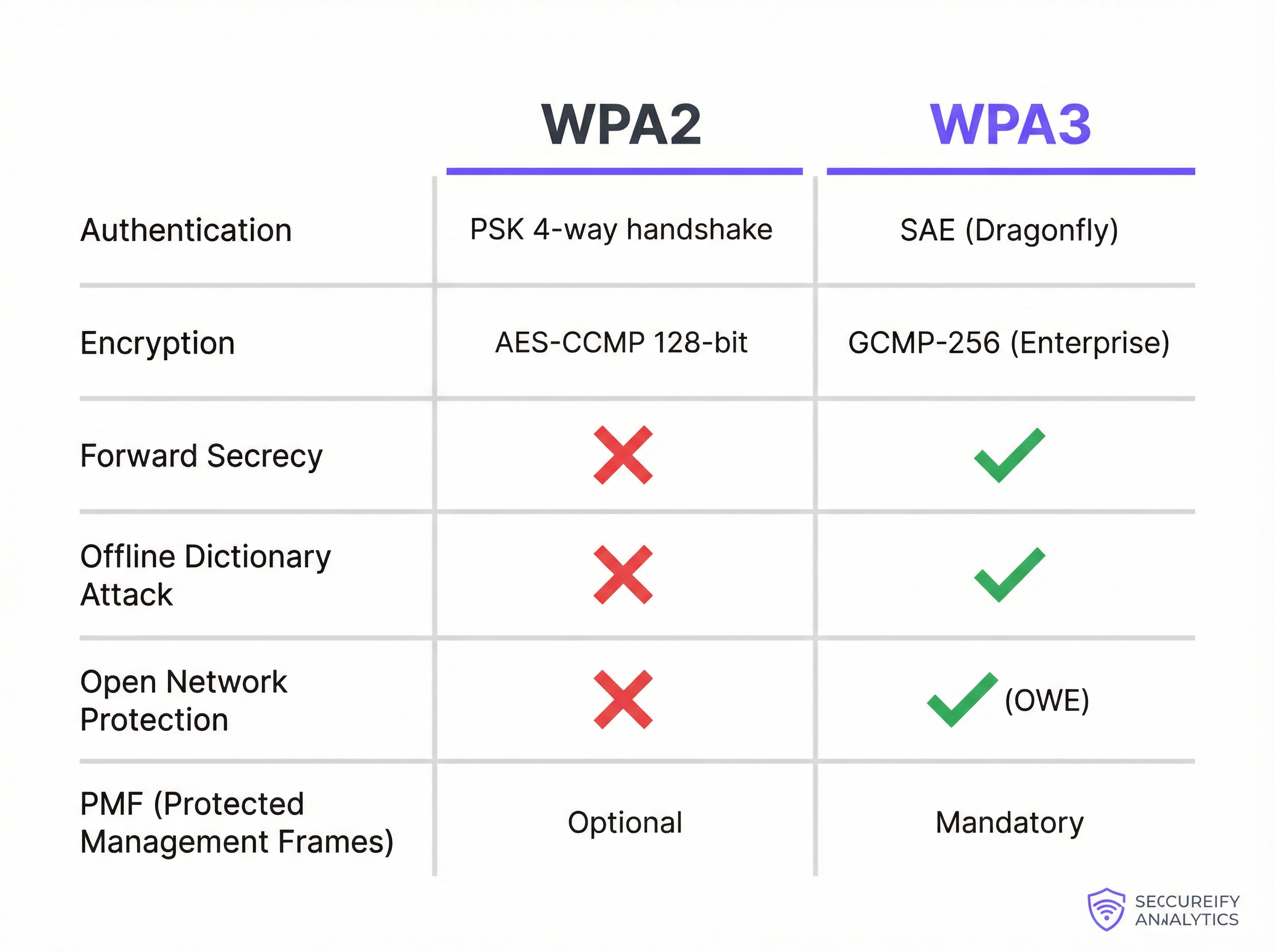
Die grundlegendste Änderung zwischen WPA2-Personal und WPA3-Personal ist der Authentifizierungsmechanismus. WPA2 verwendet einen Pre-Shared Key (PSK) in Kombination mit einem 4-Way-Handshake. Obwohl diese Methode zum Zeitpunkt ihrer Entwicklung effektiv war, ist sie anfällig für Offline-Wörterbuchangriffe. Ein Angreifer kann den Handshake passiv abfangen und dann Rechenleistung nutzen, um das Passwort offline zu erraten, ohne weiter mit dem Netzwerk zu interagieren. Dies macht Netzwerke, die mit schwachen oder mäßig komplexen Passwörtern gesichert sind, sehr anfällig für Kompromittierungen.
WPA3 ersetzt PSK durch Simultaneous Authentication of Equals (SAE), auch bekannt als Dragonfly Key Exchange. SAE ist ein passwortauthentifiziertes Schlüsselaustauschprotokoll, das resistent gegen Offline-Wörterbuchangriffe ist. Während des Authentifizierungsprozesses wird das Passwort niemals direkt ausgetauscht. Stattdessen verwenden sowohl der Client als auch der Access Point das Passwort, um kryptografische Hashes zu generieren, die dann ausgetauscht werden, um die gegenseitige Kenntnis des Schlüssels zu beweisen. Ein Angreifer, der diesen Austausch abfängt, kann ihn nicht nutzen, um das Passwort offline per Brute-Force zu knacken. Jeder Versuch, das Passwort zu erraten, muss ein aktiver Online-Angriff sein – was weitaus langsamer und viel einfacher zu erkennen und zu blockieren ist.
Verschlüsselung, Schlüsselverwaltung und Forward Secrecy
WPA2-Enterprise nutzt AES-CCMP mit 128-Bit-Verschlüsselung, was viele Jahre lang als sicher galt. WPA3-Enterprise legt die Messlatte deutlich höher und bietet einen optionalen 192-Bit-Sicherheitsmodus, der auf die Commercial National Security Algorithm (CNSA) Suite abgestimmt ist. Dies bietet ein kryptografisches Sicherheitsniveau, das für Regierungs-, Verteidigungs- und andere Hochsicherheitsumgebungen erforderlich ist.
Im weiteren Sinne führt WPA3 Perfect Forward Secrecy (PFS) ein. Wenn ein Angreifer bei WPA2 das Netzwerkpasswort kompromittiert, könnte er potenziell vergangenen Datenverkehr entschlüsseln, den er zuvor abgefangen und gespeichert hat. WPA3 mit SAE stellt sicher, dass jede Sitzung einen eindeutigen, ephemeren Verschlüsselungsschlüssel hat. Selbst wenn ein Schlüssel aus einer einzelnen Sitzung kompromittiert wird, kann er nicht zur Entschlüsselung früherer oder zukünftiger Sitzungen verwendet werden – was den Schadensradius einer potenziellen Sicherheitsverletzung drastisch reduziert.
Schutz für offene Netzwerke: Enhanced Open (OWE)
An öffentlichen Orten wie Hotels, Flughäfen und Einzelhandelsgeschäften sind offene (passwortfreie) WiFi-Netzwerke für den Gastzugang üblich. In einem herkömmlichen offenen Netzwerk wird der gesamte Datenverkehr im Klartext übertragen, wodurch jeder Nutzer anfällig für passives Abhören durch andere Personen im selben Netzwerk ist. WPA3 begegnet dem mit Enhanced Open, das Opportunistic Wireless Encryption (OWE) implementiert. OWE erstellt automatisch einen individuellen, verschlüsselten Tunnel zwischen jedem Nutzer und dem Access Point, selbst in einem Netzwerk ohne Passwort. Dies bietet echten Datenschutz, ohne den Verbindungsprozess zu erschweren – eine entscheidende Verbesserung für großflächige Gast-WiFi-Bereitstellungen.
Protected Management Frames (PMF)
Management Frames steuern, wie WiFi-Geräte ihre Verbindungen verwalten, einschließlich Assoziierung und Disassoziierung. In WPA2 sind diese Frames ungeschützt, was es einem Angreifer ermöglicht, sie zu fälschen, um einen legitimen Nutzer gewaltsam zu deauthentifizieren und so Denial-of-Service- oder Man-in-the-Middle-Angriffe zu ermöglichen. Während PMF (definiert in IEEE 802.11w) unter WPA2 optional war, schreibt WPA3 die Verwendung von Protected Management Frames vor. Dies gewährleistet die Integrität und Authentizität dieser kritischen Kontrollnachrichten und schützt die allgemeine Stabilität der drahtlosen Verbindung.
Implementierungsleitfaden
Die Migration eines Unternehmensnetzwerks von WPA2 zu WPA3 ist nicht mit dem einfachen Umlegen eines Schalters getan, sondern ein strategisches Projekt, das sorgfältige Planung und Ausführung erfordert. Das Ziel ist es, die Sicherheit zu erhöhen und gleichzeitig Störungen des Geschäftsbetriebs und der User Experience zu minimieren. Ein phasenweiser Ansatz ist fast immer der empfohlene Weg.
Phase 1 — Infrastruktur- und Geräte-Audit. Der erste Schritt ist ein umfassendes Audit Ihres gesamten drahtlosen Ökosystems. Identifizieren Sie bei Access Points Marke, Modell und Firmware-Version aller Geräte und prüfen Sie die Herstellerdokumentation auf WPA3-Unterstützung. Die meisten seit 2019 verkauften Enterprise-APs unterstützen WPA3, in der Regel ist jedoch ein Firmware-Upgrade erforderlich. Wenn Sie eine Controller-basierte Architektur verwenden, stellen Sie sicher, dass die Controller-Software auf eine Version aktualisiert wird, die WPA3-Konfiguration und -Verwaltung unterstützt. Der kritischste und anspruchsvollste Teil des Audits ist die Bestandsaufnahme der Client-Geräte. Sie müssen jedes Gerät katalogisieren, das sich mit Ihrem WiFi-Netzwerk verbindet – Firmen-Laptops, Smartphones, BYOD-Geräte und Spezialhardware wie Point-of-Sale (POS)-Terminals, Barcode-Scanner, IoT-Sensoren und Smart-Building-Komponenten.
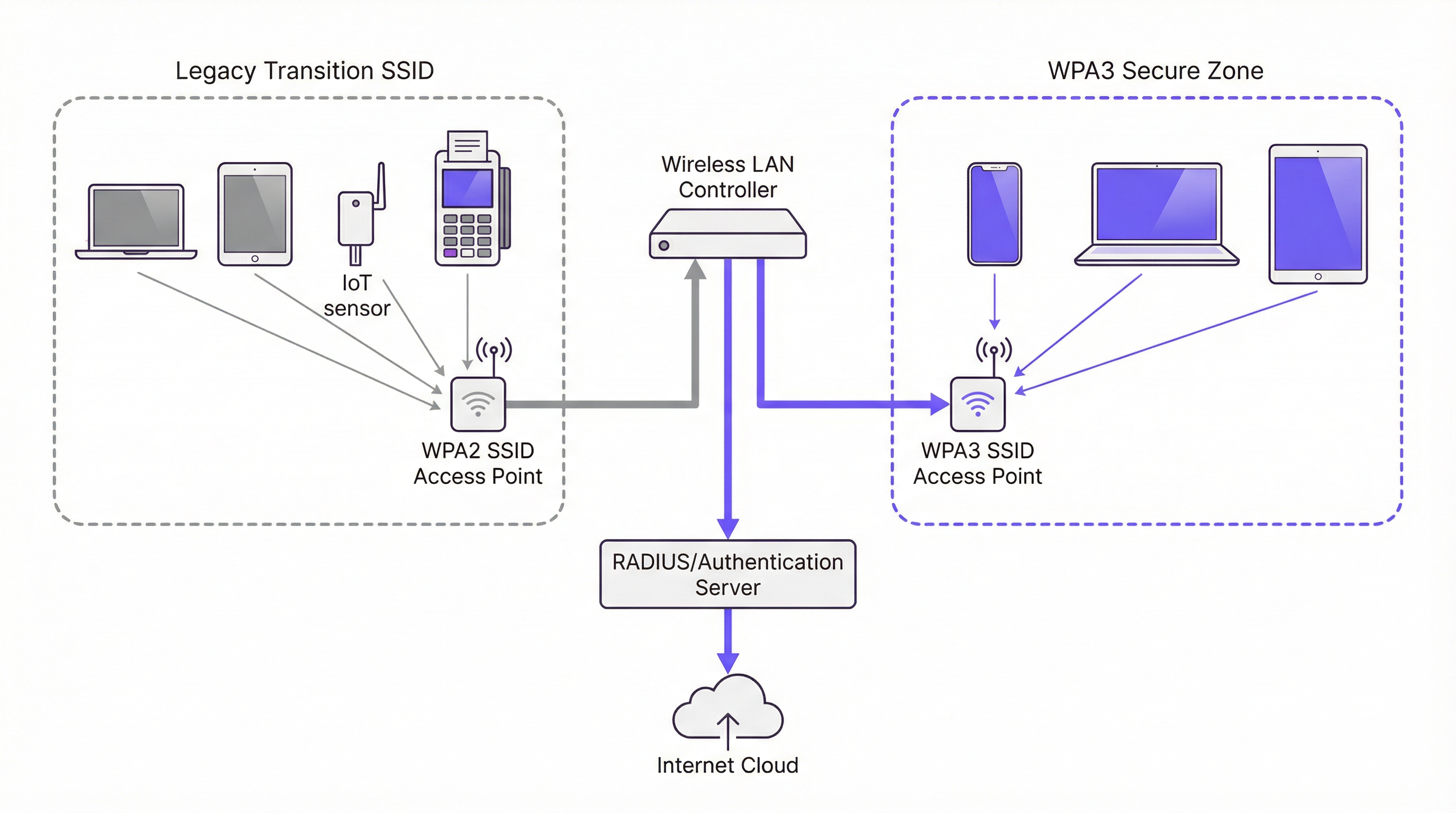
Phase 2 — Aktivierung des WPA3/WPA2 Transition Mode. Eine vollständige, sofortige Umstellung auf WPA3 ist für die meisten Unternehmen aufgrund der Vielfalt der Client-Geräte nicht praktikabel. Die branchenübliche Lösung ist die Verwendung des WPA3/WPA2 Mixed Mode, auch Transition Mode genannt. In dieser Konfiguration wird dieselbe SSID mit Unterstützung für sowohl WPA3- als auch WPA2-Authentifizierung ausgestrahlt. WPA3-fähige Clients verhandeln und verbinden sich automatisch über das sicherere Protokoll; Legacy-Clients verbinden sich über WPA2. Dies ermöglicht eine nahtlose User Experience während der Migrationsphase. In Ihrem Wireless LAN Controller oder der AP-Management-Oberfläche finden Sie in der Regel eine Sicherheitseinstellung für Ihre SSID, mit der Sie "WPA3+WPA2-Enterprise" oder eine ähnliche Mixed-Mode-Option auswählen können.
Phase 3 — Erstellung von reinen WPA3-Sicherheitszonen. Wenn Ihre Client-Geräte zunehmend WPA3-fähig werden, beginnen Sie mit der Erstellung von reinen WPA3-SSIDs für bestimmte Nutzergruppen oder Gerätetypen. Priorisieren Sie die Geräte und Nutzer, die die sensibelsten Daten verarbeiten. Erstellen Sie beispielsweise eine reine WPA3-SSID für die Finanzabteilung oder für Geräte der Geschäftsführung. Nutzen Sie dann Ihre Device-Management-Plattform, um neue Netzwerkprofile auf fähige Geräte zu pushen und so Ihre Abhängigkeit von der Mixed-Mode-SSID schrittweise zu verringern.
Phase 4 — Isolierung und Verwaltung von Legacy-Geräten. Unweigerlich werden Sie eine Vielzahl von Legacy-Geräten haben, die WPA3 nicht unterstützen. Erstellen Sie eine separate, dedizierte SSID, die nur für WPA2 konfiguriert ist und durch eine Firewall mit strengen Zugriffsregeln vom Rest des Unternehmensnetzwerks getrennt ist. Entwickeln Sie gleichzeitig einen Hardware-Refresh-Lifecycle-Plan, um nicht konforme Geräte im Laufe der Zeit auszumustern. Machen Sie bei jeder Neuanschaffung von Geräten die WPA3-Unterstützung zu einer zwingenden Beschaffungsanforderung.
Best Practices
Die folgende Tabelle fasst die wichtigsten branchenüblichen Empfehlungen für eine sichere WPA3-Bereitstellung zusammen und stützt sich dabei auf Richtlinien von IEEE 802.1X, Spezifikationen der Wi-Fi Alliance und PCI DSS v4.0-Anforderungen.
| Best Practice | Begründung | Priorität |
|---|---|---|
| 802.1X für alle Unternehmens-SSIDs vorschreiben | Eliminiert geteilte Passwörter; bietet nutzerbezogene Nachvollziehbarkeit und zentrale Richtlinienkontrolle über RADIUS. | Kritisch |
| EAP-TLS (zertifikatsbasierte Authentifizierung) implementieren | Beseitigt die passwortbasierte Angriffsfläche vollständig; Zertifikate können nicht durch Phishing entwendet werden. | Hoch |
| PMF in allen WPA2-Netzwerken aktivieren | Schützt vor Deauthentifizierungs- und Disassoziierungsangriffen, noch vor der vollständigen WPA3-Migration. | Hoch |
| Legacy-Datenraten (< 6 Mbps) deaktivieren | Entfernt die Kompatibilität mit den ältesten, am wenigsten sicheren Clients und verbessert die allgemeine Airtime-Effizienz. | Mittel |
| IoT- und Gastverkehr in dedizierte VLANs segmentieren | Begrenzt den Schadensradius bei einer Kompromittierung eines Legacy-Geräts oder offenen Netzwerks. | Kritisch |
| Einen Rhythmus für Firmware-Updates etablieren | Stellt sicher, dass bekannte Schwachstellen auf APs und Controllern zeitnah gepatcht werden. | Hoch |
| WPA3 bei allen neuen Hardwarebeschaffungen vorschreiben | Verhindert die Anhäufung technischer Schulden und beschleunigt den Zeitplan für die Migration. | Hoch |
Fehlerbehebung & Risikominderung
Die Bereitstellung von WPA3 kann neue Herausforderungen mit sich bringen. Die häufigste Fehlerquelle ist die Client-Konnektivität, bei der Geräte mit veralteten WLAN-Treibern oder Betriebssystemen keine WPA3-Verbindung aushandeln können. Die Lösung besteht fast immer darin, sicherzustellen, dass die neuesten Treiber und OS-Updates angewendet werden, bevor WPA3 aktiviert wird. Das Testen mit einer repräsentativen Auswahl an Gerätetypen vor einem breiten Rollout ist ein nicht verhandelbarer Schritt in jedem verantwortungsvollen Bereitstellungsplan.
Leistungseinbußen sind ein weiteres Bedenken, obwohl sie in der Praxis selten durch WPA3 selbst verursacht werden. Häufiger resultieren sie aus falsch konfigurierten Access Points oder fehlerhaften Firmware-Versionen. Die Validierung neuer Firmware in einer Laborumgebung vor der Bereitstellung in der Produktion und die genaue Überwachung wichtiger Metriken wie Latenz, Paketverlustraten und Retransmission-Counts nach jeder Konfigurationsänderung ermöglichen es Ihnen, Probleme schnell zu erkennen und zu beheben.
Die hartnäckigste Herausforderung ist die Verwaltung von IoT- und Headless-Geräten, denen die hochentwickelten Supplicants moderner Betriebssysteme fehlen. Diese Geräte sollten auf einer dedizierten, gehärteten reinen WPA2-SSID mit strengen Firewall-Regeln isoliert werden. Dies ist keine dauerhafte Lösung, sondern eine Maßnahme zur Risikoeindämmung, während ein Austauschplan entwickelt und ausgeführt wird.
ROI & Business Impact
Der ROI eines WPA3-Upgrades wird in erster Linie durch Risikominderung getrieben. Die Schwachstellen in WPA2 werden aktiv ausgenutzt, und ein erfolgreicher Angriff auf ein drahtloses Netzwerk kann zu Datenexfiltration, Reputationsschäden und erheblichen Compliance-Strafen unter Frameworks wie PCI DSS v4.0 und GDPR führen. Die Kosten einer einzigen Sicherheitsverletzung – einschließlich forensischer Untersuchungen, Anwaltskosten, Kundenbenachrichtigungen und behördlicher Geldstrafen – können leicht Hunderttausende von Euro erreichen. Die Investition in eine WPA3-fähige Infrastruktur ist nur ein Bruchteil dieser potenziellen Kosten.
Über das Risiko hinaus gibt es direkte Auswirkungen auf die Guest Experience und das Markenvertrauen. An öffentlichen Orten ist die Sicherheit des Gast-WiFi Teil des Markenversprechens. WPA3 Enhanced Open ermöglicht es Veranstaltungsorten, einen nahtlosen, passwortfreien Zugang bereitzustellen und gleichzeitig sicherzustellen, dass der Datenverkehr jedes Nutzers verschlüsselt und von anderen Nutzern im selben Netzwerk isoliert ist. Dies schafft Vertrauen und verbessert die allgemeine Guest Experience, ohne die betriebliche Komplexität zu erhöhen.
Schließlich ist WPA3 eine zukunftssichere Investition. Es ist die Sicherheitsgrundlage für WiFi 6, 6E und WiFi 7. Eine Verzögerung des Übergangs häuft nur technische Schulden an, was die spätere Migration komplexer und kostspieliger macht. Ein strategisches, phasenweises Upgrade auf WPA3 ist ein fiskalisch verantwortungsvoller Ansatz für die langfristige Planung der Netzwerkarchitektur, der über den Lebenszyklus der Infrastrukturinvestition hinweg steigende Erträge liefert.
Key Terms & Definitions
SAE (Simultaneous Authentication of Equals)
A password-authenticated key agreement protocol, also known as the Dragonfly handshake, that replaces WPA2's Pre-Shared Key (PSK) mechanism. SAE prevents offline dictionary attacks by ensuring the password is never transmitted or exposed during the authentication process. Both parties prove knowledge of the password through cryptographic exchange, making passive capture of the handshake useless to an attacker.
IT teams encounter SAE when configuring WPA3-Personal SSIDs. It is the primary reason WPA3-Personal is significantly more secure than WPA2-PSK and is the first capability to verify when assessing WPA3 readiness.
GCMP-256 (Galois/Counter Mode Protocol, 256-bit)
The encryption cipher used in WPA3-Enterprise's 192-bit security mode. GCMP-256 provides both data confidentiality and data integrity (authentication) in a single, highly efficient operation. It is aligned with the Commercial National Security Algorithm (CNSA) suite and represents a significant improvement over WPA2's AES-CCMP-128.
Relevant for network architects designing networks for government, defence, financial services, or healthcare environments where regulatory requirements mandate the highest available encryption standards.
Perfect Forward Secrecy (PFS)
A cryptographic property that ensures each communication session uses a unique, ephemeral encryption key. If a session key is compromised, it cannot be used to decrypt any past or future sessions. WPA3 achieves PFS through the SAE handshake, which generates a unique Pairwise Master Key (PMK) for each session.
Critical for environments where sensitive data is transmitted over WiFi and where the threat of 'capture now, decrypt later' attacks is a concern. PFS is a key differentiator between WPA2 and WPA3 from a data protection standpoint.
OWE (Opportunistic Wireless Encryption)
A WiFi security mechanism defined in RFC 8110 and implemented in WPA3 as 'Enhanced Open'. OWE automatically establishes an encrypted connection between each client and the access point on an open (password-free) network, providing individualised data encryption without any user interaction or credential exchange.
The standard configuration for guest and public WiFi in hospitality, retail, and venue environments. OWE allows operators to provide seamless connectivity while protecting users from passive eavesdropping, directly addressing a long-standing privacy concern with traditional open networks.
PMF (Protected Management Frames)
A security mechanism defined in IEEE 802.11w that encrypts and authenticates WiFi management frames, such as de-authentication and disassociation frames. Without PMF, an attacker can spoof these frames to forcibly disconnect legitimate users from the network. PMF is optional in WPA2 but mandatory in WPA3.
IT teams should enable PMF on all WPA2 networks as a hardening measure, even before migrating to WPA3. It is a simple configuration change that provides meaningful protection against denial-of-service attacks.
WPA3 Transition Mode
A mixed-mode SSID configuration that simultaneously supports both WPA3 and WPA2 authentication on the same network name (SSID). WPA3-capable clients automatically negotiate and use the more secure WPA3 protocol; legacy WPA2-only clients connect using the older protocol. This is the primary mechanism for managing the migration from WPA2 to WPA3 in environments with mixed device populations.
The recommended starting point for any WPA3 migration. IT teams should enable transition mode on existing SSIDs as the first step, then monitor which devices are connecting via WPA2 to identify the remaining legacy device population.
802.1X / RADIUS Authentication
An IEEE standard for port-based network access control. In the context of enterprise WiFi, 802.1X uses a RADIUS (Remote Authentication Dial-In User Service) server to authenticate individual users or devices before granting network access. This provides per-user accountability and centralised access control, replacing the single shared password of PSK-based networks.
The mandatory authentication framework for any corporate WiFi network carrying sensitive data. Both WPA2-Enterprise and WPA3-Enterprise use 802.1X as their authentication layer. IT teams should use this in conjunction with EAP-TLS (certificate-based authentication) for the highest security posture.
EAP-TLS (Extensible Authentication Protocol - Transport Layer Security)
A certificate-based WiFi authentication method that uses digital certificates on both the client and the authentication server to establish mutual trust, without requiring a password. EAP-TLS is considered the gold standard for enterprise WiFi authentication as it eliminates the risk of password phishing, credential theft, and brute-force attacks.
IT teams should prioritise EAP-TLS over password-based EAP methods (like PEAP-MSCHAPv2) for all corporate devices. It requires a Public Key Infrastructure (PKI) to manage and distribute certificates, but this investment is justified by the significant security improvement.
KRACK (Key Reinstallation Attack)
A vulnerability discovered in 2017 that exploits a flaw in the WPA2 four-way handshake. By manipulating and replaying cryptographic handshake messages, an attacker can force a victim's device to reinstall an already-in-use encryption key, causing nonce reuse and potentially allowing the attacker to decrypt, replay, or forge network packets. WPA3's SAE handshake is not susceptible to KRACK.
KRACK is a key reason for migrating to WPA3. While patches were released for many devices, not all devices received updates, and the underlying vulnerability is a structural weakness of the WPA2 handshake design. IT teams should treat unpatched devices as a significant risk.
Case Studies
A 450-room luxury hotel group with 12 properties needs to upgrade its guest and staff WiFi. The network currently runs WPA2-PSK for guests and WPA2-Enterprise for staff. The IT director is concerned about PCI DSS compliance for the payment systems on the staff network, and wants to improve guest privacy without adding a password requirement to the guest network. The estate includes a mix of Cisco Catalyst 9130 APs (WPA3-capable) and older Cisco 2800 series APs (WPA2-only). What is the recommended migration strategy?
The recommended approach is a phased, property-by-property migration that prioritises the highest-risk network segments first. For properties with Cisco 9130 APs, the immediate action is to update the controller software (Cisco IOS-XE) to a version that supports WPA3, then enable WPA3-Enterprise Transition Mode on the staff SSID. This allows WPA3-capable corporate devices to automatically use the more secure protocol while legacy devices continue to connect via WPA2-Enterprise. For the guest network, enable WPA3 Enhanced Open (OWE) on a new SSID. This provides automatic, per-user encryption for all guests without requiring a password, directly addressing the privacy concern. For properties with legacy Cisco 2800 APs, these units should be placed on a hardware refresh roadmap. In the interim, harden the existing WPA2-Enterprise configuration by ensuring 802.1X with EAP-TLS (certificate-based authentication) is in use for all staff devices. For PCI DSS compliance, ensure the payment systems are on a dedicated, isolated SSID or VLAN with the strictest possible access controls, and document the compensating controls in place while the hardware refresh is underway. The migration should be completed property by property, starting with the highest-revenue or highest-risk locations, to manage change and validate the configuration before a full estate rollout.
A national retail chain with 250 stores is preparing for a PCI DSS v4.0 audit. Each store has a mix of corporate WiFi (for staff devices and POS terminals) and guest WiFi (for customer-facing promotions and loyalty app connectivity). The IT security team has been told by the auditors that their current WPA2-PSK configuration for the staff network is a finding. The POS terminals are a mix of modern Android-based units (WPA3-capable) and older Windows CE-based units (WPA2-only). How should the IT team respond to the audit finding and plan the remediation?
The audit finding is valid. WPA2-PSK for a network carrying payment card data is a significant risk, as a single compromised password exposes the entire network. The immediate remediation for the staff network is to migrate from WPA2-PSK to WPA2-Enterprise with 802.1X authentication, using a RADIUS server (e.g., Cisco ISE, Aruba ClearPass, or a cloud-based RADIUS service). This provides per-device authentication and eliminates the shared password vulnerability. This action alone resolves the audit finding and is achievable without any hardware changes. In parallel, the team should audit all POS terminals and other staff devices for WPA3 capability. For the modern Android POS terminals, enable WPA3-Enterprise Transition Mode on the staff SSID. For the legacy Windows CE units, these must be placed on a dedicated, isolated SSID with WPA2-Enterprise and strict VLAN-based network segmentation, ensuring they can only communicate with the payment processing server and nothing else. For the guest network, implement WPA3 Enhanced Open to provide customer privacy. This also demonstrates a proactive security posture to the auditors, which is beneficial for the overall compliance assessment.
Scenario Analysis
Q1. A 20,000-seat stadium is deploying a new WiFi network for a major multi-day event. The network must support 15,000 concurrent guest connections and a separate staff network for 500 employees handling ticketing and point-of-sale. The IT team has a budget for new WiFi 6E access points. The event organiser wants to offer free, seamless WiFi to all attendees without a password. What security protocol configuration would you recommend for the guest and staff networks, and why?
💡 Hint:Consider the specific use case for each network segment. The guest network requires seamless access with privacy; the staff network requires strong authentication for PCI DSS compliance. WPA3 has specific features designed for each of these scenarios.
Show Recommended Approach
For the guest network, the correct configuration is WPA3 Enhanced Open (OWE). This provides automatic, per-user encrypted tunnels without requiring a password, delivering the seamless experience the organiser wants while protecting each attendee's traffic from eavesdropping by other users. A traditional open network would leave all guest traffic in plaintext. For the staff network, the configuration should be WPA3-Enterprise with 802.1X authentication using a RADIUS server. Since the staff are handling payment card data via POS terminals, this is a PCI DSS requirement. If the POS terminals support it, EAP-TLS (certificate-based authentication) is the preferred EAP method. The two networks should be on completely separate VLANs with strict firewall rules between them. Since the new APs are WiFi 6E, they will natively support WPA3, so no transition mode is required for a greenfield deployment.
Q2. An IT manager at a 50-store retail chain has just received a penetration test report showing that the WPA2-PSK password for the staff network was cracked using an offline dictionary attack. The password was 12 characters long and considered 'strong'. The manager needs to remediate the finding immediately. What is the most effective immediate action, and what is the longer-term strategic recommendation?
💡 Hint:The root cause is not the password strength — it is the use of PSK. Consider what authentication mechanism would eliminate this entire class of vulnerability, regardless of password complexity.
Show Recommended Approach
The immediate action is to change the PSK to a highly complex, randomly generated passphrase (at least 20 characters) to reduce the risk while the longer-term fix is implemented. However, the strategic recommendation is to migrate from WPA2-PSK to WPA2-Enterprise with 802.1X authentication. This eliminates the shared password entirely. Each device or user authenticates individually against a RADIUS server, and there is no single password to crack. The preferred EAP method is EAP-TLS, which uses digital certificates instead of passwords, making offline dictionary attacks impossible. In parallel, the team should assess the WPA3 readiness of their access points and begin planning a migration to WPA3-Enterprise, which provides the additional protection of SAE and Perfect Forward Secrecy. The key insight is that the problem is not the password strength but the use of a shared secret — 802.1X eliminates this vulnerability class entirely.
Q3. A large conference centre is planning to upgrade its WiFi infrastructure. The venue hosts events ranging from small corporate meetings to large trade shows with 5,000+ attendees. The IT team is evaluating whether to deploy WPA3-only, WPA2-only, or a mixed WPA3/WPA2 configuration. The venue's device inventory shows that 85% of client devices are modern smartphones and laptops that support WPA3, but 15% are older event management tablets and barcode scanners that only support WPA2. What is the recommended SSID architecture?
💡 Hint:Consider the different user groups and device types. A single SSID for all devices may not be the optimal solution. Think about how to provide the highest security for the majority while managing the risk of the legacy minority.
Show Recommended Approach
The recommended architecture is a three-SSID model. First, a WPA3-Enterprise SSID for staff corporate devices (the modern laptops and smartphones), providing the highest security with 802.1X authentication. Second, a WPA3 Enhanced Open SSID for event attendees and guests, providing seamless, encrypted public access. Third, a dedicated WPA2-Enterprise (or WPA2-PSK) SSID, isolated on its own VLAN with strict firewall rules, for the legacy event management tablets and barcode scanners. This architecture ensures that the 85% of capable devices get the full benefit of WPA3, while the legacy 15% are contained and managed without compromising the security of the rest of the network. The legacy SSID should be treated as a temporary measure, with a hardware refresh plan to replace the non-compliant devices within a defined timeframe. Using WPA3 Transition Mode on a single SSID is an alternative but less preferable option, as it means the entire SSID operates at WPA2 security levels for any client that connects via WPA2.
Key Takeaways
- ✓WPA3 replaces WPA2's vulnerable PSK 4-way handshake with SAE (Simultaneous Authentication of Equals), which completely eliminates offline dictionary attacks — the most common method used to crack WiFi passwords.
- ✓WPA3 introduces Perfect Forward Secrecy, ensuring that a compromised session key cannot be used to decrypt previously captured traffic, defeating 'steal now, decrypt later' attack strategies.
- ✓WPA3 Enhanced Open (OWE) provides automatic, per-user encrypted tunnels on open, password-free networks — the optimal configuration for guest WiFi in hotels, retail stores, and stadiums.
- ✓WPA3 Transition Mode is the recommended migration path: it allows a single SSID to support both WPA2 and WPA3 clients simultaneously, enabling a phased migration without disrupting legacy devices.
- ✓The most critical immediate action for any organisation still using WPA2-PSK on a corporate network is to migrate to 802.1X authentication — this eliminates the shared password vulnerability regardless of WPA version.
- ✓A comprehensive device audit is the non-negotiable first step in any WPA3 migration. Legacy IoT and headless devices that cannot support WPA3 must be isolated on dedicated, firewalled network segments.
- ✓WPA3 is the security foundation for WiFi 6, 6E, and WiFi 7. Mandating WPA3 support in all new hardware procurement is the most effective long-term strategy for managing the transition and preventing the accumulation of technical debt.




