

SMS Authentication for WiFi: How It Works and When to Use It
A technical reference for IT managers and venue operators on implementing SMS-based WiFi authentication. This guide details the technical workflow, compares it against social login, and provides actionable best practices for deployment in enterprise environments like hotels, retail, and stadiums.
🎧 Listen to this Guide
View Transcript
Executive Summary
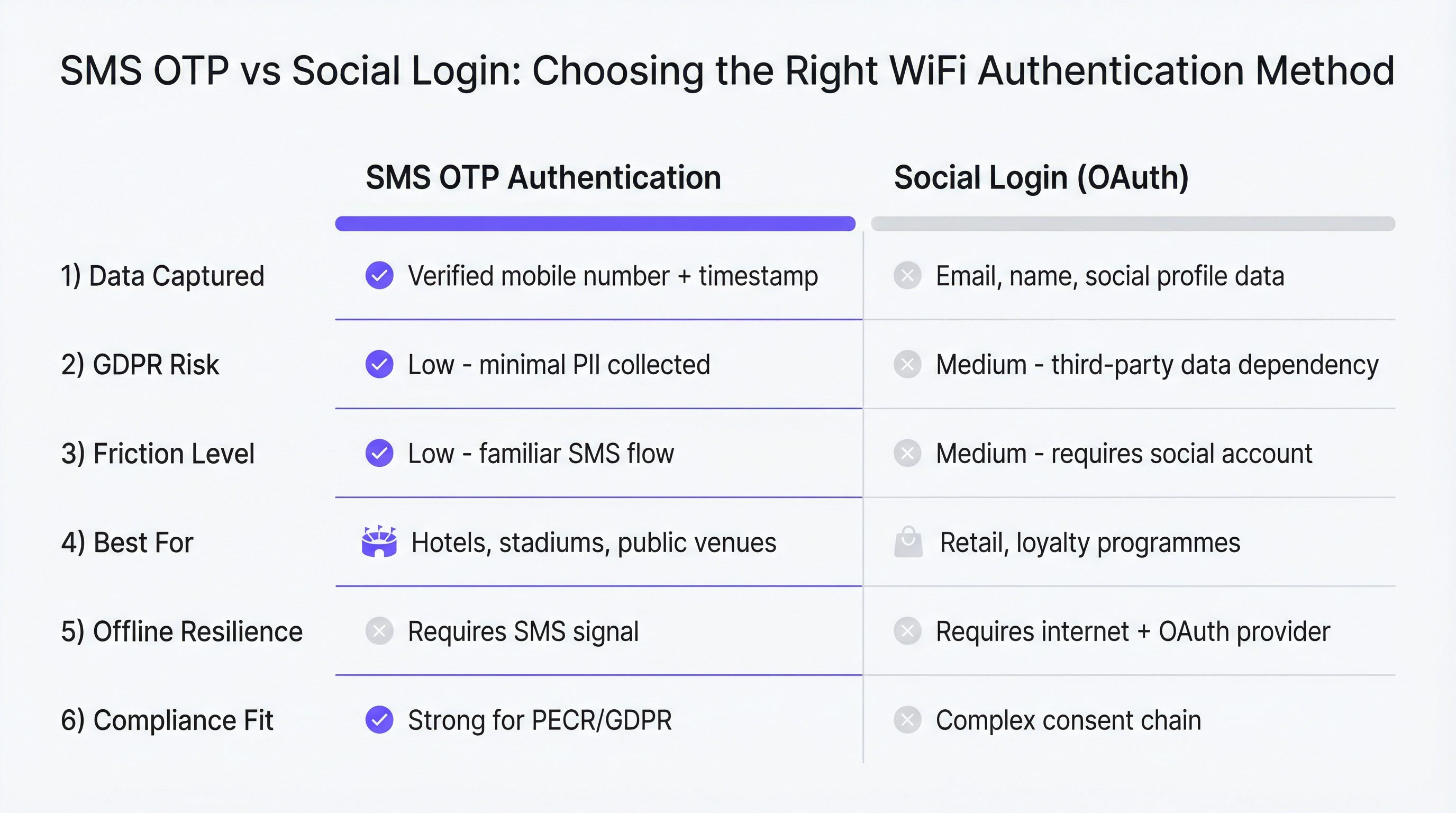
For IT executives and venue operators, deploying guest WiFi is no longer just about providing connectivity; it's a strategic tool for data acquisition, marketing, and enhancing the visitor experience. The choice of authentication method is a critical decision with direct implications for compliance, data quality, and return on investment. SMS-based authentication, using a one-time passcode (OTP) sent to a user's mobile phone, has emerged as a robust, secure, and highly effective method for large-scale deployments. Unlike social media logins, which introduce third-party data dependencies and complex consent chains, SMS OTP provides a direct, verified link to the user via their mobile number. This lean data approach simplifies GDPR and PECR compliance while capturing a persistent, actionable identity anchor. This guide provides a comprehensive technical and strategic overview of SMS WiFi authentication, offering vendor-neutral deployment blueprints, risk mitigation strategies, and clear ROI metrics for CTOs, network architects, and operations directors.
Technical Deep-Dive
The SMS authentication workflow is initiated when a guest connects to the public-facing SSID and is redirected to a captive portal. This process, governed by standards like RFC 7710, intercepts the user's initial HTTP request and presents a branded login page. The core components of this architecture include:
- Captive Portal: The web interface where users interact with the authentication system. It captures the user's mobile number.
- RADIUS Server/Access Controller: The backend system (like Purple) that manages authentication logic, user policies, and communicates with the network hardware.
- SMS Gateway: A third-party service (e.g., Twilio, Vonage) that handles the dispatch and delivery of the OTP to the user's mobile device via an API call.
- Network Infrastructure: The WiFi access points and controllers (e.g., Cisco Meraki, Aruba, Ruckus) that enforce the access policies defined by the RADIUS server.
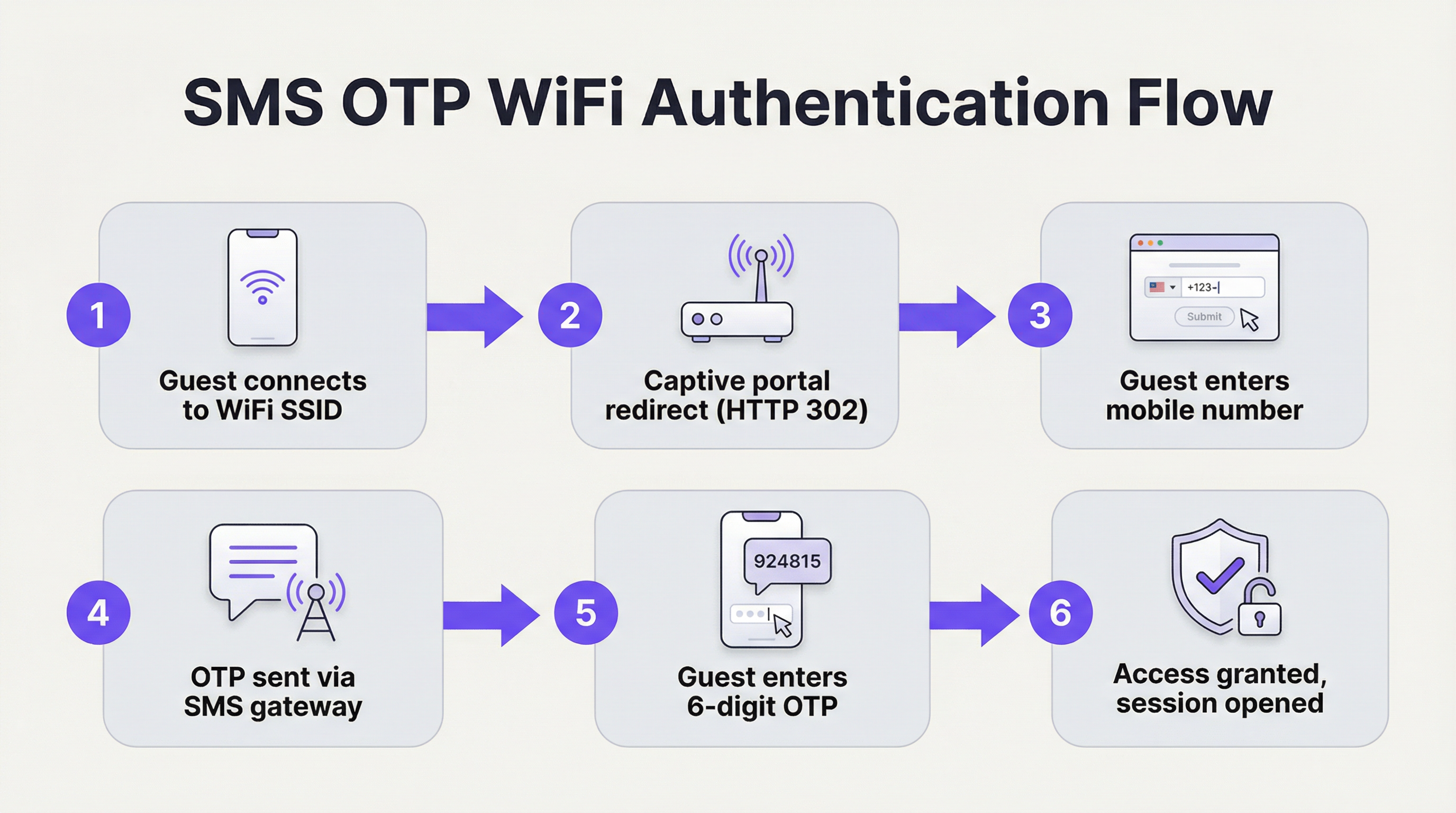
The flow is as follows: The user enters their number, the platform sends an OTP via the gateway, the user enters the OTP, and upon successful validation, the access controller opens a session for the device's MAC address. This creates a verified data record linking the device, phone number, and session time, providing a powerful dataset for analytics and marketing.
Implementation Guide
Deploying a resilient SMS authentication system requires careful planning. The following steps provide a vendor-neutral framework for a successful rollout:
- Infrastructure Assessment: Ensure your network hardware supports captive portal redirection and RADIUS integration. Most enterprise-grade vendors are compatible.
- Platform Selection: Choose a WiFi intelligence platform that offers robust SMS authentication features, including multi-gateway support and detailed analytics.
- Gateway Configuration: Select and configure at least two SMS gateway providers for redundancy. Prioritise providers with strong delivery rates in your primary operating regions.
- Portal Design: Design a clean, mobile-first captive portal. It must include an international dialling code selector, a clear call-to-action, and separate, un-ticked checkboxes for marketing consent and terms of service acceptance.
- Policy Definition: Configure session policies, including session duration, bandwidth limits, and re-authentication windows. For a hotel, a 24-hour session is standard; for a conference, a 4-hour session might be more appropriate.
- Testing and Go-Live: Test the end-to-end flow with multiple device types and international numbers before full deployment.
Best Practices
- Redundancy is Key: Never rely on a single SMS gateway. Network conditions and provider outages can disrupt OTP delivery. Configure automatic failover.
- Prioritise User Experience: The login process should be frictionless. Provide clear instructions and error messages. Offer a fallback authentication method (e.g., email) for users without cellular service.
- Compliance by Design: Embed data privacy into the system. Capture explicit, unbundled consent for marketing communications. Ensure your data retention policies are aligned with GDPR requirements.
- Monitor and Analyse: Use the captured data to understand visitor behaviour, dwell times, and footfall patterns. Integrate this data with your CRM and marketing automation platforms to drive engagement.
Troubleshooting & Risk Mitigation
- OTP Delivery Failure: The most common issue. Caused by poor in-venue cellular coverage or gateway deliverability problems. Mitigate with gateway redundancy and by offering a fallback authentication method.
- International Number Issues: Incorrect handling of E.164 number formatting can prevent international guests from receiving OTPs. Test thoroughly.
- SMS Pumping/Toll Fraud: Malicious actors can abuse the OTP form to generate high volumes of SMS messages, driving up costs. Mitigate with strict rate limiting (e.g., max 3 OTP requests per number per hour) and CAPTCHA implementation.
ROI & Business Impact
The investment in an SMS authentication system delivers returns across multiple business functions:
- Marketing: Builds a high-quality, verified database of mobile numbers for targeted SMS marketing campaigns, driving repeat visits and increasing customer lifetime value.
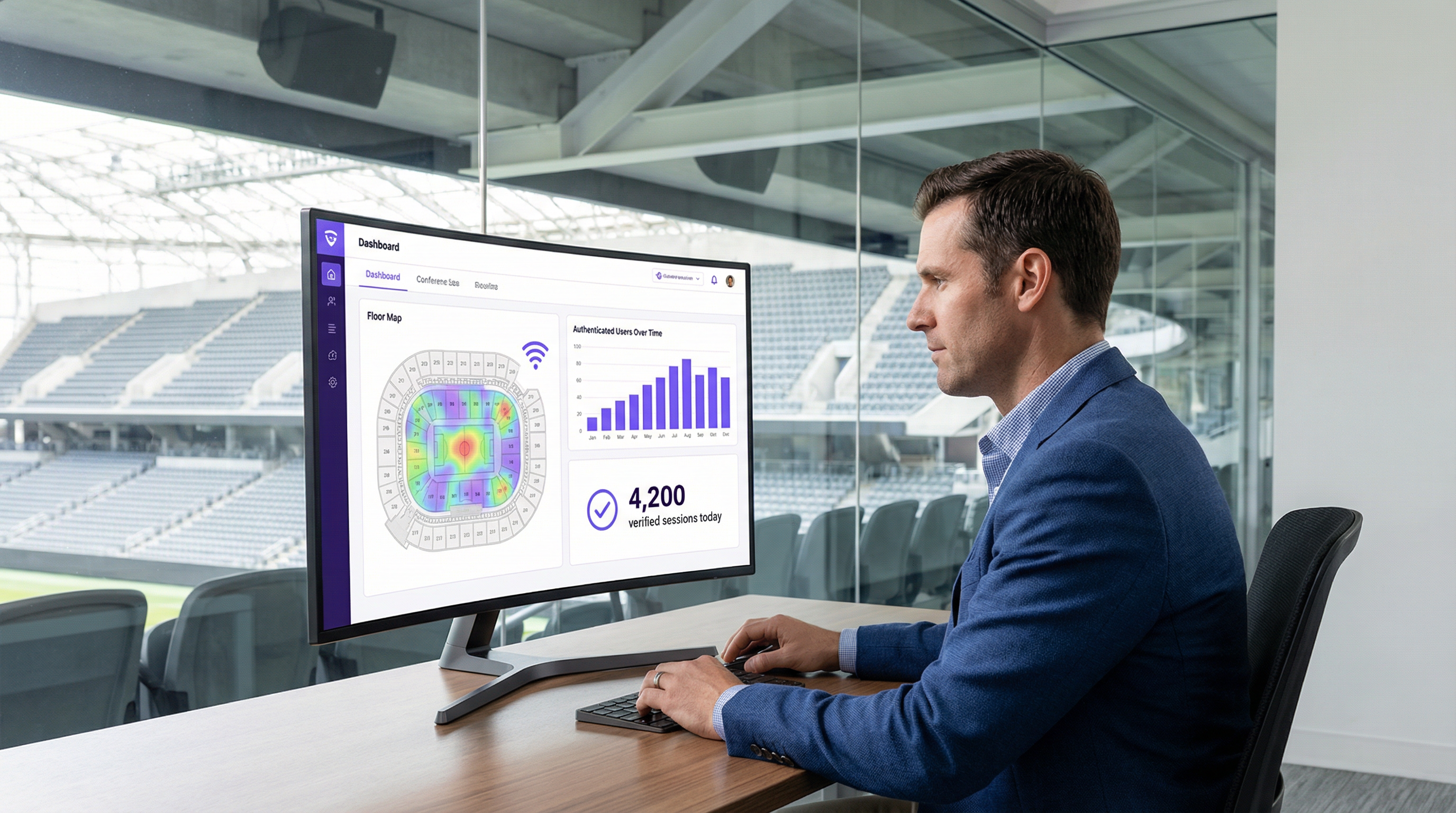
- Operations: Provides rich analytics on visitor footfall, dwell times, and movement patterns, enabling optimisation of staffing, layout, and resource allocation.
- IT & Security: Reduces the compliance burden compared to social login and provides a secure, auditable record of network access, fulfilling legal requirements for public WiFi provision in many jurisdictions.
Key Terms & Definitions
Captive Portal
A web page that the user of a public-access network is obliged to view and interact with before access is granted. It intercepts traffic and redirects the user to a login page.
This is the primary user interface for any guest WiFi authentication method, including SMS OTP. Its design and usability directly impact guest experience and data capture rates.
SMS Gateway
A service that allows a computer to send or receive Short Message Service (SMS) transmissions to or from a telecommunications network. Most gateways use APIs to integrate with software platforms.
This is the engine that powers SMS authentication. The choice of gateway provider affects OTP delivery speed, reliability, and cost.
RADIUS (Remote Authentication Dial-In User Service)
A networking protocol that provides centralized Authentication, Authorization, and Accounting (AAA) management for users who connect and use a network service.
In a guest WiFi context, the RADIUS server is the brain that communicates with the network hardware to grant or deny access based on the authentication result from the captive portal.
E.164
An international telephone numbering plan that ensures each device on the public switched telephone network has a globally unique number.
Your captive portal must correctly process numbers in E.164 format (e.g., +447123456789) to successfully authenticate international guests. Failure to do so is a common point of failure.
SSID (Service Set Identifier)
The primary name associated with an 802.11 wireless local area network (WLAN). It's the human-readable name a user sees when they scan for WiFi networks.
IT teams will often configure separate SSIDs for guest and corporate networks. The guest SSID is the one configured to trigger the captive portal and SMS authentication.
MAC Address (Media Access Control Address)
A unique identifier assigned to a network interface controller (NIC) for use as a network address in communications within a network segment.
The access controller uses the MAC address to identify a specific device during a session. While MAC randomization on modern devices complicates long-term tracking, the verified phone number becomes the persistent identifier.
GDPR (General Data Protection Regulation)
A regulation in EU law on data protection and privacy in the European Union and the European Economic Area.
SMS authentication, with its minimal data collection and clear consent model, provides a straightforward path to GDPR compliance for guest WiFi services.
SMS Pumping (Toll Fraud)
A type of fraud where attackers exploit a business's SMS services by triggering a high volume of OTPs to premium-rate numbers they control.
This is a significant financial risk for any large-scale SMS auth deployment. It must be mitigated with strict rate-limiting and security measures like CAPTCHA.
Case Studies
A 200-room luxury hotel in central London needs to replace its insecure, open WiFi network. The goal is to capture guest data for marketing, understand guest movements between the lobby, bar, and spa, and ensure compliance with UK GDPR. The guest demographic is highly international.
Deploy a new WPA2-secured SSID named 'TheGrand_GuestWiFi'. Configure a captive portal with SMS authentication as the primary method. The portal will feature the hotel's branding and an international number input. Select two SMS gateways: a UK-based provider for domestic numbers and a global provider like Vonage for international numbers, with automatic failover. Set a 24-hour session time. The portal will include a separate, un-ticked checkbox for guests to opt-in to the hotel's 'VIP Offers' SMS list. The Purple platform will be used to track device movements between APs in different zones (bar, spa, lobby) to build a behavioral profile.
A large exhibition centre hosting multiple B2B and B2C events per week needs to provide reliable WiFi for up to 10,000 concurrent users. They need to segment data by event and provide sponsors with post-event analytics on attendee engagement.
Implement a robust WiFi infrastructure with high-density APs. Use SMS authentication with event-specific SSIDs or access codes. Set short session times (e.g., 4 hours) to align with event durations and capture fresh data for each event. Implement strict rate limiting and CAPTCHA to prevent SMS toll fraud during high-traffic periods. Use the WiFi analytics platform to create separate dashboards for each event, tracking metrics like total authenticated users, peak concurrency, and popular zones. This data can be packaged into a post-event report for sponsors.
Scenario Analysis
Q1. You are deploying guest WiFi in a new-build, 50-story office tower with a mixed-use ground floor (cafes, retail). The building has a DAS (Distributed Antenna System) for cellular, but coverage can be inconsistent in elevator cores and basements. How do you design the authentication flow to maximize both security and user convenience?
💡 Hint:Consider the physical environment and potential points of failure. A single authentication method may not be sufficient.
Show Recommended Approach
The recommended approach is a multi-factor authentication strategy. The primary method should be SMS OTP due to its security and data quality benefits. However, to mitigate the risk of poor cellular coverage in specific areas, the captive portal must offer a clear, secondary option for 'email-based verification'. This ensures that users who cannot receive an SMS can still get online. The portal logic should prioritize SMS but make the email fallback easily accessible after a single failed SMS attempt.
Q2. A retail chain with 300 stores wants to use WiFi analytics to measure the effectiveness of a new window display. They need to know how many people walk past a store vs. how many enter. They are currently using a simple 'click-to-connect' open network. Why is this method insufficient, and what should they replace it with?
💡 Hint:Think about what data is needed to differentiate between a passer-by and an in-store visitor. How can you reliably identify a returning visitor?
Show Recommended Approach
'Click-to-connect' is insufficient because it doesn't provide a persistent user identifier. Due to MAC address randomization, you can't reliably tell if a device seen outside is the same one that later connects inside. They should replace it with SMS authentication. By capturing a verified phone number, they create a persistent ID for each visitor. This allows them to correlate 'probe requests' (from devices outside) with 'connection events' (from devices inside) and accurately measure their walk-in rate, as well as track repeat visits over time.
Q3. Your CFO has questioned the monthly cost of your SMS gateway service. Prepare a business case justifying the expense. What are the three key pillars of your argument?
💡 Hint:Frame the cost as an investment, not an expense. What is the tangible business value generated by the data you are collecting?
Show Recommended Approach
The business case rests on three pillars: 1) Enhanced Marketing ROI: The verified mobile numbers collected are a high-quality asset for targeted SMS marketing, leading to measurable increases in repeat visits and customer spend. 2) Operational Intelligence: The analytics derived from authenticated sessions (footfall, dwell time) allow us to optimize staffing and layout, leading to direct cost savings and revenue uplift. 3) Compliance & Risk Mitigation: SMS auth provides a robust, auditable trail of network access, fulfilling legal obligations and reducing the company's risk profile compared to less secure methods. The gateway cost is a small investment to unlock this significant business value.
Key Takeaways
- ✓SMS authentication provides a verified, persistent mobile number, a high-value asset for marketing and analytics.
- ✓The technical flow involves a captive portal redirect, phone number submission, and OTP validation via an SMS gateway.
- ✓Compared to social login, SMS auth offers a simpler GDPR compliance profile and is not dependent on third-party social media platforms.
- ✓Key deployment best practices include using redundant SMS gateways, implementing strict rate limiting, and capturing explicit marketing consent.
- ✓The primary risk is OTP delivery failure due to poor cellular coverage, which should be mitigated with a fallback authentication method.
- ✓The ROI of SMS auth is driven by improved marketing effectiveness, operational insights from analytics, and a stronger compliance posture.
- ✓SMS auth is the preferred method for large, diverse-audience venues like hotels, stadiums, and public-sector organizations.




