

Metropolitan Area Networks (MANs): A Deep Dive into Technologies, Applications, and Future Trends
This guide provides a comprehensive technical reference on Metropolitan Area Networks (MANs) for IT leaders and network architects. It covers core technologies, deployment strategies, and business considerations for implementing high-performance, city-scale networks. The content is tailored for decision-makers in hospitality, retail, events, and public-sector organisations.
🎧 Listen to this Guide
View Transcript

Executive Summary
A Metropolitan Area Network (MAN) is a critical infrastructure component for any organisation operating across multiple sites within a single geographic region. By interconnecting distributed Local Area Networks (LANs), a MAN creates a unified, high-performance network fabric that reduces latency, lowers inter-site bandwidth costs, and enables centralised management and security. For CTOs and IT directors at hotel chains, retail franchises, and large-scale venues, a well-architected MAN is the foundation for delivering a consistent, high-quality connected experience, supporting data-intensive cloud applications, and scaling for future demands like IoT and 5G. This guide provides a vendor-neutral, technical deep-dive into MAN architecture, deployment models, and operational best practices. It moves beyond academic theory to offer actionable guidance for planning, implementing, and optimising a MAN to drive measurable business value, enhance security posture, and ensure a positive return on investment.
Technical Deep-Dive
A MAN bridges the gap between the local and wide area network, typically spanning a geographic area of 5 to 50 kilometres. Its primary function is to provide high-speed, low-latency connectivity between disparate locations, such as corporate offices, data centres, and public venues. The architecture is typically hierarchical, comprising three distinct layers.
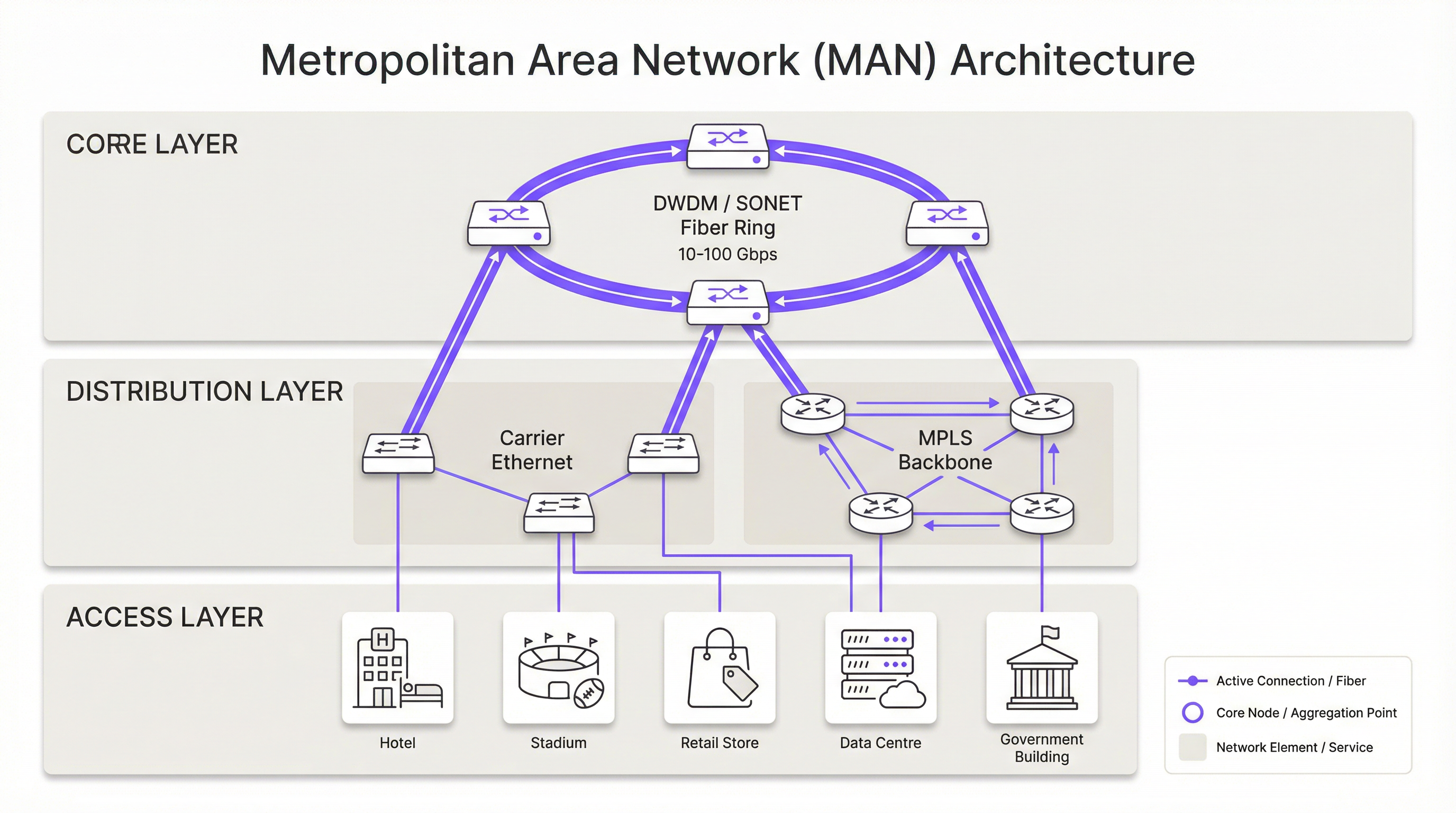
1. Core Layer: This is the network's high-speed backbone, almost exclusively built on a redundant fibre optic ring. Technologies like Dense Wavelength Division Multiplexing (DWDM) and Synchronous Optical Networking (SONET) allow for multiple data streams over a single fibre pair, with typical bandwidths ranging from 10 Gbps to 100 Gbps and beyond. The ring topology, often governed by the IEEE 802.17 Resilient Packet Ring (RPR) standard, ensures high availability with sub-50ms failover times, making the core resilient to single-node or link failures.
2. Distribution Layer: This middle layer aggregates traffic from the access layer and connects it to the core. Key technologies here include Carrier Ethernet and Multiprotocol Label Switching (MPLS). MPLS is particularly crucial for enterprise-grade MANs, as it enables traffic engineering, Quality of Service (QoS) guarantees, and the creation of secure, private Layer 2 or Layer 3 VPNs. This allows organisations to segment traffic—for instance, separating corporate data from public guest WiFi—across the shared infrastructure.
3. Access Layer: This is the "last mile" that connects individual buildings and venues to the distribution layer. While fibre remains the preferred medium for its performance and reliability, this layer often employs a mix of technologies based on cost and practicality. Fixed Wireless Access (FWA) using microwave links and, increasingly, 5G cellular technology provide robust, high-speed alternatives where laying fibre is prohibitive.
Implementation Guide
Deploying a MAN is a significant undertaking that requires careful planning. The process can be broken down into four key phases.
Phase 1: Feasibility and Business Case Development. Begin by auditing your existing inter-site connectivity costs and performance limitations. Identify the key business drivers for a MAN—are you looking to improve cloud application performance, centralise data backup, or launch a new city-wide guest service? Model the Total Cost of Ownership (TCO) of a MAN, comparing a build-out model (leasing dark fibre) versus a managed service from a carrier. For most organisations with more than five sites in a metro area, a build model offers a superior ROI over a 7-10 year period.
Phase 2: Technology Selection and Vendor-Neutral Design. Based on your business requirements, create a high-level design. Specify open, standards-based technologies (e.g., Carrier Ethernet, MPLS) to avoid vendor lock-in. Your design must detail the three-layer architecture, proposed routing protocols (like OSPF and BGP), and a comprehensive security plan incorporating IEEE 802.1X, VLAN segmentation, and encryption strategies like MACsec.
Phase 3: Procurement and Physical Deployment. This phase is often the most challenging, as it involves navigating right-of-way permits and civil works for fibre deployment. Issue RFPs based on your vendor-neutral design. When leasing dark fibre, ensure the Service Level Agreement (SLA) specifies fibre characteristics and mean-time-to-repair (MTTR). For wireless links, conduct a thorough RF survey to identify potential interference.
Phase 4: Commissioning and Operational Handover. Once the physical infrastructure is in place, the network is commissioned. This involves configuring all network elements, testing failover and redundancy mechanisms, and validating performance against the design specifications. Finally, the network is handed over to the Network Operations Centre (NOC) team, equipped with the necessary monitoring and management tools.
Best Practices
- Design for Redundancy: A MAN must be resilient. The core should feature diverse fibre paths, the distribution layer should have dual-homed connections to the core, and critical access sites should have a secondary failover path (e.g., fibre primary, 5G FWA secondary).
- Segment Traffic Logically: Use VLANs (IEEE 802.1Q) and MPLS VPNs to create logically separate networks for different traffic types (e.g., corporate, guest, IoT, VoIP). This is a foundational requirement for security and compliance with standards like PCI DSS and GDPR.
- Centralise Network Monitoring: Deploy a robust Network Monitoring System (NMS) that provides a single pane of glass for the entire MAN. The system should monitor link utilisation, latency, packet loss, and device health in real-time, with AI-driven alerting to enable proactive maintenance.
- Prioritise Security: Implement port-based access control using IEEE 802.1X on all wired ports. For wireless segments, mandate WPA3-Enterprise. Encrypt sensitive traffic in transit using IPsec or MACsec. Regularly conduct vulnerability assessments and penetration testing.
Troubleshooting & Risk Mitigation
| Common Failure Mode | Mitigation Strategy | Troubleshooting Steps |
|---|---|---|
| Fibre Cut | Use a redundant ring topology with diverse physical paths. Ensure carrier SLA includes stringent MTTR. | Use Optical Time-Domain Reflectometer (OTDR) to pinpoint the break location. Reroute traffic via the secondary path. |
| Configuration Error | Implement a rigorous change management process with peer review. Use network automation tools with pre-deployment validation. | Roll back to the last known good configuration. Use network monitoring tools to correlate the fault with the recent change. |
| DDoS Attack | Contract with a cloud-based DDoS mitigation service that can scrub malicious traffic before it reaches your network edge. | Identify the attack vector and target using NetFlow analysis. Engage DDoS mitigation provider to apply filtering rules. |
| Power Outage at Node | Equip all core and distribution nodes with uninterruptible power supplies (UPS) and, for critical nodes, backup generators. | Verify power status at the affected node. Monitor UPS and generator logs. |
ROI & Business Impact
Calculating the Return on Investment for a MAN involves more than just comparing connectivity costs. The business impact is multifaceted. Direct cost savings come from consolidating multiple expensive internet connections and leased lines into a single, more efficient backbone. Productivity gains are realised through lower latency, which improves the performance of cloud-based applications, VoIP, and video conferencing. Enhanced security and compliance reduce the risk of costly data breaches and regulatory fines. Finally, a MAN is an enabling platform for innovation; it provides the scalable, high-performance foundation required for smart building initiatives, large-scale IoT deployments, and next-generation guest experiences. When building the business case, quantify each of these benefits to present a holistic view of the project's value.

Key Terms & Definitions
Dark Fiber
Fiber optic cable that has been physically installed but is not currently in use. Organisations can lease dark fiber from carriers or municipalities to build their own private networks.
When an IT team decides to build its own MAN instead of buying a managed service, leasing dark fiber is often the most cost-effective way to create the physical backbone, offering maximum control over the network.
Carrier Ethernet
A set of standards-based services defined by the MEF (Metro Ethernet Forum) that deliver Ethernet services over MAN and WAN networks. It provides scalability and reliability comparable to older SONET/SDH technologies.
For network architects, specifying Carrier Ethernet for MAN services ensures interoperability between different vendors and provides a familiar, flexible, and cost-effective transport technology for enterprise connectivity.
MPLS (Multiprotocol Label Switching)
A network routing technique that directs data from one node to the next based on short path labels rather than long network addresses, avoiding complex lookups in a routing table.
CTOs and network architects leverage MPLS to create secure VPNs between sites and to engineer traffic flows, ensuring that high-priority applications like VoIP get the bandwidth and low latency they need, even on a congested network.
DWDM (Dense Wavelength Division Multiplexing)
A fiber-optic technology that increases bandwidth by allowing multiple data streams to be sent simultaneously over a single fiber optic cable, with each stream using a different wavelength (color) of light.
In a MAN core, DWDM is the key to achieving massive scalability. It allows network operators to add capacity to their fiber backbone without the enormous expense of laying more cables.
IEEE 802.1X
An IEEE standard for Port-Based Network Access Control (PNAC). It provides an authentication mechanism to devices wishing to attach to a LAN or WLAN.
For IT security managers, implementing 802.1X is a fundamental step in securing the network edge. It ensures that only authorized and authenticated users and devices can gain access to the wired or wireless network.
Resilient Packet Ring (RPR)
An IEEE 802.17 standard protocol designed for the transport of data traffic over optical fiber ring networks. It provides high-speed data transfer and fast (sub-50ms) recovery from link or node failures.
When designing the core of a MAN, architects specify RPR to build in carrier-grade resiliency, ensuring that a single fiber cut or equipment failure doesn't cause a catastrophic network outage.
PCI DSS
The Payment Card Industry Data Security Standard is a set of security standards designed to ensure that all companies that accept, process, store or transmit credit card information maintain a secure environment.
For any retail or hospitality business, ensuring the MAN segment that carries payment data is compliant with PCI DSS is non-negotiable. This involves strict network segmentation, access control, and monitoring to protect cardholder data.
GDPR (General Data Protection Regulation)
A regulation in EU law on data protection and privacy for all individuals within the European Union and the European Economic Area. It also addresses the transfer of personal data outside the EU and EEA areas.
When providing public or guest WiFi over a MAN, venue operators must ensure their systems comply with GDPR. This involves obtaining explicit user consent, anonymising personal data like MAC addresses for analytics, and managing data retention policies.
Case Studies
A hotel group with 10 properties spread across a major city needs to replace its expensive, slow, and separately managed internet connections at each site. The goal is to improve guest WiFi performance, centralise data backup to a private data centre, and deploy a new VoIP phone system across all locations.
The recommended solution is to deploy a private MAN using leased dark fiber. A 10 Gbps resilient fiber ring would form the core, connecting three regional distribution nodes. Each hotel would connect to its nearest distribution node via a 1 Gbps Carrier Ethernet circuit. MPLS Layer 3 VPNs would be configured to create three separate virtual networks: one for guest WiFi traffic, one for corporate/VoIP traffic, and one for the data backup service. This segmentation ensures that a surge in guest internet usage does not impact the quality of VoIP calls or the performance of critical business systems. IEEE 802.1X would be enforced on the corporate network, and the guest WiFi would be secured with WPA3 and integrated with a cloud-based analytics platform for GDPR compliance.
A 70,000-seat stadium needs to provide high-density WiFi for fans, support broadcast media operations, and connect its own retail and ticketing systems. The existing connectivity is unreliable and cannot handle the load on event days.
The stadium would act as the central hub of a campus-area MAN. The solution involves two diverse 40 Gbps fiber connections from the stadium's data centre to two different carrier hotels in the city, forming a high-availability connection to the internet and cloud services. Within the stadium, a hierarchical network of aggregation and access switches connects over 1,500 high-density WiFi 6E access points. Network segmentation is critical: a VLAN/MPLS segment is created for public fan WiFi, another for broadcast media with guaranteed bandwidth, a third for PCI DSS-compliant retail and ticketing systems, and a fourth for building management and security systems. A dedicated on-site NOC with real-time analytics monitors the network performance, especially during events, to proactively manage load and interference.
Scenario Analysis
Q1. Your organisation is opening a new branch office in a location where fiber is not available for six months, but there is strong 5G coverage. How would you integrate this site into your existing MPLS-based MAN in the interim?
💡 Hint:Consider how SD-WAN can use multiple transport types and how to secure traffic over the public internet.
Show Recommended Approach
The recommended approach is to deploy an SD-WAN appliance at the new branch. The SD-WAN appliance would use the 5G connection as its primary transport path. It would form a secure IPsec tunnel back to the SD-WAN headend in the corporate data centre, allowing the branch office to securely connect to the MPLS MAN. Application-aware routing policies would be configured to prioritise critical traffic over the 5G link. When the fiber circuit becomes available, it can be added as a second transport path, and the SD-WAN can be configured to use it as the primary path, keeping the 5G link as a high-performance backup.
Q2. A large conference centre connected to your MAN is hosting a major tech event. The event organiser wants a private, isolated, high-bandwidth network for their keynote presentations and live streams, completely separate from the public attendee WiFi. How would you provision this?
💡 Hint:Think about logical segmentation. How can you create a dedicated virtual network over the shared physical infrastructure?
Show Recommended Approach
The most robust solution is to provision a dedicated Layer 2 VPN (VPLS) or Layer 3 VPN (VRF) for the event organiser using the MAN's MPLS capabilities. This creates a completely separate virtual network for their traffic from the conference centre back to a dedicated internet breakout or to their own corporate network. A specific VLAN would be configured on the conference centre's switches for the event organiser's use, which would then be mapped to the dedicated MPLS VPN. QoS policies would be applied to guarantee the required bandwidth for their live streaming activities, ensuring it is not impacted by the thousands of attendees using the public WiFi network.
Q3. You are seeing intermittent packet loss and high latency to a retail store that is connected to your MAN via a fixed wireless link. What are the first three things you should investigate?
💡 Hint:Think about the unique failure modes of wireless technologies compared to fiber.
Show Recommended Approach
- RF Interference: Fixed wireless links are susceptible to interference from other wireless sources (e.g., other nearby networks, radar systems). The first step is to use the wireless bridge's management interface or a separate spectrum analyser to check for interference on the operating channel. If interference is detected, changing the channel to a cleaner frequency may resolve the issue. 2. Line of Sight Obstruction: Unlike fiber, wireless links require a clear line of sight between the two antennas. A physical obstruction that has appeared since installation (e.g., a new building, tree growth, a crane) can degrade the signal. A visual inspection, followed by checking the received signal strength indicator (RSSI) against its baseline from installation, is crucial. 3. Weather Conditions: Heavy rain, snow, or fog can attenuate microwave signals, a phenomenon known as "rain fade." Correlate the periods of high latency and packet loss with historical weather data. If the link is not engineered with enough fade margin for the climate, the only solutions are to upgrade to larger antennas or a higher-power radio system.
Key Takeaways
- ✓A MAN connects multiple LANs across a city or large campus, creating a single, unified network.
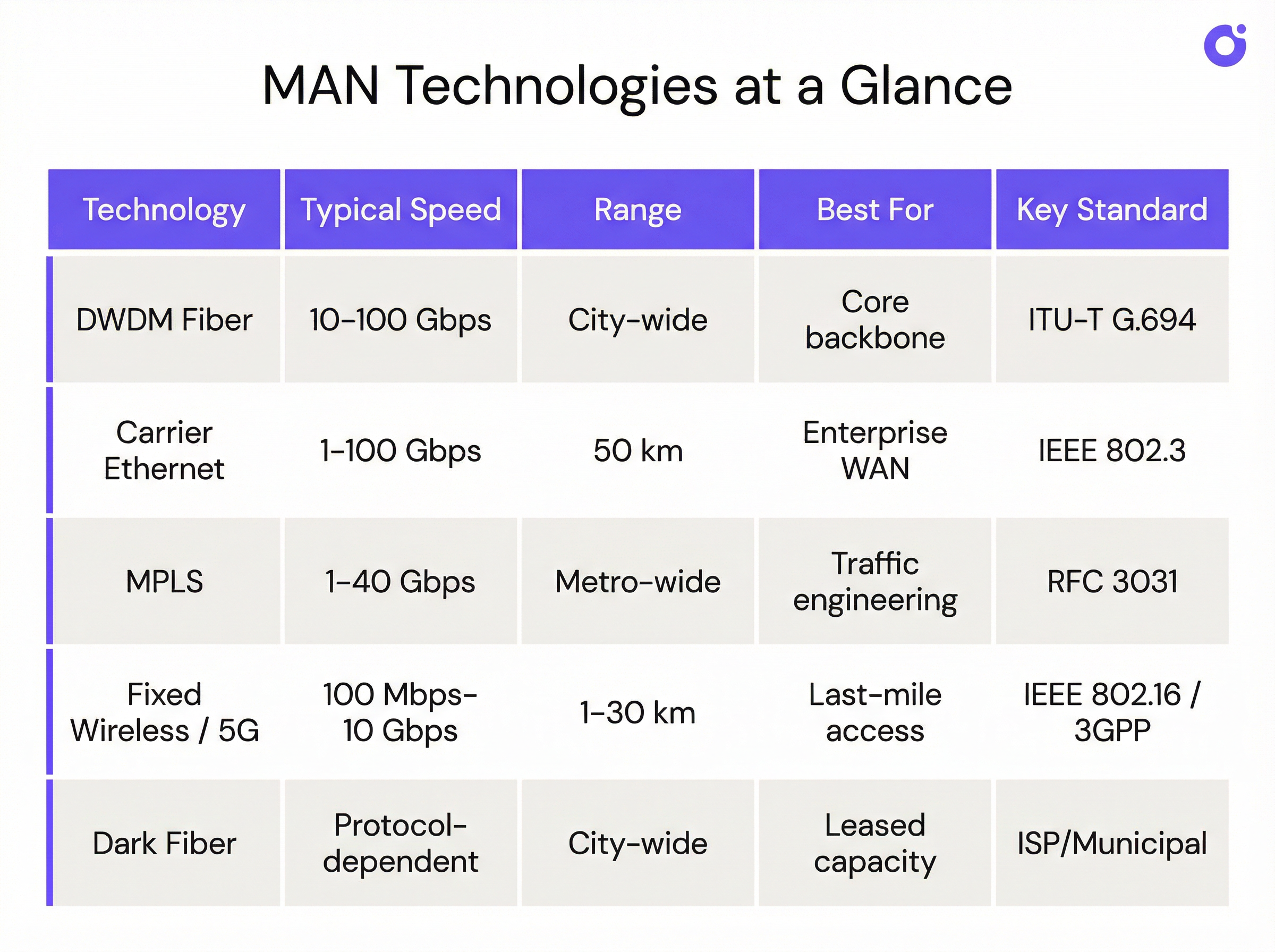
- ✓Core technologies include fiber optics (DWDM, SONET), Carrier Ethernet, and MPLS for traffic engineering.
- ✓A three-layer architecture (Core, Distribution, Access) is the standard design pattern.
- ✓Leasing dark fiber is often the most cost-effective way to build a private MAN for multi-site organisations.
- ✓Network segmentation using VLANs and MPLS is critical for security and compliance (PCI DSS, GDPR).
- ✓Redundancy through ring topologies and diverse paths is essential for high availability.
- ✓Future trends include deeper integration with 5G for backhaul and the use of SD-WAN as a control overlay.




