

The Definitive Timeline of WiFi: From ALOHAnet to WiFi 7 and Beyond
This guide provides a definitive technical timeline of WiFi, tracing its origins from the 1971 ALOHAnet experiment through every major IEEE 802.11 standard to the ratification of WiFi 7 in 2024 and the emerging WiFi 8 roadmap. It is designed for IT managers, network architects, and CTOs who need to understand the engineering evolution of wireless technology to make informed infrastructure investment decisions. By contextualising each generation's innovations within real-world deployment scenarios across hospitality, retail, and large venues, the guide delivers actionable guidance on upgrading, securing, and future-proofing enterprise wireless networks.
🎧 Listen to this Guide
View Transcript
Executive Summary
For IT leaders and venue operators, understanding the evolution of WiFi is not an academic exercise — it is a prerequisite for strategic network planning and investment. This guide provides a definitive timeline of WiFi, tracing its origins from the 1971 ALOHAnet to the launch of WiFi 7 in 2024 and beyond. It offers a technical deep-dive into the generational shifts in IEEE 802.11 standards, explaining the business impact of key innovations like MIMO, OFDMA, and Multi-Link Operation (MLO). By contextualising these advancements within real-world deployment scenarios for hospitality, retail, and large venues, this reference provides the actionable insights network architects and CTOs need to build future-proof wireless infrastructure, optimise user experience, and maximise ROI. The timeline demystifies the standards and provides a clear framework for making informed decisions on infrastructure upgrades, vendor selection, and deployment strategies in an increasingly connected world.
Technical Deep-Dive
The journey from the first wireless packet network to the multi-gigabit speeds of today is a story of relentless innovation. The foundations of WiFi were laid not in the 1990s, but decades earlier, with pioneering work in radio technology and network protocols. Understanding this progression is key to appreciating the complexity and capabilities of modern wireless networks.
The Pre-Standard Era: ALOHAnet and Unlicensed Spectrum
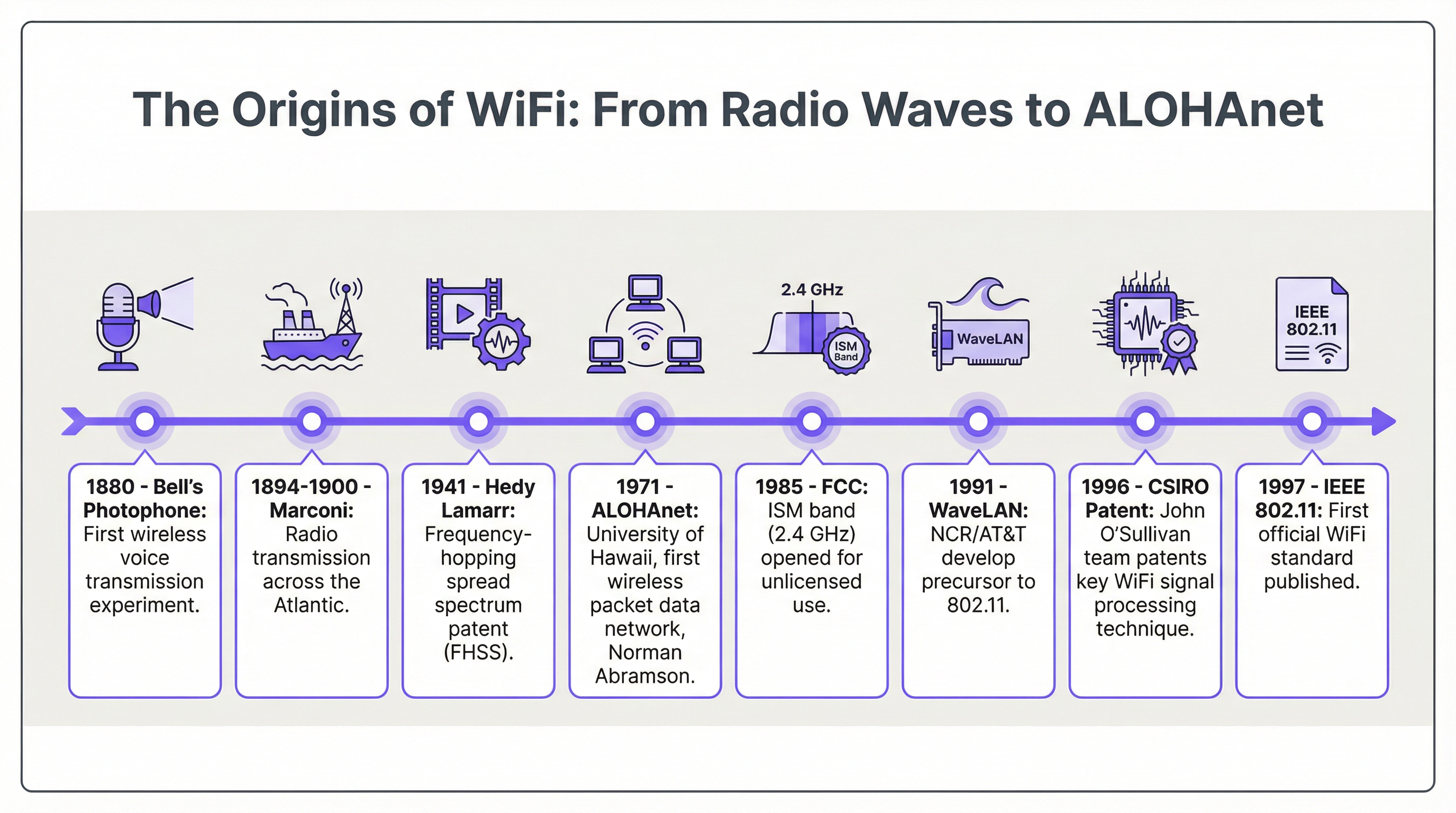
The true genesis of WiFi can be traced to 1971 with ALOHAnet, a UHF wireless packet network developed at the University of Hawaii. Led by Norman Abramson, this project was the first to demonstrate public wireless packet data networking, connecting the Hawaiian Islands. Its core innovation, the ALOHA random-access protocol, was a direct precursor to the Carrier-Sense Multiple Access with Collision Avoidance (CSMA/CA) mechanism that underpins all modern 802.11 standards. This early work proved that a shared wireless medium could be used effectively for data communication.
A critical regulatory development occurred in 1985 when the U.S. Federal Communications Commission (FCC) opened the Industrial, Scientific, and Medical (ISM) bands — including 2.4 GHz — for unlicensed use. This decision democratised the airwaves, creating a space for innovation outside the control of traditional telecom carriers and paving the way for the development of consumer-grade wireless technologies.
Further foundational work came from the Australian government's Commonwealth Scientific and Industrial Research Organisation (CSIRO). In the early 1990s, a team led by Dr. John O'Sullivan, while attempting to detect exploding mini black holes, developed and patented a crucial technique for reducing multipath interference — the phenomenon of radio signals bouncing off surfaces and arriving at the receiver at different times. This CSIRO patent was instrumental in making robust, high-speed wireless LANs a reality and underpins the OFDM waveform used in every modern WiFi standard.
The IEEE 802.11 Generations: A Standardised Evolution
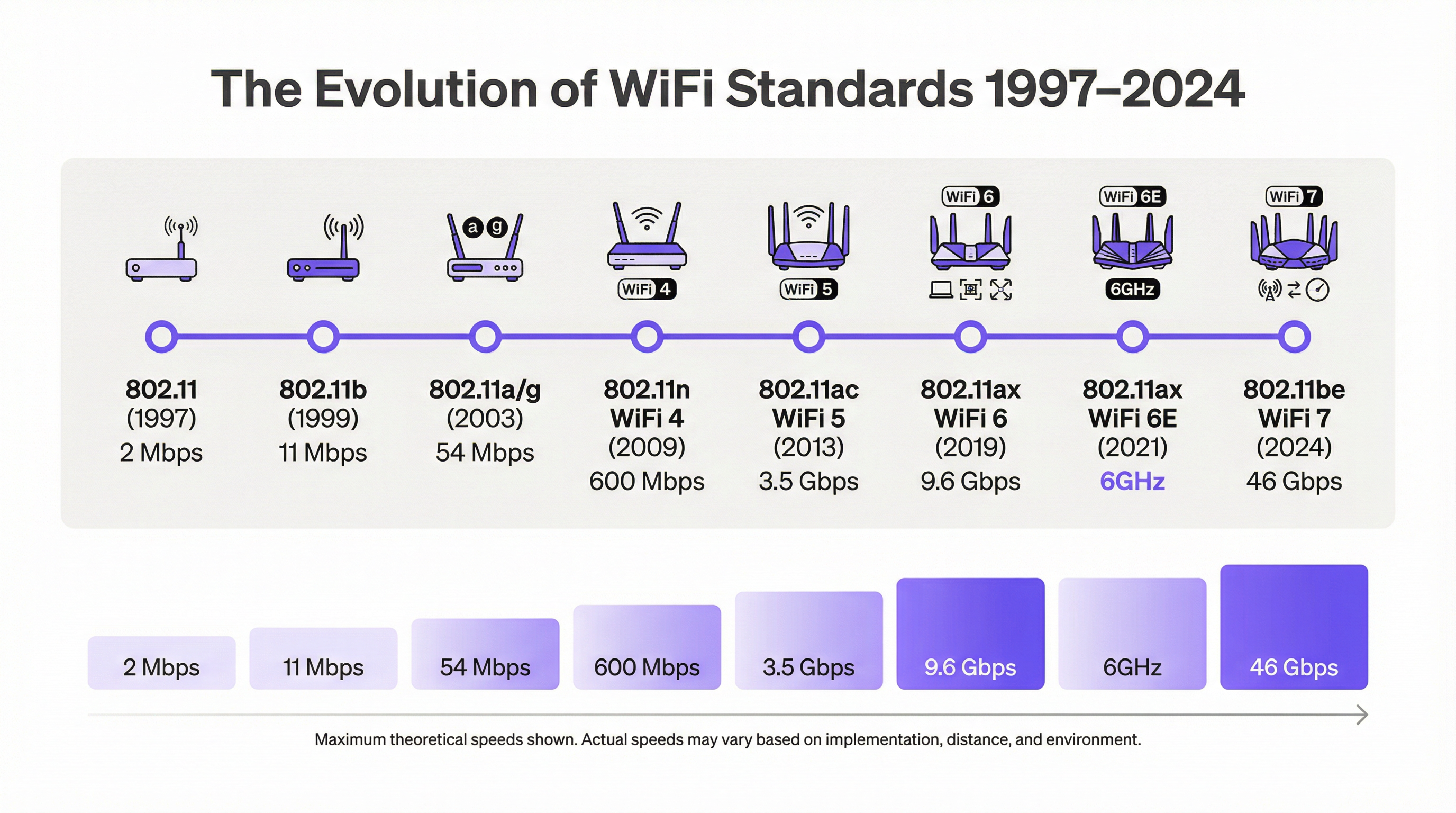
The late 1990s saw the formalisation of WiFi standards under the governance of the IEEE. This standardisation was crucial for ensuring interoperability between products from different vendors, a role later championed by the Wi-Fi Alliance, which was formed in 1999 to certify compliant products and coined the "Wi-Fi" brand name through the agency Interbrand.
| Standard | Wi-Fi Generation | Year | Frequency Band(s) | Max Theoretical Speed | Key Innovation |
|---|---|---|---|---|---|
| 802.11 | — | 1997 | 2.4 GHz | 2 Mbps | Foundational Standard |
| 802.11b | WiFi 2 | 1999 | 2.4 GHz | 11 Mbps | First Widely Adopted |
| 802.11a | WiFi 2 | 1999 | 5 GHz | 54 Mbps | OFDM in 5 GHz |
| 802.11g | WiFi 3 | 2003 | 2.4 GHz | 54 Mbps | OFDM in 2.4 GHz |
| 802.11n | WiFi 4 | 2009 | 2.4/5 GHz | 600 Mbps | MIMO |
| 802.11ac | WiFi 5 | 2013 | 5 GHz | 3.5 Gbps | MU-MIMO, 160 MHz Channels |
| 802.11ax | WiFi 6 | 2019 | 2.4/5 GHz | 9.6 Gbps | OFDMA, BSS Coloring, WPA3 |
| 802.11ax | WiFi 6E | 2021 | 2.4/5/6 GHz | 9.6 Gbps | 6 GHz Band Access |
| 802.11be | WiFi 7 | 2024 | 2.4/5/6 GHz | 46.1 Gbps | MLO, 320 MHz Channels, 4K-QAM |
| 802.11bn | WiFi 8 | ~2028 | TBD | TBD | Deterministic Latency |
802.11n (WiFi 4) marked a significant leap in throughput by introducing MIMO (Multiple-Input Multiple-Output), which uses multiple antennas to transmit and receive more data simultaneously. 802.11ac (WiFi 5) built on this with wider channels (up to 160 MHz) and Multi-User MIMO (MU-MIMO), allowing an access point to transmit to multiple clients concurrently. 802.11ax (WiFi 6/6E) was a paradigm shift focused on efficiency in crowded environments. Its headline feature, Orthogonal Frequency-Division Multiple Access (OFDMA), allows an access point to serve multiple clients with varying bandwidth needs simultaneously within the same channel — a game-changer for high-density venues. The introduction of WiFi 6E in 2021 gave devices access to the newly opened 6 GHz band, a pristine block of spectrum with far less interference than the congested 2.4 GHz and 5 GHz bands.
802.11be (WiFi 7), ratified in 2024, pushes performance into a new echelon. Its cornerstone technology is Multi-Link Operation (MLO), which enables devices to connect and aggregate data across multiple bands simultaneously. This dramatically increases throughput, reduces latency, and improves reliability. Combined with 320 MHz channel widths and 4K-QAM modulation, WiFi 7 delivers multi-gigabit speeds essential for next-generation applications like AR/VR and immersive venue experiences.
The Future: WiFi 8 and Beyond
Looking ahead, the focus of wireless evolution is shifting from raw speed to deterministic performance. The forthcoming 802.11bn (WiFi 8) standard, expected around 2028, aims to deliver extremely low and predictable latency for time-sensitive industrial and enterprise applications. This involves advanced multi-AP coordination and Coordinated Spatial Reuse (Co-SR) to manage spectrum with unprecedented precision.
Implementation Guide
Deploying a modern enterprise WiFi network requires a structured approach that goes beyond simply placing access points. For IT managers and network architects, a successful deployment hinges on meticulous planning, vendor-neutral best practices, and a deep understanding of the physical environment.
Step 1: Requirements Gathering and Site Survey. Define use cases, estimate concurrent device counts, and conduct both a predictive site survey (using tools like Ekahau or Hamina) and a physical walkthrough to identify RF interference sources and physical obstructions not present on floor plans.
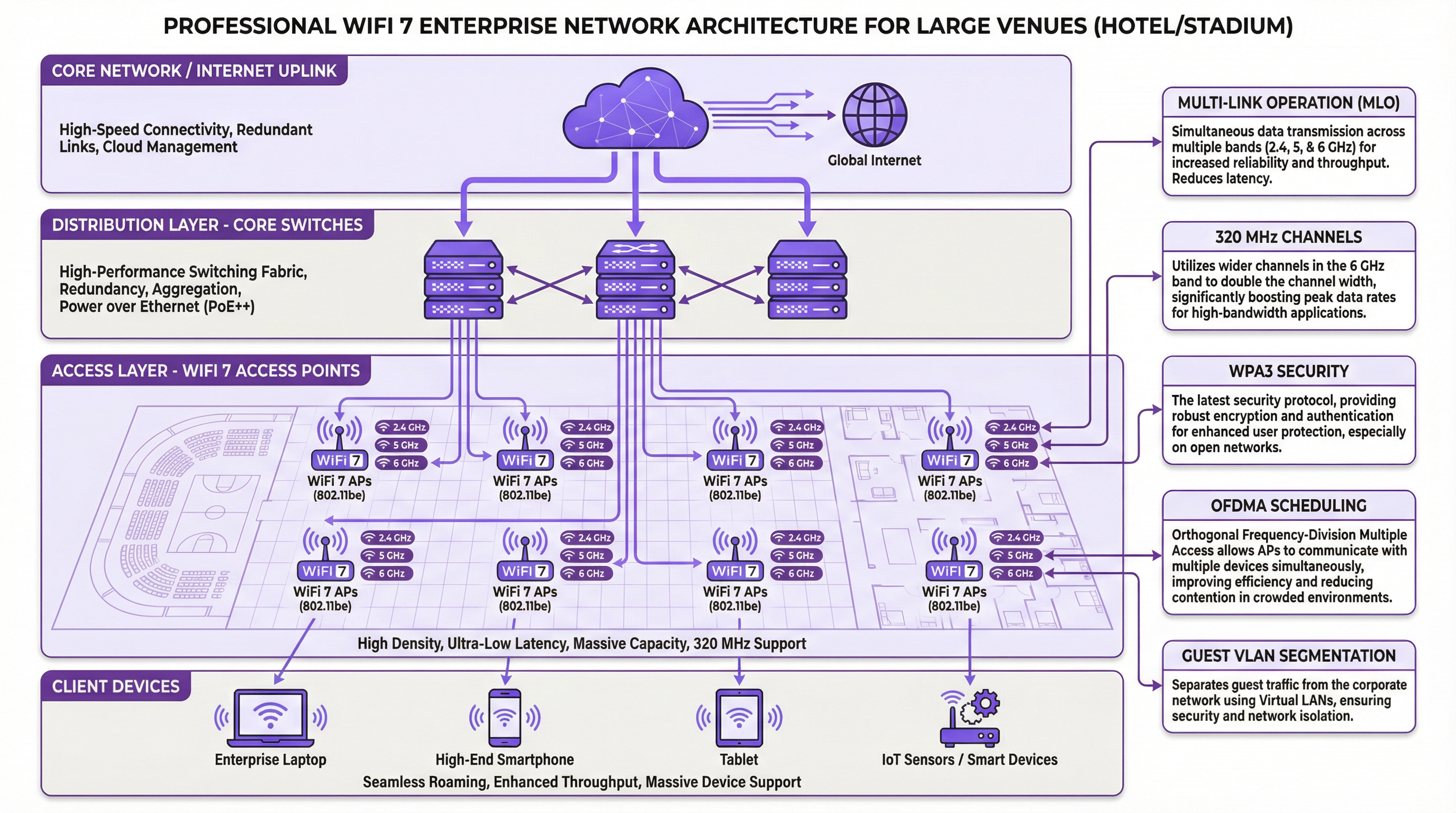
Step 2: Network Design and Architecture. Select appropriate APs based on the survey results — WiFi 6E for greenfield deployments, WiFi 7 for performance-critical areas. Develop a static channel plan for all three bands to minimise co-channel interference, and design VLAN segmentation to isolate guest, corporate, and IoT traffic. Ensure the wired backbone uses multi-gigabit PoE++ (IEEE 802.3bt) switches.
Step 3: Configuration and Security. Mandate WPA3-Enterprise for all corporate SSIDs. Implement IEEE 802.1X with a RADIUS server for certificate-based authentication. Deploy a GDPR-compliant captive portal for guest networks, integrating with a platform like Purple for analytics and marketing.
Step 4: Validation and Optimisation. Perform a post-deployment validation survey to measure actual signal strength, throughput, and latency. Continuously monitor the network to analyse traffic patterns and RF health, using insights to fine-tune AP power levels and channel assignments over time.
Best Practices
Prioritise the 6 GHz band for all new deployments, reserving 2.4 GHz exclusively for legacy IoT devices. Design for roaming by ensuring approximately 15–20% coverage overlap with a minimum signal strength of -67 dBm at the cell edge. Enforce strict network segmentation using VLANs and firewall rules — never allow guest devices on the same network as payment systems or operational servers. Mandate WPA3 across the enterprise and disable all legacy security protocols including WPA2 and TKIP. Centralise management using a cloud-based platform to maintain consistent configuration, security posture, and firmware currency across all access points.
Troubleshooting & Risk Mitigation
Co-Channel Interference (CCI) is the most common performance issue, where multiple APs on the same channel interfere with each other. Mitigation requires a thorough site survey and a static channel plan; use narrower channels in dense deployments to increase the number of available non-overlapping channels. Misconfigured Authentication causes clients to fail connection due to mismatched security settings; a centralised management platform pushing consistent profiles eliminates this risk. Insufficient PoE Power causes APs to reboot or operate in a reduced-power mode; verify that switches provide the correct PoE standard (PoE++ for WiFi 6/7) and that cable runs are within the 100-metre limit. DHCP Exhaustion prevents clients from obtaining IP addresses in high-transient environments; ensure DHCP scopes are appropriately sized and reduce lease times in conference or event settings.
ROI & Business Impact
Investing in a modern WiFi infrastructure delivers tangible returns across three dimensions. First, customer experience: in hospitality, high-performance WiFi is a primary driver of guest satisfaction scores, directly translating to positive reviews and repeat business. Second, operational efficiency: a reliable WiFi network powers critical systems like mobile POS, inventory scanners, and staff communication devices, reducing errors and accelerating processes. Third, new revenue streams: by integrating a WiFi analytics platform like Purple, venues can leverage guest WiFi to collect GDPR-compliant marketing data, understand footfall patterns, and deliver targeted promotions — turning a cost centre into a revenue generator.
Measuring ROI involves tracking increased guest satisfaction and NPS scores, reduced staff time on manual tasks, and incremental revenue from WiFi-driven marketing campaigns. A well-architected WiFi network is not an IT expense; it is a strategic asset that underpins the entire digital experience of a modern venue.
Key Terms & Definitions
ALOHAnet
The world's first wireless packet data network, developed at the University of Hawaii in 1971 by Norman Abramson. It connected the Hawaiian Islands via UHF radio and introduced the ALOHA random-access protocol, the conceptual ancestor of CSMA/CA used in all 802.11 standards.
IT teams encounter this term in the historical context of WiFi development. Understanding ALOHAnet's contribution to medium access control helps explain why modern WiFi behaves the way it does in congested environments.
OFDMA (Orthogonal Frequency-Division Multiple Access)
A multi-user version of OFDM modulation that divides a WiFi channel into smaller sub-channels (Resource Units) and allocates them to different clients simultaneously. Introduced in WiFi 6 (802.11ax), it allows an access point to serve multiple devices with different bandwidth requirements in the same transmission window.
OFDMA is the primary reason WiFi 6 outperforms WiFi 5 in high-density environments. Network architects should specify WiFi 6 or higher for any venue expecting more than 30–50 concurrent devices per access point.
Multi-Link Operation (MLO)
A WiFi 7 (802.11be) feature that enables a device to simultaneously connect and aggregate data across multiple frequency bands (2.4, 5, and 6 GHz). Unlike previous generations where a device was tied to a single band at a time, MLO allows concurrent transmission and reception across bands, increasing throughput and reducing latency.
MLO is the defining feature of WiFi 7 and the primary justification for upgrading from WiFi 6E in performance-critical environments. It is particularly valuable for applications requiring consistent low latency, such as AR/VR and real-time collaboration tools.
WPA3 (Wi-Fi Protected Access 3)
The current WiFi security standard, replacing WPA2. WPA3 introduces Simultaneous Authentication of Equals (SAE), which protects against offline dictionary attacks on passwords, and provides forward secrecy, meaning past sessions cannot be decrypted even if the password is later compromised. WPA3-Enterprise adds 192-bit cryptographic strength.
WPA3 is mandatory for WiFi 6 and later certified devices. IT teams should disable WPA2 on all corporate SSIDs and enforce WPA3-Enterprise with 802.1X for any network carrying sensitive data. This is increasingly a compliance requirement under frameworks like Cyber Essentials and PCI DSS.
IEEE 802.1X
An IEEE standard for port-based network access control that provides an authentication framework for devices connecting to a network. In WiFi deployments, it is used with a RADIUS server to authenticate users or devices via credentials or certificates before granting network access.
802.1X is the foundation of enterprise WiFi security. It eliminates the security risks of shared pre-shared keys (PSK) by providing per-user or per-device authentication. It is a requirement for PCI DSS compliance on any network segment that handles cardholder data.
MIMO (Multiple-Input Multiple-Output)
A radio technology that uses multiple antennas at both the transmitter (access point) and receiver (client device) to send and receive multiple data streams simultaneously over the same channel. Introduced in WiFi 4 (802.11n), it dramatically increases throughput and reliability.
MIMO is the foundational technology behind the throughput improvements from WiFi 4 onwards. MU-MIMO (Multi-User MIMO), introduced in WiFi 5, extends this to allow an AP to serve multiple clients simultaneously rather than sequentially.
BSS Coloring
A WiFi 6 (802.11ax) mechanism that assigns a colour identifier to each Basic Service Set (BSS). When a device detects a transmission from a different BSS on the same channel, it can identify it as 'foreign' and continue its own transmission rather than deferring, reducing unnecessary backoff and improving efficiency in dense deployments.
BSS Coloring is particularly relevant in multi-tenant buildings, dense urban deployments, and large venues where multiple overlapping WiFi networks coexist. It is a key reason why WiFi 6 performs better in interference-heavy environments than WiFi 5.
PoE++ (IEEE 802.3bt)
The latest Power over Ethernet standard, delivering up to 90W of power over a standard Ethernet cable. WiFi 6E and WiFi 7 access points often require PoE++ due to their higher power consumption from supporting three radio bands and advanced processing capabilities.
IT teams planning WiFi 6E or 7 deployments must audit their switching infrastructure for PoE++ compatibility. Deploying high-generation APs on older PoE or PoE+ switches will result in APs operating in a reduced-power mode, significantly degrading performance and coverage.
6 GHz Band
A new frequency band (5.925–7.125 GHz) opened for unlicensed WiFi use by regulatory bodies including the FCC (2020) and Ofcom (UK, 2021). It provides approximately 1,200 MHz of additional spectrum, compared to 80 MHz in the 2.4 GHz band. It is exclusively available to WiFi 6E and WiFi 7 devices, meaning it is free from legacy device interference.
The 6 GHz band is the most significant spectrum development in WiFi history since the ISM band was opened in 1985. For network architects, it is the primary reason to specify WiFi 6E or 7 for new deployments, particularly in high-density environments where the 2.4 and 5 GHz bands are congested.
Case Studies
A 350-room full-service hotel is planning a complete WiFi infrastructure refresh. The property includes a large conference centre with a 1,200-seat ballroom, three restaurant spaces, a spa, and a fitness centre. The hotel currently operates a WiFi 5 (802.11ac) network installed in 2017 and is experiencing persistent complaints about slow speeds in the ballroom during large events. The IT director needs to select a new standard, design the architecture, and ensure PCI DSS compliance for the payment network. What is the recommended approach?
The recommended approach is a phased deployment of WiFi 6E as the baseline standard, with WiFi 7 specified for the ballroom and conference centre. Phase 1 deploys WiFi 6E access points throughout guest rooms and back-of-house areas, replacing the 802.11ac infrastructure. Each floor is served by ceiling-mounted APs at approximately 15-metre intervals, with a dedicated IoT SSID on 2.4 GHz for door locks, thermostats, and HVAC sensors. Phase 2 focuses on the ballroom and conference spaces, deploying WiFi 7 (802.11be) access points with a high-density design: ceiling-mounted APs at 8-metre intervals, supplemented by under-table APs at delegate positions for the ballroom. The 6 GHz band is configured as the primary band for all client devices, with OFDMA enabled to manage the high concurrent device count during events. The network architecture uses three VLANs: VLAN 10 for guest WiFi (isolated, internet-only), VLAN 20 for staff and operational systems, and VLAN 30 for payment terminals (PCI DSS scope, isolated with dedicated firewall rules and 802.1X authentication). WPA3-Enterprise is mandated on VLANs 20 and 30. A GDPR-compliant captive portal on VLAN 10 collects guest email addresses for the hotel's CRM, integrated with Purple for analytics. The wired backbone is upgraded to multi-gigabit PoE++ switches to power the WiFi 7 APs. Post-deployment, a validation survey confirms coverage and throughput targets are met.
A national retail chain with 85 stores is planning to deploy a unified WiFi platform to support mobile POS systems, inventory management scanners, digital signage, and a customer-facing guest WiFi network. Each store averages 800 square metres. The CTO wants a single vendor-neutral architecture that can be centrally managed, supports GDPR-compliant customer data capture, and can scale to support future IoT deployments. What architecture and standards should be recommended?
The recommended architecture is a cloud-managed WiFi 6E deployment with a standardised three-SSID design across all 85 stores. Each store is served by 4–6 ceiling-mounted WiFi 6E access points, providing full coverage with appropriate overlap. The three SSIDs are: (1) a corporate SSID on 5 GHz with WPA3-Enterprise and 802.1X authentication, carrying POS and inventory scanner traffic on a dedicated VLAN with firewall rules restricting access to the payment processor and inventory system only; (2) an IoT SSID on 2.4 GHz with WPA2-PSK (or WPA3-SAE for newer devices) for digital signage, environmental sensors, and HVAC controls; and (3) a guest WiFi SSID on 5/6 GHz with a GDPR-compliant captive portal integrated with Purple, collecting opt-in customer data for the chain's loyalty programme. Central management is provided through a cloud-based controller, enabling the IT team to push configuration changes, firmware updates, and security policies to all 85 stores simultaneously. Purple's analytics platform provides footfall data, dwell time analysis, and customer journey mapping across all stores, enabling the marketing team to optimise store layouts and promotional campaigns. The architecture is designed to accommodate future WiFi 7 AP upgrades without changes to the underlying network design.
Scenario Analysis
Q1. A 15,000-seat indoor arena is planning a WiFi upgrade ahead of a major esports tournament series. During the last event, the existing WiFi 5 network experienced severe congestion, with average client throughput dropping below 2 Mbps during peak attendance. The venue operator needs to support 12,000 concurrent devices, with 20% of users streaming 4K video and 5% using AR-enhanced experiences. What WiFi standard should be specified, and what are the three most critical design decisions?
💡 Hint:Consider the specific features of WiFi 6/6E/7 that address high-density performance, and think about the physical deployment pattern for a tiered seating environment.
Show Recommended Approach
WiFi 7 (802.11be) should be specified as the primary standard for this deployment, with WiFi 6E as a fallback for areas where WiFi 7 hardware is not yet available. The three most critical design decisions are: (1) Band allocation — deploy all primary client traffic on the 6 GHz band using 80 MHz channels to maximise the number of non-overlapping channels and minimise interference. The 6 GHz band's 1,200 MHz of spectrum allows for significantly more simultaneous channels than 2.4 or 5 GHz. (2) AP placement — use a high-density under-seat or seat-back AP deployment pattern rather than relying on ceiling-mounted APs. This reduces the number of clients per AP (targeting no more than 30–40 devices per AP) and improves signal quality by reducing path loss. (3) OFDMA configuration — enable OFDMA on all APs and configure the network to prioritise the AR/VR traffic using QoS policies, ensuring the 5% of users with the most demanding latency requirements receive consistent sub-10ms latency. MLO should be enabled to allow devices to aggregate 5 and 6 GHz bandwidth for the 4K streaming use case.
Q2. A regional council is deploying public WiFi across 12 libraries and 8 leisure centres. The network must be GDPR-compliant, support a maximum of 200 concurrent users per site, and integrate with the council's existing Active Directory for staff authentication. The IT team has a limited budget and needs to justify the investment to elected members. What architecture would you recommend, and how would you frame the ROI case?
💡 Hint:Consider the balance between performance requirements and cost-efficiency, and think about how GDPR compliance and analytics can be framed as a public service benefit.
Show Recommended Approach
WiFi 6 (802.11ax) is the appropriate standard for this deployment — the 200 concurrent user density does not justify the premium of WiFi 6E or 7, but WiFi 6's OFDMA efficiency is valuable for the mixed-use environment of libraries and leisure centres. The architecture uses two SSIDs per site: a public SSID with a GDPR-compliant captive portal (collecting only the minimum required data — email for service communications, with explicit opt-in) and a staff SSID with WPA3-Enterprise and 802.1X integrated with Active Directory via RADIUS. The ROI case for elected members should be framed around three outcomes: (1) Digital inclusion — providing free, high-quality internet access supports the council's digital inclusion strategy and is a measurable public service outcome; (2) Service analytics — footfall and dwell time data from the WiFi platform informs decisions about opening hours, staffing levels, and facility investments; (3) Cost avoidance — a modern, centrally managed platform reduces the IT overhead of managing 20 separate sites, with firmware updates and security patches deployed centrally.
Q3. An IT director at a 500-store fast-casual restaurant chain is evaluating whether to upgrade from WiFi 5 to WiFi 6E or wait for WiFi 7. Each restaurant has approximately 80 seats, 15 staff devices (POS, kitchen display systems, handheld ordering tablets), and a guest WiFi network. The chain is also planning to deploy IoT sensors for temperature monitoring and predictive maintenance over the next 18 months. What is your recommendation, and what factors would change it?
💡 Hint:Consider the density requirements, the IoT roadmap, and the total cost of ownership over a 5-year horizon.
Show Recommended Approach
WiFi 6E is the recommended standard for this deployment. The density of 80 seats plus 15 staff devices does not require the peak throughput of WiFi 7, and the cost premium is not justified at this scale. WiFi 6E's 6 GHz band provides clean spectrum for the guest WiFi network, while OFDMA ensures efficient service of the mixed device types. The IoT sensor deployment should use a dedicated 2.4 GHz SSID on a separate VLAN, as most IoT sensors do not support 5 or 6 GHz. The factors that would change this recommendation are: (1) If the chain plans to introduce AR-enhanced ordering or real-time analytics applications within the 5-year horizon, WiFi 7 should be specified now to avoid a mid-cycle refresh; (2) If the switching infrastructure already supports PoE++ and multi-gigabit uplinks, the incremental cost of WiFi 7 hardware may be small enough to justify the future-proofing; (3) If the chain operates in markets where the 6 GHz band is not yet approved by the local regulator, WiFi 6 (not 6E) may be the appropriate choice.
Key Takeaways
- ✓WiFi's origins trace back to 1971 with ALOHAnet, the world's first wireless packet network, and the ALOHA protocol that directly inspired the CSMA/CA mechanism used in every 802.11 standard today.
- ✓The 1985 FCC decision to open the 2.4 GHz ISM band for unlicensed use was the regulatory catalyst that made consumer WiFi possible, and the CSIRO's 1996 OFDM patent provided the signal processing foundation for all modern standards from 802.11a onwards.
- ✓Each WiFi generation has solved a specific bottleneck: WiFi 4 added MIMO for throughput, WiFi 5 added MU-MIMO and wider channels, WiFi 6 added OFDMA for high-density efficiency, WiFi 6E added the clean 6 GHz band, and WiFi 7 added MLO for simultaneous multi-band aggregation.
- ✓For new enterprise deployments in high-density venues, WiFi 6E is the minimum baseline standard; WiFi 7 should be specified for environments requiring sub-10ms latency, AR/VR support, or future-proofing against next-generation applications.
- ✓Security architecture is non-negotiable: WPA3-Enterprise with IEEE 802.1X authentication on corporate SSIDs, strict VLAN segmentation between guest, staff, IoT, and payment networks, and a GDPR-compliant captive portal for public-facing WiFi.
- ✓The wired backhaul is the most commonly overlooked element of a WiFi upgrade: WiFi 6E and 7 APs require PoE++ (IEEE 802.3bt) switches and multi-gigabit uplinks — deploying next-generation APs on legacy switching infrastructure negates the investment.
- ✓A modern WiFi platform like Purple transforms the network from a cost centre into a strategic asset, enabling GDPR-compliant customer data capture, footfall analytics, and targeted marketing that delivers measurable ROI for hospitality, retail, and venue operators.




