

Indoor Wayfinding: A Comprehensive Guide to Technologies, Applications, and Benefits for Businesses
This guide provides a comprehensive technical overview of indoor wayfinding for IT leaders and venue operators. It details the core technologies, deployment strategies, and business benefits, offering actionable guidance for implementing a system that enhances visitor experience and delivers measurable ROI.
🎧 Listen to this Guide
View Transcript

Executive Summary
For CTOs, IT managers, and venue operations directors, deploying an effective indoor wayfinding system is no longer a luxury but a strategic imperative. In complex indoor environments such as corporate campuses, hospitals, retail centres, and stadiums, seamless navigation directly translates to enhanced visitor experience, improved operational efficiency, and significant ROI. This guide serves as a technical reference for planning, implementing, and maintaining an indoor wayfinding solution. We will explore the primary technologies—WiFi, Bluetooth Low Energy (BLE), and Ultra-Wideband (UWB)—and their respective trade-offs in accuracy, cost, and complexity. The document details a phased implementation framework, from initial site survey and infrastructure deployment to integration with enterprise systems like CRM and Building Management Systems (BMS). Crucially, we will quantify the business impact, citing real-world case studies that demonstrate millions in cost savings from reclaimed productivity and reduced missed appointments. By leveraging existing network infrastructure, as Purple's platform does, organisations can minimise upfront investment while unlocking powerful location analytics that drive data-driven decisions and create smarter, more responsive venue experiences. This guide provides the vendor-neutral best practices and technical insights needed to architect a solution that meets security standards like WPA3 and complies with data privacy regulations such as GDPR.
Technical Deep-Dive
Understanding the technologies that power indoor positioning systems (IPS) is critical for selecting the right solution. The choice of technology dictates accuracy, scalability, cost, and maintenance overhead. The three primary methods used in enterprise environments are WiFi-based positioning, Bluetooth Low Energy (BLE) beacons, and Ultra-Wideband (UWB).
WiFi-Based Positioning
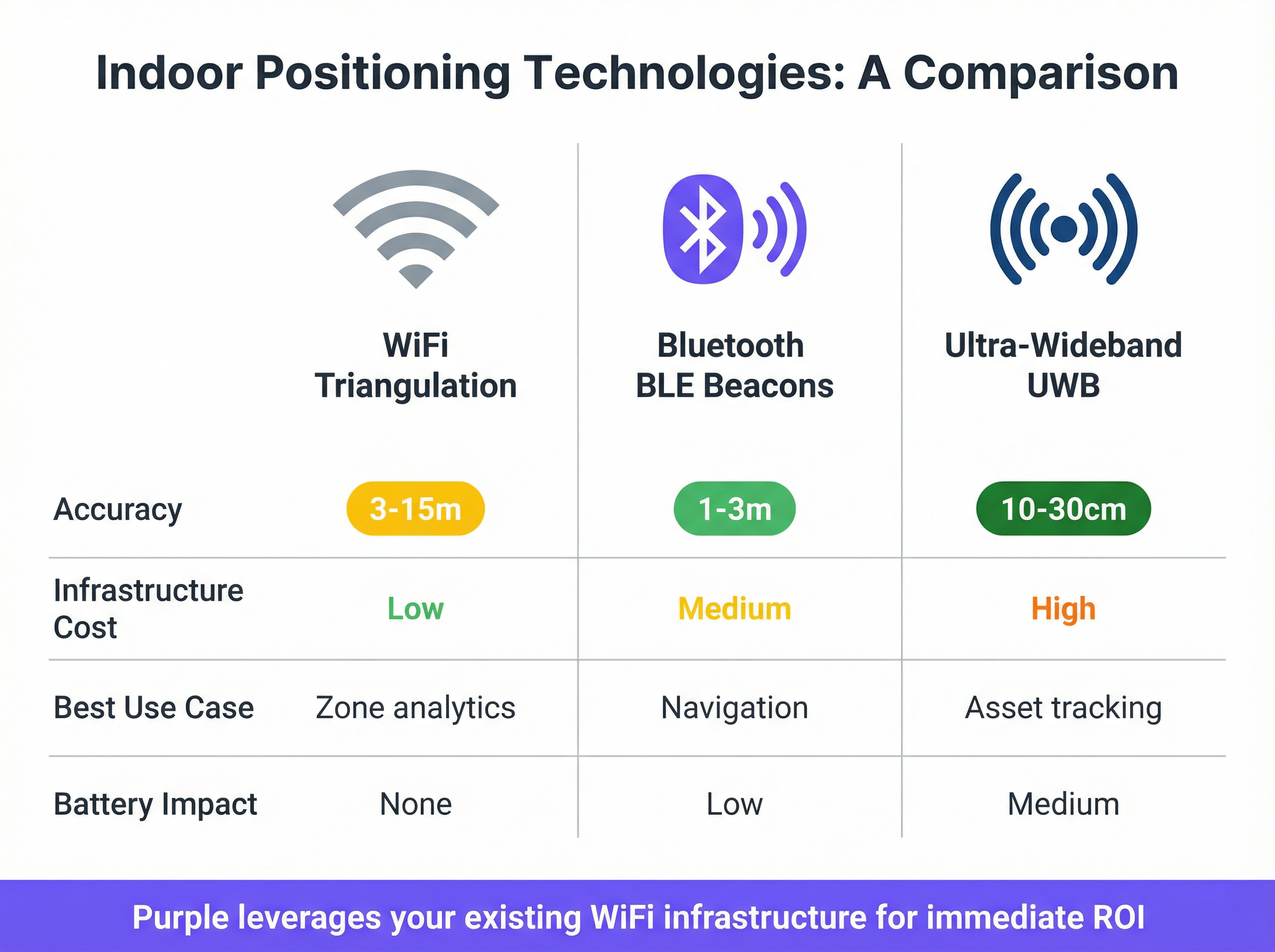
WiFi is the most ubiquitous technology for indoor wayfinding, primarily because it allows venues to leverage their existing wireless network infrastructure, significantly reducing initial deployment costs. Positioning is typically achieved through methods like Received Signal Strength Indication (RSSI) fingerprinting, where the signal strength from multiple access points is measured to triangulate a user's position. While cost-effective, RSSI-based accuracy is generally in the 3-15 meter range, making it ideal for zone-level analytics, presence detection, and basic navigation rather than precise, turn-by-turn directions. Newer standards like WiFi RTT (Round-Trip Time), part of IEEE 802.11mc, offer much higher accuracy (1-2 meters) by measuring the time it takes for a signal to travel between the client device and the access point. Purple's platform excels by integrating with existing enterprise WiFi from vendors like Cisco, Juniper (Mist), and Aruba to provide immediate location analytics and wayfinding capabilities without requiring a complete hardware overhaul.
Bluetooth Low Energy (BLE) Beacons
BLE beacons are small, battery-powered transmitters that broadcast a unique identifier. Mobile devices can detect these signals and use them to determine their proximity to a beacon. For wayfinding, a grid of beacons is deployed throughout a venue. By measuring the signal strength from multiple beacons, an application can calculate the user's position with an accuracy of 1-3 meters. This makes BLE suitable for turn-by-turn navigation and room-level accuracy. However, this approach requires the installation and maintenance of potentially thousands of battery-powered devices, introducing a significant operational burden for large venues. Battery life, deployment density, and environmental factors can all impact system performance and require ongoing management.
Ultra-Wideband (UWB)
UWB offers the highest level of accuracy, capable of pinpointing a location to within 10-30 centimetres. It operates by sending very short pulses of radio energy across a wide frequency spectrum. By measuring the time-of-flight of these signals between a tag and multiple receivers (anchors), the system can calculate a precise 3D position. This precision makes UWB ideal for industrial applications, high-value asset tracking, and safety-critical scenarios like staff duress alerts. However, UWB requires a dedicated infrastructure of anchors and tags, making it the most expensive option to deploy. While increasingly supported by flagship smartphones, its primary enterprise use remains in specialised, high-precision applications rather than general public wayfinding.
| Technology | Accuracy | Infrastructure Cost | Best Use Case | Key Standards |
|---|---|---|---|---|
| WiFi (RSSI) | 3-15 meters | Low (leverages existing network) | Zone Analytics, Presence | IEEE 802.11ax (Wi-Fi 6) |
| WiFi (RTT/FTM) | 1-2 meters | Low (requires compatible hardware) | Turn-by-Turn Navigation | IEEE 802.11mc |
| BLE Beacons | 1-3 meters | Medium | Turn-by-Turn Navigation | Bluetooth 5.1+ |
| Ultra-Wideband (UWB) | 10-30 cm | High | High-Precision Asset Tracking | IEEE 802.15.4 |
Implementation Guide
A successful indoor wayfinding deployment follows a structured, multi-phase approach. Rushing implementation without proper planning is a common cause of failure, leading to poor accuracy, low user adoption, and a failure to achieve ROI. The following roadmap outlines a best-practice methodology for enterprise deployments.
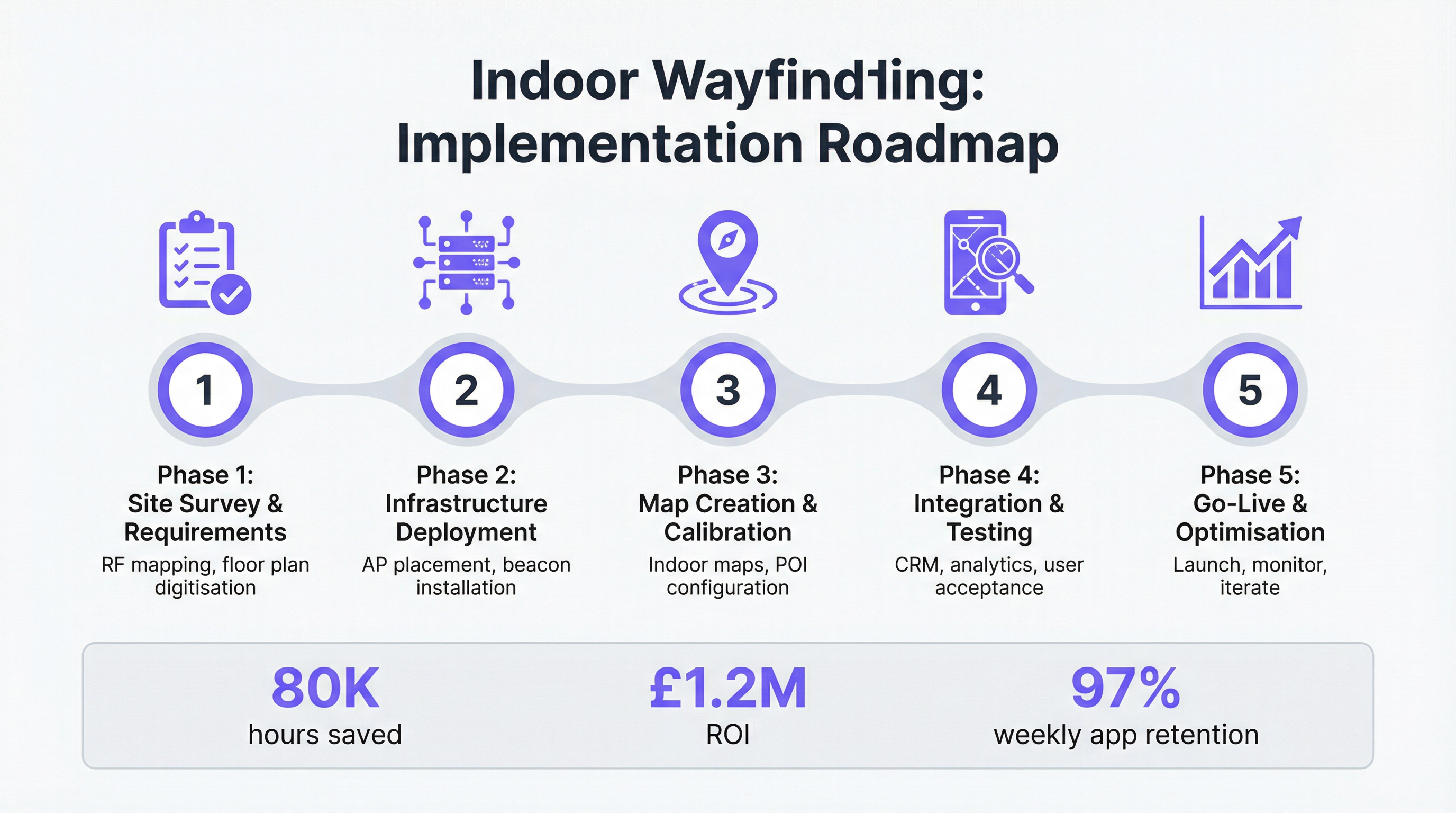
Phase 1: Site Survey & Requirements Gathering This foundational phase involves a thorough assessment of the venue. Key activities include conducting an RF (Radio Frequency) survey to identify potential sources of interference and dead zones, obtaining or creating accurate digital floor plans, and defining the specific use cases and business objectives. Stakeholder interviews with IT, operations, and marketing teams are crucial to ensure the system is designed to meet diverse needs, from improving patient flow in a hospital to increasing dwell time in a retail setting.
Phase 2: Infrastructure Deployment Based on the chosen technology and site survey results, this phase involves the physical installation of hardware. For a WiFi-based system, this may involve optimising the placement of existing access points or adding new ones to ensure adequate coverage. For BLE or UWB systems, it requires the strategic placement and installation of beacons or anchors. All hardware deployment must adhere to building codes and be planned to minimise disruption to daily operations.
Phase 3: Map Creation & Calibration With the infrastructure in place, the digital maps are created and calibrated. This involves digitising the floor plans and overlaying them with the positioning grid. Points of Interest (POIs), such as meeting rooms, retail stores, or hospital departments, are defined and geolocated on the map. The system is then calibrated by taking measurements throughout the venue to build the positioning model (e.g., the WiFi or BLE fingerprint). This step is critical for system accuracy.
Phase 4: Integration & Testing The true power of an enterprise wayfinding system is unlocked through integration. This phase involves connecting the location platform to other business systems via APIs. Examples include integrating with a hospital's Electronic Health Record (EHR) system to guide patients to appointments, a corporate calendar to book meeting rooms, or a retail CRM to deliver location-based offers. Rigorous User Acceptance Testing (UAT) is performed to ensure the system is accurate, reliable, and provides a seamless user experience.
Phase 5: Go-Live & Optimisation Following a successful testing phase, the system is launched to users. The launch should be supported by a communications plan to drive awareness and adoption. Post-launch, the work is not over. The location analytics data generated by the system should be continuously monitored to identify opportunities for optimisation. Heatmaps may reveal areas of congestion that need to be addressed, while pathing analysis can show opportunities to improve venue layout and flow.
Best Practices
- Prioritise User Privacy: Ensure your solution is GDPR compliant. Anonymise data where possible and provide users with clear control over their location information. Platforms like Purple are designed with privacy at their core.
- Design for Accessibility: Your wayfinding solution should be inclusive. Incorporate features like wheelchair-accessible routes, voice-over commands for the visually impaired, and multi-language support.
- Secure the Network: Wayfinding systems are an extension of your network. Ensure all communications are encrypted and that the deployment adheres to enterprise security standards like WPA3 and IEEE 802.1X for network access control.
- Start with a Pilot: Before a full-scale rollout, conduct a pilot project in a limited area of your venue. This allows you to validate the technology, gather user feedback, and refine your deployment strategy in a controlled environment.
- Focus on Integration: A standalone wayfinding app has limited value. The highest ROI comes from integrating location data into core business processes and applications to automate workflows and create context-aware experiences.
Troubleshooting & Risk Mitigation
- Signal Interference: RF interference from building materials (metal, concrete) or other wireless devices can degrade positioning accuracy. A thorough site survey is the primary mitigation for this risk.
- Calibration Drift: Over time, changes in the physical environment (e.g., moving large furniture, seasonal crowds) can cause the positioning model to become less accurate. Plan for periodic recalibration to maintain performance.
- Low User Adoption: If the app is not intuitive or does not solve a real problem, people will not use it. Involve end-users in the design process and heavily promote the benefits of the system at launch.
- Data Inaccuracy: Inaccurate or outdated map information is a common pitfall. Establish a clear process for updating POIs and map layouts as the venue changes.
ROI & Business Impact
The business case for indoor wayfinding is built on measurable improvements in efficiency, experience, and revenue. In a corporate setting, data from Pointr shows that employees save an average of 12 minutes per meeting by eliminating time spent searching for rooms, translating to nearly 20 days of reclaimed productivity per employee annually and a cost saving of $1.46 million for an average campus. In healthcare, Purple's deployment at Croydon University Hospital resulted in £1.2 million in total savings by reducing missed appointments and saving 80,000 hours of staff time previously spent giving directions. In retail, wayfinding increases dwell time, improves foot traffic to specific zones, and enables location-based marketing that can directly lift sales. The key is to define the target KPIs for your specific venue and leverage the location analytics platform to measure and report on that impact.
Key Terms & Definitions
Indoor Positioning System (IPS)
A system that continuously determines the real-time location of objects or people inside a building. Unlike GPS, which is ineffective indoors, an IPS uses technologies like WiFi, Bluetooth, or UWB.
IT teams deploy an IPS as the core engine for any indoor location-based service, including wayfinding, asset tracking, and location analytics.
Wayfinding
The process of orienting and navigating from point to point in a physical environment. Digital wayfinding provides this service through mobile apps or kiosks, offering turn-by-turn directions.
For venue operators, wayfinding is the primary user-facing application of an IPS, directly impacting visitor experience by reducing stress and improving efficiency.
WiFi RTT (Round-Trip Time)
A feature specified in the IEEE 802.11mc standard that enables an access point to calculate its distance from a client device with high accuracy (1-2 meters) by measuring the time it takes for a radio signal to travel between them.
Network architects should specify RTT-compatible hardware for new WiFi deployments to enable high-accuracy indoor positioning without needing a separate beacon infrastructure.
Bluetooth Beacon
A small, low-power radio transmitter that repeatedly broadcasts a unique identifier. Mobile devices can detect this signal to determine their proximity to the beacon.
In wayfinding deployments, beacons are installed throughout a venue to create a positioning grid. They represent a trade-off: higher accuracy than basic WiFi, but with the added cost and maintenance of battery-powered hardware.
Ultra-Wideband (UWB)
A short-range wireless communication protocol that uses a wide portion of the radio spectrum to achieve highly accurate, centimetre-level positioning. It measures the precise time-of-flight of radio signals.
CTOs should consider UWB for specialised, mission-critical use cases like tracking surgical equipment in a hospital or managing automated guided vehicles in a warehouse, where the high cost is justified by the need for extreme precision.
RSSI (Received Signal Strength Indicator)
A measurement of the power present in a received radio signal. In wayfinding, the RSSI from multiple access points or beacons is used to estimate a user's location via triangulation or fingerprinting.
While RSSI is a foundational metric for most positioning systems, IT teams must understand that it can be affected by obstacles, interference, and multi-path fading, which is why calibration is so important.
Geofencing
A virtual perimeter for a real-world geographic area. A geofencing system can trigger an action (like sending a push notification) when a device enters or leaves this defined area.
Venue operators use geofencing to create location-aware marketing campaigns, sending a promotional offer to a visitor's phone when they walk past a specific store, or to trigger operational alerts for staff.
GDPR (General Data Protection Regulation)
A regulation in EU law on data protection and privacy for all individuals within the European Union and the European Economic Area. It governs how personal data is collected, processed, and stored.
When deploying any location-based service, IT and compliance teams must ensure the platform is GDPR-compliant, providing users with transparency and control over their data. This is a non-negotiable requirement for enterprise deployments.
Case Studies
A 500-bed hospital needs to reduce late and missed appointments, which cost the trust over £1 million annually. Patients frequently report getting lost in the large, complex facility, causing stress and delays. Staff are interrupted constantly for directions, reducing time available for patient care. The hospital has an existing enterprise-grade WiFi network from a major vendor.
The recommended solution is to deploy a WiFi-based indoor wayfinding system, leveraging the hospital's existing network infrastructure to minimise costs. The implementation would follow a phased approach:
- Assessment: Digitize the hospital's floor plans and conduct an RF survey to confirm WiFi coverage is sufficient for positioning. Integrate with the hospital's Patient Administration System (PAS) to access appointment schedules.
- Map Creation: Create a detailed digital map of the hospital, including all departments, clinics, wards, and amenities as Points of Interest (POIs). Define accessible routes for wheelchair users.
- Application: Develop a mobile application (or integrate into the existing hospital app) that provides patients with turn-by-turn navigation from the hospital entrance directly to their appointment location. Send a link to the map in appointment reminder notifications.
- Analytics: Use the platform's analytics dashboard to monitor patient flow, identify bottlenecks, and measure the impact on appointment punctuality. Track staff time saved through reduced interruptions.
A large shopping centre with over 300 retail units wants to increase visitor dwell time and drive foot traffic to under-utilised zones. The marketing team wants to run targeted promotional campaigns but lacks the tools to reach shoppers in real-time within the venue.
Deploy a guest WiFi and indoor positioning solution. The system would serve a dual purpose: providing valuable guest internet access and enabling location-based services.
- Captive Portal: Implement a branded captive portal for WiFi login. This provides an opportunity to capture anonymised visitor data (with consent) and promote the wayfinding app.
- Wayfinding & Promotions: The mobile app provides a full store directory and turn-by-turn navigation. Using geofencing, the system can trigger push notifications with relevant offers when a shopper dwells near a particular store or enters a specific zone.
- Analytics for Tenants: The location analytics platform generates valuable insights for both the mall operator and its retail tenants. Heatmaps show visitor traffic patterns, dwell times, and popular paths. This data can be used to inform leasing decisions, optimise store layouts, and measure the effectiveness of marketing campaigns.
Scenario Analysis
Q1. You are the CTO of a multi-campus university. Students complain about finding lecture halls, and the estates department wants to understand classroom utilisation better. Your WiFi network is due for a refresh in the next 12 months. What technology would you propose for a wayfinding and space utilisation solution, and why?
💡 Hint:Consider the upcoming network refresh and the dual requirements of navigation and analytics.
Show Recommended Approach
The recommended approach is to specify IEEE 802.11mc (WiFi RTT) compatible access points for the upcoming network refresh. This strategy leverages a single infrastructure investment to solve both problems. WiFi RTT will provide the 1-2 meter accuracy needed for effective turn-by-turn navigation for students. Simultaneously, the location data from the WiFi network can be fed into an analytics platform like Purple's to generate detailed space utilisation reports for the estates department, showing which lecture halls are occupied and when. This avoids the cost and complexity of deploying and managing a separate BLE beacon network.
Q2. A major international airport is planning to deploy a wayfinding solution to guide passengers to their gates. They are also under pressure to increase retail revenue. The IT Director is concerned about the cost of a full beacon deployment across all terminals. How would you advise them?
💡 Hint:Think about how to generate revenue from the system to offset its cost.
Show Recommended Approach
Advise a hybrid approach that leverages the existing airport WiFi network for baseline coverage and supplements it with BLE beacons in key high-traffic retail areas. The business case should be built around ROI, not just cost. By integrating the wayfinding app with a location-based marketing engine, the airport can generate new revenue. When a passenger with the app dwells near a duty-free shop, the system can send a targeted voucher. This promotional revenue can be used to fund the infrastructure deployment. The analytics on passenger flow and dwell time are also highly valuable for optimising retail layouts and negotiating tenant leases.
Q3. You are an IT Manager at a large manufacturing plant. The operations director wants to track the location of high-value tools and automated guided vehicles (AGVs) on the factory floor to prevent loss and optimise workflows. Accuracy needs to be extremely high to avoid collisions and ensure safety. What is your primary recommendation?
💡 Hint:The key requirements are high precision and reliability in a challenging RF environment.
Show Recommended Approach
The only suitable technology for this use case is Ultra-Wideband (UWB). While WiFi and BLE are effective for people navigation, they cannot provide the centimetre-level accuracy and low latency required for tracking moving equipment in a dynamic industrial environment. The risk of collision with AGVs or misplacing a critical tool justifies the higher deployment cost of a dedicated UWB infrastructure (anchors and tags). The solution should be integrated with the plant's Manufacturing Execution System (MES) to provide real-time location data that can be used to automate workflows and trigger safety alerts.
Key Takeaways
- ✓Indoor wayfinding is a strategic tool for improving visitor experience and operational efficiency in large venues.
- ✓The primary technologies are WiFi, BLE beacons, and UWB, each with different trade-offs in accuracy, cost, and complexity.
- ✓Leveraging existing enterprise WiFi infrastructure offers the fastest path to ROI for many organisations.
- ✓A structured, phased implementation approach is critical for success, from site survey to post-launch optimisation.
- ✓The highest ROI is achieved by integrating location data with core business systems (e.g., CRM, EHR, BMS).
- ✓Data privacy and security (GDPR, WPA3) are non-negotiable requirements for any enterprise deployment.
- ✓Real-world deployments have demonstrated multi-million pound savings through increased productivity and efficiency.




