

La cronología definitiva del WiFi: de ALOHAnet al WiFi 7 y más allá
This guide provides a definitive technical timeline of WiFi, tracing its origins from the 1971 ALOHAnet experiment through every major IEEE 802.11 standard to the ratification of WiFi 7 in 2024 and the emerging WiFi 8 roadmap. It is designed for IT managers, network architects, and CTOs who need to understand the engineering evolution of wireless technology to make informed infrastructure investment decisions. By contextualising each generation's innovations within real-world deployment scenarios across hospitality, retail, and large venues, the guide delivers actionable guidance on upgrading, securing, and future-proofing enterprise wireless networks.
🎧 Listen to this Guide
View Transcript
Resumen ejecutivo
Para los líderes de TI y operadores de recintos, comprender la evolución del WiFi no es un ejercicio académico, sino un requisito previo para la planificación y la inversión estratégicas de la red. Esta guía ofrece una cronología definitiva del WiFi, trazando sus orígenes desde la red ALOHAnet de 1971 hasta el lanzamiento del WiFi 7 en 2024 y más allá. Ofrece un análisis técnico exhaustivo de los cambios generacionales en los estándares IEEE 802.11, explicando el impacto empresarial de innovaciones clave como MIMO, OFDMA y Multi-Link Operation (MLO). Al contextualizar estos avances en escenarios de implementación reales para el sector hotelero, el comercio minorista y los grandes recintos, esta referencia proporciona la información práctica que los arquitectos de redes y los directores de tecnología (CTO) necesitan para crear una infraestructura inalámbrica preparada para el futuro, optimizar la experiencia del usuario y maximizar el ROI. La cronología desmitifica los estándares y proporciona un marco claro para tomar decisiones fundamentadas sobre las actualizaciones de la infraestructura, la selección de proveedores y las estrategias de implementación en un mundo cada vez más conectado.
Análisis técnico exhaustivo
El viaje desde la primera red inalámbrica de paquetes hasta las velocidades multigigabit actuales es una historia de innovación incesante. Los cimientos del WiFi no se sentaron en la década de 1990, sino décadas antes, con trabajos pioneros en tecnología de radio y protocolos de red. Comprender esta progresión es clave para apreciar la complejidad y las capacidades de las redes inalámbricas modernas.
La era previa a los estándares: ALOHAnet y el espectro sin licencia
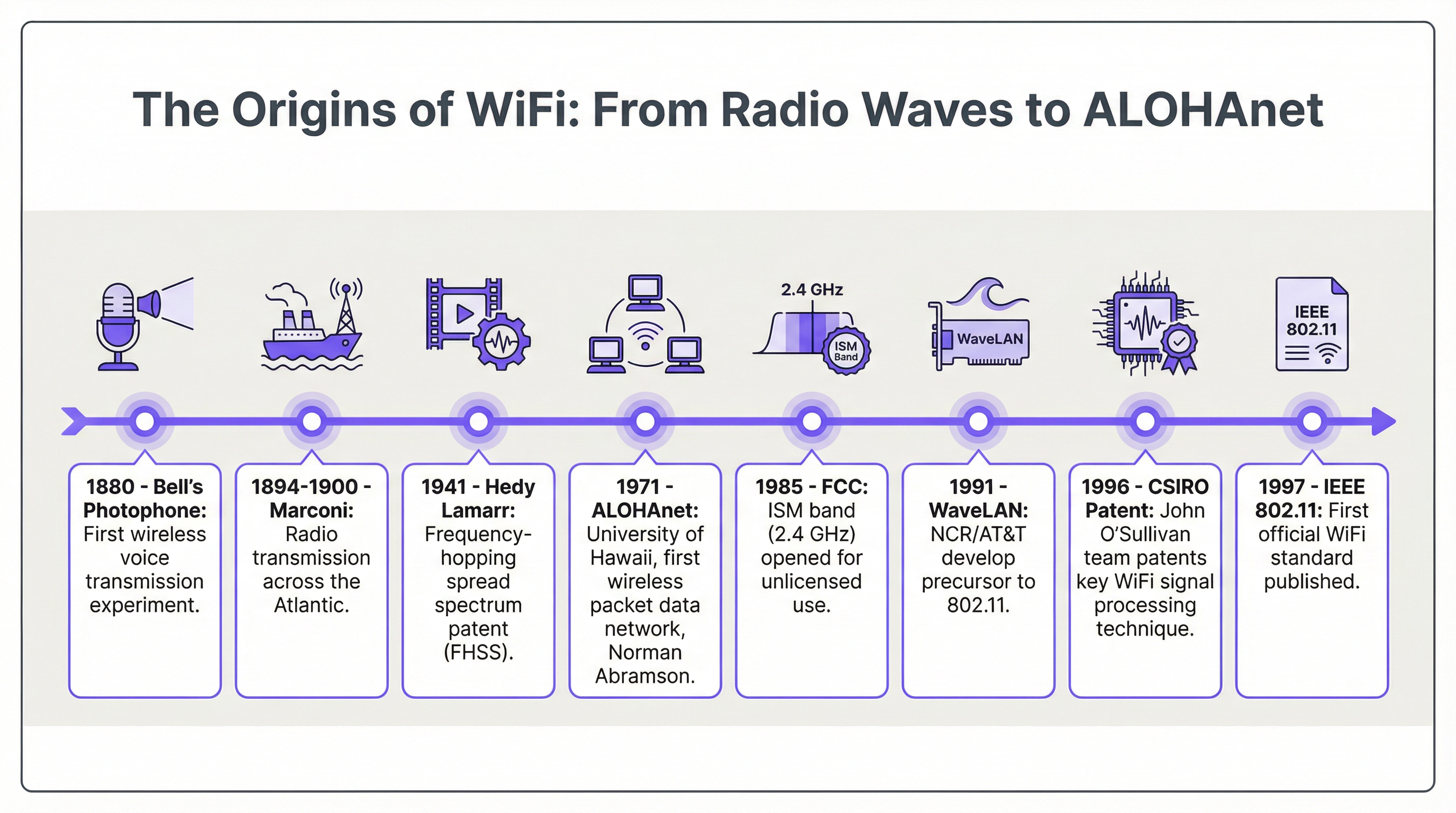
La verdadera génesis del WiFi se remonta a 1971 con ALOHAnet, una red inalámbrica de paquetes UHF desarrollada en la Universidad de Hawái. Liderado por Norman Abramson, este proyecto fue el primero en demostrar la conexión pública de datos por paquetes inalámbricos, conectando las islas hawaianas. Su principal innovación, el protocolo de acceso aleatorio ALOHA, fue un precursor directo del mecanismo de acceso múltiple con escucha de portadora y prevención de colisiones (CSMA/CA) que sustenta todos los estándares 802.11 modernos. Este trabajo inicial demostró que un medio inalámbrico compartido podía utilizarse eficazmente para la comunicación de datos.
Un avance normativo fundamental se produjo en 1985, cuando la Comisión Federal de Comunicaciones (FCC) de EE. UU. abrió las bandas industriales, científicas y médicas (ISM), incluida la de 2,4 GHz, para su uso sin licencia. Esta decisión democratizó las ondas, creando un espacio para la innovación fuera del control de los operadores de telecomunicaciones tradicionales y allanando el camino para el desarrollo de tecnologías inalámbricas de consumo.
Otro trabajo fundacional provino de la Organización de Investigación Científica e Industrial de la Commonwealth (CSIRO) del gobierno australiano. A principios de la década de 1990, un equipo dirigido por el Dr. John O'Sullivan, mientras intentaba detectar la explosión de miniaujeros negros, desarrolló y patentó una técnica crucial para reducir la interferencia multitrayecto: el fenómeno de las señales de radio que rebotan en las superficies y llegan al receptor en diferentes momentos. Esta patente de la CSIRO fue fundamental para hacer realidad las redes LAN inalámbricas robustas y de alta velocidad, y sustenta la forma de onda OFDM utilizada en todos los estándares WiFi modernos.
Las generaciones IEEE 802.11: una evolución estandarizada
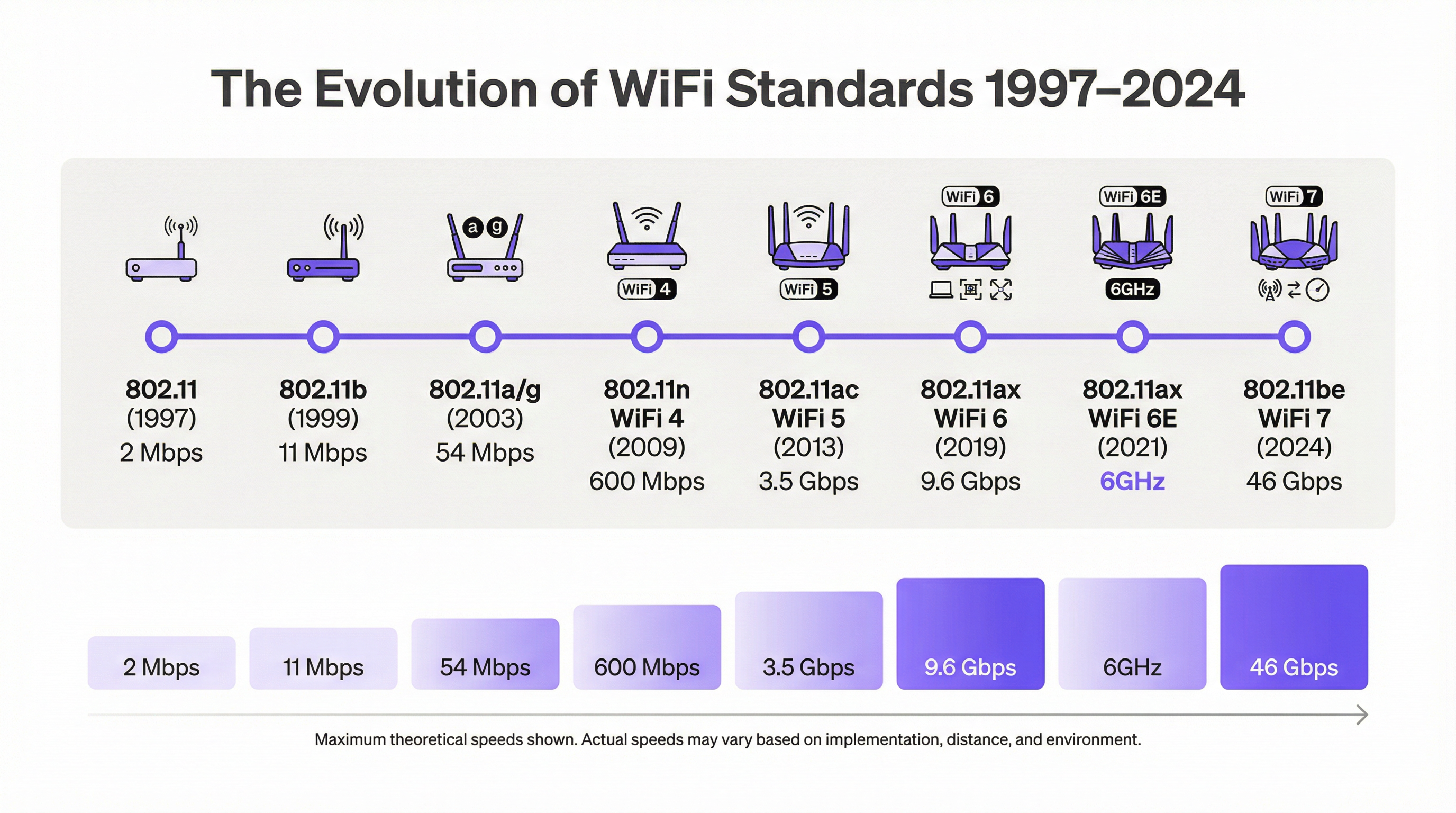
A finales de la década de 1990 se formalizaron los estándares WiFi bajo la gobernanza del IEEE. Esta estandarización fue crucial para garantizar la interoperabilidad entre productos de diferentes proveedores, un papel que más tarde defendió la Wi-Fi Alliance, formada en 1999 para certificar los productos compatibles y que acuñó la marca "Wi-Fi" a través de la agencia Interbrand.
| Estándar | Generación Wi-Fi | Año | Banda(s) de frecuencia | Velocidad teórica máxima | Innovación clave |
|---|---|---|---|---|---|
| 802.11 | — | 1997 | 2,4 GHz | 2 Mbps | Estándar fundacional |
| 802.11b | WiFi 2 | 1999 | 2,4 GHz | 11 Mbps | Primera adopción generalizada |
| 802.11a | WiFi 2 | 1999 | 5 GHz | 54 Mbps | OFDM en 5 GHz |
| 802.11g | WiFi 3 | 2003 | 2,4 GHz | 54 Mbps | OFDM en 2,4 GHz |
| 802.11n | WiFi 4 | 2009 | 2,4/5 GHz | 600 Mbps | MIMO |
| 802.11ac | WiFi 5 | 2013 | 5 GHz | 3,5 Gbps | MU-MIMO, canales de 160 MHz |
| 802.11ax | WiFi 6 | 2019 | 2,4/5 GHz | 9,6 Gbps | OFDMA, BSS Coloring, WPA3 |
| 802.11ax | WiFi 6E | 2021 | 2,4/5/6 GHz | 9,6 Gbps | Acceso a la banda de 6 GHz |
| 802.11be | WiFi 7 | 2024 | 2,4/5/6 GHz | 46,1 Gbps | MLO, canales de 320 MHz, 4K-QAM |
| 802.11bn | WiFi 8 | ~2028 | Por determinar | Por determinar | Latencia determinista |
802.11n (WiFi 4) marcó un salto significativo en el rendimiento al introducir MIMO (Multiple-Input Multiple-Output), que utiliza múltiples antenas para transmitir y recibir más datos simultáneamente. 802.11ac (WiFi 5) se basó en esto con canales más amplios (hasta 160 MHz) y Multi-User MIMO (MU-MIMO), lo que permite a un punto de acceso transmitir a múltiples clientes de forma simultánea. 802.11ax (WiFi 6/6E) supuso un cambio de paradigma centrado en la eficiencia en entornos concurridos. Su característica principal, el acceso múltiple por división de frecuencias ortogonales (OFDMA), permite a un punto de acceso dar servicio a múltiples clientes con diferentes necesidades de ancho de banda simultáneamente dentro del mismo canal, lo que supone un punto de inflexión para los recintos de alta densidad. La introducción del WiFi 6E en 2021 dio a los dispositivos acceso a la recién inaugurada banda de 6 GHz, un bloque de espectro inmaculado con muchas menos interferencias que las congestionadas bandas de 2,4 GHz y 5 GHz.
802.11be (WiFi 7), ratificado en 2024, eleva el rendimiento a un nuevo nivel. Su tecnología fundamental es Multi-Link Operation (MLO), que permite a los dispositivos conectarse y agregar datos a través de múltiples bandas simultáneamente. Esto aumenta drásticamente el rendimiento, reduce la latencia y mejora la fiabilidad. Combinado con anchos de canal de 320 MHz y modulación 4K-QAM, el WiFi 7 ofrece velocidades multigigabit esenciales para aplicaciones de próxima generación como la realidad aumentada/virtual (AR/VR) y las experiencias inmersivas en recintos.
El futuro: WiFi 8 y más allá
De cara al futuro, el enfoque de la evolución inalámbrica está pasando de la velocidad bruta al rendimiento determinista. El próximo estándar 802.11bn (WiFi 8), previsto para 2028, tiene como objetivo ofrecer una latencia extremadamente baja y predecible para aplicaciones industriales y empresariales sensibles al tiempo. Esto implica una coordinación avanzada de múltiples puntos de acceso (AP) y la reutilización espacial coordinada (Co-SR) para gestionar el espectro con una precisión sin precedentes.
Guía de implementación
La implementación de una red WiFi empresarial moderna requiere un enfoque estructurado que va más allá de la simple colocación de puntos de acceso. Para los directores de TI y los arquitectos de redes, el éxito de una implementación depende de una planificación meticulosa, de las mejores prácticas independientes del proveedor y de un profundo conocimiento del entorno físico.
Paso 1: Recopilación de requisitos y estudio del emplazamiento. Defina los casos de uso, calcule el número de dispositivos simultáneos y realice tanto un estudio predictivo del emplazamiento (utilizando herramientas como Ekahau o Hamina) como un recorrido físico para identificar fuentes de interferencia de radiofrecuencia (RF) y obstrucciones físicas que no estén presentes en los planos.
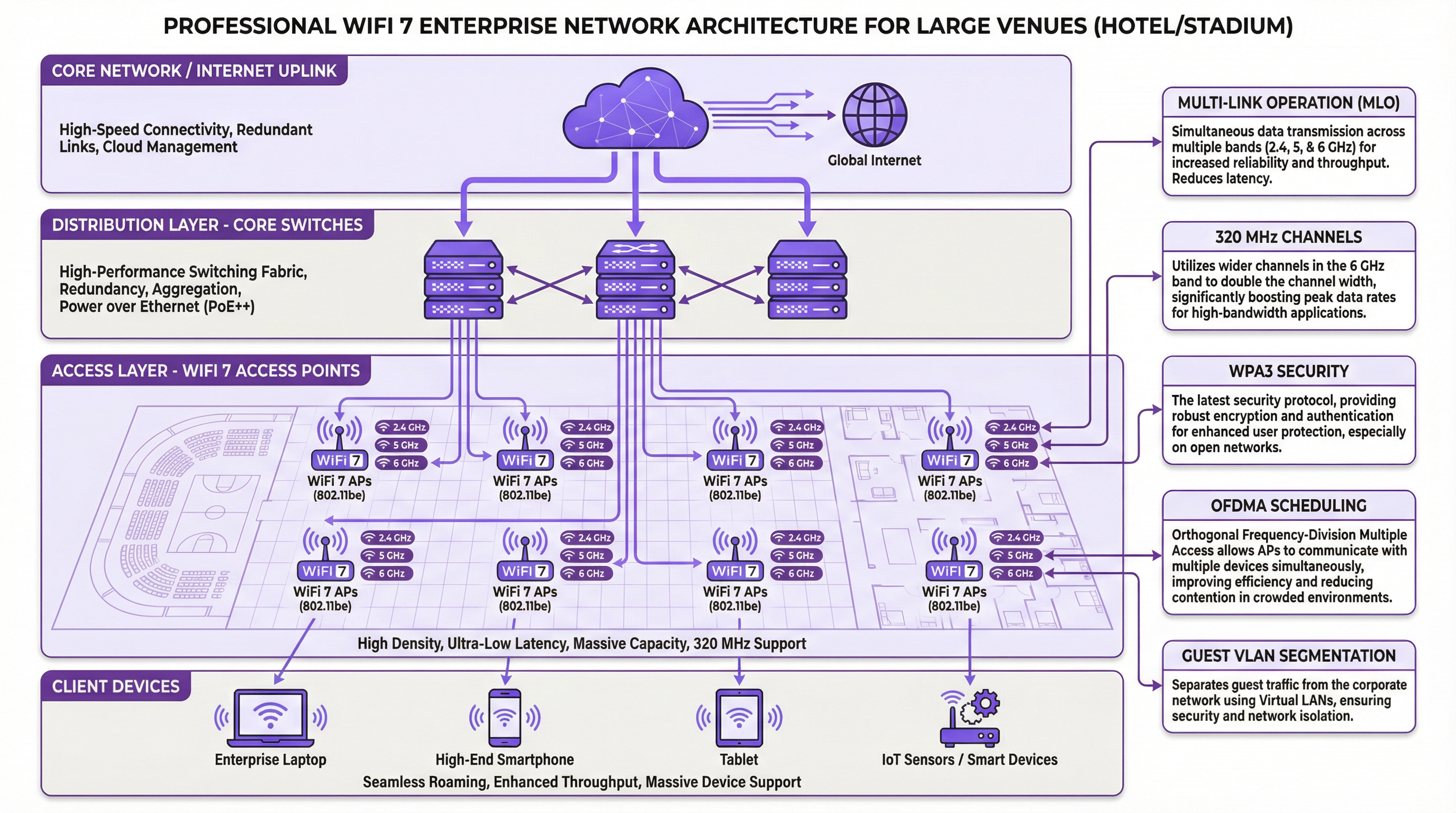
Paso 2: Diseño y arquitectura de la red. Seleccione los puntos de acceso (AP) adecuados en función de los resultados del estudio: WiFi 6E para nuevas implementaciones, WiFi 7 para áreas de rendimiento crítico. Desarrolle un plan de canales estático para las tres bandas con el fin de minimizar las interferencias cocanal y diseñe la segmentación de VLAN para aislar el tráfico de invitados, corporativo y de IoT. Asegúrese de que la red troncal cableada utilice conmutadores PoE++ multigigabit (IEEE 802.3bt).
Paso 3: Configuración y seguridad. Exija WPA3-Enterprise para todos los SSID corporativos. Implemente IEEE 802.1X con un servidor RADIUS para la autenticación basada en certificados. Implemente un Captive Portal compatible con el GDPR para las redes de invitados, integrándolo con una plataforma como Purple para análisis y marketing.
Paso 4: Validación y optimización. Realice un estudio de validación posterior a la implementación para medir la intensidad de la señal, el rendimiento y la latencia reales. Supervise continuamente la red para analizar los patrones de tráfico y el estado de la radiofrecuencia (RF), utilizando la información obtenida para ajustar los niveles de potencia de los puntos de acceso y las asignaciones de canales a lo largo del tiempo.
Mejores prácticas
Priorice la banda de 6 GHz para todas las nuevas implementaciones, reservando la de 2,4 GHz exclusivamente para dispositivos IoT heredados. Diseñe para la itinerancia (roaming) garantizando un solapamiento de cobertura de aproximadamente el 15-20 % con una intensidad de señal mínima de -67 dBm en el borde de la celda. Aplique una estricta segmentación de red mediante VLAN y reglas de firewall: nunca permita que los dispositivos de invitados estén en la misma red que los sistemas de pago o los servidores operativos. Exija WPA3 en toda la empresa y desactive todos los protocolos de seguridad heredados, incluidos WPA2 y TKIP. Centralice la gestión mediante una plataforma basada en la nube para mantener una configuración, una postura de seguridad y una actualización de firmware coherentes en todos los puntos de acceso.
Resolución de problemas y mitigación de riesgos
La interferencia cocanal (CCI) es el problema de rendimiento más común, en el que varios puntos de acceso en el mismo canal interfieren entre sí. Su mitigación requiere un estudio exhaustivo del emplazamiento y un plan de canales estático; utilice canales más estrechos en implementaciones densas para aumentar el número de canales disponibles que no se solapan. La autenticación mal configurada hace que los clientes no puedan conectarse debido a una configuración de seguridad no coincidente; una plataforma de gestión centralizada que aplique perfiles coherentes elimina este riesgo. La potencia PoE insuficiente hace que los puntos de acceso se reinicien o funcionen en un modo de energía reducida; verifique que los conmutadores proporcionen el estándar PoE correcto (PoE++ para WiFi 6/7) y que los tramos de cable estén dentro del límite de 100 metros. El agotamiento de DHCP impide que los clientes obtengan direcciones IP en entornos de alta transitoriedad; asegúrese de que los ámbitos de DHCP tengan el tamaño adecuado y reduzca los tiempos de concesión en entornos de conferencias o eventos.
ROI e impacto empresarial
Invertir en una infraestructura WiFi moderna ofrece una rentabilidad tangible en tres dimensiones. En primer lugar, la experiencia del cliente: en el sector hotelero, un WiFi de alto rendimiento es uno de los principales impulsores de las puntuaciones de satisfacción de los huéspedes, lo que se traduce directamente en reseñas positivas y en la repetición de negocios. En segundo lugar, la eficiencia operativa: una red WiFi fiable impulsa sistemas críticos como los TPV móviles, los escáneres de inventario y los dispositivos de comunicación del personal, lo que reduce los errores y acelera los procesos. En tercer lugar, las nuevas fuentes de ingresos: al integrar una plataforma de análisis de WiFi como Purple, los recintos pueden aprovechar el WiFi para invitados con el fin de recopilar datos de marketing compatibles con el GDPR, comprender los patrones de afluencia y ofrecer promociones específicas, convirtiendo un centro de costes en un generador de ingresos.
La medición del ROI implica el seguimiento del aumento de la satisfacción de los huéspedes y de las puntuaciones NPS, la reducción del tiempo que el personal dedica a tareas manuales y los ingresos incrementales derivados de las campañas de marketing impulsadas por el WiFi. Una red WiFi bien diseñada no es un gasto de TI; es un activo estratégico que sustenta toda la experiencia digital de un recinto moderno.
Key Terms & Definitions
ALOHAnet
The world's first wireless packet data network, developed at the University of Hawaii in 1971 by Norman Abramson. It connected the Hawaiian Islands via UHF radio and introduced the ALOHA random-access protocol, the conceptual ancestor of CSMA/CA used in all 802.11 standards.
IT teams encounter this term in the historical context of WiFi development. Understanding ALOHAnet's contribution to medium access control helps explain why modern WiFi behaves the way it does in congested environments.
OFDMA (Orthogonal Frequency-Division Multiple Access)
A multi-user version of OFDM modulation that divides a WiFi channel into smaller sub-channels (Resource Units) and allocates them to different clients simultaneously. Introduced in WiFi 6 (802.11ax), it allows an access point to serve multiple devices with different bandwidth requirements in the same transmission window.
OFDMA is the primary reason WiFi 6 outperforms WiFi 5 in high-density environments. Network architects should specify WiFi 6 or higher for any venue expecting more than 30–50 concurrent devices per access point.
Multi-Link Operation (MLO)
A WiFi 7 (802.11be) feature that enables a device to simultaneously connect and aggregate data across multiple frequency bands (2.4, 5, and 6 GHz). Unlike previous generations where a device was tied to a single band at a time, MLO allows concurrent transmission and reception across bands, increasing throughput and reducing latency.
MLO is the defining feature of WiFi 7 and the primary justification for upgrading from WiFi 6E in performance-critical environments. It is particularly valuable for applications requiring consistent low latency, such as AR/VR and real-time collaboration tools.
WPA3 (Wi-Fi Protected Access 3)
The current WiFi security standard, replacing WPA2. WPA3 introduces Simultaneous Authentication of Equals (SAE), which protects against offline dictionary attacks on passwords, and provides forward secrecy, meaning past sessions cannot be decrypted even if the password is later compromised. WPA3-Enterprise adds 192-bit cryptographic strength.
WPA3 is mandatory for WiFi 6 and later certified devices. IT teams should disable WPA2 on all corporate SSIDs and enforce WPA3-Enterprise with 802.1X for any network carrying sensitive data. This is increasingly a compliance requirement under frameworks like Cyber Essentials and PCI DSS.
IEEE 802.1X
An IEEE standard for port-based network access control that provides an authentication framework for devices connecting to a network. In WiFi deployments, it is used with a RADIUS server to authenticate users or devices via credentials or certificates before granting network access.
802.1X is the foundation of enterprise WiFi security. It eliminates the security risks of shared pre-shared keys (PSK) by providing per-user or per-device authentication. It is a requirement for PCI DSS compliance on any network segment that handles cardholder data.
MIMO (Multiple-Input Multiple-Output)
A radio technology that uses multiple antennas at both the transmitter (access point) and receiver (client device) to send and receive multiple data streams simultaneously over the same channel. Introduced in WiFi 4 (802.11n), it dramatically increases throughput and reliability.
MIMO is the foundational technology behind the throughput improvements from WiFi 4 onwards. MU-MIMO (Multi-User MIMO), introduced in WiFi 5, extends this to allow an AP to serve multiple clients simultaneously rather than sequentially.
BSS Coloring
A WiFi 6 (802.11ax) mechanism that assigns a colour identifier to each Basic Service Set (BSS). When a device detects a transmission from a different BSS on the same channel, it can identify it as 'foreign' and continue its own transmission rather than deferring, reducing unnecessary backoff and improving efficiency in dense deployments.
BSS Coloring is particularly relevant in multi-tenant buildings, dense urban deployments, and large venues where multiple overlapping WiFi networks coexist. It is a key reason why WiFi 6 performs better in interference-heavy environments than WiFi 5.
PoE++ (IEEE 802.3bt)
The latest Power over Ethernet standard, delivering up to 90W of power over a standard Ethernet cable. WiFi 6E and WiFi 7 access points often require PoE++ due to their higher power consumption from supporting three radio bands and advanced processing capabilities.
IT teams planning WiFi 6E or 7 deployments must audit their switching infrastructure for PoE++ compatibility. Deploying high-generation APs on older PoE or PoE+ switches will result in APs operating in a reduced-power mode, significantly degrading performance and coverage.
6 GHz Band
A new frequency band (5.925–7.125 GHz) opened for unlicensed WiFi use by regulatory bodies including the FCC (2020) and Ofcom (UK, 2021). It provides approximately 1,200 MHz of additional spectrum, compared to 80 MHz in the 2.4 GHz band. It is exclusively available to WiFi 6E and WiFi 7 devices, meaning it is free from legacy device interference.
The 6 GHz band is the most significant spectrum development in WiFi history since the ISM band was opened in 1985. For network architects, it is the primary reason to specify WiFi 6E or 7 for new deployments, particularly in high-density environments where the 2.4 and 5 GHz bands are congested.
Case Studies
A 350-room full-service hotel is planning a complete WiFi infrastructure refresh. The property includes a large conference centre with a 1,200-seat ballroom, three restaurant spaces, a spa, and a fitness centre. The hotel currently operates a WiFi 5 (802.11ac) network installed in 2017 and is experiencing persistent complaints about slow speeds in the ballroom during large events. The IT director needs to select a new standard, design the architecture, and ensure PCI DSS compliance for the payment network. What is the recommended approach?
The recommended approach is a phased deployment of WiFi 6E as the baseline standard, with WiFi 7 specified for the ballroom and conference centre. Phase 1 deploys WiFi 6E access points throughout guest rooms and back-of-house areas, replacing the 802.11ac infrastructure. Each floor is served by ceiling-mounted APs at approximately 15-metre intervals, with a dedicated IoT SSID on 2.4 GHz for door locks, thermostats, and HVAC sensors. Phase 2 focuses on the ballroom and conference spaces, deploying WiFi 7 (802.11be) access points with a high-density design: ceiling-mounted APs at 8-metre intervals, supplemented by under-table APs at delegate positions for the ballroom. The 6 GHz band is configured as the primary band for all client devices, with OFDMA enabled to manage the high concurrent device count during events. The network architecture uses three VLANs: VLAN 10 for guest WiFi (isolated, internet-only), VLAN 20 for staff and operational systems, and VLAN 30 for payment terminals (PCI DSS scope, isolated with dedicated firewall rules and 802.1X authentication). WPA3-Enterprise is mandated on VLANs 20 and 30. A GDPR-compliant captive portal on VLAN 10 collects guest email addresses for the hotel's CRM, integrated with Purple for analytics. The wired backbone is upgraded to multi-gigabit PoE++ switches to power the WiFi 7 APs. Post-deployment, a validation survey confirms coverage and throughput targets are met.
A national retail chain with 85 stores is planning to deploy a unified WiFi platform to support mobile POS systems, inventory management scanners, digital signage, and a customer-facing guest WiFi network. Each store averages 800 square metres. The CTO wants a single vendor-neutral architecture that can be centrally managed, supports GDPR-compliant customer data capture, and can scale to support future IoT deployments. What architecture and standards should be recommended?
The recommended architecture is a cloud-managed WiFi 6E deployment with a standardised three-SSID design across all 85 stores. Each store is served by 4–6 ceiling-mounted WiFi 6E access points, providing full coverage with appropriate overlap. The three SSIDs are: (1) a corporate SSID on 5 GHz with WPA3-Enterprise and 802.1X authentication, carrying POS and inventory scanner traffic on a dedicated VLAN with firewall rules restricting access to the payment processor and inventory system only; (2) an IoT SSID on 2.4 GHz with WPA2-PSK (or WPA3-SAE for newer devices) for digital signage, environmental sensors, and HVAC controls; and (3) a guest WiFi SSID on 5/6 GHz with a GDPR-compliant captive portal integrated with Purple, collecting opt-in customer data for the chain's loyalty programme. Central management is provided through a cloud-based controller, enabling the IT team to push configuration changes, firmware updates, and security policies to all 85 stores simultaneously. Purple's analytics platform provides footfall data, dwell time analysis, and customer journey mapping across all stores, enabling the marketing team to optimise store layouts and promotional campaigns. The architecture is designed to accommodate future WiFi 7 AP upgrades without changes to the underlying network design.
Scenario Analysis
Q1. A 15,000-seat indoor arena is planning a WiFi upgrade ahead of a major esports tournament series. During the last event, the existing WiFi 5 network experienced severe congestion, with average client throughput dropping below 2 Mbps during peak attendance. The venue operator needs to support 12,000 concurrent devices, with 20% of users streaming 4K video and 5% using AR-enhanced experiences. What WiFi standard should be specified, and what are the three most critical design decisions?
💡 Hint:Consider the specific features of WiFi 6/6E/7 that address high-density performance, and think about the physical deployment pattern for a tiered seating environment.
Show Recommended Approach
WiFi 7 (802.11be) should be specified as the primary standard for this deployment, with WiFi 6E as a fallback for areas where WiFi 7 hardware is not yet available. The three most critical design decisions are: (1) Band allocation — deploy all primary client traffic on the 6 GHz band using 80 MHz channels to maximise the number of non-overlapping channels and minimise interference. The 6 GHz band's 1,200 MHz of spectrum allows for significantly more simultaneous channels than 2.4 or 5 GHz. (2) AP placement — use a high-density under-seat or seat-back AP deployment pattern rather than relying on ceiling-mounted APs. This reduces the number of clients per AP (targeting no more than 30–40 devices per AP) and improves signal quality by reducing path loss. (3) OFDMA configuration — enable OFDMA on all APs and configure the network to prioritise the AR/VR traffic using QoS policies, ensuring the 5% of users with the most demanding latency requirements receive consistent sub-10ms latency. MLO should be enabled to allow devices to aggregate 5 and 6 GHz bandwidth for the 4K streaming use case.
Q2. A regional council is deploying public WiFi across 12 libraries and 8 leisure centres. The network must be GDPR-compliant, support a maximum of 200 concurrent users per site, and integrate with the council's existing Active Directory for staff authentication. The IT team has a limited budget and needs to justify the investment to elected members. What architecture would you recommend, and how would you frame the ROI case?
💡 Hint:Consider the balance between performance requirements and cost-efficiency, and think about how GDPR compliance and analytics can be framed as a public service benefit.
Show Recommended Approach
WiFi 6 (802.11ax) is the appropriate standard for this deployment — the 200 concurrent user density does not justify the premium of WiFi 6E or 7, but WiFi 6's OFDMA efficiency is valuable for the mixed-use environment of libraries and leisure centres. The architecture uses two SSIDs per site: a public SSID with a GDPR-compliant captive portal (collecting only the minimum required data — email for service communications, with explicit opt-in) and a staff SSID with WPA3-Enterprise and 802.1X integrated with Active Directory via RADIUS. The ROI case for elected members should be framed around three outcomes: (1) Digital inclusion — providing free, high-quality internet access supports the council's digital inclusion strategy and is a measurable public service outcome; (2) Service analytics — footfall and dwell time data from the WiFi platform informs decisions about opening hours, staffing levels, and facility investments; (3) Cost avoidance — a modern, centrally managed platform reduces the IT overhead of managing 20 separate sites, with firmware updates and security patches deployed centrally.
Q3. An IT director at a 500-store fast-casual restaurant chain is evaluating whether to upgrade from WiFi 5 to WiFi 6E or wait for WiFi 7. Each restaurant has approximately 80 seats, 15 staff devices (POS, kitchen display systems, handheld ordering tablets), and a guest WiFi network. The chain is also planning to deploy IoT sensors for temperature monitoring and predictive maintenance over the next 18 months. What is your recommendation, and what factors would change it?
💡 Hint:Consider the density requirements, the IoT roadmap, and the total cost of ownership over a 5-year horizon.
Show Recommended Approach
WiFi 6E is the recommended standard for this deployment. The density of 80 seats plus 15 staff devices does not require the peak throughput of WiFi 7, and the cost premium is not justified at this scale. WiFi 6E's 6 GHz band provides clean spectrum for the guest WiFi network, while OFDMA ensures efficient service of the mixed device types. The IoT sensor deployment should use a dedicated 2.4 GHz SSID on a separate VLAN, as most IoT sensors do not support 5 or 6 GHz. The factors that would change this recommendation are: (1) If the chain plans to introduce AR-enhanced ordering or real-time analytics applications within the 5-year horizon, WiFi 7 should be specified now to avoid a mid-cycle refresh; (2) If the switching infrastructure already supports PoE++ and multi-gigabit uplinks, the incremental cost of WiFi 7 hardware may be small enough to justify the future-proofing; (3) If the chain operates in markets where the 6 GHz band is not yet approved by the local regulator, WiFi 6 (not 6E) may be the appropriate choice.
Key Takeaways
- ✓WiFi's origins trace back to 1971 with ALOHAnet, the world's first wireless packet network, and the ALOHA protocol that directly inspired the CSMA/CA mechanism used in every 802.11 standard today.
- ✓The 1985 FCC decision to open the 2.4 GHz ISM band for unlicensed use was the regulatory catalyst that made consumer WiFi possible, and the CSIRO's 1996 OFDM patent provided the signal processing foundation for all modern standards from 802.11a onwards.
- ✓Each WiFi generation has solved a specific bottleneck: WiFi 4 added MIMO for throughput, WiFi 5 added MU-MIMO and wider channels, WiFi 6 added OFDMA for high-density efficiency, WiFi 6E added the clean 6 GHz band, and WiFi 7 added MLO for simultaneous multi-band aggregation.
- ✓For new enterprise deployments in high-density venues, WiFi 6E is the minimum baseline standard; WiFi 7 should be specified for environments requiring sub-10ms latency, AR/VR support, or future-proofing against next-generation applications.
- ✓Security architecture is non-negotiable: WPA3-Enterprise with IEEE 802.1X authentication on corporate SSIDs, strict VLAN segmentation between guest, staff, IoT, and payment networks, and a GDPR-compliant captive portal for public-facing WiFi.
- ✓The wired backhaul is the most commonly overlooked element of a WiFi upgrade: WiFi 6E and 7 APs require PoE++ (IEEE 802.3bt) switches and multi-gigabit uplinks — deploying next-generation APs on legacy switching infrastructure negates the investment.
- ✓A modern WiFi platform like Purple transforms the network from a cost centre into a strategic asset, enabling GDPR-compliant customer data capture, footfall analytics, and targeted marketing that delivers measurable ROI for hospitality, retail, and venue operators.




