

Beacons de Estimote: Una guía completa de instalación, configuración y casos de uso
This guide provides a comprehensive technical reference for IT managers and network architects on deploying Estimote beacons. It covers setup, configuration, and advanced use cases like wayfinding, proximity marketing, and asset tracking, offering actionable guidance for achieving measurable ROI in enterprise environments.
🎧 Listen to this Guide
View Transcript

Resumen ejecutivo
Para los CTO, directores de TI y arquitectos de redes, los beacons Bluetooth Low Energy (BLE) representan una tecnología madura y escalable para conectar los mundos físico y digital. Estimote, un proveedor líder de hardware, ofrece un ecosistema robusto de beacons que permiten un posicionamiento preciso en interiores, interacciones basadas en proximidad y seguimiento de activos de alto valor. Esta guía sirve como referencia técnica para la implementación de beacons de Estimote en entornos empresariales como la hostelería, el comercio minorista y recintos de gran escala. Analizaremos la tecnología subyacente, proporcionaremos esquemas de implementación independientes del proveedor y evaluaremos el ROI de las iniciativas impulsadas por beacons. La propuesta de valor central de los beacons de Estimote radica en su funcionamiento de bajo consumo y larga duración, y en un kit de desarrollo de software (SDK) flexible que se integra a la perfección con aplicaciones móviles existentes y plataformas de análisis como Purple. Una implementación de beacons correctamente diseñada puede generar un impacto comercial significativo, desde mejorar la experiencia del huésped y aumentar los ingresos complementarios hasta optimizar los flujos de trabajo operativos y mitigar la pérdida de activos. Este documento proporciona la orientación estratégica y táctica necesaria para pasar de una prueba de concepto a una implementación empresarial a gran escala, segura y en cumplimiento normativo.
Análisis técnico detallado
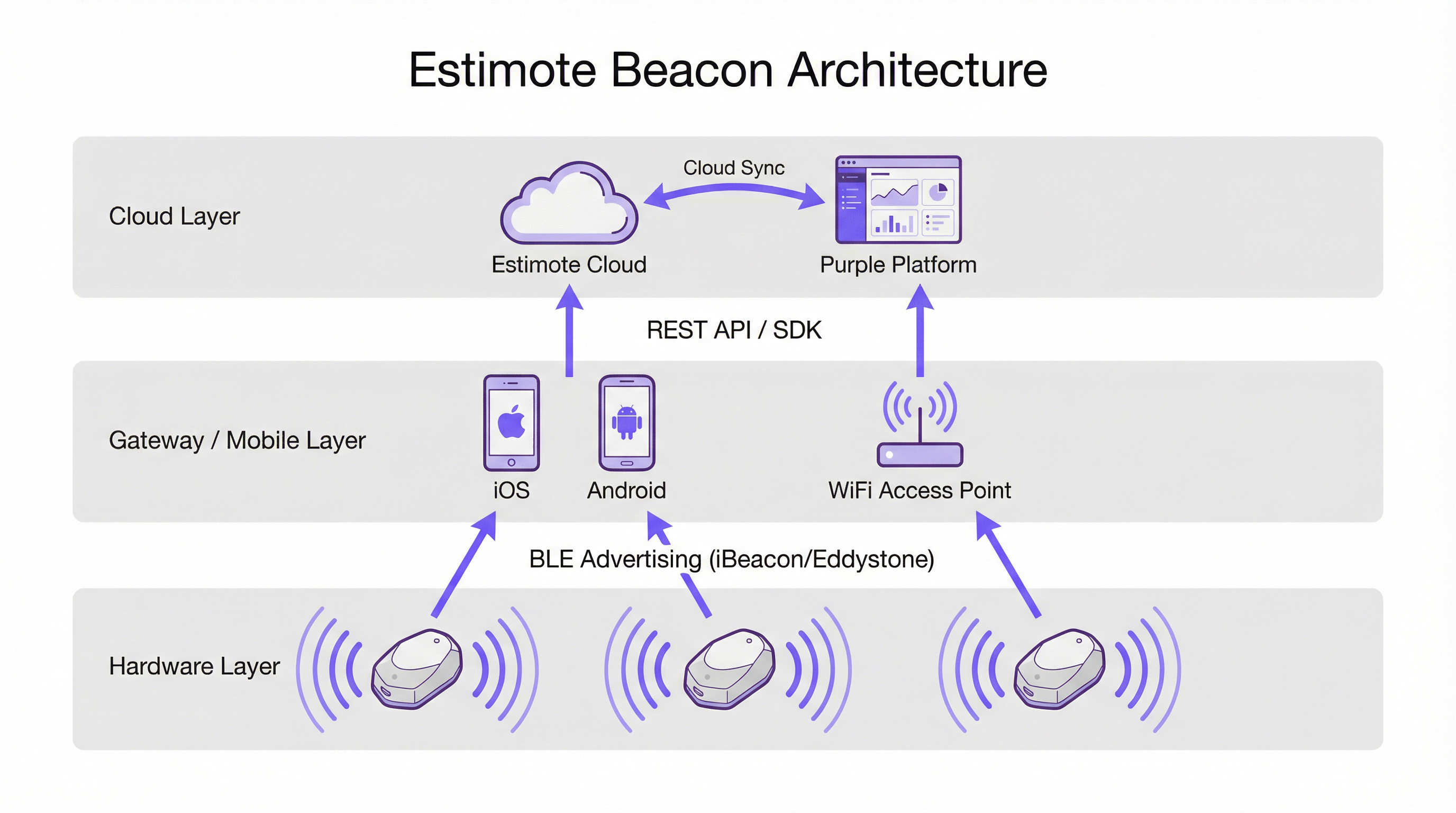
En esencia, un beacon de Estimote es una pequeña computadora alimentada por batería que emite una señal Bluetooth Low Energy (BLE). Este proceso, conocido como "publicidad no dirigida" (undirected advertising), permite que cualquier dispositivo compatible con BLE, como un teléfono inteligente, detecte la presencia del beacon sin necesidad de emparejamiento o conexión directa. El beacon transmite un pequeño paquete de datos a intervalos regulares, el cual contiene un identificador que una aplicación móvil puede reconocer y utilizar para ejecutar una acción. Este modelo de comunicación de uno a muchos es altamente eficiente y forma la base de todas las soluciones de proximidad basadas en beacons.
Protocolos: iBeacon y Eddystone
Dos protocolos principales rigen las comunicaciones de los beacons: iBeacon de Apple y Eddystone de Google. Un beacon de Estimote puede emitir uno o ambos.
- iBeacon: Transmite un identificador único compuesto por tres partes: un UUID (Identificador Único Universal), un valor Major y un valor Minor. Esta estructura jerárquica es ideal para mapear espacios físicos. Por ejemplo, un UUID puede representar a toda una organización, un valor Major puede representar un recinto o piso específico, y un valor Minor puede identificar un solo beacon.
- Eddystone: Un protocolo de código abierto de Google que ofrece mayor flexibilidad. Define varios tipos de tramas, incluyendo Eddystone-UID (similar al identificador de iBeacon), Eddystone-URL (emite una dirección web) y Eddystone-EID (un identificador efímero y cifrado que cambia periódicamente, mejorando la seguridad y la privacidad).
Hardware y rendimiento
La generación actual de Proximity Beacons de Estimote opera con Bluetooth 5.0, ofreciendo un alcance máximo teórico de hasta 100 metros. Sin embargo, para la orientación práctica en interiores (wayfinding), la potencia de transmisión se configura para alcances mucho más cortos con el fin de garantizar la precisión y evitar la filtración de señales entre pisos. Alimentados por dos baterías AA estándar, estos beacons pueden alcanzar una vida útil de 3 a 5 años, dependiendo del intervalo de publicidad y la configuración de la potencia de transmisión. Esta larga vida operativa es un factor crítico para reducir el costo total de propiedad (TCO) en implementaciones a gran escala.
La familia de productos de Estimote
Estimote ofrece una gama de hardware adaptada a casos de uso específicos:
| Línea de productos | Características principales y casos de uso |
|---|---|
| Proximity Beacons | El equipo estándar para orientación en interiores y marketing de proximidad. |
| LTE Beacons | Conectividad celular integrada (LTE-M/NB-IoT) y GPS para el seguimiento de activos en interiores y exteriores sin necesidad de un teléfono inteligente como intermediario. |
| UWB Tags | Utiliza tecnología de banda ultraancha (Ultra-Wideband) para una precisión de posicionamiento a nivel de centímetros, ideal para el seguimiento de activos de alta precisión y la prevención de colisiones. |
| Mirror Beacons | Se conecta a pantallas digitales para mostrar contenido activado por beacons o usuarios cercanos. |
Guía de implementación
Una implementación exitosa de beacons depende de una planificación meticulosa y una ejecución disciplinada. Los siguientes pasos proporcionan un esquema independiente del proveedor para los equipos de TI.
Paso 1: Estudio del sitio y ubicación de los beacons
Antes de instalar cualquier hardware, es obligatorio realizar un estudio exhaustivo del sitio. Las obstrucciones físicas como pilares de concreto, estanterías metálicas y huecos de ascensores atenúan significativamente las señales BLE. Utilice una herramienta como IndoorAtlas para mapear la propagación de la señal e identificar las ubicaciones óptimas para los beacons.
Mejores prácticas para la ubicación:
- Altura: Monte los beacons a una altura de 2.5 a 3 metros (8-10 pies) del suelo para evitar manipulaciones y minimizar la obstrucción de la señal.
- Ubicaciones clave: Coloque beacons en todos los bancos de ascensores, entradas/salidas, puntos de transición entre pisos y en las intersecciones de los pasillos principales.
- Configuración del alcance: Este es el paso de configuración más crítico. Una potencia de transmisión mal configurada es la causa principal de un rendimiento deficiente.
- Entradas y ascensores: Configure el alcance a ~15 metros o 50 pies (-12dBm).
- Pasillos largos: Configure el alcance a ~30 metros o 100 pies (-4dBm).
- Atrios abiertos y paredes de cristal: Reduzca el alcance a ~7 metros o 22 pies (-20dBm) para evitar la filtración de señales entre pisos.
Paso 2: Configuración de los beacons
La disciplina en la configuración evita dolores de cabeza en la resolución de problemas más adelante. Todos los beacons dentro de una implementación deben compartir un perfil de configuración común.
Parámetros de configuración:
- UUID: Asigne un único UUID exclusivo para toda su organización.
- Major/Minor: Utilice el valor Major para indicar el número de piso (por ejemplo, 1 para el primer piso, 99 para el sótano). Utilice el valor Minor como un número secuencial único para cada beacon en ese piso.
- Intervalo de publicidad (Advertising Interval): Para la orientación en interiores, se recomienda un intervalo de 300-500 ms. Un intervalo de 300 ms proporciona una experiencia de usuario fluida con un impacto manejable en la vida útil de la batería.
- Tipos de paquetes: Desactive cualquier paquete de publicidad que no sea necesario para su caso de uso (por ejemplo, desactive los paquetes específicos de Estimote si solo está utilizando iBeacon para una implementación de Purple).
Paso 3: Gestión de la flota
Para cualquier implementación que supere unas pocas docenas de beacons, la configuración manual no es escalable. Aproveche Estimote Cloud y su herramienta Bulk Updater para aplicar cambios de configuración a cientos o miles de dispositivos simultáneamente. Establezca un proceso para monitorear la vida útil de la batería (disponible a través del SDK de Estimote y la API en la nube) y para aplicar actualizaciones de firmware, que a menudo contienen parches de seguridad críticos y mejoras de rendimiento.
Mejores prácticas
- Documente todo: Etiquete físicamente cada beacon con sus valores Major y Minor antes de la instalación. Mantenga un mapa digital correspondiente que vincule los ID de los beacons con sus ubicaciones físicas precisas.
- Priorice la seguridad: Para aplicaciones sensibles, utilice el protocolo Eddystone-EID con sus identificadores rotativos y cifrados. Esto evita que actores malintencionados falsifiquen sus beacons o rastreen a los usuarios sin autorización.
- Garantice el cumplimiento normativo (GDPR/PCI DSS): Las implementaciones de beacons que procesan datos personales entran en el ámbito de aplicación del GDPR. Asegúrese de tener un mecanismo de consentimiento explícito (opt-in) dentro de su aplicación móvil. Para entornos minoristas, asegúrese de que su infraestructura de beacons y las aplicaciones asociadas no comprometan el cumplimiento de PCI DSS al manejar incorrectamente los datos de las tarjetas de pago.
- Intégrese con plataformas de análisis: El verdadero ROI de una implementación de beacons se materializa a través de los datos. Integre los datos de ubicación de los beacons con una plataforma de análisis como Purple para medir los tiempos de permanencia, analizar los patrones de tráfico peatonal y cuantificar el impacto de las campañas de marketing de proximidad.
Resolución de problemas y mitigación de riesgos
- Detección de piso inexacta: Esto casi siempre es causado por la filtración de señales. La mitigación principal es reducir la potencia de transmisión (alcance) de los beacons en áreas abiertas y cerca de las transiciones de piso. Un estudio adecuado del sitio es la mejor medida preventiva.
- Mala precisión de ubicación: Si el "punto azul" se retrasa o salta, disminuya el intervalo de publicidad (por ejemplo, de 500 ms a 300 ms) para proporcionar actualizaciones de ubicación más frecuentes a la aplicación móvil. Además, verifique la ubicación y densidad de los beacons en comparación con el estudio del sitio.
- Agotamiento de la batería: Si las baterías se agotan más rápido que los 3 a 5 años proyectados, revise la configuración del beacon. Un intervalo de publicidad demasiado agresivo (por ejemplo, 100 ms) o una potencia de transmisión excesivamente alta son los culpables más comunes.
ROI e impacto comercial
El caso de negocio para los beacons de Estimote se basa en mejoras medibles en la experiencia del cliente y la eficiencia operativa.
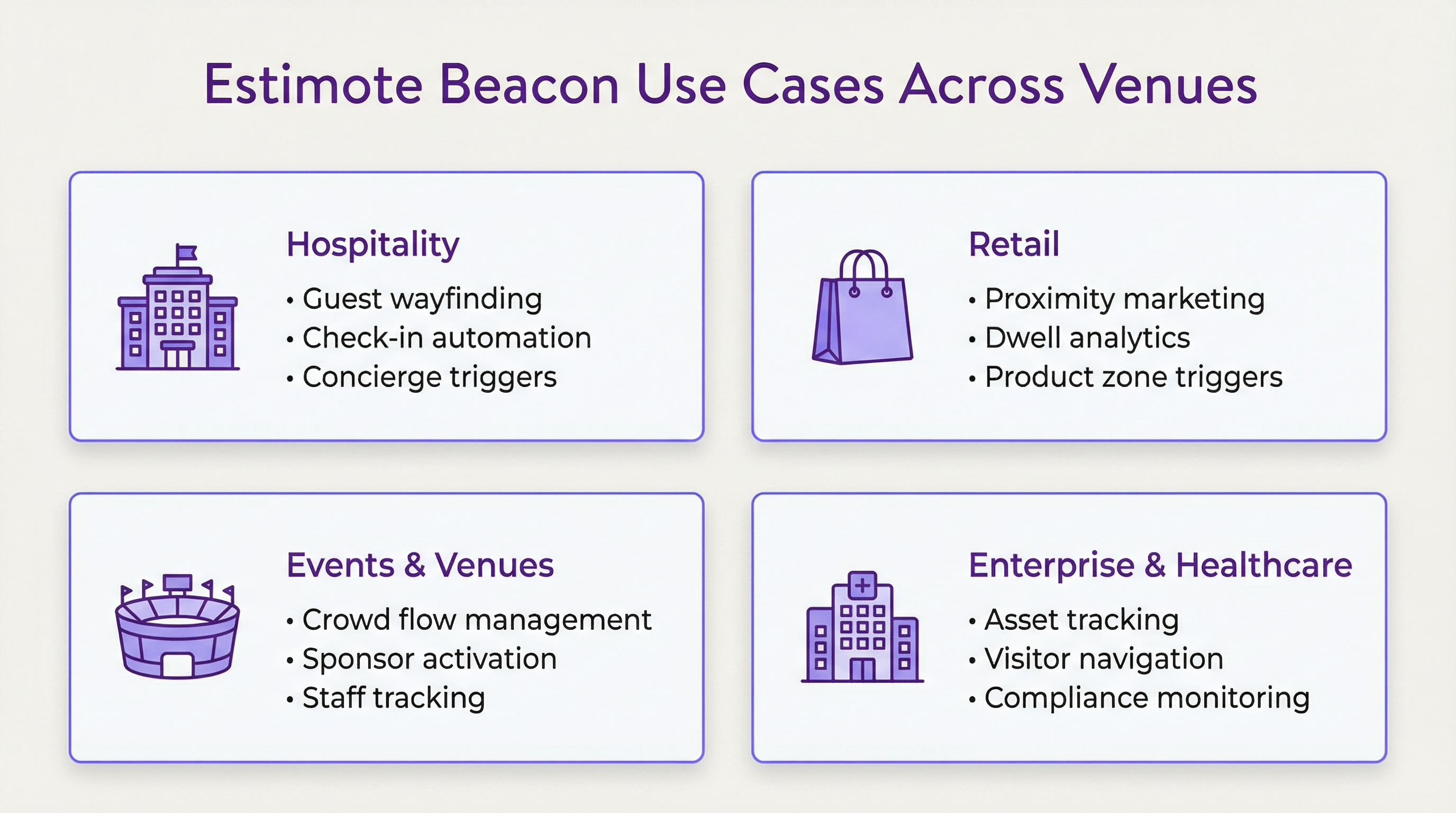
- Hostelería: Un hotel puede utilizar beacons para habilitar un check-in móvil sin fricciones, proporcionar navegación paso a paso hasta la habitación del huésped y enviar ofertas personalizadas de servicios de spa o reservas de restaurantes a medida que el huésped pasa por el lugar. El ROI se mide en el aumento de las puntuaciones de satisfacción del huésped (NPS), mayores ingresos complementarios y una mejor eficiencia del personal.
- Comercio minorista: Un minorista puede analizar los recorridos de los clientes en la tienda, medir el tiempo de permanencia en departamentos específicos y activar promociones personalizadas cuando un miembro del programa de lealtad ingresa a una zona de productos de alto valor. El ROI se mide en el aumento del tamaño de la cesta, mejores tasas de conversión y un mayor valor de vida del cliente.
- Recintos de gran escala (estadios/aeropuertos): Los beacons impulsan la orientación hacia los asientos o puertas de embarque, facilitan la gestión del flujo de multitudes y permiten activaciones de patrocinadores basadas en la ubicación. El ROI se mide en la reducción de la congestión, una mejor experiencia para el aficionado o viajero y nuevas fuentes de ingresos provenientes de la publicidad basada en la ubicación.
Key Terms & Definitions
Bluetooth Low Energy (BLE)
A power-efficient variant of the Bluetooth wireless standard, designed for Internet of Things (IoT) devices to communicate small amounts of data over short distances. Its low power consumption is what enables beacons to operate for years on small batteries.
IT teams will encounter BLE as the fundamental communication technology for all modern beacons. Understanding its range and power characteristics is crucial for designing a sustainable deployment.
iBeacon
Apple's protocol for BLE advertising. It structures the beacon's broadcast around a three-tiered identifier: UUID, Major, and Minor. It is the most widely supported protocol for indoor navigation on iOS devices.
This is a non-negotiable standard to support for any public-facing venue. If you want to provide wayfinding for iPhone users, your beacons must be broadcasting iBeacon packets.
Eddystone
Google's open-source alternative to iBeacon. It is more flexible, with multiple frame types including Eddystone-EID, which uses ephemeral (short-lived) identifiers to enhance security and privacy.
For enterprise deployments concerned with security or wanting to avoid vendor lock-in, Eddystone provides a powerful and flexible option. Eddystone-EID is a key feature for mitigating tracking and spoofing risks.
UUID (Universally Unique Identifier)
A 128-bit number used to identify information in computer systems. In the context of iBeacon, it serves as the top-level identifier for an organization or a specific app.
The UUID acts as a unique namespace for your beacon deployment. All beacons in your organization should be configured with the same UUID to ensure your app does not respond to beacons from other nearby businesses.
Advertising Interval
The frequency at which a beacon broadcasts its advertising packet. A shorter interval (e.g., 100ms) results in more responsive location updates but consumes more battery. A longer interval (e.g., 1000ms) conserves battery but can feel sluggish.
This is a critical trade-off that network architects must balance. For active wayfinding, 300-500ms is the sweet spot. For passive asset tracking, the interval can be much longer.
Transmission Power (Tx Power)
The signal strength of the beacon's broadcast, measured in dBm. This setting directly controls the beacon's range. A higher Tx Power (e.g., +4dBm) means longer range, while a lower Tx Power (e.g., -20dBm) means shorter range.
This is the primary tool for tuning a beacon network. Correctly setting Tx Power is the key to preventing signal bleed and ensuring accurate positioning. It is more important than physical beacon density in many cases.
Signal Bleed
The phenomenon where a beacon's signal is detected in an unintended area, most commonly on the floor above or below its actual location. It is the primary cause of inaccurate floor detection in wayfinding applications.
IT teams must actively design against signal bleed, especially in buildings with atriums or thin floors. The main mitigation strategy is to reduce the transmission power of beacons in problematic areas.
Ultra-Wideband (UWB)
A short-range radio technology that can measure location with very high precision (down to a few centimeters). It works by measuring the time-of-flight of radio signals between a tag and multiple anchors.
When an IT team is tasked with a use case that requires 'inch-level' or 'sub-meter' accuracy, such as tool tracking in manufacturing or collision avoidance, BLE is not sufficient. UWB is the appropriate technology for these high-precision requirements.
Case Studies
A 500-room luxury hotel in a dense urban environment wants to implement 'blue dot' wayfinding for guests from the lobby to their rooms, elevators, and amenities (pool, restaurant). The hotel has a large, three-story glass atrium at its center. What is the recommended Estimote beacon deployment strategy?
- Hardware Selection: Standard Estimote Proximity Beacons are sufficient for this use case.
- Site Survey: Conduct a mandatory site survey focusing on the glass atrium. Use a signal mapping tool to visualize BLE signal propagation and identify potential for inter-floor signal bleed.
- Beacon Placement & Configuration:
- Guest Corridors: Place one beacon every 50-75 feet, mounted 8-10 feet high. Configure with a -8dBm transmit power (approx. 100ft range) and a 400ms advertising interval.
- Elevator Banks: Place one beacon at each elevator bank on every floor. Configure with a -12dBm transmit power (approx.50ft range) to ensure the signal is localized to the waiting area.
- Atrium: This is the critical zone. Place beacons around the perimeter of the atrium on each floor. Configure them with a significantly lower transmit power, such as -20dBm (approx. 22ft range), to prevent signals from reaching the floors above and below. The advertising interval can be increased to 600ms as fine-grained accuracy is less critical in this open space.
- Naming Convention: Use the hotel's unique UUID. Set Major to the floor number (e.g., 1, 2, 3...). Assign sequential Minor values for each beacon on that floor. Physically label each beacon.
- Fleet Management: Use the Estimote Cloud to bulk-configure all beacons and monitor battery life post-deployment.
A retail chain with 200 stores wants to track high-value assets (e.g., portable payment terminals, specialized scanning equipment) that move between the stockroom and the sales floor. The assets sometimes leave the store for sidewalk sales events. What is the optimal Estimote solution?
- Hardware Selection: The ideal solution is the Estimote LTE Beacon. Its integrated cellular connectivity and GPS make it perfect for tracking assets both indoors and outdoors, without relying on the store's Wi-Fi or nearby smartphones.
- Deployment: Attach one LTE Beacon to each high-value asset. No complex beacon infrastructure is required within the store itself.
- Cloud Configuration: In the Estimote Cloud, configure the LTE Beacons to report their location at a set interval (e.g., every 5 minutes when stationary, every 1 minute when in motion). Set up geofences for each store location.
- Application Integration: Use the Estimote Cloud API to pull location data for each asset into the retailer's central inventory management system. Configure API-triggered alerts for specific events:
- An alert is sent to the store manager if an asset's battery level drops below 20%.
- An alert is sent if an asset leaves the store's geofence outside of a scheduled sidewalk sale event.
- ROI Measurement: The ROI is calculated by the reduction in lost or stolen assets, the decrease in time spent by staff searching for equipment, and the improved availability of revenue-generating devices like payment terminals.
Scenario Analysis
Q1. Your stadium client wants to use beacons to track the real-time location of mobile food and beverage carts to optimize stock levels and deployment. The carts move throughout the stadium, including outdoor plaza areas. Which Estimote product is the best fit and why?
💡 Hint:Consider the need for tracking both indoors and outdoors, without relying on the stadium's public Wi-Fi or guest smartphones.
Show Recommended Approach
The Estimote LTE Beacon is the best fit. Its built-in cellular (LTE-M) and GPS capabilities allow it to report its location independently from anywhere in the stadium, whether inside the concourse or outside in the plaza. Standard proximity beacons would not work reliably as they depend on a nearby smartphone with a specific app to relay their location, and UWB would be overkill and too complex for this wide-area tracking use case.
Q2. A hospital is deploying beacons for patient wayfinding. During testing, they find that when patients are in the central atrium, the app frequently switches between showing them on the 2nd and 3rd floors. What are the two most likely causes and the primary solution?
💡 Hint:Think about how BLE signals behave in large, open, multi-story spaces.
Show Recommended Approach
The two most likely causes are: 1) The transmission power (range) of the beacons around the atrium is set too high. 2) The beacons are placed in locations that allow for a clear, unobstructed line of sight between floors. The primary solution is to significantly reduce the transmission power of the beacons located in and around the atrium to a very short range (e.g., -20dBm) to create a tight signal bubble on each floor and prevent this inter-floor 'signal bleed'.
Q3. A retail CTO is concerned about the privacy implications of a beacon deployment under GDPR. They ask if beacons are "tracking our customers' phones." How would you accurately describe the data flow to reassure them?
💡 Hint:Focus on where the 'intelligence' lies in the system and the role of user consent.
Show Recommended Approach
You should clarify that the beacons themselves do not track anyone. They are simple, one-way broadcast devices, like a lighthouse. They have no knowledge of who is nearby. The tracking event occurs at the application layer, on the customer's own phone, and only if they have explicitly opted-in and granted the app location permissions. The app detects the beacon's signal and then reports the phone's proximity to that beacon to the cloud. The entire process is user-initiated and consent-driven, which is a key principle of GDPR. Furthermore, using protocols like Eddystone-EID can encrypt the beacon's identifier, adding another layer of privacy.
Key Takeaways
- ✓Estimote beacons are low-power, battery-operated devices that broadcast BLE signals to enable indoor positioning and proximity-based actions.
- ✓Successful deployment requires a thorough site survey to plan beacon placement and prevent signal bleed, especially in open, multi-story areas.
- ✓Configuration discipline is key: use a consistent UUID, logical Major/Minor assignments, and an appropriate advertising interval (300-500ms for wayfinding).
- ✓For indoor/outdoor asset tracking, Estimote LTE Beacons with integrated cellular/GPS are the optimal solution, removing dependency on smartphones.
- ✓For high-precision (inch-level) tracking, Ultra-Wideband (UWB) tags are the appropriate technology, not standard BLE beacons.
- ✓Compliance with GDPR requires an explicit opt-in consent model within the mobile application; the beacons themselves do not store or process personal data.
- ✓The ROI of a beacon deployment is realized by integrating location data with analytics platforms to measure improvements in customer experience, operational efficiency, and revenue.




