

Redes de área metropolitana (MAN): un análisis exhaustivo de tecnologías, aplicaciones y tendencias futuras
This guide provides a comprehensive technical reference on Metropolitan Area Networks (MANs) for IT leaders and network architects. It covers core technologies, deployment strategies, and business considerations for implementing high-performance, city-scale networks. The content is tailored for decision-makers in hospitality, retail, events, and public-sector organisations.
🎧 Listen to this Guide
View Transcript
Resumen ejecutivo
Una red de área metropolitana (MAN, por sus siglas en inglés) es un componente de infraestructura crítico para cualquier organización que opere en múltiples sitios dentro de una sola región geográfica. Al interconectar redes de área local (LAN) distribuidas, una MAN crea una estructura de red unificada y de alto rendimiento que reduce la latencia, disminuye los costos de ancho de banda entre sitios y permite la gestión y seguridad centralizadas. Para los CTO y directores de TI de cadenas hoteleras, franquicias minoristas y recintos de gran escala, una MAN bien diseñada es la base para ofrecer una experiencia de conexión consistente y de alta calidad, soportar aplicaciones en la nube con uso intensivo de datos y escalar para demandas futuras como IoT y 5G. Esta guía proporciona un análisis técnico exhaustivo e independiente del proveedor sobre la arquitectura de las MAN, los modelos de implementación y las mejores prácticas operativas. Va más allá de la teoría académica para ofrecer orientación práctica en la planificación, implementación y optimización de una MAN con el fin de impulsar un valor comercial medible, mejorar la postura de seguridad y garantizar un retorno de inversión positivo.
Análisis técnico exhaustivo
Una MAN cierra la brecha entre la red de área local y la de área amplia, abarcando típicamente un área geográfica de 5 a 50 kilómetros. Su función principal es proporcionar conectividad de alta velocidad y baja latencia entre ubicaciones dispares, como oficinas corporativas, centros de datos y recintos públicos. La arquitectura suele ser jerárquica y consta de tres capas distintas.
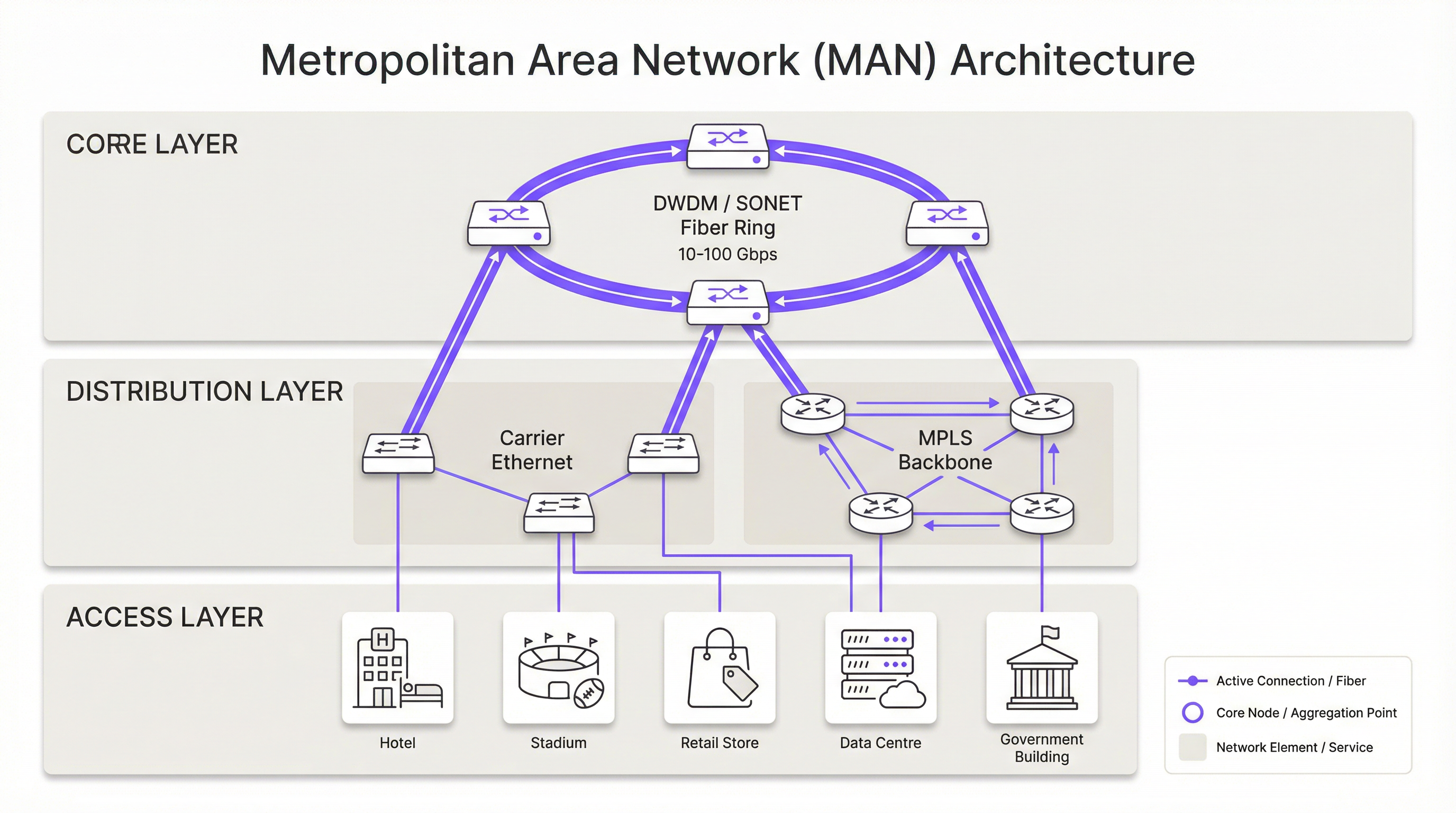
1. Capa de núcleo (Core): Es la red troncal de alta velocidad, construida casi exclusivamente sobre un anillo de fibra óptica redundante. Tecnologías como la multiplexación por división de longitud de onda densa (DWDM) y la red óptica síncrona (SONET) permiten múltiples flujos de datos a través de un solo par de fibra, con anchos de banda típicos que van desde 10 Gbps hasta 100 Gbps y más. La topología de anillo, a menudo regida por el estándar IEEE 802.17 Resilient Packet Ring (RPR), garantiza una alta disponibilidad con tiempos de conmutación por error inferiores a 50 ms, lo que hace que el núcleo sea resistente a fallas de un solo nodo o enlace.
2. Capa de distribución: Esta capa intermedia agrega el tráfico de la capa de acceso y lo conecta al núcleo. Las tecnologías clave aquí incluyen Carrier Ethernet y la conmutación de etiquetas multiprotocolo (MPLS). MPLS es particularmente crucial para las MAN de nivel empresarial, ya que permite la ingeniería de tráfico, garantías de calidad de servicio (QoS) y la creación de VPN privadas y seguras de Capa 2 o Capa 3. Esto permite a las organizaciones segmentar el tráfico (por ejemplo, separar los datos corporativos del WiFi público para invitados) a través de la infraestructura compartida.
3. Capa de acceso: Esta es la "última milla" que conecta edificios y recintos individuales a la capa de distribución. Si bien la fibra sigue siendo el medio preferido por su rendimiento y confiabilidad, esta capa a menudo emplea una combinación de tecnologías basadas en el costo y la viabilidad. El acceso inalámbrico fijo (FWA) mediante enlaces de microondas y, cada vez más, la tecnología celular 5G proporcionan alternativas robustas y de alta velocidad donde el tendido de fibra resulta prohibitivo.
Guía de implementación
La implementación de una MAN es un proyecto importante que requiere una planificación cuidadosa. El proceso se puede dividir en cuatro fases clave.
Fase 1: Viabilidad y desarrollo del caso de negocio. Comience auditando los costos de conectividad entre sitios y las limitaciones de rendimiento actuales. Identifique los principales impulsores comerciales para una MAN: ¿busca mejorar el rendimiento de las aplicaciones en la nube, centralizar el respaldo de datos o lanzar un nuevo servicio para invitados en toda la ciudad? Modele el costo total de propiedad (TCO) de una MAN, comparando un modelo de construcción propia (arrendamiento de fibra oscura) frente a un servicio administrado por un operador. Para la mayoría de las organizaciones con más de cinco sitios en un área metropolitana, un modelo de construcción ofrece un mejor ROI en un período de 7 a 10 años.
Fase 2: Selección de tecnología y diseño independiente del proveedor. Con base en sus requisitos comerciales, cree un diseño de alto nivel. Especifique tecnologías abiertas y basadas en estándares (por ejemplo, Carrier Ethernet, MPLS) para evitar la dependencia de un solo proveedor. Su diseño debe detallar la arquitectura de tres capas, los protocolos de enrutamiento propuestos (como OSPF y BGP) y un plan de seguridad integral que incorpore IEEE 802.1X, segmentación de VLAN y estrategias de cifrado como MACsec.
Fase 3: Adquisición e implementación física. Esta fase suele ser la más desafiante, ya que implica gestionar permisos de derecho de vía y obras civiles para el tendido de fibra. Emita solicitudes de propuestas (RFP) basadas en su diseño independiente del proveedor. Al arrendar fibra oscura, asegúrese de que el acuerdo de nivel de servicio (SLA) especifique las características de la fibra y el tiempo medio de reparación (MTTR). Para los enlaces inalámbricos, realice un estudio de RF exhaustivo para identificar posibles interferencias.
Fase 4: Puesta en marcha y entrega operativa. Una vez que la infraestructura física está en su lugar, la red se pone en marcha. Esto implica configurar todos los elementos de la red, probar los mecanismos de conmutación por error y redundancia, y validar el rendimiento frente a las especificaciones de diseño. Finalmente, la red se entrega al equipo del Centro de Operaciones de Red (NOC), equipado con las herramientas de monitoreo y gestión necesarias.
Mejores prácticas
- Diseño para la redundancia: Una MAN debe ser resiliente. El núcleo debe contar con diversas rutas de fibra, la capa de distribución debe tener conexiones de doble origen (dual-homed) al núcleo y los sitios de acceso crítico deben tener una ruta de conmutación por error secundaria (por ejemplo, fibra como principal, 5G FWA como secundaria).
- Segmentación lógica del tráfico: Utilice VLAN (IEEE 802.1Q) y VPN MPLS para crear redes lógicamente separadas para diferentes tipos de tráfico (por ejemplo, corporativo, invitados, IoT, VoIP). Este es un requisito fundamental para la seguridad y el cumplimiento de estándares como PCI DSS y GDPR.
- Centralización del monitoreo de red: Implemente un sistema de monitoreo de red (NMS) robusto que proporcione un panel de control único para toda la MAN. El sistema debe monitorear la utilización de enlaces, la latencia, la pérdida de paquetes y el estado de los dispositivos en tiempo real, con alertas impulsadas por IA para permitir un mantenimiento proactivo.
- Priorización de la seguridad: Implemente el control de acceso basado en puertos utilizando IEEE 802.1X en todos los puertos cableados. Para los segmentos inalámbricos, exija WPA3-Enterprise. Cifre el tráfico confidencial en tránsito utilizando IPsec o MACsec. Realice evaluaciones de vulnerabilidad y pruebas de penetración con regularidad.
Solución de problemas y mitigación de riesgos
| Modo de falla común | Estrategia de mitigación | Pasos para la solución de problemas |
|---|---|---|
| Corte de fibra | Utilice una topología de anillo redundante con diversas rutas físicas. Asegúrese de que el SLA del operador incluya un MTTR estricto. | Utilice un reflectómetro óptico en el dominio del tiempo (OTDR) para identificar la ubicación de la ruptura. Redirija el tráfico a través de la ruta secundaria. |
| Error de configuración | Implemente un riguroso proceso de gestión de cambios con revisión por pares. Utilice herramientas de automatización de red con validación previa a la implementación. | Revierta a la última configuración válida conocida. Utilice herramientas de monitoreo de red para correlacionar la falla con el cambio reciente. |
| Ataque DDoS | Contrate un servicio de mitigación de DDoS basado en la nube que pueda limpiar el tráfico malicioso antes de que llegue al borde de su red. | Identifique el vector de ataque y el objetivo mediante el análisis de NetFlow. Involucre al proveedor de mitigación de DDoS para aplicar reglas de filtrado. |
| Corte de energía en el nodo | Equipe todos los nodos de núcleo y distribución con sistemas de alimentación ininterrumpida (UPS) y, para los nodos críticos, generadores de respaldo. | Verifique el estado de la energía en el nodo afectado. Monitoree los registros del UPS y del generador. |
ROI e impacto comercial
Calcular el retorno de inversión de una MAN implica más que solo comparar los costos de conectividad. El impacto comercial es multifacético. Los ahorros de costos directos provienen de la consolidación de múltiples conexiones a Internet costosas y líneas arrendadas en una red troncal única y más eficiente. Las ganancias de productividad se logran a través de una menor latencia, lo que mejora el rendimiento de las aplicaciones basadas en la nube, VoIP y videoconferencias. La mejora en la seguridad y el cumplimiento reduce el riesgo de costosas filtraciones de datos y multas regulatorias. Finalmente, una MAN es una plataforma habilitadora para la innovación; proporciona la base escalable y de alto rendimiento requerida para iniciativas de edificios inteligentes, implementaciones de IoT a gran escala y experiencias de invitados de próxima generación. Al desarrollar el caso de negocio, cuantifique cada uno de estos beneficios para presentar una visión holística del valor del proyecto.

Key Terms & Definitions
Dark Fiber
Fiber optic cable that has been physically installed but is not currently in use. Organisations can lease dark fiber from carriers or municipalities to build their own private networks.
When an IT team decides to build its own MAN instead of buying a managed service, leasing dark fiber is often the most cost-effective way to create the physical backbone, offering maximum control over the network.
Carrier Ethernet
A set of standards-based services defined by the MEF (Metro Ethernet Forum) that deliver Ethernet services over MAN and WAN networks. It provides scalability and reliability comparable to older SONET/SDH technologies.
For network architects, specifying Carrier Ethernet for MAN services ensures interoperability between different vendors and provides a familiar, flexible, and cost-effective transport technology for enterprise connectivity.
MPLS (Multiprotocol Label Switching)
A network routing technique that directs data from one node to the next based on short path labels rather than long network addresses, avoiding complex lookups in a routing table.
CTOs and network architects leverage MPLS to create secure VPNs between sites and to engineer traffic flows, ensuring that high-priority applications like VoIP get the bandwidth and low latency they need, even on a congested network.
DWDM (Dense Wavelength Division Multiplexing)
A fiber-optic technology that increases bandwidth by allowing multiple data streams to be sent simultaneously over a single fiber optic cable, with each stream using a different wavelength (color) of light.
In a MAN core, DWDM is the key to achieving massive scalability. It allows network operators to add capacity to their fiber backbone without the enormous expense of laying more cables.
IEEE 802.1X
An IEEE standard for Port-Based Network Access Control (PNAC). It provides an authentication mechanism to devices wishing to attach to a LAN or WLAN.
For IT security managers, implementing 802.1X is a fundamental step in securing the network edge. It ensures that only authorized and authenticated users and devices can gain access to the wired or wireless network.
Resilient Packet Ring (RPR)
An IEEE 802.17 standard protocol designed for the transport of data traffic over optical fiber ring networks. It provides high-speed data transfer and fast (sub-50ms) recovery from link or node failures.
When designing the core of a MAN, architects specify RPR to build in carrier-grade resiliency, ensuring that a single fiber cut or equipment failure doesn't cause a catastrophic network outage.
PCI DSS
The Payment Card Industry Data Security Standard is a set of security standards designed to ensure that all companies that accept, process, store or transmit credit card information maintain a secure environment.
For any retail or hospitality business, ensuring the MAN segment that carries payment data is compliant with PCI DSS is non-negotiable. This involves strict network segmentation, access control, and monitoring to protect cardholder data.
GDPR (General Data Protection Regulation)
A regulation in EU law on data protection and privacy for all individuals within the European Union and the European Economic Area. It also addresses the transfer of personal data outside the EU and EEA areas.
When providing public or guest WiFi over a MAN, venue operators must ensure their systems comply with GDPR. This involves obtaining explicit user consent, anonymising personal data like MAC addresses for analytics, and managing data retention policies.
Case Studies
A hotel group with 10 properties spread across a major city needs to replace its expensive, slow, and separately managed internet connections at each site. The goal is to improve guest WiFi performance, centralise data backup to a private data centre, and deploy a new VoIP phone system across all locations.
The recommended solution is to deploy a private MAN using leased dark fiber. A 10 Gbps resilient fiber ring would form the core, connecting three regional distribution nodes. Each hotel would connect to its nearest distribution node via a 1 Gbps Carrier Ethernet circuit. MPLS Layer 3 VPNs would be configured to create three separate virtual networks: one for guest WiFi traffic, one for corporate/VoIP traffic, and one for the data backup service. This segmentation ensures that a surge in guest internet usage does not impact the quality of VoIP calls or the performance of critical business systems. IEEE 802.1X would be enforced on the corporate network, and the guest WiFi would be secured with WPA3 and integrated with a cloud-based analytics platform for GDPR compliance.
A 70,000-seat stadium needs to provide high-density WiFi for fans, support broadcast media operations, and connect its own retail and ticketing systems. The existing connectivity is unreliable and cannot handle the load on event days.
The stadium would act as the central hub of a campus-area MAN. The solution involves two diverse 40 Gbps fiber connections from the stadium's data centre to two different carrier hotels in the city, forming a high-availability connection to the internet and cloud services. Within the stadium, a hierarchical network of aggregation and access switches connects over 1,500 high-density WiFi 6E access points. Network segmentation is critical: a VLAN/MPLS segment is created for public fan WiFi, another for broadcast media with guaranteed bandwidth, a third for PCI DSS-compliant retail and ticketing systems, and a fourth for building management and security systems. A dedicated on-site NOC with real-time analytics monitors the network performance, especially during events, to proactively manage load and interference.
Scenario Analysis
Q1. Your organisation is opening a new branch office in a location where fiber is not available for six months, but there is strong 5G coverage. How would you integrate this site into your existing MPLS-based MAN in the interim?
💡 Hint:Consider how SD-WAN can use multiple transport types and how to secure traffic over the public internet.
Show Recommended Approach
The recommended approach is to deploy an SD-WAN appliance at the new branch. The SD-WAN appliance would use the 5G connection as its primary transport path. It would form a secure IPsec tunnel back to the SD-WAN headend in the corporate data centre, allowing the branch office to securely connect to the MPLS MAN. Application-aware routing policies would be configured to prioritise critical traffic over the 5G link. When the fiber circuit becomes available, it can be added as a second transport path, and the SD-WAN can be configured to use it as the primary path, keeping the 5G link as a high-performance backup.
Q2. A large conference centre connected to your MAN is hosting a major tech event. The event organiser wants a private, isolated, high-bandwidth network for their keynote presentations and live streams, completely separate from the public attendee WiFi. How would you provision this?
💡 Hint:Think about logical segmentation. How can you create a dedicated virtual network over the shared physical infrastructure?
Show Recommended Approach
The most robust solution is to provision a dedicated Layer 2 VPN (VPLS) or Layer 3 VPN (VRF) for the event organiser using the MAN's MPLS capabilities. This creates a completely separate virtual network for their traffic from the conference centre back to a dedicated internet breakout or to their own corporate network. A specific VLAN would be configured on the conference centre's switches for the event organiser's use, which would then be mapped to the dedicated MPLS VPN. QoS policies would be applied to guarantee the required bandwidth for their live streaming activities, ensuring it is not impacted by the thousands of attendees using the public WiFi network.
Q3. You are seeing intermittent packet loss and high latency to a retail store that is connected to your MAN via a fixed wireless link. What are the first three things you should investigate?
💡 Hint:Think about the unique failure modes of wireless technologies compared to fiber.
Show Recommended Approach
- RF Interference: Fixed wireless links are susceptible to interference from other wireless sources (e.g., other nearby networks, radar systems). The first step is to use the wireless bridge's management interface or a separate spectrum analyser to check for interference on the operating channel. If interference is detected, changing the channel to a cleaner frequency may resolve the issue. 2. Line of Sight Obstruction: Unlike fiber, wireless links require a clear line of sight between the two antennas. A physical obstruction that has appeared since installation (e.g., a new building, tree growth, a crane) can degrade the signal. A visual inspection, followed by checking the received signal strength indicator (RSSI) against its baseline from installation, is crucial. 3. Weather Conditions: Heavy rain, snow, or fog can attenuate microwave signals, a phenomenon known as "rain fade." Correlate the periods of high latency and packet loss with historical weather data. If the link is not engineered with enough fade margin for the climate, the only solutions are to upgrade to larger antennas or a higher-power radio system.
Key Takeaways
- ✓A MAN connects multiple LANs across a city or large campus, creating a single, unified network.
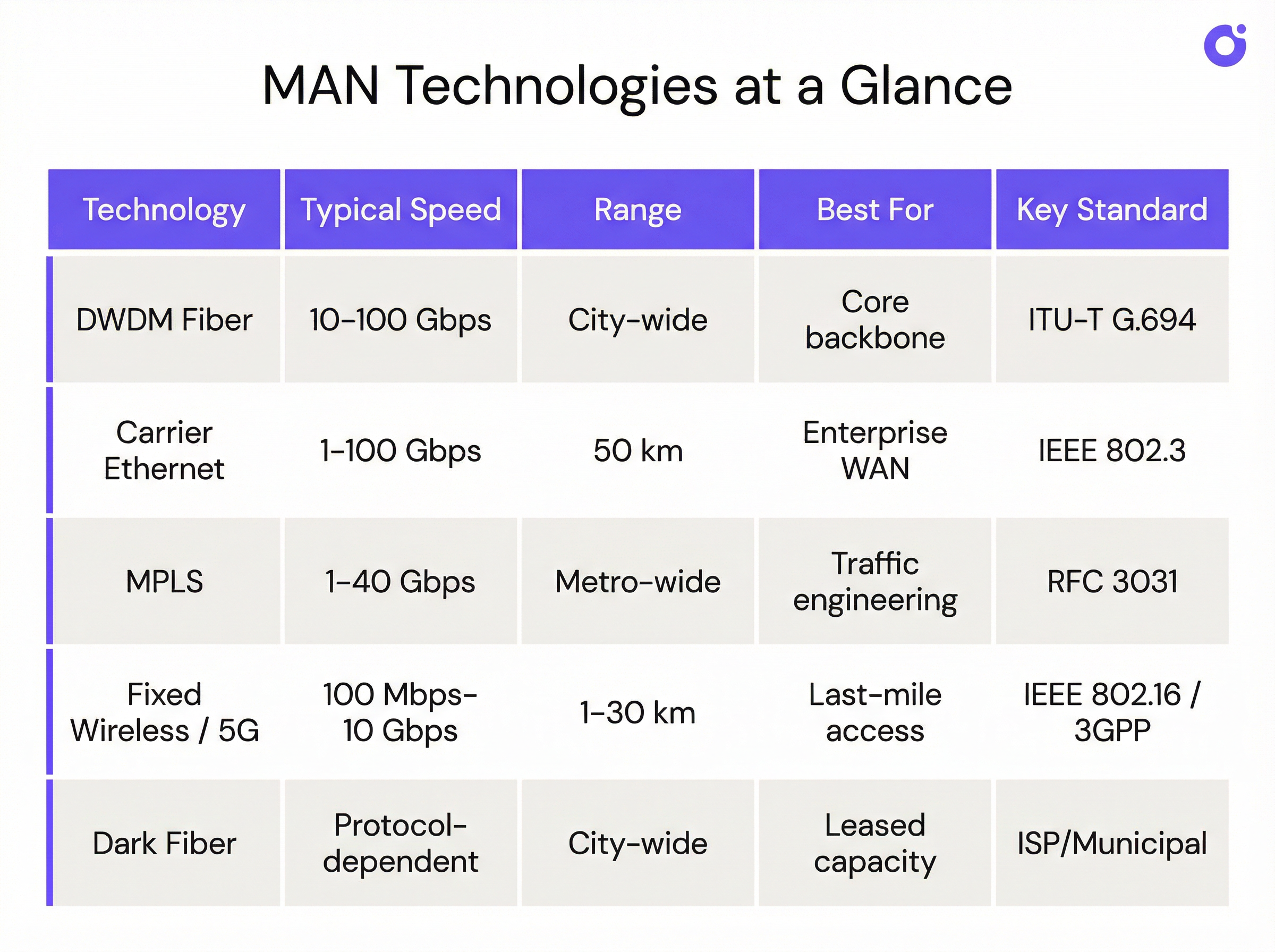
- ✓Core technologies include fiber optics (DWDM, SONET), Carrier Ethernet, and MPLS for traffic engineering.
- ✓A three-layer architecture (Core, Distribution, Access) is the standard design pattern.
- ✓Leasing dark fiber is often the most cost-effective way to build a private MAN for multi-site organisations.
- ✓Network segmentation using VLANs and MPLS is critical for security and compliance (PCI DSS, GDPR).
- ✓Redundancy through ring topologies and diverse paths is essential for high availability.
- ✓Future trends include deeper integration with 5G for backhaul and the use of SD-WAN as a control overlay.




