

Webhooks vs. API Polling para datos de WiFi: ¿Cuál utilizar?
This guide provides a definitive technical comparison between webhooks and API polling for retrieving WiFi intelligence data. It offers actionable guidance for IT managers, architects, and developers to help them select the optimal data integration pattern for real-time responsiveness, operational efficiency, and scalable deployments in enterprise environments.
🎧 Listen to this Guide
View Transcript

Resumen ejecutivo
Para los líderes de TI y operadores de recintos, el método elegido para extraer datos de una plataforma de inteligencia de WiFi como Purple es una decisión arquitectónica fundamental con importantes consecuencias operativas. Los dos patrones principales, el API Polling y los webhooks, ofrecen un claro equilibrio entre la simplicidad de implementación y el rendimiento en tiempo real. El API Polling, un modelo de extracción (pull) iniciado por el cliente, consulta repetidamente una API en busca de nuevos datos a intervalos fijos. Aunque es fácil de implementar, consume muchos recursos, introduce una latencia de datos inherente y no escala bien. Por el contrario, los webhooks emplean un modelo de envío (push) basado en eventos e iniciado por el servidor. Entregan cargas útiles de datos (payloads) a un endpoint predefinido en el instante en que ocurre un evento específico, como cuando un invitado se conecta a la red. Este enfoque proporciona verdaderos datos en tiempo real, garantiza una alta eficiencia de recursos y ofrece una escalabilidad superior. Para cualquier aplicación que requiera una interacción inmediata y contextual, desde la activación de automatizaciones de marketing hasta el envío de alertas operativas, los webhooks son la opción arquitectónica superior. Esta guía ofrece un análisis técnico profundo de ambos patrones, proporciona orientación de implementación neutral en cuanto a proveedores y presenta casos de estudio del mundo real para ayudar a arquitectos y desarrolladores a tomar una decisión informada que se alinee con sus objetivos comerciales de ROI, rendimiento y mitigación de riesgos.
Análisis técnico profundo
Comprender las diferencias fundamentales entre el API Polling y los webhooks es fundamental para diseñar sistemas robustos y eficientes que aprovechen los datos de WiFi. Esta sección explora la arquitectura, las características de rendimiento y las implicaciones de seguridad de cada patrón.
¿Qué es el API Polling?
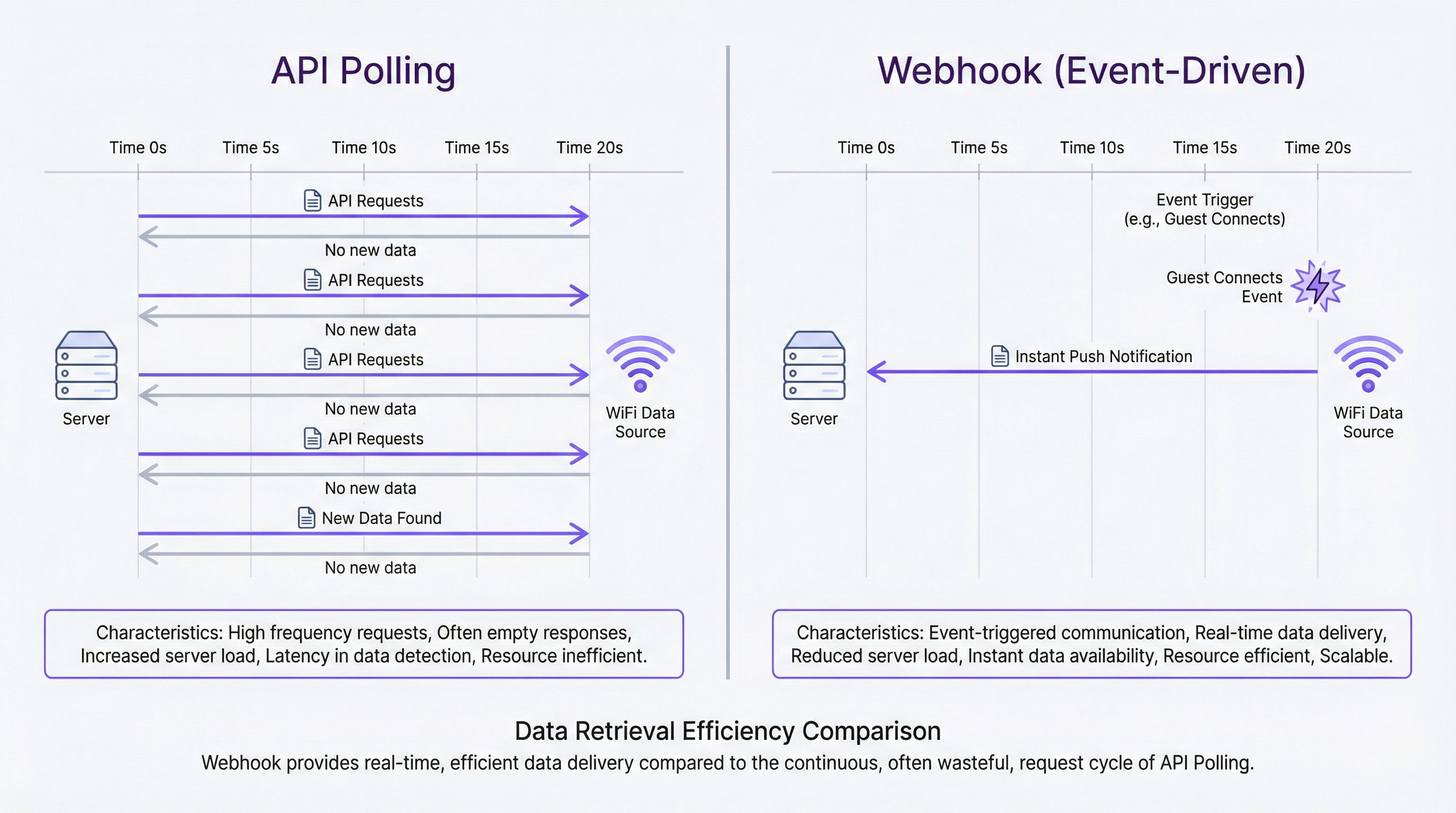
El API Polling es un mecanismo sincrónico basado en la extracción (pull) en el que una aplicación cliente realiza solicitudes HTTP repetidas a una API del servidor con una frecuencia predeterminada para comprobar si hay nuevos datos. Opera en un ciclo simple de solicitud-respuesta: el cliente pregunta "¿Hay alguna información nueva?" y el servidor responde.
Características:
- Iniciado por el cliente: El cliente es responsable de iniciar toda la comunicación.
- Intervalo fijo: Las solicitudes se realizan a intervalos regulares (por ejemplo, cada 60 segundos).
- Sincrónico: El cliente espera una respuesta antes de continuar o realizar la siguiente solicitud.
Ventajas:
- Simplicidad: La implementación suele ser sencilla y solo requiere un script simple o una tarea programada para realizar solicitudes HTTP GET.
- Carga predecible: La carga en el sistema del cliente es constante y fácil de pronosticar.
Desventajas:
- Ineficiencia: La gran mayoría de los sondeos no devuelven datos nuevos, lo que consume ancho de banda y ciclos de procesamiento innecesarios tanto en el lado del cliente como del servidor. Esta es una fuente importante de desperdicio en implementaciones a gran escala.
- Latencia: Los datos nunca son verdaderamente en tiempo real. La "frescura" de los datos está, en el mejor de los casos, limitada por el intervalo de sondeo. Para un intervalo de 5 minutos, los datos pueden tener hasta 4 minutos y 59 segundos de antigüedad, lo cual es inaceptable para aplicaciones sensibles al tiempo.
- Problemas de escalabilidad: A medida que aumenta el número de clientes o la frecuencia de los sondeos, la carga en la API del servidor crece linealmente, lo que puede provocar una degradación del rendimiento o la limitación de la tasa de solicitudes (rate-limiting).
¿Qué son los Webhooks?
Los webhooks son un mecanismo asincrónico basado en el envío (push) para la comunicación de servidor a servidor. En lugar de que el cliente solicite datos repetidamente, el servidor envía (o empuja) automáticamente un payload de datos a una URL de cliente designada (el "endpoint del webhook") tan pronto como ocurre un evento específico. A esto se le suele llamar "API inversa" o arquitectura basada en eventos.
Características:
- Iniciado por el servidor (basado en eventos): La comunicación se activa por un evento en el servidor (por ejemplo,
guest_connects,user_leaves_venue). - Tiempo real: Los datos se entregan casi instantáneamente al ocurrir el evento.
- Asincrónico: El cliente recibe datos de forma pasiva sin necesidad de iniciar una solicitud.
Ventajas:
- Eficiencia: La comunicación solo ocurre cuando hay nuevos datos para compartir, lo que elimina las solicitudes desperdiciadas y reduce drásticamente la carga del servidor y de la red.
- Datos en tiempo real: Los webhooks son el estándar de la industria para lograr la entrega de datos en tiempo real, lo que permite acciones inmediatas y flujos de trabajo contextuales.
- Escalabilidad: La arquitectura es altamente escalable, ya que el servidor solo gasta recursos cuando se activa un evento, en lugar de manejar continuamente los sondeos de miles de clientes.
Desventajas:
- Complejidad de implementación: La configuración inicial es más compleja. Requiere crear un endpoint HTTP estable y de acceso público en el lado del cliente para recibir las solicitudes POST entrantes del servidor.
- Gestión de la confiabilidad: La aplicación cliente debe estar diseñada para manejar los datos entrantes de manera confiable, lo que incluye la gestión de posibles tiempos de inactividad y picos de procesamiento.
Comparación arquitectónica
| Característica | API Polling | Webhooks (Basado en eventos) |
|---|---|---|
| Flujo de datos | Pull (Iniciado por el cliente) | Push (Iniciado por el servidor) |
| Frescura de los datos | Retrasada (por el intervalo de sondeo) | Tiempo real |
| Eficiencia | Baja (muchas solicitudes vacías) | Alta (comunicación solo en el evento) |
| Carga del servidor | Alta y constante | Baja y esporádica (en el evento) |
| Carga del cliente | Alta (solicitudes constantes) | Baja (escucha pasivamente) |
| Escalabilidad | Deficiente | Excelente |
| Implementación | Configuración inicial sencilla | Requiere un endpoint público |
Consideraciones de seguridad
Ambos patrones requieren medidas de seguridad sólidas, particularmente al manejar información de identificación personal (PII) sujeta a regulaciones como el GDPR. [1]
Para Webhooks: La seguridad es primordial. El endpoint receptor DEBE estar protegido mediante HTTPS (cifrado TLS) para proteger los datos en tránsito. Además, para evitar ataques de suplantación de identidad (spoofing) en los que un actor malintencionado envía datos falsos a su endpoint, se deben verificar los payloads. La plataforma de Purple, en línea con las mejores prácticas de la industria, incluye una firma única en el encabezado HTTP
X-Purple-Signaturede cada solicitud de webhook. Esta firma es un hash (HMAC-SHA256) del cuerpo del payload, creado mediante una clave secreta compartida entre su aplicación y Purple. Su endpoint debe calcular el mismo hash y verificar que coincida con la firma en el encabezado antes de procesar los datos. Esto garantiza que los datos sean auténticos (de Purple) y no hayan sido manipulados.Para API Polling: La principal preocupación de seguridad es la gestión de la clave de la API. Esta clave debe almacenarse de forma segura y nunca exponerse en el código del lado del cliente. Toda la comunicación de la API también debe realizarse a través de HTTPS. El acceso debe registrarse y monitorearse en busca de actividades anómalas que puedan indicar una clave comprometida.
Guía de implementación
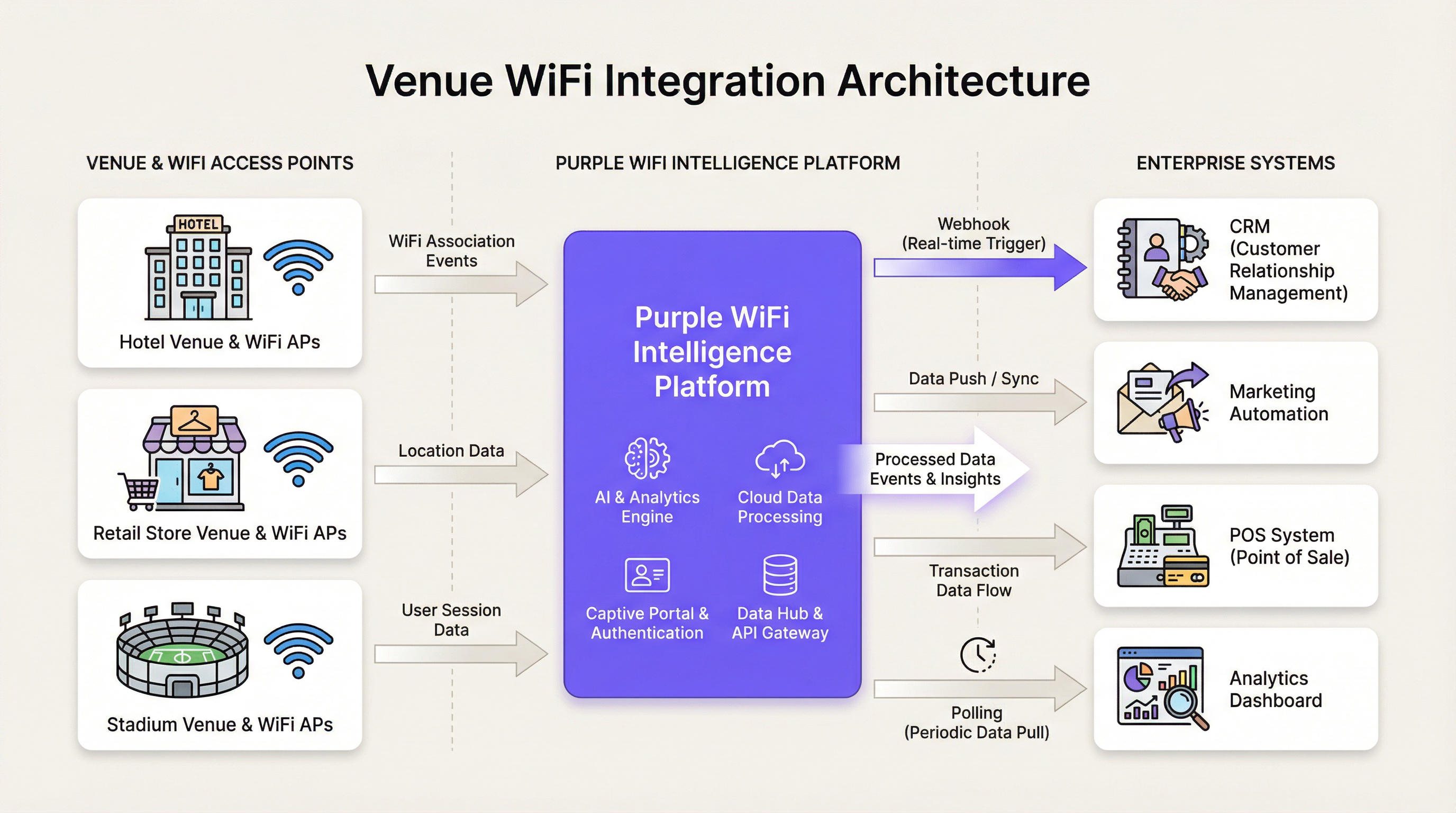
La elección del patrón adecuado depende completamente de los requisitos comerciales de la integración. Un enfoque mixto es común en arquitecturas empresariales complejas.
Cuándo utilizar el API Polling
A pesar de sus ineficiencias, el API Polling es una opción viable para casos de uso específicos y no críticos:
- Informes por lotes (Batch Reporting): Generación de informes nocturnos o semanales sobre el uso agregado de WiFi, donde un retraso de datos de varias horas es aceptable.
- Dashboards internos: Llenado de un panel interno no crítico con datos de tendencias que no requieren precisión segundo a segundo.
- Sistemas heredados: Integración con sistemas más antiguos que no pueden exponer un endpoint público para recibir webhooks.
- Restricciones de infraestructura: En entornos de alta seguridad donde el tráfico entrante de servicios externos está fuertemente restringido por políticas.
Cuándo utilizar Webhooks
Los webhooks son la opción definitiva para cualquier aplicación moderna en tiempo real. Utilícelos siempre que una respuesta inmediata y automatizada a un evento de WiFi pueda crear valor comercial.
- Marketing en tiempo real: Activación de un correo electrónico de bienvenida, un SMS con un cupón o una notificación push a una aplicación de lealtad en el momento en que un invitado se conecta al WiFi en un hotel o tienda minorista.
- Alertas operativas: Envío de una alerta instantánea al personal a través de Slack o una aplicación dedicada cuando ocurre un evento específico, como la llegada de un invitado VIP, la superación de un umbral de tiempo de permanencia en una zona específica o la desconexión del hardware de red.
- Integración con CRM: Creación o actualización instantánea de un registro de cliente en un CRM como Salesforce o HubSpot cuando un nuevo invitado se registra en el Captive Portal.
- Operaciones del recinto: Uso de datos de densidad de dispositivos en tiempo real para gestionar el flujo de multitudes en un estadio, ajustar el sistema HVAC en un centro de conferencias o enviar personal de limpieza a áreas de alto tráfico.
Implementación de los Webhooks de Purple: Una guía conceptual
- Cree su endpoint: Desarrolle una URL pública y estable en su servidor que pueda aceptar solicitudes HTTP POST. Puede ser una función serverless (por ejemplo, AWS Lambda, Google Cloud Function) o una ruta dedicada en su aplicación web.
- Registre el endpoint en Purple: En el portal de Purple, navegue a la sección de webhooks y agregue la URL de su endpoint. Se le proporcionará una clave secreta para la verificación de la firma.
- Procese los datos entrantes: Cuando ocurra un evento, Purple enviará un payload JSON a su endpoint. Su endpoint debe estar programado para:
a. Confirmar la recepción inmediatamente: Responda con un código de estado
200 OKlo más rápido posible para que Purple sepa que se recibieron los datos. Esto evita tiempos de espera (timeouts) y reintentos. b. Verificar la firma: Antes de procesar, calcule la firma HMAC-SHA256 del cuerpo de la solicitud sin procesar utilizando su clave secreta y compárela con el valor en el encabezadoX-Purple-Signature. Si no coinciden, descarte la solicitud. c. Procesar de forma asincrónica: Descargue la lógica comercial real (por ejemplo, enviar un correo electrónico, actualizar una base de datos) a una cola de trabajos en segundo plano (por ejemplo, RabbitMQ, Redis Queue). Esto garantiza que su endpoint siga respondiendo y pueda manejar grandes volúmenes de eventos sin bloquearse.
Mejores prácticas
Cumplir con las mejores prácticas estándar de la industria es esencial para crear integraciones confiables y seguras.
Mejores prácticas para Webhooks
- Idempotencia: Diseñe su lógica de procesamiento para manejar eventos duplicados sin problemas. Los problemas de red a veces pueden provocar que un webhook se entregue más de una vez. Un sistema idempotente garantiza que el procesamiento del mismo evento varias veces no resulte en datos o acciones duplicadas.
- Procesamiento asincrónico: Nunca realice una lógica compleja o que consuma mucho tiempo directamente dentro del controlador de solicitudes. Confirme la recepción y ponga en cola.
- Validación del payload: Verifique siempre la firma del webhook. Este es un paso de seguridad crítico.
- Monitoreo y registro (Logging): Implemente un registro exhaustivo para rastrear los webhooks entrantes y el resultado de su procesamiento. Configure el monitoreo para que le avise si su endpoint falla o los tiempos de respuesta se degradan.
- Fallas controladas y reintentos: Si bien el sistema de Purple incluye un mecanismo de reintento, su propio sistema debe ser resistente a las fallas en los servicios posteriores (por ejemplo, una base de datos o una API de terceros que no esté disponible temporalmente).
Mejores prácticas para API Polling
- Elija una frecuencia adecuada: No realice sondeos con más frecuencia de la necesaria. El exceso de sondeos proporciona rendimientos decrecientes y aumenta el riesgo de que se limite la tasa de solicitudes. Respete el encabezado
Retry-Aftersi recibe una respuesta429 Too Many Requests. - Utilice solicitudes condicionales: Cuando sea compatible, utilice encabezados como
If-Modified-SinceoETagpara evitar volver a descargar datos que no han cambiado. - Implemente una estrategia de retroceso (Backoff): Si falla una llamada a la API, implemente una estrategia de retroceso exponencial para los reintentos y así evitar sobrecargar el servidor.
- Proteja las claves de la API: Almacene las claves de la API de forma segura utilizando un servicio de gestión de secretos. Nunca las codifique (hard-code) en su aplicación ni las confirme en el control de versiones.
Solución de problemas y mitigación de riesgos
- Modo de falla común (Webhooks): Tiempo de inactividad del endpoint. Si su endpoint se cae, perderá eventos. Mitigación: Utilice una arquitectura de alta disponibilidad para su endpoint (por ejemplo, funciones serverless, servidores con balanceo de carga). Confíe en el mecanismo de reintento integrado de Purple para interrupciones breves e implemente un monitoreo robusto para recibir alertas de tiempo de inactividad de inmediato.
- Modo de falla común (Webhooks): Picos de procesamiento. Una ráfaga repentina de eventos (por ejemplo, una gran multitud conectándose al inicio de un evento) puede abrumar su cola de procesamiento. Mitigación: Asegúrese de que su infraestructura de procesamiento en segundo plano pueda escalar automáticamente para manejar los picos de demanda.
- Modo de falla común (API Polling): Limitación de tasa (Rate Limiting). El sondeo agresivo hará que su aplicación sufra limitaciones de tasa, cortando efectivamente su flujo de datos. Mitigación: Realice sondeos a un intervalo razonable y respetuoso, e implemente una estrategia de retroceso exponencial.
- Modo de falla común (Ambos): Datos no válidos. Un cambio en el formato de los datos o un valor inesperado puede romper su lógica de procesamiento. Mitigación: Implemente prácticas de programación defensiva. Valide los datos entrantes contra un esquema y maneje los errores de validación sin problemas, registrándolos para su investigación sin bloquear todo el proceso.
ROI e impacto comercial
La elección entre webhooks y sondeos tiene un impacto directo en el Costo Total de Propiedad (TCO) y el Retorno de Inversión (ROI).
- Análisis de costo-beneficio: Si bien el sondeo puede tener un costo de desarrollo inicial ligeramente menor, sus costos operativos son significativamente mayores debido al desperdicio de recursos del servidor y ancho de banda. Los webhooks, con su eficiencia basada en eventos, conducen a un TCO mucho menor a escala. El costo de infraestructura de manejar millones de sondeos vacíos por día supera con creces el costo de desarrollar un endpoint de webhook confiable.
- Medición del éxito: El éxito de una integración de datos en tiempo real se mide por su impacto comercial. Para un hotel, esto podría ser un aumento del 15% en los pedidos de servicio a la habitación impulsados por ofertas de bienvenida activadas por webhooks. Para un minorista, podría ser un aumento medible en el valor de vida del cliente para los VIP que reciben un servicio personalizado en la tienda. Para un recinto, podría ser una reducción en los incidentes operativos debido a la gestión proactiva de multitudes.
- Resultados esperados: La implementación de una arquitectura basada en webhooks posiciona a su organización para ser más ágil y receptiva. Cambia sus operaciones de una postura reactiva (analizar lo que sucedió ayer) a una postura proactiva en tiempo real (actuar sobre lo que está sucediendo en este momento). Esta capacidad es un diferenciador clave para ofrecer experiencias superiores al cliente y lograr la excelencia operativa.
Referencias
[1] Reglamento General de Protección de Datos (GDPR). (2016). Diario Oficial de la Unión Europea. https://eur-lex.europa.eu/eli/reg/2016/679/oj
Key Terms & Definitions
Webhook
A mechanism for enabling server-to-server communication in real-time. It allows a server to automatically push data to a client as soon as an event occurs, rather than the client repeatedly polling for it.
IT teams use webhooks to receive instant notifications from platforms like Purple, enabling event-driven workflows such as sending a welcome email the moment a guest connects to WiFi.
API Polling
A data retrieval method where a client application makes requests to a server at a fixed interval to check for new data. It is a client-initiated "pull" model.
A developer might use API polling to update an internal dashboard with new WiFi analytics every 15 minutes, where real-time data is not a critical business requirement.
Endpoint
A publicly accessible URL on a client's server that is designed to receive and process incoming data from a webhook.
When configuring a webhook in Purple, the network architect must provide a stable and secure endpoint URL where the platform should send event data.
Payload
The actual data, typically formatted as JSON, that is sent from the server to the webhook endpoint when an event is triggered.
For a `guest_connects` event, the payload would contain information about the guest, their device, and the location, which a marketing automation tool can then use for personalization.
Idempotency
A principle in computing where an operation, if performed multiple times, has the same effect as if it were performed only once. In the context of webhooks, it means processing a duplicate event will not result in duplicate outcomes.
To achieve idempotency, a developer ensures their endpoint checks if an event ID has already been processed before taking action, preventing a single WiFi connection from triggering two welcome emails.
Asynchronous Processing
A processing model where a task is executed in the background, separate from the main application thread. For webhooks, it means acknowledging the request instantly and then handling the payload in a separate queue.
An IT team implements asynchronous processing to ensure their webhook endpoint can handle thousands of simultaneous WiFi connection events during a stadium concert without timing out.
HMAC (Hash-based Message Authentication Code)
A cryptographic hash that uses a secret key to verify both the data integrity and the authenticity of a message.
For compliance with data security standards like PCI DSS, a network architect must ensure their webhook endpoint validates the HMAC signature on all incoming payloads to prevent fraudulent data injection.
Rate Limiting
An API management technique used to control the amount of incoming traffic to a server. If a client exceeds a certain number of requests in a given time frame, the server will temporarily block them.
An operations director finds their hourly analytics report is failing because their aggressive API polling strategy caused the Purple platform to enforce rate limiting. They must adjust their polling interval to be less frequent.
Case Studies
A 500-room airport hotel wants to automatically send a welcome email with a restaurant voucher to guests the moment they first connect to the hotel WiFi. The goal is to drive dinner reservations on the day of arrival. The hotel uses Salesforce Marketing Cloud.
This is a classic real-time engagement scenario, making webhooks the only viable solution.
- Create a Journey API Endpoint in Salesforce: Within Salesforce Marketing Cloud, create a new Journey with an API Event as the entry source. This will provide a unique URL and API key that can accept incoming events.
- Configure the Webhook in Purple: In the Purple portal, create a new webhook for the
guest_connectsevent. Paste the Salesforce Journey URL as the destination. - Set the Payload Format: Configure the webhook payload to send the necessary guest data (e.g.,
first_name,email,location) in the JSON format expected by the Salesforce Journey API. - Secure the Webhook: Ensure the endpoint URL uses HTTPS. While Salesforce's endpoint is inherently secure, it's crucial to add the Purple webhook secret to your Salesforce configuration for signature validation if possible, or build a lightweight middleware (like an AWS Lambda function) to perform validation before forwarding the request to Salesforce.
- Activate the Journey: Once a test event is successfully received, activate the Journey in Salesforce. Now, when a guest connects to the WiFi, Purple will instantly fire the webhook, injecting the guest into the Salesforce Journey, which then immediately dispatches the personalized welcome email.
A national retail chain with 200 stores needs to populate a central analytics dashboard with hourly footfall data for each store. The dashboard is used by the corporate strategy team to analyze trends over weeks and months. Real-time data is not a requirement.
In this scenario, the requirement is for periodic, aggregate data, not real-time events. Therefore, API polling is a suitable and pragmatic choice.
- Identify the Correct API Endpoint: Use the Purple API documentation to find the endpoint that provides historical location analytics data, filterable by venue and time period.
- Develop a Polling Script: Create a server-side script (e.g., a Python script running on a cron job) that will execute once per hour.
- Implement the Polling Logic: The script will iterate through the list of 200 store IDs. For each store, it will make an HTTP GET request to the analytics API endpoint, requesting the visitor count for the previous 60-minute window.
- Store the Data: The script will then parse the JSON responses and write the aggregated data (timestamp, store_id, visitor_count) into the central analytics database that powers the dashboard.
- Handle Errors and Retries: The script must include error handling for API failures or network issues, implementing an exponential backoff strategy to retry failed requests without overwhelming the API.
Scenario Analysis
Q1. A large shopping mall wants to display a live counter of the number of connected devices on a public dashboard in the main atrium. The display needs to be updated as accurately as possible. Which integration pattern should the development team use and why?
💡 Hint:Consider the requirement for "live" and "accurate" data. What is the tolerance for delay?
Show Recommended Approach
The team must use webhooks. The requirement for a "live" counter means that data latency is a critical factor. Webhooks for device_connected and device_disconnected events would allow the dashboard to increment and decrement the counter in true real-time. Using API polling would result in a counter that only updates periodically (e.g., every minute), which would not feel "live" and could be visibly out of sync with the actual crowd flow.
Q2. An IT compliance officer needs to generate a quarterly report detailing all WiFi authentication methods used across the organization's 50 sites to ensure compliance with IEEE 802.1X standards. The report is generated manually by an analyst. Which pattern should be used to gather this data?
💡 Hint:Focus on the time-sensitivity of the task. Is this an operational task or an analytical one?
Show Recommended Approach
API polling is the most appropriate pattern. The task is analytical, not operational, and has a very low time-sensitivity (quarterly). A script can be run once per quarter to poll the Purple API for all authentication events over the last 90 days. This is a simple, efficient way to gather a large historical dataset for a one-off analysis. Using webhooks would be inappropriate as it would involve storing millions of real-time events for months, which is unnecessarily complex for this requirement.
Q3. A stadium's mobile app has a feature that allows fans to order food directly to their seats. The operations team wants to use WiFi location data to disable this feature for fans seated in sections where the food service is at capacity. The decision to disable a section must be made instantly. When designing the integration, what is the most critical security practice the developers must implement?
💡 Hint:The system involves real-time operational control based on incoming data. What is the primary threat to such a system?
Show Recommended Approach
The most critical security practice is mandatory signature validation on the webhook endpoint. Because the webhook triggers a direct operational action (disabling a service), the system is a prime target for a spoofing attack. A malicious actor could send a fraudulent webhook payload to the endpoint, pretending to be from Purple, and shut down the ordering service for the entire stadium. By validating the X-Purple-Signature using the shared secret, the endpoint can guarantee that the request is authentic and its data can be trusted before taking action. While HTTPS and asynchronous processing are also crucial, signature validation is the key defense against data-driven attacks in this real-time operational context.
Key Takeaways
- ✓Webhooks provide real-time, event-driven data, while API polling is delayed by the polling interval.
- ✓Use webhooks for time-sensitive actions like marketing automation, operational alerts, and instant CRM updates.
- ✓Use API polling for non-critical, batch-oriented tasks like nightly reports or trend analysis dashboards.
- ✓Webhooks are significantly more efficient and scalable, leading to a lower Total Cost of Ownership (TCO).
- ✓Securing your webhook endpoint with HTTPS and signature validation is a non-negotiable best practice.
- ✓Always process webhook payloads asynchronously to ensure your endpoint is resilient and responsive.
- ✓The choice is a strategic architectural decision: choose webhooks for real-time responsiveness and operational agility.




