

Balises Estimote : Guide complet d'installation, de configuration et de cas d'usage
This guide provides a comprehensive technical reference for IT managers and network architects on deploying Estimote beacons. It covers setup, configuration, and advanced use cases like wayfinding, proximity marketing, and asset tracking, offering actionable guidance for achieving measurable ROI in enterprise environments.
🎧 Écouter ce guide
Voir la transcription
Synthèse
Pour les directeurs techniques (CTO), les directeurs informatiques et les architectes réseau, les balises Bluetooth Low Energy (BLE) représentent une technologie mature et évolutive permettant de faire le pont entre les mondes physique et numérique. Estimote, l'un des principaux fournisseurs de matériel, propose un écosystème robuste de balises qui permettent un positionnement précis en intérieur, un engagement basé sur la proximité et le suivi des actifs de grande valeur. Ce guide sert de référence technique pour le déploiement des balises Estimote dans des environnements d'entreprise tels que l'hôtellerie, la vente au détail et les sites de grande envergure. Nous décortiquerons la technologie sous-jacente, fournirons des plans de mise en œuvre indépendants des fournisseurs et analyserons le retour sur investissement (ROI) des initiatives basées sur les balises. La proposition de valeur fondamentale des balises Estimote réside dans leur fonctionnement à faible consommation d'énergie et à longue durée de vie, ainsi que dans un kit de développement logiciel (SDK) flexible qui s'intègre parfaitement aux applications mobiles existantes et aux plateformes d'analyse comme Purple. Un déploiement de balises correctement structuré peut avoir un impact commercial significatif, allant de l'amélioration de l'expérience client et de l'augmentation des revenus annexes à l'optimisation des flux de travail opérationnels et à la réduction de la perte d'actifs. Ce document fournit les conseils stratégiques et tactiques nécessaires pour passer d'une preuve de concept à un déploiement d'entreprise à grande échelle, sécurisé et conforme.
Analyse technique approfondie
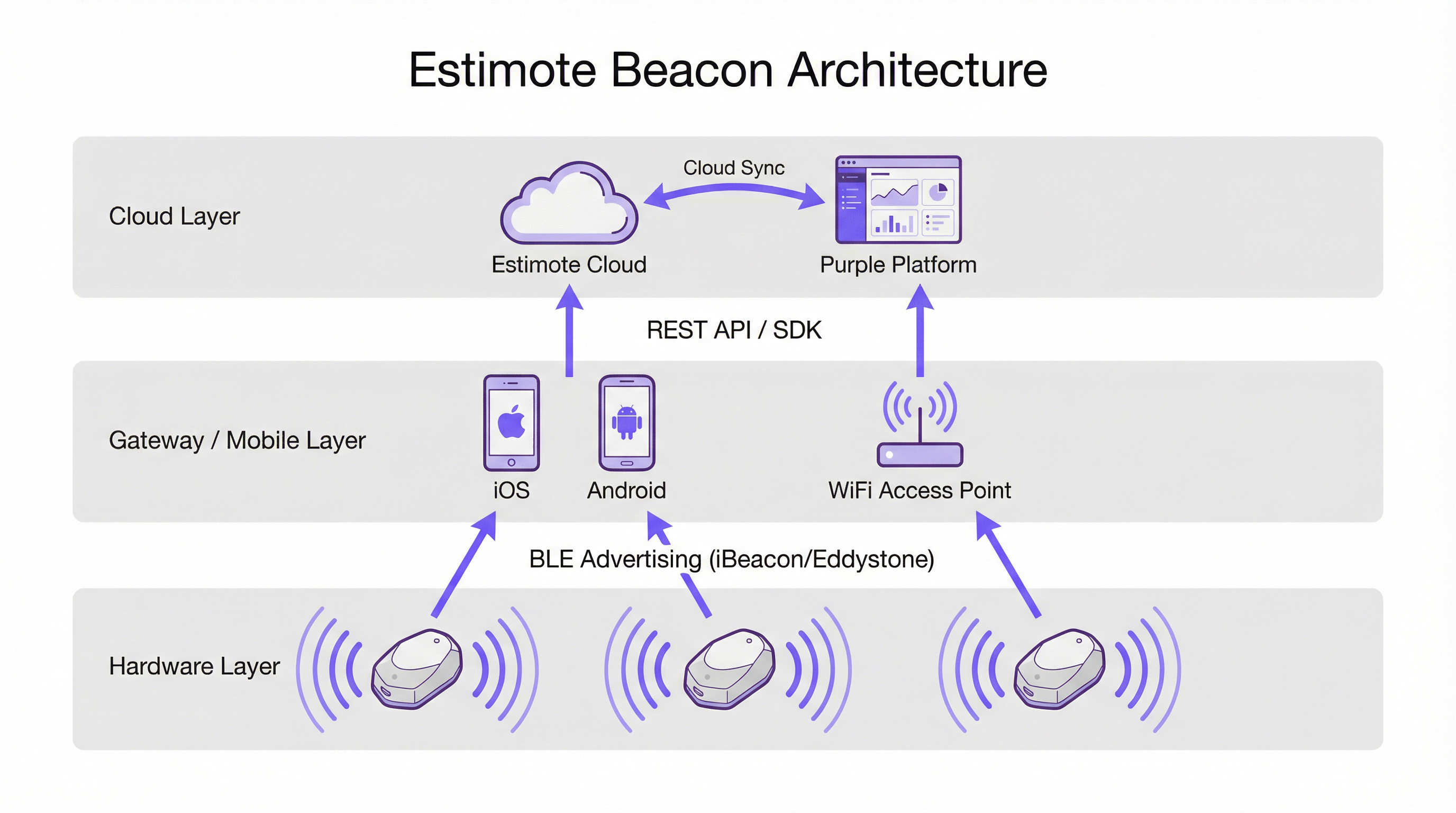
À la base, une balise Estimote est un petit ordinateur alimenté par batterie qui diffuse un signal Bluetooth Low Energy (BLE). Ce processus, connu sous le nom de « diffusion non dirigée » (undirected advertising), permet à tout appareil compatible BLE, tel qu'un smartphone, de détecter la présence de la balise sans appairage ni connexion directe. La balise transmet à intervalles réguliers un petit paquet de données contenant un identifiant qu'une application mobile peut reconnaître et sur lequel elle peut agir. Ce modèle de communication de un à plusieurs est très efficace et constitue la base de toutes les solutions de proximité basées sur des balises.
Protocoles : iBeacon et Eddystone
Deux protocoles principaux régissent les communications des balises : iBeacon d'Apple et Eddystone de Google. Une balise Estimote peut diffuser l'un ou l'autre, ou les deux.
- iBeacon : transmet un identifiant unique composé de trois parties : un UUID (Universally Unique Identifier), une valeur Majeure (Major) et une valeur Mineure (Minor). Cette structure hiérarchique est idéale pour cartographier les espaces physiques. Par exemple, un UUID peut représenter une organisation entière, une valeur Majeure peut représenter un lieu ou un étage spécifique, et une valeur Mineure peut identifier une seule balise.
- Eddystone : un protocole open source de Google qui offre plus de flexibilité. Il définit plusieurs types de trames, notamment Eddystone-UID (similaire à l'identifiant d'iBeacon), Eddystone-URL (diffuse une adresse web) et Eddystone-EID (un identifiant crypté et éphémère qui change périodiquement, renforçant ainsi la sécurité et la confidentialité).
Matériel et performances
La génération actuelle de balises de proximité (Proximity Beacons) d'Estimote fonctionne sur Bluetooth 5.0, offrant une portée maximale théorique allant jusqu'à 100 mètres. Cependant, pour une orientation en intérieur pratique, la puissance de transmission est configurée pour des portées beaucoup plus courtes afin de garantir la précision et d'éviter les fuites de signaux entre les étages. Alimentées par deux piles AA standard, ces balises peuvent atteindre une durée de vie de 3 à 5 ans, selon l'intervalle de diffusion et les paramètres de puissance de transmission. Cette longue durée de vie opérationnelle est un facteur critique pour réduire le coût total de possession (TCO) des déploiements à grande échelle.
La gamme de produits Estimote
Estimote propose une gamme de matériel adaptée à des cas d'usage spécifiques :
| Gamme de produits | Fonctionnalités clés et cas d'usage |
|---|---|
| Proximity Beacons | L'outil standard pour l'orientation et le marketing de proximité. |
| LTE Beacons | Connectivité cellulaire (LTE-M/NB-IoT) et GPS intégrés pour le suivi des actifs en intérieur/extérieur sans l'intermédiaire d'un smartphone. |
| UWB Tags | Utilise la technologie Ultra-Wideband pour une précision de positionnement au centimètre près, idéale pour le suivi des actifs de haute précision et l'évitement des collisions. |
| Mirror Beacons | Se connecte aux écrans numériques pour afficher du contenu déclenché par des balises ou des utilisateurs à proximité. |
Guide de mise en œuvre
Le succès d'un déploiement de balises repose sur une planification méticuleuse et une exécution rigoureuse. Les étapes suivantes fournissent un plan d'action indépendant des fournisseurs pour les équipes informatiques.
Étape 1 : Étude de site et placement des balises
Avant d'installer tout matériel, une étude de site approfondie est obligatoire. Les obstacles physiques tels que les piliers en béton, les étagères métalliques et les cages d'ascenseur atténuent considérablement les signaux BLE. Utilisez un outil comme IndoorAtlas pour cartographier la propagation du signal et identifier les emplacements optimaux des balises.
Bonnes pratiques de placement :
- Hauteur : montez les balises à une hauteur de 2,5 à 3 mètres du sol pour éviter les manipulations et minimiser l'obstruction du signal.
- Emplacements clés : placez des balises à toutes les batteries d'ascenseurs, aux entrées/sorties, aux points de transition entre les étages et aux principales intersections de couloirs.
- Configuration de la portée : il s'agit de l'étape de configuration la plus critique. Une puissance de transmission mal configurée est la principale cause de mauvaises performances.
- Entrées et ascenseurs : réglez la portée à environ 15 mètres (-12 dBm).
- Longs couloirs : réglez la portée à environ 30 mètres (-4 dBm).
- Atriums ouverts/Murs de verre : réduisez la portée à environ 7 mètres (-20 dBm) pour éviter les fuites de signaux entre les étages.
Étape 2 : Configuration des balises
La rigueur dans la configuration évite les maux de tête liés au dépannage par la suite. Toutes les balises d'un déploiement doivent partager un profil de configuration commun.
Paramètres de configuration :
- UUID : attribuez un UUID unique pour l'ensemble de votre organisation.
- Majeur/Mineur (Major/Minor) : utilisez la valeur Majeure pour indiquer le numéro de l'étage (par ex., 1 pour le 1er étage, 99 pour le sous-sol). Utilisez la valeur Mineure comme numéro séquentiel unique pour chaque balise à cet étage.
- Intervalle de diffusion (Advertising Interval) : pour l'orientation, un intervalle de 300 à 500 ms est recommandé. Un intervalle de 300 ms offre une expérience utilisateur réactive avec un impact gérable sur la durée de vie de la batterie.
- Types de paquets : désactivez tous les paquets de diffusion qui ne sont pas nécessaires à votre cas d'usage (par ex., désactivez les paquets spécifiques à Estimote si vous utilisez uniquement iBeacon pour un déploiement Purple).
Étape 3 : Gestion de la flotte
Pour tout déploiement dépassant quelques dizaines de balises, la configuration manuelle n'est pas évolutive. Tirez parti d'Estimote Cloud et de son outil Bulk Updater pour appliquer des modifications de configuration à des centaines ou des milliers d'appareils simultanément. Établissez un processus pour surveiller la durée de vie de la batterie (disponible via le SDK Estimote et l'API Cloud) et pour appliquer les mises à jour du firmware, qui contiennent souvent des correctifs de sécurité critiques et des améliorations de performances.
Bonnes pratiques
- Tout documenter : étiquetez physiquement chaque balise avec ses valeurs Majeure et Mineure avant l'installation. Maintenez une carte numérique correspondante qui relie les identifiants des balises à leurs emplacements physiques précis.
- Prioriser la sécurité : pour les applications sensibles, utilisez le protocole Eddystone-EID avec ses identifiants tournants et cryptés. Cela empêche les acteurs malveillants d'usurper vos balises ou de suivre les utilisateurs sans autorisation.
- Assurer la conformité (GDPR/PCI DSS) : les déploiements de balises qui traitent des données personnelles entrent dans le champ d'application du GDPR. Assurez-vous de disposer d'un mécanisme de consentement explicite (opt-in) au sein de votre application mobile. Pour les environnements de vente au détail, veillez à ce que votre infrastructure de balises et les applications associées ne compromettent pas la conformité PCI DSS en gérant mal les données des cartes de paiement.
- Intégrer aux analyses : le véritable ROI d'un déploiement de balises se concrétise grâce aux données. Intégrez les données de localisation des balises à une plateforme d'analyse comme Purple pour mesurer les temps de séjour, analyser les modèles de trafic piétonnier et quantifier l'impact des campagnes de marketing de proximité.
Dépannage et atténuation des risques
- Détection d'étage inexacte : cela est presque toujours causé par une fuite de signal. La principale mesure d'atténuation consiste à réduire la puissance de transmission (portée) des balises dans les zones ouvertes et près des transitions d'étage. Une étude de site appropriée est la meilleure mesure préventive.
- Mauvaise précision de localisation : si le « point bleu » est en retard ou saute, diminuez l'intervalle de diffusion (par ex., de 500 ms à 300 ms) pour fournir des mises à jour de localisation plus fréquentes à l'application mobile. Vérifiez également le placement et la densité des balises par rapport à l'étude de site.
- Épuisement de la batterie : si les batteries s'épuisent plus rapidement que les 3 à 5 ans prévus, revoyez la configuration des balises. Un intervalle de diffusion trop agressif (par ex., 100 ms) ou une puissance de transmission excessivement élevée sont les coupables les plus fréquents.
ROI et impact commercial
L'analyse de rentabilisation des balises Estimote repose sur des améliorations mesurables de l'expérience client et de l'efficacité opérationnelle.
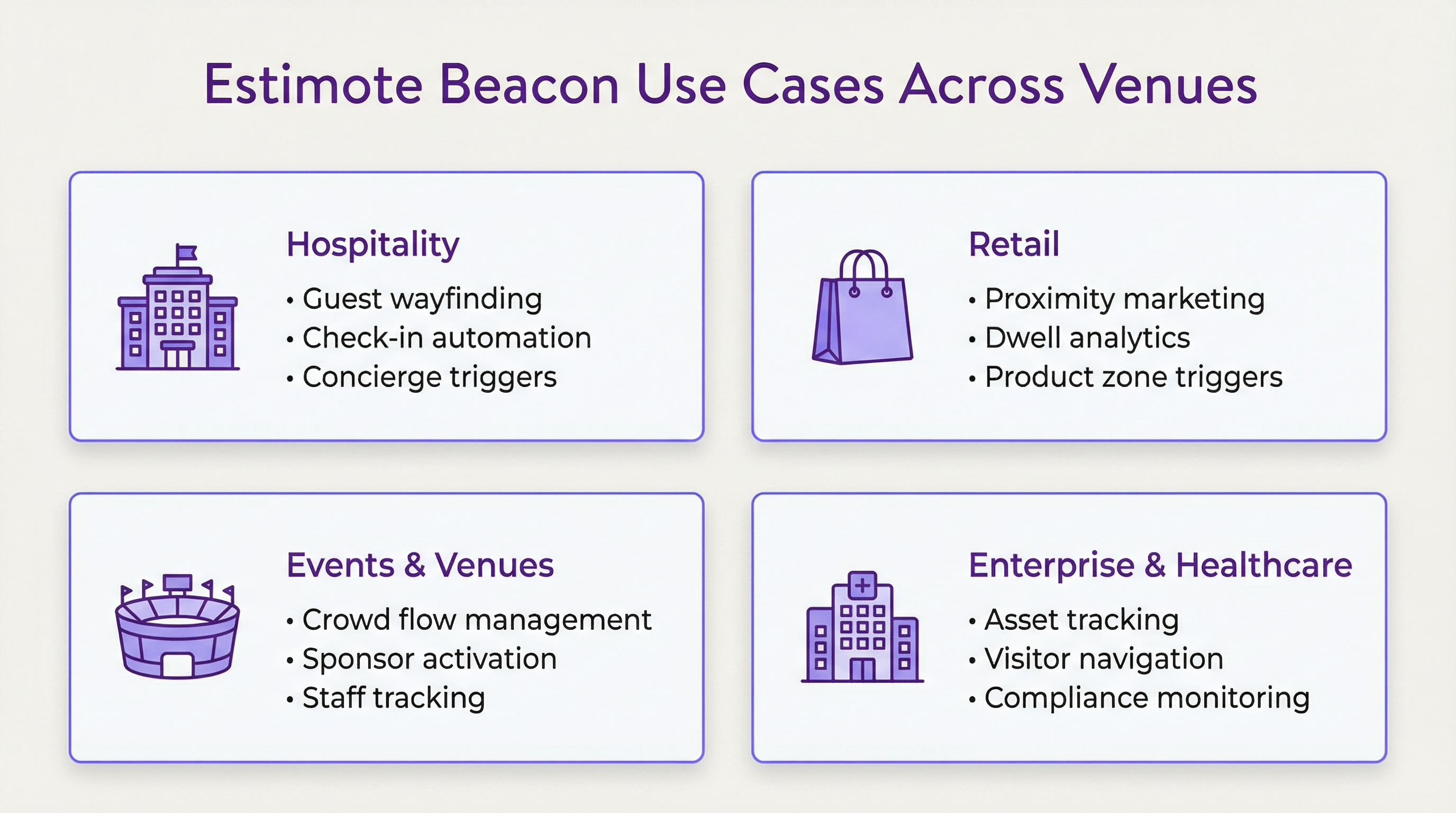
- Hôtellerie : un hôtel peut utiliser des balises pour permettre un enregistrement mobile fluide, fournir une navigation étape par étape jusqu'à la chambre d'un client et proposer des offres ciblées pour des services de spa ou des réservations de restaurant lorsqu'un client passe à proximité. Le ROI se mesure par l'augmentation des scores de satisfaction client (NPS), la hausse des revenus annexes et l'amélioration de l'efficacité du personnel.
- Vente au détail : un détaillant peut analyser les parcours clients en magasin, mesurer le temps de séjour dans des rayons spécifiques et déclencher des promotions personnalisées lorsqu'un membre du programme de fidélité entre dans une zone de produits de grande valeur. Le ROI se mesure par l'augmentation de la taille du panier, l'amélioration des taux de conversion et l'augmentation de la valeur à vie du client.
- Grands sites (Stades/Aéroports) : les balises facilitent l'orientation vers les sièges ou les portes d'embarquement, facilitent la gestion des flux de foule et permettent des activations de sponsors basées sur la localisation. Le ROI se mesure par la réduction de la congestion, l'amélioration de l'expérience des fans/voyageurs et de nouvelles sources de revenus provenant de la publicité géolocalisée.
Termes clés et définitions
Bluetooth Low Energy (BLE)
A power-efficient variant of the Bluetooth wireless standard, designed for Internet of Things (IoT) devices to communicate small amounts of data over short distances. Its low power consumption is what enables beacons to operate for years on small batteries.
IT teams will encounter BLE as the fundamental communication technology for all modern beacons. Understanding its range and power characteristics is crucial for designing a sustainable deployment.
iBeacon
Apple's protocol for BLE advertising. It structures the beacon's broadcast around a three-tiered identifier: UUID, Major, and Minor. It is the most widely supported protocol for indoor navigation on iOS devices.
This is a non-negotiable standard to support for any public-facing venue. If you want to provide wayfinding for iPhone users, your beacons must be broadcasting iBeacon packets.
Eddystone
Google's open-source alternative to iBeacon. It is more flexible, with multiple frame types including Eddystone-EID, which uses ephemeral (short-lived) identifiers to enhance security and privacy.
For enterprise deployments concerned with security or wanting to avoid vendor lock-in, Eddystone provides a powerful and flexible option. Eddystone-EID is a key feature for mitigating tracking and spoofing risks.
UUID (Universally Unique Identifier)
A 128-bit number used to identify information in computer systems. In the context of iBeacon, it serves as the top-level identifier for an organization or a specific app.
The UUID acts as a unique namespace for your beacon deployment. All beacons in your organization should be configured with the same UUID to ensure your app does not respond to beacons from other nearby businesses.
Advertising Interval
The frequency at which a beacon broadcasts its advertising packet. A shorter interval (e.g., 100ms) results in more responsive location updates but consumes more battery. A longer interval (e.g., 1000ms) conserves battery but can feel sluggish.
This is a critical trade-off that network architects must balance. For active wayfinding, 300-500ms is the sweet spot. For passive asset tracking, the interval can be much longer.
Transmission Power (Tx Power)
The signal strength of the beacon's broadcast, measured in dBm. This setting directly controls the beacon's range. A higher Tx Power (e.g., +4dBm) means longer range, while a lower Tx Power (e.g., -20dBm) means shorter range.
This is the primary tool for tuning a beacon network. Correctly setting Tx Power is the key to preventing signal bleed and ensuring accurate positioning. It is more important than physical beacon density in many cases.
Signal Bleed
The phenomenon where a beacon's signal is detected in an unintended area, most commonly on the floor above or below its actual location. It is the primary cause of inaccurate floor detection in wayfinding applications.
IT teams must actively design against signal bleed, especially in buildings with atriums or thin floors. The main mitigation strategy is to reduce the transmission power of beacons in problematic areas.
Ultra-Wideband (UWB)
A short-range radio technology that can measure location with very high precision (down to a few centimeters). It works by measuring the time-of-flight of radio signals between a tag and multiple anchors.
When an IT team is tasked with a use case that requires 'inch-level' or 'sub-meter' accuracy, such as tool tracking in manufacturing or collision avoidance, BLE is not sufficient. UWB is the appropriate technology for these high-precision requirements.
Études de cas
A 500-room luxury hotel in a dense urban environment wants to implement 'blue dot' wayfinding for guests from the lobby to their rooms, elevators, and amenities (pool, restaurant). The hotel has a large, three-story glass atrium at its center. What is the recommended Estimote beacon deployment strategy?
- Hardware Selection: Standard Estimote Proximity Beacons are sufficient for this use case.
- Site Survey: Conduct a mandatory site survey focusing on the glass atrium. Use a signal mapping tool to visualize BLE signal propagation and identify potential for inter-floor signal bleed.
- Beacon Placement & Configuration:
- Guest Corridors: Place one beacon every 50-75 feet, mounted 8-10 feet high. Configure with a -8dBm transmit power (approx. 100ft range) and a 400ms advertising interval.
- Elevator Banks: Place one beacon at each elevator bank on every floor. Configure with a -12dBm transmit power (approx.50ft range) to ensure the signal is localized to the waiting area.
- Atrium: This is the critical zone. Place beacons around the perimeter of the atrium on each floor. Configure them with a significantly lower transmit power, such as -20dBm (approx. 22ft range), to prevent signals from reaching the floors above and below. The advertising interval can be increased to 600ms as fine-grained accuracy is less critical in this open space.
- Naming Convention: Use the hotel's unique UUID. Set Major to the floor number (e.g., 1, 2, 3...). Assign sequential Minor values for each beacon on that floor. Physically label each beacon.
- Fleet Management: Use the Estimote Cloud to bulk-configure all beacons and monitor battery life post-deployment.
A retail chain with 200 stores wants to track high-value assets (e.g., portable payment terminals, specialized scanning equipment) that move between the stockroom and the sales floor. The assets sometimes leave the store for sidewalk sales events. What is the optimal Estimote solution?
- Hardware Selection: The ideal solution is the Estimote LTE Beacon. Its integrated cellular connectivity and GPS make it perfect for tracking assets both indoors and outdoors, without relying on the store's Wi-Fi or nearby smartphones.
- Deployment: Attach one LTE Beacon to each high-value asset. No complex beacon infrastructure is required within the store itself.
- Cloud Configuration: In the Estimote Cloud, configure the LTE Beacons to report their location at a set interval (e.g., every 5 minutes when stationary, every 1 minute when in motion). Set up geofences for each store location.
- Application Integration: Use the Estimote Cloud API to pull location data for each asset into the retailer's central inventory management system. Configure API-triggered alerts for specific events:
- An alert is sent to the store manager if an asset's battery level drops below 20%.
- An alert is sent if an asset leaves the store's geofence outside of a scheduled sidewalk sale event.
- ROI Measurement: The ROI is calculated by the reduction in lost or stolen assets, the decrease in time spent by staff searching for equipment, and the improved availability of revenue-generating devices like payment terminals.
Analyse de scénario
Q1. Your stadium client wants to use beacons to track the real-time location of mobile food and beverage carts to optimize stock levels and deployment. The carts move throughout the stadium, including outdoor plaza areas. Which Estimote product is the best fit and why?
💡 Astuce :Consider the need for tracking both indoors and outdoors, without relying on the stadium's public Wi-Fi or guest smartphones.
Afficher l'approche recommandée
The Estimote LTE Beacon is the best fit. Its built-in cellular (LTE-M) and GPS capabilities allow it to report its location independently from anywhere in the stadium, whether inside the concourse or outside in the plaza. Standard proximity beacons would not work reliably as they depend on a nearby smartphone with a specific app to relay their location, and UWB would be overkill and too complex for this wide-area tracking use case.
Q2. A hospital is deploying beacons for patient wayfinding. During testing, they find that when patients are in the central atrium, the app frequently switches between showing them on the 2nd and 3rd floors. What are the two most likely causes and the primary solution?
💡 Astuce :Think about how BLE signals behave in large, open, multi-story spaces.
Afficher l'approche recommandée
The two most likely causes are: 1) The transmission power (range) of the beacons around the atrium is set too high. 2) The beacons are placed in locations that allow for a clear, unobstructed line of sight between floors. The primary solution is to significantly reduce the transmission power of the beacons located in and around the atrium to a very short range (e.g., -20dBm) to create a tight signal bubble on each floor and prevent this inter-floor 'signal bleed'.
Q3. A retail CTO is concerned about the privacy implications of a beacon deployment under GDPR. They ask if beacons are "tracking our customers' phones." How would you accurately describe the data flow to reassure them?
💡 Astuce :Focus on where the 'intelligence' lies in the system and the role of user consent.
Afficher l'approche recommandée
You should clarify that the beacons themselves do not track anyone. They are simple, one-way broadcast devices, like a lighthouse. They have no knowledge of who is nearby. The tracking event occurs at the application layer, on the customer's own phone, and only if they have explicitly opted-in and granted the app location permissions. The app detects the beacon's signal and then reports the phone's proximity to that beacon to the cloud. The entire process is user-initiated and consent-driven, which is a key principle of GDPR. Furthermore, using protocols like Eddystone-EID can encrypt the beacon's identifier, adding another layer of privacy.
Points clés à retenir
- ✓Estimote beacons are low-power, battery-operated devices that broadcast BLE signals to enable indoor positioning and proximity-based actions.
- ✓Successful deployment requires a thorough site survey to plan beacon placement and prevent signal bleed, especially in open, multi-story areas.
- ✓Configuration discipline is key: use a consistent UUID, logical Major/Minor assignments, and an appropriate advertising interval (300-500ms for wayfinding).
- ✓For indoor/outdoor asset tracking, Estimote LTE Beacons with integrated cellular/GPS are the optimal solution, removing dependency on smartphones.
- ✓For high-precision (inch-level) tracking, Ultra-Wideband (UWB) tags are the appropriate technology, not standard BLE beacons.
- ✓Compliance with GDPR requires an explicit opt-in consent model within the mobile application; the beacons themselves do not store or process personal data.
- ✓The ROI of a beacon deployment is realized by integrating location data with analytics platforms to measure improvements in customer experience, operational efficiency, and revenue.




