

Marketing WiFi invité : Le guide ultime pour capturer des leads, stimuler les ventes et améliorer l'expérience client
This guide provides a technical deep-dive into leveraging guest WiFi for marketing, lead capture, and customer analytics. It offers actionable strategies for IT managers and venue operators to transform their WiFi from a cost centre into a powerful, ROI-driven marketing platform, covering architecture, implementation, and compliance.
🎧 Écouter ce guide
Voir la transcription
Résumé exécutif
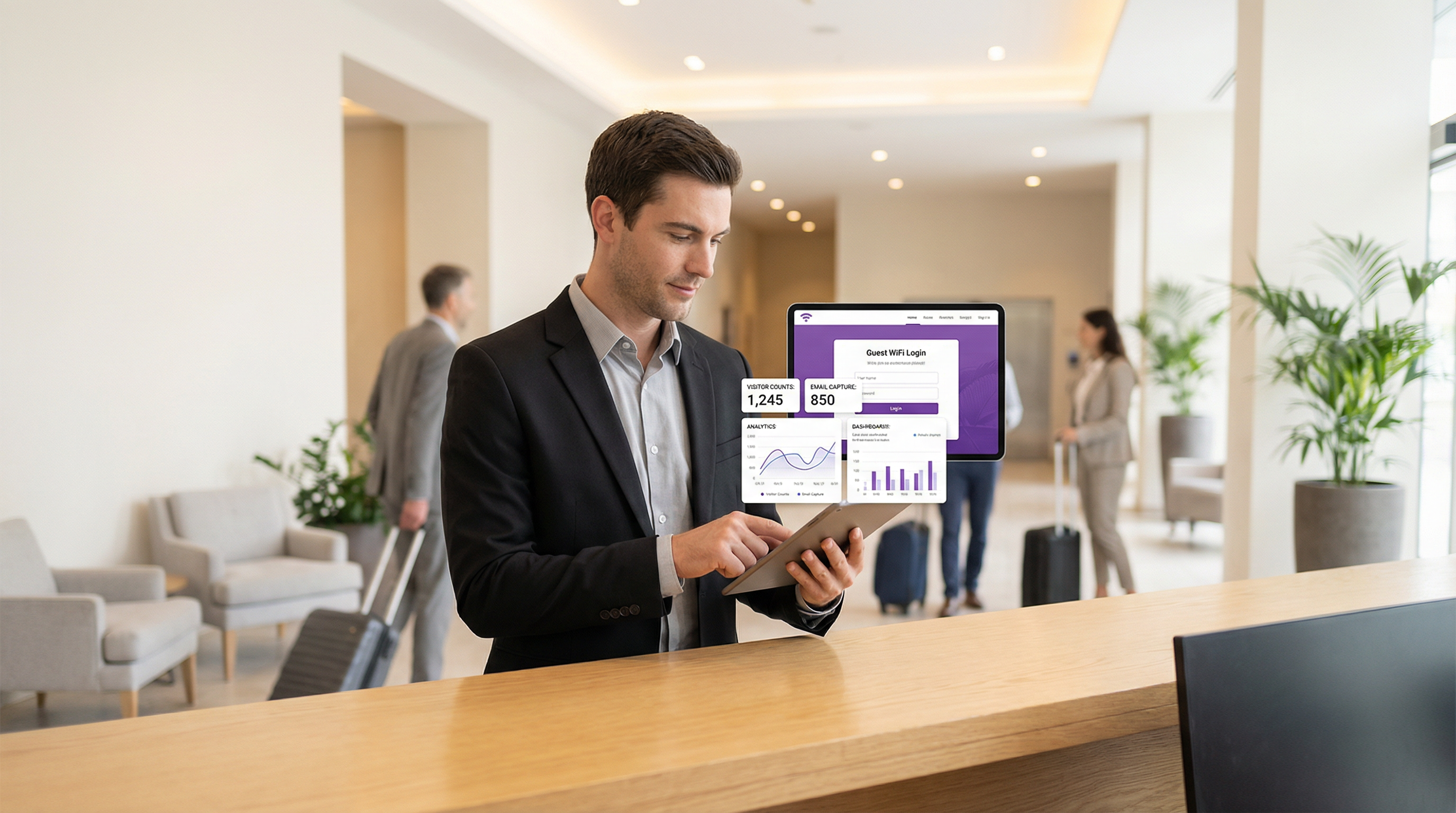
Le WiFi invité n'est plus une simple commodité ; c'est un atout stratégique capable de générer une valeur commerciale substantielle. Pour les directeurs techniques (CTO), les responsables informatiques et les directeurs d'établissements, il est impératif de changer la perception du WiFi invité, passant d'une dépense opérationnelle nécessaire à un moteur proactif de marketing et d'analyse. Ce guide fournit un cadre technique et stratégique pour réaliser cette transformation. En déployant une solution de WiFi invité axée sur le marketing, les entreprises peuvent capturer de riches données clients de première main (first-party data), comprendre le comportement des visiteurs dans les espaces physiques et mener des campagnes marketing ciblées qui génèrent un retour sur investissement (ROI) mesurable. Les composants principaux impliquent une infrastructure réseau robuste, un Captive Portal sophistiqué pour l'acquisition de données et une intégration fluide avec les plateformes de CRM et de marketing automation. Il est crucial que cela soit exécuté dans un cadre sécurisé et conforme, en respectant des normes telles que le WPA3 pour la sécurité du réseau et le GDPR pour la confidentialité des données. Le résultat est un outil puissant qui comble le fossé entre le parcours client numérique et physique, permettant des expériences personnalisées et stimulant les revenus.
Analyse technique approfondie
L'architecture d'une solution de marketing WiFi invité se compose de trois couches principales : l'Infrastructure réseau, le Captive Portal et la plateforme marketing, et la Couche d'intégration et d'analyse.
Infrastructure réseau : La fondation repose sur votre matériel WiFi existant : points d'accès (AP), contrôleurs et passerelles. Pour une analyse de localisation efficace, la densité des AP doit être suffisante pour trianguler avec précision la position des appareils. La segmentation du réseau est primordiale ; le trafic invité doit être isolé du réseau d'entreprise à l'aide de VLAN (Virtual LAN) et de règles de pare-feu strictes. Cela atténue le risque de faille de sécurité provenant du réseau public. Le respect de la norme IEEE 802.1X pour le contrôle d'accès au réseau basé sur les ports et du WPA3 pour un chiffrement robuste est une exigence de base pour une sécurité de niveau entreprise.
Captive Portal et plateforme marketing : Il s'agit de la couche logicielle qui se superpose à votre matériel réseau. Lorsqu'un utilisateur se connecte au SSID invité, il est redirigé vers un Captive Portal. Contrairement à une simple page de saisie de mot de passe, un portail marketing offre plusieurs méthodes d'authentification :
- E-mail / Formulaire : La méthode la plus directe pour la capture de leads.
- Connexion sociale (Social Login) : (ex. Google, LinkedIn, Facebook) Fournit des données démographiques plus riches et validées avec le consentement de l'utilisateur.
- Bon / Code d'accès : Permet un accès hiérarchisé et des sessions limitées dans le temps, courant dans le secteur de l'hôtellerie.
La plateforme capture ces données, les associe à l'adresse MAC de l'appareil et les stocke dans une base de données centralisée. C'est ici que la conformité au GDPR et aux autres réglementations sur la confidentialité des données est appliquée via des cases à cocher de consentement explicite et des liens clairs vers les politiques de confidentialité.
- Couche d'intégration et d'analyse : La véritable valeur des données capturées est libérée grâce à l'intégration. En utilisant des API REST et des Webhooks, la plateforme de marketing WiFi doit transmettre les données en temps réel aux systèmes externes :
- Systèmes CRM (Salesforce, HubSpot) : Pour enrichir les profils clients avec le comportement sur site.
- Marketing Automation (Mailchimp, Klaviyo) : Pour déclencher des campagnes e-mail/SMS automatisées (ex. une offre de "bon retour" pour un visiteur récurrent).
- Outils de Business Intelligence (BI) : Pour corréler les analyses WiFi avec les données de vente.
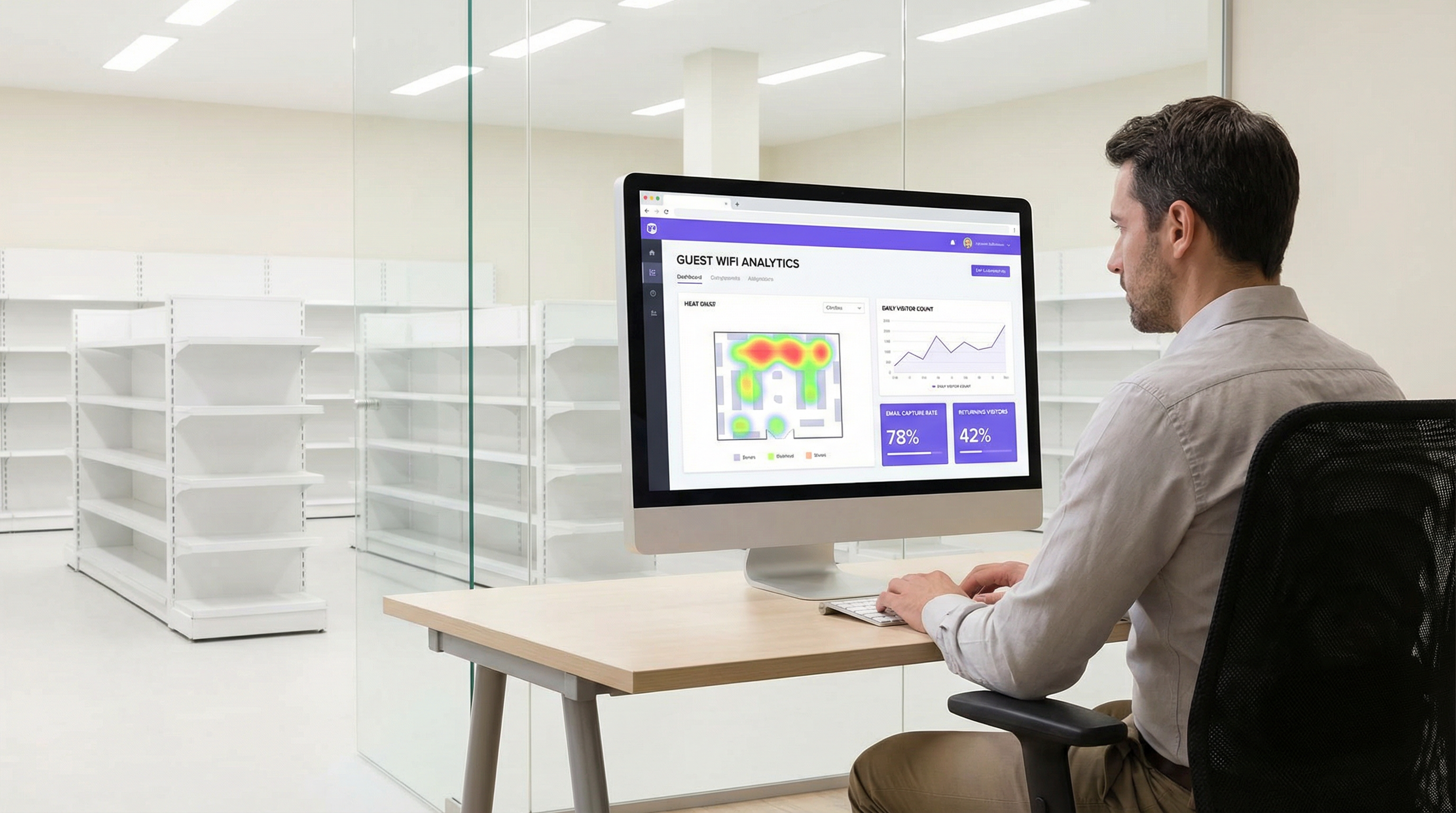
Cette couche fournit également le tableau de bord d'analyse, offrant des informations sur la fréquentation, les temps de séjour, la fidélité des visiteurs et les cartes de chaleur (heatmaps) de localisation.
Guide de mise en œuvre
Le déploiement d'une solution de marketing WiFi invité nécessite une approche par étapes :
Définir les objectifs commerciaux : Quels sont les buts principaux ? Augmenter la taille de la liste de diffusion de 25 % ? Générer une hausse de 10 % de la clientèle fidèle ? Lier 5 % des ventes en magasin à une promotion basée sur le WiFi ? Des KPI clairs sont essentiels.
Audit de l'infrastructure : Évaluez votre réseau actuel. La couverture des AP est-elle adéquate pour l'analyse de localisation ? Votre passerelle prend-elle en charge l'intégration avec des plateformes de Captive Portal tierces ? Une étude de site approfondie est souvent nécessaire.
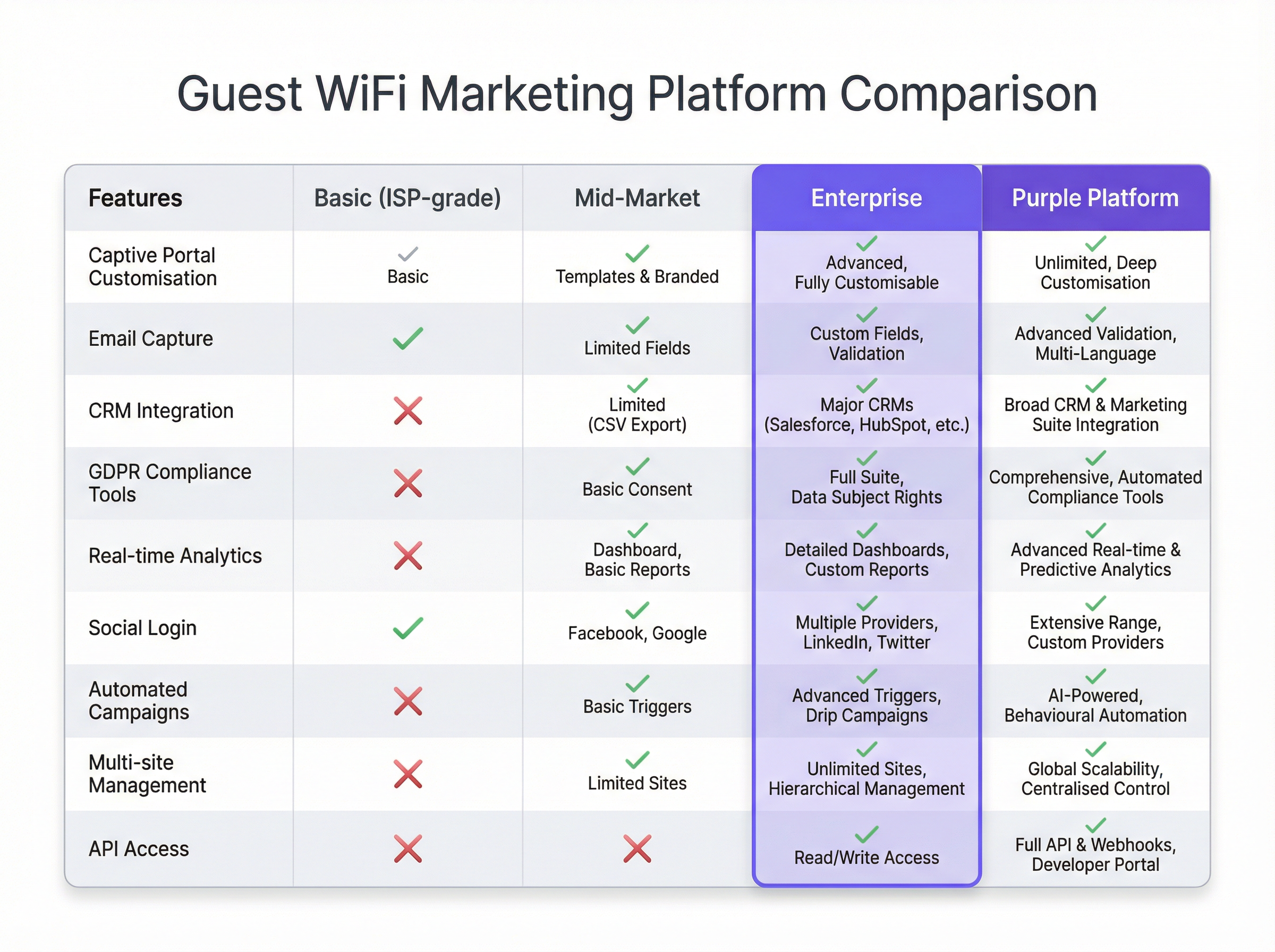
Sélection de la plateforme : Choisissez une plateforme qui répond à vos objectifs. Les considérations clés incluent l'étendue des intégrations CRM, la sophistication de ses analyses et la robustesse de ses outils de conformité. Consultez le tableau comparatif ci-dessous pour un aperçu neutre des fournisseurs.
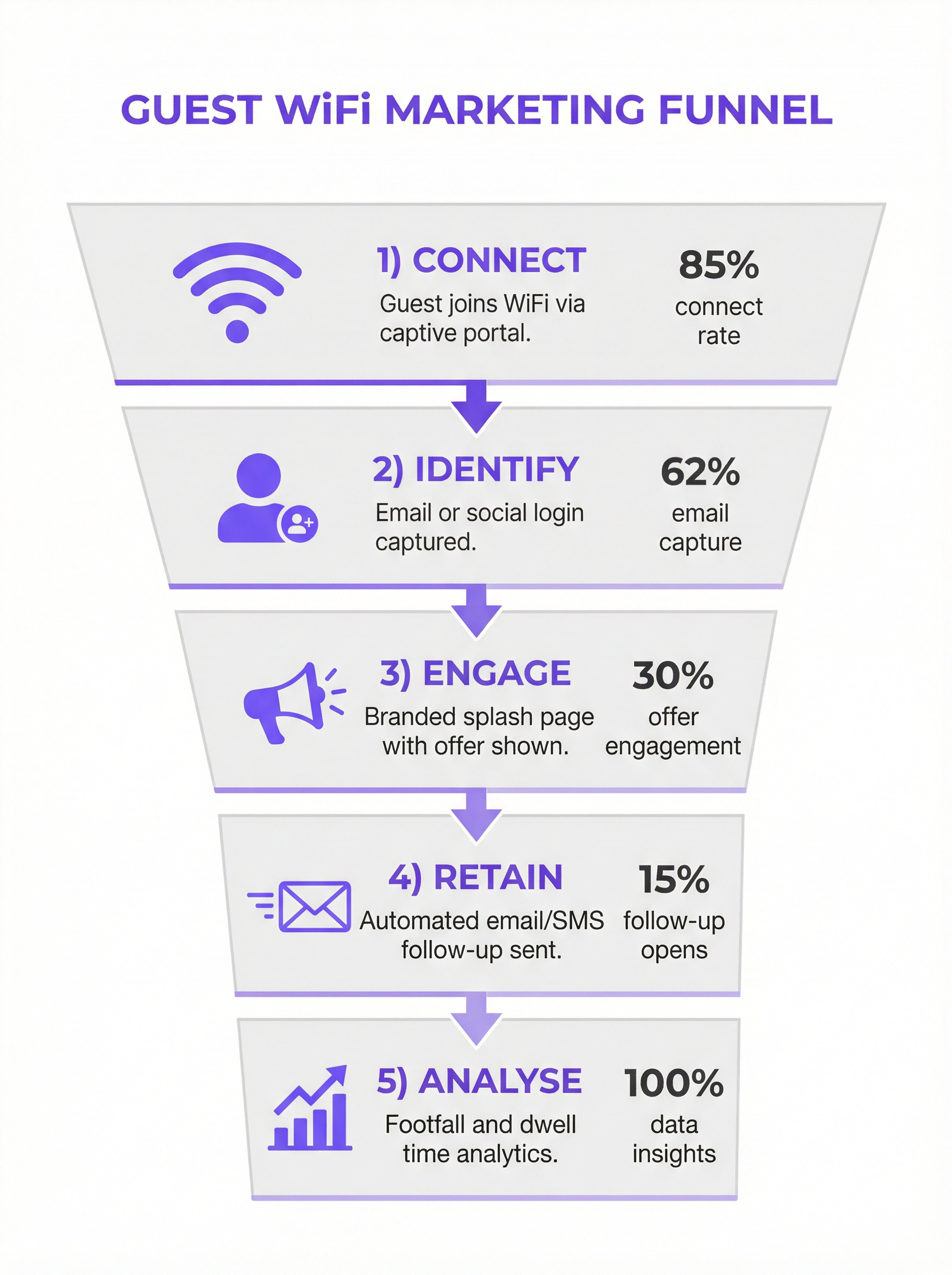
Concevoir le parcours client : Cartographiez l'expérience utilisateur, de la connexion à la communication post-visite. Concevez un Captive Portal épuré, orienté mobile (mobile-first), avec un échange de valeur clair (ex. "WiFi gratuit en échange de votre e-mail et d'un bon de réduction de 15 %").
Configurer et intégrer : Configurez le Captive Portal, paramétrez les déclencheurs de marketing automation et établissez les liens API vers votre CRM. Il s'agit d'une tâche technique nécessitant une collaboration entre les équipes réseau et marketing.
Piloter et itérer : Lancez la solution dans un nombre limité de sites. Surveillez les taux de connexion, la qualité de la capture des données et les performances des campagnes. Utilisez ces informations pour affiner l'approche avant un déploiement complet.
Bonnes pratiques
- Prioriser l'expérience utilisateur : Un processus de connexion lent, complexe ou peu fiable tuera l'adoption. Gardez les formulaires courts et le processus de connexion fluide.
- Offrir un échange de valeur clair : Les utilisateurs sont plus enclins à partager leurs données s'ils reçoivent une valeur tangible en retour. Il peut s'agir d'une vitesse premium, d'une réduction ou de contenu exclusif.
- Intégrer la conformité dès la conception : La confidentialité des données n'est pas une réflexion après coup. Assurez-vous que chaque étape, du consentement sur le Captive Portal à la gestion des données dans le CRM, est conforme au GDPR/CCPA.
- Segmenter et personnaliser : N'envoyez pas le même message à chaque utilisateur. Utilisez les données pour segmenter votre audience (ex. nouveaux visiteurs vs visiteurs récurrents) et personnaliser la communication.
- Sécuriser le réseau : Auditez régulièrement la segmentation de votre réseau et vos règles de pare-feu. Les réseaux invités sont un vecteur d'attaque courant.
Dépannage et atténuation des risques
- Faibles taux de connexion : Souvent causés par une mauvaise expérience utilisateur. Simplifiez le processus de connexion, améliorez les performances du réseau ou augmentez la visibilité du service WiFi.
- Mauvaise qualité des données : Implémentez la validation des e-mails en temps réel sur votre Captive Portal pour réduire les entrées fausses ou mal orthographiées. Privilégiez les connexions sociales pour des données vérifiées et de meilleure qualité.
- Violations de conformité : Le risque le plus important. Collaborez avec les équipes juridiques pour vous assurer que l'ensemble de votre flux de données est conforme. Utilisez une plateforme dotée d'outils de conformité intégrés et automatisés pour gérer le consentement et les demandes des personnes concernées.
- ROI négatif : Cela se produit lorsque les données sont collectées mais ne sont pas exploitées. Assurez-vous que la couche d'intégration fonctionne et que les équipes marketing utilisent activement les données pour mener des campagnes ciblées.
ROI et impact commercial
Le ROI du marketing WiFi invité se mesure sur plusieurs axes :
- Croissance de la base de données marketing : Suivez les nouveaux contacts nets acquis via la plateforme WiFi. Attribuez une valeur à chaque lead en fonction des références du secteur.
- Augmentation des ventes : Attribuez les revenus aux promotions générées par le WiFi. Par exemple, suivez le taux d'utilisation des codes de réduction offerts sur le Captive Portal.
- Amélioration de la fidélité client : Mesurez l'augmentation des visites récurrentes de clients connus après la mise en œuvre du système.
- Efficacité opérationnelle : Utilisez les données de fréquentation et de temps de séjour pour optimiser les effectifs, l'agencement des magasins et les heures d'ouverture.
En connectant le comportement hors ligne aux profils numériques, le marketing WiFi invité fournit le chaînon manquant du parcours client omnicanal, offrant un impact clair et mesurable sur les résultats financiers.
Termes clés et définitions
Captive Portal
A web page that the user of a public-access network is obliged to view and interact with before access is granted. In a marketing context, it's the primary tool for data capture.
IT teams deploy captive portals as the gateway to the guest network. It's the bridge between the network infrastructure and the marketing platform.
MAC Address (Media Access Control)
A unique identifier assigned to a network interface controller (NIC) for use as a network address in communications within a network segment.
The WiFi marketing platform links a user's captured data (e.g., email) to their device's MAC address to track their presence and behaviour (dwell time, repeat visits) anonymously.
VLAN (Virtual Local Area Network)
A logical grouping of devices in the same broadcast domain. VLANs are usually configured on switches by placing some interfaces into one broadcast domain and some into another.
This is the fundamental mechanism IT teams use to segregate the guest WiFi network from the secure internal corporate network, preventing lateral movement by attackers.
GDPR (General Data Protection Regulation)
A regulation in EU law on data protection and privacy in the European Union and the European Economic Area.
For any organisation collecting data from EU citizens, GDPR compliance is mandatory. IT and marketing teams must ensure the WiFi platform provides tools for explicit consent, data access requests, and the right to be forgotten.
Webhook
An automated message sent from an app when something happens. It has a message—or payload—and is sent to a unique URL—a webhook URL.
This is how a WiFi platform can instantly notify a CRM when a new guest connects. For example, a webhook can trigger an action in Salesforce to create a new lead record the moment a guest logs into the WiFi.
Presence Analytics
The analysis of data from WiFi signals to understand how many people are in a physical space, without identifying them personally.
Venue operators use this data to understand footfall patterns, peak hours, and popular areas, allowing them to optimise staffing, layout, and operations.
Location Analytics
A more granular form of analytics that uses the signal strength from multiple access points to triangulate a device's position within a venue.
This provides heatmaps and path analysis, showing where visitors spend the most time and the routes they take. It requires a higher density of APs than simple presence analytics.
WPA3 (Wi-Fi Protected Access 3)
The latest generation of security for wireless networks. It provides more robust authentication and increased cryptographic strength.
Network architects should specify WPA3-compatible hardware for all new deployments to provide the highest level of security for guest and corporate wireless networks.
Études de cas
A 200-room luxury hotel wants to increase direct bookings and build a guest database for marketing, moving away from reliance on Online Travel Agencies (OTAs). They have a modern Cisco Meraki network infrastructure.
The hotel integrates Purple with their Meraki dashboard. They configure a captive portal offering two tiers of WiFi: a free, standard-speed service requiring email and consent for marketing, and a paid, high-speed premium service. The captured email is sent via webhook to their HubSpot CRM and added to a 'New Guest' workflow. This workflow sends a welcome email with a 10% discount code for their next direct booking. The hotel also uses the presence analytics to understand guest flow in the lobby, bar, and spa, helping them optimise staffing.
A retail chain with 50 stores wants to understand in-store customer behaviour and drive footfall through targeted promotions. They use a mix of Aruba and Ruckus hardware.
The chain deploys a hardware-agnostic platform like Purple across all 50 stores. They use a social login (Facebook/Google) on their captive portal to gather rich demographic data. This data is fed into their central BI tool. They identify that their highest-value customers (those with high repeat visits and long dwell times) are predominantly in the 25-34 age bracket. They then run a targeted Facebook ad campaign aimed at this demographic in the geographic areas around their underperforming stores, promoting a new product line. The WiFi analytics are then used to measure the uplift in footfall from this specific demographic post-campaign.
Analyse de scénario
Q1. A large conference centre is hosting a 3-day tech event with 5,000 attendees. They want to provide WiFi while also giving event sponsors opportunities for lead generation. How would you architect the WiFi solution?
💡 Astuce :Consider tiered access and how to provide value to both attendees and sponsors.
Afficher l'approche recommandée
Implement a two-tiered WiFi system. Tier 1 is a free, baseline-speed service for all attendees, with a captive portal that requires only email registration. This builds the centre's own marketing list. Tier 2 is a sponsored, high-speed premium service. Attendees can access it by opting-in to share their details (name, email, company) with a specific sponsor. Each major sponsor gets their own 'branded' access portal. This provides high-quality leads for sponsors and a clear value exchange for attendees (premium speed for data). The network must be robust with high AP density in breakout rooms and the main hall to handle the load.
Q2. A public library wants to offer free WiFi but is concerned about GDPR compliance and data security. They have a limited budget and minimal IT staff. What is the most critical first step in their deployment?
💡 Astuce :What is the single most important security measure for any guest network?
Afficher l'approche recommandée
The most critical first step is to ensure complete network segmentation. Using a VLAN, the guest WiFi network must be entirely isolated from the library's internal administrative network. This prevents any possibility of a user on the public network accessing sensitive internal systems, like the library management system or staff computers. Before even considering data capture, this fundamental security measure must be implemented and verified. A simple, reliable firewall rule blocking all traffic between the guest VLAN and the internal VLAN is essential.
Q3. A restaurant chain notices a high connection rate on their guest WiFi but a very low open rate on their marketing emails. What is the likely cause and how would you troubleshoot it?
💡 Astuce :Think about the quality of the data being captured at the source.
Afficher l'approche recommandée
The most likely cause is poor data quality, specifically fake or mistyped email addresses being entered on the captive portal. To troubleshoot, first analyse the captured data for obvious fake domains (e.g., test@test.com). The best long-term solution is to implement real-time email validation via an API on the captive portal. This checks if an email address is valid before the user is granted access. An alternative or complementary solution is to incentivise social logins, which provide verified email addresses and richer data, leading to higher engagement.
Points clés à retenir
- ✓Guest WiFi can be transformed from a cost centre into a powerful marketing and analytics tool.
- ✓A captive portal is the gateway for capturing valuable first-party customer data with their consent.
- ✓Seamless integration with CRM and marketing platforms is crucial for acting on captured data and proving ROI.
- ✓Network segmentation (using VLANs) is the most critical security measure to protect your corporate network.
- ✓Compliance with data privacy regulations like GDPR is non-negotiable and must be built into the system design.
- ✓A clear value exchange (e.g., a discount for an email) is essential to maximise user adoption and data capture rates.
- ✓WiFi analytics provide unprecedented insight into customer behaviour in physical spaces, bridging the online-offline gap.




