

Réseaux Métropolitains (MAN) : Analyse Approfondie des Technologies, Applications et Tendances Futures
This guide provides a comprehensive technical reference on Metropolitan Area Networks (MANs) for IT leaders and network architects. It covers core technologies, deployment strategies, and business considerations for implementing high-performance, city-scale networks. The content is tailored for decision-makers in hospitality, retail, events, and public-sector organisations.
🎧 Écouter ce guide
Voir la transcription

Synthèse
Un réseau métropolitain (MAN) est un composant d'infrastructure critique pour toute organisation opérant sur plusieurs sites au sein d'une même région géographique. En interconnectant des réseaux locaux (LAN) distribués, un MAN crée une structure réseau unifiée et très performante qui réduit la latence, diminue les coûts de bande passante inter-sites et permet une gestion et une sécurité centralisées. Pour les directeurs techniques (CTO) et les directeurs informatiques de chaînes hôtelières, de franchises de vente au détail et de grands complexes, un MAN bien conçu constitue la base pour offrir une expérience connectée cohérente et de haute qualité, prendre en charge les applications cloud gourmandes en données et évoluer pour répondre aux exigences futures telles que l'IoT et la 5G. Ce guide propose une analyse technique approfondie et indépendante des fournisseurs sur l'architecture, les modèles de déploiement et les meilleures pratiques opérationnelles des MAN. Il va au-delà de la théorie académique pour offrir des conseils pratiques sur la planification, la mise en œuvre et l'optimisation d'un MAN afin de générer une valeur commerciale mesurable, d'améliorer la posture de sécurité et de garantir un retour sur investissement positif.
Analyse Technique Approfondie
Un MAN comble le fossé entre le réseau local et le réseau étendu, couvrant généralement une zone géographique de 5 à 50 kilomètres. Sa fonction principale est de fournir une connectivité haut débit et à faible latence entre des sites disparates, tels que des bureaux d'entreprise, des centres de données et des lieux publics. L'architecture est généralement hiérarchique et comprend trois couches distinctes.
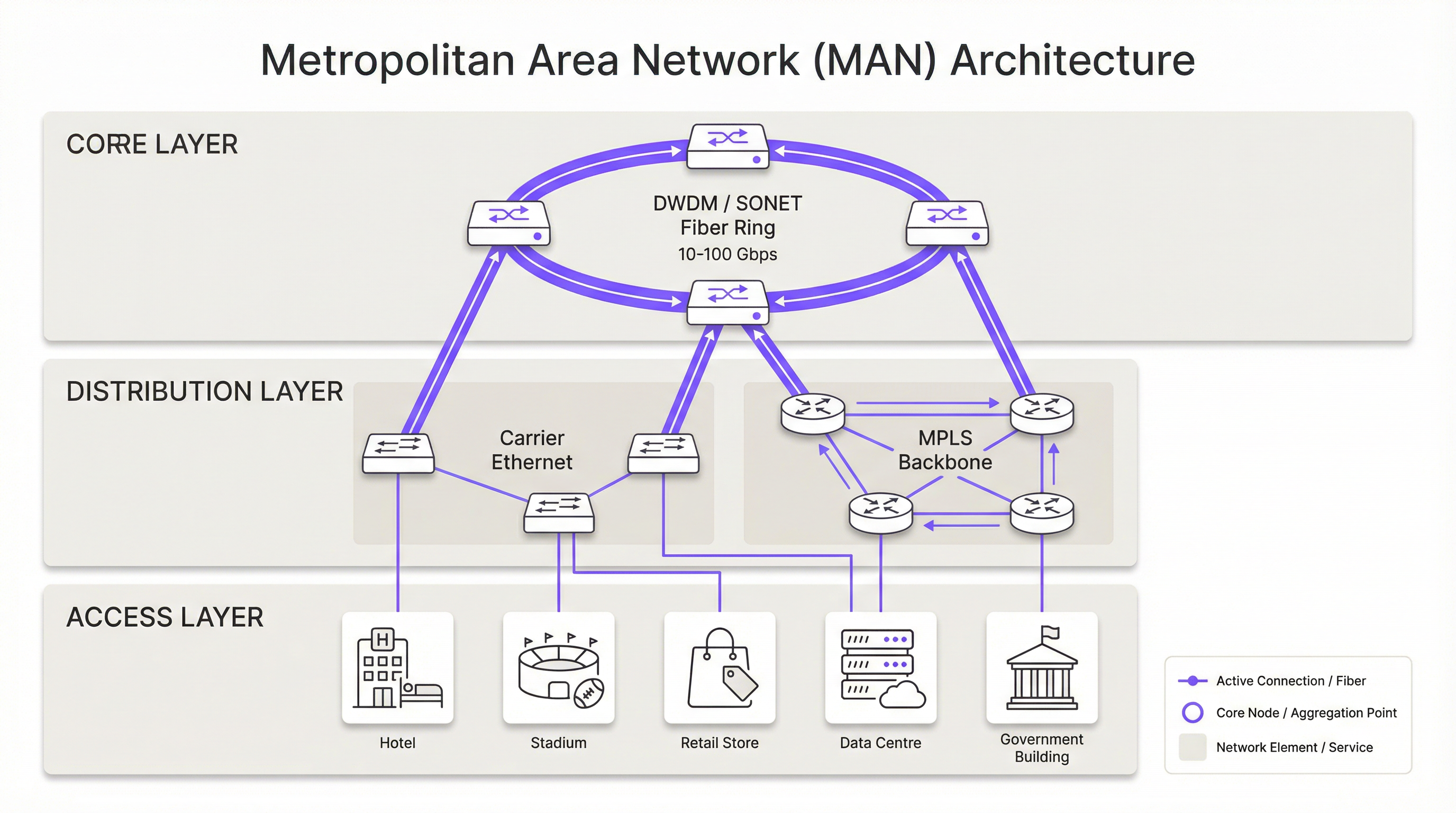
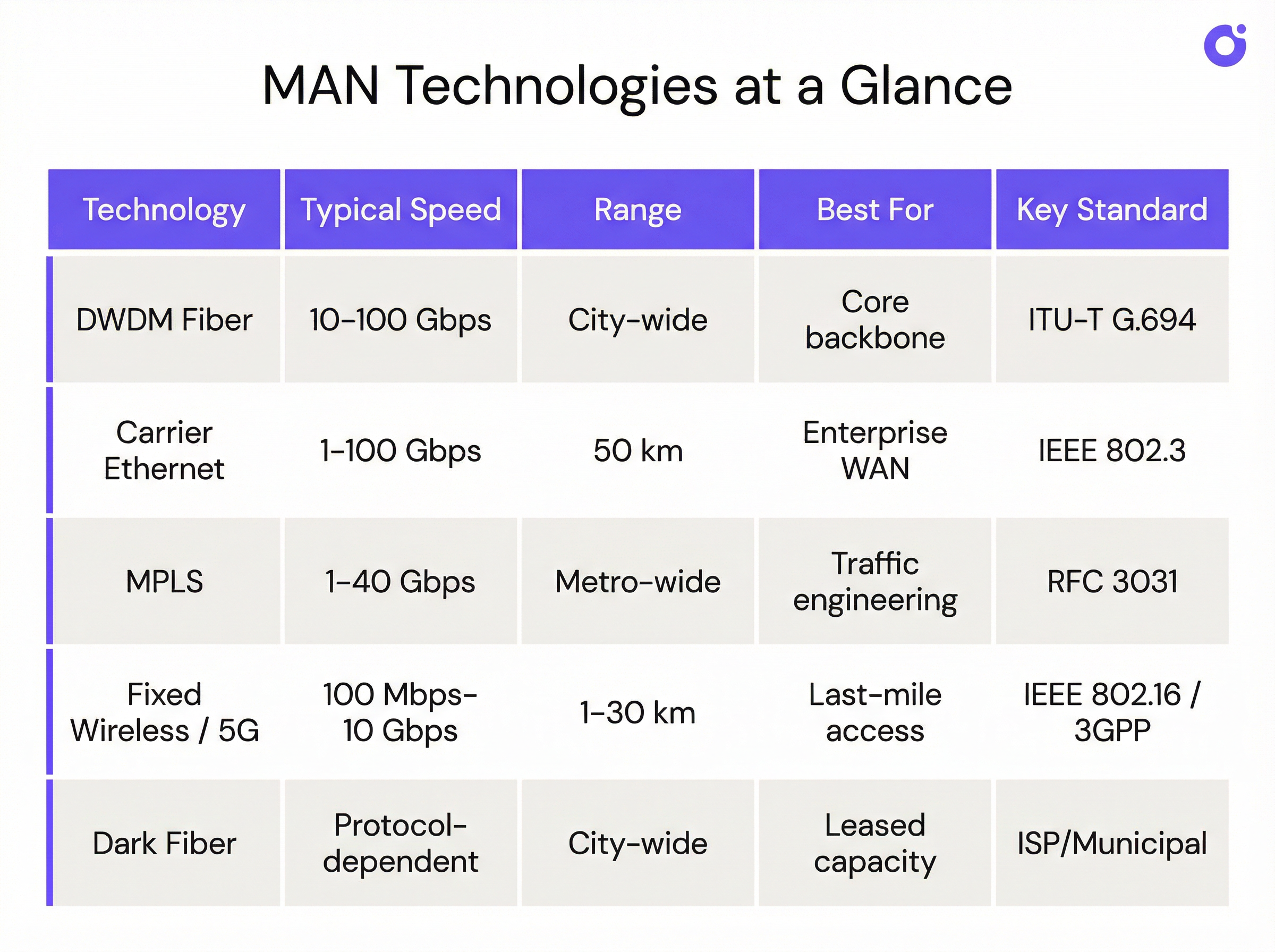
1. Couche Cœur (Core Layer) : Il s'agit de la dorsale haut débit du réseau, presque exclusivement construite sur un anneau de fibre optique redondant. Des technologies telles que le multiplexage par répartition en longueur d'onde dense (DWDM) et les réseaux optiques synchrones (SONET) permettent de transmettre plusieurs flux de données sur une seule paire de fibres, avec des bandes passantes typiques allant de 10 Gbit/s à 100 Gbit/s et au-delà. La topologie en anneau, souvent régie par la norme IEEE 802.17 Resilient Packet Ring (RPR), garantit une haute disponibilité avec des temps de basculement inférieurs à 50 ms, rendant le cœur résilient aux pannes de nœud unique ou de liaison.
2. Couche de Distribution : Cette couche intermédiaire agrège le trafic de la couche d'accès et le connecte au cœur. Les technologies clés incluent ici le Carrier Ethernet et le Multiprotocol Label Switching (MPLS). Le MPLS est particulièrement crucial pour les MAN d'entreprise, car il permet l'ingénierie du trafic, les garanties de qualité de service (QoS) et la création de VPN privés et sécurisés de niveau 2 ou 3. Cela permet aux organisations de segmenter le trafic — par exemple, en séparant les données d'entreprise du WiFi public invité — sur l'infrastructure partagée.
3. Couche d'Accès : Il s'agit du « dernier kilomètre » qui relie les bâtiments et les sites individuels à la couche de distribution. Bien que la fibre reste le support privilégié pour ses performances et sa fiabilité, cette couche utilise souvent un mélange de technologies en fonction des coûts et des aspects pratiques. L'accès sans fil fixe (FWA) utilisant des liaisons micro-ondes et, de plus en plus, la technologie cellulaire 5G offrent des alternatives robustes et à haut débit là où le déploiement de la fibre est prohibitif.
Guide de Mise en Œuvre
Le déploiement d'un MAN est une entreprise majeure qui nécessite une planification minutieuse. Le processus peut être divisé en quatre phases clés.
Phase 1 : Faisabilité et Élaboration de l'Analyse de Rentabilité. Commencez par auditer vos coûts de connectivité inter-sites existants et vos limites de performance. Identifiez les principaux moteurs commerciaux d'un MAN : cherchez-vous à améliorer les performances des applications cloud, à centraliser la sauvegarde des données ou à lancer un nouveau service invité à l'échelle de la ville ? Modélisez le coût total de possession (TCO) d'un MAN, en comparant un modèle de construction (location de fibre noire) à un service géré par un opérateur. Pour la plupart des organisations comptant plus de cinq sites dans une zone métropolitaine, un modèle de construction offre un retour sur investissement supérieur sur une période de 7 à 10 ans.
Phase 2 : Sélection des Technologies et Conception Indépendante des Fournisseurs. Sur la base de vos exigences commerciales, créez une conception de haut niveau. Spécifiez des technologies ouvertes et basées sur des normes (par exemple, Carrier Ethernet, MPLS) pour éviter la dépendance vis-à-vis d'un fournisseur. Votre conception doit détailler l'architecture à trois couches, les protocoles de routage proposés (comme OSPF et BGP) et un plan de sécurité complet intégrant la norme IEEE 802.1X, la segmentation VLAN et des stratégies de chiffrement telles que MACsec.
Phase 3 : Approvisionnement et Déploiement Physique. Cette phase est souvent la plus complexe, car elle implique la gestion des permis de droit de passage et des travaux de génie civil pour le déploiement de la fibre. Émettez des appels d'offres (RFP) basés sur votre conception indépendante des fournisseurs. Lors de la location de fibre noire, assurez-vous que l'accord de niveau de service (SLA) spécifie les caractéristiques de la fibre et le temps moyen de réparation (MTTR). Pour les liaisons sans fil, effectuez une étude RF approfondie afin d'identifier les interférences potentielles.
Phase 4 : Mise en Service et Transfert Opérationnel. Une fois l'infrastructure physique en place, le réseau est mis en service. Cela implique la configuration de tous les éléments du réseau, le test des mécanismes de basculement et de redondance, et la validation des performances par rapport aux spécifications de conception. Enfin, le réseau est transféré à l'équipe du centre d'opérations réseau (NOC), équipée des outils de surveillance et de gestion nécessaires.
Meilleures Pratiques
- Concevoir pour la Redondance : Un MAN doit être résilient. Le cœur doit comporter des chemins de fibre diversifiés, la couche de distribution doit avoir des connexions à double attachement vers le cœur, et les sites d'accès critiques doivent disposer d'un chemin de basculement secondaire (par exemple, fibre en principal, 5G FWA en secondaire).
- Segmenter Logiquement le Trafic : Utilisez des VLAN (IEEE 802.1Q) et des VPN MPLS pour créer des réseaux logiquement séparés pour différents types de trafic (par exemple, entreprise, invité, IoT, VoIP). Il s'agit d'une exigence fondamentale pour la sécurité et la conformité aux normes telles que PCI DSS et GDPR.
- Centraliser la Surveillance du Réseau : Déployez un système de surveillance réseau (NMS) robuste qui offre une vue unifiée de l'ensemble du MAN. Le système doit surveiller l'utilisation des liaisons, la latence, la perte de paquets et l'état des appareils en temps réel, avec des alertes basées sur l'IA pour permettre une maintenance proactive.
- Prioriser la Sécurité : Mettez en œuvre un contrôle d'accès basé sur les ports à l'aide de la norme IEEE 802.1X sur tous les ports filaires. Pour les segments sans fil, imposez le WPA3-Enterprise. Chiffrez le trafic sensible en transit à l'aide d'IPsec ou de MACsec. Effectuez régulièrement des évaluations de vulnérabilité et des tests d'intrusion.
Dépannage et Atténuation des Risques
| Mode de Défaillance Courant | Stratégie d'Atténuation | Étapes de Dépannage |
|---|---|---|
| Coupure de Fibre | Utilisez une topologie en anneau redondante avec des chemins physiques diversifiés. Assurez-vous que le SLA de l'opérateur inclut un MTTR strict. | Utilisez un réflectomètre optique dans le domaine temporel (OTDR) pour localiser précisément la rupture. Réacheminez le trafic via le chemin secondaire. |
| Erreur de Configuration | Mettez en œuvre un processus rigoureux de gestion des changements avec évaluation par les pairs. Utilisez des outils d'automatisation réseau avec validation avant déploiement. | Revenez à la dernière configuration correcte connue. Utilisez des outils de surveillance réseau pour corréler la panne avec le changement récent. |
| Attaque DDoS | Souscrivez à un service d'atténuation DDoS basé sur le cloud capable de nettoyer le trafic malveillant avant qu'il n'atteigne la périphérie de votre réseau. | Identifiez le vecteur d'attaque et la cible à l'aide de l'analyse NetFlow. Engagez le fournisseur d'atténuation DDoS pour appliquer des règles de filtrage. |
| Panne de Courant au Nœud | Équipez tous les nœuds de cœur et de distribution d'onduleurs (UPS) et, pour les nœuds critiques, de générateurs de secours. | Vérifiez l'état de l'alimentation au niveau du nœud affecté. Surveillez les journaux de l'onduleur et du générateur. |
ROI et Impact Commercial
Le calcul du retour sur investissement d'un MAN implique bien plus qu'une simple comparaison des coûts de connectivité. L'impact commercial est multidimensionnel. Les économies de coûts directes proviennent de la consolidation de multiples connexions Internet et lignes louées coûteuses en une dorsale unique et plus efficace. Les gains de productivité sont réalisés grâce à une latence plus faible, ce qui améliore les performances des applications basées sur le cloud, de la VoIP et de la visioconférence. Une sécurité et une conformité renforcées réduisent le risque de violations de données coûteuses et d'amendes réglementaires. Enfin, un MAN est une plateforme propice à l'innovation ; il fournit la base évolutive et performante requise pour les initiatives de bâtiments intelligents, les déploiements IoT à grande échelle et les expériences client de nouvelle génération. Lors de l'élaboration de l'analyse de rentabilité, quantifiez chacun de ces avantages pour présenter une vision globale de la valeur du projet.

Termes clés et définitions
Dark Fiber
Fiber optic cable that has been physically installed but is not currently in use. Organisations can lease dark fiber from carriers or municipalities to build their own private networks.
When an IT team decides to build its own MAN instead of buying a managed service, leasing dark fiber is often the most cost-effective way to create the physical backbone, offering maximum control over the network.
Carrier Ethernet
A set of standards-based services defined by the MEF (Metro Ethernet Forum) that deliver Ethernet services over MAN and WAN networks. It provides scalability and reliability comparable to older SONET/SDH technologies.
For network architects, specifying Carrier Ethernet for MAN services ensures interoperability between different vendors and provides a familiar, flexible, and cost-effective transport technology for enterprise connectivity.
MPLS (Multiprotocol Label Switching)
A network routing technique that directs data from one node to the next based on short path labels rather than long network addresses, avoiding complex lookups in a routing table.
CTOs and network architects leverage MPLS to create secure VPNs between sites and to engineer traffic flows, ensuring that high-priority applications like VoIP get the bandwidth and low latency they need, even on a congested network.
DWDM (Dense Wavelength Division Multiplexing)
A fiber-optic technology that increases bandwidth by allowing multiple data streams to be sent simultaneously over a single fiber optic cable, with each stream using a different wavelength (color) of light.
In a MAN core, DWDM is the key to achieving massive scalability. It allows network operators to add capacity to their fiber backbone without the enormous expense of laying more cables.
IEEE 802.1X
An IEEE standard for Port-Based Network Access Control (PNAC). It provides an authentication mechanism to devices wishing to attach to a LAN or WLAN.
For IT security managers, implementing 802.1X is a fundamental step in securing the network edge. It ensures that only authorized and authenticated users and devices can gain access to the wired or wireless network.
Resilient Packet Ring (RPR)
An IEEE 802.17 standard protocol designed for the transport of data traffic over optical fiber ring networks. It provides high-speed data transfer and fast (sub-50ms) recovery from link or node failures.
When designing the core of a MAN, architects specify RPR to build in carrier-grade resiliency, ensuring that a single fiber cut or equipment failure doesn't cause a catastrophic network outage.
PCI DSS
The Payment Card Industry Data Security Standard is a set of security standards designed to ensure that all companies that accept, process, store or transmit credit card information maintain a secure environment.
For any retail or hospitality business, ensuring the MAN segment that carries payment data is compliant with PCI DSS is non-negotiable. This involves strict network segmentation, access control, and monitoring to protect cardholder data.
GDPR (General Data Protection Regulation)
A regulation in EU law on data protection and privacy for all individuals within the European Union and the European Economic Area. It also addresses the transfer of personal data outside the EU and EEA areas.
When providing public or guest WiFi over a MAN, venue operators must ensure their systems comply with GDPR. This involves obtaining explicit user consent, anonymising personal data like MAC addresses for analytics, and managing data retention policies.
Études de cas
A hotel group with 10 properties spread across a major city needs to replace its expensive, slow, and separately managed internet connections at each site. The goal is to improve guest WiFi performance, centralise data backup to a private data centre, and deploy a new VoIP phone system across all locations.
The recommended solution is to deploy a private MAN using leased dark fiber. A 10 Gbps resilient fiber ring would form the core, connecting three regional distribution nodes. Each hotel would connect to its nearest distribution node via a 1 Gbps Carrier Ethernet circuit. MPLS Layer 3 VPNs would be configured to create three separate virtual networks: one for guest WiFi traffic, one for corporate/VoIP traffic, and one for the data backup service. This segmentation ensures that a surge in guest internet usage does not impact the quality of VoIP calls or the performance of critical business systems. IEEE 802.1X would be enforced on the corporate network, and the guest WiFi would be secured with WPA3 and integrated with a cloud-based analytics platform for GDPR compliance.
A 70,000-seat stadium needs to provide high-density WiFi for fans, support broadcast media operations, and connect its own retail and ticketing systems. The existing connectivity is unreliable and cannot handle the load on event days.
The stadium would act as the central hub of a campus-area MAN. The solution involves two diverse 40 Gbps fiber connections from the stadium's data centre to two different carrier hotels in the city, forming a high-availability connection to the internet and cloud services. Within the stadium, a hierarchical network of aggregation and access switches connects over 1,500 high-density WiFi 6E access points. Network segmentation is critical: a VLAN/MPLS segment is created for public fan WiFi, another for broadcast media with guaranteed bandwidth, a third for PCI DSS-compliant retail and ticketing systems, and a fourth for building management and security systems. A dedicated on-site NOC with real-time analytics monitors the network performance, especially during events, to proactively manage load and interference.
Analyse de scénario
Q1. Your organisation is opening a new branch office in a location where fiber is not available for six months, but there is strong 5G coverage. How would you integrate this site into your existing MPLS-based MAN in the interim?
💡 Astuce :Consider how SD-WAN can use multiple transport types and how to secure traffic over the public internet.
Afficher l'approche recommandée
The recommended approach is to deploy an SD-WAN appliance at the new branch. The SD-WAN appliance would use the 5G connection as its primary transport path. It would form a secure IPsec tunnel back to the SD-WAN headend in the corporate data centre, allowing the branch office to securely connect to the MPLS MAN. Application-aware routing policies would be configured to prioritise critical traffic over the 5G link. When the fiber circuit becomes available, it can be added as a second transport path, and the SD-WAN can be configured to use it as the primary path, keeping the 5G link as a high-performance backup.
Q2. A large conference centre connected to your MAN is hosting a major tech event. The event organiser wants a private, isolated, high-bandwidth network for their keynote presentations and live streams, completely separate from the public attendee WiFi. How would you provision this?
💡 Astuce :Think about logical segmentation. How can you create a dedicated virtual network over the shared physical infrastructure?
Afficher l'approche recommandée
The most robust solution is to provision a dedicated Layer 2 VPN (VPLS) or Layer 3 VPN (VRF) for the event organiser using the MAN's MPLS capabilities. This creates a completely separate virtual network for their traffic from the conference centre back to a dedicated internet breakout or to their own corporate network. A specific VLAN would be configured on the conference centre's switches for the event organiser's use, which would then be mapped to the dedicated MPLS VPN. QoS policies would be applied to guarantee the required bandwidth for their live streaming activities, ensuring it is not impacted by the thousands of attendees using the public WiFi network.
Q3. You are seeing intermittent packet loss and high latency to a retail store that is connected to your MAN via a fixed wireless link. What are the first three things you should investigate?
💡 Astuce :Think about the unique failure modes of wireless technologies compared to fiber.
Afficher l'approche recommandée
- RF Interference: Fixed wireless links are susceptible to interference from other wireless sources (e.g., other nearby networks, radar systems). The first step is to use the wireless bridge's management interface or a separate spectrum analyser to check for interference on the operating channel. If interference is detected, changing the channel to a cleaner frequency may resolve the issue. 2. Line of Sight Obstruction: Unlike fiber, wireless links require a clear line of sight between the two antennas. A physical obstruction that has appeared since installation (e.g., a new building, tree growth, a crane) can degrade the signal. A visual inspection, followed by checking the received signal strength indicator (RSSI) against its baseline from installation, is crucial. 3. Weather Conditions: Heavy rain, snow, or fog can attenuate microwave signals, a phenomenon known as "rain fade." Correlate the periods of high latency and packet loss with historical weather data. If the link is not engineered with enough fade margin for the climate, the only solutions are to upgrade to larger antennas or a higher-power radio system.
Points clés à retenir
- ✓A MAN connects multiple LANs across a city or large campus, creating a single, unified network.
- ✓Core technologies include fiber optics (DWDM, SONET), Carrier Ethernet, and MPLS for traffic engineering.
- ✓A three-layer architecture (Core, Distribution, Access) is the standard design pattern.
- ✓Leasing dark fiber is often the most cost-effective way to build a private MAN for multi-site organisations.
- ✓Network segmentation using VLANs and MPLS is critical for security and compliance (PCI DSS, GDPR).
- ✓Redundancy through ring topologies and diverse paths is essential for high availability.
- ✓Future trends include deeper integration with 5G for backhaul and the use of SD-WAN as a control overlay.




