

La chronologie définitive du WiFi : d'ALOHAnet au WiFi 7 et au-delà
This guide provides a definitive technical timeline of WiFi, tracing its origins from the 1971 ALOHAnet experiment through every major IEEE 802.11 standard to the ratification of WiFi 7 in 2024 and the emerging WiFi 8 roadmap. It is designed for IT managers, network architects, and CTOs who need to understand the engineering evolution of wireless technology to make informed infrastructure investment decisions. By contextualising each generation's innovations within real-world deployment scenarios across hospitality, retail, and large venues, the guide delivers actionable guidance on upgrading, securing, and future-proofing enterprise wireless networks.
🎧 Écouter ce guide
Voir la transcription
Synthèse
Pour les responsables informatiques et les exploitants de sites, comprendre l'évolution du WiFi n'est pas un exercice académique : c'est un prérequis pour la planification stratégique et l'investissement réseau. Ce guide présente la chronologie définitive du WiFi, retraçant ses origines depuis l'ALOHAnet de 1971 jusqu'au lancement du WiFi 7 en 2024 et au-delà. Il propose une analyse technique approfondie des changements générationnels des normes IEEE 802.11, en expliquant l'impact commercial des innovations clés telles que le MIMO, l'OFDMA et le Multi-Link Operation (MLO). En contextualisant ces avancées dans des scénarios de déploiement réels pour l'hôtellerie, la vente au détail et les grands sites, cette référence fournit les informations exploitables dont les architectes réseau et les directeurs techniques ont besoin pour concevoir une infrastructure sans fil pérenne, optimiser l'expérience utilisateur et maximiser le retour sur investissement. Cette chronologie démystifie les normes et offre un cadre clair pour prendre des décisions éclairées sur les mises à niveau d'infrastructure, le choix des fournisseurs et les stratégies de déploiement dans un monde de plus en plus connecté.
Analyse technique approfondie
Le parcours, du premier réseau de paquets sans fil aux vitesses multi-gigabits d'aujourd'hui, est une histoire d'innovation incessante. Les fondations du WiFi n'ont pas été posées dans les années 1990, mais des décennies plus tôt, grâce à des travaux pionniers dans la technologie radio et les protocoles réseau. Comprendre cette progression est essentiel pour apprécier la complexité et les capacités des réseaux sans fil modernes.
L'ère pré-norme : ALOHAnet et le spectre sans licence
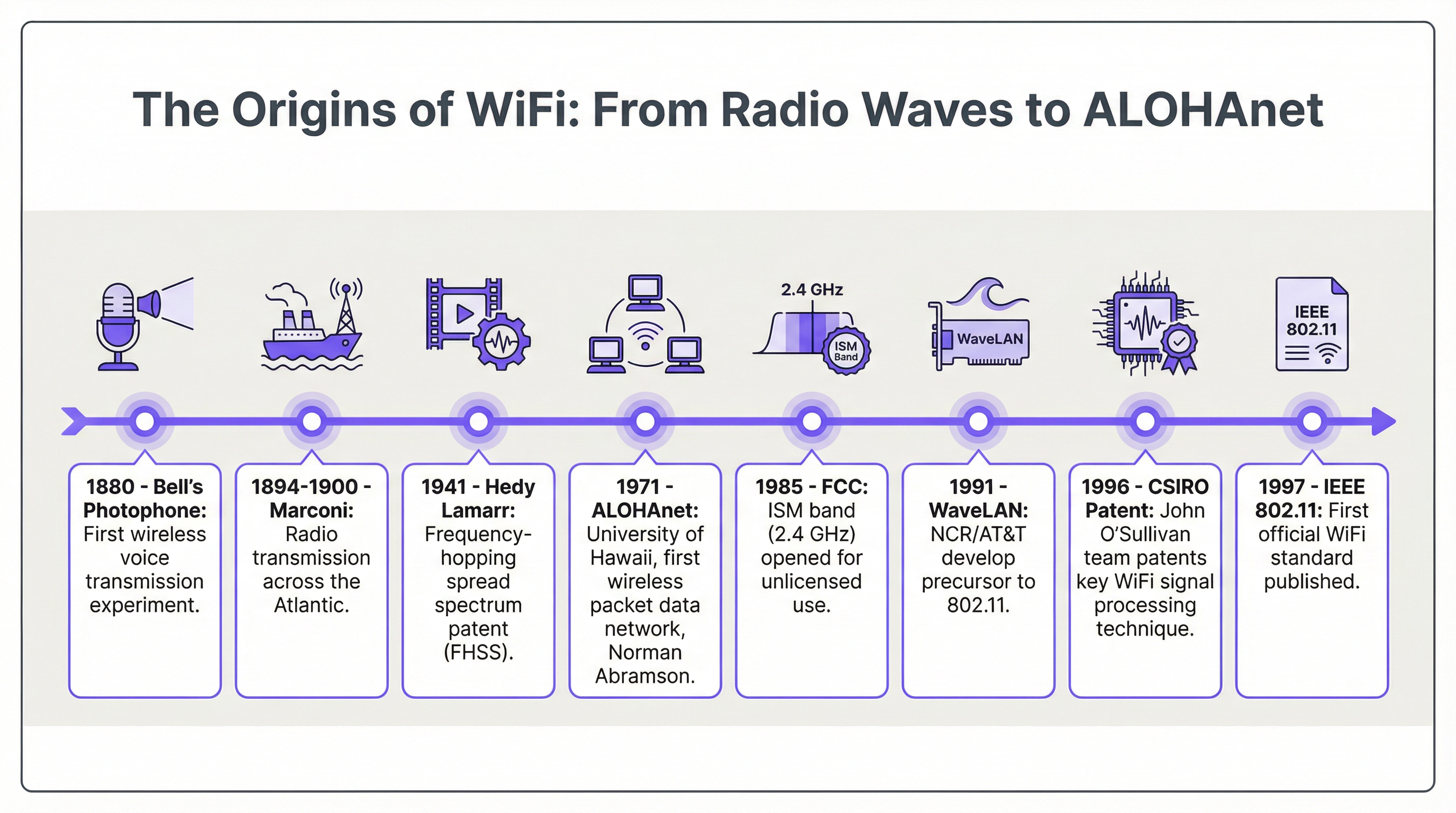
La véritable genèse du WiFi remonte à 1971 avec ALOHAnet, un réseau de paquets sans fil UHF développé à l'Université d'Hawaï. Dirigé par Norman Abramson, ce projet a été le premier à démontrer la mise en réseau public de données par paquets sans fil, reliant les îles hawaïennes. Son innovation principale, le protocole d'accès aléatoire ALOHA, était un précurseur direct du mécanisme d'accès multiple avec écoute de porteuse et évitement de collision (CSMA/CA) qui sous-tend toutes les normes 802.11 modernes. Ces premiers travaux ont prouvé qu'un support sans fil partagé pouvait être utilisé efficacement pour la communication de données.
Une évolution réglementaire cruciale a eu lieu en 1985 lorsque la Federal Communications Commission (FCC) des États-Unis a ouvert les bandes industrielles, scientifiques et médicales (ISM) — y compris le 2,4 GHz — à une utilisation sans licence. Cette décision a démocratisé les ondes, créant un espace d'innovation échappant au contrôle des opérateurs de télécommunications traditionnels et ouvrant la voie au développement de technologies sans fil grand public.
D'autres travaux fondateurs ont été menés par la Commonwealth Scientific and Industrial Research Organisation (CSIRO) du gouvernement australien. Au début des années 1990, une équipe dirigée par le Dr John O'Sullivan, alors qu'elle tentait de détecter l'explosion de mini-trous noirs, a développé et breveté une technique cruciale pour réduire les interférences par trajets multiples — le phénomène des signaux radio rebondissant sur les surfaces et arrivant au récepteur à des moments différents. Ce brevet du CSIRO a contribué à faire des réseaux locaux sans fil robustes et à haut débit une réalité et sous-tend la forme d'onde OFDM utilisée dans chaque norme WiFi moderne.
Les générations IEEE 802.11 : une évolution normalisée
La fin des années 1990 a vu l'officialisation des normes WiFi sous la gouvernance de l'IEEE. Cette normalisation était cruciale pour garantir l'interopérabilité entre les produits de différents fournisseurs, un rôle par la suite défendu par la Wi-Fi Alliance, créée en 1999 pour certifier les produits conformes et qui a inventé la marque « Wi-Fi » par l'intermédiaire de l'agence Interbrand.
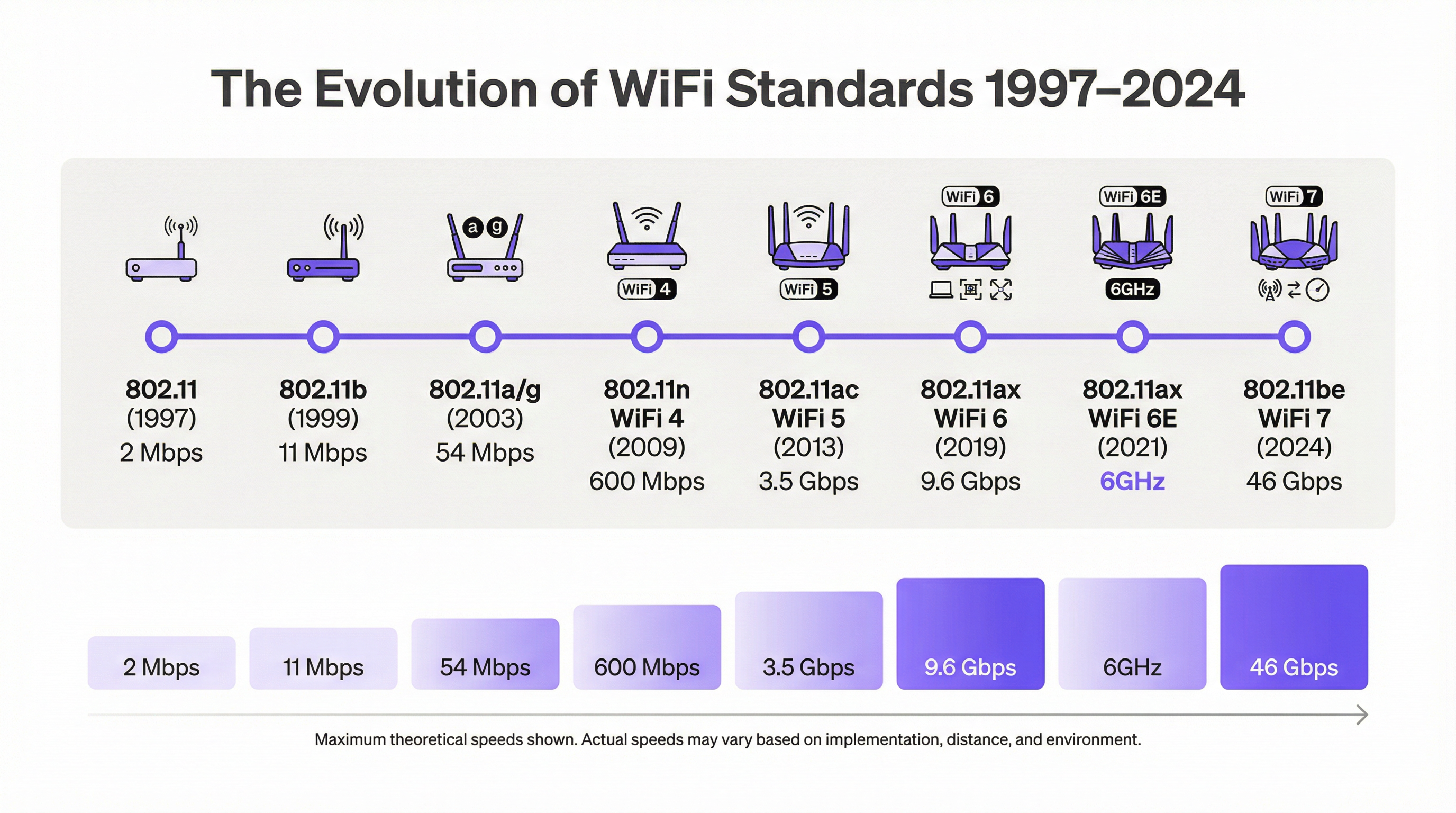
| Norme | Génération Wi-Fi | Année | Bande(s) de fréquences | Vitesse théorique max. | Innovation clé |
|---|---|---|---|---|---|
| 802.11 | — | 1997 | 2,4 GHz | 2 Mbps | Norme fondatrice |
| 802.11b | WiFi 2 | 1999 | 2,4 GHz | 11 Mbps | Première adoption massive |
| 802.11a | WiFi 2 | 1999 | 5 GHz | 54 Mbps | OFDM en 5 GHz |
| 802.11g | WiFi 3 | 2003 | 2,4 GHz | 54 Mbps | OFDM en 2,4 GHz |
| 802.11n | WiFi 4 | 2009 | 2,4/5 GHz | 600 Mbps | MIMO |
| 802.11ac | WiFi 5 | 2013 | 5 GHz | 3,5 Gbps | MU-MIMO, canaux de 160 MHz |
| 802.11ax | WiFi 6 | 2019 | 2,4/5 GHz | 9,6 Gbps | OFDMA, BSS Coloring, WPA3 |
| 802.11ax | WiFi 6E | 2021 | 2,4/5/6 GHz | 9,6 Gbps | Accès à la bande des 6 GHz |
| 802.11be | WiFi 7 | 2024 | 2,4/5/6 GHz | 46,1 Gbps | MLO, canaux de 320 MHz, 4K-QAM |
| 802.11bn | WiFi 8 | ~2028 | À définir | À définir | Latence déterministe |
802.11n (WiFi 4) a marqué un bond significatif en matière de débit en introduisant le MIMO (Multiple-Input Multiple-Output), qui utilise plusieurs antennes pour transmettre et recevoir plus de données simultanément. Le 802.11ac (WiFi 5) s'est appuyé sur cette technologie avec des canaux plus larges (jusqu'à 160 MHz) et le Multi-User MIMO (MU-MIMO), permettant à un point d'accès de transmettre à plusieurs clients simultanément. Le 802.11ax (WiFi 6/6E) a constitué un changement de paradigme axé sur l'efficacité dans les environnements très fréquentés. Sa fonctionnalité phare, l'Orthogonal Frequency-Division Multiple Access (OFDMA), permet à un point d'accès de servir simultanément plusieurs clients ayant des besoins en bande passante variables sur le même canal — une véritable révolution pour les sites à haute densité. L'introduction du WiFi 6E en 2021 a permis aux appareils d'accéder à la bande des 6 GHz nouvellement ouverte, un bloc de spectre vierge présentant beaucoup moins d'interférences que les bandes encombrées de 2,4 GHz et 5 GHz.
Le 802.11be (WiFi 7), ratifié en 2024, propulse les performances à un niveau supérieur. Sa technologie fondamentale est le Multi-Link Operation (MLO), qui permet aux appareils de se connecter et d'agréger des données sur plusieurs bandes simultanément. Cela augmente considérablement le débit, réduit la latence et améliore la fiabilité. Combiné à des largeurs de canal de 320 MHz et à la modulation 4K-QAM, le WiFi 7 offre les vitesses multi-gigabits essentielles pour les applications de nouvelle génération telles que la réalité augmentée/virtuelle (AR/VR) et les expériences immersives sur site.
L'avenir : le WiFi 8 et au-delà
À l'avenir, l'évolution du sans fil passera de la vitesse brute aux performances déterministes. La future norme 802.11bn (WiFi 8), attendue vers 2028, vise à offrir une latence extrêmement faible et prévisible pour les applications industrielles et d'entreprise sensibles au temps. Cela implique une coordination multi-AP avancée et la réutilisation spatiale coordonnée (Co-SR) pour gérer le spectre avec une précision sans précédent.
Guide de mise en œuvre
Le déploiement d'un réseau WiFi d'entreprise moderne nécessite une approche structurée qui va au-delà du simple placement de points d'accès. Pour les responsables informatiques et les architectes réseau, la réussite d'un déploiement repose sur une planification méticuleuse, des bonnes pratiques indépendantes des fournisseurs et une compréhension approfondie de l'environnement physique.
Étape 1 : Recueil des besoins et étude de site. Définissez les cas d'usage, estimez le nombre d'appareils simultanés et réalisez à la fois une étude de site prédictive (à l'aide d'outils comme Ekahau ou Hamina) et une visite physique pour identifier les sources d'interférences RF et les obstacles physiques qui ne figurent pas sur les plans d'étage.
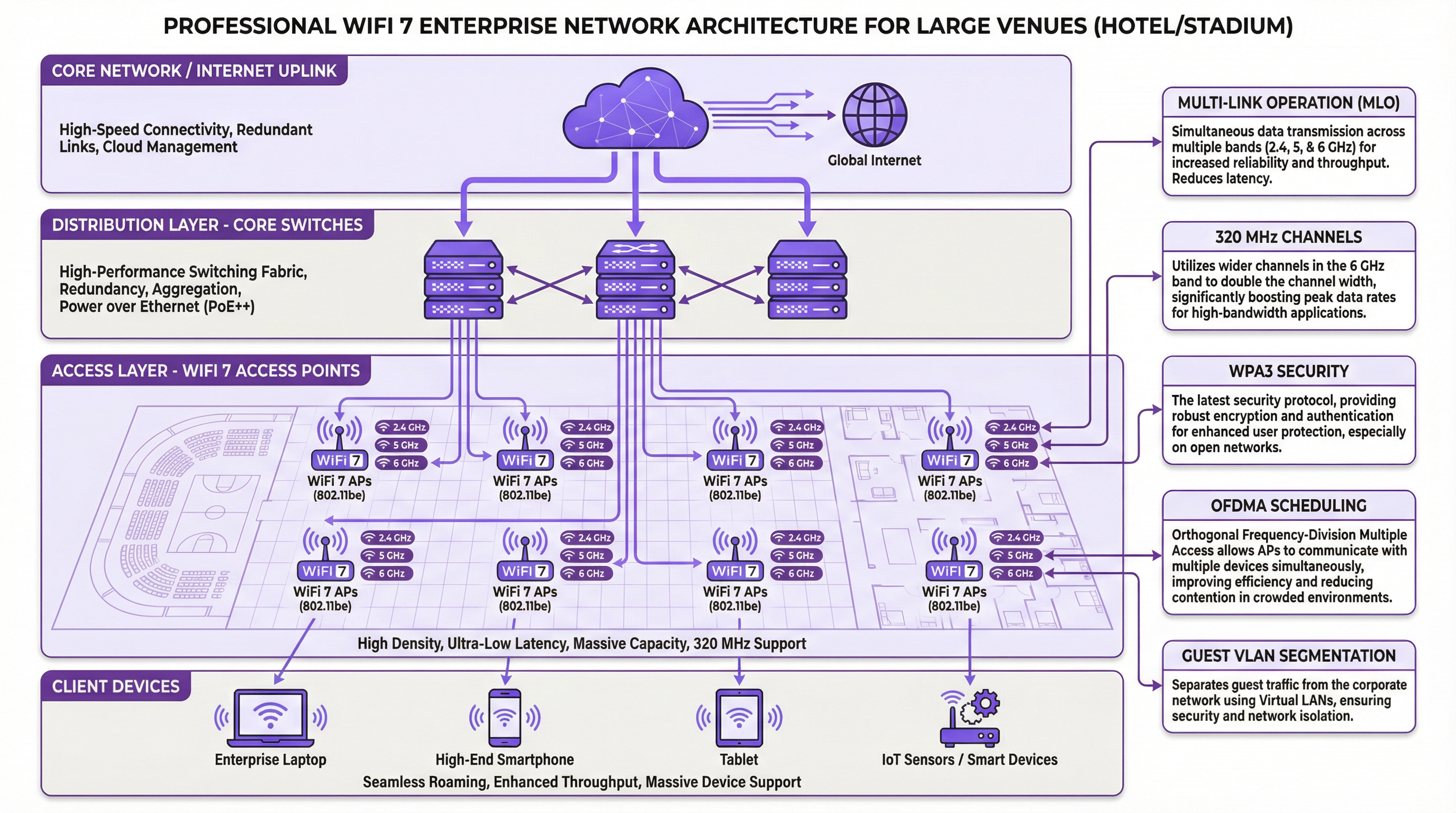
Étape 2 : Conception et architecture du réseau. Sélectionnez les points d'accès appropriés en fonction des résultats de l'étude — WiFi 6E pour les nouveaux déploiements, WiFi 7 pour les zones critiques en termes de performances. Élaborez un plan de canaux statique pour les trois bandes afin de minimiser les interférences co-canal, et concevez une segmentation VLAN pour isoler le trafic invité, d'entreprise et IoT. Assurez-vous que le réseau fédérateur filaire utilise des commutateurs PoE++ multi-gigabits (IEEE 802.3bt).
Étape 3 : Configuration et sécurité. Imposez le WPA3-Enterprise pour tous les SSID d'entreprise. Implémentez la norme IEEE 802.1X avec un serveur RADIUS pour l'authentification basée sur des certificats. Déployez un Captive Portal conforme au GDPR pour les réseaux invités, en l'intégrant à une plateforme comme Purple pour l'analyse et le marketing.
Étape 4 : Validation et optimisation. Effectuez une étude de validation post-déploiement pour mesurer la force réelle du signal, le débit et la latence. Surveillez le réseau en continu pour analyser les modèles de trafic et la santé RF, en utilisant ces informations pour affiner les niveaux de puissance des points d'accès et l'attribution des canaux au fil du temps.
Bonnes pratiques
Privilégiez la bande des 6 GHz pour tous les nouveaux déploiements, en réservant le 2,4 GHz exclusivement aux anciens appareils IoT. Concevez pour l'itinérance (roaming) en assurant un chevauchement de couverture d'environ 15 à 20 % avec une force de signal minimale de -67 dBm en bordure de cellule. Appliquez une segmentation stricte du réseau à l'aide de VLAN et de règles de pare-feu — n'autorisez jamais les appareils invités sur le même réseau que les systèmes de paiement ou les serveurs opérationnels. Imposez le WPA3 dans toute l'entreprise et désactivez tous les anciens protocoles de sécurité, y compris le WPA2 et le TKIP. Centralisez la gestion à l'aide d'une plateforme cloud pour maintenir une configuration, une posture de sécurité et des mises à jour de firmware cohérentes sur tous les points d'accès.
Dépannage et atténuation des risques
Les interférences co-canal (CCI) constituent le problème de performance le plus courant, où plusieurs points d'accès sur le même canal interfèrent les uns avec les autres. L'atténuation nécessite une étude de site approfondie et un plan de canaux statique ; utilisez des canaux plus étroits dans les déploiements denses pour augmenter le nombre de canaux non chevauchants disponibles. Une authentification mal configurée entraîne l'échec de la connexion des clients en raison de paramètres de sécurité incompatibles ; une plateforme de gestion centralisée diffusant des profils cohérents élimine ce risque. Une alimentation PoE insuffisante provoque le redémarrage des points d'accès ou leur fonctionnement en mode d'alimentation réduite ; vérifiez que les commutateurs fournissent la norme PoE correcte (PoE++ pour le WiFi 6/7) et que les longueurs de câble respectent la limite de 100 mètres. L'épuisement du DHCP empêche les clients d'obtenir des adresses IP dans les environnements à forte rotation ; assurez-vous que les étendues DHCP sont correctement dimensionnées et réduisez les durées de bail dans les configurations de conférence ou d'événement.
ROI et impact commercial
Investir dans une infrastructure WiFi moderne offre des rendements tangibles dans trois dimensions. Premièrement, l'expérience client : dans l'hôtellerie, un WiFi performant est l'un des principaux moteurs des scores de satisfaction des clients, se traduisant directement par des avis positifs et une fidélisation. Deuxièmement, l'efficacité opérationnelle : un réseau WiFi fiable alimente des systèmes critiques tels que les points de vente mobiles (POS), les scanners d'inventaire et les appareils de communication du personnel, réduisant ainsi les erreurs et accélérant les processus. Troisièmement, de nouvelles sources de revenus : en intégrant une plateforme d'analyse WiFi comme Purple, les sites peuvent exploiter le WiFi invité pour collecter des données marketing conformes au GDPR, comprendre les modèles de fréquentation et proposer des promotions ciblées — transformant ainsi un centre de coûts en un générateur de revenus.
Mesurer le ROI implique de suivre l'augmentation de la satisfaction client et des scores NPS, la réduction du temps passé par le personnel sur des tâches manuelles, et les revenus supplémentaires générés par les campagnes marketing basées sur le WiFi. Un réseau WiFi bien conçu n'est pas une dépense informatique ; c'est un atout stratégique qui sous-tend l'ensemble de l'expérience numérique d'un site moderne.
Termes clés et définitions
ALOHAnet
The world's first wireless packet data network, developed at the University of Hawaii in 1971 by Norman Abramson. It connected the Hawaiian Islands via UHF radio and introduced the ALOHA random-access protocol, the conceptual ancestor of CSMA/CA used in all 802.11 standards.
IT teams encounter this term in the historical context of WiFi development. Understanding ALOHAnet's contribution to medium access control helps explain why modern WiFi behaves the way it does in congested environments.
OFDMA (Orthogonal Frequency-Division Multiple Access)
A multi-user version of OFDM modulation that divides a WiFi channel into smaller sub-channels (Resource Units) and allocates them to different clients simultaneously. Introduced in WiFi 6 (802.11ax), it allows an access point to serve multiple devices with different bandwidth requirements in the same transmission window.
OFDMA is the primary reason WiFi 6 outperforms WiFi 5 in high-density environments. Network architects should specify WiFi 6 or higher for any venue expecting more than 30–50 concurrent devices per access point.
Multi-Link Operation (MLO)
A WiFi 7 (802.11be) feature that enables a device to simultaneously connect and aggregate data across multiple frequency bands (2.4, 5, and 6 GHz). Unlike previous generations where a device was tied to a single band at a time, MLO allows concurrent transmission and reception across bands, increasing throughput and reducing latency.
MLO is the defining feature of WiFi 7 and the primary justification for upgrading from WiFi 6E in performance-critical environments. It is particularly valuable for applications requiring consistent low latency, such as AR/VR and real-time collaboration tools.
WPA3 (Wi-Fi Protected Access 3)
The current WiFi security standard, replacing WPA2. WPA3 introduces Simultaneous Authentication of Equals (SAE), which protects against offline dictionary attacks on passwords, and provides forward secrecy, meaning past sessions cannot be decrypted even if the password is later compromised. WPA3-Enterprise adds 192-bit cryptographic strength.
WPA3 is mandatory for WiFi 6 and later certified devices. IT teams should disable WPA2 on all corporate SSIDs and enforce WPA3-Enterprise with 802.1X for any network carrying sensitive data. This is increasingly a compliance requirement under frameworks like Cyber Essentials and PCI DSS.
IEEE 802.1X
An IEEE standard for port-based network access control that provides an authentication framework for devices connecting to a network. In WiFi deployments, it is used with a RADIUS server to authenticate users or devices via credentials or certificates before granting network access.
802.1X is the foundation of enterprise WiFi security. It eliminates the security risks of shared pre-shared keys (PSK) by providing per-user or per-device authentication. It is a requirement for PCI DSS compliance on any network segment that handles cardholder data.
MIMO (Multiple-Input Multiple-Output)
A radio technology that uses multiple antennas at both the transmitter (access point) and receiver (client device) to send and receive multiple data streams simultaneously over the same channel. Introduced in WiFi 4 (802.11n), it dramatically increases throughput and reliability.
MIMO is the foundational technology behind the throughput improvements from WiFi 4 onwards. MU-MIMO (Multi-User MIMO), introduced in WiFi 5, extends this to allow an AP to serve multiple clients simultaneously rather than sequentially.
BSS Coloring
A WiFi 6 (802.11ax) mechanism that assigns a colour identifier to each Basic Service Set (BSS). When a device detects a transmission from a different BSS on the same channel, it can identify it as 'foreign' and continue its own transmission rather than deferring, reducing unnecessary backoff and improving efficiency in dense deployments.
BSS Coloring is particularly relevant in multi-tenant buildings, dense urban deployments, and large venues where multiple overlapping WiFi networks coexist. It is a key reason why WiFi 6 performs better in interference-heavy environments than WiFi 5.
PoE++ (IEEE 802.3bt)
The latest Power over Ethernet standard, delivering up to 90W of power over a standard Ethernet cable. WiFi 6E and WiFi 7 access points often require PoE++ due to their higher power consumption from supporting three radio bands and advanced processing capabilities.
IT teams planning WiFi 6E or 7 deployments must audit their switching infrastructure for PoE++ compatibility. Deploying high-generation APs on older PoE or PoE+ switches will result in APs operating in a reduced-power mode, significantly degrading performance and coverage.
6 GHz Band
A new frequency band (5.925–7.125 GHz) opened for unlicensed WiFi use by regulatory bodies including the FCC (2020) and Ofcom (UK, 2021). It provides approximately 1,200 MHz of additional spectrum, compared to 80 MHz in the 2.4 GHz band. It is exclusively available to WiFi 6E and WiFi 7 devices, meaning it is free from legacy device interference.
The 6 GHz band is the most significant spectrum development in WiFi history since the ISM band was opened in 1985. For network architects, it is the primary reason to specify WiFi 6E or 7 for new deployments, particularly in high-density environments where the 2.4 and 5 GHz bands are congested.
Études de cas
A 350-room full-service hotel is planning a complete WiFi infrastructure refresh. The property includes a large conference centre with a 1,200-seat ballroom, three restaurant spaces, a spa, and a fitness centre. The hotel currently operates a WiFi 5 (802.11ac) network installed in 2017 and is experiencing persistent complaints about slow speeds in the ballroom during large events. The IT director needs to select a new standard, design the architecture, and ensure PCI DSS compliance for the payment network. What is the recommended approach?
The recommended approach is a phased deployment of WiFi 6E as the baseline standard, with WiFi 7 specified for the ballroom and conference centre. Phase 1 deploys WiFi 6E access points throughout guest rooms and back-of-house areas, replacing the 802.11ac infrastructure. Each floor is served by ceiling-mounted APs at approximately 15-metre intervals, with a dedicated IoT SSID on 2.4 GHz for door locks, thermostats, and HVAC sensors. Phase 2 focuses on the ballroom and conference spaces, deploying WiFi 7 (802.11be) access points with a high-density design: ceiling-mounted APs at 8-metre intervals, supplemented by under-table APs at delegate positions for the ballroom. The 6 GHz band is configured as the primary band for all client devices, with OFDMA enabled to manage the high concurrent device count during events. The network architecture uses three VLANs: VLAN 10 for guest WiFi (isolated, internet-only), VLAN 20 for staff and operational systems, and VLAN 30 for payment terminals (PCI DSS scope, isolated with dedicated firewall rules and 802.1X authentication). WPA3-Enterprise is mandated on VLANs 20 and 30. A GDPR-compliant captive portal on VLAN 10 collects guest email addresses for the hotel's CRM, integrated with Purple for analytics. The wired backbone is upgraded to multi-gigabit PoE++ switches to power the WiFi 7 APs. Post-deployment, a validation survey confirms coverage and throughput targets are met.
A national retail chain with 85 stores is planning to deploy a unified WiFi platform to support mobile POS systems, inventory management scanners, digital signage, and a customer-facing guest WiFi network. Each store averages 800 square metres. The CTO wants a single vendor-neutral architecture that can be centrally managed, supports GDPR-compliant customer data capture, and can scale to support future IoT deployments. What architecture and standards should be recommended?
The recommended architecture is a cloud-managed WiFi 6E deployment with a standardised three-SSID design across all 85 stores. Each store is served by 4–6 ceiling-mounted WiFi 6E access points, providing full coverage with appropriate overlap. The three SSIDs are: (1) a corporate SSID on 5 GHz with WPA3-Enterprise and 802.1X authentication, carrying POS and inventory scanner traffic on a dedicated VLAN with firewall rules restricting access to the payment processor and inventory system only; (2) an IoT SSID on 2.4 GHz with WPA2-PSK (or WPA3-SAE for newer devices) for digital signage, environmental sensors, and HVAC controls; and (3) a guest WiFi SSID on 5/6 GHz with a GDPR-compliant captive portal integrated with Purple, collecting opt-in customer data for the chain's loyalty programme. Central management is provided through a cloud-based controller, enabling the IT team to push configuration changes, firmware updates, and security policies to all 85 stores simultaneously. Purple's analytics platform provides footfall data, dwell time analysis, and customer journey mapping across all stores, enabling the marketing team to optimise store layouts and promotional campaigns. The architecture is designed to accommodate future WiFi 7 AP upgrades without changes to the underlying network design.
Analyse de scénario
Q1. A 15,000-seat indoor arena is planning a WiFi upgrade ahead of a major esports tournament series. During the last event, the existing WiFi 5 network experienced severe congestion, with average client throughput dropping below 2 Mbps during peak attendance. The venue operator needs to support 12,000 concurrent devices, with 20% of users streaming 4K video and 5% using AR-enhanced experiences. What WiFi standard should be specified, and what are the three most critical design decisions?
💡 Astuce :Consider the specific features of WiFi 6/6E/7 that address high-density performance, and think about the physical deployment pattern for a tiered seating environment.
Afficher l'approche recommandée
WiFi 7 (802.11be) should be specified as the primary standard for this deployment, with WiFi 6E as a fallback for areas where WiFi 7 hardware is not yet available. The three most critical design decisions are: (1) Band allocation — deploy all primary client traffic on the 6 GHz band using 80 MHz channels to maximise the number of non-overlapping channels and minimise interference. The 6 GHz band's 1,200 MHz of spectrum allows for significantly more simultaneous channels than 2.4 or 5 GHz. (2) AP placement — use a high-density under-seat or seat-back AP deployment pattern rather than relying on ceiling-mounted APs. This reduces the number of clients per AP (targeting no more than 30–40 devices per AP) and improves signal quality by reducing path loss. (3) OFDMA configuration — enable OFDMA on all APs and configure the network to prioritise the AR/VR traffic using QoS policies, ensuring the 5% of users with the most demanding latency requirements receive consistent sub-10ms latency. MLO should be enabled to allow devices to aggregate 5 and 6 GHz bandwidth for the 4K streaming use case.
Q2. A regional council is deploying public WiFi across 12 libraries and 8 leisure centres. The network must be GDPR-compliant, support a maximum of 200 concurrent users per site, and integrate with the council's existing Active Directory for staff authentication. The IT team has a limited budget and needs to justify the investment to elected members. What architecture would you recommend, and how would you frame the ROI case?
💡 Astuce :Consider the balance between performance requirements and cost-efficiency, and think about how GDPR compliance and analytics can be framed as a public service benefit.
Afficher l'approche recommandée
WiFi 6 (802.11ax) is the appropriate standard for this deployment — the 200 concurrent user density does not justify the premium of WiFi 6E or 7, but WiFi 6's OFDMA efficiency is valuable for the mixed-use environment of libraries and leisure centres. The architecture uses two SSIDs per site: a public SSID with a GDPR-compliant captive portal (collecting only the minimum required data — email for service communications, with explicit opt-in) and a staff SSID with WPA3-Enterprise and 802.1X integrated with Active Directory via RADIUS. The ROI case for elected members should be framed around three outcomes: (1) Digital inclusion — providing free, high-quality internet access supports the council's digital inclusion strategy and is a measurable public service outcome; (2) Service analytics — footfall and dwell time data from the WiFi platform informs decisions about opening hours, staffing levels, and facility investments; (3) Cost avoidance — a modern, centrally managed platform reduces the IT overhead of managing 20 separate sites, with firmware updates and security patches deployed centrally.
Q3. An IT director at a 500-store fast-casual restaurant chain is evaluating whether to upgrade from WiFi 5 to WiFi 6E or wait for WiFi 7. Each restaurant has approximately 80 seats, 15 staff devices (POS, kitchen display systems, handheld ordering tablets), and a guest WiFi network. The chain is also planning to deploy IoT sensors for temperature monitoring and predictive maintenance over the next 18 months. What is your recommendation, and what factors would change it?
💡 Astuce :Consider the density requirements, the IoT roadmap, and the total cost of ownership over a 5-year horizon.
Afficher l'approche recommandée
WiFi 6E is the recommended standard for this deployment. The density of 80 seats plus 15 staff devices does not require the peak throughput of WiFi 7, and the cost premium is not justified at this scale. WiFi 6E's 6 GHz band provides clean spectrum for the guest WiFi network, while OFDMA ensures efficient service of the mixed device types. The IoT sensor deployment should use a dedicated 2.4 GHz SSID on a separate VLAN, as most IoT sensors do not support 5 or 6 GHz. The factors that would change this recommendation are: (1) If the chain plans to introduce AR-enhanced ordering or real-time analytics applications within the 5-year horizon, WiFi 7 should be specified now to avoid a mid-cycle refresh; (2) If the switching infrastructure already supports PoE++ and multi-gigabit uplinks, the incremental cost of WiFi 7 hardware may be small enough to justify the future-proofing; (3) If the chain operates in markets where the 6 GHz band is not yet approved by the local regulator, WiFi 6 (not 6E) may be the appropriate choice.
Points clés à retenir
- ✓WiFi's origins trace back to 1971 with ALOHAnet, the world's first wireless packet network, and the ALOHA protocol that directly inspired the CSMA/CA mechanism used in every 802.11 standard today.
- ✓The 1985 FCC decision to open the 2.4 GHz ISM band for unlicensed use was the regulatory catalyst that made consumer WiFi possible, and the CSIRO's 1996 OFDM patent provided the signal processing foundation for all modern standards from 802.11a onwards.
- ✓Each WiFi generation has solved a specific bottleneck: WiFi 4 added MIMO for throughput, WiFi 5 added MU-MIMO and wider channels, WiFi 6 added OFDMA for high-density efficiency, WiFi 6E added the clean 6 GHz band, and WiFi 7 added MLO for simultaneous multi-band aggregation.
- ✓For new enterprise deployments in high-density venues, WiFi 6E is the minimum baseline standard; WiFi 7 should be specified for environments requiring sub-10ms latency, AR/VR support, or future-proofing against next-generation applications.
- ✓Security architecture is non-negotiable: WPA3-Enterprise with IEEE 802.1X authentication on corporate SSIDs, strict VLAN segmentation between guest, staff, IoT, and payment networks, and a GDPR-compliant captive portal for public-facing WiFi.
- ✓The wired backhaul is the most commonly overlooked element of a WiFi upgrade: WiFi 6E and 7 APs require PoE++ (IEEE 802.3bt) switches and multi-gigabit uplinks — deploying next-generation APs on legacy switching infrastructure negates the investment.
- ✓A modern WiFi platform like Purple transforms the network from a cost centre into a strategic asset, enabling GDPR-compliant customer data capture, footfall analytics, and targeted marketing that delivers measurable ROI for hospitality, retail, and venue operators.




