

Estimote Beacons: A Comprehensive Guide to Setup, Configuration, and Use Cases
This guide provides a comprehensive technical reference for IT managers and network architects on deploying Estimote beacons. It covers setup, configuration, and advanced use cases like wayfinding, proximity marketing, and asset tracking, offering actionable guidance for achieving measurable ROI in enterprise environments.
🎧 Listen to this Guide
View Transcript

Executive Summary
For CTOs, IT Directors, and Network Architects, Bluetooth Low Energy (BLE) beacons represent a mature, scalable technology for bridging the physical and digital worlds. Estimote, a leading hardware provider, offers a robust ecosystem of beacons that enable precise indoor positioning, proximity-based engagement, and high-value asset tracking. This guide serves as a technical reference for deploying Estimote beacons within enterprise environments such as hospitality, retail, and large-scale venues. We will dissect the underlying technology, provide vendor-neutral implementation blueprints, and analyze the ROI of beacon-driven initiatives. The core value proposition of Estimote beacons lies in their low-power, long-life operation, and a flexible software development kit (SDK) that integrates seamlessly with existing mobile applications and analytics platforms like Purple. A correctly architected beacon deployment can deliver significant business impact, from enhancing guest experience and increasing ancillary revenue to optimizing operational workflows and mitigating asset loss. This document provides the strategic and tactical guidance necessary to move from proof-of-concept to a full-scale, secure, and compliant enterprise rollout.
Technical Deep-Dive
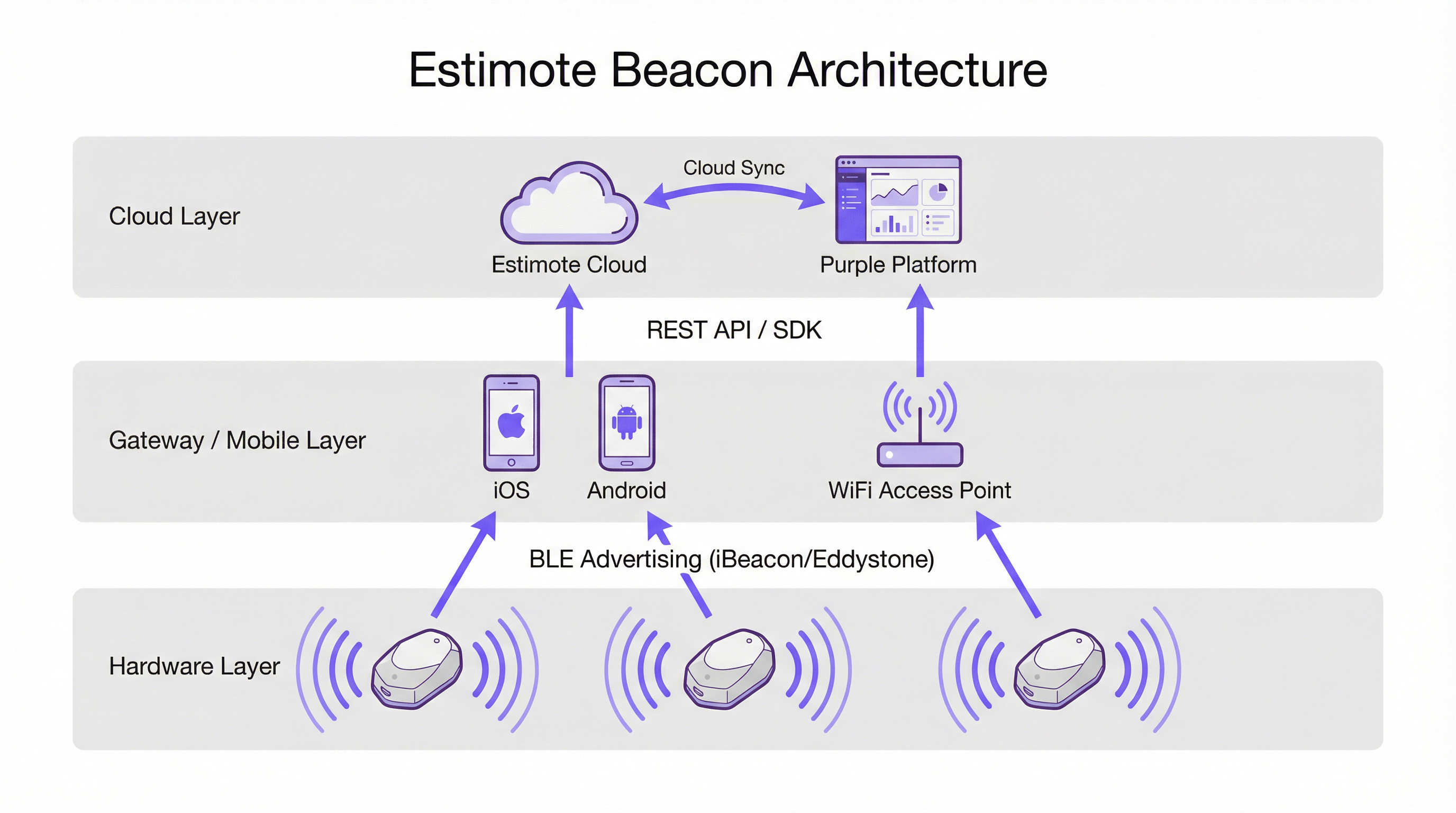
At its core, an Estimote beacon is a small, battery-powered computer that broadcasts a Bluetooth Low Energy (BLE) signal. This process, known as "undirected advertising," allows any BLE-enabled device, such as a smartphone, to detect the beacon's presence without pairing or direct connection. The beacon transmits a small data packet at regular intervals, containing an identifier that a mobile application can recognize and act upon. This one-to-many communication model is highly efficient and forms the basis of all beacon-based proximity solutions.
Protocols: iBeacon and Eddystone
Two primary protocols govern beacon communications: Apple's iBeacon and Google's Eddystone. An Estimote beacon can broadcast either or both.
- iBeacon: Transmits a unique identifier composed of three parts: a UUID (Universally Unique Identifier), a Major value, and a Minor value. This hierarchical structure is ideal for mapping physical spaces. For example, a UUID can represent an entire organization, a Major value can represent a specific venue or floor, and a Minor value can identify a single beacon.
- Eddystone: An open-source protocol from Google that offers more flexibility. It defines several frame types, including Eddystone-UID (similar to iBeacon's identifier), Eddystone-URL (broadcasts a web address), and Eddystone-EID (an encrypted, ephemeral identifier that changes periodically, enhancing security and privacy).
Hardware and Performance
Estimote's current generation of Proximity Beacons operates on Bluetooth 5.0, offering a theoretical maximum range of up to 100 meters. However, for practical indoor wayfinding, the transmission power is configured for much shorter ranges to ensure accuracy and prevent signal bleed between floors. Powered by two standard AA batteries, these beacons can achieve a lifespan of 3-5 years, depending on the advertising interval and transmission power settings. This long operational life is a critical factor in reducing the total cost of ownership (TCO) for large-scale deployments.
The Estimote Product Family
Estimote offers a range of hardware tailored to specific use cases:
| Product Line | Key Features & Use Cases |
|---|---|
| Proximity Beacons | The standard workhorse for wayfinding and proximity marketing. |
| LTE Beacons | Integrated cellular (LTE-M/NB-IoT) and GPS for indoor/outdoor asset tracking without a smartphone intermediary. |
| UWB Tags | Utilizes Ultra-Wideband technology for inch-level positioning accuracy, ideal for high-precision asset tracking and collision avoidance. |
| Mirror Beacons | Connects to digital displays to show content triggered by nearby beacons or users. |
Implementation Guide
A successful beacon deployment hinges on meticulous planning and disciplined execution. The following steps provide a vendor-neutral blueprint for IT teams.
Step 1: Site Survey and Beacon Placement
Before any hardware is installed, a thorough site survey is mandatory. Physical obstructions like concrete pillars, metal shelving, and elevator shafts significantly attenuate BLE signals. Use a tool like IndoorAtlas to map signal propagation and identify optimal beacon locations.
Best Practices for Placement:
- Height: Mount beacons 8-10 feet from the floor to avoid tampering and minimize signal obstruction.
- Key Locations: Place beacons at all elevator banks, entrances/exits, floor transition points, and major corridor intersections.
- Range Configuration: This is the most critical configuration step. A misconfigured transmission power is the leading cause of poor performance.
- Entrances & Elevators: Set range to ~50 feet (-12dBm).
- Long Corridors: Set range to ~100 feet (-4dBm).
- Open Atriums/Glass Walls: Reduce range to ~22 feet (-20dBm) to prevent signal bleed between floors.
Step 2: Beacon Configuration
Discipline in configuration prevents troubleshooting headaches later. All beacons within a deployment should share a common configuration profile.
Configuration Parameters:
- UUID: Assign a single, unique UUID for your entire organization.
- Major/Minor: Use the Major value to denote the floor number (e.g., 1 for 1st floor, 99 for basement). Use the Minor value as a unique sequential number for each beacon on that floor.
- Advertising Interval: For wayfinding, an interval of 300-500ms is recommended. A 300ms interval provides a responsive user experience with a manageable impact on battery life.
- Packet Types: Disable any advertising packets not required for your use case (e.g., disable Estimote-specific packets if you are only using iBeacon for a Purple deployment).
Step 3: Fleet Management
For any deployment exceeding a few dozen beacons, manual configuration is not scalable. Leverage the Estimote Cloud and its Bulk Updater tool to apply configuration changes to hundreds or thousands of devices simultaneously. Establish a process for monitoring battery life (available via the Estimote SDK and Cloud API) and for applying firmware updates, which often contain critical security patches and performance improvements.
Best Practices
- Document Everything: Physically label each beacon with its Major and Minor values before installation. Maintain a corresponding digital map that links beacon IDs to their precise physical locations.
- Prioritize Security: For sensitive applications, use the Eddystone-EID protocol with its rolling, encrypted identifiers. This prevents malicious actors from spoofing your beacons or tracking users without authorization.
- Ensure Compliance (GDPR/PCI DSS): Beacon deployments that process personal data fall under the scope of GDPR. Ensure you have an explicit, opt-in consent mechanism within your mobile application. For retail environments, ensure your beacon infrastructure and associated applications do not compromise PCI DSS compliance by mishandling payment card data.
- Integrate with Analytics: The true ROI of a beacon deployment is realized through data. Integrate beacon location data with an analytics platform like Purple to measure dwell times, analyze foot traffic patterns, and quantify the impact of proximity marketing campaigns.
Troubleshooting & Risk Mitigation
- Inaccurate Floor Detection: This is almost always caused by signal bleed. The primary mitigation is to reduce the transmission power (range) of beacons in open areas and near floor transitions. A proper site survey is the best preventative measure.
- Poor Location Accuracy: If the "blue dot" is lagging or jumping, decrease the advertising interval (e.g., from 500ms to 300ms) to provide more frequent location updates to the mobile app. Also, verify beacon placement and density against the site survey.
- Battery Drain: If batteries are depleting faster than the projected 3-5 years, review the beacon configuration. An overly aggressive advertising interval (e.g., 100ms) or excessively high transmission power are the most common culprits.
ROI & Business Impact
The business case for Estimote beacons is built on measurable improvements to customer experience and operational efficiency.
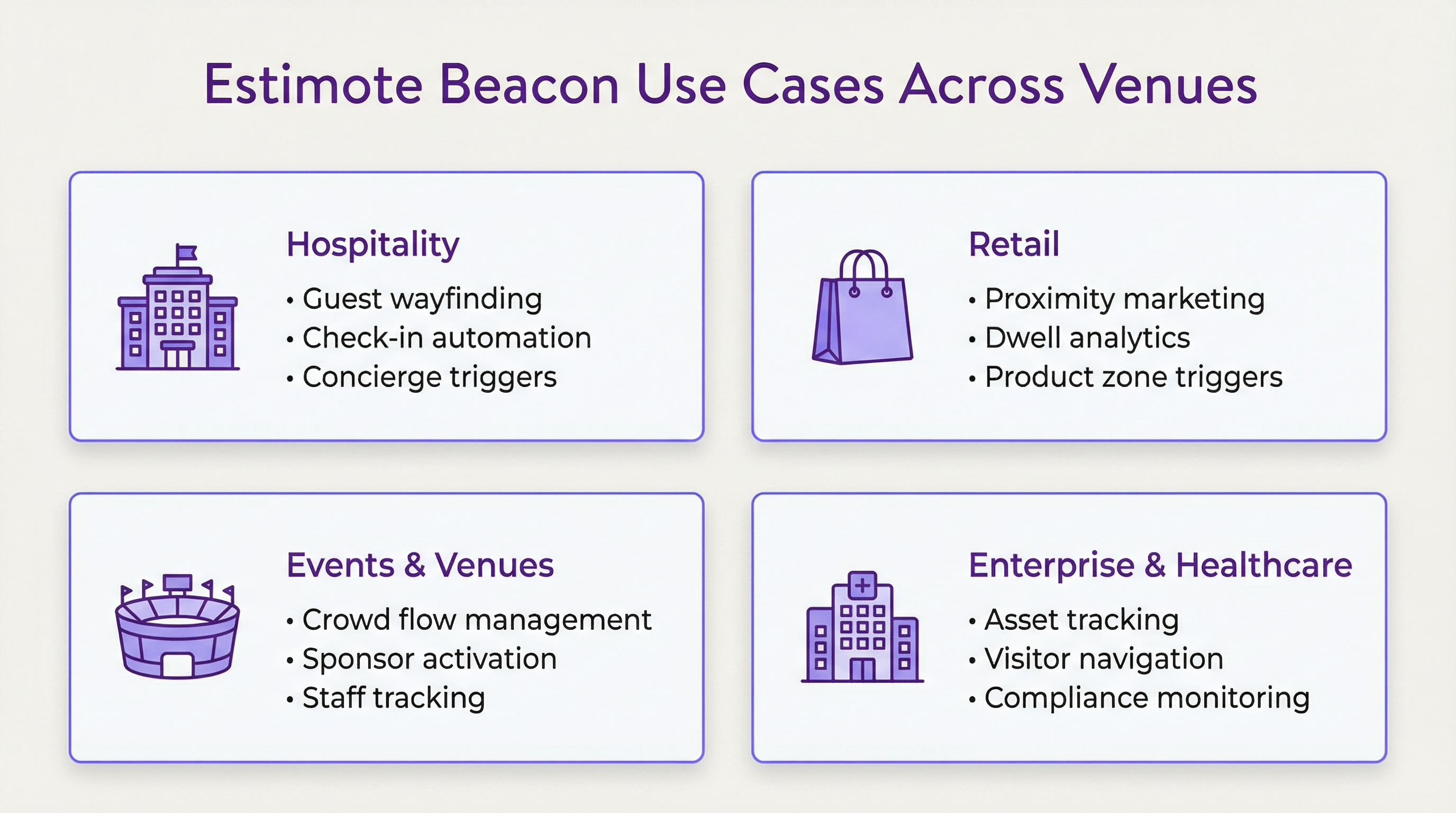
- Hospitality: A hotel can use beacons to enable seamless mobile check-in, provide turn-by-turn navigation to a guest's room, and push targeted offers for spa services or restaurant reservations as a guest walks by. The ROI is measured in increased guest satisfaction scores (NPS), higher ancillary revenue, and improved staff efficiency.
- Retail: A retailer can analyze in-store customer journeys, measure dwell time in specific departments, and trigger personalized promotions when a loyalty program member enters a high-value product zone. The ROI is measured in increased basket size, improved conversion rates, and higher customer lifetime value.
- Large Venues (Stadiums/Airports): Beacons power wayfinding to seats or gates, facilitate crowd flow management, and enable location-based sponsor activations. The ROI is measured in reduced congestion, improved fan/traveler experience, and new revenue streams from location-aware advertising.
Key Terms & Definitions
Bluetooth Low Energy (BLE)
A power-efficient variant of the Bluetooth wireless standard, designed for Internet of Things (IoT) devices to communicate small amounts of data over short distances. Its low power consumption is what enables beacons to operate for years on small batteries.
IT teams will encounter BLE as the fundamental communication technology for all modern beacons. Understanding its range and power characteristics is crucial for designing a sustainable deployment.
iBeacon
Apple's protocol for BLE advertising. It structures the beacon's broadcast around a three-tiered identifier: UUID, Major, and Minor. It is the most widely supported protocol for indoor navigation on iOS devices.
This is a non-negotiable standard to support for any public-facing venue. If you want to provide wayfinding for iPhone users, your beacons must be broadcasting iBeacon packets.
Eddystone
Google's open-source alternative to iBeacon. It is more flexible, with multiple frame types including Eddystone-EID, which uses ephemeral (short-lived) identifiers to enhance security and privacy.
For enterprise deployments concerned with security or wanting to avoid vendor lock-in, Eddystone provides a powerful and flexible option. Eddystone-EID is a key feature for mitigating tracking and spoofing risks.
UUID (Universally Unique Identifier)
A 128-bit number used to identify information in computer systems. In the context of iBeacon, it serves as the top-level identifier for an organization or a specific app.
The UUID acts as a unique namespace for your beacon deployment. All beacons in your organization should be configured with the same UUID to ensure your app does not respond to beacons from other nearby businesses.
Advertising Interval
The frequency at which a beacon broadcasts its advertising packet. A shorter interval (e.g., 100ms) results in more responsive location updates but consumes more battery. A longer interval (e.g., 1000ms) conserves battery but can feel sluggish.
This is a critical trade-off that network architects must balance. For active wayfinding, 300-500ms is the sweet spot. For passive asset tracking, the interval can be much longer.
Transmission Power (Tx Power)
The signal strength of the beacon's broadcast, measured in dBm. This setting directly controls the beacon's range. A higher Tx Power (e.g., +4dBm) means longer range, while a lower Tx Power (e.g., -20dBm) means shorter range.
This is the primary tool for tuning a beacon network. Correctly setting Tx Power is the key to preventing signal bleed and ensuring accurate positioning. It is more important than physical beacon density in many cases.
Signal Bleed
The phenomenon where a beacon's signal is detected in an unintended area, most commonly on the floor above or below its actual location. It is the primary cause of inaccurate floor detection in wayfinding applications.
IT teams must actively design against signal bleed, especially in buildings with atriums or thin floors. The main mitigation strategy is to reduce the transmission power of beacons in problematic areas.
Ultra-Wideband (UWB)
A short-range radio technology that can measure location with very high precision (down to a few centimeters). It works by measuring the time-of-flight of radio signals between a tag and multiple anchors.
When an IT team is tasked with a use case that requires 'inch-level' or 'sub-meter' accuracy, such as tool tracking in manufacturing or collision avoidance, BLE is not sufficient. UWB is the appropriate technology for these high-precision requirements.
Case Studies
A 500-room luxury hotel in a dense urban environment wants to implement 'blue dot' wayfinding for guests from the lobby to their rooms, elevators, and amenities (pool, restaurant). The hotel has a large, three-story glass atrium at its center. What is the recommended Estimote beacon deployment strategy?
- Hardware Selection: Standard Estimote Proximity Beacons are sufficient for this use case.
- Site Survey: Conduct a mandatory site survey focusing on the glass atrium. Use a signal mapping tool to visualize BLE signal propagation and identify potential for inter-floor signal bleed.
- Beacon Placement & Configuration:
- Guest Corridors: Place one beacon every 50-75 feet, mounted 8-10 feet high. Configure with a -8dBm transmit power (approx. 100ft range) and a 400ms advertising interval.
- Elevator Banks: Place one beacon at each elevator bank on every floor. Configure with a -12dBm transmit power (approx.50ft range) to ensure the signal is localized to the waiting area.
- Atrium: This is the critical zone. Place beacons around the perimeter of the atrium on each floor. Configure them with a significantly lower transmit power, such as -20dBm (approx. 22ft range), to prevent signals from reaching the floors above and below. The advertising interval can be increased to 600ms as fine-grained accuracy is less critical in this open space.
- Naming Convention: Use the hotel's unique UUID. Set Major to the floor number (e.g., 1, 2, 3...). Assign sequential Minor values for each beacon on that floor. Physically label each beacon.
- Fleet Management: Use the Estimote Cloud to bulk-configure all beacons and monitor battery life post-deployment.
A retail chain with 200 stores wants to track high-value assets (e.g., portable payment terminals, specialized scanning equipment) that move between the stockroom and the sales floor. The assets sometimes leave the store for sidewalk sales events. What is the optimal Estimote solution?
- Hardware Selection: The ideal solution is the Estimote LTE Beacon. Its integrated cellular connectivity and GPS make it perfect for tracking assets both indoors and outdoors, without relying on the store's Wi-Fi or nearby smartphones.
- Deployment: Attach one LTE Beacon to each high-value asset. No complex beacon infrastructure is required within the store itself.
- Cloud Configuration: In the Estimote Cloud, configure the LTE Beacons to report their location at a set interval (e.g., every 5 minutes when stationary, every 1 minute when in motion). Set up geofences for each store location.
- Application Integration: Use the Estimote Cloud API to pull location data for each asset into the retailer's central inventory management system. Configure API-triggered alerts for specific events:
- An alert is sent to the store manager if an asset's battery level drops below 20%.
- An alert is sent if an asset leaves the store's geofence outside of a scheduled sidewalk sale event.
- ROI Measurement: The ROI is calculated by the reduction in lost or stolen assets, the decrease in time spent by staff searching for equipment, and the improved availability of revenue-generating devices like payment terminals.
Scenario Analysis
Q1. Your stadium client wants to use beacons to track the real-time location of mobile food and beverage carts to optimize stock levels and deployment. The carts move throughout the stadium, including outdoor plaza areas. Which Estimote product is the best fit and why?
💡 Hint:Consider the need for tracking both indoors and outdoors, without relying on the stadium's public Wi-Fi or guest smartphones.
Show Recommended Approach
The Estimote LTE Beacon is the best fit. Its built-in cellular (LTE-M) and GPS capabilities allow it to report its location independently from anywhere in the stadium, whether inside the concourse or outside in the plaza. Standard proximity beacons would not work reliably as they depend on a nearby smartphone with a specific app to relay their location, and UWB would be overkill and too complex for this wide-area tracking use case.
Q2. A hospital is deploying beacons for patient wayfinding. During testing, they find that when patients are in the central atrium, the app frequently switches between showing them on the 2nd and 3rd floors. What are the two most likely causes and the primary solution?
💡 Hint:Think about how BLE signals behave in large, open, multi-story spaces.
Show Recommended Approach
The two most likely causes are: 1) The transmission power (range) of the beacons around the atrium is set too high. 2) The beacons are placed in locations that allow for a clear, unobstructed line of sight between floors. The primary solution is to significantly reduce the transmission power of the beacons located in and around the atrium to a very short range (e.g., -20dBm) to create a tight signal bubble on each floor and prevent this inter-floor 'signal bleed'.
Q3. A retail CTO is concerned about the privacy implications of a beacon deployment under GDPR. They ask if beacons are "tracking our customers' phones." How would you accurately describe the data flow to reassure them?
💡 Hint:Focus on where the 'intelligence' lies in the system and the role of user consent.
Show Recommended Approach
You should clarify that the beacons themselves do not track anyone. They are simple, one-way broadcast devices, like a lighthouse. They have no knowledge of who is nearby. The tracking event occurs at the application layer, on the customer's own phone, and only if they have explicitly opted-in and granted the app location permissions. The app detects the beacon's signal and then reports the phone's proximity to that beacon to the cloud. The entire process is user-initiated and consent-driven, which is a key principle of GDPR. Furthermore, using protocols like Eddystone-EID can encrypt the beacon's identifier, adding another layer of privacy.
Key Takeaways
- ✓Estimote beacons are low-power, battery-operated devices that broadcast BLE signals to enable indoor positioning and proximity-based actions.
- ✓Successful deployment requires a thorough site survey to plan beacon placement and prevent signal bleed, especially in open, multi-story areas.
- ✓Configuration discipline is key: use a consistent UUID, logical Major/Minor assignments, and an appropriate advertising interval (300-500ms for wayfinding).
- ✓For indoor/outdoor asset tracking, Estimote LTE Beacons with integrated cellular/GPS are the optimal solution, removing dependency on smartphones.
- ✓For high-precision (inch-level) tracking, Ultra-Wideband (UWB) tags are the appropriate technology, not standard BLE beacons.
- ✓Compliance with GDPR requires an explicit opt-in consent model within the mobile application; the beacons themselves do not store or process personal data.
- ✓The ROI of a beacon deployment is realized by integrating location data with analytics platforms to measure improvements in customer experience, operational efficiency, and revenue.




