

802.1X प्रमाणीकरण: आधुनिक डिवाइस पर नेटवर्क एक्सेस सुरक्षित करना
This guide provides a comprehensive, actionable overview of IEEE 802.1X authentication for senior IT professionals and network architects. It details the critical steps for securing network access across diverse enterprise environments, focusing on practical, vendor-neutral deployment guidance to mitigate risk, ensure compliance, and deliver a seamless, secure user experience.
🎧 Listen to this Guide
View Transcript
कार्यकारी सारांश
यह गाइड वरिष्ठ IT पेशेवरों और नेटवर्क आर्किटेक्ट्स के लिए IEEE 802.1X प्रमाणीकरण का एक व्यापक और कार्रवाई योग्य अवलोकन प्रदान करती है। यह हॉस्पिटैलिटी और रिटेल से लेकर बड़े पैमाने के सार्वजनिक स्थानों तक—विभिन्न एंटरप्राइज़ परिवेशों में नेटवर्क एक्सेस को सुरक्षित करने के महत्वपूर्ण चरणों का विवरण देती है। हम जोखिम को कम करने, PCI DSS और GDPR जैसे मानकों के अनुपालन को सुनिश्चित करने, और iOS और Android सहित आधुनिक डिवाइस पर एक निर्बाध, सुरक्षित उपयोगकर्ता अनुभव प्रदान करने पर केंद्रित व्यावहारिक, वेंडर-न्यूट्रल डिप्लॉयमेंट मार्गदर्शन प्रदान करने के लिए अकादमिक सिद्धांत से आगे बढ़ते हैं। 802.1X का लाभ उठाकर, संगठन कमज़ोर प्री-शेयर्ड कीज़ (pre-shared keys) को मज़बूत, पहचान-आधारित एक्सेस कंट्रोल से बदल सकते हैं, जिससे यह सुनिश्चित होता है कि केवल अधिकृत और विश्वसनीय डिवाइस ही कॉर्पोरेट नेटवर्क संसाधनों से कनेक्ट हो सकें। यह दस्तावेज़ एक सफल 802.1X कार्यान्वयन की योजना बनाने और उसे निष्पादित करने के लिए एक रणनीतिक संदर्भ के रूप में कार्य करता है, जिसमें आर्किटेक्चर, EAP विधि चयन, प्रमाणपत्र प्रबंधन और ROI विश्लेषण शामिल हैं, ताकि आपको ऐसे सूचित निर्णय लेने में मदद मिल सके जो आपकी सुरक्षा स्थिति को बढ़ाते हैं और व्यावसायिक उद्देश्यों का समर्थन करते हैं।
तकनीकी डीप-डाइव
IEEE 802.1X मानक ईथरनेट और 802.11 वायरलेस नेटवर्क के लिए प्रमाणित नेटवर्क एक्सेस प्रदान करने के लिए पोर्ट-आधारित नेटवर्क एक्सेस कंट्रोल (PNAC) तंत्र को परिभाषित करता है। यह पुराने सुरक्षा प्रोटोकॉल से एक बुनियादी बदलाव का प्रतिनिधित्व करता है, जो अक्सर सभी उपयोगकर्ताओं के लिए एक ही साझा पासवर्ड (प्री-शेयर्ड की या PSK) पर निर्भर होते थे। एक 802.1X फ्रेमवर्क उपयोगकर्ता या डिवाइस को IP एड्रेस असाइन किए जाने और नेटवर्क तक एक्सेस दिए जाने से पहले प्रमाणित करता है, जिससे प्रवेश बिंदु पर एक शक्तिशाली सुरक्षा सीमा बन जाती है。
आर्किटेक्चर तीन प्राथमिक घटकों से बना है:
- सप्लिकेंट (Supplicant): नेटवर्क से कनेक्ट होने का प्रयास करने वाला क्लाइंट डिवाइस (उदा., लैपटॉप, स्मार्टफोन, या IoT डिवाइस)। सप्लिकेंट क्लाइंट डिवाइस पर मौजूद वह सॉफ़्टवेयर है जो ऑथेंटिकेटर को क्रेडेंशियल्स प्रदान करता है।
- ऑथेंटिकेटर (Authenticator): वह नेटवर्क डिवाइस जो नेटवर्क के एक्सेस को नियंत्रित करता है, आमतौर पर एक वायरलेस एक्सेस पॉइंट (AP) या स्विच। ऑथेंटिकेटर एक मध्यस्थ के रूप में कार्य करता है, जो सप्लिकेंट और ऑथेंटिकेशन सर्वर के बीच प्रमाणीकरण संदेशों को पास करता है।
- ऑथेंटिकेशन सर्वर (AS): केंद्रीकृत सर्वर जो सप्लिकेंट के क्रेडेंशियल्स को मान्य करता है और एक्सेस देने या अस्वीकार करने का अंतिम निर्णय लेता है। लगभग सभी एंटरप्राइज़ डिप्लॉयमेंट में, यह भूमिका RADIUS (रिमोट ऑथेंटिकेशन डायल-इन यूज़र सर्विस) सर्वर द्वारा पूरी की जाती है।
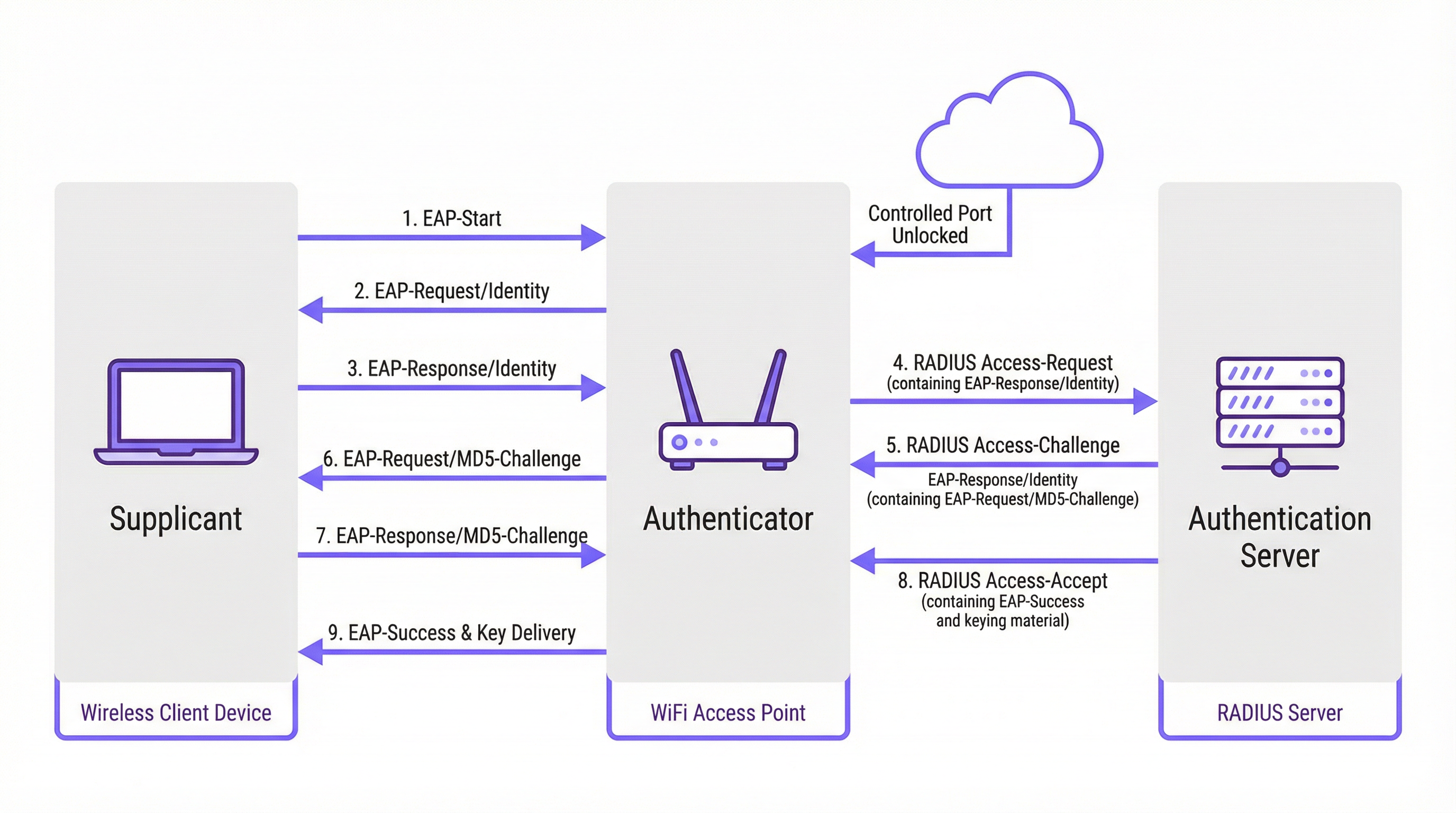
प्रमाणीकरण प्रक्रिया एक्सटेंसिबल ऑथेंटिकेशन प्रोटोकॉल (EAP) द्वारा संचालित एक संरचित संदेश विनिमय का पालन करती है। EAP एक लचीला फ्रेमवर्क है जो विभिन्न प्रमाणीकरण विधियों (EAP प्रकारों) का समर्थन करता है, जिससे संगठनों को अपनी सुरक्षा आवश्यकताओं और मौजूदा बुनियादी ढांचे के लिए सबसे उपयुक्त विधि चुनने की अनुमति मिलती है।
EAP विधियों की तुलना
सही EAP विधि चुनना एक महत्वपूर्ण डिप्लॉयमेंट निर्णय है। आधुनिक एंटरप्राइज़ नेटवर्क में उपयोग की जाने वाली प्राथमिक विधियाँ EAP-TLS, PEAP और EAP-TTLS हैं।
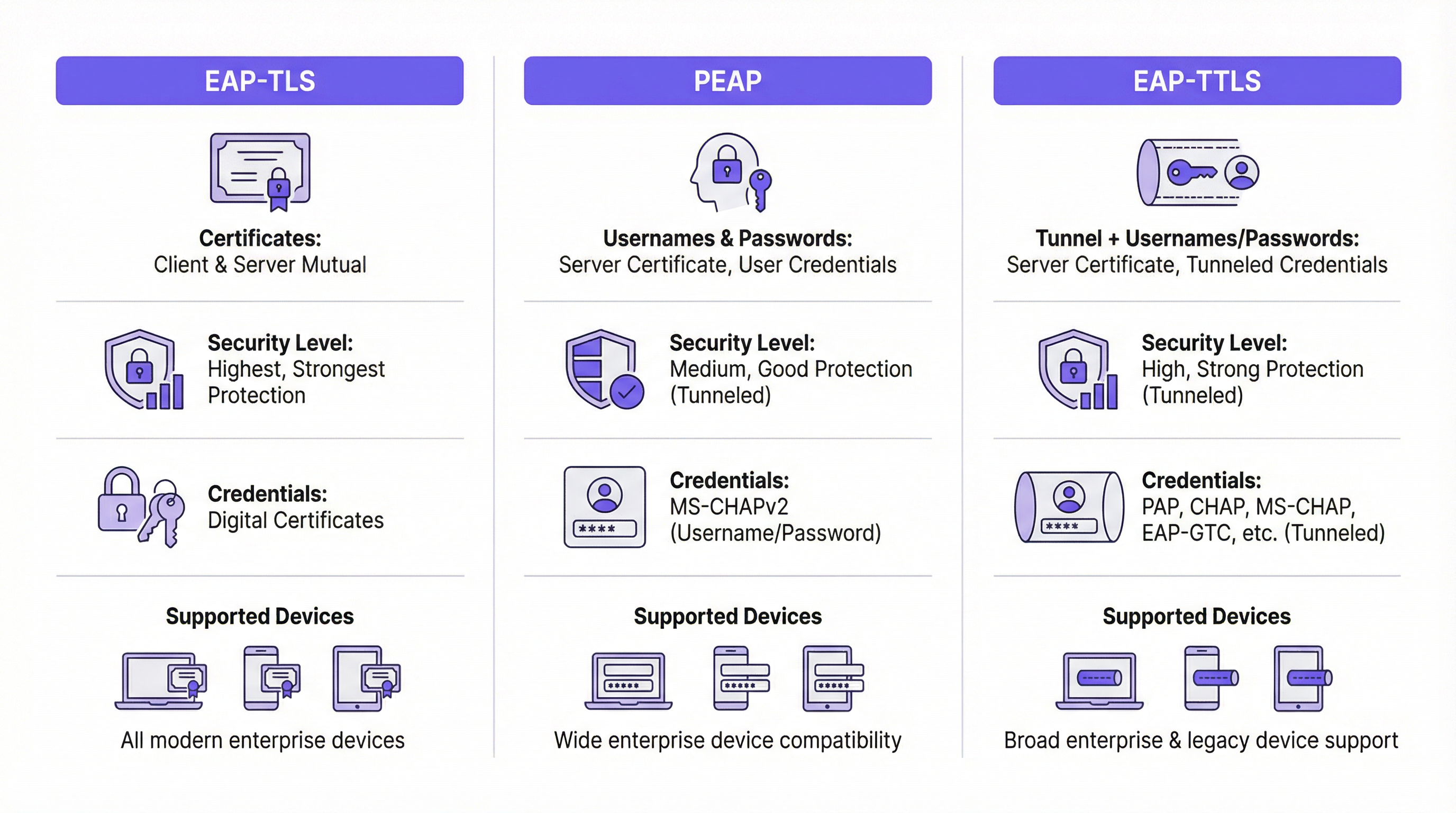
| विशेषता | EAP-TLS (ट्रांसपोर्ट लेयर सिक्योरिटी) | PEAP (प्रोटेक्टेड EAP) | EAP-TTLS (टनल्ड TLS) |
|---|---|---|---|
| सुरक्षा स्तर | सर्वोच्च। पारस्परिक प्रमाणपत्र-आधारित प्रमाणीकरण प्रदान करता है। | उच्च। TLS टनल के भीतर क्रेडेंशियल एक्सचेंज को एन्क्रिप्ट करता है। | उच्च। PEAP के समान, क्रेडेंशियल एक्सचेंज को एन्क्रिप्ट करता है। |
| क्रेडेंशियल्स | क्लाइंट और सर्वर डिजिटल प्रमाणपत्र | सर्वर प्रमाणपत्र, उपयोगकर्ता क्रेडेंशियल्स (उदा., यूज़रनेम/पासवर्ड) | सर्वर प्रमाणपत्र, उपयोगकर्ता क्रेडेंशियल्स (अधिक लचीले विकल्प) |
| जटिलता | उच्च। सभी डिवाइस के लिए प्रमाणपत्र प्रबंधित करने हेतु पब्लिक की इन्फ्रास्ट्रक्चर (PKI) की आवश्यकता होती है। | मध्यम। मौजूदा डायरेक्टरी क्रेडेंशियल्स (उदा., एक्टिव डायरेक्टरी) का लाभ उठाता है। | मध्यम। PEAP के समान लेकिन प्रमाणीकरण प्रोटोकॉल के लिए अधिक लचीलापन प्रदान करता है। |
| उपयोग का मामला (Use Case) | कॉर्पोरेट-स्वामित्व वाले डिवाइस जहाँ MDM के माध्यम से प्रमाणपत्र डिप्लॉयमेंट को स्वचालित किया जा सकता है। उच्च-सुरक्षा परिवेश। | BYOD और कॉर्पोरेट परिवेश जहाँ यूज़रनेम/पासवर्ड प्रमाणीकरण को प्राथमिकता दी जाती है। | क्लाइंट ऑपरेटिंग सिस्टम (उदा., macOS, Linux) के मिश्रण वाले विविध परिवेश। |
EAP-TLS को व्यापक रूप से 802.1X सुरक्षा के लिए स्वर्ण मानक (gold standard) माना जाता है। इसमें क्लाइंट और सर्वर दोनों के पास डिजिटल प्रमाणपत्र होना आवश्यक है, जो पारस्परिक प्रमाणीकरण को सक्षम करता है। यह पासवर्ड-आधारित हमलों के जोखिम को समाप्त करता है, लेकिन प्रत्येक क्लाइंट डिवाइस पर प्रमाणपत्र को डिप्लॉय और प्रबंधित करने का ओवरहेड पेश करता है।
PEAP एंटरप्राइज़ परिवेशों में सबसे आम EAP प्रकार है। यह केवल ऑथेंटिकेशन सर्वर पर प्रमाणपत्र की आवश्यकता के द्वारा डिप्लॉयमेंट को सरल बनाता है। क्लाइंट सर्वर की पहचान को सत्यापित करता है और फिर एक एन्क्रिप्टेड TLS टनल बनाता है। इस टनल के अंदर, क्लाइंट कम जटिल विधियों, आमतौर पर MS-CHAPv2 (यूज़रनेम और पासवर्ड) का उपयोग करके प्रमाणित करता है। सुरक्षित होने के बावजूद, यह अभी भी फ़िशिंग हमलों के प्रति संवेदनशील है यदि उपयोगकर्ताओं को वैध दिखने वाले सर्वर प्रमाणपत्र के साथ किसी दुष्ट (rogue) AP से कनेक्ट करने के लिए धोखा दिया जाता है।
EAP-TTLS कार्यात्मक रूप से PEAP के समान है लेकिन अधिक लचीलापन प्रदान करता है। यह भी एक TLS टनल बनाता है लेकिन आंतरिक प्रमाणीकरण प्रोटोकॉल की एक विस्तृत श्रृंखला की अनुमति देता है, जैसे कि PAP, CHAP, या EAP-MD5, जो इसे पुराने सिस्टम या विविध क्लाइंट प्रकारों वाले परिवेशों के लिए एक बहुमुखी विकल्प बनाता है।
कार्यान्वयन गाइड
एक सफल 802.1X डिप्लॉयमेंट के लिए सावधानीपूर्वक योजना और चरणबद्ध निष्पादन की आवश्यकता होती है। निम्नलिखित चरण एक वेंडर-न्यूट्रल रोडमैप प्रदान करते हैं।
चरण 1: इन्फ्रास्ट्रक्चर और योजना
- अपना RADIUS सर्वर चुनें: एक ऐसा RADIUS सर्वर चुनें जो आपके मौजूदा इन्फ्रास्ट्रक्चर के अनुकूल हो। Windows-केंद्रित परिवेशों के लिए Microsoft का नेटवर्क पॉलिसी सर्वर (NPS) एक आम विकल्प है, जबकि FreeRADIUS जैसे ओपन-सोर्स विकल्प अत्यधिक लचीले हैं। क्लाउड-आधारित RADIUS सेवाएँ भी अपनी स्केलेबिलिटी और कम प्रबंधन ओवरहेड के कारण तेज़ी से लोकप्रिय हो रही हैं।
- अपनी EAP विधि चुनें: उपरोक्त तुलना के आधार पर, वह EAP विधि चुनें जो आपकी सुरक्षा आवश्यकताओं, उपयोगकर्ता आधार और प्रशासनिक क्षमताओं को सबसे अच्छी तरह संतुलित करती हो। अधिकांश कॉर्पोरेट परिवेशों के लिए, PEAP एक मज़बूत संतुलन प्रदान करता है। उच्च-सुरक्षा डिप्लॉयमेंट के लिए, EAP-TLS अनुशंसित मार्ग है。
- अपनी प्रमाणपत्र रणनीति की योजना बनाएँ: यह सबसे महत्वपूर्ण कदम है। PEAP या EAP-TTLS के लिए, आपको अपने RADIUS सर्वर के लिए एक सर्वर प्रमाणपत्र की आवश्यकता होगी। यह प्रमाणपत्र एक विश्वसनीय सार्वजनिक प्रमाणपत्र प्राधिकरण (CA) द्वारा जारी किया जाना चाहिए। स्व-हस्ताक्षरित (self-signed) प्रमाणपत्र का उपयोग करने से सभी क्लाइंट डिवाइस पर सुरक्षा चेतावनियाँ आएँगी, जिससे उपयोगकर्ता का विश्वास और सुरक्षा कमज़ोर होगी।
चरण 2: कॉन्फ़िगरेशन
- RADIUS सर्वर कॉन्फ़िगर करें: अपना चुना हुआ RADIUS सर्वर इंस्टॉल और कॉन्फ़िगर करें। इसमें शामिल है:
- सर्वर प्रमाणपत्र इंस्टॉल करना।
- RADIUS क्लाइंट (आपके एक्सेस पॉइंट और स्विच) को परिभाषित करना।
- आने वाले अनुरोधों को प्रोसेस करने के लिए कनेक्शन रिक्वेस्ट पॉलिसी बनाना।
- नेटवर्क पॉलिसी बनाना जो प्रमाणीकरण के लिए शर्तें, बाधाएँ और सेटिंग्स परिभाषित करती हैं। उदाहरण के लिए, एक पॉलिसी यह बता सकती है कि केवल एक विशिष्ट एक्टिव डायरेक्टरी समूह के सदस्यों को ही कनेक्ट करने की अनुमति है।
- ऑथेंटिकेटर (वायरलेस APs/स्विच) कॉन्फ़िगर करें:
- अपने वायरलेस LAN कंट्रोलर या व्यक्तिगत एक्सेस पॉइंट्स को अपने RADIUS सर्वर के IP एड्रेस और शेयर्ड सीक्रेट के साथ कॉन्फ़िगर करें।
- 802.1X को समर्पित एक नया WLAN/SSID बनाएँ। मौजूदा PSK या ओपन नेटवर्क पर 802.1X चलाने का प्रयास न करें।
- सुनिश्चित करें कि SSID को WPA2-Enterprise या WPA3-Enterprise के लिए कॉन्फ़िगर किया गया है।
चरण 3: क्लाइंट ऑनबोर्डिंग और डिप्लॉयमेंट
- कॉर्पोरेट डिवाइस: कॉर्पोरेट-स्वामित्व वाले डिवाइस को स्वचालित रूप से कॉन्फ़िगर करने के लिए मोबाइल डिवाइस मैनेजमेंट (MDM) या ग्रुप पॉलिसी (GPO) समाधान का उपयोग करें। MDM/GPO वायरलेस नेटवर्क प्रोफ़ाइल को डिवाइस पर पुश कर सकता है, जिसमें SSID, EAP प्रकार और कोई भी आवश्यक CA प्रमाणपत्र शामिल हैं। यह अंतिम उपयोगकर्ता के लिए एक ज़ीरो-टच अनुभव प्रदान करता है।
- BYOD (ब्रिंग योर ओन डिवाइस): व्यक्तिगत डिवाइस को ऑनबोर्ड करना अधिक जटिल है। सबसे अच्छा अभ्यास एक समर्पित ऑनबोर्डिंग समाधान का उपयोग करना है। ये समाधान एक अस्थायी, ओपन "ऑनबोर्डिंग" SSID प्रदान करते हैं। जब कोई उपयोगकर्ता कनेक्ट होता है, तो उन्हें एक Captive Portal पर रीडायरेक्ट किया जाता है जहाँ वे प्रमाणित कर सकते हैं और एक कॉन्फ़िगरेशन उपयोगिता या प्रोफ़ाइल डाउनलोड कर सकते हैं जो स्वचालित रूप से सुरक्षित 802.1X नेटवर्क के लिए उनके डिवाइस को सेट अप करता है।
सर्वोत्तम अभ्यास
- अपने नेटवर्क को सेगमेंट करें: RADIUS विशेषताओं के आधार पर डायनामिक VLAN असाइनमेंट का उपयोग करें। यह आपको विभिन्न उपयोगकर्ता समूहों (उदा., कर्मचारी, ठेकेदार, अतिथि) को अलग-अलग एक्सेस नीतियों के साथ विभिन्न VLAN में रखने की अनुमति देता है, भले ही वे एक ही SSID से कनेक्ट हों।
- हमेशा सार्वजनिक रूप से विश्वसनीय प्रमाणपत्र का उपयोग करें: आपके RADIUS सर्वर पर सार्वजनिक प्रमाणपत्र का उपयोग करने के महत्व को कम करके नहीं आंका जा सकता। यह क्लाइंट के विश्वास की आधारशिला है और मैन-इन-द-मिडिल हमलों को रोकता है।
- निगरानी और लॉग: RADIUS प्रमाणीकरण लॉग की सक्रिय रूप से निगरानी करें। यह कनेक्शन समस्याओं के निवारण और सुरक्षा ऑडिटिंग के लिए अमूल्य है। विफल प्रमाणीकरण प्रयास संभावित हमले का प्रारंभिक संकेतक हो सकते हैं।
- WPA3-Enterprise को प्राथमिकता दें: जहाँ आपके हार्डवेयर और क्लाइंट द्वारा समर्थित हो, WPA3-Enterprise WPA2-Enterprise की तुलना में महत्वपूर्ण सुरक्षा संवर्द्धन प्रदान करता है, जिसमें डी-ऑथेंटिकेशन हमलों को रोकने के लिए प्रोटेक्टेड मैनेजमेंट फ्रेम्स (PMF) शामिल हैं।
समस्या निवारण और जोखिम न्यूनीकरण
| सामान्य समस्या | कारण | न्यूनीकरण रणनीति |
|---|---|---|
| कनेक्शन विफल | क्लाइंट और सर्वर के बीच EAP प्रकारों में बेमेल। गलत RADIUS शेयर्ड सीक्रेट। फ़ायरवॉल RADIUS पोर्ट (UDP 1812/1813) को ब्लॉक कर रहा है। | क्लाइंट और सर्वर दोनों पर EAP सेटिंग्स सत्यापित करें। AP और RADIUS सर्वर पर शेयर्ड सीक्रेट की दोबारा जाँच करें। सुनिश्चित करें कि फ़ायरवॉल RADIUS ट्रैफ़िक की अनुमति देते हैं। |
| प्रमाणपत्र चेतावनियाँ | RADIUS सर्वर स्व-हस्ताक्षरित या अविश्वसनीय प्रमाणपत्र का उपयोग कर रहा है। | स्व-हस्ताक्षरित प्रमाणपत्र को किसी विश्वसनीय सार्वजनिक CA (उदा., DigiCert, Sectigo) के प्रमाणपत्र से बदलें। |
| धीमे कनेक्शन | RADIUS सर्वर अंडर-प्रोविज़न है या डायरेक्टरी सेवा के लिए उच्च विलंबता (latency) है। | RADIUS सर्वर के प्रदर्शन की निगरानी करें। RADIUS सर्वर और डोमेन कंट्रोलर के बीच कम-विलंबता कनेक्टिविटी सुनिश्चित करें। |
| फ़िशिंग/दुष्ट APs | उपयोगकर्ताओं को समान SSID प्रसारित करने वाले दुर्भावनापूर्ण AP से कनेक्ट करने के लिए धोखा दिया जाता है। | पासवर्ड समाप्त करने के लिए EAP-TLS का उपयोग करें। PEAP/EAP-TTLS के लिए, सुनिश्चित करें कि क्लाइंट सर्वर प्रमाणपत्र और नाम को मान्य करने के लिए कॉन्फ़िगर किए गए हैं। |
ROI और व्यावसायिक प्रभाव
हालाँकि 802.1X को लागू करने के लिए समय और संसाधनों में प्रारंभिक निवेश की आवश्यकता होती है, लेकिन निवेश पर प्रतिफल (ROI) महत्वपूर्ण है, विशेष रूप से बड़े पैमाने के स्थानों के लिए।
- उन्नत सुरक्षा स्थिति: एकल साझा पासवर्ड से अद्वितीय, प्रति-उपयोगकर्ता या प्रति-डिवाइस क्रेडेंशियल्स पर जाने से, आप अनधिकृत एक्सेस के जोखिम को नाटकीय रूप से कम करते हैं। डेटा उल्लंघनों को कम करने में यह एक महत्वपूर्ण कदम है।
- अनुपालन: PCI DSS, GDPR, या HIPAA के अधीन संगठनों के लिए, 802.1X यह प्रदर्शित करने के लिए एक प्रमुख नियंत्रण है कि आपने मज़बूत एक्सेस कंट्रोल उपाय लागू किए हैं। विफल ऑडिट या अनुपालन दंड की लागत डिप्लॉयमेंट की लागत से कहीं अधिक होती है।
- परिचालन दक्षता: ऑनबोर्डिंग को स्वचालित करने और डायनामिक VLAN का उपयोग करने से IT टीमों पर प्रशासनिक बोझ कम होता है। नए कर्मचारियों को उनके डायरेक्टरी समूह के आधार पर स्वचालित रूप से एक्सेस दिया जा सकता है, और हटाए जाने पर एक्सेस तुरंत रद्द कर दिया जाता है।
- बेहतर उपयोगकर्ता अनुभव: स्वचालित ऑनबोर्डिंग के साथ सही ढंग से डिप्लॉय किए जाने पर, 802.1X एक निर्बाध और सुरक्षित कनेक्शन अनुभव प्रदान करता है। उपयोगकर्ता बस अपना डिवाइस चालू करते हैं, और यह उन्हें पासवर्ड फिर से दर्ज करने की आवश्यकता के बिना कनेक्ट हो जाता है। यह Captive Portal या जटिल PSK की तुलना में एक महत्वपूर्ण सुधार है।
Key Terms & Definitions
RADIUS
Remote Authentication Dial-In User Service. A networking protocol that provides centralized Authentication, Authorization, and Accounting (AAA) management for users and devices that attempt to access a network service.
In an 802.1X context, the RADIUS server is the 'brain' of the operation. It's the server that checks the user's or device's credentials and tells the access point whether to grant or deny access. IT teams will spend most of their time configuring policies on the RADIUS server.
EAP
Extensible Authentication Protocol. An authentication framework, not a specific authentication mechanism. It provides a standardized way for clients and servers to negotiate an authentication method.
EAP is the language spoken between the client device, the access point, and the RADIUS server. Understanding that EAP is a framework helps explain why there are so many different 'types' of 802.1X (EAP-TLS, PEAP, etc.). The choice of EAP type is the most important decision in an 802.1X deployment.
Supplicant
The software on a client device (like a laptop or smartphone) that is responsible for responding to the authenticator's requests for credentials.
The supplicant is built into modern operating systems like Windows, macOS, iOS, and Android. IT teams rarely interact with the supplicant directly, but they configure it via network profiles, telling it which EAP type to use and which server to trust.
Authenticator
The network device that acts as a gatekeeper, blocking or allowing traffic from the supplicant. In a wireless network, this is the access point (AP).
The authenticator doesn't make the authentication decision itself. It's a middleman that simply passes EAP messages between the supplicant and the authentication server. Its primary job is to enforce the decision made by the RADIUS server.
PKI
Public Key Infrastructure. A set of roles, policies, hardware, software, and procedures needed to create, manage, distribute, use, store, and revoke digital certificates.
A PKI is essential for deploying EAP-TLS, the most secure form of 802.1X. While the term sounds intimidating, a basic PKI can be set up using Microsoft Active Directory Certificate Services or a cloud-based service. It's the foundation for a certificate-based security model.
MDM
Mobile Device Management. Software that allows IT administrators to control, secure, and enforce policies on smartphones, tablets, and other endpoints.
MDM is the key to a scalable and seamless 802.1X deployment for corporate-owned devices. IT teams use the MDM to automatically push the WiFi profile and client certificate to devices, meaning users can connect securely with zero manual configuration.
Dynamic VLAN Assignment
A feature that allows the RADIUS server to assign a user or device to a specific VLAN based on their identity or group membership.
This is a powerful tool for network segmentation. Instead of having multiple SSIDs for different user groups, you can have one secure SSID. The RADIUS server then places employees in the corporate VLAN, guests in the guest VLAN, and IoT devices in their own isolated VLAN, all based on the credentials they present.
WPA3-Enterprise
The latest generation of Wi-Fi security for enterprise networks, building on WPA2-Enterprise by adding stronger encryption and protection against de-authentication attacks.
When procuring new network hardware, IT managers should ensure it supports WPA3-Enterprise. It provides a significant security uplift over its predecessor and is a key component of a modern, secure wireless infrastructure. It's the 'Enterprise' version that integrates with 802.1X.
Case Studies
A 500-room luxury hotel needs to provide secure WiFi for staff (on corporate-issued tablets) and a separate, seamless experience for guests. The hotel must comply with PCI DSS due to its payment systems.
Staff Network: Implement an 802.1X EAP-TLS network. Deploy a RADIUS server and an internal Certificate Authority (or use a cloud PKI service). Use an MDM to automatically provision the corporate tablets with client certificates and the WPA2/WPA3-Enterprise network profile. This provides the highest level of security for devices handling sensitive operational data. Guest Network: Implement a separate SSID using a captive portal with a straightforward, time-limited voucher or social login. This network should be completely isolated from the staff and PCI networks using VLANs and firewall rules. This approach balances high security for corporate assets with ease of use for transient guests.
A large retail chain with 200 stores needs to secure its in-store network, which is used by Point-of-Sale (POS) terminals, employee-used handheld inventory scanners, and a guest WiFi network.
POS & Inventory Scanners: Deploy a single, hidden SSID using 802.1X EAP-TLS. Since these are corporate-controlled devices, certificates can be pre-loaded before deployment. Use MAC Authentication Bypass (MAB) as a fallback for legacy devices that may not support 802.1X, but this should be an exception. Assign this network to a secure, firewalled VLAN that only allows traffic to the payment processor and inventory management servers. Guest WiFi: Deploy a separate, public-facing SSID with a branded captive portal that requires acceptance of terms and conditions. This network must be completely isolated from the secure store network.
Scenario Analysis
Q1. Your CFO is concerned about the cost of a commercial certificate for the RADIUS server and suggests using a self-signed certificate from your internal Windows CA. How do you respond?
💡 Hint:Consider the user experience and the security implications of a client not being able to automatically trust the server.
Show Recommended Approach
A self-signed certificate will cause a security warning on every single device that connects to the network for the first time. This trains users to ignore security warnings, which is a significant security risk. A publicly trusted certificate is automatically recognized by all modern devices, providing a seamless connection experience and ensuring that clients can verify they are connecting to the legitimate server, which is crucial for preventing man-in-the-middle attacks. The annual cost of a public certificate is a small price to pay for the enhanced security and improved user experience.
Q2. A conference centre wants to use 802.1X for event attendees. They have thousands of new users each week. Is EAP-TLS a viable option? Why or why not?
💡 Hint:Think about the lifecycle of a guest user and the administrative overhead of certificate management.
Show Recommended Approach
EAP-TLS is likely not a viable option for this scenario. The primary challenge is the administrative overhead of provisioning a unique digital certificate for thousands of transient users each week. The process of generating, distributing, and then revoking these certificates would be operationally complex and costly. A better approach would be to use a simpler authentication method for guests, such as a captive portal with voucher codes or social login, while reserving 802.1X for staff and permanent infrastructure.
Q3. You are deploying a PEAP-MS-CHAPv2 network. A user reports that they can connect from their Windows laptop but not from their personal Android phone. What is the most likely cause of this issue?
💡 Hint:Consider how different operating systems handle certificate validation and network profiles.
Show Recommended Approach
The most likely cause is that the Android phone has not been configured to properly trust the RADIUS server's certificate. While a Windows laptop joined to a domain might automatically trust the certificate (if the root CA is pushed via Group Policy), a personal Android device needs to be manually configured. The user likely needs to install the root CA certificate on their phone and/or explicitly configure the network profile to validate the server certificate and specify the correct domain name. This highlights the importance of a clear and simple onboarding process for BYOD users.
Key Takeaways
- ✓802.1X provides port-based network access control, authenticating users or devices before granting network access.
- ✓The core components are the Supplicant (client), Authenticator (AP/switch), and Authentication Server (RADIUS).
- ✓EAP-TLS is the most secure method, using mutual certificate authentication, but has higher administrative overhead.
- ✓PEAP and EAP-TTLS are widely used, balancing strong security with easier deployment by using server-side certificates and user credentials.
- ✓Always use a publicly trusted certificate for your RADIUS server to avoid security warnings and prevent man-in-the-middle attacks.
- ✓Automate client configuration using MDM for corporate devices and a dedicated onboarding portal for BYOD.
- ✓Use dynamic VLAN assignment to segment users and devices into different network zones based on their identity and permissions.




