

स्थानों के लिए एक्सेस पॉइंट प्लेसमेंट और कवरेज योजना
A technical reference for IT leaders on designing high-performance WiFi networks in complex venues. This guide provides actionable best practices for access point placement, coverage planning, and capacity calculation to improve guest experience and operational ROI.
🎧 Listen to this Guide
View Transcript

कार्यकारी सारांश
प्रभावी WiFi नेटवर्क डिज़ाइन किसी भी आधुनिक स्थान के लिए एक महत्वपूर्ण बुनियादी ढांचा घटक है, जो सीधे अतिथि संतुष्टि, परिचालन दक्षता और राजस्व सृजन को प्रभावित करता है। यह गाइड IT प्रबंधकों, नेटवर्क आर्किटेक्ट्स और वेन्यू ऑपरेटरों के लिए एक तकनीकी संदर्भ के रूप में कार्य करती है, जो एक्सेस पॉइंट (AP) प्लेसमेंट और कवरेज योजना के लिए वेंडर-न्यूट्रल, कार्रवाई योग्य सर्वोत्तम प्रथाएं प्रदान करती है। हम सैद्धांतिक अवधारणाओं से आगे बढ़कर हॉस्पिटैलिटी, रिटेल, बड़े सार्वजनिक स्थानों और कॉर्पोरेट वातावरण की अनूठी चुनौतियों के अनुरूप व्यावहारिक डिप्लॉयमेंट रणनीतियाँ प्रदान करते हैं। हमारा ध्यान एक सफल WiFi डिप्लॉयमेंट के मुख्य स्तंभों को संतुलित करने पर है: कवरेज, क्षमता, और क्लाइंट अनुभव। बताए गए सिद्धांतों का पालन करके, संगठन निर्बाध रोमिंग सुनिश्चित कर सकते हैं, इंटरफेरेंस (हस्तक्षेप) को कम कर सकते हैं, और आज के डिवाइस-सघन उपयोगकर्ता आधार द्वारा आवश्यक हाई-थ्रूपुट कनेक्टिविटी प्रदान कर सकते हैं। यह दस्तावेज़ उचित AP घनत्व की गणना करने, सिग्नल ओवरलैप और चैनलाइज़ेशन की योजना बनाने, और सामान्य डिप्लॉयमेंट त्रुटियों से बचने के लिए रूपरेखा प्रदान करता है, जो अंततः एक बेहतर और अधिक विश्वसनीय वायरलेस अनुभव को सक्षम करता है जो निवेश पर मापने योग्य रिटर्न (ROI) प्रदान करता है。
तकनीकी डीप-डाइव
सफल WiFi डिप्लॉयमेंट रेडियो फ्रीक्वेंसी (RF) व्यवहार की गहरी समझ पर निर्भर करता है। प्राथमिक लक्ष्य एक व्यापक और विश्वसनीय कवरेज मैप बनाना है, जबकि साथ ही क्लाइंट डिवाइसों के अपेक्षित घनत्व को संभालने के लिए पर्याप्त क्षमता प्रदान करना है। इसके लिए योजना बनाने हेतु एक व्यवस्थित दृष्टिकोण की आवश्यकता होती है।
AP घनत्व और क्षमता की गणना
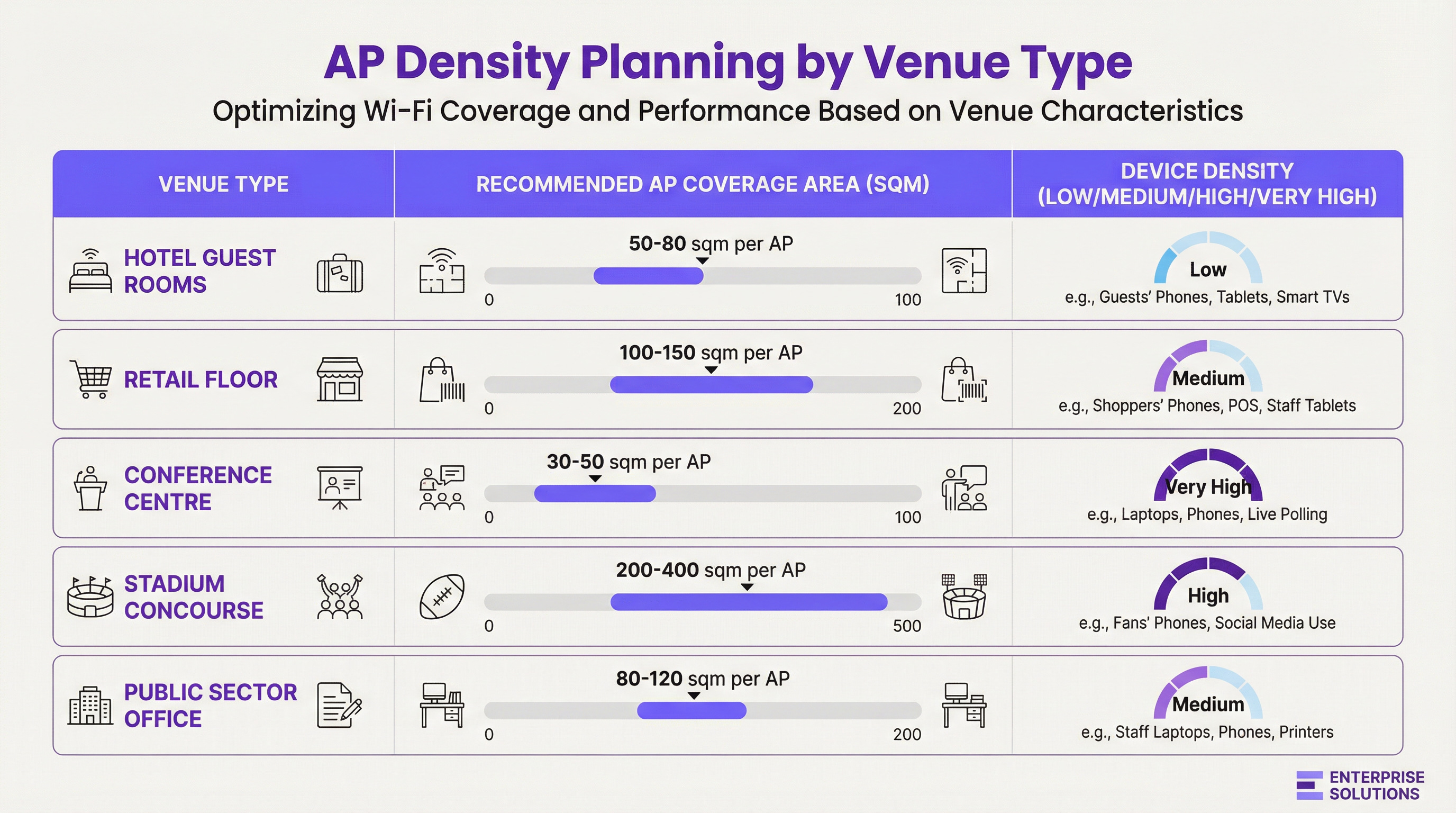
AP घनत्व कोई 'वन-साइज़-फिट्स-ऑल' (सभी के लिए एक समान) मीट्रिक नहीं है। यह तीन चरों का एक फलन है: क्षेत्र का भौतिक आकार, समवर्ती उपयोगकर्ताओं की संख्या, और उनके द्वारा उपयोग किए जाने वाले एप्लिकेशन के प्रकार।
- कवरेज-उन्मुख डिज़ाइन: होटल या गोदाम जैसे वातावरण में, प्राथमिक लक्ष्य एक बड़े क्षेत्र में निरंतर सिग्नल प्रदान करना है। यहाँ, योजना AP के प्रभावी कवरेज रेडियस से शुरू होती है, जिसमें निर्माण सामग्री से होने वाले क्षीणन (attenuation) को ध्यान में रखा जाता है।
- क्षमता-उन्मुख डिज़ाइन: सम्मेलन केंद्रों या स्टेडियमों जैसे उच्च-घनत्व वाले वातावरण में, योजना को उन समकालिक कनेक्शनों की संख्या को प्राथमिकता देनी चाहिए जिन्हें एक AP संभाल सकता है। इसके परिणामस्वरूप अक्सर केवल कवरेज के लिए आवश्यक APs की तुलना में अधिक APs तैनात किए जाते हैं, जो छोटे, अधिक केंद्रित सेल बनाने के लिए कम ट्रांसमिट पावर पर काम करते हैं।
सिग्नल क्षीणन (Attenuation) और सामग्री का प्रभाव
RF सिग्नल निर्माण सामग्री द्वारा अवशोषित, परावर्तित और विवर्तित (diffracted) होते हैं। एक व्यापक साइट सर्वेक्षण में सामान्य बाधाओं के कारण होने वाले dB नुकसान को ध्यान में रखा जाना चाहिए:
| सामग्री | 2.4 GHz क्षीणन (लगभग) | 5 GHz क्षीणन (लगभग) | प्लेसमेंट पर प्रभाव |
|---|---|---|---|
| ड्राईवॉल | -3 dB | -4 से -5 dB | न्यूनतम प्रभाव, कार्यालय वातावरण के लिए मानक। |
| कंक्रीट की दीवार | -10 से -15 dB | -15 से -20 dB | उच्च प्रभाव; दोनों तरफ APs की आवश्यकता है। |
| कांच की खिड़की | -4 dB | -7 dB | मध्यम प्रभाव; परावर्तन का कारण बन सकता है। |
| धातु का दरवाजा/लिफ्ट | -15 से -25 dB | -20 से -30 dB | RF शैडो बनाता है; इनके चारों ओर कवरेज की योजना बनाएं। |
चैनल प्लानिंग और सिग्नल ओवरलैप
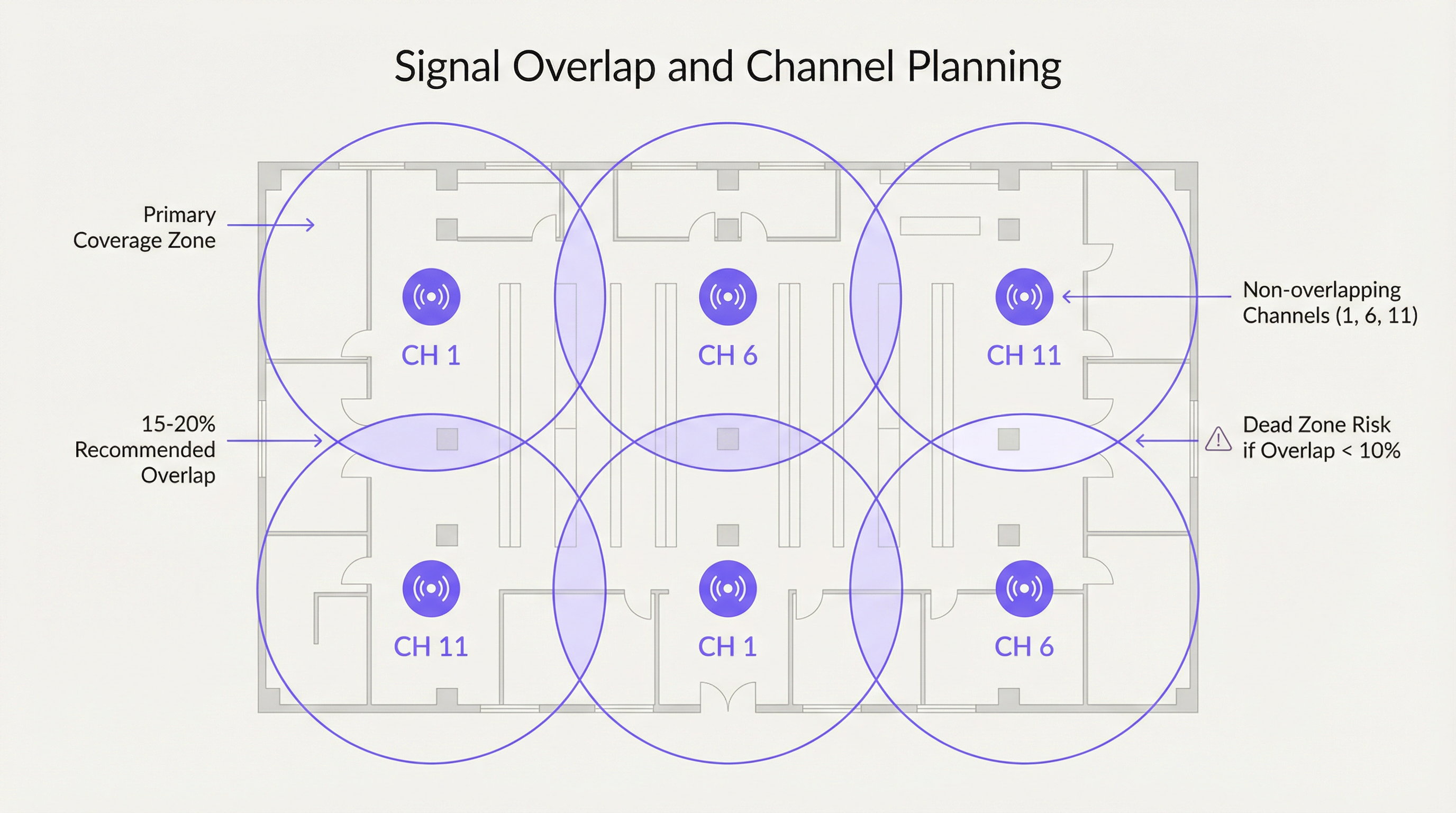
निर्बाध रोमिंग सुनिश्चित करने के लिए, आसन्न AP कवरेज सेल के बीच 15-20% के जानबूझकर ओवरलैप की सिफारिश की जाती है। यह एक क्लाइंट डिवाइस को पिछले AP से सिग्नल खोने से पहले एक नए AP को खोजने और उससे जुड़ने की अनुमति देता है। हालाँकि, इंटरफेरेंस से बचने के लिए इस ओवरलैप को एक उचित चैनल योजना के साथ प्रबंधित किया जाना चाहिए।
- को-चैनल इंटरफेरेंस (CCI): तब होता है जब एक ही चैनल पर दो AP बहुत करीब होते हैं। उन्हें एयरटाइम के लिए संघर्ष करना पड़ता है, जिससे सभी कनेक्टेड क्लाइंट्स का प्रदर्शन कम हो जाता है।
- एडजसेंट चैनल इंटरफेरेंस (ACI): तब होता है जब ओवरलैपिंग चैनलों पर AP बहुत करीब होते हैं (उदा., 2.4 GHz बैंड में चैनल 1 और 2)।
2.4 GHz बैंड के लिए, केवल चैनल 1, 6, और 11 नॉन-ओवरलैपिंग हैं और किसी भी एंटरप्राइज़ डिप्लॉयमेंट में विशेष रूप से इनका उपयोग किया जाना चाहिए। 5 GHz बैंड बहुत बड़ी संख्या में नॉन-ओवरलैपिंग चैनल प्रदान करता है, जिससे यह क्षमता-संचालित डिज़ाइनों के लिए पसंदीदा विकल्प बन जाता है।
कार्यान्वयन गाइड
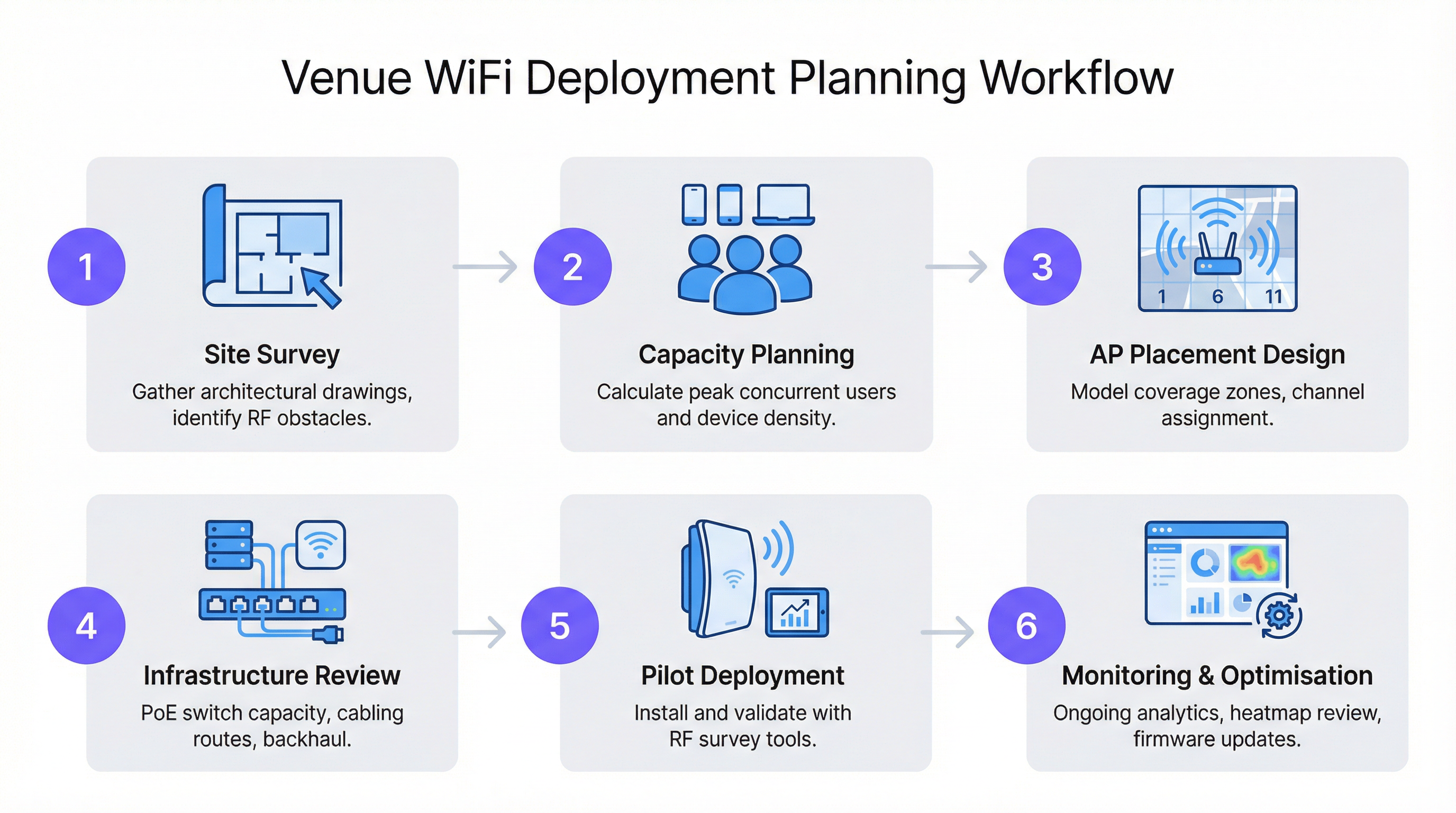
एक सफल और स्केलेबल WiFi डिप्लॉयमेंट के लिए एक संरचित वर्कफ़्लो का पालन करना महत्वपूर्ण है। यह प्रक्रिया सुनिश्चित करती है कि प्रारंभिक योजना से लेकर इंस्टॉलेशन के बाद के अनुकूलन (ऑप्टिमाइज़ेशन) तक सभी चरों पर विचार किया गया है।
चरण 1: साइट सर्वेक्षण
एक पेशेवर साइट सर्वेक्षण किसी भी नेटवर्क डिज़ाइन की आधारशिला है। इसमें दो चरण शामिल हैं:
- प्रेडिक्टिव सर्वे: RF प्रसार को मॉडल करने और प्रारंभिक AP प्लेसमेंट मैप बनाने के लिए फ्लोर प्लान और Ekahau या AirMagnet जैसे सॉफ़्टवेयर का उपयोग करना।
- फिजिकल सर्वे: प्रेडिक्टिव मॉडल को मान्य करने, RF इंटरफेरेंस के स्रोतों (जैसे माइक्रोवेव ओवन या पड़ोसी नेटवर्क) की पहचान करने और निर्माण सामग्री के RF गुणों की पुष्टि करने के लिए स्पेक्ट्रम एनालाइज़र और सर्वेक्षण टूल के साथ वेन्यू का वॉक-थ्रू।
चरण 2: माउंटिंग और प्लेसमेंट
- सीलिंग माउंट: ऊंची छत (3-5 मीटर) वाले खुले क्षेत्रों, जैसे रिटेल फ्लोर या बॉलरूम के लिए आदर्श। केंद्रित कवरेज के लिए डाउन-टिल्ट एंटीना पैटर्न का उपयोग करें。
- वॉल माउंट: हॉस्पिटैलिटी (होटल के कमरे) और कार्यालयों में पसंदीदा। अधिकांश फर्नीचर और बाधाओं के ऊपर रखने के लिए APs को 2.5-3 मीटर की ऊंचाई पर माउंट करें।
- सीलिंग वॉयड्स से बचें: ड्रॉप सीलिंग के ऊपर की जगह में APs रखने से सिग्नल की शक्ति 3-5 dB तक कम हो सकती है और रखरखाव के लिए भौतिक पहुंच मुश्किल हो जाती है।
- वर्टिकल स्टैगरिंग: बहुमंजिला इमारतों में, APs को प्रत्येक मंजिल पर एक ही स्थान पर नहीं रखा जाना चाहिए। प्लेसमेंट को स्टैगर (आगे-पीछे) करने से मंजिलों के बीच को-चैनल इंटरफेरेंस को कम करने में मदद मिलती है।
सर्वोत्तम प्रथाएं
- 5 GHz को प्राथमिकता दें: सक्षम क्लाइंट्स को 5 GHz बैंड की ओर निर्देशित करें। इसमें अधिक चैनल, कम इंटरफेरेंस और उच्च डेटा दरें होती हैं। इसे प्रोत्साहित करने के लिए अपने APs पर बैंड-स्टीयरिंग सुविधाओं का उपयोग करें।
- सही आकार की ट्रांसमिट पावर: अधिकतम पावर हमेशा सबसे अच्छी नहीं होती है। उच्च-घनत्व वाले डिज़ाइनों में, ट्रांसमिट पावर को कम करने से छोटे माइक्रोसेल बनते हैं, जो अधिक लगातार चैनल पुन: उपयोग की अनुमति देकर समग्र नेटवर्क क्षमता को बढ़ाता है।
- आधुनिक मानकों का लाभ उठाएं: Wi-Fi 6 (802.11ax) या Wi-Fi 6E सक्षम APs तैनात करें। OFDMA और MU-MIMO जैसी सुविधाएँ विशेष रूप से भीड़भाड़ वाले वातावरण में प्रदर्शन को बेहतर बनाने के लिए डिज़ाइन की गई हैं।
- बैकहॉल के लिए योजना बनाएं: सुनिश्चित करें कि आपका स्विचिंग इन्फ्रास्ट्रक्चर आवश्यक पावर ओवर इथरनेट (PoE) बजट (उच्च-प्रदर्शन वाले APs के लिए PoE+ या PoE++) प्रदान कर सकता है और इसमें एकत्रित वायरलेस ट्रैफ़िक को संभालने के लिए पर्याप्त अपलिंक क्षमता है।
समस्या निवारण और जोखिम न्यूनीकरण
- लक्षण: मजबूत सिग्नल के बावजूद धीमी गति। कारण: संभवतः को-चैनल इंटरफेरेंस या ओवर-सैचुरेटेड AP। समाधान: प्रतिस्पर्धी नेटवर्क की पहचान करने के लिए स्पेक्ट्रम विश्लेषण करें। AP क्लाइंट लोड की समीक्षा करें और क्षमता जोड़ने या क्लाइंट्स को लोड-बैलेंस करने पर विचार करें।
- लक्षण: चलते समय कनेक्शन का टूटना। कारण: अपर्याप्त कवरेज ओवरलैप (<10%) या अनुचित रोमिंग कॉन्फ़िगरेशन। समाधान: प्रभावित क्षेत्र में AP घनत्व बढ़ाएं या एक बड़ा ओवरलैप ज़ोन बनाने के लिए आसन्न APs की ट्रांसमिट पावर को समायोजित करें।
- लक्षण: कुछ क्षेत्रों में कोई कवरेज नहीं है (डेड ज़ोन)। कारण: अप्रत्याशित RF बाधाएं (उदा., नई धातु की शेल्विंग)। समाधान: डेड ज़ोन की पहचान करने के लिए इंस्टॉलेशन के बाद का सर्वेक्षण करें और अंतर को भरने के लिए एक अतिरिक्त AP तैनात करें。
ROI और व्यावसायिक प्रभाव
एक अच्छी तरह से डिज़ाइन किया गया WiFi नेटवर्क कोई लागत केंद्र नहीं है; यह बिज़नेस इंटेलिजेंस और बेहतर ग्राहक अनुभव का एक प्रवर्तक (enabler) है। एक रिटेल चेन के लिए, Purple-सक्षम WiFi नेटवर्क से एकत्र किया गया डेटा स्टोर लेआउट निर्णयों को सूचित कर सकता है, फुटफॉल (आवाजाही) को माप सकता है, और वैयक्तिकृत मार्केटिंग को बढ़ावा दे सकता है। हॉस्पिटैलिटी में, यह अतिथि संतुष्टि स्कोर का एक प्रमुख चालक है और मोबाइल चेक-इन और इन-रूम स्ट्रीमिंग जैसी सेवाओं को सक्षम बनाता है। ROI को इसमें मापा जाता है:
- अतिथि संतुष्टि और वफादारी में वृद्धि: उच्च-प्रदर्शन वाला WiFi अब एक प्राथमिक सुविधा है, जो बुकिंग निर्णयों को प्रभावित करता है।
- बढ़ी हुई परिचालन दक्षता: स्टाफ डिवाइसों (POS सिस्टम, इन्वेंट्री स्कैनर, संचार उपकरण) के लिए विश्वसनीय कनेक्टिविटी डाउनटाइम को कम करती है।
- नए राजस्व स्रोत: स्थान-आधारित एनालिटिक्स और Captive Portal मार्केटिंग जुड़ाव और बिक्री के लिए नए अवसर पैदा कर सकते हैं।
Key Terms & Definitions
Access Point (AP)
A networking hardware device that allows a Wi-Fi compliant device to connect to a wired network. APs are the bridge between the wireless and wired worlds.
This is the fundamental building block of your WiFi network. IT teams will be physically deploying and configuring these devices based on the network plan.
Site Survey
The process of planning and designing a wireless network to provide a solution that will deliver the required wireless coverage, data rates, network capacity, roaming capability and Quality of Service (QoS).
This is the most critical pre-deployment step. Skipping or rushing a site survey is the number one cause of poor WiFi performance. It provides the data needed to justify AP count and placement to management.
AP Density
The concentration of access points within a given physical area. High density refers to a large number of APs in a small area, typically for capacity reasons.
This term is central to budget discussions. A CTO needs to understand why a high-density area like a conference room requires a higher AP density (and thus cost) than a hallway.
Signal-to-Noise Ratio (SNR)
A measure that compares the level of a desired signal to the level of background noise. It is expressed in decibels (dB). A higher SNR means a cleaner, more reliable signal.
When troubleshooting a user's complaint of 'bad WiFi', SNR is a key metric. A strong signal is useless if the background noise (from other networks, microwaves, etc.) is also high. Aim for an SNR of 25 dB or higher for good performance.
Co-Channel Interference (CCI)
Interference that occurs when two or more access points on the same channel operate in close proximity. They are forced to share the available airtime, reducing throughput for all clients.
This is why channel planning is crucial. A network architect must design the AP layout to minimize CCI by reusing channels effectively across the venue.
Roaming
The process of a wireless client device moving from one access point to another within the same network without losing connectivity.
For venue operations, seamless roaming is essential for staff using mobile devices (e.g., scanners, tablets) and for guests on calls. It relies on having sufficient coverage overlap between APs.
Power over Ethernet (PoE)
A standard that allows electrical power to be passed along with data on twisted-pair Ethernet cabling. This allows a single cable to provide both data connection and electrical power to devices like APs.
This simplifies deployment and reduces costs by eliminating the need for a separate power outlet at every AP location. Network architects must ensure their switches have a large enough PoE budget to power all planned APs.
Wi-Fi 6 (802.11ax)
The latest generation of Wi-Fi technology, offering faster speeds and, more importantly, better performance in congested, high-density environments through technologies like OFDMA and MU-MIMO.
When planning a new deployment, especially for a high-traffic venue, specifying Wi-Fi 6 is a form of future-proofing and risk mitigation. It ensures the network can handle the increasing number of devices per user.
Case Studies
A 200-room, 5-story luxury hotel needs to upgrade its WiFi. The building is concrete and steel. The goal is to provide high-performance streaming for guests and reliable connectivity for staff operations.
A capacity-driven design is required. Plan for one AP per 2-4 guest rooms, depending on wall density. Given the concrete construction, placing APs in hallways is not viable; an in-room or near-room wall-plate AP strategy is necessary. For example, a wall-plate AP in every other room, with careful channel planning to avoid interference with rooms on adjacent floors. A staggered floor-by-floor layout is critical. For common areas like the lobby and restaurant, a ceiling-mounted, high-density AP solution is required, with APs placed approximately 10-15 meters apart. The entire network should be designed using Wi-Fi 6 APs to handle the high number of devices and streaming applications. A physical site survey is mandatory to validate RF penetration through the hotel's specific wall types.
A large retail store (5,000 sq. meters) wants to deploy guest WiFi and support staff inventory scanners and POS devices. The store has high ceilings and wide, open aisles, but also dense shelving units.
A mixed-coverage and capacity approach is needed. The primary design should be coverage-oriented, using ceiling-mounted APs with omnidirectional antennas placed in a grid pattern across the open floor areas, approximately 15-20 meters apart. However, a secondary survey must be done to identify potential RF dead zones created by high, metal shelving units. In these areas, additional, lower-power APs may be needed, mounted to the ends of aisles or on pillars. Channel planning should use a standard 1, 6, 11 rotation for 2.4 GHz and a wider range of non-overlapping channels for 5 GHz. The network must be configured with separate SSIDs and VLANs for guest and corporate traffic, in line with PCI DSS compliance for the POS systems.
Scenario Analysis
Q1. You are designing WiFi for a historic hotel with thick plaster and lath walls. A predictive survey suggests a single AP in the corridor can cover four rooms. What is your primary concern and how do you validate your design?
💡 Hint:Historic building materials are notoriously unpredictable for RF signals.
Show Recommended Approach
The primary concern is that the predictive model is inaccurate due to the variable density of the plaster and lath walls. The model should not be trusted. The only way to validate the design is with a physical pilot test. Place a single AP on a temporary stand in the corridor and use a survey tool (like Ekahau Sidekick) to measure the actual signal strength inside each of the four rooms. It is highly likely that an in-room or two-room deployment model will be required.
Q2. A conference is reporting that WiFi performance is excellent in the main hall but becomes unusable in the smaller breakout rooms. All APs are the same model. What is the most likely cause?
💡 Hint:Think about user density and the difference between a large hall and a small room.
Show Recommended Approach
The most likely cause is a capacity issue, not a coverage one. The AP density was likely planned for the lower-density main hall and not adjusted for the much higher user density in the breakout rooms. During breakout sessions, a large number of users move into small spaces, overwhelming the few APs covering those rooms. The solution is to increase the AP density in the breakout rooms and potentially use directional antennas to focus coverage and limit interference.
Q3. Your company is deploying a new network in a multi-tenant office building. You do not control the other tenants' networks. What is the most critical step in your site survey process?
💡 Hint:You can't control your neighbours, but you need to account for them.
Show Recommended Approach
The most critical step is a thorough spectrum analysis. In a multi-tenant building, the RF environment is chaotic. You must identify all other WiFi networks operating in the space, paying close attention to the channels they are using and their signal strength in your deployment area. This analysis is crucial for creating a channel plan that avoids the most congested channels, mitigating co-channel and adjacent channel interference from networks you do not control. You may need to rely more heavily on the 5 GHz band and potentially use narrower channel widths (e.g., 20 MHz) to find clean spectrum.
Key Takeaways
- ✓AP placement is a balance of providing wide coverage and sufficient capacity for users.
- ✓A physical site survey is non-negotiable to understand a building's unique RF characteristics.
- ✓Plan for 15-20% signal overlap between APs to ensure seamless roaming.
- ✓In the 2.4 GHz band, only ever use channels 1, 6, and 11 to avoid interference.
- ✓High-density venues like conference halls require more APs for capacity, not just coverage.
- ✓Deploy Wi-Fi 6 (802.11ax) for better performance in crowded environments.
- ✓A WiFi network is not 'set and forget'; it requires continuous monitoring and optimisation.




