

WiFi साइन-इन के लिए ईमेल सत्यापन: डेटा गुणवत्ता में सुधार
This guide provides IT managers, network architects, and venue operations directors with a definitive technical reference on email verification for WiFi sign-in, explaining why guest WiFi environments produce degraded email data, how Purple's Verify feature implements a layered validation architecture, and what measurable improvements operators can expect after deployment. It covers the full verification stack — from RFC 5322 syntax checking through DNS MX record validation, disposable-email blocklisting, and OTP confirmation — alongside GDPR compliance considerations and CRM integration guidance. Venue operators who act on this guidance can expect to reduce invalid email rates from an industry-average 25–35% to under 2%, materially improving marketing ROI, sender reputation, and regulatory defensibility.
🎧 Listen to this Guide
View Transcript

कार्यकारी सारांश
गेस्ट WiFi वेन्यू ऑपरेटरों के लिए उपलब्ध सबसे अधिक मात्रा वाले फर्स्ट-पार्टी डेटा कलेक्शन टचपॉइंट्स में से एक है, फिर भी इसके द्वारा उत्पन्न ईमेल डेटा अक्सर अविश्वसनीय होता है। कैप्चर के बिंदु पर सक्रिय सत्यापन के बिना, Captive Portal के माध्यम से सबमिट किए गए 25% से 35% ईमेल पते या तो सिंटैक्स के रूप में विकृत होते हैं, गैर-मौजूद डोमेन को इंगित करते हैं, या विशेष रूप से पंजीकरण आवश्यकताओं से बचने के लिए डिज़ाइन की गई डिस्पोजेबल ईमेल सेवाओं से संबंधित होते हैं। इसके डाउनस्ट्रीम परिणाम महत्वपूर्ण हैं: बढ़े हुए CRM डेटाबेस, ईमेल सेंडर की खराब प्रतिष्ठा, बर्बाद अभियान खर्च, और अनुच्छेद 5(1)(d) के सटीकता सिद्धांत के तहत बढ़ा हुआ GDPR अनुपालन जोखिम।
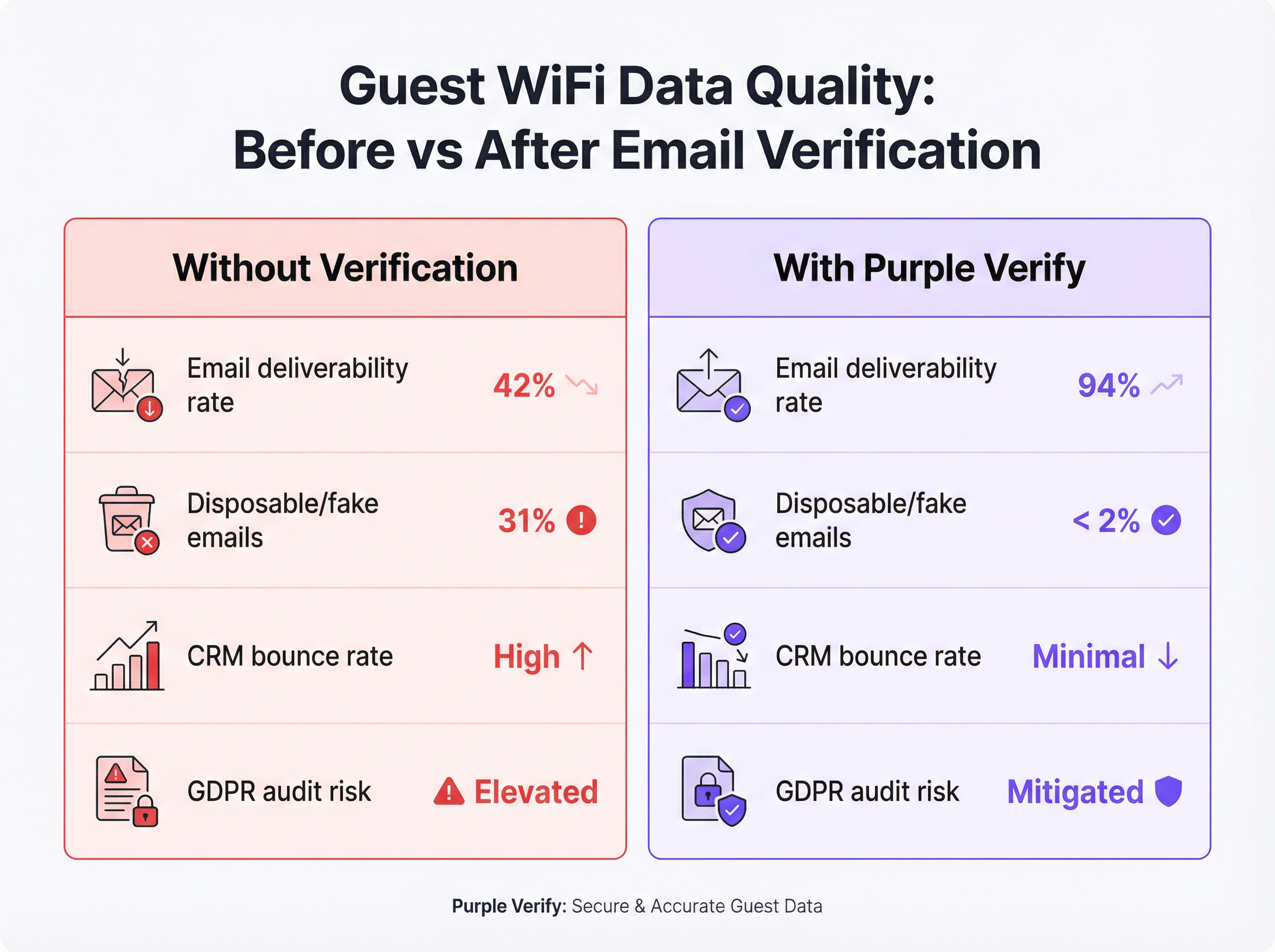
Purple का Verify फीचर इसे इंफ्रास्ट्रक्चर लेयर पर संबोधित करता है, जो गेस्ट को नेटवर्क एक्सेस दिए जाने से पहले रियल-टाइम में चार-चरणीय वैलिडेशन पाइपलाइन — सिंटैक्स चेक, DNS MX रिकॉर्ड लुकअप, डिस्पोजेबल-ईमेल डोमेन ब्लॉकलिस्टिंग, और वैकल्पिक वन-टाइम पासकोड (OTP) कन्फर्मेशन — लागू करता है। हॉस्पिटैलिटी, रिटेल और इवेंट वर्टिकल्स में डिप्लॉयमेंट लगातार अमान्य ईमेल दरों में 2% से कम की कमी प्रदर्शित करते हैं, जिसमें एक्टिवेशन के 60 दिनों के भीतर ईमेल डिलीवरेबिलिटी दरें 42% की सामान्य बेसलाइन से बढ़कर 90% से अधिक हो जाती हैं।
इस तिमाही के डेटा गुणवत्ता रोडमैप का मूल्यांकन करने वाले CTO के लिए: ईमेल सत्यापन WiFi केवल एक अतिरिक्त सुविधा नहीं है। यह वह मूलभूत नियंत्रण है जो यह निर्धारित करता है कि आपका गेस्ट WiFi निवेश कार्रवाई योग्य बुद्धिमत्ता (actionable intelligence) उत्पन्न करता है या एक महंगी देयता (expensive liability)।
तकनीकी डीप-डाइव
गेस्ट WiFi खराब ईमेल डेटा क्यों उत्पन्न करता है
इसका मूल कारण संरचनात्मक है, आकस्मिक नहीं। जब कोई गेस्ट Captive Portal से कनेक्ट होता है, तो यह आदान-प्रदान मौलिक रूप से असममित होता है: गेस्ट तुरंत इंटरनेट एक्सेस चाहता है, और ऑपरेटर बदले में एक वैध ईमेल पता चाहता है। गेस्ट के पास घर्षण (friction) को कम करने का हर संभव कारण होता है, और ऑपरेटर के पास — सत्यापन नियंत्रण के बिना — सबमिशन के बिंदु पर डेटा गुणवत्ता लागू करने का कोई तंत्र नहीं होता है।
यह खराब डेटा की चार अलग-अलग श्रेणियां उत्पन्न करता है। टाइपोग्राफिकल त्रुटियां (Typographical errors) सबसे सामान्य हैं: एक गेस्ट वास्तव में अपना असली पता प्रदान करने का इरादा रखता है लेकिन समय के दबाव में या छोटे मोबाइल कीबोर्ड पर इसे गलत टाइप कर देता है। मनगढ़ंत पते (Fabricated addresses) जानबूझकर किए जाते हैं: test@test.com या noemail@noemail.com जैसी स्ट्रिंग्स जो प्रशंसनीय लगती हैं लेकिन किसी काम की नहीं होतीं। समाप्त या अमान्य डोमेन (Expired or invalid domains) तब उत्पन्न होते हैं जब कोई गेस्ट किसी पूर्व नियोक्ता के डोमेन, एक बंद हो चुके ISP, या एक व्यक्तिगत डोमेन पर पता सबमिट करता है जिसे वे अब बनाए नहीं रखते हैं। डिस्पोजेबल ईमेल पते (Disposable email addresses) सबसे परिष्कृत श्रेणी हैं: Mailinator, Guerrilla Mail, और Temp Mail जैसी सेवाएं पूरी तरह से कार्यात्मक इनबॉक्स प्रदान करती हैं जो मिनटों या घंटों के बाद समाप्त हो जाती हैं, जिससे गेस्ट को बुनियादी डिलीवरेबिलिटी चेक पास करने की अनुमति मिलती है, जबकि यह सुनिश्चित होता है कि कोई दीर्घकालिक मार्केटिंग संपर्क संभव नहीं है।
IEEE 802.11 मानक WiFi नेटवर्क के रेडियो और MAC-लेयर व्यवहार को नियंत्रित करता है लेकिन कनेक्ट होने वाले उपयोगकर्ताओं के पहचान सत्यापन पर कोई आवश्यकता नहीं रखता है। Captive Portal व्यवहार का वर्णन RFC 7710 और इसके उत्तराधिकारी RFC 8910 में किया गया है, जिनमें से कोई भी ईमेल सत्यापन को अनिवार्य नहीं करता है। इसलिए डेटा गुणवत्ता की समस्या पूरी तरह से एक एप्लिकेशन-लेयर चिंता है, जो नेटवर्क स्टैक के ऊपर स्थित है, और इसे Captive Portal सॉफ्टवेयर स्तर पर संबोधित किया जाना चाहिए。
चार-स्तरीय सत्यापन आर्किटेक्चर
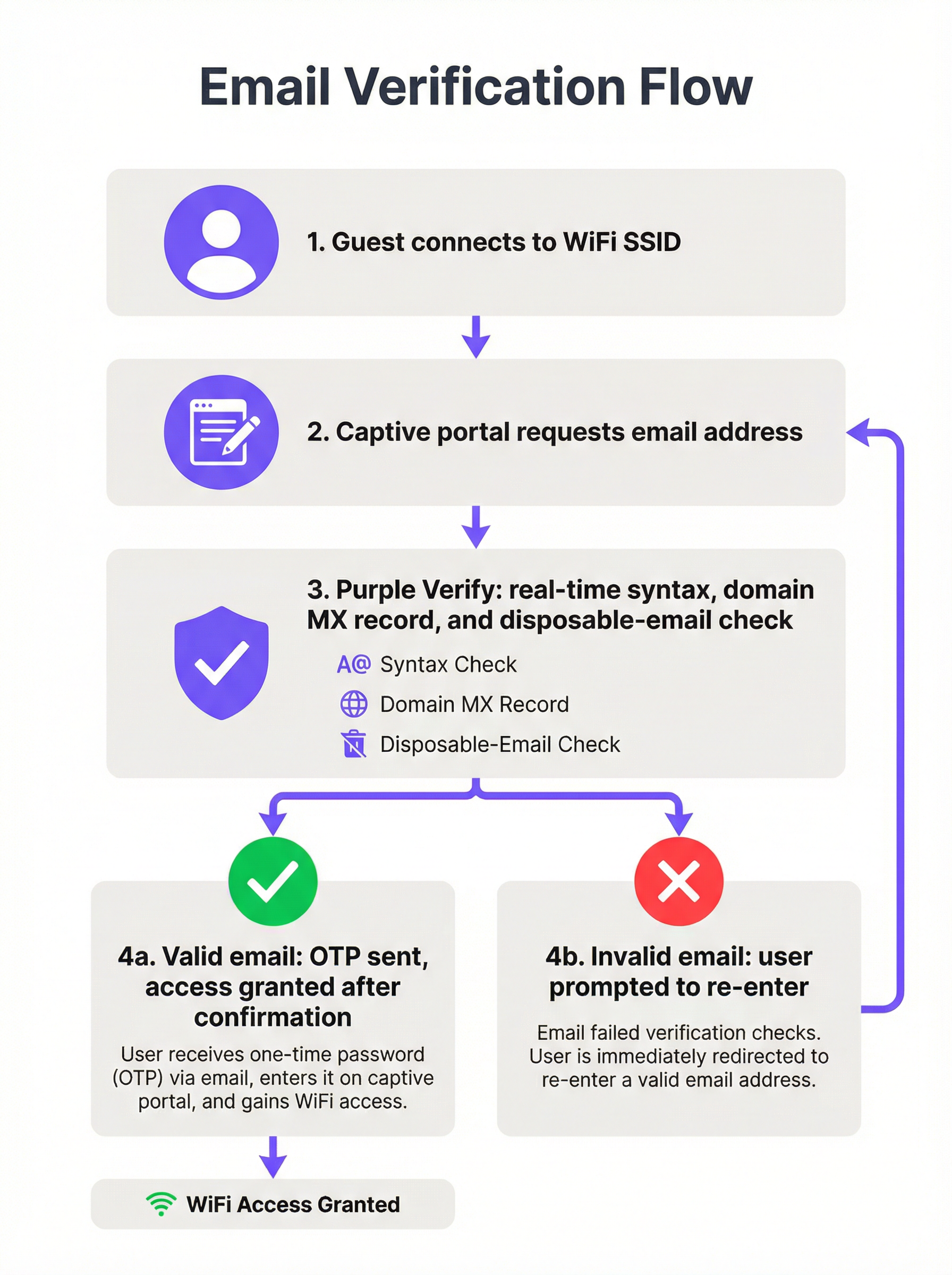
एक प्रोडक्शन-ग्रेड ईमेल सत्यापन WiFi डिप्लॉयमेंट चार अलग-अलग वैलिडेशन लेयर्स को लागू करता है, जिनमें से प्रत्येक वृद्धिशील गुणवत्ता आश्वासन प्रदान करता है।
लेयर 1 — सिंटैक्स वैलिडेशन (RFC 5322): सबमिट की गई स्ट्रिंग को इंटरनेट मैसेज फॉर्मेट मानक के विरुद्ध पार्स किया जाता है। यह एक स्थानीय भाग, एक एट-सिंबल (@), और कम से कम एक डॉट वाले डोमेन घटक की उपस्थिति की पुष्टि करता है। यह अवैध वर्णों, कई एट-सिंबल और अन्य संरचनात्मक उल्लंघनों वाली स्ट्रिंग्स को अस्वीकार करता है। केवल सिंटैक्स वैलिडेशन लगभग 15–20% खराब सबमिशन को पकड़ता है और नगण्य विलंबता (सब-मिलीसेकंड, क्लाइंट-साइड) जोड़ता है।
लेयर 2 — डोमेन और MX रिकॉर्ड सत्यापन: एक DNS लुकअप पुष्टि करता है कि सबमिट किया गया डोमेन मौजूद है और इसमें एक वैध मेल एक्सचेंज (MX) रिकॉर्ड है, जो यह दर्शाता है कि इसे ईमेल प्राप्त करने के लिए कॉन्फ़िगर किया गया है। यह जांच सर्वर-साइड पर की जाती है और आमतौर पर 100–300 मिलीसेकंड के भीतर पूरी हो जाती है। यह समाप्त हो चुके डोमेन, काल्पनिक डोमेन और डिकमीशन किए गए कॉर्पोरेट डोमेन के पतों को समाप्त करता है — एक ऐसी श्रेणी जिसका सिंटैक्स वैलिडेशन पता नहीं लगा सकता है।
लेयर 3 — डिस्पोजेबल ईमेल डोमेन ब्लॉकलिस्टिंग: डोमेन घटक को ज्ञात डिस्पोजेबल और अस्थायी ईमेल सेवा प्रदाताओं की लगातार अपडेट की जाने वाली ब्लॉकलिस्ट के विरुद्ध क्रॉस-रेफरेंस किया जाता है। यहीं पर इंटेलिजेंस लेयर महत्वपूर्ण हो जाती है। एक स्थिर ब्लॉकलिस्ट — जो रियल-टाइम में अपडेट नहीं होती है — नई लॉन्च की गई डिस्पोजेबल सेवाओं को छोड़ देगी और समय के साथ प्रभावशीलता में कम हो जाएगी। Purple का Verify फीचर एक लाइव-अपडेटेड ब्लॉकलिस्ट बनाए रखता है, जो ऐतिहासिक स्नैपशॉट के बजाय वर्तमान डिस्पोजेबल ईमेल इकोसिस्टम की कवरेज सुनिश्चित करता है।
लेयर 4 — वन-टाइम पासकोड (OTP) कन्फर्मेशन: सबमिट किए गए ईमेल पते पर एक समय-सीमित संख्यात्मक कोड भेजा जाता है। प्रमाणीकरण पूरा करने के लिए गेस्ट को इस कोड को अपने वास्तविक इनबॉक्स से प्राप्त करना होगा और इसे Captive Portal में दर्ज करना होगा। यह स्वामित्व का निश्चित प्रमाण (proof-of-ownership) जांच है: इसे मनगढ़ंत पते, गलत टाइप किए गए पते, या समाप्त हो चुके डिस्पोजेबल इनबॉक्स के साथ पास करना असंभव है। OTP कन्फर्मेशन मल्टी-फैक्टर ऑथेंटिकेशन सिद्धांतों के साथ संरेखित होता है और सबसे मजबूत उपलब्ध आश्वासन प्रदान करता है कि एकत्र किया गया ईमेल पता वैध है और गेस्ट के लिए सुलभ है।
| वैलिडेशन लेयर | यह क्या पकड़ता है | विलंबता प्रभाव | इसके लिए अनुशंसित |
|---|---|---|---|
| सिंटैक्स (RFC 5322) | विकृत स्ट्रिंग्स | < 1 ms | सभी डिप्लॉयमेंट |
| डोमेन / MX रिकॉर्ड | गैर-मौजूद डोमेन | 100–300 ms | सभी डिप्लॉयमेंट |
| डिस्पोजेबल ईमेल ब्लॉकलिस्ट | अस्थायी इनबॉक्स | 50–100 ms | मार्केटिंग-केंद्रित डिप्लॉयमेंट |
| OTP कन्फर्मेशन | सभी अमान्य पते | 30–120 सेकंड (उपयोगकर्ता पर निर्भर) | हॉस्पिटैलिटी, इवेंट्स, लॉयल्टी प्रोग्राम |
अनुपालन और मानक संदर्भ
WiFi साइन-इन बिंदु पर ईमेल सत्यापन कई विनियामक और मानक ढांचे के लिए सीधे प्रासंगिक है जिनके अधीन वेन्यू ऑपरेटरों के होने की संभावना है।
GDPR अनुच्छेद 5(1)(d) के लिए आवश्यक है कि व्यक्तिगत डेटा सटीक हो और, जहां आवश्यक हो, अद्यतित रखा जाए। कैप्चर के बिंदु पर एक सत्यापित ईमेल पता एकत्र करना एक असत्यापित पते को एकत्र करने और पूर्वव्यापी सफाई का प्रयास करने की तुलना में पर्यवेक्षी प्राधिकरण ऑडिट में काफी अधिक बचाव योग्य है। सत्यापन प्रक्रिया को स्वयं आपके अनुच्छेद 30 प्रसंस्करण गतिविधियों के रिकॉर्ड (Records of Processing Activities) में प्रलेखित किया जाना चाहिए।
GDPR अनुच्छेद 7 के लिए आवश्यक है कि मार्केटिंग संचार के लिए सहमति स्वतंत्र रूप से दी गई, विशिष्ट, सूचित और स्पष्ट हो। एक OTP कन्फर्मेशन चरण एक समकालीन रिकॉर्ड प्रदान करता है कि सहमति के समय डेटा विषय की सबमिट किए गए ईमेल पते तक पहुंच थी, जो ऑडिट ट्रेल को मजबूत करता है।
PCI DSS v4.0 सीधे ईमेल सत्यापन को नियंत्रित नहीं करता है, लेकिन आवश्यकता 8 (उपयोगकर्ताओं की पहचान करें और एक्सेस को प्रमाणित करें) और व्यापक नेटवर्क विभाजन आवश्यकताएं प्रासंगिक हैं यदि आपका गेस्ट WiFi कार्डधारक डेटा वातावरण के निकटवर्ती नेटवर्क सेगमेंट पर है। OTP सत्यापन द्वारा प्रदान किया गया पहचान आश्वासन एक बचाव योग्य एक्सेस कंट्रोल पोस्चर में योगदान देता है।
ISO/IEC 27001:2022 अनुलग्नक A नियंत्रण 5.14 (सूचना हस्तांतरण) और नियंत्रण 8.5 (सुरक्षित प्रमाणीकरण) ISMS के तहत गेस्ट WiFi संचालित करने वाले संगठनों के लिए प्रासंगिक हैं। ईमेल सत्यापन नेटवर्क एक्सेस पॉइंट पर एक प्रलेखित, ऑडिट योग्य पहचान जांच प्रदान करता है।
कार्यान्वयन मार्गदर्शिका
डिप्लॉयमेंट-पूर्व मूल्यांकन
ईमेल सत्यापन को सक्रिय करने से पहले, एक परिमाणित बेसलाइन स्थापित करें। अपने मौजूदा गेस्ट WiFi डेटाबेस से कम से कम 5,000 ईमेल पतों का एक प्रतिनिधि नमूना निर्यात करें और उन्हें बल्क ईमेल वैलिडेशन सेवा के माध्यम से चलाएं। अपने ईमेल मार्केटिंग प्लेटफॉर्म से अपनी वर्तमान अमान्य दर, डिस्पोजेबल ईमेल दर और हार्ड बाउंस दर रिकॉर्ड करें। ये आंकड़े वह बेसलाइन बनाते हैं जिसके विरुद्ध आप सुधार को मापेंगे और डिप्लॉयमेंट के लिए आंतरिक बिजनेस केस बनाएंगे।
अपनी सत्यापन गहराई का चयन करना
उपयुक्त सत्यापन कॉन्फ़िगरेशन तीन कारकों पर निर्भर करता है: आपके गेस्ट संबंध की प्रकृति (लेन-देन बनाम दीर्घकालिक), आपके गेस्ट जनसांख्यिकीय की घर्षण के प्रति सहनशीलता, और एकत्र किए गए डेटा के लिए डाउनस्ट्रीम उपयोग का मामला।
उच्च-फुटफॉल वाले क्षणिक वातावरण (high-footfall transient environments) — ट्रांसपोर्ट हब, शॉपिंग सेंटर, क्विक-सर्विस रेस्तरां — के लिए डिस्पोजेबल ईमेल ब्लॉकिंग के साथ सिंटैक्स और डोमेन वैलिडेशन अनुशंसित न्यूनतम है। OTP चरण ऐसा घर्षण उत्पन्न करता है जो उस संदर्भ में डेटा के मूल्य के अनुपात से बाहर हो सकता है जहां गेस्ट संबंध संक्षिप्त है और प्राथमिक उपयोग का मामला व्यक्तिगत मार्केटिंग के बजाय समग्र एनालिटिक्स है।
हॉस्पिटैलिटी और इवेंट्स — होटल, सम्मेलन केंद्र, स्टेडियम — के लिए पूर्ण OTP कन्फर्मेशन की दृढ़ता से अनुशंसा की जाती है। गेस्ट संबंध लंबा होता है, एक सत्यापित ईमेल का मार्केटिंग मूल्य अधिक होता है, और इन वातावरणों में गेस्ट के पास आमतौर पर उस डिवाइस पर अपना ईमेल सुलभ होता है जिसका उपयोग वे साइन इन करने के लिए कर रहे हैं। अतिरिक्त 30–60 सेकंड का घर्षण स्वीकार्य सीमा के भीतर है।
लॉयल्टी-एकीकृत रिटेल के लिए — जहां WiFi साइन-इन सीधे लॉयल्टी प्रोग्राम या वैयक्तिकरण इंजन में फीड होता है — OTP कन्फर्मेशन आवश्यक है। लॉयल्टी डेटाबेस की अखंडता अंतर्निहित ईमेल पहचानकर्ताओं की विशिष्टता और सटीकता पर निर्भर करती है।
Purple पर कॉन्फ़िगरेशन चरण
- Purple डैशबोर्ड में Venue Settings > Captive Portal > Authentication पर नेविगेट करें।
- प्रमाणीकरण विधि के रूप में Email चुनें और Verify टॉगल को सक्षम करें।
- अपनी सत्यापन गहराई चुनें: Standard (सिंटैक्स + डोमेन + डिस्पोजेबल ब्लॉकलिस्ट) या Full (Standard + OTP कन्फर्मेशन)।
- OTP ईमेल टेम्प्लेट कॉन्फ़िगर करें — सुनिश्चित करें कि इसमें आपकी वेन्यू ब्रांडिंग और एक स्पष्ट विषय पंक्ति (जैसे, "आपका [Venue Name] WiFi एक्सेस कोड") हो।
- OTP समाप्ति विंडो सेट करें। 10-मिनट की विंडो अनुशंसित है; छोटी विंडो परित्याग (abandonment) को बढ़ाती हैं, लंबी विंडो सुरक्षा को कम करती हैं।
- Captive Portal UI में पुनर्प्रयास और त्रुटि संदेश (retry and error messaging) कॉन्फ़िगर करें। सिंटैक्स विफलताओं, डोमेन विफलताओं और डिस्पोजेबल ईमेल अस्वीकृतियों के लिए अलग-अलग त्रुटि संदेश निर्दिष्ट करें।
- Purple API या वेबहुक एकीकरण के माध्यम से अपने कनेक्टेड CRM या मार्केटिंग प्लेटफॉर्म पर सत्यापन मेटाडेटा पासथ्रू (verification metadata passthrough) सक्षम करें。
- एक चरणबद्ध रोलआउट आयोजित करें: पहले एक वेन्यू या SSID पर सक्रिय करें, 7 दिनों के लिए सत्यापन पास दर और OTP पूर्णता दर की निगरानी करें, फिर पूरी एस्टेट में रोल आउट करें।
डाउनस्ट्रीम सिस्टम के साथ एकीकरण
ईमेल सत्यापन का मूल्य केवल तभी पूरी तरह से महसूस किया जाता है जब सत्यापित स्थिति को डाउनस्ट्रीम सिस्टम में प्रचारित किया जाता है। अपने CRM और ईमेल मार्केटिंग प्लेटफॉर्म पर email_verified बूलियन फ्लैग — और, जहां OTP का उपयोग किया गया था, otp_confirmed फ्लैग — पास करने के लिए अपने Purple एकीकरण को कॉन्फ़िगर करें। अपने गेस्ट डेटाबेस को खंडित करने के लिए इस फ्लैग का उपयोग करें: व्यक्तिगत अभियानों के लिए OTP-पुष्टि किए गए पतों को अपने उच्चतम-गुणवत्ता वाले टियर के रूप में मानें, और कम-प्राथमिकता वाले संचार के लिए केवल डोमेन-सत्यापित पतों का उपयोग करें।
सर्वोत्तम प्रथाएं
ईमेल सत्यापन को डेटा गवर्नेंस नियंत्रण के रूप में मानें, सुरक्षा नियंत्रण के रूप में नहीं। प्राथमिक लाभ डेटा गुणवत्ता और GDPR अनुपालन है, नेटवर्क सुरक्षा नहीं। आंतरिक बिजनेस केस बनाते समय डिप्लॉयमेंट को उसी के अनुसार फ्रेम करें।
लाइव-अपडेटेड डिस्पोजेबल ईमेल ब्लॉकलिस्ट का उपयोग करें। एक स्थिर ब्लॉकलिस्ट तेजी से खराब होती है। नई डिस्पोजेबल ईमेल सेवाएं साप्ताहिक रूप से लॉन्च होती हैं। सुनिश्चित करें कि आपका सत्यापन प्रदाता — चाहे Purple हो या कोई तृतीय-पक्ष सेवा — लगातार अपडेट की जाने वाली ब्लॉकलिस्ट बनाए रखता है।
वास्तविक उपयोगकर्ता को ध्यान में रखते हुए त्रुटि UX डिज़ाइन करें। सत्यापन में विफल रहने वाले अधिकांश गेस्ट ने वास्तविक टाइपो किया है, न कि सिस्टम को दरकिनार करने का जानबूझकर प्रयास। त्रुटि संदेश विशिष्ट, सहायक और गैर-आरोपात्मक होने चाहिए। "हमें वह ईमेल डोमेन नहीं मिला — कृपया जांचें और पुनः प्रयास करें" एक सामान्य "अमान्य ईमेल पता" संदेश की तुलना में अधिक प्रभावी है।
एक प्रमुख संकेतक के रूप में अपनी OTP पूर्णता दर की निगरानी करें। घटती OTP पूर्णता दर डिलीवरी विलंबता समस्याओं, सत्र टाइमआउट समस्याओं, या आपकी गेस्ट आबादी में जनसांख्यिकीय बदलाव का संकेत दे सकती है। यदि पूर्णता दर एक सीमा से नीचे आती है (आमतौर पर हॉस्पिटैलिटी वातावरण के लिए 70% एक उचित बेसलाइन है) तो स्वचालित अलर्ट सेट करें।
GDPR अनुच्छेद 30 अनुपालन के लिए अपनी सत्यापन प्रक्रिया का दस्तावेजीकरण करें। आपके प्रसंस्करण गतिविधियों के रिकॉर्ड (Records of Processing Activities) में डेटा संग्रह के बिंदु पर लागू सत्यापन चरणों, प्रसंस्करण के कानूनी आधार और सत्यापन लॉग के लिए प्रतिधारण अवधि का वर्णन होना चाहिए।
अपनी एस्टेट में आनुपातिक रूप से सत्यापन गहराई लागू करें। एक बहु-साइट डिप्लॉयमेंट विभिन्न वेन्यू प्रकारों पर विभिन्न सत्यापन कॉन्फ़िगरेशन को उचित ठहरा सकता है। पूरी एस्टेट में सबसे कम सामान्य हर (lowest common denominator) को डिफ़ॉल्ट करने के बजाय प्रत्येक स्थान पर उपयुक्त गहराई लागू करने के लिए Purple की प्रति-वेन्यू कॉन्फ़िगरेशन क्षमता का उपयोग करें।
समस्या निवारण और जोखिम न्यूनीकरण
सामान्य विफलता मोड
विफलता मोड 1: उच्च OTP परित्याग दर। यदि आपकी OTP पूर्णता दर 60% से कम है, तो सबसे आम कारण हैं: ईमेल डिलीवरी विलंबता 60 सेकंड से अधिक होना; Captive Portal सत्र टाइमआउट बहुत कम (5 मिनट से कम) सेट होना; या गेस्ट वेबमेल क्लाइंट का उपयोग कर रहे हैं जिनके लिए मोबाइल पर ऐप्स स्विच करने की आवश्यकता होती है, जिससे Captive Portal सत्र रीसेट हो जाता है। उपचारात्मक उपाय: अपने SMTP प्रदाता के साथ अपने ईमेल डिलीवरी SLA की जांच करें, सत्र टाइमआउट को कम से कम 8 मिनट तक बढ़ाएं, और उन गेस्ट के लिए संख्यात्मक कोड के विकल्प के रूप में "मैजिक लिंक" लागू करने पर विचार करें जो सिंगल-टैप कन्फर्मेशन पसंद करते हैं।
विफलता मोड 2: वैध कॉर्पोरेट ईमेल पतों को अस्वीकार किया जाना। कुछ कॉर्पोरेट ईमेल डोमेन में असामान्य MX रिकॉर्ड कॉन्फ़िगरेशन होते हैं — उदाहरण के लिए, वे संगठन जो गैर-मानक DNS रिकॉर्ड के साथ तृतीय-पक्ष सुरक्षा गेटवे के माध्यम से ईमेल रूट करते हैं। यदि आप ऐसे पतों की अस्वीकृति देख रहे हैं जो वैध प्रतीत होते हैं, तो अपने डोमेन वैलिडेशन लॉजिक की समीक्षा करें और ज्ञात एंटरप्राइज़ डोमेन के लिए एक श्वेतसूची (whitelist) लागू करने पर विचार करें जो गलत सकारात्मक (false positives) उत्पन्न कर रहे हैं।
विफलता मोड 3: डिस्पोजेबल ईमेल ब्लॉकलिस्ट नई सेवाओं को कवर नहीं कर रही है। डिस्पोजेबल ईमेल पैठ के संकेतों के लिए अपने सत्यापन-पश्चात डेटाबेस की निगरानी करें — उदाहरण के लिए, किसी अपरिचित डोमेन से पतों में अचानक वृद्धि। यदि आप किसी नई डिस्पोजेबल सेवा की पहचान करते हैं जिसे ब्लॉक नहीं किया जा रहा है, तो ब्लॉकलिस्ट में शामिल करने के लिए अपने सत्यापन प्रदाता को इसकी रिपोर्ट करें।
विफलता मोड 4: सत्यापन मेटाडेटा CRM तक नहीं पहुंच रहा है। यदि आपका ईमेल मार्केटिंग प्लेटफॉर्म email_verified फ्लैग प्राप्त नहीं कर रहा है, तो अपने Purple वेबहुक कॉन्फ़िगरेशन की जांच करें और पुष्टि करें कि प्राप्त करने वाला एंडपॉइंट पेलोड को सही ढंग से पार्स कर रहा है। उत्पादन में इस पर भरोसा करने से पहले एकीकरण को मान्य करने के लिए Purple के वेबहुक परीक्षण टूल का उपयोग करें।
जोखिम रजिस्टर
| जोखिम | संभावना | प्रभाव | न्यूनीकरण |
|---|---|---|---|
| OTP डिलीवरी विफलता (SMTP आउटेज) | कम | उच्च | एक द्वितीयक SMTP रिले कॉन्फ़िगर करें; केवल-डोमेन वैलिडेशन के लिए ग्रेसफुल फ़ॉलबैक लागू करें |
| डिस्पोजेबल ईमेल सेवा ब्लॉकलिस्ट पर नहीं है | मध्यम | मध्यम | लाइव-अपडेटेड ब्लॉकलिस्ट का उपयोग करें; सत्यापन-पश्चात डेटाबेस गुणवत्ता की निगरानी करें |
| सत्यापन डेटा प्रतिधारण पर GDPR चुनौती | कम | उच्च | प्रतिधारण नीति का दस्तावेजीकरण करें; 30 दिनों के बाद OTP लॉग हटाएं |
| OTP घर्षण के कारण गेस्ट परित्याग | मध्यम | मध्यम | ईमेल डिलीवरी विलंबता को अनुकूलित करें; सत्र टाइमआउट बढ़ाएं; वैकल्पिक प्रमाणीकरण विधियों की पेशकश करें |
| वैध पतों की गलत सकारात्मक अस्वीकृति | कम | मध्यम | डोमेन श्वेतसूची लागू करें; वेन्यू कर्मचारियों के लिए मैनुअल ओवरराइड पथ प्रदान करें |
ROI और व्यावसायिक प्रभाव
सफलता मापना
ईमेल सत्यापन WiFi डिप्लॉयमेंट के लिए प्राथमिक KPI तीन श्रेणियों में आते हैं: डेटा गुणवत्ता मेट्रिक्स, मार्केटिंग प्रदर्शन मेट्रिक्स, और अनुपालन मेट्रिक्स।
डेटा गुणवत्ता मेट्रिक्स में अमान्य ईमेल अस्वीकृति दर (प्रत्येक सत्यापन लेयर पर अस्वीकार किए गए सबमिट किए गए पतों का प्रतिशत), OTP पूर्णता दर, और आपके ईमेल मार्केटिंग प्लेटफॉर्म से डिप्लॉयमेंट-पश्चात हार्ड बाउंस दर शामिल हैं। एक अच्छी तरह से कॉन्फ़िगर किए गए डिप्लॉयमेंट को WiFi-स्रोत वाले संपर्कों पर 2% से कम की अमान्य ईमेल दर और 0.5% से कम की हार्ड बाउंस दर प्राप्त करनी चाहिए।
मार्केटिंग प्रदर्शन मेट्रिक्स में अन्य अधिग्रहण चैनलों के मुकाबले WiFi-स्रोत वाले सेगमेंट के लिए ईमेल डिलीवरेबिलिटी दर, अभियान ओपन दर और क्लिक-थ्रू दर शामिल हैं। सत्यापित WiFi संपर्क इन मेट्रिक्स पर असत्यापित संपर्कों से लगातार बेहतर प्रदर्शन करते हैं क्योंकि अंतर्निहित डेटा सटीक है और गेस्ट ने OTP चरण को पूरा करके सक्रिय इरादा प्रदर्शित किया है।
अनुपालन मेट्रिक्स में GDPR डेटा विषय एक्सेस अनुरोधों की संख्या शामिल है जिन्हें सटीक रूप से पूरा किया जा सकता है (एक स्वच्छ डेटाबेस गलत व्यक्ति को व्यक्तिगत डेटा भेजने के जोखिम को कम करता है), और आपके अनुच्छेद 30 रिकॉर्ड की ऑडिट तत्परता।
लागत-लाभ ढांचा
ईमेल सत्यापन को तैनात करने की प्रत्यक्ष लागत न्यूनतम है: Purple का Verify फीचर प्लेटफॉर्म सदस्यता के भीतर शामिल है, और वृद्धिशील परिचालन ओवरहेड प्रारंभिक कॉन्फ़िगरेशन और चल रही निगरानी तक सीमित है। अप्रत्यक्ष लागतें साइन-इन घर्षण में मामूली वृद्धि और कच्चे डेटा की मात्रा में छोटी कमी हैं (चूंकि कुछ गेस्ट जो पहले नकली पते सबमिट करते थे, वे अब वास्तविक पता प्रदान करने के बजाय साइन-इन प्रवाह को छोड़ देंगे)।
लाभ मात्रात्मक हैं। 50 संपत्तियों वाले एक होटल समूह के लिए, जिनमें से प्रत्येक में प्रति दिन औसतन 150 गेस्ट WiFi साइन-इन होते हैं, वार्षिक डेटा मात्रा लगभग 2.7 मिलियन रिकॉर्ड है। 30% की असत्यापित अमान्य दर पर, यह प्रति वर्ष 810,000 बेकार रिकॉर्ड है — जिनमें से प्रत्येक CRM स्टोरेज, ईमेल सेंड बजट की खपत करता है, और संभावित रूप से GDPR एक्सपोज़र बनाता है। प्रति सेंड £0.002 की सामान्य ईमेल मार्केटिंग प्लेटफॉर्म लागत पर, केवल अमान्य पतों पर प्रत्यक्ष बर्बाद खर्च प्रति अभियान प्रति वर्ष £1,600 से अधिक है। प्रति वर्ष 12 अभियान चलाने वाले ऑपरेटर के लिए, यह प्रत्यक्ष बर्बादी में £19,000 से अधिक है — वास्तविक ग्राहकों को डिलीवरेबिलिटी को प्रभावित करने वाली उच्च बाउंस दरों की प्रतिष्ठित लागत का हिसाब लगाने से पहले।
ROI की गणना सीधी है: सत्यापन की लागत प्रभावी रूप से शून्य है (यह मौजूदा प्लेटफॉर्म सदस्यता पर एक कॉन्फ़िगरेशन टॉगल है), और लाभ — कम बर्बादी, बेहतर अभियान प्रदर्शन, और कम अनुपालन जोखिम में — डिप्लॉयमेंट के 60–90 दिनों के भीतर भौतिक और मापने योग्य हैं।
यह मार्गदर्शिका एंटरप्राइज़ WiFi इंटेलिजेंस प्लेटफॉर्म, Purple द्वारा प्रकाशित की गई है। डिप्लॉयमेंट सहायता या तकनीकी परामर्श के लिए, अपनी Purple खाता टीम से संपर्क करें या purple.ai पर जाएं।
Key Terms & Definitions
Captive Portal
A web page presented to a guest attempting to connect to a WiFi network, requiring authentication or acceptance of terms before network access is granted. Captive portal behaviour is described in RFC 8910. The portal is the primary data collection interface in a guest WiFi deployment and the point at which email verification is applied.
IT teams encounter captive portals as the front-end interface of their guest WiFi deployment. The design and configuration of the captive portal — including its verification logic and error messaging — directly determines the quality of data collected.
MX Record (Mail Exchange Record)
A DNS resource record that specifies the mail server responsible for accepting email messages on behalf of a domain. During email verification, a DNS lookup for the MX record of the submitted domain confirms that the domain is configured to receive email. The absence of an MX record indicates that the domain cannot receive email, making any address at that domain invalid for communication purposes.
IT teams encounter MX record checks as part of the domain validation layer of email verification. Understanding MX records is also relevant for diagnosing false positive rejections of legitimate corporate email addresses with non-standard DNS configurations.
Disposable Email Address (DEA)
A temporary email address provided by a disposable email service (such as Mailinator, Guerrilla Mail, or Temp Mail) that is functional for a short period — typically minutes to hours — before expiring. DEAs are specifically designed to allow users to register for services without providing a permanent, contactable email address. They represent the most sophisticated category of invalid email data in guest WiFi deployments.
IT and marketing teams encounter DEAs as a primary source of data quality degradation in guest WiFi databases. A guest using a DEA will pass syntax and domain validation but will be unreachable for any subsequent marketing or transactional communication.
One-Time Passcode (OTP)
A time-limited numeric or alphanumeric code sent to a user's email address (or mobile number) as part of an authentication or verification flow. In the context of email verification WiFi, the OTP is dispatched to the submitted email address and must be entered into the captive portal to complete sign-in. Successful OTP entry constitutes proof of ownership of the submitted address.
IT teams configure OTP delivery as part of the captive portal authentication flow. Key configuration parameters include the OTP expiry window (typically 5–10 minutes), the SMTP relay used for delivery, and the session timeout on the captive portal (which must be long enough to allow the guest to retrieve and enter the code).
Email Deliverability Rate
The percentage of sent emails that successfully reach the recipient's inbox, as opposed to being bounced (returned as undeliverable) or filtered to spam. Deliverability rate is a function of both the quality of the underlying email list and the sender's reputation with Internet Service Providers (ISPs). A high proportion of invalid addresses in a list will generate hard bounces, which damage sender reputation and reduce deliverability even to valid addresses.
Marketing managers use deliverability rate as the primary indicator of email list health. IT teams are involved when deliverability issues are traced to infrastructure problems — such as a sender domain being flagged as high-risk by ISPs due to excessive bounce rates from WiFi-sourced contacts.
Hard Bounce
A permanent email delivery failure caused by an invalid, non-existent, or blocked recipient address. Hard bounces are distinguished from soft bounces (temporary delivery failures due to a full inbox or server unavailability). Email marketing platforms track hard bounce rates and will typically suppress addresses that generate hard bounces. A hard bounce rate above 2% is generally considered a threshold for sender reputation risk.
IT and marketing teams encounter hard bounces as the primary measurable symptom of poor email data quality. A high hard bounce rate from WiFi-sourced contacts is often the trigger for an email verification deployment project.
RFC 5322 (Internet Message Format)
The Internet Engineering Task Force (IETF) standard that defines the syntax of email messages, including the format of email addresses. RFC 5322 specifies that an email address consists of a local part (before the at-symbol) and a domain (after the at-symbol), with specific rules governing permissible characters and structure. Syntax validation in email verification checks submitted addresses against RFC 5322 requirements.
IT teams reference RFC 5322 when configuring or evaluating email validation logic. Understanding the standard helps distinguish between syntactically valid addresses (which conform to RFC 5322) and deliverable addresses (which additionally require a valid domain and MX record).
Sender Reputation
A score assigned by Internet Service Providers (ISPs) and email filtering services to a sending domain and IP address, based on factors including bounce rates, spam complaint rates, and sending volume patterns. A degraded sender reputation causes emails to be filtered to spam or rejected outright, even for valid recipient addresses. Sender reputation is directly affected by the quality of the underlying email list: high bounce rates from invalid addresses are one of the fastest ways to damage reputation.
IT teams are typically involved in sender reputation issues when the email marketing platform flags deliverability problems that trace back to infrastructure — such as a sending domain being blacklisted. Marketing managers experience sender reputation degradation as unexplained drops in campaign open rates. Email verification WiFi directly protects sender reputation by preventing invalid addresses from entering the list.
GDPR Article 5(1)(d) — Accuracy Principle
The provision of the General Data Protection Regulation that requires personal data to be 'accurate and, where necessary, kept up to date', with 'every reasonable step' taken to ensure that inaccurate personal data is erased or rectified without delay. In the context of guest WiFi data collection, this principle requires operators to take reasonable steps to ensure that email addresses collected at the point of sign-in are accurate — a requirement that email verification directly addresses.
Data protection officers and IT compliance teams reference Article 5(1)(d) when assessing the legal basis for email verification deployments. The principle provides the regulatory anchor for the business case: collecting unverified email addresses and storing them in a CRM is a potential compliance risk under GDPR, and verification is the most direct mitigation.
Case Studies
A 12-property UK hotel group has been operating guest WiFi for 18 months without email verification. Their CRM contains approximately 144,000 guest records sourced from WiFi sign-ins, but their email marketing platform is flagging their sender domain as high-risk due to a 31% hard bounce rate. The marketing director wants to launch a loyalty programme using WiFi-sourced contacts. What is the recommended approach?
The immediate priority is to stop the flow of new invalid data before addressing the existing database. Step 1: Activate Purple Verify with full OTP confirmation on all 12 properties. Configure a branded OTP email template and set the session timeout to 8 minutes. This halts the accumulation of new invalid records. Step 2: Run the existing 144,000-record database through a bulk email validation service to identify the invalid, disposable, and undeliverable addresses. Suppress these from all future sends immediately — do not attempt to re-engage them, as doing so will further damage sender reputation. Step 3: Implement a re-permission campaign to the remaining valid contacts, inviting them to opt in to the new loyalty programme. This simultaneously cleans the list and establishes a fresh, documented consent record for GDPR purposes. Step 4: Configure the Purple API integration to pass the otp_confirmed flag to the CRM, and create a segmentation rule that tags all new WiFi contacts with their verification tier. Step 5: Monitor the sender reputation score weekly using a tool such as Google Postmaster Tools or Microsoft SNDS. Expect the bounce rate to normalise to under 0.5% within 60 days as the invalid addresses are suppressed and new verified contacts replace them.
A retail chain operating 47 stores wants to use guest WiFi sign-in data to personalise in-store digital signage and feed a loyalty programme. Their current WiFi deployment captures approximately 3,200 sign-ins per day across the estate, but the data team reports that their customer segmentation models are unreliable due to a high proportion of duplicate and ghost accounts. The IT manager is concerned that adding OTP verification will reduce sign-in completion rates in a high-footfall, fast-turnover retail environment. What verification configuration is recommended, and how should the trade-off between data quality and conversion rate be managed?
For a high-footfall retail environment, the recommended configuration is syntax validation plus domain/MX record checking plus disposable email blocking, without the OTP step. This configuration eliminates the majority of low-quality data — fabricated addresses, non-existent domains, and disposable inboxes — while adding only 200–400 milliseconds of latency to the sign-in flow, which is imperceptible to the guest. The OTP step is omitted because the guest relationship in a retail context is typically brief and the device-switching friction (from captive portal to email app and back) is disproportionate to the value gained in a fast-turnover environment. To address the duplicate account problem specifically, configure the Purple platform to enforce email uniqueness at the point of sign-in: if a guest submits an address that already exists in the database, merge the session data with the existing record rather than creating a new one. This directly addresses the ghost account proliferation without requiring OTP. For the loyalty programme integration, apply a tiered trust model: contacts acquired through the WiFi flow with domain validation are treated as 'standard' tier; contacts who have additionally authenticated via a social login (which provides implicit email verification through the OAuth flow) are treated as 'verified' tier and are eligible for higher-value personalisation. Monitor the duplicate account rate monthly as the primary KPI for this deployment.
Scenario Analysis
Q1. A conference centre hosts 200 events per year, ranging from 50-person board meetings to 5,000-delegate industry conferences. Their guest WiFi currently captures approximately 180,000 email addresses per year with no verification. The events team wants to use this data for post-event marketing and delegate re-engagement. The IT manager is concerned about the compliance implications of the existing unverified database. What verification configuration would you recommend for new data collection, and how would you address the existing database?
💡 Hint:Consider the variability in event type and delegate profile. A 5,000-person conference has different data quality requirements and guest behaviour patterns than a 50-person board meeting. Also consider that conference delegates typically have their corporate email accessible on their device.
Show Recommended Approach
For new data collection, deploy full OTP confirmation for all events. Conference delegates are a high-value audience for post-event marketing, and the OTP step is well-suited to this context: delegates have their corporate email accessible on the device they are using to sign in, and the sign-in friction is proportionate to the value of the relationship. Configure the OTP email with event-specific branding (using Purple's dynamic template variables to insert the event name and date) to increase trust and completion rates. For large events (500+ delegates), pre-stage the SMTP relay capacity to handle peak OTP send volumes at event start. For the existing unverified database of 180,000 addresses, run a bulk validation audit immediately and suppress all addresses that fail domain and MX checks. For the remaining addresses, run a re-permission campaign framed around the new loyalty or delegate programme — this simultaneously cleans the list and establishes fresh GDPR consent records. Document the audit and re-permission process in the Article 30 Records of Processing Activities, noting the date of the remediation exercise and the methodology used.
Q2. A local authority is deploying free public WiFi across 23 libraries and community centres. The project is funded partly on the basis of providing anonymised footfall analytics to the council's planning department. The data protection officer has raised concerns about collecting email addresses from members of the public on council-operated infrastructure. The IT team is evaluating whether to require email sign-in at all, and if so, what verification to apply. What is your recommendation?
💡 Hint:Consider the data minimisation principle under GDPR Article 5(1)(c) — only collect data that is necessary for the specified purpose. If the primary purpose is anonymised footfall analytics, is email collection required at all? If email collection is retained, what is the legal basis and what verification depth is proportionate?
Show Recommended Approach
The data minimisation principle is the governing consideration here. If the primary purpose is anonymised footfall analytics, email collection is not required — device presence detection (using MAC address randomisation-aware counting methods) can provide footfall data without any personal data collection. Recommend separating the analytics use case from the marketing use case: deploy a no-registration WiFi option for general public access (satisfying the footfall analytics requirement with anonymised data), and offer an optional email registration path for users who wish to receive council communications or loyalty benefits. For the optional registration path, apply syntax validation and domain/MX checking as the minimum — OTP confirmation is recommended given the public-sector context and the DPO's concerns, as it provides the strongest available evidence of informed consent and accurate data collection. Document the legal basis for email processing (likely legitimate interests or consent, depending on the use case) in the Article 30 records, and ensure the captive portal privacy notice clearly distinguishes between the anonymised analytics processing and the optional email registration processing.
Q3. An IT manager at a 300-outlet fast-food chain has activated Purple Verify with syntax, domain, and disposable email blocking (no OTP) across all outlets. Three months after deployment, the marketing team reports that their email deliverability rate has improved from 48% to 71% — a significant improvement, but still below the 90%+ target. The IT manager suspects that a new category of invalid addresses is getting through the current verification stack. What diagnostic steps would you recommend, and what additional configuration changes might close the gap?
💡 Hint:A deliverability rate of 71% after deploying three-layer verification (without OTP) suggests that a significant proportion of addresses are passing all three checks but are still undeliverable. Consider what categories of address could pass syntax, domain, and disposable email checks but still be undeliverable.
Show Recommended Approach
The most likely explanation is a combination of two factors: role-based email addresses (such as info@, noreply@, admin@, or postmaster@) that are syntactically valid, have valid MX records, and are not disposable services, but are not monitored by an individual and generate soft bounces or spam complaints; and addresses at legitimate domains where the specific mailbox does not exist (the domain is valid, the MX record is valid, but the local part — the username — is fabricated). To diagnose: export a sample of 1,000 addresses that passed verification but generated bounces, and categorise them by bounce type and address pattern. If role-based addresses are a significant category, add a role-based address filter to the verification configuration. For the mailbox-existence problem, the only reliable solution is OTP confirmation — which verifies that the specific mailbox exists and is accessible to the submitting guest. Given the fast-food context, the IT manager should evaluate whether a limited OTP deployment — for example, on the loyalty programme sign-in flow only, not the general WiFi access flow — would close the remaining gap without imposing OTP friction on the full guest population. This tiered approach is a practical compromise between data quality and conversion rate in a high-footfall environment.
Key Takeaways
- ✓Between 25% and 35% of email addresses captured through unverified guest WiFi captive portals are invalid, disposable, or fabricated — making email verification WiFi a foundational data governance control, not an optional enhancement.
- ✓A production-grade verification architecture implements four layers in sequence: RFC 5322 syntax validation, DNS MX record lookup, live-updated disposable email blocklisting, and OTP confirmation. Each layer provides incremental quality assurance; the appropriate depth depends on the use case and guest context.
- ✓Purple's Verify feature implements all four layers natively within the captive portal flow, with a continuously updated disposable email blocklist and configurable OTP step — reducing invalid email rates to under 2% within 60 days of activation in documented deployments.
- ✓GDPR Article 5(1)(d)'s accuracy principle provides the regulatory anchor for email verification deployments: collecting unverified personal data and storing it in a CRM is a documentable compliance risk, and verification at the point of capture is the most direct mitigation.
- ✓The ROI is measurable and rapid: a 12-property hotel group deploying Verify saw email deliverability rise from 42% to 94% within 60 days, with the invalid email rate dropping from 31% to under 2% — directly improving campaign performance and reducing wasted send budget.
- ✓Verification depth should be calibrated to context: full OTP confirmation for hospitality, events, and loyalty programmes; syntax, domain, and disposable email blocking for high-footfall retail and transient environments; and a data minimisation review for public-sector deployments where email collection may not be required at all.
- ✓Post-deployment monitoring is essential: track the OTP completion rate, invalid email rejection rate, and sender reputation score at 30, 60, and 90 days. A declining OTP completion rate is the leading indicator of delivery latency or session timeout issues that require remediation.




