

गेस्ट WiFi Captive Portals: एक निर्बाध और सुरक्षित उपयोगकर्ता अनुभव बनाने के लिए विस्तृत मार्गदर्शिका
This guide provides IT leaders and venue operators with a comprehensive technical reference for designing, implementing, and securing guest WiFi captive portals at enterprise scale. It covers the full authentication architecture from RADIUS to CRM integration, GDPR compliance requirements, advanced customisation options including A/B testing and personalised content delivery for Purple AI users, and a proven ROI framework with real-world case studies from hospitality and retail environments.
🎧 Listen to this Guide
View Transcript

कार्यकारी सारांश
IT प्रबंधकों, नेटवर्क आर्किटेक्ट्स और वेन्यू ऑपरेटरों के लिए, गेस्ट WiFi नेटवर्क एक साधारण सुविधा से विकसित होकर एक महत्वपूर्ण व्यावसायिक संपत्ति बन गया है। एक अच्छी तरह से निष्पादित गेस्ट WiFi Captive Portal इस संपत्ति का प्रवेश द्वार है — ग्राहकों और आगंतुकों के साथ बातचीत का पहला बिंदु, और डेटा संग्रह, ब्रांड एंगेजमेंट और राजस्व सृजन के लिए एक शक्तिशाली इंजन। यह मार्गदर्शिका महत्वपूर्ण व्यावसायिक मूल्य को अनलॉक करते हुए एक निर्बाध उपयोगकर्ता अनुभव बनाने के लिए Captive Portals को डिज़ाइन करने, लागू करने और सुरक्षित करने के लिए एक व्यापक तकनीकी संदर्भ प्रदान करती है।
हम प्रारंभिक उपयोगकर्ता जुड़ाव से लेकर बैकएंड प्रमाणीकरण और CRM एकीकरण तक, Captive Portal आर्किटेक्चर के मुख्य घटकों का पता लगाते हैं। प्रमुख विषयों में GDPR और UK GDPR जैसे डेटा गोपनीयता नियमों का अनुपालन, WPA3 और IEEE 802.1X के साथ संरेखित मजबूत सुरक्षा उपायों का कार्यान्वयन, A/B परीक्षण और वैयक्तिकृत सामग्री वितरण सहित उन्नत अनुकूलन विकल्प, और निवेश पर रिटर्न (ROI) को अधिकतम करने की रणनीतियां शामिल हैं। वरिष्ठ IT पेशेवरों के लिए, यह मार्गदर्शिका इस तिमाही में खरीद निर्णयों और परिनियोजन रणनीतियों को सूचित करने के लिए कार्रवाई योग्य, वेंडर-न्यूट्रल सिफारिशें प्रदान करती है। एक घर्षण रहित उपयोगकर्ता यात्रा, मजबूत सुरक्षा स्थिति और डेटा-संचालित वैयक्तिकरण पर ध्यान केंद्रित करके, संगठन अपने गेस्ट WiFi को एक लागत केंद्र से ग्राहक एंगेजमेंट और बिजनेस इंटेलिजेंस के लिए एक शक्तिशाली उपकरण में बदल सकते हैं।
तकनीकी डीप-डाइव
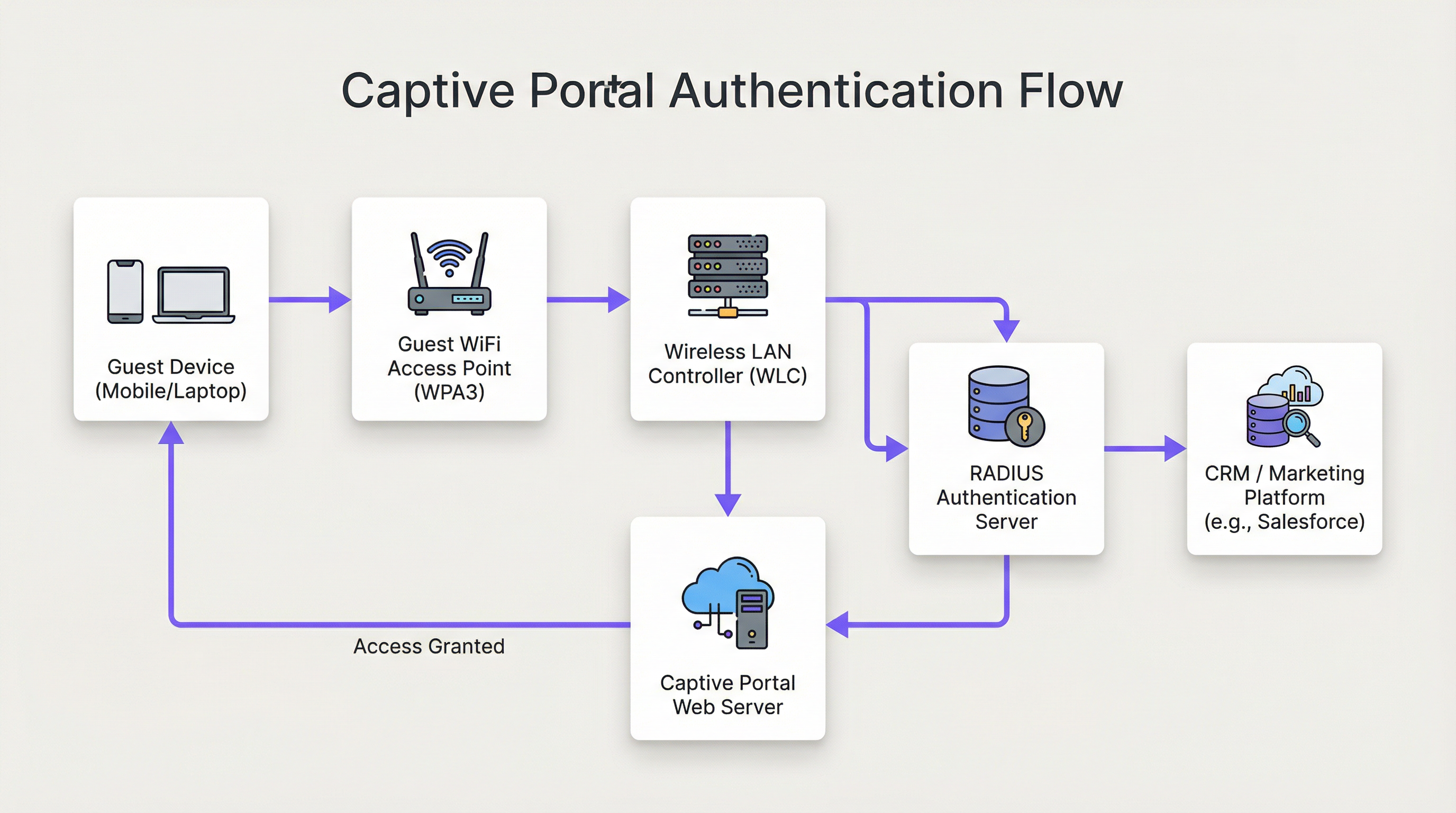
एक आधुनिक गेस्ट WiFi Captive Portal समाधान के आर्किटेक्चर में नेटवर्क हार्डवेयर, सॉफ़्टवेयर और क्लाउड सेवाओं के बीच एक परिष्कृत इंटरप्ले शामिल है। इसके मूल में, Captive Portal उपयोगकर्ता के वेब ट्रैफ़िक को इंटरसेप्ट करता है और व्यापक नेटवर्क एक्सेस देने से पहले उन्हें प्रमाणीकरण के लिए एक विशिष्ट वेब पेज पर रीडायरेक्ट करता है। ऐसे सिस्टम को तैनात करने या बनाए रखने के लिए जिम्मेदार किसी भी नेटवर्क आर्किटेक्ट के लिए इस प्रवाह को विस्तार से समझना आवश्यक है।
चरण 1 — वायरलेस एसोसिएशन: उपयोगकर्ता का डिवाइस गेस्ट WiFi SSID को खोजता है और उससे कनेक्ट होता है। इस स्तर पर, डिवाइस पूर्व-प्रमाणीकृत, वॉल्ड-गार्डन स्थिति में होता है। WLC या AP, DHCP के माध्यम से डिवाइस को एक IP पता प्रदान करता है, लेकिन व्हाइटलिस्ट किए गए डोमेन की एक परिभाषित सूची और स्वयं Captive Portal होस्ट को छोड़कर सभी आउटबाउंड ट्रैफ़िक को प्रतिबंधित करता है।
चरण 2 — HTTP/S रीडायरेक्ट: जब उपयोगकर्ता कोई ब्राउज़र या कोई एप्लिकेशन खोलता है जो HTTP/S अनुरोध करता है, तो WLC उसे इंटरसेप्ट करता है। DNS हाईजैकिंग (जहां सभी DNS प्रश्नों का उत्तर पोर्टल के IP के साथ दिया जाता है) या HTTP 302 रीडायरेक्शन का उपयोग करके, उपयोगकर्ता को Captive Portal के वेब सर्वर पर भेज दिया जाता है। आधुनिक परिनियोजन के लिए, iOS, Android और Windows क्लाइंट्स में विश्वसनीयता के लिए HTTP रीडायरेक्शन को प्राथमिकता दी जाती है।
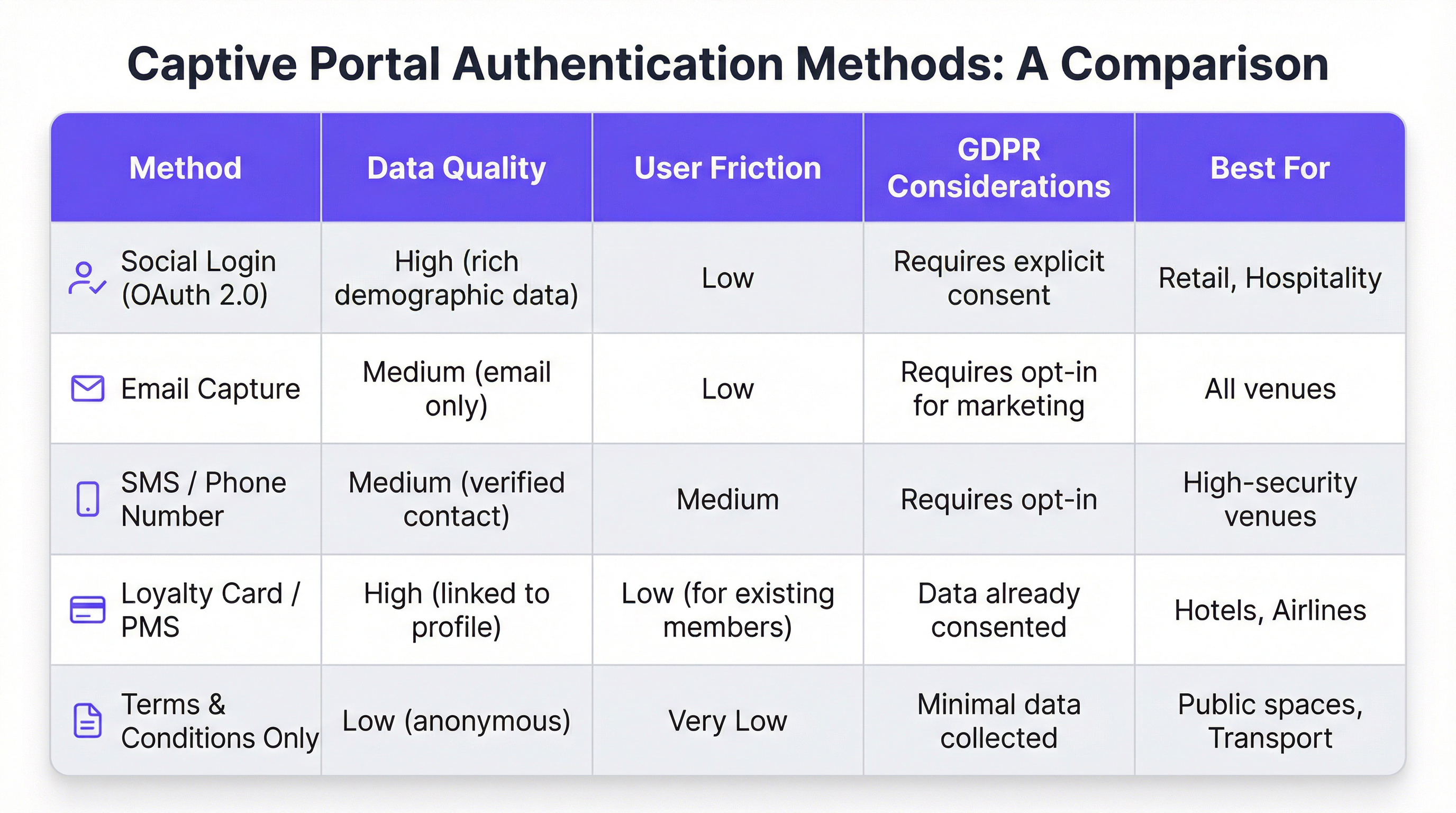
चरण 3 — पोर्टल इंटरैक्शन और प्रमाणीकरण: उपयोगकर्ता के सामने Captive Portal पेज प्रस्तुत किया जाता है। प्रमाणीकरण विधियों में OAuth 2.0 (Facebook, Google, LinkedIn) के माध्यम से सोशल लॉगिन, ईमेल या SMS कैप्चर, नियम-और-शर्तों की स्वीकृति, या REST API के माध्यम से लॉयल्टी प्रोग्राम या प्रॉपर्टी मैनेजमेंट सिस्टम (PMS) के साथ एकीकरण शामिल हैं। विधि का चुनाव सीधे तौर पर कैप्चर किए गए डेटा की गुणवत्ता और उपयोगकर्ता यात्रा में आने वाले घर्षण को नियंत्रित करता है।
चरण 4 — RADIUS प्रमाणीकरण: फॉर्म जमा करने पर, पोर्टल सेवा एक RADIUS सर्वर (RFC 2865) के साथ संचार करती है। RADIUS सर्वर बैकएंड डेटा स्टोर — एक स्थानीय डेटाबेस, LDAP डायरेक्टरी, CRM, या मार्केटिंग ऑटोमेशन प्लेटफ़ॉर्म के विरुद्ध क्रेडेंशियल्स को मान्य करता है। सत्र नीतियों को लागू करने के लिए Session-Timeout और Idle-Timeout जैसे RADIUS एट्रिब्यूट्स का उपयोग किया जाता है।
चरण 5 — एक्सेस स्वीकृत: सफल प्रमाणीकरण पर, RADIUS सर्वर WLC को उपयोगकर्ता की प्राधिकरण स्थिति बदलने का संकेत देता है, जिससे पूर्ण इंटरनेट एक्सेस मिल जाता है। इस बिंदु पर WLC के पॉलिसी इंजन के माध्यम से बैंडविड्थ नीतियां, सामग्री फ़िल्टरिंग नियम और सत्र अवधि सीमाएं लागू की जाती हैं।
सुरक्षा के दृष्टिकोण से, IEEE 802.1X के साथ WPA3-Enterprise सुरक्षा का उच्चतम स्तर प्रदान करता है, जो WPA3-Enterprise मोड में 192-बिट सुरक्षा का उपयोग करके क्लाइंट और AP के बीच ट्रैफ़िक को एन्क्रिप्ट करता है। स्वयं पोर्टल के लिए, सभी संचारों में TLS 1.2 या उच्चतर के साथ HTTPS का उपयोग होना चाहिए। जहां पोर्टल प्रवाह के भीतर कोई भुगतान प्रसंस्करण होता है, वहां PCI DSS v4.0 का अनुपालन अनिवार्य है।
Purple AI उपयोगकर्ताओं के लिए, उन्नत अनुकूलन क्षमताएं इस आर्किटेक्चर को महत्वपूर्ण रूप से बढ़ाती हैं। Purple प्लेटफ़ॉर्म वेन्यू स्तर पर पोर्टल डिज़ाइनों के A/B परीक्षण का समर्थन करता है, जिससे ऑपरेटर रूपांतरण दरों को अनुकूलित करने के लिए विभिन्न लेआउट, कॉल-टू-एक्शन और प्रमाणीकरण प्रवाह का परीक्षण कर सकते हैं। लॉगिन के बाद वैयक्तिकृत सामग्री वितरण — जैसे कि अतिथि के CRM प्रोफ़ाइल या लॉयल्टी टियर के आधार पर लक्षित ऑफ़र — Salesforce, HubSpot, या REST API वाले किसी भी मार्केटिंग ऑटोमेशन प्लेटफ़ॉर्म पर रीयल-टाइम API कॉल के माध्यम से प्राप्त किया जाता है। Purple का एनालिटिक्स इंजन हीटमैप ओवरले और ड्वेल-टाइम विश्लेषण भी प्रदान करता है, जिससे वेन्यू ऑपरेटर भौतिक फुटफॉल पैटर्न के साथ WiFi एंगेजमेंट डेटा को सहसंबंधित कर सकते हैं।
कार्यान्वयन मार्गदर्शिका
एंटरप्राइज़ स्तर पर गेस्ट WiFi Captive Portal को तैनात करने के लिए एक संरचित, चरणबद्ध दृष्टिकोण की आवश्यकता होती है। निम्नलिखित ढांचा वेंडर-न्यूट्रल है और हॉस्पिटैलिटी, रिटेल, इवेंट्स और सार्वजनिक क्षेत्र के वातावरण में लागू होता है।
चरण 1 — व्यावसायिक उद्देश्यों को परिभाषित करें: कोई भी तकनीकी कार्य शुरू होने से पहले, गेस्ट WiFi सेवा के विशिष्ट लक्ष्यों का दस्तावेजीकरण करें। सामान्य उद्देश्यों में फ़र्स्ट-पार्टी मार्केटिंग डेटाबेस बनाना, वेन्यू के विशिष्ट क्षेत्रों में फुटफॉल बढ़ाना, लक्षित प्रचारों के माध्यम से सहायक राजस्व बढ़ाना, या बस एक विश्वसनीय सुविधा प्रदान करना शामिल है। ये उद्देश्य प्रमाणीकरण विधि से लेकर लॉगिन के बाद की सामग्री रणनीति तक, हर बाद के डिज़ाइन निर्णय को निर्धारित करेंगे।
चरण 2 — नेटवर्क इन्फ्रास्ट्रक्चर मूल्यांकन: अपने मौजूदा वायरलेस इन्फ्रास्ट्रक्चर का पूर्ण ऑडिट करें। सत्यापित करें कि आपके APs और WLC, Captive Portal रीडायरेक्शन, VLAN टैगिंग और बाहरी RADIUS एकीकरण का समर्थन करते हैं। उच्च-घनत्व वाले वातावरण — स्टेडियम, सम्मेलन केंद्र, परिवहन हब — के लिए पर्याप्त कवरेज और क्षमता सुनिश्चित करने के लिए एक पेशेवर RF साइट सर्वेक्षण शुरू करें। खराब प्रदर्शन करने वाला नेटवर्क सबसे खूबसूरती से डिज़ाइन किए गए पोर्टल को भी कमजोर कर देगा।
चरण 3 — प्लेटफ़ॉर्म चयन: अपने व्यावसायिक उद्देश्यों के विरुद्ध Captive Portal प्लेटफ़ॉर्म का मूल्यांकन करें। प्रमुख मानदंडों में हार्डवेयर अज्ञेयवाद (मल्टी-वेंडर एस्टेट्स के लिए महत्वपूर्ण), CRM और मार्केटिंग ऑटोमेशन एकीकरण की गहराई, एनालिटिक्स और रिपोर्टिंग की गुणवत्ता, GDPR अनुपालन टूलिंग, और डेवलपर संसाधन के बिना पोर्टल डिज़ाइन को अनुकूलित करने की क्षमता शामिल है। जटिल एकीकरण आवश्यकताओं वाले संगठनों के लिए, प्लेटफ़ॉर्म के API दस्तावेज़ और वेबहुक समर्थन का मूल्यांकन करें।
चरण 4 — उपयोगकर्ता यात्रा डिज़ाइन: WiFi डिस्कवरी से लेकर पोस्ट-लॉगिन एंगेजमेंट तक संपूर्ण उपयोगकर्ता अनुभव को मैप करें। उपयोगकर्ता को इंटरनेट एक्सेस मिलने से पहले अधिकतम तीन इंटरैक्शन का लक्ष्य रखें। पूर्णता दरों को अधिकतम करने वाले लेआउट और प्रमाणीकरण प्रवाह की पहचान करने के लिए विभिन्न पोर्टल डिज़ाइनों का A/B परीक्षण करें। सुनिश्चित करें कि पोर्टल पूरी तरह से उत्तरदायी है और मोबाइल-फ़र्स्ट उपयोग के लिए अनुकूलित है।
चरण 5 — कॉन्फ़िगरेशन और एकीकरण: अप्रमाणीकृत उपयोगकर्ताओं को पोर्टल URL पर रीडायरेक्ट करने के लिए WLC को कॉन्फ़िगर करें। पोर्टल होस्ट, सोशल लॉगिन डोमेन (accounts.google.com, www.facebook.com, www.linkedin.com), और पोर्टल को रेंडर करने के लिए आवश्यक किसी भी CDN संसाधनों तक पहुंच की अनुमति देने के लिए वॉल्ड गार्डन को परिभाषित करें। RADIUS साझा रहस्यों को कॉन्फ़िगर करें और लाइव होने से पहले पूर्ण प्रमाणीकरण प्रवाह का एंड-टू-एंड परीक्षण करें।
चरण 6 — पायलट और रोलआउट: एक ही पायलट स्थान पर तैनात करें और पूर्ण रोलआउट से पहले कम से कम दो सप्ताह के लिए प्रमाणीकरण दरों, सत्र अवधि और त्रुटि लॉग की निगरानी करें। बेसलाइन KPIs स्थापित करें जिनके विरुद्ध आप परिनियोजन की सफलता को मापेंगे।
सर्वोत्तम प्रथाएं
उपयोगकर्ता अनुभव को प्राथमिकता दें: एक धीमा, भ्रमित करने वाला या अविश्वसनीय Captive Portal आपके ब्रांड पर खराब प्रभाव डालता है। 15-सेकंड से कम के एंड-टू-एंड प्रमाणीकरण समय का लक्ष्य रखें। पोर्टल डिज़ाइन को साफ़ रखें, निर्देशों को स्पष्ट रखें, और कॉल-टू-एक्शन को प्रमुखता दें। आपके द्वारा जोड़ा गया प्रत्येक अतिरिक्त क्लिक या फ़ॉर्म फ़ील्ड आपकी पूर्णता दर को कम कर देगा।
मोबाइल-फ़र्स्ट डिज़ाइन लागू करें: 75% से अधिक गेस्ट WiFi कनेक्शन मोबाइल उपकरणों से उत्पन्न होते हैं। आपका पोर्टल पूरी तरह से उत्तरदायी होना चाहिए, जिसमें टच-फ्रेंडली UI तत्व और ऐसा टेक्स्ट हो जो बिना ज़ूम किए पढ़ने योग्य हो। परिनियोजन से पहले कई स्क्रीन आकारों में iOS और Android दोनों पर परीक्षण करें।
डेटा संग्रह के बारे में पारदर्शी रहें: आप कौन सा डेटा एकत्र कर रहे हैं और इसका उपयोग कैसे किया जाएगा, इसका स्पष्ट, सरल भाषा में स्पष्टीकरण प्रस्तुत करें। अपनी गोपनीयता नीति का लिंक प्रदान करें और सुनिश्चित करें कि आपका सहमति तंत्र GDPR अनुच्छेद 7 के अनुपालन में है। GDPR के तहत पहले से टिक किए गए सहमति बॉक्स मान्य नहीं हैं।
अपने नेटवर्क को सख्ती से विभाजित करें: अपने कॉर्पोरेट नेटवर्क से गेस्ट ट्रैफ़िक को अलग करने के लिए VLANs का उपयोग करें। यह एक मौलिक सुरक्षा नियंत्रण है। गेस्ट उपकरणों को आपके कॉर्पोरेट नेटवर्क पर RFC 1918 एड्रेस स्पेस तक पहुंचने से रोकने के लिए फ़ायरवॉल नियम लागू करें। गेस्ट उपकरणों को एक-दूसरे के साथ संचार करने से रोकने के लिए अपने APs पर क्लाइंट आइसोलेशन सक्षम करें।
रखरखाव और निगरानी करें: Captive Portal परिनियोजन सेट-एंड-फॉरगेट नहीं हैं। प्रमाणीकरण लॉग की समीक्षा करने, APs और WLCs पर फ़र्मवेयर अपडेट करने और अपने वॉल्ड गार्डन कॉन्फ़िगरेशन का ऑडिट करने के लिए एक नियमित तालमेल स्थापित करें। प्रमाणीकरण विफलता दर में वृद्धि के लिए अलर्ट सेट करें, जो अक्सर गलत कॉन्फ़िगरेशन या सुरक्षा घटना का पहला संकेतक होता है।
समस्या निवारण और जोखिम न्यूनीकरण
गेस्ट WiFi Captive Portal परिनियोजन में सबसे आम विफलता मोड पोर्टल का लोड न होना है। यह लगभग हमेशा तीन में से किसी एक समस्या के कारण होता है: DNS रिज़ॉल्यूशन विफलता (क्लाइंट पोर्टल होस्टनाम को रिज़ॉल्व नहीं कर सकता), अत्यधिक प्रतिबंधात्मक वॉल्ड गार्डन (पोर्टल के CDN संसाधन अवरुद्ध हैं), या पोर्ट 443 पर पोर्टल के वेब सर्वर तक पहुंच को रोकने वाला फ़ायरवॉल नियम। WLC के अपलिंक इंटरफ़ेस पर पैकेट कैप्चर का उपयोग करके व्यवस्थित निदान जल्दी से मूल कारण की पहचान करेगा।
प्रमाणीकरण विफलताएं दूसरी सबसे आम समस्या हैं। ये आमतौर पर गलत RADIUS साझा रहस्यों, WLC और RADIUS सर्वर के बीच क्लॉक स्क्यू (जिसके कारण EAP प्रमाणीकरण विफलताएं होती हैं), या बैकएंड डेटा स्टोर के साथ समस्याओं से उत्पन्न होती हैं। विस्तृत RADIUS लॉगिंग को सक्षम करना और WLC, RADIUS सर्वर और पोर्टल एप्लिकेशन लॉग में टाइमस्टैम्प को सहसंबंधित करना सबसे कुशल नैदानिक दृष्टिकोण है।
सुरक्षा जोखिम के दृष्टिकोण से, गेस्ट WiFi नेटवर्क के लिए सबसे महत्वपूर्ण खतरा वेक्टर एक अनएन्क्रिप्टेड या कमज़ोर रूप से एन्क्रिप्टेड SSID है। बिना एन्क्रिप्शन वाला एक खुला SSID सभी उपयोगकर्ता ट्रैफ़िक को निष्क्रिय इंटरसेप्शन के लिए उजागर करता है। हमेशा WPA2 या WPA3 एन्क्रिप्शन लागू करें। अपने SSID को प्रसारित करने वाले दुष्ट एक्सेस पॉइंट्स के लिए नियमित रूप से अपने एयरस्पेस को स्कैन करें — एक सामान्य हमले का वेक्टर जिसे "ईविल ट्विन" हमले के रूप में जाना जाता है। अपने WLC पर या स्टैंडअलोन ओवरले सिस्टम के रूप में वायरलेस घुसपैठ का पता लगाने और रोकथाम (WIDS/WIPS) क्षमताओं को लागू करें।
ROI और व्यावसायिक प्रभाव
एक परिष्कृत गेस्ट WiFi Captive Portal के लिए व्यावसायिक मामला एक बुनियादी इंटरनेट कनेक्शन प्रदान करने से कहीं आगे तक फैला हुआ है। निम्नलिखित तालिका विभिन्न वेन्यू प्रकारों में प्रमुख ROI ड्राइवरों का सारांश देती है:
| वेन्यू का प्रकार | प्राथमिक ROI ड्राइवर | विशिष्ट KPI | उदाहरण परिणाम |
|---|---|---|---|
| होटल | सहायक राजस्व में वृद्धि | WiFi उपयोगकर्ताओं से स्पा/F&B बुकिंग | +42% स्पा बुकिंग (200-कमरों वाले होटल का केस स्टडी) |
| रिटेल | मार्केटिंग डेटाबेस वृद्धि | प्रति माह नए ऑप्ट-इन संपर्क | 6 महीने में 8,000+ संपर्क (500-स्टोर रिटेल केस स्टडी) |
| स्टेडियम / इवेंट्स | प्रायोजक सक्रियण | ब्रांडेड पोर्टल इंप्रेशन | प्रमुख इवेंट्स में 95%+ पोर्टल पूर्णता दर |
| सम्मेलन केंद्र | प्रतिनिधि एंगेजमेंट | WiFi के माध्यम से सत्र चेक-इन दर | इवेंट आयोजकों के लिए रीयल-टाइम उपस्थिति डेटा |
| सार्वजनिक क्षेत्र | नागरिक एंगेजमेंट | सर्वेक्षण पूर्णता दर | सत्यापित निवासियों के लिए लक्षित सार्वजनिक घोषणाएं |
गेस्ट WiFi निवेश के लिए ROI गणना में प्रत्यक्ष राजस्व प्रभाव (सहायक बिक्री, मार्केटिंग अभियान राजस्व) और अप्रत्यक्ष लाभ (बेहतर ग्राहक संतुष्टि स्कोर, कम चर्न, समृद्ध फ़र्स्ट-पार्टी डेटा) दोनों को ध्यान में रखना चाहिए। 200 कमरों और 70% की औसत ऑक्यूपेंसी वाले होटल के लिए, WiFi-संचालित प्रचारों के कारण स्पा बुकिंग में 42% की वृद्धि वृद्धिशील वार्षिक राजस्व में हजारों पाउंड का प्रतिनिधित्व कर सकती है — एक ऐसा रिटर्न जो आमतौर पर परिनियोजन के पहले वर्ष के भीतर प्लेटफ़ॉर्म निवेश को उचित ठहराता है।
Key Terms & Definitions
Captive Portal
A web page that a network operator presents to a newly connected user before granting broader access to the internet. The portal intercepts all HTTP/S traffic from the unauthenticated device and redirects it to a designated URL.
This is the primary mechanism for authenticating, communicating with, and collecting data from users on a guest WiFi network. IT teams configure this at the WLC or AP level to control access and gather marketing consent.
RADIUS (Remote Authentication Dial-In User Service)
A networking protocol (RFC 2865) that provides centralised Authentication, Authorization, and Accounting (AAA) management for users connecting to a network service. It operates over UDP and uses a shared secret for security.
RADIUS is the backend authentication engine for most enterprise captive portal deployments. When a user submits their login credentials, the portal sends an Access-Request to the RADIUS server, which responds with an Access-Accept or Access-Reject. IT teams must configure the correct RADIUS shared secret on both the WLC and the portal platform.
Walled Garden
A restricted network environment in which a pre-authenticated user can only access a defined list of approved domains and IP addresses, typically limited to the captive portal itself and any resources required to render it.
Before a user completes the captive portal login, they are in a walled garden. Network architects must carefully define the walled garden whitelist to include all resources required for the portal to function (including social login provider domains) while blocking all other internet access.
IEEE 802.1X
An IEEE standard for port-based Network Access Control (PNAC) that provides an authentication mechanism for devices wishing to attach to a LAN or WLAN. It requires a supplicant (client device), an authenticator (AP or switch), and an authentication server (RADIUS).
802.1X is the foundation of enterprise-grade wireless security. When combined with WPA3-Enterprise, it provides per-user, per-session encryption keys and strong mutual authentication. Network architects should specify 802.1X for any deployment where security is a primary concern.
WPA3 (Wi-Fi Protected Access 3)
The third generation of the WPA security certification programme for wireless networks, introduced by the Wi-Fi Alliance in 2018. WPA3-Personal uses Simultaneous Authentication of Equals (SAE) to replace the vulnerable PSK handshake, while WPA3-Enterprise offers 192-bit security mode.
WPA3 should be the default security protocol for any new guest WiFi deployment. It provides significant security improvements over WPA2, including protection against offline dictionary attacks and forward secrecy. IT teams should verify WPA3 client support before mandating it as the sole security mode.
GDPR (General Data Protection Regulation)
A regulation in EU law (Regulation 2016/679) on data protection and privacy, applicable to all organisations processing personal data of individuals in the EU/EEA. The UK GDPR is a retained version of the regulation applicable in the United Kingdom post-Brexit.
GDPR compliance is a legal obligation for any organisation collecting personal data via a guest WiFi captive portal. Key requirements include a lawful basis for processing (typically consent), transparent privacy notices, the right to erasure, and data minimisation. Non-compliance can result in fines of up to €20 million or 4% of global annual turnover, whichever is higher.
OAuth 2.0
An open standard for access delegation (RFC 6749) that allows users to grant third-party applications limited access to their accounts on other services without exposing their passwords. It is the protocol underpinning social login functionality.
OAuth 2.0 is the technology that powers 'Log in with Google/Facebook/LinkedIn' on captive portals. It provides a secure, user-friendly authentication flow and, with the user's consent, allows the portal to retrieve profile data (name, email, age range, gender) from the social platform. IT teams must register the portal as an OAuth application with each social provider and configure the correct redirect URIs.
PCI DSS (Payment Card Industry Data Security Standard)
A set of security standards (currently v4.0) designed to ensure that all companies that accept, process, store, or transmit credit card information maintain a secure environment. Compliance is mandated by the major card schemes.
PCI DSS compliance is mandatory for any captive portal that processes payments for premium WiFi access or any other service. Key requirements include network segmentation, encryption of cardholder data in transit and at rest, and regular penetration testing. IT teams should engage a Qualified Security Assessor (QSA) to validate compliance.
VLAN (Virtual Local Area Network)
A logical segmentation of a physical network into multiple isolated broadcast domains, configured at the switch or WLC level. Traffic on one VLAN cannot communicate with traffic on another VLAN without passing through a router or firewall.
VLAN segmentation is the primary mechanism for isolating guest WiFi traffic from the corporate network. IT teams should assign guest WiFi traffic to a dedicated VLAN and enforce strict firewall rules at the inter-VLAN routing point to prevent guest devices from accessing internal resources.
Case Studies
A 200-room luxury hotel wants to replace its outdated voucher-based guest WiFi system with a modern captive portal. The goals are to provide a seamless login experience for guests, promote hotel amenities, and integrate with their existing CRM (Salesforce) to track guest preferences. The hotel has a mixed-vendor wireless estate comprising both Cisco WLCs and Meraki cloud-managed APs.
The recommended approach is to deploy a cloud-based, hardware-agnostic captive portal platform such as Purple, which offers native support for both Cisco and Meraki hardware and a pre-built Salesforce integration. The implementation proceeds as follows: (1) Create a dedicated guest SSID on both the Cisco WLC and Meraki dashboard, tagged to a guest VLAN (e.g., VLAN 100) that is isolated from the corporate network. (2) Configure both controllers to redirect unauthenticated HTTP/S traffic to the Purple-hosted captive portal URL. Define the walled garden to permit access to the portal host, Salesforce domains, and social login providers. (3) Design a branded portal with two authentication paths: social login (LinkedIn, Facebook) for transient guests, and room number plus surname authentication for registered guests, validated in real-time against the hotel's PMS via a REST API call. (4) Configure the post-login redirect to a personalised welcome page that queries Salesforce for the guest's loyalty tier and surfaces relevant offers for the hotel's spa and restaurant. (5) Configure Purple's Salesforce connector to push all login events, demographic data, and session metadata to Salesforce in real-time, enriching the guest's contact record. (6) Enable Purple's analytics dashboard to track daily active users, authentication method split, and dwell time by venue zone. Establish a baseline and review monthly.
A national retail chain with 500 stores wants to implement guest WiFi to track in-store footfall, build a first-party marketing database, and send personalised promotional offers to customers. The IT team is concerned about the cost and disruption of replacing the diverse range of wireless hardware across the estate, which includes equipment from at least four different vendors.
The critical success factor for this deployment is hardware agnosticism. Select a cloud-based captive portal platform that supports all four vendors via standard RADIUS and HTTP redirection protocols, avoiding any hardware replacement. The implementation proceeds as follows: (1) Conduct a hardware audit across all 500 stores to document AP and controller models, firmware versions, and current SSID configurations. Identify any hardware that cannot support external RADIUS or HTTP redirection and plan for targeted upgrades at those locations only. (2) Deploy the captive portal platform in a phased rollout, starting with a 20-store pilot in a single region. Configure each store's hardware to redirect guest traffic to the centralised portal. (3) Design a single, mobile-optimised portal page with email capture as the primary authentication method, supplemented by social login. Ensure the consent mechanism is GDPR-compliant with a clear opt-in for marketing communications. (4) Configure the platform's marketing automation connector to push new contacts to the chain's email marketing platform (e.g., Klaviyo or Salesforce Marketing Cloud) in real-time. (5) Implement Purple's footfall analytics to track dwell time and repeat visit frequency by store. Use this data to identify high-performing stores and replicate their layout and offer strategies. (6) After a 4-week pilot, review KPIs (authentication rate, opt-in rate, email open rate) and iterate on the portal design before rolling out to the remaining 480 stores.
Scenario Analysis
Q1. A 500-store national retail chain wants to implement guest WiFi across its entire estate to build a first-party marketing database. The IT director has confirmed that the chain uses wireless hardware from four different vendors and has no budget for hardware replacement. The marketing director wants to send personalised promotional emails to customers within 24 hours of their in-store WiFi session. What is the most critical platform selection criterion, and what integration architecture would you recommend?
💡 Hint:Consider the hardware diversity challenge and the real-time data pipeline requirement between the captive portal and the email marketing platform.
Show Recommended Approach
The most critical platform selection criterion is hardware agnosticism — the platform must support all four wireless vendors via standard RADIUS and HTTP redirection protocols without requiring proprietary hardware or firmware modifications. For the integration architecture, configure the platform to push login events and contact data to the email marketing platform via a real-time webhook or API connector. This ensures that new contacts are available for campaign targeting within minutes of authentication, well within the 24-hour window. Ensure the consent mechanism on the portal captures explicit opt-in for marketing emails (GDPR Article 7), and configure the email platform to suppress contacts who have not opted in. Implement a data deduplication process to handle users who log in at multiple stores.
Q2. A conference centre is hosting a high-profile international event for 5,000 attendees over three days. The event organiser wants to provide a fast, seamless WiFi experience with a branded captive portal, but the centre's IT team is concerned about: (a) the security implications of 5,000 unknown devices on the network, (b) the performance of the captive portal under peak load, and (c) GDPR compliance given the international audience. What are your recommendations for each concern?
💡 Hint:Address each concern separately: security (segmentation and encryption), performance (load testing and CDN), and GDPR (consent mechanism and data residency).
Show Recommended Approach
(a) Security: Implement WPA3-Personal or WPA3-Enterprise on the event SSID. Create a dedicated VLAN for event traffic, completely isolated from the centre's corporate network. Enable client isolation on all APs to prevent device-to-device communication. Deploy a content filtering policy to block known malicious domains. Enable WIDS/WIPS to detect rogue APs. (b) Performance: Load test the captive portal platform to verify it can handle 5,000 concurrent authentication requests. Use a cloud-based portal platform with auto-scaling capabilities. Ensure the portal page is served from a CDN to minimise latency for international attendees. Pre-stage the RADIUS server with event attendee credentials if using pre-registration, to reduce authentication latency. (c) GDPR: Ensure the consent mechanism is available in all relevant languages. Use a cloud-based portal platform with data residency options to ensure EU citizen data is processed and stored within the EU/EEA. Implement a data retention policy that deletes personal data within the timeframe specified in your privacy notice. Appoint a Data Protection Officer if not already in place.
Q3. Following a routine security audit, your organisation's penetration testers have identified that the guest WiFi captive portal at your flagship venue is being served over HTTP rather than HTTPS, and that the guest VLAN has a misconfigured firewall rule that permits access to a subnet containing file servers. Describe the specific risks these two findings present and the remediation steps you would take.
💡 Hint:Consider the attack vectors enabled by each misconfiguration: man-in-the-middle for the HTTP finding, and lateral movement for the VLAN finding.
Show Recommended Approach
Finding 1 (HTTP portal): The risk is a man-in-the-middle (MitM) attack. An attacker on the same network segment can intercept the unencrypted HTTP traffic between the user's device and the portal server, capturing login credentials, session tokens, and any personal data submitted via the portal form. Remediation: Immediately provision a TLS certificate for the portal domain (a free Let's Encrypt certificate is acceptable for most deployments) and configure the portal web server to enforce HTTPS and redirect all HTTP requests to HTTPS. Update the WLC redirect URL to use HTTPS. Verify the certificate chain is valid and that HSTS is configured. Finding 2 (VLAN misconfiguration): The risk is lateral movement. A guest device that has authenticated to the WiFi network could access the file server subnet, potentially exfiltrating sensitive data or deploying malware. Remediation: Immediately review and correct the firewall ACL at the inter-VLAN routing point to deny all traffic from the guest VLAN to the file server subnet. Implement a default-deny policy on the guest VLAN firewall rule set, with explicit permit rules only for internet-bound traffic. Review all inter-VLAN rules as part of a broader firewall audit.
Key Takeaways
- ✓A guest WiFi captive portal is a strategic business asset — not a utility. It is the primary mechanism for customer data collection, brand engagement, and revenue generation from your wireless network.
- ✓The authentication method you choose (social login, email capture, PMS integration, T&C only) directly determines the quality of data you collect and the friction you introduce. Match the method to your business objectives.
- ✓Security is non-negotiable: enforce WPA3 encryption, segment guest traffic onto a dedicated VLAN, serve the portal over HTTPS, and comply with PCI DSS if processing payments.
- ✓GDPR compliance requires a valid lawful basis for processing (typically explicit consent), a transparent privacy notice, and a documented data retention and deletion policy. Fines of up to 4% of global turnover apply for non-compliance.
- ✓Hardware agnosticism is the most critical platform selection criterion for multi-site, multi-vendor deployments. A cloud-based platform avoids costly hardware replacement programmes.
- ✓The 15-Second Rule: if end-to-end authentication takes longer than 15 seconds, completion rates will drop significantly. Benchmark and optimise your RADIUS response times and portal page load speed.
- ✓Measure ROI using concrete business metrics: marketing database growth, ancillary revenue uplift, customer dwell time, and repeat visit frequency. These metrics justify the investment and guide ongoing optimisation.




