

LogicFlow: WiFi इवेंट्स और ट्रिगर्स को ऑटोमेट करना
This authoritative technical reference guide covers Purple's LogicFlow, an enterprise-grade WiFi event automation engine that enables IT managers and network architects to build intelligent, trigger-based workflows across hospitality, retail, stadium, and public-sector venues. It details the platform's Event-Decision-Action architecture, explores the full range of available triggers, and provides concrete implementation guidance with real-world case studies from hotel and retail deployments. For venue operators and IT teams, this guide demonstrates how to transform passive WiFi infrastructure into a proactive, revenue-generating, and operationally efficient platform.
🎧 Listen to this Guide
View Transcript
कार्यकारी सारांश
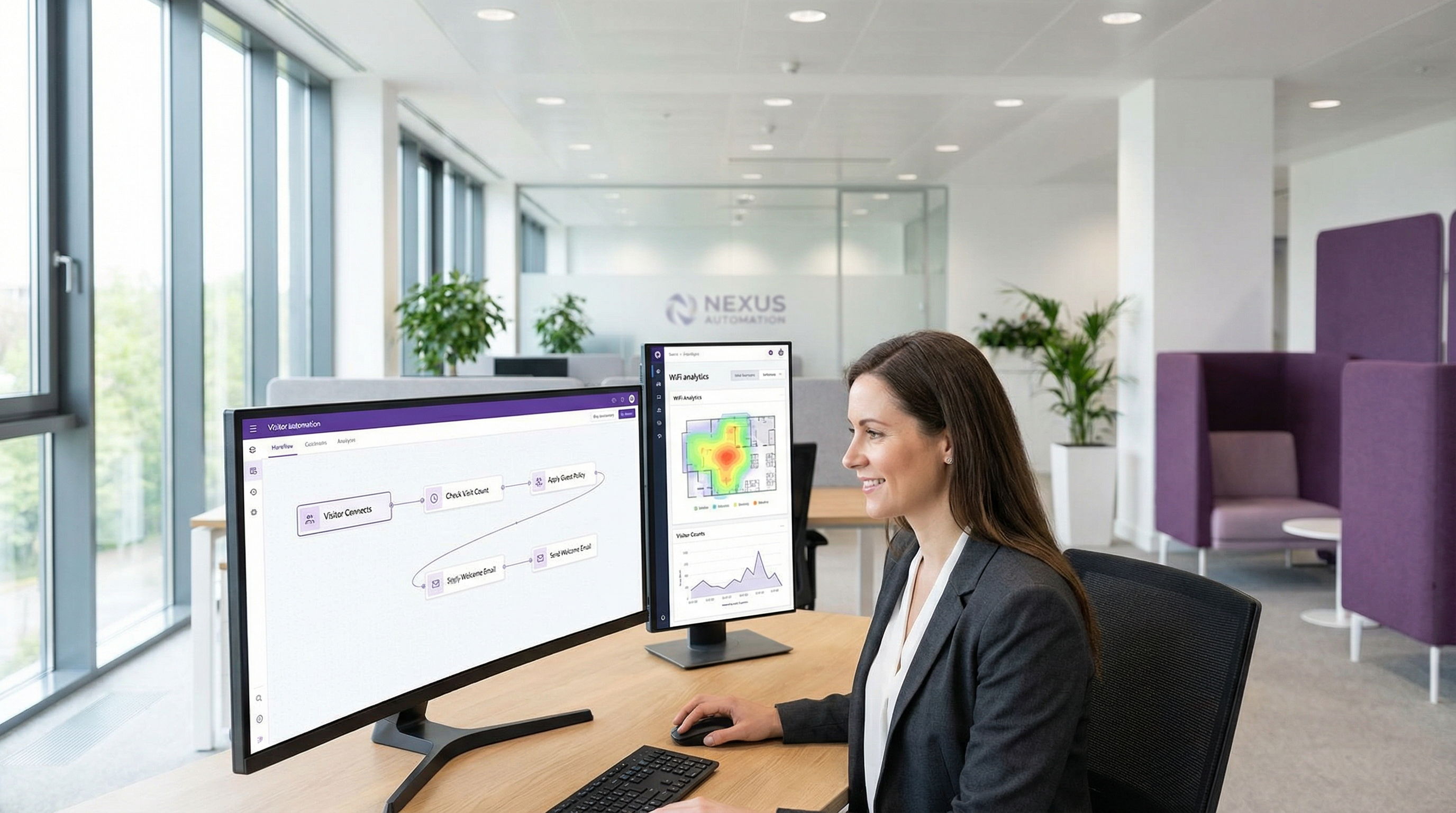
एंटरप्राइज़ नेटवर्किंग के प्रतिस्पर्धी परिदृश्य में, रियल-टाइम इवेंट्स के लिए रिस्पॉन्स को ऑटोमेट करने की क्षमता अब कोई विलासिता नहीं बल्कि एक मुख्य परिचालन आवश्यकता है। IT प्रबंधकों, नेटवर्क आर्किटेक्ट्स और वेन्यू ऑपरेटरों के लिए, चुनौती कच्चे नेटवर्क डेटा को तत्काल, मूल्य-संचालित कार्यों में बदलने में है। Purple का LogicFlow एक एंटरप्राइज़-ग्रेड ऑटोमेशन इंजन है जिसे सीधे इस चुनौती का समाधान करने के लिए डिज़ाइन किया गया है। यह WiFi और विज़िटर-संबंधित इवेंट्स की एक विस्तृत श्रृंखला द्वारा ट्रिगर किए गए परिष्कृत वर्कफ़्लो बनाने के लिए एक विज़ुअल, ड्रैग-एंड-ड्रॉप इंटरफ़ेस प्रदान करता है। यह गाइड LogicFlow में एक तकनीकी डीप-डाइव के रूप में कार्य करती है, जो मार्केटिंग के सार से आगे बढ़कर कार्रवाई योग्य कार्यान्वयन मार्गदर्शन प्रदान करती है। हम प्लेटफ़ॉर्म के आर्किटेक्चर का विश्लेषण करेंगे, हॉस्पिटैलिटी और रिटेल जैसे उद्योगों में सामान्य परिनियोजन (deployment) परिदृश्यों का पता लगाएंगे, और परिचालन दक्षता, बेहतर गेस्ट एंगेजमेंट और जोखिम न्यूनीकरण के संदर्भ में ROI की मात्रा निर्धारित करेंगे। CTO के लिए, यह दस्तावेज़ मौजूदा WiFi इन्फ्रास्ट्रक्चर को एक सक्रिय, बुद्धिमान प्रणाली के रूप में उपयोग करने की रणनीति की रूपरेखा तैयार करता है जो व्यावसायिक परिणाम देता है। IT प्रबंधक और डेवलपर के लिए, यह मजबूत, स्वचालित वर्कफ़्लो तैनात करने के लिए एक व्यावहारिक पुस्तिका है जो GDPR और PCI DSS जैसे प्रमुख अनुपालन मानकों के साथ संरेखित होती है, जिससे सुरक्षा और एक सहज उपयोगकर्ता अनुभव दोनों सुनिश्चित होते हैं。
तकनीकी डीप-डाइव
LogicFlow Purple प्लेटफ़ॉर्म के केंद्रीय तंत्रिका तंत्र (central nervous system) के रूप में कार्य करता है, जो पूर्व-निर्धारित कार्यों को ट्रिगर करने के लिए डेटा पॉइंट्स की एक निरंतर स्ट्रीम को प्रोसेस करता है। इसका आर्किटेक्चर तीन मुख्य अवधारणाओं के इर्द-गिर्द बनाया गया है: इवेंट्स (Events), निर्णय (Decisions), और एक्शन्स (Actions)। यह मॉडल जटिल, स्टेटफुल वर्कफ़्लो के निर्माण की अनुमति देता है जो रियल-टाइम में बदलती परिस्थितियों के अनुकूल हो सकते हैं।
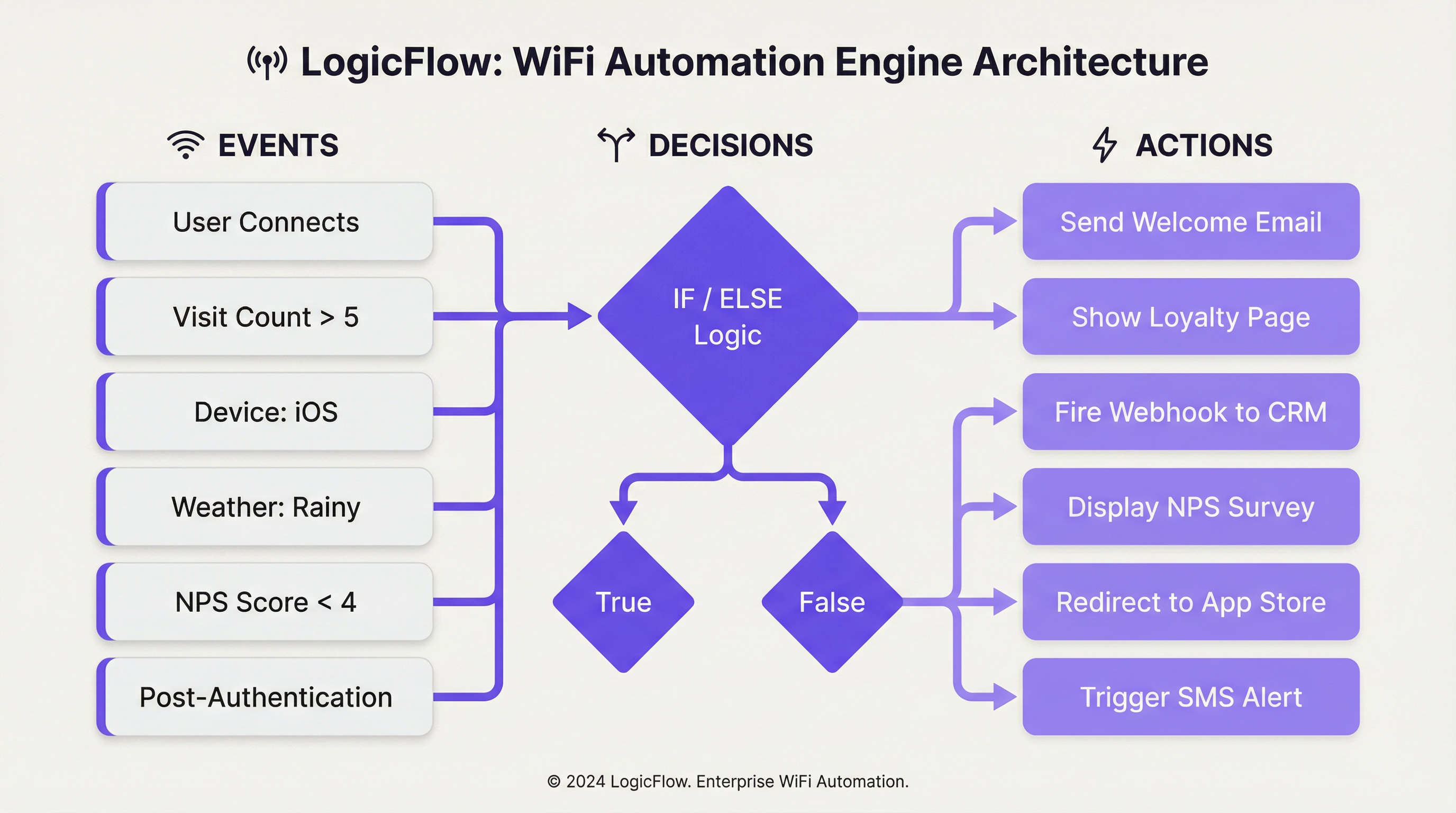
इवेंट ट्रिगर्स: प्रक्रिया तब शुरू होती है जब किसी इवेंट का पता चलता है। LogicFlow ट्रिगर्स के एक व्यापक सेट का समर्थन करता है, जिन्हें मोटे तौर पर वर्गीकृत किया जा सकता है:
| श्रेणी | विशिष्ट ट्रिगर्स | तकनीकी संदर्भ |
|---|---|---|
| ऑनबोर्डिंग इवेंट्स | प्री-ऑथेंटिकेशन, पोस्ट-ऑथेंटिकेशन, ऑनलाइन | ये गेस्ट WiFi कनेक्शन यात्रा के विभिन्न चरणों से मेल खाते हैं। प्री-ऑथेंटिकेशन कार्रवाइयां सीमित होती हैं क्योंकि उपयोगकर्ता अभी तक ऑनलाइन नहीं है, जबकि पोस्ट-ऑथेंटिकेशन और ऑनलाइन ट्रिगर्स एक समृद्ध डेटासेट का लाभ उठा सकते हैं। |
| विज़िटर डेमोग्राफिक्स | आयु, लिंग, भाषा, ईमेल पता, विज़िट काउंट | Captive Portal लॉगिन फ़ॉर्म या सोशल साइन-ऑन से प्राप्त, यह डेटा अत्यधिक वैयक्तिकृत उपयोगकर्ता यात्राओं को सक्षम बनाता है। इस डेटा का उपयोग करते समय GDPR जैसे डेटा गोपनीयता नियमों का अनुपालन सर्वोपरि है। |
| डिवाइस और नेटवर्क | ऑपरेटिंग सिस्टम, ब्राउज़र, SSID, एक्सेस पॉइंट MAC/नाम, निर्माता | डिवाइस-विशिष्ट अनुकूलन (उदा. iOS उपयोगकर्ताओं को ऐप डाउनलोड के लिए प्रेरित करना) या उपयोगकर्ता किस AP से जुड़ा है, उसके आधार पर स्थान-विशिष्ट कार्रवाइयों के लिए आवश्यक है। |
| पर्यावरणीय डेटा | वेन्यू लोकेशन (देश, टैग), मौसम (स्थिति, तापमान), समय/दिन/दिनांक | संदर्भ-जागरूक ऑटोमेशन की अनुमति देता है, जैसे रिटेल स्टोर के स्प्लैश पेज पर 'बारिश के दिन' का ऑफ़र प्रदर्शित करना या राष्ट्रीय छुट्टियों के आधार पर कंटेंट बदलना। |
| उपयोगकर्ता व्यवहार | NPS रिस्पॉन्स, माइक्रो-सर्वे उत्तर, लॉगिन विधि, सशुल्क WiFi प्लान | सीधे उपयोगकर्ता फ़ीडबैक या विकल्पों पर आधारित ट्रिगर्स, जो तत्काल सर्विस रिकवरी या अपसेलिंग के अवसरों को सक्षम करते हैं। |
डिसीजन नोड्स (Decision Nodes): एक बार इवेंट ट्रिगर होने के बाद, इसे डिसीजन नोड में पास किया जाता है। यहीं पर LogicFlow का 'लॉजिक' रहता है। 'True/False' या 'If/Else' स्टेटमेंट्स का उपयोग करके, एडमिनिस्ट्रेटर इवेंट डेटा द्वारा पूरी की गई शर्तों के आधार पर ब्रांचिंग पाथ बना सकते हैं। उदाहरण के लिए, एक 'If/Else' नोड विज़िटर के visit_count की जांच कर सकता है। यदि यह 5 से अधिक है (एक वफादार ग्राहक), तो यह 'True' पाथ का अनुसरण करता है; अन्यथा, यह नए विज़िटर्स के लिए 'False' पाथ का अनुसरण करता है। 'AND'/'OR' लॉजिक का उपयोग करके कई शर्तों को समूहीकृत किया जा सकता है, जिससे अत्यधिक ग्रैन्युलर टारगेटिंग की अनुमति मिलती है।
एक्शन नोड्स (Action Nodes): अंतिम चरण एक्शन नोड है, जो एक विशिष्ट कार्य निष्पादित करता है। कार्रवाइयां इवेंट के प्रकार के आधार पर संदर्भ-निर्भर होती हैं।
- प्री-ऑथेंटिकेशन: मुख्य रूप से
Splash Pageएक्शन, जो स्थान या दिन के समय के आधार पर डायनामिक ब्रांडिंग की अनुमति देता है। - पोस्ट-ऑथेंटिकेशन: इसमें कार्रवाइयों की एक विस्तृत श्रृंखला उपलब्ध है, जिसमें
NPS/Micro-surveyप्रस्तुति, किसी थर्ड-पार्टी सिस्टम परWebhookफ़ायर करना,Mediaडिस्प्ले (उदा. एक वीडियो विज्ञापन), याPaid WiFiटियर असाइन करना शामिल है। - ऑनलाइन: वे कार्रवाइयां जो उपयोगकर्ता को पूर्ण नेटवर्क एक्सेस मिलने के बाद होती हैं, जैसे किसी विशिष्ट URL पर
Redirectकरना,Email/SMS Campaignभेजना, या उनकी अगली विज़िट पर एक अलगSplash Pageप्रदर्शित करना।
यह संरचित दृष्टिकोण सुनिश्चित करता है कि वर्कफ़्लो शक्तिशाली और रखरखाव योग्य दोनों हैं, जो ऑटोमेशन और इवेंट-संचालित आर्किटेक्चर के लिए मानक सर्वोत्तम प्रथाओं का पालन करते हैं।
कार्यान्वयन गाइड
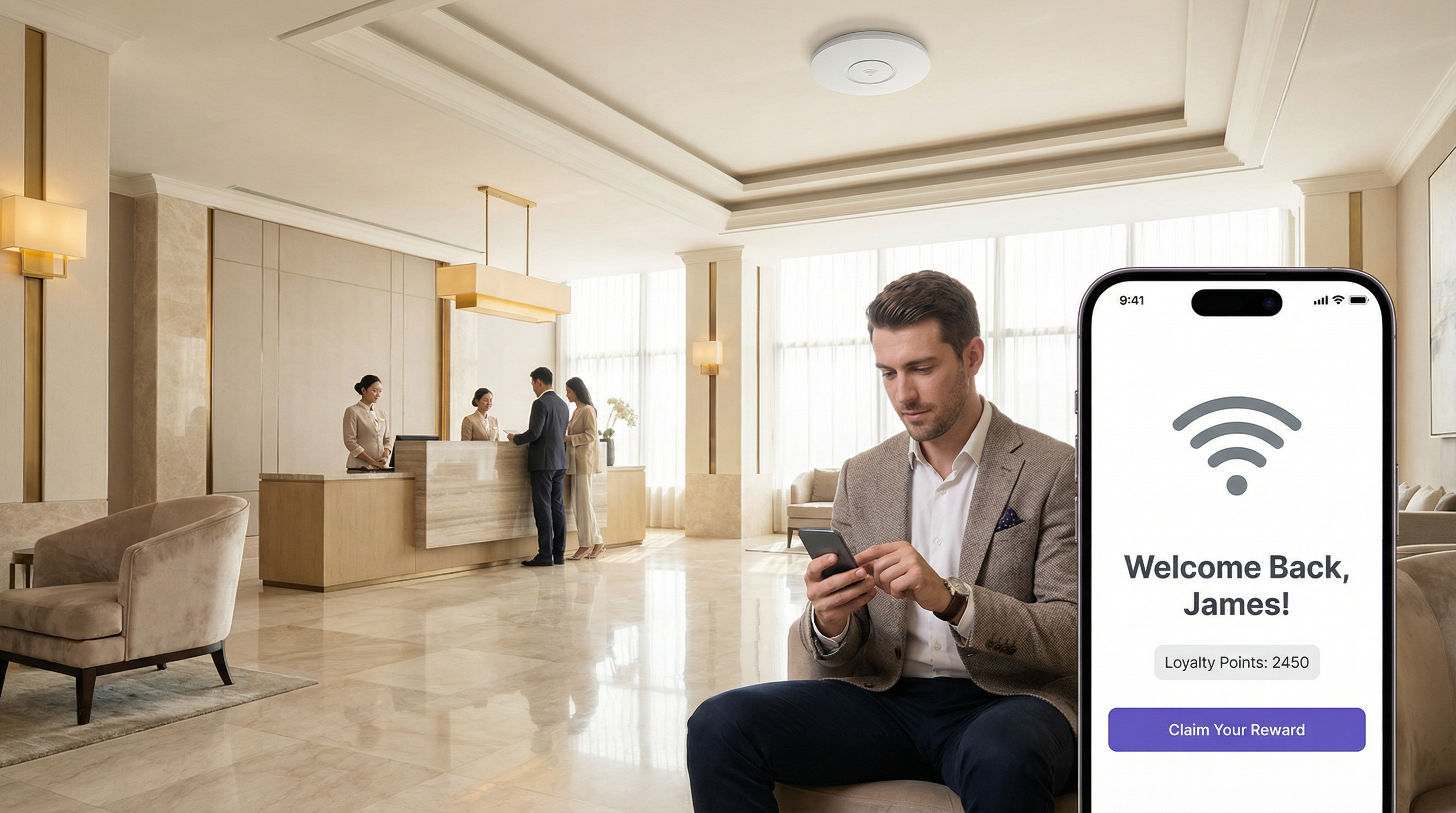
LogicFlow को प्रभावी ढंग से तैनात करने के लिए एक संरचित दृष्टिकोण की आवश्यकता होती है, जो रणनीतिक लक्ष्यों से सामरिक कॉन्फ़िगरेशन की ओर बढ़ता है। निम्नलिखित चरण कार्यान्वयन के लिए एक वेंडर-न्यूट्रल फ्रेमवर्क प्रदान करते हैं।
चरण 1 — व्यावसायिक उद्देश्यों को परिभाषित करें: कोई भी वर्कफ़्लो बनाने से पहले, वांछित परिणाम को स्पष्ट रूप से परिभाषित करें। क्या लक्ष्य लॉयल्टी ऐप डाउनलोड बढ़ाना है, गेस्ट संतुष्टि स्कोर में सुधार करना है, या किसी विशिष्ट क्षेत्र में फुटफॉल (आवाजाही) बढ़ाना है? एक स्पष्ट उद्देश्य आवश्यक ट्रिगर्स और कार्रवाइयों को निर्धारित करता है।
चरण 2 — कस्टमर जर्नी को मैप करें: विज़िटर अनुभव में उन प्रमुख टचपॉइंट्स की पहचान करें जहां ऑटोमेशन मूल्य जोड़ सकता है। यह आमतौर पर WiFi एक्सेस यात्रा के प्री-ऑथेंटिकेशन, पोस्ट-ऑथेंटिकेशन और ऑनलाइन चरणों के साथ संरेखित होता है।
चरण 3 — वर्कफ़्लो बनाएं: एक एकल, सरल वर्कफ़्लो से शुरुआत करें। उदाहरण के लिए, लौटने वाले विज़िटर्स के लिए 'Welcome Back' संदेश। LogicFlow v2 के भीतर, 'Add logic flow' चुनें और उपयुक्त इवेंट प्रकार चुनें। कैनवास पर एक 'Visitor' डिसीजन नोड खींचें और इसे 'True/False' शर्त के साथ कॉन्फ़िगर करें: visit_count, 1 से greater than (अधिक) है। 'True' पाथ के लिए, एक Email Campaign एक्शन नोड जोड़ें और पूर्व-कॉन्फ़िगर किया गया 'Welcome Back' ईमेल टेम्प्लेट चुनें। 'False' पाथ (नए विज़िटर्स) के लिए, एक अलग एक्शन जोड़ें, जैसे 'First Visit Discount' ईमेल। सभी नोड्स को कनेक्ट करें, यह सुनिश्चित करते हुए कि प्रत्येक पाथ 'End' नोड के साथ समाप्त होता है।
चरण 4 — मान्य (Validate) और प्रकाशित (Publish) करें: लॉजिक में त्रुटियों की जांच करने के लिए अंतर्निहित 'Validate' टूल का उपयोग करें। मान्य होने के बाद, वर्कफ़्लो को 'Publish' करें।
चरण 5 — एक्सेस जर्नी को असाइन करें: प्रकाशित LogicFlow को एक विशिष्ट एक्सेस जर्नी (किसी दिए गए वेन्यू या SSID के लिए Captive Portal अनुभव) से लिंक करें। यह वर्कफ़्लो को सक्रिय करता है।
चरण 6 — मॉनिटर और इटरेट करें: वर्कफ़्लो के प्रभाव को मापने के लिए प्लेटफ़ॉर्म के एनालिटिक्स का उपयोग करें। ईमेल ओपन रेट, रिडेम्पशन रेट और विज़िट फ़्रीक्वेंसी को ट्रैक करें। समय के साथ लॉजिक को परिष्कृत करने और प्रदर्शन को बेहतर बनाने के लिए इस डेटा का उपयोग करें।
सर्वोत्तम प्रथाएं
सरल शुरुआत करें, समझदारी से स्केल करें: शुरुआत से ही अत्यधिक जटिल, मोनोलिथिक वर्कफ़्लो बनाने से बचें। सिंगल-पर्पस फ़्लो से शुरू करें और जैसे-जैसे आप आत्मविश्वास हासिल करते हैं और डेटा इकट्ठा करते हैं, उन्हें संयोजित करें। मापने योग्य परिणाम देने वाला एक अच्छी तरह से ट्यून किया गया वर्कफ़्लो दस खराब-लक्षित वर्कफ़्लो से अधिक मूल्यवान है।
अनुपालन मानकों का पालन करें: डेमोग्राफिक डेटा का उपयोग करते समय, सुनिश्चित करें कि आपका लॉजिक उपयोगकर्ता की सहमति का सम्मान करता है और GDPR जैसे नियमों के साथ संरेखित है। एक डिसीजन नोड बनाएं जो किसी भी मार्केटिंग कार्रवाई को ट्रिगर करने से पहले emailable फ़्लैग की जांच करता है। भुगतान डेटा को संभालने वाले वेन्यू के लिए, सुनिश्चित करें कि वित्तीय लेनदेन से जुड़े वर्कफ़्लो की PCI DSS आवश्यकताओं के विरुद्ध समीक्षा की गई है।
इंटीग्रेशन के लिए वेबहुक (Webhooks) का लाभ उठाएं: वेबहुक LogicFlow की क्षमताओं को बढ़ाने के लिए एक शक्तिशाली टूल हैं। बाहरी CRM सिस्टम में डेटा पुश करने, ऑपरेशनल डैशबोर्ड (जैसे Slack या Microsoft Teams) में अलर्ट ट्रिगर करने, या बिल्डिंग मैनेजमेंट सिस्टम के साथ इंटीग्रेट करने के लिए उनका उपयोग करें। यह एक वेंडर-न्यूट्रल, API-फ़र्स्ट इंटीग्रेशन रणनीति को बढ़ावा देता है जो आपके प्रौद्योगिकी निवेश की सुरक्षा करता है।
नामकरण परंपराओं (Naming Conventions) का उपयोग करें: जैसे-जैसे वर्कफ़्लो की संख्या बढ़ती है, एक सुसंगत नामकरण परंपरा — उदाहरण के लिए, [Venue]-[Objective]-[Trigger] — रखरखाव और टीम सहयोग के लिए आवश्यक हो जाती है।
नियमित रूप से ऑडिट और प्रून करें: यह सुनिश्चित करने के लिए समय-समय पर सभी सक्रिय वर्कफ़्लो की समीक्षा करें कि वे वर्तमान व्यावसायिक उद्देश्यों के साथ संरेखित रहें। जटिलता को कम करने और अनपेक्षित परिणामों के जोखिम को कम करने के लिए अप्रचलित फ़्लो को निष्क्रिय या आर्काइव करें।
समस्या निवारण और जोखिम न्यूनीकरण
समस्या — वर्कफ़्लो ट्रिगर नहीं हो रहा है: सबसे आम समस्या असाइनमेंट में गलत कॉन्फ़िगरेशन है। सत्यापित करें कि LogicFlow सही ढंग से प्रकाशित है और लक्ष्य वेन्यू या SSID के लिए सक्रिय एक्सेस जर्नी को असाइन किया गया है। डिसीजन नोड्स के भीतर लॉजिक की भी जांच करें; अत्यधिक प्रतिबंधात्मक शर्त ट्रिगर को फ़ायर होने से रोक सकती है।
समस्या — अनपेक्षित उपयोगकर्ता अनुभव: कई शाखाओं वाले जटिल वर्कफ़्लो से अप्रत्याशित परिणाम हो सकते हैं। लाइव वातावरण में रोल आउट करने से पहले 'Validate' टूल का उपयोग करें और गैर-उत्पादन SSID के साथ पूरी तरह से परीक्षण करें। संचालन के क्रम पर विचार करें, विशेष रूप से पोस्ट-ऑथेंटिकेशन फ़्लो में जहां कई कार्रवाइयां (उदा. एक सर्वेक्षण और एक रीडायरेक्ट) प्रतिस्पर्धा कर सकती हैं।
जोखिम — अलर्ट फटीग (Alert Fatigue): ईमेल या वेबहुक के माध्यम से अलर्ट को ऑटोमेट करना शक्तिशाली है, लेकिन यदि इसे सावधानी से प्रबंधित नहीं किया जाता है तो यह 'अलर्ट फटीग' का कारण बन सकता है। ऐसा डिसीजन लॉजिक लागू करें जो केवल उच्च-प्राथमिकता वाले इवेंट्स के लिए अलर्ट ट्रिगर करता है — उदाहरण के लिए, 1 से 3 का NPS स्कोर, जो एक महत्वपूर्ण सेवा विफलता का संकेत देता है — न कि हर एक कनेक्शन इवेंट के लिए।
जोखिम — डेटा गोपनीयता उल्लंघन: व्यक्तिगत डेटा (आयु, लिंग, ईमेल) का उपयोग एक प्रमुख विशेषता है लेकिन एक महत्वपूर्ण जिम्मेदारी भी है। न्यूनीकरण में डेटा न्यूनीकरण के सिद्धांत का कड़ाई से पालन शामिल है। केवल एक विशिष्ट, परिभाषित उद्देश्य के लिए आवश्यक डेटा एकत्र करें, और सुनिश्चित करें कि इस डेटा का उपयोग करने वाले सभी वर्कफ़्लो उपयोगकर्ता की सहमति की जांच करते हैं। GDPR दायित्वों के विरुद्ध नियमित रूप से फ़्लो की समीक्षा करें और एक अद्यतित डेटा प्रोसेसिंग रजिस्टर बनाए रखें।
ROI और व्यावसायिक प्रभाव
परिचालन दक्षता: सर्विस रिकवरी अलर्ट या लॉयल्टी प्रोग्राम साइन-अप जैसे कार्यों को ऑटोमेट करने से कर्मचारियों पर मैन्युअल कार्यभार कम हो जाता है। यदि कोई गेस्ट WiFi से कनेक्ट होने के बाद खराब NPS रेटिंग छोड़ता है, तो एक होटल स्वचालित रूप से एक मेंटेनेंस टिकट ट्रिगर कर सकता है और फ्रंट डेस्क मैनेजर को सचेत कर सकता है, जिससे तत्काल हस्तक्षेप संभव हो जाता है। यह सीधे तौर पर कम परिचालन ओवरहेड और तेज़ समस्या समाधान में तब्दील होता है — जिसे बचाए गए स्टाफ घंटों और गेस्ट संतुष्टि स्कोर में मापा जा सकता है।
बढ़ी हुई कस्टमर लाइफटाइम वैल्यू (CLV): गेस्ट अनुभव को वैयक्तिकृत करके, वेन्यू वफादारी और रिपीट बिज़नेस बढ़ा सकते हैं। एक रिटेल चेन जो 90 दिनों से न देखे गए विज़िटर्स को लक्षित डिस्काउंट वाउचर भेजने के लिए LogicFlow का उपयोग करती है, वह सक्रिय रूप से ग्राहक मंथन (customer churn) को रोकने के लिए काम कर रही है। इसकी सफलता को इन ऑफ़र की रिडेम्पशन दर और लक्षित समूह की बाद की विज़िट फ़्रीक्वेंसी को ट्रैक करके मापा जा सकता है।
बेहतर वेन्यू इंटेलिजेंस: LogicFlow द्वारा उत्पन्न डेटा विज़िटर के व्यवहार में गहरी अंतर्दृष्टि प्रदान करता है। एक स्टेडियम विशिष्ट APs के पास डिवाइस घनत्व को ट्रैक करके यह विश्लेषण कर सकता है कि विशिष्ट अवधि के दौरान कौन से रियायती क्षेत्र (concession areas) सबसे लोकप्रिय हैं, और भविष्य के इवेंट्स के लिए स्टाफिंग और इन्वेंट्री को अनुकूलित करने के लिए इस डेटा का उपयोग कर सकता है। वेन्यू प्रबंधन के लिए यह डेटा-संचालित दृष्टिकोण उच्च थ्रूपुट और प्रति विज़िटर राजस्व में वृद्धि की ओर ले जाता है।
अनुपालन और जोखिम न्यूनीकरण: अनुपालन जांच को ऑटोमेट करना — जैसे यह सुनिश्चित करना कि प्रत्येक उपयोगकर्ता को वर्ष की उनकी पहली विज़िट पर नवीनतम नियम और शर्तें प्रस्तुत की जाएं — कानूनी और वित्तीय जोखिम को कम करता है। GDPR जैसे नियमों का पालन न करने की लागत पर्याप्त हो सकती है, जिससे स्वचालित प्रवर्तन (automated enforcement) किसी भी ROI गणना का एक महत्वपूर्ण घटक बन जाता है।
Key Terms & Definitions
LogicFlow
A visual, drag-and-drop workflow automation engine within the Purple platform that enables the triggering of specific actions based on a wide range of WiFi events, visitor demographics, device data, and environmental context.
IT teams use LogicFlow to move beyond providing simple connectivity, transforming their WiFi network into an intelligent, responsive system that can drive marketing, operational, and security objectives without manual intervention.
Event-Driven Architecture (EDA)
A software architecture paradigm that promotes the production, detection, consumption of, and reaction to events. LogicFlow is a practical, no-code application of EDA principles for enterprise WiFi networks.
For a network architect, understanding that LogicFlow is based on EDA principles clarifies its asynchronous, non-blocking nature. It is not about polling for status; it is about reacting instantly when a specific event, such as a new user connection or a negative survey response, occurs.
Webhook
An automated HTTP callback sent from one application to another when a specific event occurs. In LogicFlow, a webhook is an action node that can push data to an external system in real-time upon a trigger condition being met.
A developer can use a webhook action in LogicFlow to send guest data to a corporate CRM, trigger an alert in a Slack channel, or instruct a building management system to take an action, providing limitless integration possibilities with any platform that exposes a REST API.
Access Journey
The complete sequence of steps and pages a visitor interacts with from the moment they connect to a WiFi SSID to the point they are granted online access. A published LogicFlow must be assigned to an Access Journey to become active.
Venue operations directors are concerned with the Access Journey as a whole. LogicFlow gives them the power to make this journey dynamic, ensuring the branding, messaging, and any required steps are appropriate for the specific venue, event, or user type.
Captive Portal
A web page that is displayed to newly connected users of a WiFi network before they are granted broader access to network resources. It is the primary source of demographic and consent data for many LogicFlow triggers.
While IT managers deploy captive portals for authentication and security, LogicFlow allows them to transform the portal from a simple gatekeeper into a strategic tool for data collection and personalised engagement, without requiring changes to the underlying network infrastructure.
Decision Node
A component in the LogicFlow canvas that evaluates incoming event data against a set of predefined conditions and directs the workflow down a specific path based on the outcome, using True/False or If/Else logic.
For an IT professional configuring a workflow, the Decision Node is the core component for creating targeted logic. It is where the 'if-then' intelligence of the automation is defined, ensuring actions are only performed on the intended segment of users.
SSID (Service Set Identifier)
The public name of a wireless local area network (WLAN). A single venue may broadcast multiple SSIDs — for example, 'Hotel-Guest', 'Hotel-Conference', and 'Hotel-Staff' — each of which can be assigned a different Access Journey and LogicFlow.
Network architects can use the SSID as a trigger in LogicFlow to apply completely different automation rules depending on which network a user connects to, ensuring that a conference delegate and a hotel guest in the same building have entirely different and contextually appropriate online experiences.
GDPR (General Data Protection Regulation)
A regulation in EU law on data protection and privacy for all individuals within the European Union and the European Economic Area, governing how personal data is collected, processed, and stored.
When a CTO or IT Manager designs a LogicFlow that uses personal data such as email address or age, they must build in checks to ensure compliance with GDPR. This means using LogicFlow's capabilities to verify consent before triggering any marketing actions, mitigating significant legal and financial risk.
NPS (Net Promoter Score)
A widely used customer experience metric that measures customer loyalty by asking respondents to rate, on a scale of 0 to 10, how likely they are to recommend a product or service. Scores of 9–10 are Promoters, 7–8 are Passives, and 0–6 are Detractors.
In LogicFlow, an NPS survey can be presented as a Post-Authentication or Online action, and the resulting score can be used as a decision trigger. This enables real-time service recovery for Detractors and automated review solicitation for Promoters, directly impacting online reputation management.
Case Studies
A 500-room luxury hotel wants to improve its guest satisfaction scores and encourage positive online reviews. They have identified two key visitor segments: first-time guests and returning VIP members. How can they use LogicFlow to create a tailored experience for each segment?
The IT Director implements a multi-path LogicFlow triggered on the 'Post-Authentication' event.
Workflow Configuration:
- Start Node: Triggers after a guest successfully authenticates on the hotel WiFi.
- Decision Node 1 (If/Else): Checks the visitor's profile for a 'VIP Member' tag, synced from the hotel's Property Management System via the Purple API.
- IF True (VIP Member): Route to Path A.
- ELSE (First-Time or Regular Guest): Route to Path B.
- Path A — VIP Member:
- Action Node 1:
Redirectthe guest to a personalised welcome page (https://hotel.com/vip-welcome) with exclusive offers and an upgrade prompt. - Action Node 2:
Email Campaigntriggered with a 1-hour delay, sending a 'Welcome Back' email with a direct link to book spa treatments.
- Action Node 1:
- Path B — First-Time Guest:
- Action Node 1:
NPS Surveypresented immediately to capture initial sentiment. - Decision Node 2 (If/Else): Evaluates the NPS Survey response.
- IF
NPS Scoreis between 9 and 10 (Promoter): Trigger anEmail Campaignwith a 24-hour delay, thanking the guest and providing a direct link to leave a review on TripAdvisor. - ELSE (Score 0–8): Trigger a
Webhookaction that sends an immediate alert to the Front Desk Manager's Slack channel with the guest's name and room number, enabling proactive service recovery.
- IF
- Action Node 1:
- End Node: All paths terminate here.
A large retail shopping centre with over 200 stores wants to increase downloads of its new loyalty and wayfinding app. How can they leverage their existing guest WiFi infrastructure to drive app adoption without disrupting the experience for loyal customers?
The Head of Digital Marketing deploys a LogicFlow that specifically targets users based on device type and visit frequency.
Workflow Configuration:
- Start Node: Triggers on the 'Online' event, once the visitor has full network access.
- Decision Node 1 (True/False): Checks if
visit_countisless than3. This targets newer visitors who are less likely to have downloaded the app. - Decision Node 2 (True/False): Nested under the 'True' path of Node 1. Checks if
Operating SystemisiOSORAndroid. This filters out laptops and other non-mobile devices where an app download is not relevant. - Action Node (True path of Node 2):
Redirectthe user to a custom, mobile-friendly landing page. This page explains the benefits of the app — interactive maps, exclusive offers, loyalty points — and has prominent, one-click buttons to the Apple App Store and Google Play Store. - Alternative Paths: The 'False' path from either decision node (a visitor with more than 3 visits, or a laptop user) proceeds without any redirect, ensuring a standard browsing experience for loyal customers or those on non-mobile devices.
- End Node: All paths terminate here.
Scenario Analysis
Q1. A multi-national coffee chain wants to ensure a consistent global brand experience while also promoting location-specific specials. How would you configure LogicFlow to show a global branding page to all visitors, but also surface a location-specific offer for visitors in specific cities?
💡 Hint:Consider using a combination of Pre-Authentication and Online event triggers. How can venue tags or venue names be used as decision criteria?
Show Recommended Approach
You would implement two LogicFlows. The first is a Pre-Authentication flow assigned globally to all venues. It contains a single Action node to display the main corporate-branded Splash Page, ensuring brand consistency across all locations. The second is an Online flow. It uses a Decision node based on 'Venue Name' or 'Venue Tags'. For each specific venue (e.g., tagged 'London-Covent-Garden'), you create a path that redirects the user to a page for the local special offer. Venues without a specific tag follow a default path with no redirect. This layered approach meets both requirements without requiring separate infrastructure configurations per venue.
Q2. A stadium is hosting a major sporting event and wants to manage network congestion. How could LogicFlow be used to mitigate performance issues for general attendees while preserving bandwidth for press and VIP guests?
💡 Hint:Think about how different SSIDs can be used in conjunction with LogicFlow. What actions can influence user behaviour to reduce bandwidth consumption during peak periods?
Show Recommended Approach
The network architect should configure multiple SSIDs: 'Stadium-Public', 'Stadium-VIP', and 'Stadium-Press'. The VIP and Press SSIDs receive higher QoS priority at the network infrastructure level (IEEE 802.11e/WMM). A LogicFlow is then applied to the 'Stadium-Public' Access Journey with a 'Day/Time' decision node. During peak periods such as halftime, the flow triggers a 'Redirect' action that sends public users to a cached, lightweight page with game statistics and social media feeds rather than allowing unrestricted internet access. This contains traffic and reduces load on the main internet uplink. The VIP and Press SSIDs have no such restriction, preserving their performance for critical use cases.
Q3. A conference centre wants to gather feedback on individual speaker sessions. How can they use LogicFlow to send a targeted micro-survey to attendees shortly after a specific session ends, without surveying attendees who were in a different room?
💡 Hint:This requires integrating location data from the network infrastructure. How can AP naming conventions and time-based triggers be combined to achieve room-level targeting?
Show Recommended Approach
This use case requires precise AP naming. Each conference room's access points are named with a room identifier (e.g., 'Room-101-AP1'). An Online LogicFlow uses a Decision node checking the 'Access Point Name' field. If a user was associated with an AP containing 'Room-101' between the session start and end times (using the 'Time' decision node), they are added to a tagged segment. A second LogicFlow, triggered 15 minutes after the session end time, sends an Email Campaign or Micro Survey to all visitors in that segment, asking specifically about the session in Room 101. This requires disciplined AP naming conventions and careful time-based logic, but delivers highly relevant, timely feedback that is directly attributable to a specific session.
Key Takeaways
- ✓LogicFlow is Purple's visual, event-driven automation engine that transforms passive WiFi infrastructure into an intelligent, responsive business platform.
- ✓Every workflow follows the Event-Decision-Action architecture: a trigger event feeds into If/Else logic, which executes a targeted action.
- ✓Key trigger categories include visitor demographics, device and network data, environmental context (including real-time weather), and user behaviour such as NPS responses.
- ✓Common high-value use cases include real-time service recovery, personalised loyalty engagement, targeted app download campaigns, and dynamic venue branding.
- ✓Webhooks are the primary integration mechanism, enabling LogicFlow to communicate with external CRMs, operational dashboards, and building management systems via REST APIs.
- ✓GDPR compliance must be built into every marketing workflow by checking user consent flags before triggering any communications.
- ✓Implementation best practice is to start with single-purpose, clearly-scoped workflows, validate thoroughly on a non-production SSID, and iterate based on measurable outcomes.




