

MD5 Collision Attacks के विरुद्ध RADIUS को समझना और सुदृढ़ करना
This guide provides a comprehensive technical reference on the RADIUS MD5 collision vulnerability (CVE-2024-3596, 'Blast-RADIUS'), explaining how man-in-the-middle attackers can exploit weaknesses in the MD5-based Response Authenticator to forge authentication approvals without knowing user credentials. It is essential reading for IT managers, network architects, and CTOs operating enterprise WiFi in hospitality, retail, events, and public-sector environments who need to assess their exposure, apply immediate mitigations, and plan a strategic migration to modern authentication standards. The guide covers the full attack lifecycle, a phased hardening roadmap, real-world deployment scenarios, and compliance implications under PCI DSS, GDPR, and ISO 27001.
🎧 Listen to this Guide
View Transcript

कार्यकारी सारांश (Executive Summary)
RADIUS प्रोटोकॉल, जो 1991 से एंटरप्राइज़ नेटवर्क ऑथेंटिकेशन की आधारशिला है, में एक गंभीर और अब व्यावहारिक रूप से शोषण योग्य (exploitable) भेद्यता (vulnerability) है। जुलाई 2024 में CVE-2024-3596 के तहत खुलासा किया गया और 'Blast-RADIUS' नाम दिया गया, यह खामी RADIUS क्लाइंट और सर्वर के बीच स्थित एक man-in-the-middle (MitM) हमलावर को एक वैध ऑथेंटिकेशन स्वीकृति (approval) बनाने की अनुमति देती है — जो एक वैध 'Access-Reject' को 'Access-Accept' में बदल देती है — वह भी उपयोगकर्ता के पासवर्ड या साझा RADIUS सीक्रेट को जाने बिना। यह हमला MD5 chosen-prefix collision तकनीकों का फायदा उठाता है, जिन्हें आधुनिक हार्डवेयर के साथ मिनटों में निष्पादित (execute) किया जा सकता है।
वेन्यू ऑपरेटरों और एंटरप्राइज़ IT टीमों के लिए, व्यावसायिक जोखिम सीधा है: एक हमलावर जो अनधिकृत नेटवर्क एक्सेस प्राप्त करता है, वह इन्फ्रास्ट्रक्चर में लेटरल रूप से (laterally) जा सकता है, पॉइंट-ऑफ़-सेल सिस्टम तक पहुँच सकता है, अतिथि डेटा चुरा (exfiltrate) सकता है, और PCI DSS और GDPR के तहत अनुपालन उल्लंघनों (compliance violations) को ट्रिगर कर सकता है। PAP, CHAP, या MS-CHAP ऑथेंटिकेशन मोड के साथ RADIUS/UDP चलाने वाला प्रत्येक संगठन तब तक खतरे में है जब तक कि पैच लागू नहीं किए जाते और आर्किटेक्चरल बदलावों की योजना नहीं बनाई जाती। तत्काल शमन (mitigation) — सभी RADIUS ट्रैफ़िक पर Message-Authenticator एट्रिब्यूट को लागू करना — एक कम-व्यवधान (low-disruption) वाला कॉन्फ़िगरेशन बदलाव है जो सभी प्रमुख वेंडर्स से उपलब्ध है। रणनीतिक प्रतिक्रिया EAP-TLS और RADIUS over TLS (RADSEC) में चरणबद्ध माइग्रेशन है।
तकनीकी डीप-डाइव
RADIUS प्रोटोकॉल और इसकी क्रिप्टोग्राफ़िक विरासत
RFC 2865 में मानकीकृत RADIUS (Remote Authentication Dial-In User Service), उस युग में डिज़ाइन किया गया था जब नेटवर्क सुरक्षा आवश्यकताएँ मौलिक रूप से भिन्न थीं। यह प्रोटोकॉल UDP पर काम करता है और संदेश की अखंडता (integrity) प्रदान करने के लिए RADIUS क्लाइंट (आमतौर पर एक एक्सेस पॉइंट या नेटवर्क एक्सेस सर्वर) और RADIUS सर्वर के बीच एक साझा सीक्रेट (shared secret) का उपयोग करता है। विशेष रूप से, सर्वर प्रतिक्रियाओं को Response Authenticator नामक कंस्ट्रक्ट का उपयोग करके 'प्रमाणित (authenticated)' किया जाता है, जिसकी गणना इस प्रकार की जाती है:
MD5(Code || ID || Length || RequestAuthenticator || Attributes || SharedSecret)
यह निर्माण कभी भी एक उचित मैसेज ऑथेंटिकेशन कोड (MAC) नहीं था। यह HMAC से पहले का है, जिसे 1997 में विशेष रूप से रॉ हैश-आधारित MAC की कमजोरियों को दूर करने के लिए मानकीकृत किया गया था। जब HMAC पेश किया गया था, तब RADIUS विनिर्देश (specification) को अपडेट नहीं किया गया था, और न ही तब जब 2004 में पहली बार MD5 collisions का प्रदर्शन किया गया था। यह आर्किटेक्चरल ऋण (debt) अब एक गंभीर दायित्व (liability) बन गया है।
Blast-RADIUS हमले की कार्यप्रणाली (Mechanics)
Blast-RADIUS हमला (CVE-2024-3596) तीन तत्वों को जोड़ता है: RADIUS अपने Response Authenticator का निर्माण कैसे करता है, इसमें एक प्रोटोकॉल-स्तरीय भेद्यता, एक MD5 chosen-prefix collision तकनीक, और collision गणना की गति में महत्वपूर्ण सुधार जो इस हमले को रीयल-टाइम नेटवर्क इंटरसेप्शन परिदृश्य में व्यावहारिक बनाते हैं।
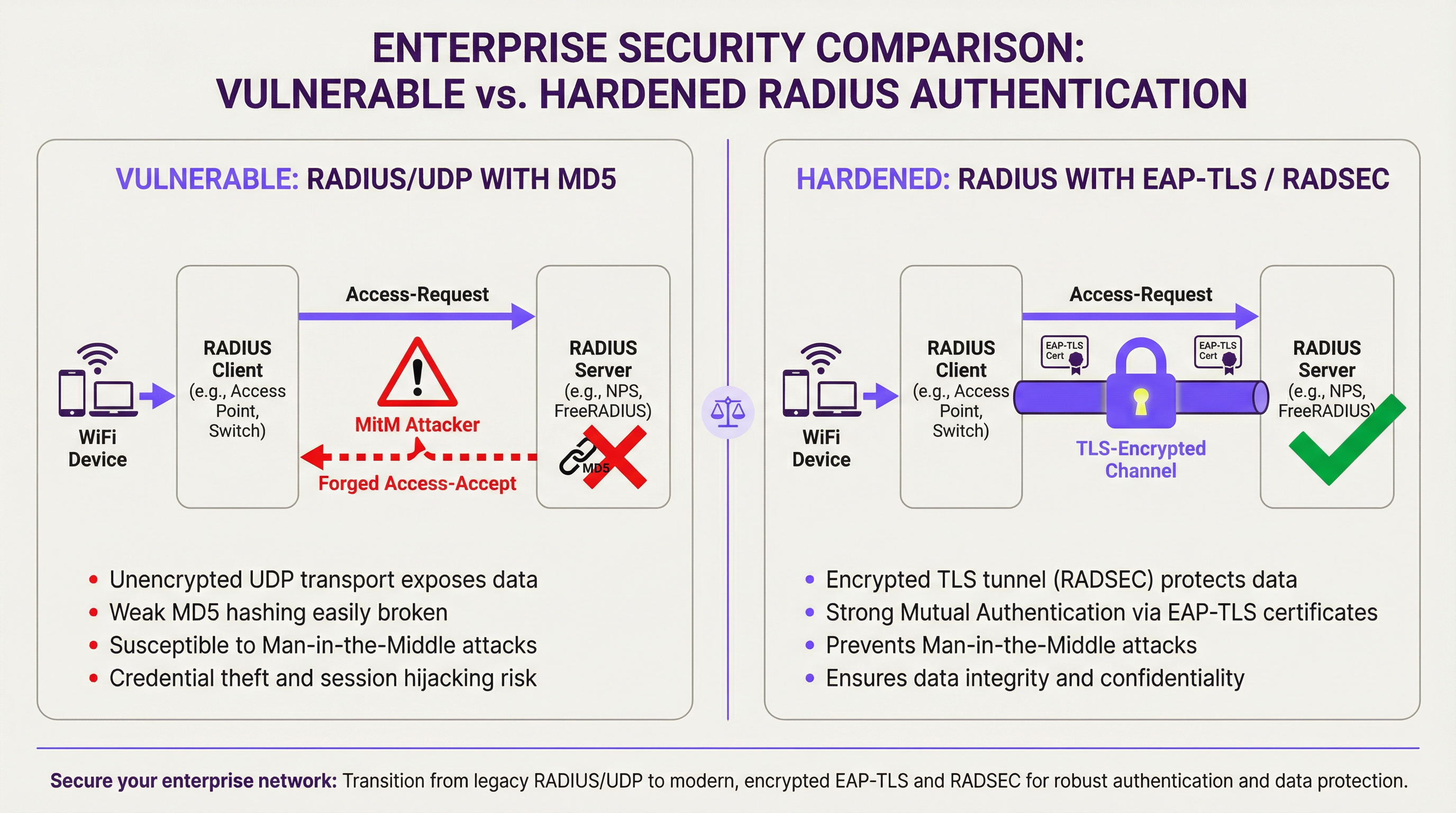
हमला इस प्रकार आगे बढ़ता है। एक MitM हमलावर RADIUS क्लाइंट से सर्वर को भेजे गए Access-Request पैकेट को इंटरसेप्ट करता है। हमलावर इस अनुरोध में एक दुर्भावनापूर्ण एट्रिब्यूट इंजेक्ट करता है — एक सावधानीपूर्वक तैयार किया गया पेलोड जो वैध सर्वर प्रतिक्रिया के MD5 हैश और हमलावर की वांछित जाली प्रतिक्रिया के MD5 हैश के बीच collision का कारण बनेगा। जब सर्वर Access-Reject (एक विफल ऑथेंटिकेशन) लौटाता है, तो हमलावर एक वैध Access-Accept पैकेट बनाने के लिए पूर्व-गणना किए गए (pre-computed) collision का उपयोग करता है, जो एक Response Authenticator के साथ पूरा होता है जिसे RADIUS क्लाइंट वास्तविक मानकर स्वीकार करेगा। हमलावर को साझा सीक्रेट या उपयोगकर्ता के क्रेडेंशियल्स जानने की आवश्यकता नहीं है।
बोस्टन यूनिवर्सिटी, यूसी सैन डिएगो, CWI एम्स्टर्डम और माइक्रोसॉफ्ट के शोधकर्ताओं ने प्रदर्शित किया कि अनुकूलित (optimised) एल्गोरिदम के साथ, इस हमले के लिए आवश्यक MD5 chosen-prefix collision की गणना कमोडिटी हार्डवेयर पर पांच मिनट से कम समय में की जा सकती है। यह RADIUS क्लाइंट और सर्वर के बीच नेटवर्क पथ तक पहुंच रखने वाले एक दृढ़ प्रतिद्वंद्वी (adversary) के लिए हमले को परिचालन रूप से (operationally) व्यवहार्य बनाता है。
प्रभावित ऑथेंटिकेशन मोड
यह भेद्यता गैर-EAP ऑथेंटिकेशन विधियों का उपयोग करने वाले सभी RADIUS/UDP परिनियोजन (deployments) को प्रभावित करती है। नीचे दी गई तालिका ऑथेंटिकेशन मोड द्वारा जोखिम को सारांशित करती है:
| ऑथेंटिकेशन मोड | प्रोटोकॉल | Blast-RADIUS के प्रति संवेदनशील? | नोट्स |
|---|---|---|---|
| PAP | Password Authentication Protocol | हाँ (Yes) | लिगेसी परिनियोजन में सबसे आम |
| CHAP | Challenge Handshake Authentication Protocol | हाँ (Yes) | PAP से थोड़ा मजबूत, फिर भी खतरे में |
| MS-CHAP / MS-CHAPv2 | Microsoft CHAP | हाँ (Yes) | Windows वातावरण में आम |
| EAP-MD5 | EAP with MD5 | हाँ (Yes) | अप्रचलित (Deprecated); पूरी तरह से बचें |
| PEAP (MSCHAPv2 inner) | Protected EAP | नहीं (No) (EAP टनल सुरक्षा करता है) | सही सर्वर प्रमाणपत्र (cert) सत्यापन की आवश्यकता है |
| EAP-TLS | EAP with TLS | नहीं (No) | अनुशंसित गोल्ड स्टैंडर्ड |
| EAP-TTLS | EAP Tunnelled TLS | नहीं (No) | स्वीकार्य विकल्प |
महत्वपूर्ण अंतर यह है कि EAP-आधारित विधियाँ ऑथेंटिकेशन के लिए अपनी स्वयं की क्रिप्टोग्राफ़िक टनल स्थापित करती हैं, जो MD5 Response Authenticator पर निर्भर नहीं है। यह उन्हें विशिष्ट Blast-RADIUS अटैक वेक्टर से सुरक्षित (immune) बनाता है।
VLAN सेगमेंटेशन पर्याप्त क्यों नहीं है
एक आम गलत धारणा यह है कि RADIUS ट्रैफ़िक को एक समर्पित (dedicated) मैनेजमेंट VLAN में अलग करने से पर्याप्त सुरक्षा मिलती है। हालाँकि नेटवर्क सेगमेंटेशन एक अच्छी सुरक्षा प्रथा है, लेकिन यह Blast-RADIUS जोखिम को समाप्त नहीं करता है। एक हमलावर जिसने पहले ही मैनेजमेंट नेटवर्क पर किसी डिवाइस से समझौता (compromise) कर लिया है — फ़िशिंग हमले, सप्लाई-चेन समझौते, या किसी अन्य भेद्यता के शोषण के माध्यम से — वह खुद को RADIUS ट्रैफ़िक पथ पर MitM के रूप में स्थापित कर सकता है। हमले के लिए केवल नेटवर्क-पथ (network-path) एक्सेस की आवश्यकता होती है, बाहरी इंटरनेट एक्सेस की नहीं। सेगमेंटेशन हमले की सतह (attack surface) को कम करता है लेकिन अंतर्निहित क्रिप्टोग्राफ़िक कमजोरी को समाप्त नहीं करता है।
कार्यान्वयन मार्गदर्शिका (Implementation Guide)
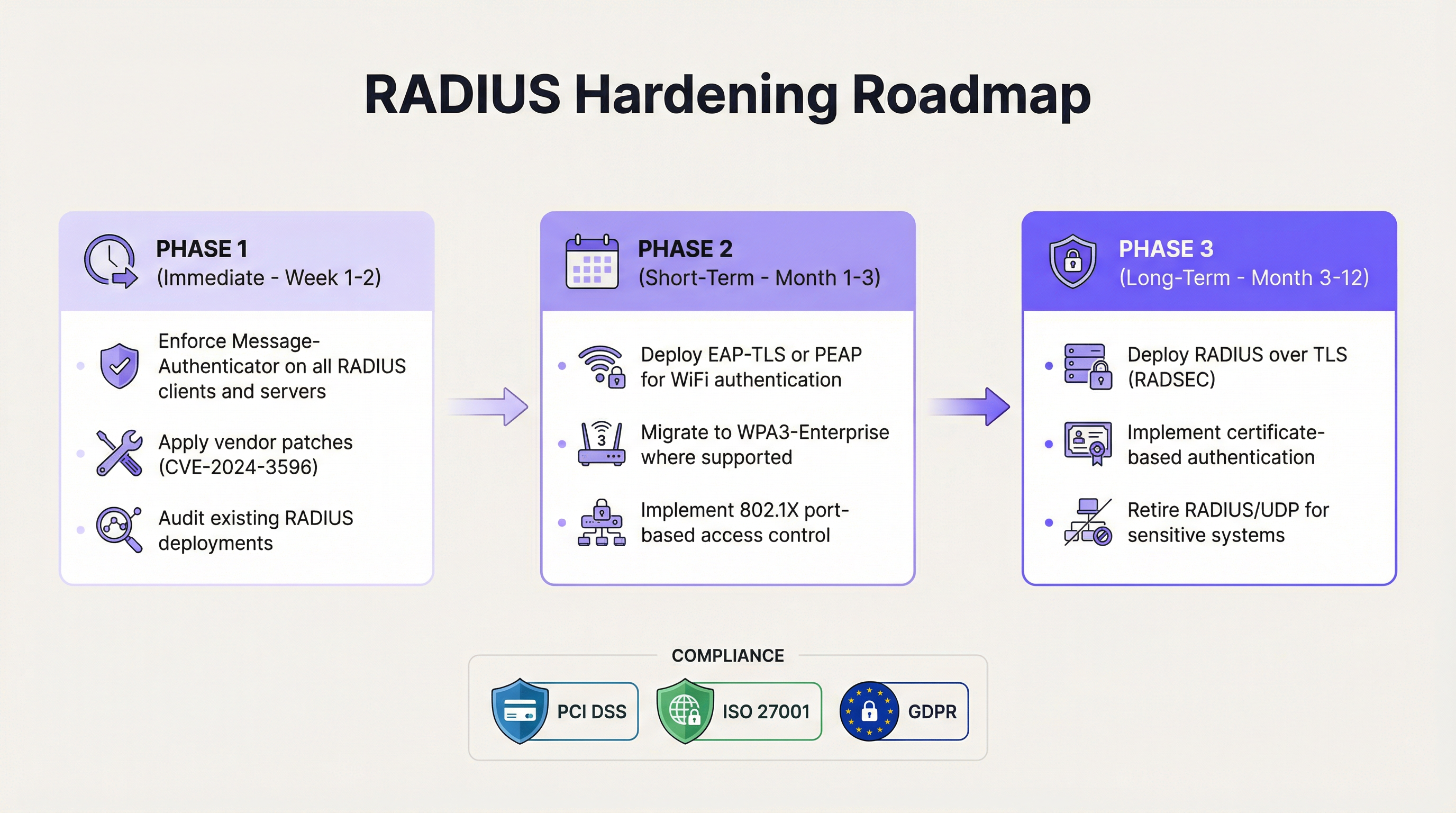
चरण 1: तत्काल सुदृढ़ीकरण (सप्ताह 1–2)
पहली प्राथमिकता सभी RADIUS इन्फ्रास्ट्रक्चर में CVE-2024-3596 के लिए वेंडर पैच लागू करना है। Cisco ISE, Microsoft NPS, FreeRADIUS, Juniper, Aruba, और Ruckus सहित सभी प्रमुख वेंडर्स ने अपडेट जारी किए हैं। पैचिंग के साथ, महत्वपूर्ण कॉन्फ़िगरेशन बदलाव सभी RADIUS क्लाइंट्स और सर्वर पर Message-Authenticator एट्रिब्यूट को लागू करना है।
Message-Authenticator एट्रिब्यूट (RFC 2869 में परिभाषित) संपूर्ण RADIUS पैकेट पर एक HMAC-MD5 अखंडता (integrity) जाँच प्रदान करता है। Response Authenticator के विपरीत, यह निर्माण chosen-prefix collision हमले के प्रति संवेदनशील नहीं है क्योंकि HMAC निर्माण हैश को साझा सीक्रेट से इस तरह से बांधता है जो हमलावर को वैध जालसाजी (forgery) करने से रोकता है। क्लाइंट्स और सर्वर को इस एट्रिब्यूट की आवश्यकता के लिए कॉन्फ़िगर करना — और किसी भी ऐसे संदेश को अस्वीकार करना जिसमें यह शामिल नहीं है — तत्काल अटैक वेक्टर को बंद कर देता है。
FreeRADIUS के लिए, इसमें clients.conf फ़ाइल में require_message_authenticator = yes सेट करना शामिल है। Microsoft NPS के लिए, समतुल्य (equivalent) नीति नेटवर्क पॉलिसी सेटिंग्स के माध्यम से लागू की जाती है। Cisco ISE के लिए, यह सेटिंग ऑथेंटिकेशन नीति के तहत RADIUS क्लाइंट कॉन्फ़िगरेशन में उपलब्ध है। सटीक कॉन्फ़िगरेशन चरणों के लिए CVE-2024-3596 के लिए अपने वेंडर की विशिष्ट एडवाइजरी देखें।
चरण 2: ऑथेंटिकेशन आधुनिकीकरण (महीने 1–3)
मध्यम अवधि का उद्देश्य WiFi ऑथेंटिकेशन को लिगेसी PAP/CHAP मोड से EAP-आधारित विधियों में माइग्रेट करना है। एंटरप्राइज़ WiFi वातावरण के लिए, अनुशंसित पथ WPA3-Enterprise with EAP-TLS है। इसके लिए डिवाइस और/या उपयोगकर्ता प्रमाणपत्र (certificates) जारी करने के लिए एक Public Key Infrastructure (PKI) तैनात करने, इन प्रमाणपत्रों को मान्य करने के लिए अपने RADIUS सर्वर को कॉन्फ़िगर करने, और उचित प्रमाणपत्रों और RADIUS सर्वर ट्रस्ट एंकर के साथ क्लाइंट डिवाइस को प्रोविज़न करने की आवश्यकता होती है।
ऐसे वातावरण के लिए जहाँ प्रमाणपत्र परिनियोजन जटिल है — जैसे कि उच्च डिवाइस टर्नओवर या BYOD नीतियों वाले वेन्यू — PEAP with MSCHAPv2 एक स्वीकार्य अंतरिम कदम प्रदान करता है, बशर्ते कि क्लाइंट्स RADIUS सर्वर प्रमाणपत्र को मान्य करने के लिए कॉन्फ़िगर किए गए हों। सर्वर प्रमाणपत्र सत्यापन के बिना, PEAP दुष्ट (rogue) एक्सेस पॉइंट हमलों के प्रति संवेदनशील है। नेटवर्क भर में सुसंगत ऑथेंटिकेशन नीति सुनिश्चित करने के लिए वायर्ड इन्फ्रास्ट्रक्चर पर एक साथ IEEE 802.1X पोर्ट-आधारित एक्सेस कंट्रोल लागू किया जाना चाहिए।
चरण 3: ट्रांसपोर्ट लेयर सिक्योरिटी (महीने 3–12)
दीर्घकालिक आर्किटेक्चरल लक्ष्य RFC 6614 में मानकीकृत RADIUS over TLS (RADSEC) का उपयोग करके सभी RADIUS ट्रैफ़िक को TLS टनल के भीतर एनकैप्सुलेट करना है। RADSEC UDP को TCP से बदल देता है और संपूर्ण RADIUS सत्र को पारस्परिक रूप से प्रमाणित (mutually authenticated) TLS कनेक्शन में लपेटता है। यह सभी ऑथेंटिकेशन ट्रैफ़िक के लिए गोपनीयता, अखंडता और रीप्ले सुरक्षा प्रदान करता है, जिससे MD5 Response Authenticator अप्रासंगिक हो जाता है क्योंकि ट्रांसपोर्ट लेयर स्वयं क्रिप्टोग्राफ़िक रूप से सुरक्षित है।
RADSEC विशेष रूप से वितरित परिनियोजन (distributed deployments) — जैसे होटल चेन, रिटेल नेटवर्क, या स्टेडियम वातावरण — में मूल्यवान है जहाँ RADIUS ट्रैफ़िक मध्यवर्ती नेटवर्क सेगमेंट को पार कर सकता है। IETF वर्तमान में RADIUS over TLS और DTLS को स्टैंडर्ड-ट्रैक स्थिति में आगे बढ़ा रहा है, जो उद्योग की आम सहमति को दर्शाता है कि संवेदनशील परिनियोजन के लिए RADIUS/UDP को अप्रचलित (deprecated) किया जाना चाहिए।
सर्वोत्तम प्रथाएँ (Best Practices)
निम्नलिखित वेंडर-न्यूट्रल सर्वोत्तम प्रथाएँ एंटरप्राइज़ WiFi ऑथेंटिकेशन सुरक्षा के लिए वर्तमान उद्योग मानकों और विनियामक (regulatory) मार्गदर्शन को दर्शाती हैं।
Message-Authenticator को सार्वभौमिक रूप से लागू करें। आपकी एस्टेट (estate) में प्रत्येक RADIUS क्लाइंट और सर्वर को Message-Authenticator एट्रिब्यूट भेजने और उसकी आवश्यकता के लिए कॉन्फ़िगर किया जाना चाहिए। यह आज उपलब्ध सबसे अधिक प्रभाव वाला, सबसे कम व्यवधान वाला एकल कार्य है। Blast-RADIUS शोध दल के मार्गदर्शन के अनुसार, यह एट्रिब्यूट Access-Accept और Access-Reject प्रतिक्रियाओं में पहले एट्रिब्यूट के रूप में दिखाई देना चाहिए।
ऑथेंटिकेशन मानक के रूप में EAP-TLS को अपनाएं। IEEE 802.1X with EAP-TLS पारस्परिक प्रमाणपत्र-आधारित ऑथेंटिकेशन प्रदान करता है जो Blast-RADIUS हमले के वर्ग से सुरक्षित है और वायरलेस नेटवर्क एक्सेस में EAP विधियों के लिए NIST SP 800-120 अनुशंसाओं के साथ संरेखित (aligns) है। WPA3-Enterprise उच्चतम सुरक्षा टियर के लिए EAP-TLS के साथ 192-बिट सुरक्षा मोड को अनिवार्य करता है।
RADIUS साझा सीक्रेट्स को नियमित रूप से रोटेट करें। हालाँकि Blast-RADIUS हमले के लिए साझा सीक्रेट के ज्ञान की आवश्यकता नहीं होती है, मजबूत, अद्वितीय साझा सीक्रेट्स (न्यूनतम 32 वर्ण, बेतरतीब ढंग से उत्पन्न) अन्य हमला वर्गों से जोखिम को कम करते हैं। सीक्रेट्स को कम से कम सालाना और किसी भी संदिग्ध समझौते (compromise) पर तुरंत रोटेट किया जाना चाहिए।
RADIUS अकाउंटिंग और विसंगति (anomaly) निगरानी लागू करें। RADIUS अकाउंटिंग लॉग ऑथेंटिकेशन घटनाओं का एक ऑडिट ट्रेल प्रदान करते हैं। विसंगतिपूर्ण (anomalous) पैटर्न की निगरानी — जैसे अप्रत्याशित डिवाइस प्रकारों, MAC पतों से, या असामान्य समय पर सफल ऑथेंटिकेशन — शोषण की प्रारंभिक चेतावनी प्रदान कर सकती है। स्वचालित अलर्टिंग के लिए RADIUS अकाउंटिंग को अपने SIEM के साथ एकीकृत करें।
RADIUS ट्रैफ़िक को सेगमेंट करें। हालाँकि यह पूर्ण शमन नहीं है, RADIUS ट्रैफ़िक को सख्त ACLs के साथ एक समर्पित मैनेजमेंट VLAN में रखने से उन उपकरणों की आबादी कम हो जाती है जिनका उपयोग MitM पिवट पॉइंट के रूप में किया जा सकता है। यह सुनिश्चित करने के लिए कि केवल अधिकृत डिवाइस ही RADIUS सर्वर तक पहुँच सकें, इसे नेटवर्क एक्सेस कंट्रोल के साथ मिलाएँ।
PCI DSS आवश्यकताओं के साथ संरेखित करें। PCI DSS v4.0 आवश्यकता 8.6 सभी खातों के लिए मजबूत ऑथेंटिकेशन को अनिवार्य करती है। आवश्यकता 1.3 के लिए नेटवर्क सेगमेंटेशन नियंत्रण की आवश्यकता होती है। भुगतान कार्ड डेटा को प्रोसेस करने वाले संगठनों को यह सुनिश्चित करना चाहिए कि उनका WiFi ऑथेंटिकेशन आर्किटेक्चर इन आवश्यकताओं को पूरा करता है, और Blast-RADIUS भेद्यता सीधे दायरे में आने वाले किसी भी नेटवर्क सेगमेंट के लिए अनुपालन स्थिति (compliance posture) को प्रभावित करती है।
समस्या निवारण (Troubleshooting) और जोखिम शमन (Risk Mitigation)
सुदृढ़ीकरण के दौरान सामान्य विफलता मोड (Failure Modes)
Message-Authenticator को लागू करते समय सबसे अधिक सामना की जाने वाली समस्या लिगेसी डिवाइस असंगतता (incompatibility) है। पुराने एक्सेस पॉइंट, स्विच, या VPN कंसंट्रेटर एट्रिब्यूट का समर्थन नहीं कर सकते हैं, जिससे सर्वर को इसकी आवश्यकता के लिए कॉन्फ़िगर किए जाने के बाद ऑथेंटिकेशन विफल हो जाता है। अनुशंसित दृष्टिकोण सर्वर-साइड आवश्यकता को लागू करने से पहले सभी RADIUS क्लाइंट्स का ऑडिट करना है, और उन उपकरणों की सूची बनाए रखना है जिन्हें फ़र्मवेयर अपडेट या प्रतिस्थापन (replacement) की आवश्यकता है।
EAP-TLS माइग्रेशन के दौरान एक दूसरी आम समस्या प्रमाणपत्र सत्यापन विफलताएँ (certificate validation failures) है। यदि क्लाइंट डिवाइस सही RADIUS सर्वर प्रमाणपत्र ट्रस्ट एंकर के साथ प्रोविज़न नहीं किए गए हैं, तो वे सर्वर प्रमाणपत्र को अस्वीकार कर देंगे और ऑथेंटिकेशन विफल हो जाएगा। यह BYOD वातावरण में विशेष रूप से प्रचलित है। प्रमाणपत्र प्रोफ़ाइल को पुश करने के लिए Mobile Device Management (MDM) समाधान तैनात करना मानक समाधान है।
RADSEC माइग्रेशन के दौरान साझा सीक्रेट बेमेल (Shared secret mismatches) हो सकते हैं यदि TLS प्रमाणपत्र Common Name अपेक्षित क्लाइंट पहचानकर्ता (identifier) से मेल नहीं खाता है। सुनिश्चित करें कि प्रमाणपत्र विषय नाम (subject names) सर्वर पर कॉन्फ़िगर किए गए RADIUS क्लाइंट IP पते या होस्टनाम के अनुरूप हैं।
उन वातावरणों के लिए जोखिम शमन जो तुरंत पैच नहीं कर सकते
ऐसे वातावरण के लिए जहाँ तत्काल पैचिंग संभव नहीं है — जैसे कि लिगेसी औद्योगिक नियंत्रण प्रणाली या एम्बेडेड नेटवर्क डिवाइस — सख्त नेटवर्क एक्सेस कंट्रोल लागू करके जोखिम को आंशिक रूप से कम किया जा सकता है जो यह सीमित करते हैं कि कौन से होस्ट RADIUS सर्वर के साथ संचार कर सकते हैं, जिससे MitM हमलावर के लिए ट्रैफ़िक को इंटरसेप्ट करने का अवसर कम हो जाता है। यह केवल एक अस्थायी उपाय है; एक पैचिंग और प्रतिस्थापन (replacement) रोडमैप स्थापित किया जाना चाहिए।
ROI और व्यावसायिक प्रभाव (Business Impact)
जोखिम का परिमाणीकरण (Quantifying the Risk)
उल्लंघन लागत (breach cost) और अनुपालन दायित्व (compliance liability) के संदर्भ में तैयार किए जाने पर RADIUS सुदृढ़ीकरण के लिए व्यावसायिक मामला सीधा है। होटल या रिटेल वातावरण में एक सफल Blast-RADIUS शोषण एक हमलावर को कॉर्पोरेट नेटवर्क तक पहुंच प्रदान कर सकता है, जो संभावित रूप से पॉइंट-ऑफ़-सेल सिस्टम, अतिथि डेटा रिपॉजिटरी और बैक-ऑफ़िस इन्फ्रास्ट्रक्चर तक पहुंच सकता है। उद्योग बेंचमार्क के अनुसार, हॉस्पिटैलिटी क्षेत्र में डेटा उल्लंघन की औसत लागत £3 मिलियन से अधिक है, जिसमें GDPR के तहत विनियामक (regulatory) जुर्माना संभावित रूप से वैश्विक वार्षिक कारोबार का 4% तक जुड़ सकता है।
PCI DSS के दायरे में आने वाले संगठनों के लिए, एक नेटवर्क ऑथेंटिकेशन विफलता जिसके परिणामस्वरूप कार्डधारक डेटा एक्सपोज़र होता है, अनिवार्य फोरेंसिक जांच, कार्ड ब्रांड जुर्माना, और कार्ड प्रोसेसिंग विशेषाधिकारों के संभावित नुकसान को ट्रिगर कर सकती है — ऐसी लागतें जो EAP-TLS और RADSEC को लागू करने के लिए आवश्यक निवेश से कहीं अधिक हैं।
कार्यान्वयन लागत बेंचमार्क
निम्नलिखित तालिका विशिष्ट वेन्यू वातावरणों में तीन-चरण सुदृढ़ीकरण रोडमैप के लिए सांकेतिक लागत और प्रयास अनुमान प्रदान करती है:
| चरण | कार्य | अनुमानित प्रयास | अनुमानित लागत | जोखिम में कमी |
|---|---|---|---|---|
| चरण 1 | पैच + Message-Authenticator लागू करें | 1–3 दिन (IT टीम) | केवल स्टाफ का समय | उच्च (तत्काल CVE बंद करता है) |
| चरण 2 | EAP-TLS / WPA3-Enterprise माइग्रेशन | 2–6 सप्ताह | PKI + MDM लाइसेंसिंग | बहुत उच्च |
| चरण 3 | RADSEC परिनियोजन | 4–12 सप्ताह | इन्फ्रास्ट्रक्चर अपग्रेड | व्यापक (Comprehensive) |
सुरक्षा से परे परिचालन लाभ
EAP-TLS और RADSEC में माइग्रेट करने से सुरक्षा सुदृढ़ीकरण से परे परिचालन लाभ मिलते हैं। प्रमाणपत्र-आधारित ऑथेंटिकेशन बड़े डिवाइस बेड़े (fleets) में साझा पासवर्ड के प्रबंधन और रोटेट करने के परिचालन ओवरहेड को समाप्त करता है। WPA3-Enterprise घने वातावरण में कनेक्शन विश्वसनीयता में सुधार करता है — स्टेडियमों और सम्मेलन केंद्रों के लिए एक मापने योग्य लाभ जहाँ सैकड़ों डिवाइस ऑथेंटिकेशन के लिए प्रतिस्पर्धा करते हैं। RADSEC का TCP ट्रांसपोर्ट उच्च-विलंबता (high-latency) या नुकसानदेह (lossy) नेटवर्क स्थितियों में UDP की तुलना में बेहतर विश्वसनीयता प्रदान करता है, जिससे अंतिम उपयोगकर्ताओं के लिए ऑथेंटिकेशन अनुभव में सुधार होता है।

Key Terms & Definitions
RADIUS (Remote Authentication Dial-In User Service)
A client-server networking protocol (RFC 2865) that provides centralised authentication, authorisation, and accounting (AAA) for users connecting to a network. RADIUS clients (access points, switches, VPN concentrators) forward authentication requests to a central RADIUS server, which validates credentials and returns an Access-Accept or Access-Reject response.
IT teams encounter RADIUS as the authentication backbone for enterprise WiFi (802.1X), VPN access, and network device administration. Its age and architectural limitations are now a direct security liability under CVE-2024-3596.
MD5 Chosen-Prefix Collision Attack
A cryptographic attack against the MD5 hash function in which an attacker constructs two different messages with the same MD5 hash, where both messages begin with attacker-chosen prefixes. This is more powerful than a standard collision attack because the attacker can control the meaningful content of both colliding messages.
This is the specific attack technique used in Blast-RADIUS. The attacker uses it to forge a RADIUS Response Authenticator that the client will accept as genuine, even though the response content has been modified from Access-Reject to Access-Accept.
Response Authenticator
A 16-byte field in RADIUS response packets (Access-Accept, Access-Reject, Access-Challenge) computed as MD5(Code || ID || Length || RequestAuthenticator || Attributes || SharedSecret). It is intended to verify the integrity of the server response but is not a proper cryptographic MAC and is vulnerable to the Blast-RADIUS attack.
Network architects need to understand that the Response Authenticator is the specific field being forged in a Blast-RADIUS attack. Enforcing the Message-Authenticator attribute provides a stronger integrity check that is not vulnerable to the same collision technique.
Message-Authenticator Attribute
A RADIUS attribute (Attribute 80, defined in RFC 2869) that provides an HMAC-MD5 integrity check over the entire RADIUS packet, including all attributes. Unlike the Response Authenticator, the HMAC construction binds the integrity check to the shared secret in a way that prevents chosen-prefix collision forgery.
Enforcing the Message-Authenticator attribute on all RADIUS clients and servers is the primary short-term mitigation for CVE-2024-3596. IT teams should verify that all RADIUS infrastructure is patched and configured to require this attribute before accepting any response.
EAP-TLS (Extensible Authentication Protocol – Transport Layer Security)
An EAP method (RFC 5216) that uses TLS for mutual certificate-based authentication between the client and the RADIUS server. Both parties must present valid digital certificates from a trusted Certificate Authority. It is immune to the Blast-RADIUS attack and is the recommended gold standard for enterprise WiFi authentication.
CTOs and network architects should treat EAP-TLS as the target state for all enterprise WiFi authentication. It requires a PKI infrastructure but eliminates shared secrets, password-based attacks, and the MD5 vulnerability class entirely.
RADSEC (RADIUS over TLS)
A protocol extension (RFC 6614) that encapsulates RADIUS messages within a mutually authenticated TLS session over TCP, replacing the traditional UDP transport. RADSEC provides confidentiality, integrity, and replay protection for all RADIUS traffic, making transport-layer attacks such as Blast-RADIUS impossible.
RADSEC is the long-term architectural solution for RADIUS security. It is particularly valuable in distributed deployments (hotel chains, retail networks) where RADIUS traffic traverses multiple network segments. Vendors including Cisco, Juniper, Aruba, and FreeRADIUS support RADSEC.
IEEE 802.1X
An IEEE standard for port-based Network Access Control (PNAC) that provides an authentication mechanism for devices wishing to connect to a LAN or WLAN. It uses EAP as the authentication framework and RADIUS as the backend authentication server. 802.1X ensures that only authenticated devices can access network resources.
802.1X is the framework within which RADIUS and EAP operate for enterprise WiFi. IT managers implementing WPA2/WPA3-Enterprise are deploying 802.1X. Understanding this relationship is essential for configuring authentication policies and troubleshooting access issues.
WPA3-Enterprise
The enterprise variant of the Wi-Fi Protected Access 3 (WPA3) security standard, which mandates 802.1X authentication and, in its highest security mode (192-bit), requires EAP-TLS with a 384-bit elliptic curve cipher suite. WPA3-Enterprise provides significantly stronger security guarantees than WPA2-Enterprise and is immune to the Blast-RADIUS attack when correctly configured.
Network architects planning new WiFi deployments or major infrastructure refreshes should specify WPA3-Enterprise as the minimum security standard. It is supported by all modern access points and client devices manufactured after 2020.
Man-in-the-Middle (MitM) Attack
An attack in which the adversary secretly intercepts and potentially alters communications between two parties who believe they are communicating directly with each other. In the context of Blast-RADIUS, the MitM is positioned between the RADIUS client (access point) and the RADIUS server, enabling them to intercept and forge authentication responses.
The Blast-RADIUS attack requires MitM positioning. This is achievable through ARP spoofing on a shared network segment, compromise of an intermediate network device, or physical access to network infrastructure. Understanding this threat model helps IT teams prioritise network segmentation and device hardening alongside RADIUS-specific mitigations.
Case Studies
A 350-room luxury hotel chain with 12 properties is running Cisco Meraki access points with Microsoft NPS as the RADIUS server for staff WiFi. Authentication is via MSCHAPv2. The IT director has been alerted to CVE-2024-3596 and needs to assess exposure and implement mitigations without disrupting the 24/7 hotel operations.
The immediate priority is to confirm that Microsoft NPS has been updated to include the Message-Authenticator enforcement patch (released July 2024). In NPS, navigate to the RADIUS Clients and Servers configuration and enable the 'Require Message-Authenticator' setting for all configured RADIUS clients. On the Meraki side, confirm that the firmware version supports sending the Message-Authenticator attribute in Access-Request packets — Meraki released a firmware update addressing CVE-2024-3596 in Q3 2024. This configuration change can be deployed during a low-traffic window (typically 03:00–05:00 local time) with minimal guest impact, as it affects only staff authentication. Once Phase 1 is stable, plan the migration from MSCHAPv2 to EAP-TLS. Deploy a Microsoft Active Directory Certificate Services (ADCS) PKI to issue computer certificates to all staff devices via Group Policy. Configure NPS with an EAP-TLS network policy and update the Meraki SSID security settings to WPA2/WPA3-Enterprise with EAP-TLS. Use Meraki's Systems Manager MDM to push the NPS server certificate trust anchor to all managed devices. Roll out property-by-property to manage risk, starting with the lowest-occupancy property.
A national retail chain with 200 stores uses a centralised FreeRADIUS server for 802.1X authentication on its store network infrastructure. Each store has a mix of managed corporate devices (Windows laptops, handheld scanners) and unmanaged IoT devices (digital signage, payment terminals). The network team needs to harden against Blast-RADIUS while maintaining PCI DSS compliance for the payment card environment.
Begin with a network segmentation audit to confirm that RADIUS traffic between store access points and the central FreeRADIUS server is isolated from the payment card data environment (CDE). If RADIUS traffic traverses any segment that is in PCI DSS scope, this must be addressed as a priority. Update FreeRADIUS to version 3.2.3 or later, which includes the Message-Authenticator enforcement fix. In the FreeRADIUS clients.conf file, add 'require_message_authenticator = yes' for all store RADIUS clients. For the managed device fleet, deploy EAP-TLS using an existing PKI or a cloud certificate authority. For unmanaged IoT devices that cannot support 802.1X, implement MAC Authentication Bypass (MAB) on a separate, isolated VLAN with strict firewall rules preventing lateral movement to the CDE. This ensures that even if an IoT device's MAC address is spoofed, the attacker gains access only to the IoT VLAN, not the corporate or payment network. For the RADSEC migration, deploy a RADSEC proxy at each store that terminates the local UDP RADIUS traffic and forwards it over TLS to the central FreeRADIUS server, avoiding the need to upgrade every store's network device firmware simultaneously.
Scenario Analysis
Q1. Your organisation operates a 500-seat conference centre that hosts corporate events. The venue WiFi uses WPA2-Enterprise with PEAP/MSCHAPv2 and a FreeRADIUS server. A security consultant has flagged CVE-2024-3596 in their report. The venue director wants to know: (a) Are you currently vulnerable? (b) What is the minimum action required to close the immediate risk? (c) What is the recommended long-term architecture?
💡 Hint:Consider whether PEAP provides immunity to Blast-RADIUS, and what conditions must be met for that immunity to hold. Also consider the operational constraints of a 24/7 venue environment when planning the remediation timeline.
Show Recommended Approach
(a) PEAP with MSCHAPv2 uses an EAP tunnel that protects the inner authentication from the Blast-RADIUS attack, so you are not directly vulnerable to CVE-2024-3596 — provided that clients are correctly configured to validate the FreeRADIUS server certificate. If certificate validation is not enforced, you are vulnerable to rogue access point attacks, which is a separate but equally serious risk. You should still update FreeRADIUS to the patched version and enforce Message-Authenticator as a defence-in-depth measure. (b) The minimum immediate action is to update FreeRADIUS to version 3.2.3 or later and enforce Message-Authenticator in clients.conf. Simultaneously, audit all client devices to confirm server certificate validation is enabled. (c) The recommended long-term architecture is WPA3-Enterprise with EAP-TLS, backed by a PKI for certificate issuance. For a conference centre with high device turnover and BYOD, consider a cloud-based certificate authority with automated provisioning to reduce the operational burden of certificate management.
Q2. A retail chain's security team has completed a RADIUS audit and identified three categories of devices on their store networks: (1) managed Windows laptops using MS-CHAP, (2) Android handheld scanners using PAP, (3) IoT digital signage devices that do not support 802.1X at all. Prioritise the remediation actions and explain the rationale for each device category.
💡 Hint:Consider the relative vulnerability of each authentication mode, the feasibility of migrating each device category to EAP, and the appropriate network architecture for devices that cannot support 802.1X.
Show Recommended Approach
All three categories require action, but the approach differs. Category 1 (Windows laptops, MS-CHAP): Highest priority for EAP-TLS migration because MS-CHAP is directly vulnerable to Blast-RADIUS. Deploy computer certificates via Group Policy and migrate to EAP-TLS within 30–60 days. Enforce Message-Authenticator immediately as an interim measure. Category 2 (Android scanners, PAP): Also directly vulnerable. PAP transmits credentials in a form that is trivially readable if the RADIUS traffic is intercepted, making this the highest-risk category from a credential exposure perspective as well. Migrate to PEAP or EAP-TLS using Android's built-in 802.1X support. If the scanner firmware does not support EAP, prioritise firmware updates or device replacement. Category 3 (IoT signage, no 802.1X): Cannot be migrated to EAP. Implement MAC Authentication Bypass (MAB) on a dedicated IoT VLAN with strict firewall rules preventing access to the corporate network or CDE. Accept that MAB provides weaker authentication (MAC addresses can be spoofed) and compensate with network monitoring and anomaly detection.
Q3. A CTO at a 50-property hotel chain asks you to present the business case for a full RADIUS modernisation programme (EAP-TLS + RADSEC) with an estimated budget of £180,000 over 12 months. She wants to understand: the risk being mitigated, the compliance benefits, and the operational ROI beyond security. How do you structure the business case?
💡 Hint:Frame the business case around three pillars: risk quantification (what is the cost of a breach?), compliance value (what fines or audit costs does this avoid?), and operational efficiency (what does this enable beyond security?). Use the 350-room hotel scenario as a reference point.
Show Recommended Approach
Structure the business case around three pillars. Risk Quantification: A successful Blast-RADIUS exploit at a single property could provide network access to guest PII, payment systems, and back-office infrastructure. The average hospitality data breach costs £3M+ in remediation, notification, and reputational damage. At 50 properties, the aggregate risk is significant. The £180,000 investment represents less than 6% of a single breach cost. Compliance Value: PCI DSS v4.0 requires strong authentication for all systems in scope. EAP-TLS and RADSEC directly satisfy Requirements 8.6 (authentication management) and 1.3 (network segmentation). Avoiding a PCI DSS Level 1 forensic investigation (typically £50,000–£150,000) and potential card brand fines justifies the programme cost. GDPR Article 32 requires 'appropriate technical measures' — a documented modernisation programme demonstrates compliance due diligence. Operational ROI: Certificate-based authentication eliminates the overhead of managing shared WiFi passwords across 50 properties (estimated 2–4 hours per property per year for rotation and distribution). WPA3-Enterprise improves connection reliability in high-density environments, directly improving guest satisfaction scores. RADSEC's TCP transport reduces authentication failures in properties with high-latency WAN connections. Combined, these operational benefits represent an estimated 200–300 IT hours per year in saved administration time.
Key Takeaways
- ✓CVE-2024-3596 ('Blast-RADIUS') is a practically exploitable vulnerability in RADIUS/UDP that allows a man-in-the-middle attacker to forge authentication approvals without knowing user credentials, affecting all PAP, CHAP, and MS-CHAP deployments.
- ✓The attack exploits the MD5-based Response Authenticator field in RADIUS responses using a chosen-prefix collision technique that can be executed in minutes on modern hardware — making this a real operational threat, not a theoretical one.
- ✓The immediate mitigation is to apply vendor patches for CVE-2024-3596 and enforce the Message-Authenticator attribute on all RADIUS clients and servers — a low-disruption configuration change available from all major vendors including Cisco, Microsoft NPS, FreeRADIUS, Aruba, and Ruckus.
- ✓EAP-based authentication methods (EAP-TLS, PEAP, EAP-TTLS) are immune to the Blast-RADIUS attack, making migration to WPA3-Enterprise with EAP-TLS the recommended medium-term strategic response.
- ✓RADIUS over TLS (RADSEC, RFC 6614) is the long-term architectural solution, encapsulating all RADIUS traffic in a mutually authenticated TLS tunnel and eliminating the transport-layer vulnerability entirely.
- ✓For hospitality, retail, and venue operators, the compliance implications are direct: a successful exploit can trigger PCI DSS violations, GDPR data breach notifications, and significant financial and reputational damage that far exceeds the cost of remediation.
- ✓Network segmentation (dedicated RADIUS VLANs) reduces the attack surface but does not eliminate the vulnerability — it must be combined with Message-Authenticator enforcement and EAP migration to provide genuine protection.




