

WiFi डेटा के लिए Webhooks बनाम API Polling: किसका उपयोग करें?
This guide provides a definitive technical comparison between webhooks and API polling for retrieving WiFi intelligence data. It offers actionable guidance for IT managers, architects, and developers to help them select the optimal data integration pattern for real-time responsiveness, operational efficiency, and scalable deployments in enterprise environments.
🎧 Listen to this Guide
View Transcript

कार्यकारी सारांश
IT लीडर्स और वेन्यू ऑपरेटरों के लिए, Purple जैसे WiFi इंटेलिजेंस प्लेटफॉर्म से डेटा प्राप्त करने के लिए चुनी गई विधि एक मूलभूत आर्किटेक्चरल निर्णय है जिसके महत्वपूर्ण परिचालन परिणाम होते हैं। दो प्राथमिक पैटर्न, API पोलिंग और वेबहुक्स, कार्यान्वयन की सरलता और रीयल-टाइम प्रदर्शन के बीच एक स्पष्ट ट्रेड-ऑफ़ प्रदान करते हैं। API पोलिंग, एक क्लाइंट-इनिशिएटेड पुल मॉडल है, जो निश्चित अंतराल पर नए डेटा के लिए बार-बार API को क्वेरी करता है। हालांकि इसे डिप्लॉय करना सीधा है, यह संसाधन-गहन है, इसमें अंतर्निहित डेटा विलंबता (latency) होती है, और यह खराब तरीके से स्केल होता है। इसके विपरीत, वेबहुक्स एक सर्वर-इनिशिएटेड, इवेंट-ड्रिवन पुश मॉडल का उपयोग करते हैं। वे किसी विशिष्ट घटना के घटित होते ही—जैसे कि किसी अतिथि का नेटवर्क से कनेक्ट होना—एक पूर्व-निर्धारित एंडपॉइंट पर डेटा पेलोड वितरित करते हैं। यह दृष्टिकोण वास्तविक रीयल-टाइम डेटा प्रदान करता है, उच्च संसाधन दक्षता सुनिश्चित करता है, और बेहतर स्केलेबिलिटी प्रदान करता है। किसी भी एप्लिकेशन के लिए जिसे तत्काल, प्रासंगिक जुड़ाव की आवश्यकता होती है—मार्केटिंग ऑटोमेशन को ट्रिगर करने से लेकर परिचालन अलर्ट भेजने तक—वेबहुक्स आर्किटेक्चरल रूप से बेहतर विकल्प हैं। यह गाइड दोनों पैटर्नों की तकनीकी गहराई प्रदान करती है, वेंडर-न्यूट्रल कार्यान्वयन मार्गदर्शन प्रदान करती है, और आर्किटेक्ट्स और डेवलपर्स को एक सूचित निर्णय लेने में मदद करने के लिए वास्तविक दुनिया के केस स्टडी प्रस्तुत करती है जो ROI, थ्रूपुट और जोखिम शमन के लिए उनके व्यावसायिक उद्देश्यों के साथ संरेखित हो।
तकनीकी डीप-डाइव
API पोलिंग और वेबहुक्स के बीच मूलभूत अंतर को समझना मजबूत और कुशल सिस्टम डिजाइन करने के लिए महत्वपूर्ण है जो WiFi डेटा का लाभ उठाते हैं। यह अनुभाग प्रत्येक पैटर्न के आर्किटेक्चर, प्रदर्शन विशेषताओं और सुरक्षा निहितार्थों की पड़ताल करता है।
API Polling क्या है?
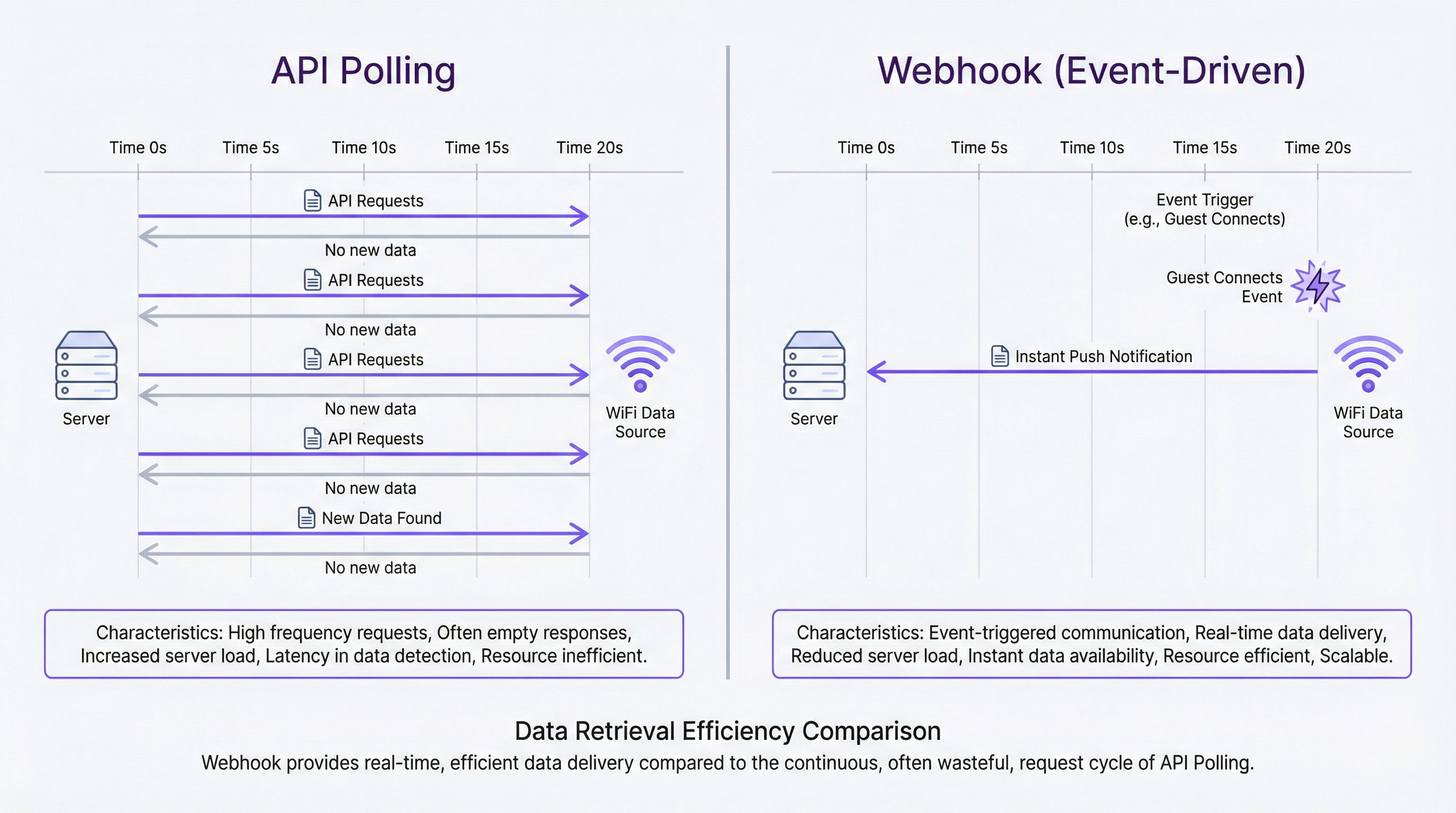
API पोलिंग एक सिंक्रोनस, पुल-आधारित तंत्र है जहां एक क्लाइंट एप्लिकेशन नए डेटा की जांच करने के लिए पूर्व निर्धारित आवृत्ति पर सर्वर API से बार-बार HTTP अनुरोध करता है। यह एक सरल अनुरोध-प्रतिक्रिया चक्र पर काम करता है: क्लाइंट पूछता है, "क्या कोई नई जानकारी है?" और सर्वर प्रतिक्रिया देता है।
विशेषताएं:
- क्लाइंट-इनिशिएटेड: क्लाइंट सभी संचार शुरू करने के लिए जिम्मेदार है।
- निश्चित अंतराल: अनुरोध नियमित अंतराल पर किए जाते हैं (उदा., हर 60 सेकंड में)।
- सिंक्रोनस: क्लाइंट आगे बढ़ने या अगला अनुरोध करने से पहले प्रतिक्रिया की प्रतीक्षा करता है।
फायदे:
- सरलता: कार्यान्वयन अक्सर सीधा होता है, जिसमें HTTP GET अनुरोध करने के लिए केवल एक साधारण स्क्रिप्ट या शेड्यूल्ड टास्क की आवश्यकता होती है।
- पूर्वानुमेय लोड: क्लाइंट सिस्टम पर लोड सुसंगत और पूर्वानुमान लगाने में आसान होता है।
नुकसान:
- अक्षमता: अधिकांश पोल कोई नया डेटा नहीं लौटाते हैं, जिससे क्लाइंट और सर्वर दोनों तरफ अनावश्यक बैंडविड्थ और प्रोसेसिंग साइकिल की खपत होती है। बड़े पैमाने पर डिप्लॉयमेंट में यह बर्बादी का एक महत्वपूर्ण स्रोत है।
- विलंबता (Latency): डेटा कभी भी वास्तव में रीयल-टाइम नहीं होता है। डेटा का "ताज़ापन" अधिक से अधिक पोलिंग अंतराल तक सीमित होता है। 5 मिनट के अंतराल के लिए, डेटा 4 मिनट और 59 सेकंड तक पुराना हो सकता है, जो समय-संवेदनशील एप्लिकेशनों के लिए अस्वीकार्य है।
- स्केलेबिलिटी की समस्याएं: जैसे-जैसे क्लाइंट्स की संख्या या पोलिंग की आवृत्ति बढ़ती है, सर्वर API पर लोड रैखिक रूप से बढ़ता है, जिससे संभावित रूप से प्रदर्शन में गिरावट या रेट-लिमिटिंग हो सकती है।
Webhooks क्या हैं?
वेबहुक्स सर्वर-टू-सर्वर संचार के लिए एक एसिंक्रोनस, पुश-आधारित तंत्र हैं। क्लाइंट द्वारा बार-बार डेटा मांगने के बजाय, सर्वर किसी विशिष्ट घटना के घटित होते ही स्वचालित रूप से एक निर्दिष्ट क्लाइंट URL ("वेबहुक एंडपॉइंट") पर डेटा पेलोड भेजता है—या पुश करता है। इसे अक्सर "रिवर्स API" या इवेंट-ड्रिवन आर्किटेक्चर कहा जाता है।
विशेषताएं:
- सर्वर-इनिशिएटेड (इवेंट-ड्रिवन): संचार सर्वर पर किसी घटना द्वारा ट्रिगर किया जाता है (उदा.,
guest_connects,user_leaves_venue)। - रीयल-टाइम: घटना के घटित होने पर डेटा लगभग तुरंत वितरित किया जाता है।
- एसिंक्रोनस: क्लाइंट बिना कोई अनुरोध शुरू किए निष्क्रिय रूप से डेटा प्राप्त करता है।
फायदे:
- दक्षता: संचार केवल तभी होता है जब साझा करने के लिए नया डेटा होता है, जिससे व्यर्थ अनुरोध समाप्त हो जाते हैं और सर्वर तथा नेटवर्क लोड में भारी कमी आती है।
- रीयल-टाइम डेटा: वेबहुक्स रीयल-टाइम डेटा डिलीवरी प्राप्त करने के लिए उद्योग मानक हैं, जो तत्काल कार्रवाई और प्रासंगिक वर्कफ़्लो को सक्षम करते हैं।
- स्केलेबिलिटी: यह आर्किटेक्चर अत्यधिक स्केलेबल है, क्योंकि सर्वर केवल तभी संसाधन खर्च करता है जब कोई घटना ट्रिगर होती है, न कि हजारों क्लाइंट्स से लगातार पोल को संभालने में।
नुकसान:
- कार्यान्वयन जटिलता: प्रारंभिक सेटअप अधिक जटिल है। सर्वर से आने वाले POST अनुरोधों को प्राप्त करने के लिए क्लाइंट-साइड पर एक स्थिर, सार्वजनिक रूप से सुलभ HTTP एंडपॉइंट बनाने की आवश्यकता होती है।
- विश्वसनीयता प्रबंधन: क्लाइंट एप्लिकेशन को संभावित डाउनटाइम और प्रोसेसिंग स्पाइक्स के प्रबंधन सहित आने वाले डेटा को मज़बूती से संभालने के लिए डिज़ाइन किया जाना चाहिए।
आर्किटेक्चरल तुलना
| विशेषता | API Polling | Webhooks (इवेंट-ड्रिवन) |
|---|---|---|
| डेटा फ्लो | पुल (क्लाइंट-इनिशिएटेड) | पुश (सर्वर-इनिशिएटेड) |
| डेटा ताज़ापन | विलंबित (पोलिंग अंतराल द्वारा) | रीयल-टाइम |
| दक्षता | कम (कई खाली अनुरोध) | उच्च (केवल घटना पर संचार) |
| सर्वर लोड | उच्च और निरंतर | कम और छिटपुट (घटना पर) |
| क्लाइंट लोड | उच्च (निरंतर अनुरोध) | कम (निष्क्रिय रूप से सुनता है) |
| स्केलेबिलिटी | खराब | उत्कृष्ट |
| कार्यान्वयन | सरल प्रारंभिक सेटअप | सार्वजनिक एंडपॉइंट की आवश्यकता |
सुरक्षा संबंधी विचार
दोनों पैटर्नों के लिए मजबूत सुरक्षा उपायों की आवश्यकता होती है, विशेष रूप से GDPR जैसे नियमों के अधीन व्यक्तिगत पहचान योग्य जानकारी (PII) को संभालते समय। [1]
Webhooks के लिए: सुरक्षा सर्वोपरि है। पारगमन (transit) में डेटा की सुरक्षा के लिए प्राप्त करने वाले एंडपॉइंट को HTTPS (TLS एन्क्रिप्शन) का उपयोग करके सुरक्षित किया जाना चाहिए। इसके अलावा, स्पूफिंग हमलों को रोकने के लिए जहां कोई दुर्भावनापूर्ण अभिनेता आपके एंडपॉइंट पर नकली डेटा भेजता है, पेलोड को सत्यापित किया जाना चाहिए। Purple का प्लेटफ़ॉर्म, उद्योग की सर्वोत्तम प्रथाओं के अनुरूप, प्रत्येक वेबहुक अनुरोध के
X-Purple-SignatureHTTP हेडर में एक अद्वितीय हस्ताक्षर (signature) शामिल करता है। यह हस्ताक्षर पेलोड बॉडी का एक हैश (HMAC-SHA256) है, जिसे आपके एप्लिकेशन और Purple के बीच साझा की गई एक गुप्त कुंजी (secret key) का उपयोग करके बनाया गया है। डेटा को प्रोसेस करने से पहले आपके एंडपॉइंट को उसी हैश की गणना करनी चाहिए और यह सत्यापित करना चाहिए कि यह हेडर में मौजूद हस्ताक्षर से मेल खाता है। यह सुनिश्चित करता है कि डेटा प्रामाणिक है (Purple से) और इसके साथ कोई छेड़छाड़ नहीं की गई है।API Polling के लिए: प्राथमिक सुरक्षा चिंता API कुंजी का प्रबंधन है। इस कुंजी को सुरक्षित रूप से संग्रहीत किया जाना चाहिए और कभी भी क्लाइंट-साइड कोड में उजागर नहीं किया जाना चाहिए। सभी API संचार भी HTTPS पर होने चाहिए। एक्सेस को लॉग किया जाना चाहिए और किसी भी असामान्य गतिविधि के लिए मॉनिटर किया जाना चाहिए जो एक समझौता की गई (compromised) कुंजी का संकेत दे सकती है।
कार्यान्वयन गाइड
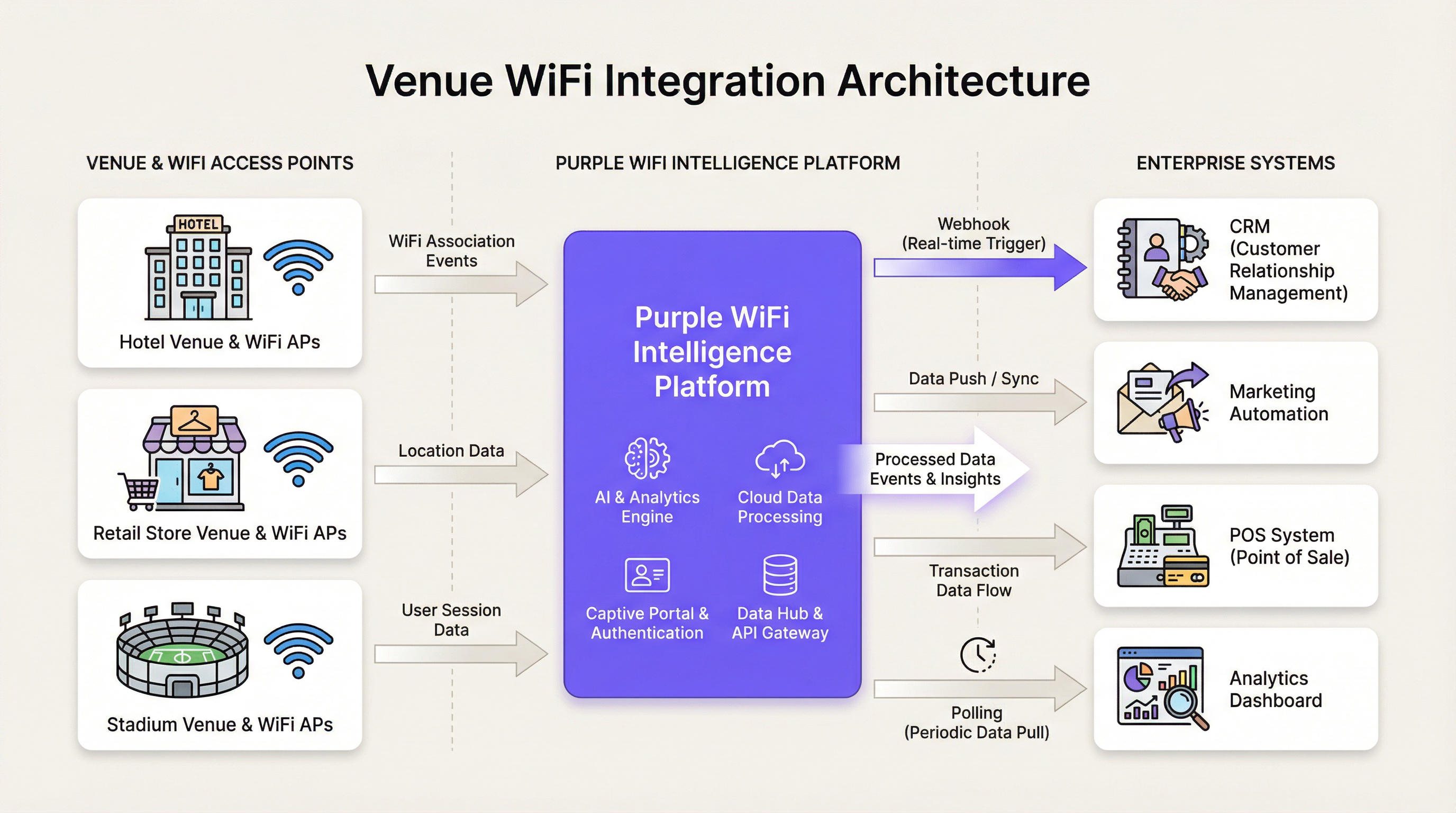
सही पैटर्न चुनना पूरी तरह से एकीकरण की व्यावसायिक आवश्यकताओं पर निर्भर करता है। जटिल एंटरप्राइज़ आर्किटेक्चर में एक मिश्रित दृष्टिकोण आम है।
API Polling का उपयोग कब करें
अपनी अक्षमताओं के बावजूद, API पोलिंग विशिष्ट, गैर-महत्वपूर्ण उपयोग के मामलों के लिए एक व्यवहार्य विकल्प है:
- बैच रिपोर्टिंग: कुल WiFi उपयोग पर रात या साप्ताहिक रिपोर्ट तैयार करना, जहां कई घंटों की डेटा देरी स्वीकार्य है।
- आंतरिक डैशबोर्ड: एक गैर-महत्वपूर्ण आंतरिक डैशबोर्ड को ट्रेंड डेटा के साथ पॉप्युलेट करना जिसमें सेकंड-दर-सेकंड सटीकता की आवश्यकता नहीं होती है।
- विरासत प्रणालियां (Legacy Systems): पुराने सिस्टम के साथ एकीकरण जो वेबहुक्स प्राप्त करने के लिए सार्वजनिक एंडपॉइंट को उजागर नहीं कर सकते हैं।
- बुनियादी ढांचे की बाधाएं: उच्च-सुरक्षा वाले वातावरण में जहां बाहरी सेवाओं से इनबाउंड ट्रैफ़िक नीति द्वारा भारी रूप से प्रतिबंधित है।
Webhooks का उपयोग कब करें
वेबहुक्स किसी भी आधुनिक, रीयल-टाइम एप्लिकेशन के लिए निश्चित विकल्प हैं। जब भी किसी WiFi घटना पर तत्काल, स्वचालित प्रतिक्रिया व्यावसायिक मूल्य बना सकती है, तब उनका उपयोग करें।
- रीयल-टाइम मार्केटिंग: किसी होटल या रिटेल स्टोर में अतिथि के WiFi से कनेक्ट होते ही एक स्वागत ईमेल, वाउचर के साथ SMS, या लॉयल्टी ऐप पर पुश नोटिफिकेशन ट्रिगर करना।
- परिचालन अलर्ट: किसी विशिष्ट घटना के घटित होने पर Slack या एक समर्पित ऐप के माध्यम से कर्मचारियों को तत्काल अलर्ट भेजना, जैसे कि VIP अतिथि का आगमन, किसी विशिष्ट क्षेत्र में ड्वेल टाइम (dwell time) सीमा का पार होना, या नेटवर्क हार्डवेयर का ऑफ़लाइन होना।
- CRM एकीकरण: जब कोई नया अतिथि Captive Portal पर पंजीकरण करता है, तो Salesforce या HubSpot जैसे CRM में तुरंत ग्राहक रिकॉर्ड बनाना या अपडेट करना।
- वेन्यू संचालन: स्टेडियम में भीड़ के प्रवाह को प्रबंधित करने, सम्मेलन केंद्र में HVAC को समायोजित करने, या उच्च-ट्रैफ़िक वाले क्षेत्रों में सफाई कर्मचारियों को भेजने के लिए रीयल-टाइम डिवाइस घनत्व डेटा का उपयोग करना।
Purple के Webhooks को लागू करना: एक वैचारिक गाइड
- अपना एंडपॉइंट बनाएं: अपने सर्वर पर एक स्थिर, सार्वजनिक URL विकसित करें जो HTTP POST अनुरोधों को स्वीकार कर सके। यह एक सर्वरलेस फ़ंक्शन (उदा., AWS Lambda, Google Cloud Function) या आपके वेब एप्लिकेशन में एक समर्पित मार्ग (route) हो सकता है।
- Purple में एंडपॉइंट पंजीकृत करें: Purple पोर्टल में, वेबहुक्स अनुभाग पर नेविगेट करें और अपना एंडपॉइंट URL जोड़ें। आपको हस्ताक्षर सत्यापन के लिए एक गुप्त कुंजी प्रदान की जाएगी।
- आने वाले डेटा को प्रोसेस करें: जब कोई घटना होती है, तो Purple आपके एंडपॉइंट पर एक JSON पेलोड भेजेगा। आपके एंडपॉइंट को इसके लिए प्रोग्राम किया जाना चाहिए:
a. प्राप्ति की तुरंत पावती दें: Purple को यह बताने के लिए कि डेटा प्राप्त हो गया है, जितनी जल्दी हो सके
200 OKस्थिति कोड के साथ प्रतिक्रिया दें। यह टाइमआउट और पुनर्प्रयास (retries) को रोकता है। b. हस्ताक्षर सत्यापित करें: प्रोसेसिंग से पहले, अपनी गुप्त कुंजी का उपयोग करके रॉ (raw) अनुरोध बॉडी के HMAC-SHA256 हस्ताक्षर की गणना करें और इसकी तुलनाX-Purple-Signatureहेडर में मौजूद मान से करें। यदि वे मेल नहीं खाते हैं, तो अनुरोध को छोड़ दें। c. एसिंक्रोनस रूप से प्रोसेस करें: वास्तविक व्यावसायिक तर्क (उदा., ईमेल भेजना, डेटाबेस अपडेट करना) को बैकग्राउंड जॉब कतार (उदा., RabbitMQ, Redis Queue) पर ऑफ़लोड करें। यह सुनिश्चित करता है कि आपका एंडपॉइंट उत्तरदायी बना रहे और बिना ब्लॉक हुए उच्च मात्रा में घटनाओं को संभाल सके。
सर्वोत्तम प्रथाएं
विश्वसनीय और सुरक्षित एकीकरण बनाने के लिए उद्योग-मानक सर्वोत्तम प्रथाओं का पालन करना आवश्यक है।
Webhook सर्वोत्तम प्रथाएं
- आइडम्पोटेंसी (Idempotency): डुप्लिकेट घटनाओं को शालीनता से संभालने के लिए अपने प्रोसेसिंग लॉजिक को डिज़ाइन करें। नेटवर्क की समस्याएं कभी-कभी एक वेबहुक को एक से अधिक बार वितरित करने का कारण बन सकती हैं। एक आइडम्पोटेंट सिस्टम यह सुनिश्चित करता है कि एक ही घटना को कई बार प्रोसेस करने से डुप्लिकेट डेटा या क्रियाएं नहीं होती हैं।
- एसिंक्रोनस प्रोसेसिंग: कभी भी जटिल या समय लेने वाले लॉजिक को सीधे अनुरोध हैंडलर के भीतर निष्पादित न करें। पावती दें और कतार में लगाएं।
- पेलोड सत्यापन: हमेशा वेबहुक हस्ताक्षर को सत्यापित करें। यह एक महत्वपूर्ण सुरक्षा कदम है।
- निगरानी और लॉगिंग: आने वाले वेबहुक्स और उनके प्रोसेसिंग के परिणाम को ट्रैक करने के लिए व्यापक लॉगिंग लागू करें। यदि आपका एंडपॉइंट विफल हो जाता है या प्रतिक्रिया समय कम हो जाता है, तो आपको सचेत करने के लिए निगरानी सेट करें।
- ग्रेसफुल विफलता और पुनर्प्रयास: हालांकि Purple के सिस्टम में एक पुनर्प्रयास तंत्र शामिल है, आपका अपना सिस्टम डाउनस्ट्रीम सेवाओं (उदा., डेटाबेस या तृतीय-पक्ष API का अस्थायी रूप से अनुपलब्ध होना) में विफलताओं के प्रति लचीला होना चाहिए。
API Polling सर्वोत्तम प्रथाएं
- एक उपयुक्त आवृत्ति चुनें: आवश्यकता से अधिक बार पोल न करें। ओवर-पोलिंग कम रिटर्न प्रदान करता है और रेट-लिमिटेड होने के जोखिम को बढ़ाता है। यदि आपको
429 Too Many Requestsप्रतिक्रिया मिलती है, तोRetry-Afterहेडर का सम्मान करें। - सशर्त अनुरोधों का उपयोग करें: जहां समर्थित हो, ऐसे डेटा को फिर से डाउनलोड करने से बचने के लिए
If-Modified-SinceयाETagजैसे हेडर का उपयोग करें जो बदला नहीं है। - बैकऑफ़ रणनीति लागू करें: यदि कोई API कॉल विफल हो जाती है, तो सर्वर पर अत्यधिक भार डालने से बचने के लिए पुनर्प्रयासों के लिए एक एक्सपोनेंशियल बैकऑफ़ रणनीति लागू करें।
- सुरक्षित API कुंजियां: सीक्रेट्स मैनेजमेंट सेवा का उपयोग करके API कुंजियों को सुरक्षित रूप से संग्रहीत करें। उन्हें कभी भी अपने एप्लिकेशन में हार्ड-कोड न करें या उन्हें संस्करण नियंत्रण (version control) में कमिट न करें।
समस्या निवारण और जोखिम शमन
- सामान्य विफलता मोड (Webhooks): एंडपॉइंट डाउनटाइम। यदि आपका एंडपॉइंट डाउन हो जाता है, तो आप घटनाओं को याद करेंगे। शमन: अपने एंडपॉइंट के लिए अत्यधिक उपलब्ध आर्किटेक्चर का उपयोग करें (उदा., सर्वरलेस फ़ंक्शंस, लोड-बैलेंस्ड सर्वर)। छोटी आउटेज के लिए Purple के अंतर्निहित पुनर्प्रयास तंत्र पर भरोसा करें और डाउनटाइम के प्रति तुरंत सचेत होने के लिए मजबूत निगरानी लागू करें।
- सामान्य विफलता मोड (Webhooks): प्रोसेसिंग स्पाइक्स। घटनाओं का अचानक फटना (उदा., किसी घटना की शुरुआत में जुड़ने वाली बड़ी भीड़) आपकी प्रोसेसिंग कतार को अभिभूत कर सकता है। शमन: सुनिश्चित करें कि आपका बैकग्राउंड प्रोसेसिंग इंफ्रास्ट्रक्चर मांग में स्पाइक्स को संभालने के लिए ऑटोस्केल कर सकता है。
- सामान्य विफलता मोड (API Polling): रेट लिमिटिंग। आक्रामक पोलिंग से आपका एप्लिकेशन रेट-लिमिटेड हो जाएगा, जिससे आपका डेटा प्रवाह प्रभावी रूप से कट जाएगा। शमन: एक उचित, सम्मानजनक अंतराल पर पोल करें और एक एक्सपोनेंशियल बैकऑफ़ रणनीति लागू करें।
- सामान्य विफलता मोड (दोनों): अमान्य डेटा। डेटा प्रारूप में बदलाव या कोई अप्रत्याशित मान आपके प्रोसेसिंग लॉजिक को तोड़ सकता है। शमन: रक्षात्मक प्रोग्रामिंग प्रथाओं को लागू करें। स्कीमा के विरुद्ध आने वाले डेटा को मान्य करें और सत्यापन त्रुटियों को शालीनता से संभालें, पूरी प्रक्रिया को क्रैश किए बिना जांच के लिए उन्हें लॉग करें।
ROI और व्यावसायिक प्रभाव
वेबहुक्स और पोलिंग के बीच चुनाव का कुल स्वामित्व लागत (TCO) और निवेश पर रिटर्न (ROI) पर सीधा प्रभाव पड़ता है।
- लागत-लाभ विश्लेषण: हालांकि पोलिंग में प्रारंभिक विकास लागत थोड़ी कम हो सकती है, लेकिन व्यर्थ सर्वर संसाधनों और बैंडविड्थ के कारण इसकी परिचालन लागत काफी अधिक है। वेबहुक्स, अपनी इवेंट-ड्रिवन दक्षता के साथ, बड़े पैमाने पर बहुत कम TCO की ओर ले जाते हैं। प्रति दिन लाखों खाली पोल को संभालने की बुनियादी ढांचे की लागत एक विश्वसनीय वेबहुक एंडपॉइंट विकसित करने की लागत से कहीं अधिक है।
- सफलता मापना: रीयल-टाइम डेटा एकीकरण की सफलता को इसके व्यावसायिक प्रभाव से मापा जाता है। एक होटल के लिए, यह वेबहुक-ट्रिगर किए गए स्वागत प्रस्तावों द्वारा संचालित रूम सर्विस ऑर्डर में 15% की वृद्धि हो सकती है। एक रिटेलर के लिए, यह उन VIP के लिए ग्राहक आजीवन मूल्य (customer lifetime value) में एक मापने योग्य वृद्धि हो सकती है जो व्यक्तिगत इन-स्टोर सेवा प्राप्त करते हैं। एक वेन्यू के लिए, यह सक्रिय भीड़ प्रबंधन के कारण परिचालन घटनाओं में कमी हो सकती है।
- अपेक्षित परिणाम: वेबहुक-आधारित आर्किटेक्चर को डिप्लॉय करना आपके संगठन को अधिक चुस्त और उत्तरदायी होने की स्थिति में रखता है। यह आपके संचालन को एक प्रतिक्रियाशील मुद्रा (कल क्या हुआ इसका विश्लेषण करना) से एक सक्रिय, रीयल-टाइम मुद्रा (अभी क्या हो रहा है उस पर कार्य करना) में ले जाता है। यह क्षमता बेहतर ग्राहक अनुभव प्रदान करने और परिचालन उत्कृष्टता प्राप्त करने में एक प्रमुख विभेदक (differentiator) है।
संदर्भ
[1] जनरल डेटा प्रोटेक्शन रेगुलेशन (GDPR)। (2016)। यूरोपीय संघ का आधिकारिक जर्नल। https://eur-lex.europa.eu/eli/reg/2016/679/oj
Key Terms & Definitions
Webhook
A mechanism for enabling server-to-server communication in real-time. It allows a server to automatically push data to a client as soon as an event occurs, rather than the client repeatedly polling for it.
IT teams use webhooks to receive instant notifications from platforms like Purple, enabling event-driven workflows such as sending a welcome email the moment a guest connects to WiFi.
API Polling
A data retrieval method where a client application makes requests to a server at a fixed interval to check for new data. It is a client-initiated "pull" model.
A developer might use API polling to update an internal dashboard with new WiFi analytics every 15 minutes, where real-time data is not a critical business requirement.
Endpoint
A publicly accessible URL on a client's server that is designed to receive and process incoming data from a webhook.
When configuring a webhook in Purple, the network architect must provide a stable and secure endpoint URL where the platform should send event data.
Payload
The actual data, typically formatted as JSON, that is sent from the server to the webhook endpoint when an event is triggered.
For a `guest_connects` event, the payload would contain information about the guest, their device, and the location, which a marketing automation tool can then use for personalization.
Idempotency
A principle in computing where an operation, if performed multiple times, has the same effect as if it were performed only once. In the context of webhooks, it means processing a duplicate event will not result in duplicate outcomes.
To achieve idempotency, a developer ensures their endpoint checks if an event ID has already been processed before taking action, preventing a single WiFi connection from triggering two welcome emails.
Asynchronous Processing
A processing model where a task is executed in the background, separate from the main application thread. For webhooks, it means acknowledging the request instantly and then handling the payload in a separate queue.
An IT team implements asynchronous processing to ensure their webhook endpoint can handle thousands of simultaneous WiFi connection events during a stadium concert without timing out.
HMAC (Hash-based Message Authentication Code)
A cryptographic hash that uses a secret key to verify both the data integrity and the authenticity of a message.
For compliance with data security standards like PCI DSS, a network architect must ensure their webhook endpoint validates the HMAC signature on all incoming payloads to prevent fraudulent data injection.
Rate Limiting
An API management technique used to control the amount of incoming traffic to a server. If a client exceeds a certain number of requests in a given time frame, the server will temporarily block them.
An operations director finds their hourly analytics report is failing because their aggressive API polling strategy caused the Purple platform to enforce rate limiting. They must adjust their polling interval to be less frequent.
Case Studies
A 500-room airport hotel wants to automatically send a welcome email with a restaurant voucher to guests the moment they first connect to the hotel WiFi. The goal is to drive dinner reservations on the day of arrival. The hotel uses Salesforce Marketing Cloud.
This is a classic real-time engagement scenario, making webhooks the only viable solution.
- Create a Journey API Endpoint in Salesforce: Within Salesforce Marketing Cloud, create a new Journey with an API Event as the entry source. This will provide a unique URL and API key that can accept incoming events.
- Configure the Webhook in Purple: In the Purple portal, create a new webhook for the
guest_connectsevent. Paste the Salesforce Journey URL as the destination. - Set the Payload Format: Configure the webhook payload to send the necessary guest data (e.g.,
first_name,email,location) in the JSON format expected by the Salesforce Journey API. - Secure the Webhook: Ensure the endpoint URL uses HTTPS. While Salesforce's endpoint is inherently secure, it's crucial to add the Purple webhook secret to your Salesforce configuration for signature validation if possible, or build a lightweight middleware (like an AWS Lambda function) to perform validation before forwarding the request to Salesforce.
- Activate the Journey: Once a test event is successfully received, activate the Journey in Salesforce. Now, when a guest connects to the WiFi, Purple will instantly fire the webhook, injecting the guest into the Salesforce Journey, which then immediately dispatches the personalized welcome email.
A national retail chain with 200 stores needs to populate a central analytics dashboard with hourly footfall data for each store. The dashboard is used by the corporate strategy team to analyze trends over weeks and months. Real-time data is not a requirement.
In this scenario, the requirement is for periodic, aggregate data, not real-time events. Therefore, API polling is a suitable and pragmatic choice.
- Identify the Correct API Endpoint: Use the Purple API documentation to find the endpoint that provides historical location analytics data, filterable by venue and time period.
- Develop a Polling Script: Create a server-side script (e.g., a Python script running on a cron job) that will execute once per hour.
- Implement the Polling Logic: The script will iterate through the list of 200 store IDs. For each store, it will make an HTTP GET request to the analytics API endpoint, requesting the visitor count for the previous 60-minute window.
- Store the Data: The script will then parse the JSON responses and write the aggregated data (timestamp, store_id, visitor_count) into the central analytics database that powers the dashboard.
- Handle Errors and Retries: The script must include error handling for API failures or network issues, implementing an exponential backoff strategy to retry failed requests without overwhelming the API.
Scenario Analysis
Q1. A large shopping mall wants to display a live counter of the number of connected devices on a public dashboard in the main atrium. The display needs to be updated as accurately as possible. Which integration pattern should the development team use and why?
💡 Hint:Consider the requirement for "live" and "accurate" data. What is the tolerance for delay?
Show Recommended Approach
The team must use webhooks. The requirement for a "live" counter means that data latency is a critical factor. Webhooks for device_connected and device_disconnected events would allow the dashboard to increment and decrement the counter in true real-time. Using API polling would result in a counter that only updates periodically (e.g., every minute), which would not feel "live" and could be visibly out of sync with the actual crowd flow.
Q2. An IT compliance officer needs to generate a quarterly report detailing all WiFi authentication methods used across the organization's 50 sites to ensure compliance with IEEE 802.1X standards. The report is generated manually by an analyst. Which pattern should be used to gather this data?
💡 Hint:Focus on the time-sensitivity of the task. Is this an operational task or an analytical one?
Show Recommended Approach
API polling is the most appropriate pattern. The task is analytical, not operational, and has a very low time-sensitivity (quarterly). A script can be run once per quarter to poll the Purple API for all authentication events over the last 90 days. This is a simple, efficient way to gather a large historical dataset for a one-off analysis. Using webhooks would be inappropriate as it would involve storing millions of real-time events for months, which is unnecessarily complex for this requirement.
Q3. A stadium's mobile app has a feature that allows fans to order food directly to their seats. The operations team wants to use WiFi location data to disable this feature for fans seated in sections where the food service is at capacity. The decision to disable a section must be made instantly. When designing the integration, what is the most critical security practice the developers must implement?
💡 Hint:The system involves real-time operational control based on incoming data. What is the primary threat to such a system?
Show Recommended Approach
The most critical security practice is mandatory signature validation on the webhook endpoint. Because the webhook triggers a direct operational action (disabling a service), the system is a prime target for a spoofing attack. A malicious actor could send a fraudulent webhook payload to the endpoint, pretending to be from Purple, and shut down the ordering service for the entire stadium. By validating the X-Purple-Signature using the shared secret, the endpoint can guarantee that the request is authentic and its data can be trusted before taking action. While HTTPS and asynchronous processing are also crucial, signature validation is the key defense against data-driven attacks in this real-time operational context.
Key Takeaways
- ✓Webhooks provide real-time, event-driven data, while API polling is delayed by the polling interval.
- ✓Use webhooks for time-sensitive actions like marketing automation, operational alerts, and instant CRM updates.
- ✓Use API polling for non-critical, batch-oriented tasks like nightly reports or trend analysis dashboards.
- ✓Webhooks are significantly more efficient and scalable, leading to a lower Total Cost of Ownership (TCO).
- ✓Securing your webhook endpoint with HTTPS and signature validation is a non-negotiable best practice.
- ✓Always process webhook payloads asynchronously to ensure your endpoint is resilient and responsive.
- ✓The choice is a strategic architectural decision: choose webhooks for real-time responsiveness and operational agility.




