

WiFi Hotspot 2.0 (Passpoint): निर्बाध और सुरक्षित WiFi रोमिंग के लिए संपूर्ण गाइड
This guide provides a comprehensive technical overview of WiFi Hotspot 2.0 (Passpoint) for IT leaders. It details the technology, security benefits, and a step-by-step implementation framework for deploying seamless, secure WiFi roaming in enterprise environments like hotels, retail, and large venues, ultimately improving user experience and reducing operational overhead.
🎧 Listen to this Guide
View Transcript

कार्यकारी सारांश
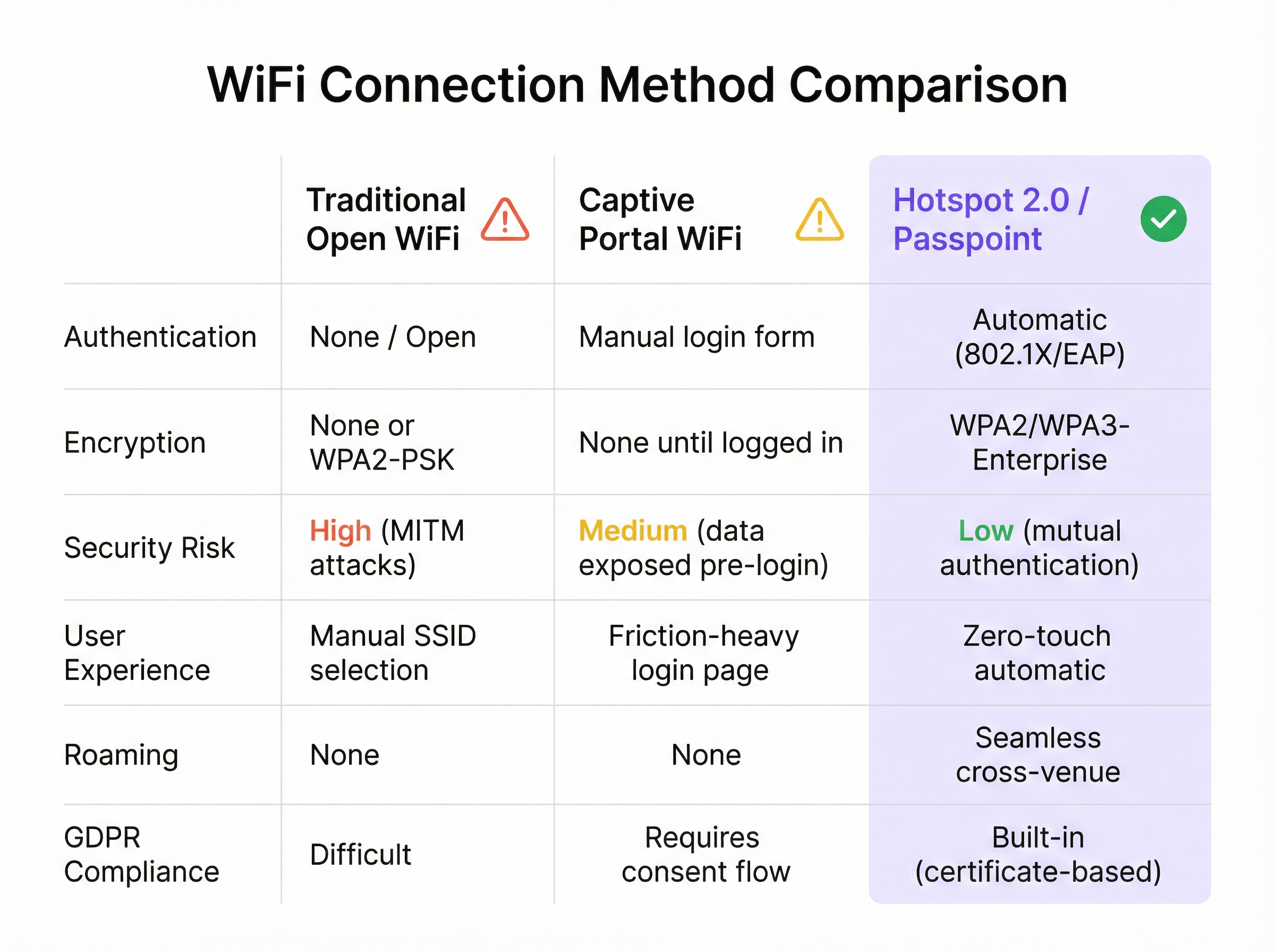
आधुनिक उद्यम के लिए, एक निर्बाध और सुरक्षित WiFi अनुभव प्रदान करना अब कोई विलासिता नहीं है—यह एक मुख्य परिचालन आवश्यकता है। WiFi Hotspot 2.0, जिसे Passpoint के रूप में भी जाना जाता है, एक उद्योग-मानक ढांचा है जिसे पारंपरिक सार्वजनिक और अतिथि WiFi से जुड़े घर्षण और सुरक्षा जोखिमों को खत्म करने के लिए डिज़ाइन किया गया है। यह मोबाइल उपकरणों को एंटरप्राइज़-ग्रेड WPA3 सुरक्षा के साथ स्वचालित रूप से WiFi नेटवर्क खोजने और प्रमाणित करने में सक्षम बनाता है, जो सेलुलर नेटवर्क के निर्बाध रोमिंग अनुभव को दर्शाता है। एक CTO या IT निदेशक के लिए, इसका अर्थ है उपयोगकर्ता-सामना करने वाले कनेक्शन मुद्दों में उल्लेखनीय कमी, सामान्य WiFi हमलों के खिलाफ एक मजबूत सुरक्षा स्थिति, और एक सुव्यवस्थित प्रमाणीकरण प्रक्रिया जो GDPR-अनुपालन दोनों है और MAC एड्रेस रैंडमाइज़ेशन की चुनौतियों से मुक्त है। असुरक्षित, उच्च-घर्षण Captive Portal को ज़ीरो-टच, क्रेडेंशियल-आधारित प्रमाणीकरण से बदलकर, Passpoint अतिथि संतुष्टि को बढ़ाता है, IT सपोर्ट ओवरहेड को कम करता है, और इंटर-वेन्यू रोमिंग और डेटा ऑफ़लोड रणनीतियों के लिए एक स्केलेबल आधार प्रदान करता है। यह गाइड आपके नेटवर्क इंफ्रास्ट्रक्चर में Passpoint को एकीकृत करने के लिए आवश्यक तकनीकी विवरण और परिनियोजन ढांचा प्रदान करती है, जिससे सुरक्षा और उपयोगकर्ता अनुभव दोनों में ठोस सुधार होता है。
तकनीकी डीप-डाइव
Hotspot 2.0 और इसका अंतर्निहित प्रमाणन, Passpoint, WiFi नेटवर्क को खोजने और एक्सेस करने के तरीके में एक मूलभूत वास्तुशिल्प बदलाव का प्रतिनिधित्व करते हैं। यह तकनीक IEEE 802.11u संशोधन पर आधारित है, जो क्लाइंट डिवाइस और एक्सेस पॉइंट के बीच प्री-एसोसिएशन संचार को सक्षम बनाती है। यह किसी डिवाइस को कनेक्शन स्थापित करने से पहले नेटवर्क के बारे में महत्वपूर्ण जानकारी इकट्ठा करने की अनुमति देता है, जो SSID पहचान के पुराने मॉडल से क्रेडेंशियल पहचान के अधिक बुद्धिमान मॉडल की ओर बढ़ता है।
मुख्य प्रोटोकॉल: ANQP, GAS, और 802.11u
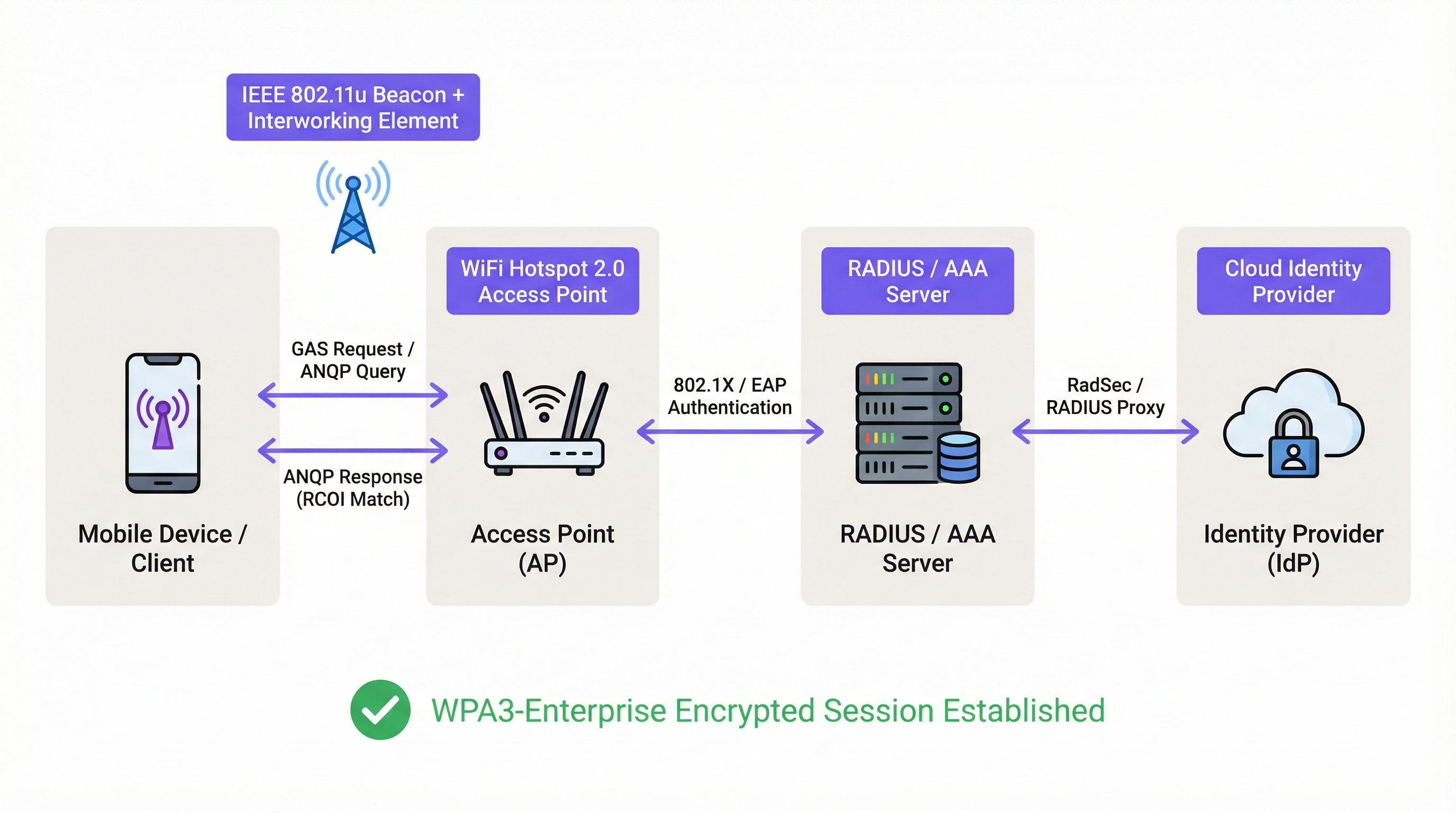
इस प्री-एसोसिएशन संवाद को सक्षम करने वाला प्राथमिक तंत्र जेनेरिक एडवरटाइजमेंट सर्विस (GAS) और एक्सेस नेटवर्क क्वेरी प्रोटोकॉल (ANQP) का संयोजन है। यहाँ बताया गया है कि वे कैसे इंटरैक्ट करते हैं:
- IEEE 802.11u बीकनिंग: एक Passpoint-सक्षम एक्सेस पॉइंट (AP) अपने बीकन फ्रेम में एक इंटरवर्किंग एलिमेंट (IE) शामिल करता है। यह एक ध्वज के रूप में कार्य करता है, जो आस-पास के उपकरणों को विज्ञापित करता है कि यह उन्नत नेटवर्क डिस्कवरी का समर्थन करता है।
- GAS और ANQP एक्सचेंज: इस IE का पता लगाने वाला क्लाइंट डिवाइस AP के लिए GAS क्वेरी शुरू कर सकता है। इस क्वेरी के भीतर, यह नेटवर्क की पहचान और क्षमताओं के बारे में विशिष्ट प्रश्न पूछने के लिए ANQP का उपयोग करता है। सबसे महत्वपूर्ण क्वेरी नेटवर्क द्वारा समर्थित रोमिंग कंसोर्टियम ऑर्गनाइजेशनल आइडेंटिफायर्स (RCOIs) के लिए है।
- क्रेडेंशियल मैचिंग: AP समर्थित RCOIs की अपनी सूची के साथ प्रतिक्रिया देता है। यदि इनमें से कोई भी क्लाइंट डिवाइस पर संग्रहीत क्रेडेंशियल प्रोफ़ाइल (उदा., मोबाइल कैरियर, होटल ब्रांड, या कॉर्पोरेट नेटवर्क के लिए प्रोफ़ाइल) से मेल खाता है, तो डिवाइस जानता है कि वह प्रमाणित कर सकता है और अगले चरण पर आगे बढ़ता है। यदि कोई मेल नहीं मिलता है, तो डिवाइस बिना किसी उपयोगकर्ता इंटरैक्शन के नेटवर्क को अनदेखा कर देता है।
प्रमाणीकरण और सुरक्षा ढांचा
एक बार क्रेडेंशियल मैच की पुष्टि हो जाने के बाद, Passpoint प्रमाणीकरण के लिए IEEE 802.1X की मजबूत सुरक्षा का लाभ उठाता है, आमतौर पर WPA2-Enterprise या अधिक सुरक्षित WPA3-Enterprise एन्क्रिप्शन के साथ। यह वही पोर्ट-आधारित नेटवर्क एक्सेस कंट्रोल मानक है जिस पर सुरक्षित वायर्ड एंटरप्राइज़ नेटवर्क में भरोसा किया जाता है। प्रमाणीकरण को एक्स्टेंसिबल ऑथेंटिकेशन प्रोटोकॉल (EAP) विधि के माध्यम से नियंत्रित किया जाता है, जैसे:
- EAP-TLS: प्रमाणपत्र-आधारित प्रमाणीकरण, जिसे सुरक्षा के लिए स्वर्ण मानक माना जाता है। क्लाइंट और सर्वर दोनों अपनी पहचान साबित करने के लिए प्रमाणपत्र प्रस्तुत करते हैं।
- EAP-TTLS/PEAP: एक सुरक्षित TLS टनल के भीतर एक लीगेसी प्रमाणीकरण विधि (जैसे उपयोगकर्ता नाम/पासवर्ड) को टनल करता है。
- EAP-SIM/AKA/AKA': SIM-आधारित प्रमाणीकरण, जो मोबाइल नेटवर्क ऑपरेटरों को अपने ग्राहकों को विश्वसनीय WiFi नेटवर्क पर निर्बाध रूप से रोम करने की अनुमति देता है।
यह प्रक्रिया पारस्परिक प्रमाणीकरण सुनिश्चित करती है: क्लाइंट मान्य करता है कि नेटवर्क वैध है ('ईविल ट्विन' AP हमलों को रोकना), और नेटवर्क मान्य करता है कि क्लाइंट अधिकृत है। बाद के सभी ट्रैफ़िक को एन्क्रिप्ट किया जाता है, जिससे खुले या PSK-आधारित नेटवर्क पर आम मैन-इन-द-मिडिल (MITM) हमलों का जोखिम कम हो जाता है।
Passpoint बनाम OpenRoaming
Passpoint और OpenRoaming के बीच अंतर करना महत्वपूर्ण है:
Passpoint वाहन है; OpenRoaming हाईवे सिस्टम है।
- Passpoint तकनीकी मानक (802.11u, ANQP/GAS, 802.1X) है जो किसी डिवाइस को एक ही प्रशासनिक नियंत्रण के तहत एकल नेटवर्क या नेटवर्क के समूह को स्वचालित रूप से खोजने और प्रमाणित करने में सक्षम बनाता है।
- WBA OpenRoaming वायरलेस ब्रॉडबैंड एलायंस द्वारा प्रबंधित एक वैश्विक फेडरेशन ढांचा है। यह मोबाइल कैरियर जैसे हजारों आइडेंटिटी प्रोवाइडर्स (IdPs) और होटल, हवाई अड्डों और रिटेल चेन जैसे एक्सेस नेटवर्क प्रोवाइडर्स (ANPs) के बीच एक ट्रस्ट इकोसिस्टम बनाता है। यह किसी भी सदस्य IdP के क्रेडेंशियल वाले उपयोगकर्ता को जटिल द्विपक्षीय रोमिंग समझौतों की आवश्यकता के बिना, किसी भी सदस्य ANP वेन्यू पर स्वचालित रूप से कनेक्ट होने की अनुमति देता है।
OpenRoaming वातावरण में अधिकतम संगतता के लिए, नेटवर्क आर्किटेक्ट्स को मानक सेटलमेंट-फ्री RCOI (5A-03-BA) और लीगेसी Cisco RCOI (00-40-96) दोनों को प्रसारित करना चाहिए।
कार्यान्वयन गाइड
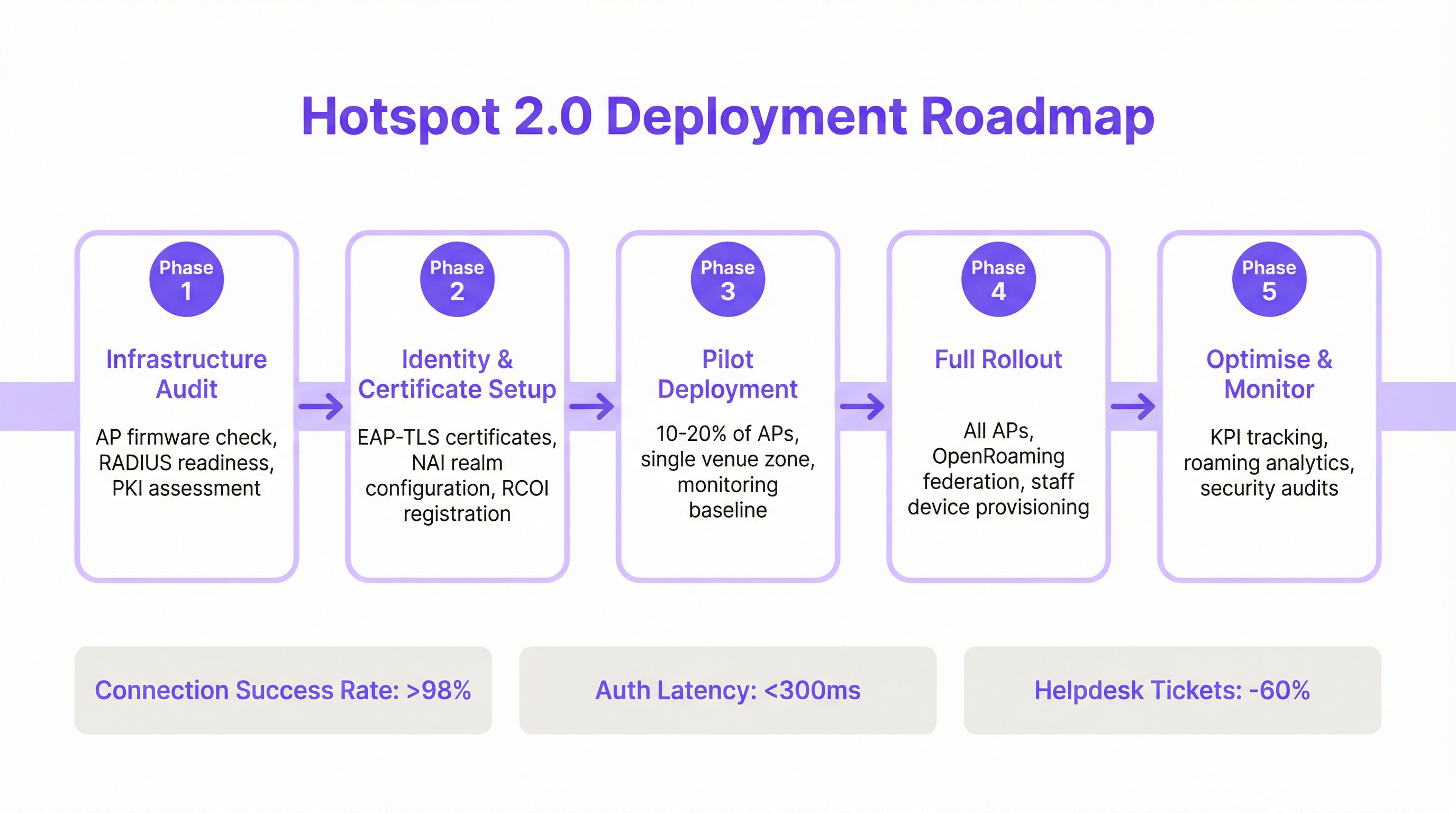
Passpoint को तैनात करना एक संरचित प्रक्रिया है जो आपके मौजूदा बुनियादी ढांचे के ऑडिटिंग से लेकर चरणबद्ध रोलआउट और अनुकूलन तक जाती है। इस रोडमैप का पालन करने से एक सुचारू संक्रमण सुनिश्चित होगा और सामान्य परिनियोजन नुकसान कम होंगे।
चरण 1: इंफ्रास्ट्रक्चर ऑडिट
शुरू करने से पहले, अपने वर्तमान नेटवर्क हार्डवेयर और सॉफ़्टवेयर का आकलन करें। प्रमुख ऑडिट बिंदुओं में शामिल हैं:
- एक्सेस पॉइंट संगतता: सत्यापित करें कि आपके APs IEEE 802.11u का समर्थन करते हैं। 2015 के बाद निर्मित अधिकांश एंटरप्राइज़-ग्रेड APs (Cisco, HPE Aruba, Juniper Mist, Ruckus जैसे वेंडर्स से) में आवश्यक हार्डवेयर होता है, लेकिन उन्हें फ़र्मवेयर अपग्रेड की आवश्यकता हो सकती है।
- RADIUS सर्वर तत्परता: आपको 802.1X EAP प्रमाणीकरण को संभालने में सक्षम RADIUS (या AAA) सर्वर की आवश्यकता होगी। यह Cisco ISE जैसा ऑन-प्रिमाइसेस समाधान या SecureW2, Foxpass, या Google Cloud Identity जैसी क्लाउड-आधारित सेवा हो सकती है।
- PKI मूल्यांकन: EAP-TLS परिनियोजन के लिए, क्लाइंट डिवाइस और सर्वर के लिए डिजिटल प्रमाणपत्र जारी करने और प्रबंधित करने के लिए एक पब्लिक की इंफ्रास्ट्रक्चर (PKI) की आवश्यकता होती है।
चरण 2: पहचान और प्रमाणपत्र सेटअप
इस चरण में मुख्य प्रमाणीकरण घटकों को कॉन्फ़िगर करना शामिल है:
- NAI Realm कॉन्फ़िगरेशन: अपने नेटवर्क एक्सेस आइडेंटिफ़ायर (NAI) realms को परिभाषित करें, जो आपके प्रमाणीकरण डोमेन (उदा.,
@yourcompany.com) की पहचान करते हैं। - RCOI पंजीकरण: यदि OpenRoaming जैसे रोमिंग कंसोर्टियम में भाग ले रहे हैं, तो WBA के साथ अपने RCOIs पंजीकृत करें।
- प्रमाणपत्र जनरेशन: EAP-TLS के लिए, मोबाइल डिवाइस मैनेजमेंट (MDM) समाधान के माध्यम से अपने प्रबंधित उपकरणों पर क्लाइंट प्रमाणपत्र जनरेट और तैनात करें। अतिथि एक्सेस के लिए, आपको आवश्यक प्रमाणपत्र ट्रस्ट चेन के साथ एक प्रोफ़ाइल प्रदान करने के लिए एक तंत्र की आवश्यकता होगी।
चरण 3: पायलट परिनियोजन
एक सीमित क्षेत्र में एक नियंत्रित पायलट के साथ शुरुआत करें, जैसे कि एक मंजिल या एक विशिष्ट वेन्यू ज़ोन, जो आपके 10-20% APs को कवर करता हो। पायलट के लक्ष्य हैं:
- एक बेसलाइन स्थापित करें: वर्तमान कनेक्शन सफलता दर, प्रमाणीकरण विलंबता, और WiFi-संबंधित हेल्पडेस्क टिकटों की मात्रा को मापें।
- डिवाइस मैट्रिक्स का परीक्षण करें: उपकरणों की एक विस्तृत श्रृंखला (iOS, Samsung और Google Pixel जैसे विभिन्न Android निर्माता, Windows, macOS) पर ऑनबोर्डिंग और कनेक्शन अनुभव का परीक्षण करें।
- ऑनबोर्डिंग को परिष्कृत करें: अप्रबंधित अतिथि उपकरणों पर Passpoint प्रोफ़ाइल प्राप्त करने की प्रक्रिया को फाइन-ट्यून करें।
चरण 4: पूर्ण रोलआउट
एक बार जब पायलट अपने सफलता मानदंडों (उदा., >98% कनेक्शन सफलता, प्रमाणीकरण विलंबता <300ms) को पूरा कर लेता है, तो सभी APs और वेन्यू में पूर्ण रोलआउट के साथ आगे बढ़ें। इस चरण में शामिल हैं:
- पूर्ण AP कॉन्फ़िगरेशन: सभी एक्सेस पॉइंट्स पर मानकीकृत Passpoint WLAN कॉन्फ़िगरेशन पुश करें।
- स्टाफ और कॉर्पोरेट डिवाइस प्रोविजनिंग: सुनिश्चित करें कि सभी कॉर्पोरेट-स्वामित्व वाले उपकरणों को MDM के माध्यम से Passpoint प्रोफ़ाइल के साथ प्रावधानित किया गया है।
- OpenRoaming फेडरेशन सक्षम करें: यदि लागू हो, तो OpenRoaming फेडरेशन में भाग लेने के लिए RADIUS प्रॉक्सी नियमों को सक्षम करें।
चरण 5: अनुकूलन और निगरानी
रोलआउट के बाद, नेटवर्क के प्रदर्शन और सुरक्षा की निरंतर निगरानी करें:
- KPI ट्रैकिंग: पायलट बेसलाइन के खिलाफ उनकी तुलना करते हुए, प्रमुख प्रदर्शन संकेतकों (KPI) को ट्रैक करें। प्रमुख मेट्रिक्स में कनेक्शन सफलता दर, प्रमाणीकरण विलंबता, रोमिंग सफलता और डेटा थ्रूपुट शामिल हैं।
- रोमिंग एनालिटिक्स: अपने वेन्यू के बीच और रोमिंग भागीदारों के साथ रोमिंग पैटर्न को समझने के लिए एनालिटिक्स का उपयोग करें।
- सुरक्षा ऑडिट: अपने RADIUS और PKI बुनियादी ढांचे की अखंडता सुनिश्चित करने के लिए नियमित सुरक्षा ऑडिट आयोजित करें।
सर्वोत्तम प्रथाएँ
अपने Passpoint परिनियोजन की सफलता और सुरक्षा को अधिकतम करने के लिए, निम्नलिखित उद्योग-मानक सर्वोत्तम प्रथाओं का पालन करें।
| श्रेणी | सर्वोत्तम प्रथा | तर्क |
|---|---|---|
| सुरक्षा | WPA3-Enterprise अनिवार्य करें | WPA3 192-बिट क्रिप्टोग्राफ़िक शक्ति और डी-ऑथेंटिकेशन हमलों को रोकने के लिए प्रोटेक्टेड मैनेजमेंट फ्रेम्स (PMF) के साथ उच्चतम स्तर की सुरक्षा प्रदान करता है। |
| सुरक्षा | कॉर्पोरेट उपकरणों के लिए EAP-TLS का उपयोग करें | प्रमाणपत्र-आधारित प्रमाणीकरण पासवर्ड-आधारित विधियों की तुलना में अधिक सुरक्षित है और फ़िशिंग और क्रेडेंशियल चोरी से मुक्त है। |
| संगतता | एकाधिक RCOIs प्रसारित करें | व्यापक डिवाइस समर्थन सुनिश्चित करने के लिए, आधुनिक OpenRoaming RCOI (5A-03-BA) और लीगेसी Cisco RCOI (00-40-96) दोनों को प्रसारित करें। |
| उपयोगकर्ता अनुभव | प्रोफ़ाइल ऑनबोर्डिंग को सुव्यवस्थित करें | प्रारंभिक ऑनबोर्डिंग घर्षण का एकमात्र बिंदु है। प्रोफ़ाइल इंस्टॉलेशन को यथासंभव आसान बनाने के लिए एक सरल, वन-टाइम Captive Portal या हल्के ऐप का उपयोग करें। |
| नेटवर्क डिज़ाइन | IoT उपकरणों को खंडित करें | अधिकांश IoT उपकरण 802.1X का समर्थन नहीं करते हैं। उन्हें एक अलग, उचित रूप से सुरक्षित SSID (उदा., MPSK या MAC प्रमाणीकरण का उपयोग करके) पर खंडित किया जाना चाहिए और Passpoint ट्रैफ़िक के साथ मिश्रित नहीं किया जाना चाहिए। |
| संचालन | एनालिटिक्स के साथ एकीकृत करें | Captive Portal की अनुपस्थिति में अतिथि व्यवहार में दृश्यता बनाए रखने के लिए, अपने Passpoint प्रमाणीकरण लॉग को Purple जैसे WiFi एनालिटिक्स प्लेटफ़ॉर्म के साथ एकीकृत करें। |
समस्या निवारण और जोखिम न्यूनीकरण
यहां तक कि सुनियोजित परिनियोजन में भी समस्याओं का सामना करना पड़ सकता है। यहाँ सामान्य विफलता मोड और उन्हें कम करने के तरीके दिए गए हैं।
| लक्षण | संभावित कारण | न्यूनीकरण रणनीति |
|---|---|---|
| उपकरण कनेक्ट करने का प्रयास नहीं कर रहे हैं | RCOI बेमेल या गायब RCOI | सत्यापित करें कि आपके APs लीगेसी 00-40-96 OI सहित सही RCOIs प्रसारित कर रहे हैं। बीकन फ्रेम का निरीक्षण करने के लिए WiFi एनालाइज़र टूल का उपयोग करें। |
| प्रमाणीकरण विफलताएं (EAP) | RADIUS सर्वर गलत कॉन्फ़िगरेशन / प्रमाणपत्र समस्याएँ | विस्तृत त्रुटि कोड के लिए RADIUS लॉग की जाँच करें। सुनिश्चित करें कि क्लाइंट प्रमाणपत्र मान्य हैं और सर्वर क्लाइंट के जारीकर्ता CA पर भरोसा करता है। सत्यापित करें कि सर्वर प्रमाणपत्र मान्य है और क्लाइंट द्वारा विश्वसनीय है। |
| उच्च प्रमाणीकरण विलंबता | धीमी RADIUS प्रतिक्रिया / नेटवर्क पथ समस्याएँ | APs और RADIUS सर्वर के बीच कम विलंबता सुनिश्चित करें। यदि क्लाउड RADIUS का उपयोग कर रहे हैं, तो किसी भी नेटवर्क कंजेशन या रूटिंग समस्याओं की जाँच करें। 300ms से कम प्रतिक्रिया समय का लक्ष्य रखें। |
| असंगत Android व्यवहार | OEM-विशिष्ट ANQP/GAS कार्यान्वयन | पायलट चरण के दौरान Android उपकरणों की एक श्रृंखला पर पूरी तरह से परीक्षण करें। कुछ पुराने या कम सामान्य Android बिल्ड में बग्गी 802.11u कार्यान्वयन हो सकते हैं। |
| वेन्यू के बीच रोमिंग विफलताएं | असंगत WLAN कॉन्फ़िगरेशन | सुनिश्चित करें कि Passpoint WLAN प्रोफ़ाइल (SSID, सुरक्षा सेटिंग्स, RCOIs) निर्बाध रोमिंग के लिए लक्षित सभी वेन्यू में बिल्कुल समान है। |
ROI और व्यावसायिक प्रभाव
हालांकि Passpoint एक तकनीकी समाधान है, इसके प्रभाव को व्यावसायिक परिणामों में मापा जाता है। निवेश पर प्रतिफल (ROI) परिचालन दक्षता, उपयोगकर्ता अनुभव और सुरक्षा स्थिति में सुधार से प्रेरित होता है।
लागत-लाभ विश्लेषण
निवेश लागत:
- हार्डवेयर: यदि मौजूदा हार्डवेयर 802.11u के अनुरूप नहीं है तो संभावित AP अपग्रेड।
- सॉफ़्टवेयर/लाइसेंसिंग: RADIUS सर्वर लाइसेंस (उदा., Cisco ISE) या क्लाउड AAA सेवाओं के लिए लागत।
- फेडरेशन शुल्क: WBA OpenRoaming में भाग लेने के लिए वार्षिक सदस्यता शुल्क।
- कार्यान्वयन: कॉन्फ़िगरेशन, परीक्षण और रोलआउट के लिए पेशेवर सेवाएँ या आंतरिक कर्मचारियों का समय।
अपेक्षित प्रतिफल और लाभ:
- कम IT ओवरहेड: WiFi-संबंधित हेल्पडेस्क टिकटों में उल्लेखनीय कमी। एक सामान्य परिणाम WiFi कनेक्टिविटी समस्याओं से संबंधित टिकटों में 40-60% की कमी है।
- बढ़ी हुई अतिथि संतुष्टि: लॉगिन घर्षण को हटाने से उच्च नेट प्रमोटर स्कोर (NPS) और बेहतर समीक्षाएं मिलती हैं, विशेष रूप से हॉस्पिटैलिटी में।
- उन्नत सुरक्षा और अनुपालन: WiFi-आधारित हमलों से डेटा उल्लंघनों के जोखिम को कम करता है, PCI DSS और GDPR अनुपालन का समर्थन करता है और संभावित वित्तीय दंड को कम करता है।
- बेहतर डेटा ऑफ़लोड: मोबाइल ऑपरेटरों और उनके वेन्यू भागीदारों के लिए, Passpoint सेलुलर डेटा को WiFi पर स्वचालित और सुरक्षित रूप से ऑफ़लोड करने में सक्षम बनाता है, जिससे सेलुलर नेटवर्क पर तनाव कम होता है。
- बढ़ी हुई सहभागिता: एक निर्बाध कनेक्शन उपयोगकर्ताओं को साइट पर अधिक समय तक रहने और डिजिटल सेवाओं के साथ अधिक जुड़ने के लिए प्रोत्साहित करता है, जिससे रिटेल और हॉस्पिटैलिटी वातावरण में राजस्व बढ़ता है।
परिनियोजन से पहले और बाद में हेल्पडेस्क टिकट वॉल्यूम, अतिथि संतुष्टि स्कोर और कनेक्शन सफलता दर जैसे KPIs को मापकर, IT टीमें एक स्पष्ट और मापने योग्य ROI प्रदर्शित करने वाला एक सम्मोहक व्यावसायिक मामला बना सकती हैं।
Key Terms & Definitions
IEEE 802.11u
An amendment to the IEEE 802.11 standard that enables 'interworking with external networks'. It allows client devices to exchange information with an access point before establishing a connection.
This is the foundational protocol that makes Hotspot 2.0 possible. When an IT team sees that an AP is '802.11u capable', it means it can support the discovery mechanisms required for Passpoint.
ANQP (Access Network Query Protocol)
The specific protocol used by a client device to query an access point about its capabilities, such as roaming partners, venue type, and authentication methods.
Network architects will configure ANQP elements on their wireless controllers to advertise network services. Troubleshooting often involves analyzing ANQP frames to see what information the AP is providing to clients.
GAS (Generic Advertisement Service)
The transport mechanism defined in 802.11u that carries ANQP frames between the client and the access point before an association is formed.
GAS and ANQP work together. GAS is the 'envelope' and ANQP is the 'letter' inside. When troubleshooting, packet captures will show GAS frames containing the ANQP queries and responses.
RCOI (Roaming Consortium Organizational Identifier)
A unique identifier that represents a group of network providers who have a roaming agreement. It's the primary piece of information a device looks for to decide if it can automatically connect.
This is a critical configuration item. An IT manager must ensure their APs are broadcasting the correct RCOIs for their own organization and any roaming partners like OpenRoaming. A missing or incorrect RCOI is a common cause of connection failures.
WPA3-Enterprise
The highest level of WiFi security, which uses 192-bit encryption and requires 802.1X authentication. It provides robust protection against eavesdropping and other sophisticated attacks.
For any organization concerned with security and compliance (PCI DSS, GDPR), deploying WPA3-Enterprise is a non-negotiable best practice. Passpoint is the most user-friendly way to implement it at scale.
EAP-TLS (Extensible Authentication Protocol-Transport Layer Security)
An EAP method that uses client-side and server-side digital certificates for mutual authentication. It is considered the most secure EAP method.
This is the recommended method for securing corporate-owned devices. IT teams will use an MDM to push certificates to devices, enabling zero-touch, highly secure network access.
RadSec (RADIUS over TLS)
A protocol that secures RADIUS authentication traffic by tunneling it through a TLS-encrypted connection (typically over TCP port 2083).
When setting up roaming with OpenRoaming or other external partners, network architects will use RadSec to ensure that authentication requests traversing the public internet are fully encrypted and secure.
NAI (Network Access Identifier)
A standardized way of identifying a user in an 802.1X authentication request, typically formatted like an email address (e.g., 'user@realm'). The realm portion is used to route the request to the correct home RADIUS server.
IT teams configure NAI realms to define their authentication domains. In a roaming scenario, the realm of the user's NAI determines which Identity Provider's RADIUS server needs to process the authentication request.
Case Studies
A 500-room luxury hotel with multiple conference wings wants to eliminate its cumbersome captive portal. Corporate guests frequently complain about having to re-authenticate multiple times per day as they move between their room, the conference centre, and the restaurant. The hotel needs to maintain PCI DSS compliance for its payment systems.
The recommended solution is a phased Passpoint deployment integrated with WBA OpenRoaming. Phase 1 (Pilot): Deploy Passpoint in the main conference wing and on one floor of guest rooms. Configure the WLAN to broadcast the hotel's own RCOI and the OpenRoaming RCOI. Use EAP-TLS for corporate-managed devices (provisioned via MDM by their employers) and provide a simple, one-time onboarding portal for guests to install a Passpoint profile with an EAP-TTLS credential. Phase 2 (Rollout): After a successful pilot, extend the Passpoint WLAN to all guest rooms, public areas, and restaurants. Decommission the legacy captive portal SSID, but keep a single, hidden SSID for specific back-of-house devices that do not support 802.1X. Security: The use of WPA3-Enterprise and 802.1X provides traffic encryption and mutual authentication, satisfying key PCI DSS requirements for securing wireless environments.
A large retail chain with 200 stores across the country wants to offer seamless WiFi to its loyalty program members. They also want to offload traffic from their in-store staff's cellular devices to the corporate WiFi to ensure reliable access to inventory and POS applications. The existing infrastructure is a mix of Cisco Meraki and Aruba hardware.
The solution is to create a unified Passpoint strategy across the mixed-vendor environment. Step 1 (Onboarding): Integrate Passpoint profile generation into the loyalty program's mobile app. When a user signs into the app, it automatically installs the Passpoint profile with a unique EAP-TTLS credential. Step 2 (Staff Provisioning): Use the company's MDM to push a separate Passpoint profile to all corporate-owned staff devices, configured for EAP-TLS using device certificates for zero-touch authentication. Step 3 (Network Configuration): In both Cisco Meraki and Aruba Central dashboards, create a new WLAN profile for Passpoint. Enable Hotspot 2.0, set security to WPA3-Enterprise, and add the company's RCOI and the OpenRoaming RCOI. Point authentication to a central cloud RADIUS server to ensure consistent policy enforcement across all stores. Step 4 (Analytics): Ingest RADIUS authentication logs into the Purple analytics platform to correlate WiFi connections with loyalty member IDs, tracking visit frequency and dwell time without a captive portal.
Scenario Analysis
Q1. You are the network architect for a large international airport. You want to implement Passpoint to provide seamless roaming for travelers from major cellular carriers. During your pilot, you notice that a large number of Android devices are not automatically connecting, while iOS devices are connecting successfully. What is the most likely cause and your first troubleshooting step?
💡 Hint:Consider the differences in how various device manufacturers implement the 802.11u standard and what specific information they look for during discovery.
Show Recommended Approach
The most likely cause is a misconfiguration of the Roaming Consortium Organizational Identifiers (RCOIs). Many Android devices, particularly older models or those with manufacturer-customized operating systems, rely on the legacy Cisco RCOI (00-40-96) to initiate an ANQP query. If only the modern OpenRoaming RCOI (5A-03-BA) is being broadcast, these devices will not attempt to connect. The first troubleshooting step is to use a WiFi analysis tool to inspect the beacon frames from the pilot APs and verify that both the OpenRoaming and the legacy Cisco RCOIs are being broadcast.
Q2. A retail chain has successfully deployed Passpoint with OpenRoaming in all its stores. The marketing team now wants to know if they can still gather customer analytics, such as visit frequency and dwell time, which they previously collected via the captive portal. What is your recommendation?
💡 Hint:Where in the new authentication flow can user identity be correlated with a connection event? Can this be done while respecting privacy and the principles of the OpenRoaming federation?
Show Recommended Approach
While Passpoint eliminates the captive portal, it is still possible to gather valuable analytics. The recommended approach is to leverage the RADIUS authentication logs. Each time a user connects, an authentication request is sent to the RADIUS server, which contains the user's Network Access Identifier (NAI). By integrating the RADIUS server with an analytics platform like Purple, the NAI can be used as a persistent anonymous identifier to track visit frequency and dwell time. This provides the marketing team with the data they need without reintroducing login friction for the user. It's important to ensure this process is compliant with privacy policies and the terms of the roaming federation.
Q3. A conference centre is setting up a Passpoint network. They plan to use EAP-TLS for staff and event organizers, but need a solution for thousands of temporary attendees. They are considering using EAP-TTLS with usernames and passwords distributed at registration. What is a significant security risk of this approach and what is a better alternative?
💡 Hint:Think about the lifecycle of shared credentials and the security of the 'inner' authentication method in EAP-TTLS.
Show Recommended Approach
The significant risk of using shared EAP-TTLS credentials (username/password) is the lack of revocation and accountability. If a credential pair is compromised, it can be used by an unauthorized party until it expires, and it's difficult to trace activity back to a specific individual. A better and more secure alternative is to use an onboarding portal that generates a unique Passpoint profile for each attendee. This can be done by having the attendee scan a QR code or visit a one-time URL. The portal generates a profile containing a unique, short-lived digital certificate (for EAP-TLS) or a unique EAP-TTLS credential. This ensures that each user has a distinct identity, and access can be revoked on a per-user basis if necessary, providing much stronger security and accountability.
Key Takeaways
- ✓WiFi Hotspot 2.0 (Passpoint) enables seamless, zero-touch roaming for users by automatically authenticating devices to trusted WiFi networks.
- ✓It replaces insecure, high-friction captive portals with credential-based authentication using the enterprise-grade WPA3-Enterprise security standard.
- ✓The core technology relies on the IEEE 802.11u standard, which allows devices to query network information (via ANQP/GAS) before connecting.
- ✓Mutual authentication (802.1X) is a key security benefit, protecting against 'Evil Twin' and Man-in-the-Middle (MITM) attacks.
- ✓OpenRoaming is a global federation that works with Passpoint to allow seamless roaming across thousands of different network providers.
- ✓A successful deployment requires a phased approach: audit your infrastructure, run a pilot to test across all device types, and then perform a full rollout.
- ✓Key business benefits include reduced IT helpdesk costs, improved guest satisfaction, enhanced security compliance (PCI DSS, GDPR), and new opportunities for data offload and analytics.




