

Beacon Estimote: una guida completa all'installazione, alla configurazione e ai casi d'uso
This guide provides a comprehensive technical reference for IT managers and network architects on deploying Estimote beacons. It covers setup, configuration, and advanced use cases like wayfinding, proximity marketing, and asset tracking, offering actionable guidance for achieving measurable ROI in enterprise environments.
🎧 Listen to this Guide
View Transcript

Sintesi esecutiva
Per CTO, direttori IT e architetti di rete, i beacon Bluetooth Low Energy (BLE) rappresentano una tecnologia matura e scalabile per collegare il mondo fisico e quello digitale. Estimote, fornitore leader di hardware, offre un solido ecosistema di beacon che consentono un posizionamento indoor preciso, un coinvolgimento basato sulla prossimità e il tracciamento di asset di alto valore. Questa guida funge da riferimento tecnico per l'implementazione dei beacon Estimote in ambienti enterprise come il settore alberghiero, il retail e le strutture di grandi dimensioni. Analizzeremo la tecnologia sottostante, forniremo modelli di implementazione indipendenti dal fornitore e valuteremo il ROI delle iniziative basate sui beacon. La proposta di valore principale dei beacon Estimote risiede nel loro funzionamento a basso consumo e di lunga durata, e in un software development kit (SDK) flessibile che si integra perfettamente con le applicazioni mobili esistenti e con piattaforme di analisi come Purple. Un'implementazione di beacon correttamente architettata può avere un impatto aziendale significativo, dal miglioramento dell'esperienza degli ospiti e dall'aumento dei ricavi accessori, fino all'ottimizzazione dei flussi di lavoro operativi e alla riduzione della perdita di asset. Questo documento fornisce la guida strategica e tattica necessaria per passare da una proof-of-concept a un'implementazione enterprise su larga scala, sicura e conforme.
Approfondimento tecnico
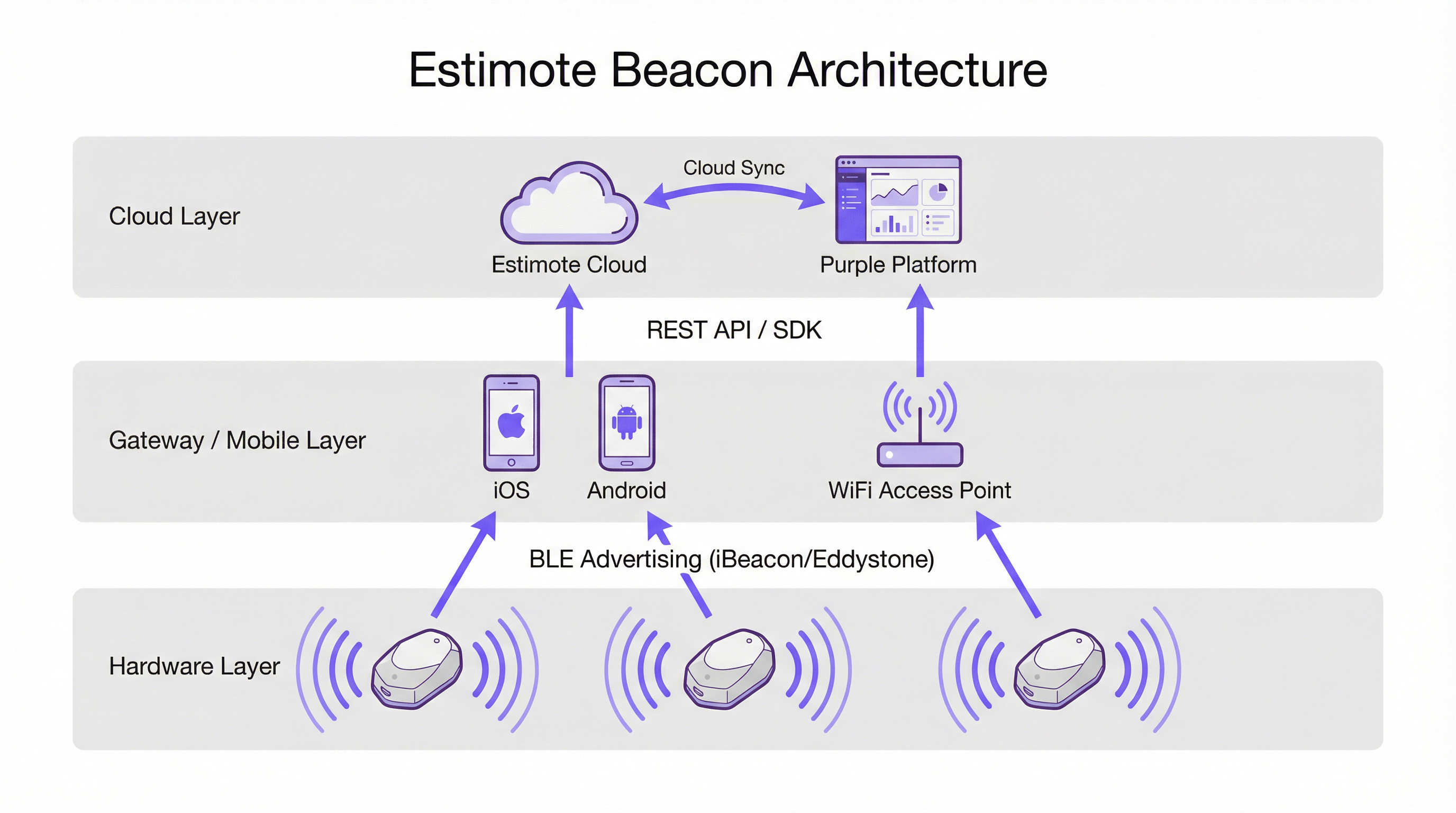
Fondamentalmente, un beacon Estimote è un piccolo computer alimentato a batteria che trasmette un segnale Bluetooth Low Energy (BLE). Questo processo, noto come "undirected advertising" (trasmissione non indirizzata), consente a qualsiasi dispositivo dotato di BLE, come uno smartphone, di rilevare la presenza del beacon senza accoppiamento o connessione diretta. Il beacon trasmette a intervalli regolari un piccolo pacchetto di dati, contenente un identificatore che un'applicazione mobile può riconoscere e su cui può agire. Questo modello di comunicazione uno-a-molti è altamente efficiente e costituisce la base di tutte le soluzioni di prossimità basate su beacon.
Protocolli: iBeacon ed Eddystone
Due protocolli principali regolano le comunicazioni dei beacon: iBeacon di Apple ed Eddystone di Google. Un beacon Estimote può trasmettere l'uno, l'altro o entrambi.
- iBeacon: trasmette un identificatore univoco composto da tre parti: un UUID (Universally Unique Identifier), un valore Major e un valore Minor. Questa struttura gerarchica è ideale per mappare gli spazi fisici. Ad esempio, un UUID può rappresentare un'intera organizzazione, un valore Major può rappresentare una sede o un piano specifico e un valore Minor può identificare un singolo beacon.
- Eddystone: un protocollo open source di Google che offre maggiore flessibilità. Definisce diversi tipi di frame, tra cui Eddystone-UID (simile all'identificatore di iBeacon), Eddystone-URL (trasmette un indirizzo web) ed Eddystone-EID (un identificatore effimero e crittografato che cambia periodicamente, migliorando sicurezza e privacy).
Hardware e prestazioni
L'attuale generazione di Proximity Beacon di Estimote opera su Bluetooth 5.0, offrendo una portata massima teorica fino a 100 metri. Tuttavia, per il wayfinding indoor pratico, la potenza di trasmissione è configurata per distanze molto più brevi per garantire precisione e prevenire la dispersione del segnale tra i piani. Alimentati da due batterie AA standard, questi beacon possono raggiungere una durata di 3-5 anni, a seconda dell'intervallo di trasmissione e delle impostazioni della potenza di trasmissione. Questa lunga vita operativa è un fattore critico per ridurre il costo totale di proprietà (TCO) nelle implementazioni su larga scala.
La famiglia di prodotti Estimote
Estimote offre una gamma di hardware su misura per casi d'uso specifici:
| Linea di prodotti | Caratteristiche principali e casi d'uso |
|---|---|
| Proximity Beacon | Il cavallo di battaglia standard per il wayfinding e il marketing di prossimità. |
| LTE Beacon | Rete cellulare integrata (LTE-M/NB-IoT) e GPS per il tracciamento di asset indoor/outdoor senza l'intermediazione di uno smartphone. |
| Tag UWB | Utilizza la tecnologia Ultra-Wideband per una precisione di posizionamento al centimetro, ideale per il tracciamento di asset ad alta precisione e l'evitamento delle collisioni. |
| Mirror Beacon | Si connette ai display digitali per mostrare contenuti attivati dai beacon o dagli utenti nelle vicinanze. |
Guida all'implementazione
Un'implementazione di beacon di successo si basa su una pianificazione meticolosa e un'esecuzione rigorosa. I passaggi seguenti forniscono un modello indipendente dal fornitore per i team IT.
Fase 1: Sopralluogo e posizionamento dei beacon
Prima di installare qualsiasi hardware, è obbligatorio un sopralluogo accurato. Ostacoli fisici come pilastri in cemento, scaffalature metalliche e vani ascensore attenuano significativamente i segnali BLE. Utilizza uno strumento come IndoorAtlas per mappare la propagazione del segnale e identificare le posizioni ottimali per i beacon.
Best practice per il posizionamento:
- Altezza: monta i beacon a 2,5-3 metri dal pavimento per evitare manomissioni e ridurre al minimo l'ostruzione del segnale.
- Posizioni chiave: posiziona i beacon in tutti i gruppi di ascensori, ingressi/uscite, punti di transizione tra i piani e incroci dei corridoi principali.
- Configurazione della portata: questo è il passaggio di configurazione più critico. Una potenza di trasmissione configurata in modo errato è la causa principale di scarse prestazioni.
- Ingressi e ascensori: imposta la portata a ~15 metri (-12dBm).
- Corridoi lunghi: imposta la portata a ~30 metri (-4dBm).
- Atri aperti/Pareti in vetro: riduci la portata a ~7 metri (-20dBm) per evitare la dispersione del segnale tra i piani.
Fase 2: Configurazione dei beacon
Il rigore nella configurazione previene futuri problemi di risoluzione degli errori. Tutti i beacon all'interno di un'implementazione dovrebbero condividere un profilo di configurazione comune.
Parametri di configurazione:
- UUID: assegna un singolo UUID univoco per l'intera organizzazione.
- Major/Minor: utilizza il valore Major per indicare il numero del piano (es. 1 per il 1° piano, 99 per il seminterrato). Utilizza il valore Minor come numero sequenziale univoco per ogni beacon su quel piano.
- Intervallo di trasmissione: per il wayfinding, si consiglia un intervallo di 300-500 ms. Un intervallo di 300 ms offre un'esperienza utente reattiva con un impatto gestibile sulla durata della batteria.
- Tipi di pacchetto: disabilita tutti i pacchetti di trasmissione non richiesti per il tuo caso d'uso (es. disabilita i pacchetti specifici di Estimote se stai utilizzando solo iBeacon per un'implementazione Purple).
Fase 3: Gestione della flotta
Per qualsiasi implementazione che superi qualche decina di beacon, la configurazione manuale non è scalabile. Sfrutta Estimote Cloud e il suo strumento Bulk Updater per applicare modifiche di configurazione a centinaia o migliaia di dispositivi contemporaneamente. Stabilisci un processo per il monitoraggio della durata della batteria (disponibile tramite l'SDK di Estimote e l'API Cloud) e per l'applicazione degli aggiornamenti firmware, che spesso contengono patch di sicurezza critiche e miglioramenti delle prestazioni.
Best practice
- Documenta tutto: etichetta fisicamente ogni beacon con i suoi valori Major e Minor prima dell'installazione. Mantieni una mappa digitale corrispondente che colleghi gli ID dei beacon alle loro posizioni fisiche precise.
- Dai priorità alla sicurezza: per le applicazioni sensibili, utilizza il protocollo Eddystone-EID con i suoi identificatori a rotazione e crittografati. Ciò impedisce ad attori malintenzionati di falsificare i beacon o tracciare gli utenti senza autorizzazione.
- Garantisci la conformità (GDPR/PCI DSS): le implementazioni di beacon che elaborano dati personali rientrano nell'ambito del GDPR. Assicurati di disporre di un meccanismo di consenso esplicito (opt-in) all'interno della tua applicazione mobile. Per gli ambienti retail, assicurati che l'infrastruttura dei beacon e le applicazioni associate non compromettano la conformità PCI DSS gestendo in modo errato i dati delle carte di pagamento.
- Integrazione con l'analisi dei dati: il vero ROI di un'implementazione di beacon si realizza attraverso i dati. Integra i dati sulla posizione dei beacon con una piattaforma di analisi come Purple per misurare i tempi di permanenza, analizzare i modelli di traffico pedonale e quantificare l'impatto delle campagne di marketing di prossimità.
Risoluzione dei problemi e mitigazione dei rischi
- Rilevamento del piano impreciso: questo è quasi sempre causato dalla dispersione del segnale. La mitigazione principale consiste nel ridurre la potenza di trasmissione (portata) dei beacon nelle aree aperte e in prossimità delle transizioni tra i piani. Un sopralluogo adeguato è la migliore misura preventiva.
- Scarsa precisione della posizione: se il "puntino blu" è in ritardo o salta, diminuisci l'intervallo di trasmissione (es. da 500 ms a 300 ms) per fornire aggiornamenti di posizione più frequenti all'app mobile. Inoltre, verifica il posizionamento e la densità dei beacon rispetto al sopralluogo.
- Consumo della batteria: se le batterie si esauriscono più velocemente dei 3-5 anni previsti, rivedi la configurazione dei beacon. Un intervallo di trasmissione troppo aggressivo (es. 100 ms) o una potenza di trasmissione eccessivamente elevata sono i colpevoli più comuni.
ROI e impatto aziendale
Il business case per i beacon Estimote si basa su miglioramenti misurabili dell'esperienza del cliente e dell'efficienza operativa.
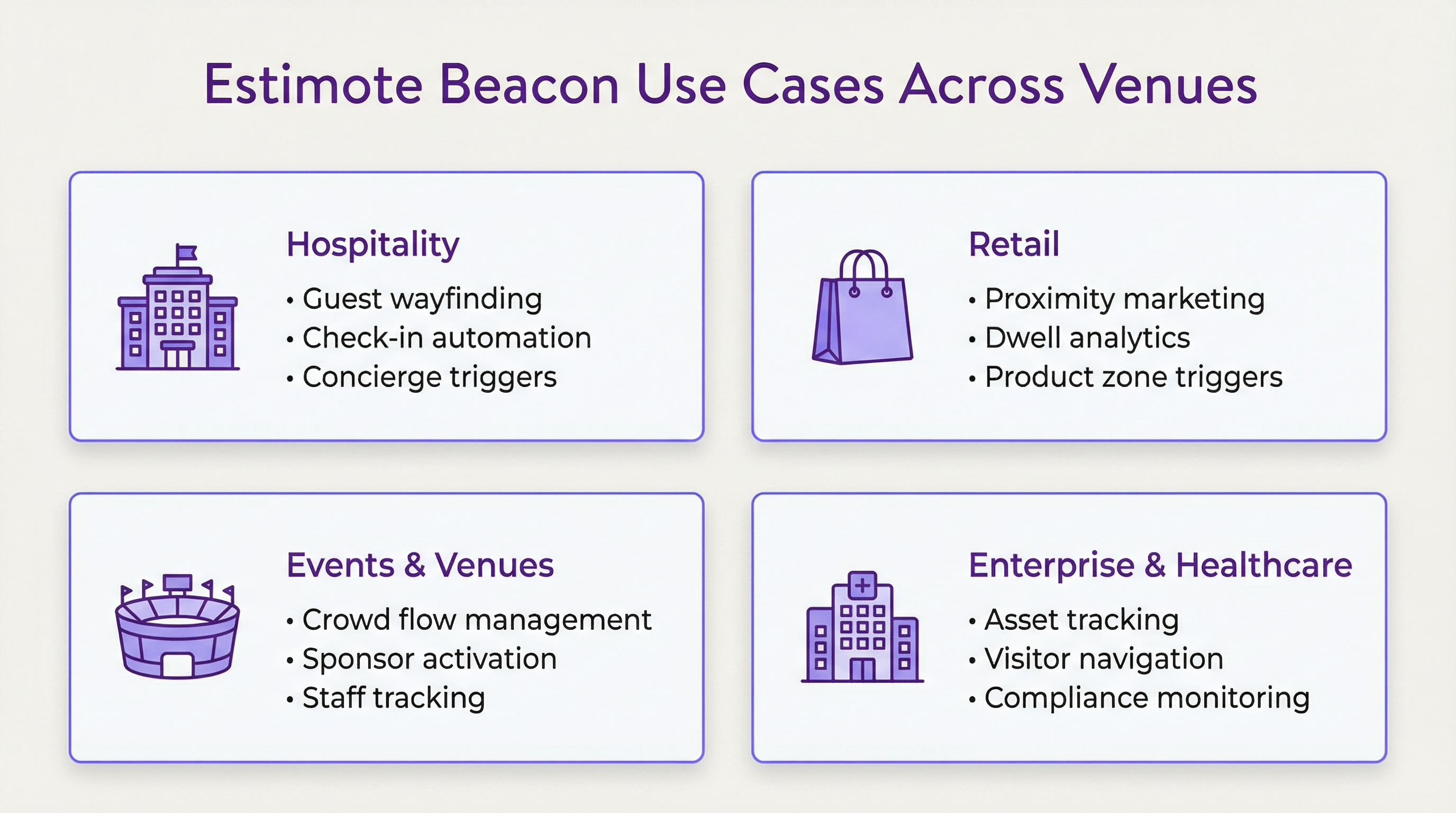
- Settore alberghiero: un hotel può utilizzare i beacon per consentire un check-in mobile senza interruzioni, fornire la navigazione passo-passo verso la camera di un ospite e inviare offerte mirate per servizi spa o prenotazioni di ristoranti al passaggio dell'ospite. Il ROI si misura nell'aumento dei punteggi di soddisfazione degli ospiti (NPS), in maggiori ricavi accessori e in una migliore efficienza del personale.
- Retail: un rivenditore può analizzare i percorsi dei clienti in negozio, misurare il tempo di permanenza in reparti specifici e attivare promozioni personalizzate quando un membro del programma fedeltà entra in una zona di prodotti di alto valore. Il ROI si misura nell'aumento delle dimensioni del carrello, nel miglioramento dei tassi di conversione e in un maggiore customer lifetime value.
- Strutture di grandi dimensioni (stadi/aeroporti): i beacon alimentano il wayfinding verso posti a sedere o gate, facilitano la gestione del flusso della folla e consentono attivazioni di sponsor basate sulla posizione. Il ROI si misura nella riduzione della congestione, nel miglioramento dell'esperienza dei fan/viaggiatori e in nuovi flussi di entrate derivanti dalla pubblicità basata sulla posizione.
Key Terms & Definitions
Bluetooth Low Energy (BLE)
A power-efficient variant of the Bluetooth wireless standard, designed for Internet of Things (IoT) devices to communicate small amounts of data over short distances. Its low power consumption is what enables beacons to operate for years on small batteries.
IT teams will encounter BLE as the fundamental communication technology for all modern beacons. Understanding its range and power characteristics is crucial for designing a sustainable deployment.
iBeacon
Apple's protocol for BLE advertising. It structures the beacon's broadcast around a three-tiered identifier: UUID, Major, and Minor. It is the most widely supported protocol for indoor navigation on iOS devices.
This is a non-negotiable standard to support for any public-facing venue. If you want to provide wayfinding for iPhone users, your beacons must be broadcasting iBeacon packets.
Eddystone
Google's open-source alternative to iBeacon. It is more flexible, with multiple frame types including Eddystone-EID, which uses ephemeral (short-lived) identifiers to enhance security and privacy.
For enterprise deployments concerned with security or wanting to avoid vendor lock-in, Eddystone provides a powerful and flexible option. Eddystone-EID is a key feature for mitigating tracking and spoofing risks.
UUID (Universally Unique Identifier)
A 128-bit number used to identify information in computer systems. In the context of iBeacon, it serves as the top-level identifier for an organization or a specific app.
The UUID acts as a unique namespace for your beacon deployment. All beacons in your organization should be configured with the same UUID to ensure your app does not respond to beacons from other nearby businesses.
Advertising Interval
The frequency at which a beacon broadcasts its advertising packet. A shorter interval (e.g., 100ms) results in more responsive location updates but consumes more battery. A longer interval (e.g., 1000ms) conserves battery but can feel sluggish.
This is a critical trade-off that network architects must balance. For active wayfinding, 300-500ms is the sweet spot. For passive asset tracking, the interval can be much longer.
Transmission Power (Tx Power)
The signal strength of the beacon's broadcast, measured in dBm. This setting directly controls the beacon's range. A higher Tx Power (e.g., +4dBm) means longer range, while a lower Tx Power (e.g., -20dBm) means shorter range.
This is the primary tool for tuning a beacon network. Correctly setting Tx Power is the key to preventing signal bleed and ensuring accurate positioning. It is more important than physical beacon density in many cases.
Signal Bleed
The phenomenon where a beacon's signal is detected in an unintended area, most commonly on the floor above or below its actual location. It is the primary cause of inaccurate floor detection in wayfinding applications.
IT teams must actively design against signal bleed, especially in buildings with atriums or thin floors. The main mitigation strategy is to reduce the transmission power of beacons in problematic areas.
Ultra-Wideband (UWB)
A short-range radio technology that can measure location with very high precision (down to a few centimeters). It works by measuring the time-of-flight of radio signals between a tag and multiple anchors.
When an IT team is tasked with a use case that requires 'inch-level' or 'sub-meter' accuracy, such as tool tracking in manufacturing or collision avoidance, BLE is not sufficient. UWB is the appropriate technology for these high-precision requirements.
Case Studies
A 500-room luxury hotel in a dense urban environment wants to implement 'blue dot' wayfinding for guests from the lobby to their rooms, elevators, and amenities (pool, restaurant). The hotel has a large, three-story glass atrium at its center. What is the recommended Estimote beacon deployment strategy?
- Hardware Selection: Standard Estimote Proximity Beacons are sufficient for this use case.
- Site Survey: Conduct a mandatory site survey focusing on the glass atrium. Use a signal mapping tool to visualize BLE signal propagation and identify potential for inter-floor signal bleed.
- Beacon Placement & Configuration:
- Guest Corridors: Place one beacon every 50-75 feet, mounted 8-10 feet high. Configure with a -8dBm transmit power (approx. 100ft range) and a 400ms advertising interval.
- Elevator Banks: Place one beacon at each elevator bank on every floor. Configure with a -12dBm transmit power (approx.50ft range) to ensure the signal is localized to the waiting area.
- Atrium: This is the critical zone. Place beacons around the perimeter of the atrium on each floor. Configure them with a significantly lower transmit power, such as -20dBm (approx. 22ft range), to prevent signals from reaching the floors above and below. The advertising interval can be increased to 600ms as fine-grained accuracy is less critical in this open space.
- Naming Convention: Use the hotel's unique UUID. Set Major to the floor number (e.g., 1, 2, 3...). Assign sequential Minor values for each beacon on that floor. Physically label each beacon.
- Fleet Management: Use the Estimote Cloud to bulk-configure all beacons and monitor battery life post-deployment.
A retail chain with 200 stores wants to track high-value assets (e.g., portable payment terminals, specialized scanning equipment) that move between the stockroom and the sales floor. The assets sometimes leave the store for sidewalk sales events. What is the optimal Estimote solution?
- Hardware Selection: The ideal solution is the Estimote LTE Beacon. Its integrated cellular connectivity and GPS make it perfect for tracking assets both indoors and outdoors, without relying on the store's Wi-Fi or nearby smartphones.
- Deployment: Attach one LTE Beacon to each high-value asset. No complex beacon infrastructure is required within the store itself.
- Cloud Configuration: In the Estimote Cloud, configure the LTE Beacons to report their location at a set interval (e.g., every 5 minutes when stationary, every 1 minute when in motion). Set up geofences for each store location.
- Application Integration: Use the Estimote Cloud API to pull location data for each asset into the retailer's central inventory management system. Configure API-triggered alerts for specific events:
- An alert is sent to the store manager if an asset's battery level drops below 20%.
- An alert is sent if an asset leaves the store's geofence outside of a scheduled sidewalk sale event.
- ROI Measurement: The ROI is calculated by the reduction in lost or stolen assets, the decrease in time spent by staff searching for equipment, and the improved availability of revenue-generating devices like payment terminals.
Scenario Analysis
Q1. Your stadium client wants to use beacons to track the real-time location of mobile food and beverage carts to optimize stock levels and deployment. The carts move throughout the stadium, including outdoor plaza areas. Which Estimote product is the best fit and why?
💡 Hint:Consider the need for tracking both indoors and outdoors, without relying on the stadium's public Wi-Fi or guest smartphones.
Show Recommended Approach
The Estimote LTE Beacon is the best fit. Its built-in cellular (LTE-M) and GPS capabilities allow it to report its location independently from anywhere in the stadium, whether inside the concourse or outside in the plaza. Standard proximity beacons would not work reliably as they depend on a nearby smartphone with a specific app to relay their location, and UWB would be overkill and too complex for this wide-area tracking use case.
Q2. A hospital is deploying beacons for patient wayfinding. During testing, they find that when patients are in the central atrium, the app frequently switches between showing them on the 2nd and 3rd floors. What are the two most likely causes and the primary solution?
💡 Hint:Think about how BLE signals behave in large, open, multi-story spaces.
Show Recommended Approach
The two most likely causes are: 1) The transmission power (range) of the beacons around the atrium is set too high. 2) The beacons are placed in locations that allow for a clear, unobstructed line of sight between floors. The primary solution is to significantly reduce the transmission power of the beacons located in and around the atrium to a very short range (e.g., -20dBm) to create a tight signal bubble on each floor and prevent this inter-floor 'signal bleed'.
Q3. A retail CTO is concerned about the privacy implications of a beacon deployment under GDPR. They ask if beacons are "tracking our customers' phones." How would you accurately describe the data flow to reassure them?
💡 Hint:Focus on where the 'intelligence' lies in the system and the role of user consent.
Show Recommended Approach
You should clarify that the beacons themselves do not track anyone. They are simple, one-way broadcast devices, like a lighthouse. They have no knowledge of who is nearby. The tracking event occurs at the application layer, on the customer's own phone, and only if they have explicitly opted-in and granted the app location permissions. The app detects the beacon's signal and then reports the phone's proximity to that beacon to the cloud. The entire process is user-initiated and consent-driven, which is a key principle of GDPR. Furthermore, using protocols like Eddystone-EID can encrypt the beacon's identifier, adding another layer of privacy.
Key Takeaways
- ✓Estimote beacons are low-power, battery-operated devices that broadcast BLE signals to enable indoor positioning and proximity-based actions.
- ✓Successful deployment requires a thorough site survey to plan beacon placement and prevent signal bleed, especially in open, multi-story areas.
- ✓Configuration discipline is key: use a consistent UUID, logical Major/Minor assignments, and an appropriate advertising interval (300-500ms for wayfinding).
- ✓For indoor/outdoor asset tracking, Estimote LTE Beacons with integrated cellular/GPS are the optimal solution, removing dependency on smartphones.
- ✓For high-precision (inch-level) tracking, Ultra-Wideband (UWB) tags are the appropriate technology, not standard BLE beacons.
- ✓Compliance with GDPR requires an explicit opt-in consent model within the mobile application; the beacons themselves do not store or process personal data.
- ✓The ROI of a beacon deployment is realized by integrating location data with analytics platforms to measure improvements in customer experience, operational efficiency, and revenue.




