

Randomizzazione dell'indirizzo MAC: un'analisi approfondita sul potenziamento della privacy e il suo impatto sulla gestione della rete
This guide provides a comprehensive technical overview of MAC address randomization, a critical privacy feature now default on iOS, Android, and Windows devices. It details the direct impact on enterprise WiFi network management — from broken MAC-based authentication and inflated analytics to security monitoring gaps — and offers actionable, identity-driven strategies for IT leaders in hospitality, retail, stadiums, and public-sector organisations to adapt their infrastructure. By shifting from hardware-based to credential-based network management, organisations can simultaneously enhance security, achieve privacy compliance, and unlock richer customer insights.
🎧 Listen to this Guide
View Transcript

Sintesi esecutiva
La randomizzazione dell'indirizzo MAC è una tecnologia per il potenziamento della privacy, ora abilitata per impostazione predefinita su iOS 14+, Android 10+ e Windows 10, progettata per impedire il tracciamento a lungo termine dei dispositivi sulle reti WiFi. Trasmettendo un indirizzo hardware temporaneo e randomizzato anziché l'identificatore permanente assegnato in fabbrica, i dispositivi moderni proteggono la privacy degli utenti a costo di interrompere i flussi di lavoro di gestione della rete legacy. Per gli operatori enterprise nei settori dell'ospitalità, del retail, degli eventi e nel settore pubblico, ciò crea tre sfide operative immediate: i sistemi di controllo degli accessi basati su MAC non riescono a riconoscere i dispositivi di ritorno; i log di monitoraggio della sicurezza diventano più difficili da interpretare poiché i dispositivi cambiano identità; e le piattaforme di analisi WiFi riportano conteggi di visitatori unici gravemente gonfiati, rendendo inaffidabili i dati sull'affluenza e sui tempi di permanenza. La risposta strategica non è combattere questa tecnologia, ma adottare un'architettura più sofisticata e incentrata sull'identità. L'implementazione di IEEE 802.1X con WPA3-Enterprise per le reti aziendali e di moderni Captive Portal con integrazione dell'identità per le reti guest, risolve tutte e tre le sfide contemporaneamente. Questa guida fornisce l'approfondimento tecnico e le indicazioni pratiche di implementazione necessarie per pianificare ed eseguire tale transizione in questo trimestre.
Approfondimento tecnico
Comprendere la randomizzazione dell'indirizzo MAC richiede una visione chiara del suo scopo, dei suoi meccanismi e degli standard che ne regolano l'implementazione. Il suo obiettivo principale è ridurre la capacità degli osservatori di rete di creare un profilo a lungo termine dei movimenti e delle abitudini di un utente, collegando la sua attività a un singolo identificatore di dispositivo persistente.
I meccanismi della randomizzazione
Il sistema operativo di un dispositivo genera un indirizzo MAC randomizzato in uno di due scenari: per la scansione delle reti vicine (probe request) o per la connessione a una rete specifica (associazione). L'implementazione varia tra i sistemi operativi, ma il principio generale è coerente su tutte le principali piattaforme.
Durante l'individuazione della rete, il dispositivo invia probe request utilizzando un indirizzo temporaneo. Quando decide di connettersi a una rete, può utilizzare un nuovo indirizzo randomizzato specifico per quella connessione. La frequenza di modifica è una variabile chiave. Le implementazioni moderne, tra cui iOS 14+ e Android 10+, creano un indirizzo MAC randomizzato unico e persistente per ogni rete WiFi salvata (SSID). Il dispositivo utilizzerà costantemente lo stesso indirizzo randomizzato per una determinata rete in caso di connessioni ripetute, ma un indirizzo randomizzato completamente diverso per qualsiasi altra rete. Ciò fornisce un'esperienza di connessione stabile su reti attendibili, impedendo al contempo la correlazione tra posizioni diverse.
L'implicazione critica per gli amministratori di rete è che, sebbene un dispositivo possa apparire stabile all'interno di una singola sede nel tempo, non vi è alcuna garanzia di permanenza. La rotazione dell'indirizzo può essere attivata da un ripristino del dispositivo, dall'eliminazione di un profilo di rete o da un aggiornamento del sistema operativo. Qualsiasi sistema che tratti un indirizzo MAC come un identificatore permanente e affidabile opera su un presupposto errato.
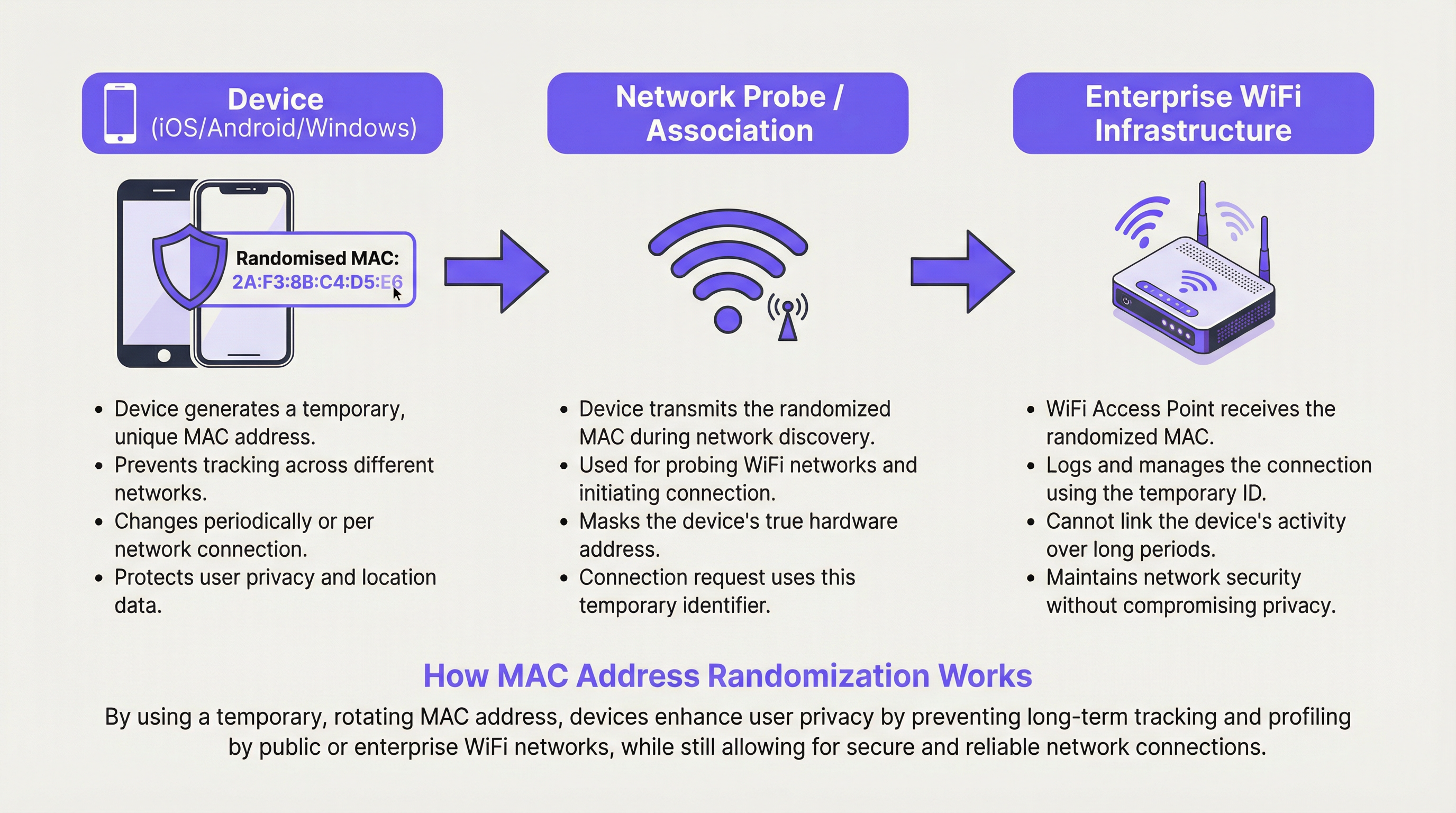
Tipi di randomizzazione dell'indirizzo MAC
Esistono due forme principali di randomizzazione dell'indirizzo MAC che gli architetti di rete devono comprendere. La Randomizzazione delle Probe Request è stata l'implementazione iniziale, in cui i dispositivi utilizzano un MAC casuale solo durante la scansione delle reti, ma rivelano il loro vero MAC al momento della connessione. Questo protegge ancora la privacy per i dispositivi non connessi, ma è meno efficace una volta stabilita una connessione. La Randomizzazione dell'Associazione è l'approccio più robusto e ora standard, in cui viene utilizzato un MAC randomizzato per la connessione effettiva a un access point. Questa è la forma che ha l'impatto più significativo sulla gestione della rete enterprise, poiché interessa tutti i dispositivi connessi.
Anche la distinzione tra randomizzazione per-SSID e per-connessione è operativamente importante. La randomizzazione per-SSID (l'impostazione predefinita attuale di iOS e Android) significa che lo stesso indirizzo casuale viene riutilizzato per lo stesso nome di rete, fornendo una certa stabilità. La randomizzazione per-connessione, che alcune configurazioni incentrate sulla privacy o versioni future dei sistemi operativi potrebbero adottare, genererebbe un nuovo indirizzo a ogni singola connessione, rendendo impossibile qualsiasi forma di continuità di sessione senza un livello di identità.
Implementazione specifica per sistema operativo
| Sistema operativo | Comportamento predefinito | Percorso di gestione | Note |
|---|---|---|---|
| iOS 14+ | Abilitato per impostazione predefinita per SSID | Impostazioni > Wi-Fi > (i) > Indirizzo Wi-Fi privato | Viene generato un MAC randomizzato univoco per ogni rete. Ruota se non connesso per un certo periodo. |
| Android 10+ | Abilitato per impostazione predefinita per SSID | Impostazioni > Rete > Wi-Fi > Avanzate > Privacy | Il comportamento può variare in base al produttore del dispositivo (OEM). |
| Windows 10/11 | Disattivato per impostazione predefinita | Impostazioni > Rete > Wi-Fi > Gestisci reti note > Proprietà | Può essere impostato su Attivato, Disattivato o Cambia quotidianamente per ogni rete. |
| macOS (Ventura+) | Abilitato per impostazione predefinita per SSID | Impostazioni di Sistema > Wi-Fi > Dettagli > Ruota indirizzo Wi-Fi | Si allinea al comportamento di iOS. |
Guida all'implementazione
L'adattamento alla randomizzazione dell'indirizzo MAC è un processo strutturato. I seguenti passaggi forniscono un framework di implementazione indipendente dal fornitore (vendor-neutral) per gli ambienti enterprise.
Fase 1: Condurre un audit delle dipendenze MAC. Prima di apportare qualsiasi modifica, identifica ogni sistema nel tuo ambiente che utilizza un indirizzo MAC come identificatore principale. Ciò include regole del firewall, prenotazioni DHCP, elenchi di controllo degli accessi (ACL), strumenti di monitoraggio della rete e piattaforme di analisi. Documenta ogni dipendenza e classificala come controllo di sicurezza, strumento operativo o input di analisi. Questo audit costituisce la base della tua roadmap di risoluzione.
Fase 2: Dismettere i controlli di sicurezza basati su MAC. Qualsiasi regola di sicurezza che conceda o neghi l'accesso basandosi esclusivamente su un indirizzo MAC deve essere sostituita. Non è un'opzione; è un imperativo di sicurezza. Gli indirizzi MAC non sono un fattore di autenticazione affidabile. Sostituisci queste regole con l'autenticazione IEEE 802.1X, che richiede ai dispositivi di presentare credenziali verificabili a un server RADIUS. Questo è l'unico metodo che fornisce sia sicurezza che resilienza alla randomizzazione del MAC.
Fase 3: Implementare WPA3-Enterprise. Assicurati che la tua infrastruttura wireless supporti WPA3. La maggior parte degli access point prodotti dopo il 2020 è compatibile con WPA3, ma verifica che il firmware sia aggiornato. WPA3-Enterprise fornisce la Simultaneous Authentication of Equals (SAE) e, nella sua modalità a 192 bit, soddisfa i requisiti di sicurezza degli ambienti sensibili, inclusi quelli soggetti a PCI DSS e ai framework di sicurezza del settore pubblico.
Fase 4: Modernizzare il portale della rete guest. Sostituisci qualsiasi semplice splash page con un Captive Portal basato sull'identità. Il portale dovrebbe offrire almeno una delle seguenti opzioni: registrazione via email con verifica, social login (OAuth), integrazione con programmi fedeltà o un codice di accesso precondiviso. Ognuna di queste opzioni fornisce un identificatore utente stabile che persiste attraverso le sessioni e i cambiamenti di indirizzo del dispositivo. Assicurati che il portale e le sue pratiche di raccolta dati siano pienamente conformi al GDPR, con meccanismi di consenso esplicito.
Fase 5: Aggiornare la piattaforma di analisi. Contatta il tuo fornitore di analisi WiFi e chiedigli direttamente come la sua piattaforma gestisce la randomizzazione del MAC. Una piattaforma moderna dovrebbe concentrarsi su analisi basate sulla sessione, flussi di utenti autenticati e clustering probabilistico dei dispositivi, piuttosto che sul conteggio grezzo degli indirizzi MAC. Stabilisci nuove metriche di base per il conteggio dei visitatori che tengano conto del cambiamento di metodologia.
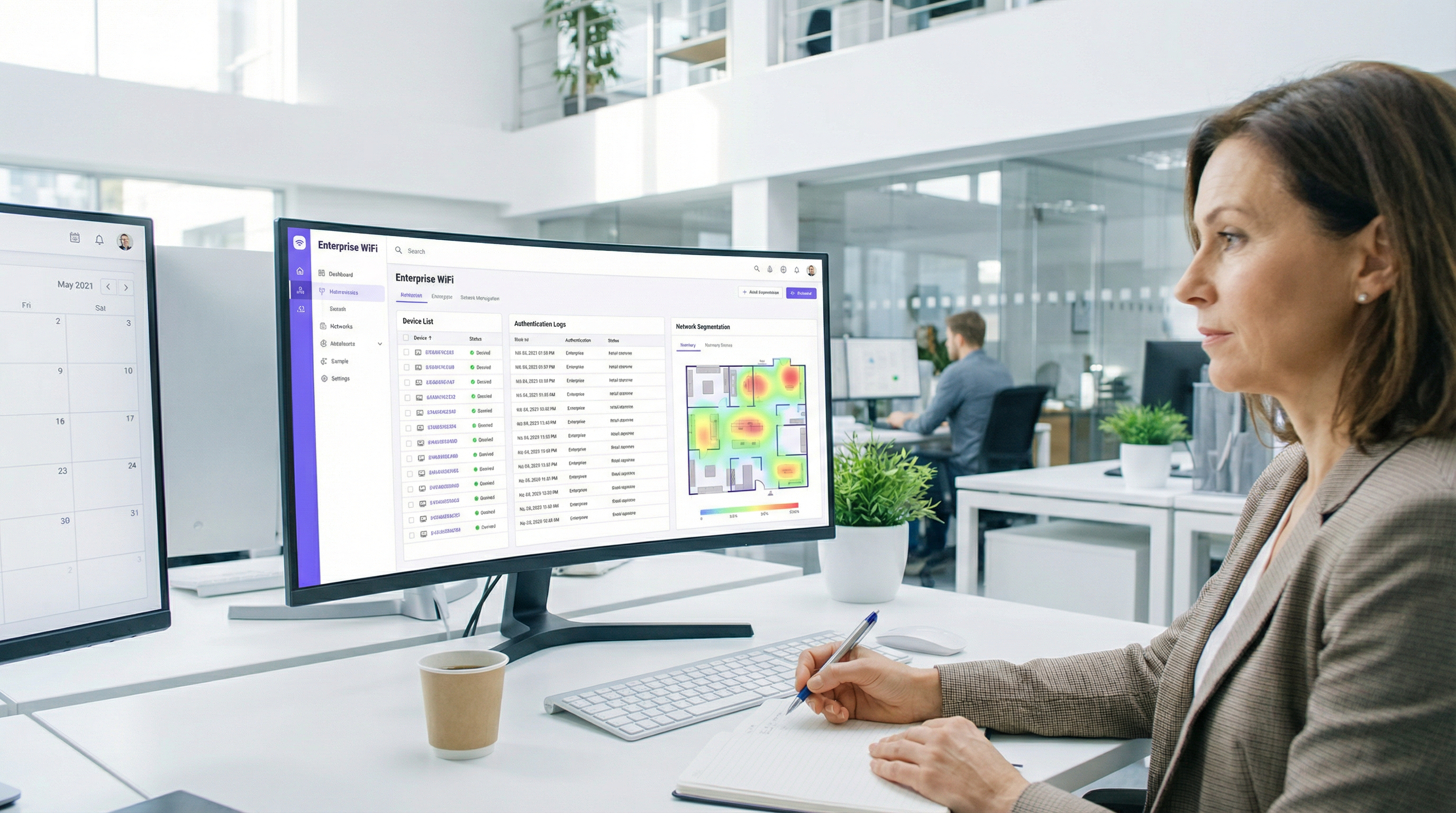
Best Practice
Le seguenti best practice riflettono gli attuali standard del settore e le linee guida indipendenti dal fornitore per la gestione del WiFi enterprise nell'era della randomizzazione dell'indirizzo MAC.
Adottare un'architettura Identity-First. Il principio generale è trattare l'identità dell'utente e del dispositivo come un'asserzione basata su credenziali, non come un'osservazione hardware. Ogni decisione di accesso, evento di analisi e voce del log di sicurezza dovrebbe essere ancorata a un'identità verificata, ove possibile. Ciò si allinea ai principi del Zero Trust Network Access (ZTNA), che presuppongono che nessun dispositivo sia intrinsecamente affidabile solo in virtù dei suoi attributi hardware.
Implementare 802.1X con autenticazione basata su certificati per i dispositivi gestiti. Per i dispositivi di proprietà dell'azienda, distribuisci i certificati del dispositivo tramite la tua piattaforma di Mobile Device Management (MDM). Ciò consente al dispositivo di autenticarsi alla rete in modo automatico e sicuro utilizzando un certificato, offrendo un'esperienza utente fluida e mantenendo al contempo una solida sicurezza. Questa è l'implementazione più robusta di 802.1X ed è consigliata per gli ambienti soggetti a framework di conformità.
Utilizzare l'assegnazione VLAN tramite RADIUS per la segmentazione della rete. Invece di utilizzare ACL basate su MAC per la segmentazione, configura il tuo server RADIUS per assegnare i dispositivi a VLAN specifiche in base alla loro identità autenticata. Un utente guest ottiene la VLAN guest; un dispositivo aziendale ottiene la VLAN aziendale; un terminale POS ottiene la VLAN dei pagamenti. Questo approccio è dinamico, scalabile e immune alla randomizzazione del MAC.
Allinearsi al GDPR e ai principi di minimizzazione dei dati. Ai sensi del GDPR, un indirizzo MAC che può essere collegato a un individuo è considerato un dato personale. Il passaggio a una gestione basata sull'identità, in cui la raccolta dei dati è esplicita e basata sul consenso, non è solo un miglioramento tecnico: è un miglioramento della conformità. Assicurati che le tue policy di conservazione dei dati per i log di rete e i dati di analisi vengano riviste alla luce di questi principi.
Risoluzione dei problemi e mitigazione dei rischi
Di seguito sono riportate le modalità di errore più comuni riscontrate durante e dopo la transizione dall'abbandono della gestione di rete basata su MAC.
Modalità di errore 1: Dispositivi ripetutamente bloccati o costretti a riautenticarsi. La causa principale è quasi sempre un'ACL residua basata su MAC o un sistema di sicurezza che non è stato completamente migrato. Conduci una revisione approfondita di tutte le policy del firewall e di accesso alla rete. Utilizza la tua piattaforma di gestione della rete per identificare eventuali regole che fanno riferimento a indirizzi MAC specifici e sostituiscile con equivalenti basati sull'identità.
Modalità di errore 2: I dati di analisi mostrano un picco massiccio di dispositivi unici. Questo è il risultato diretto di una piattaforma di analisi che utilizza gli indirizzi MAC come identificatore univoco principale. La mitigazione immediata consiste nel contrassegnare tutti i dati storici raccolti prima dell'audit come inaffidabili per i conteggi assoluti. In futuro, stabilisci nuove baseline utilizzando la tua piattaforma di analisi aggiornata e sensibile all'identità. Concentra la reportistica sulle tendenze e sulle metriche degli utenti autenticati piuttosto che sui conteggi grezzi dei dispositivi.
Modalità di errore 3: Problemi di roaming in sedi di grandi dimensioni. Negli ambienti con molti access point, un dispositivo potrebbe cambiare il proprio indirizzo MAC randomizzato quando passa da un access point (BSSID) a un altro, in particolare se il dispositivo tratta ogni BSSID come una rete distinta. Ciò può causare cadute di sessione e richieste di riautenticazione. La mitigazione consiste nell'assicurarsi che l'infrastruttura wireless utilizzi un corretto 802.11r (Fast BSS Transition) e che tutti gli access point sotto lo stesso SSID siano configurati come un singolo dominio di mobilità, riducendo al minimo i trigger per la rotazione dell'indirizzo.
Modalità di errore 4: Esaurimento del pool DHCP. Negli ambienti in cui i lease DHCP sono lunghi e il pool è piccolo, un volume elevato di dispositivi che si connettono con nuovi MAC randomizzati può esaurire gli indirizzi IP disponibili. Mitiga questo problema rivedendo e accorciando i tempi di lease DHCP per le reti guest e assicurandoti che il tuo pool DHCP sia dimensionato in modo appropriato per i picchi di connessioni simultanee piuttosto che per i dispositivi unici nel tempo.
ROI e impatto sul business
L'adattamento alla randomizzazione dell'indirizzo MAC è un investimento con un ritorno chiaro e misurabile su più dimensioni.
ROI sulla sicurezza. La sostituzione del whitelisting dei MAC con l'autenticazione 802.1X elimina una classe di vulnerabilità che viene sfruttata di frequente. Il MAC spoofing, in cui un utente malintenzionato clona un indirizzo MAC noto e valido per aggirare i controlli di accesso, è banalmente semplice e ampiamente documentato. Il passaggio all'autenticazione basata su credenziali rimuove completamente questo vettore di attacco. Il costo di una singola violazione della rete, che include la risposta agli incidenti, le notifiche normative e il danno reputazionale, supera di gran lunga il costo di un aggiornamento dell'infrastruttura di rete.
ROI sulla conformità. Per le organizzazioni soggette al GDPR, al PCI DSS o ai framework di sicurezza del settore pubblico, il passaggio alla gestione della rete basata sull'identità supporta direttamente gli obiettivi di conformità. Il principio di minimizzazione dei dati del GDPR viene rispettato raccogliendo solo i dati necessari, con consenso esplicito. Il PCI DSS richiede una robusta segmentazione della rete che non può essere ottenuta in modo affidabile con controlli basati su MAC. Evitare una singola sanzione significativa nell'ambito di uno di questi framework fornisce una valida giustificazione finanziaria per l'investimento.
ROI su analisi e ricavi. La transizione verso un portale guest basato sull'identità crea un canale diretto per il coinvolgimento dei clienti e la raccolta dei dati. Le organizzazioni che hanno implementato portali WiFi integrati con programmi fedeltà segnalano miglioramenti misurabili nella crescita delle liste email, nei tassi di visite ripetute e nell'accuratezza dell'analisi del customer journey. Per una catena di negozi o un gruppo alberghiero, la capacità di identificare e coinvolgere accuratamente i clienti di ritorno attraverso un canale di dati acconsentito ha implicazioni dirette sui ricavi. Il passaggio dal tracciamento di dispositivi anonimi al coinvolgimento di clienti noti rappresenta un miglioramento fondamentale nella qualità dei dati e nelle capacità di business intelligence.
Key Terms & Definitions
MAC Address (Media Access Control Address)
A unique, 48-bit hardware identifier assigned to a network interface controller (NIC) by the manufacturer. It is used as a network address for communications within a network segment and is structured as six pairs of hexadecimal digits (e.g., 00:1A:2B:3C:4D:5E).
Traditionally used by IT teams as a stable, unique identifier for devices on a WiFi network. Its reliability as a persistent identifier has been fundamentally undermined by MAC randomization, making it unsuitable as a primary key for security, access control, or analytics.
MAC Address Randomization
A privacy feature implemented in modern operating systems (iOS 14+, Android 10+, Windows 10+) where the device temporarily replaces its real, factory-assigned MAC address with a randomly generated one when connecting to or scanning for WiFi networks.
The central challenge for enterprise network managers. It prevents tracking of a device across different WiFi networks and over time, but disrupts legacy systems that depend on a stable MAC address for authentication, logging, and analytics.
IEEE 802.1X
An IEEE standard for port-based Network Access Control (PNAC). It provides an authentication mechanism requiring devices to present verifiable credentials to a RADIUS server before being granted access to a LAN or WLAN.
The gold-standard replacement for MAC-based access control. By authenticating the user or device via credentials rather than hardware attributes, it provides security that is entirely immune to MAC randomization. Essential for any enterprise network refresh.
WPA3-Enterprise
The latest generation of WiFi security protocol for enterprise environments, building on IEEE 802.1X. It offers enhanced encryption (up to 192-bit in its highest security mode) and protection against offline dictionary attacks and key reinstallation attacks.
The recommended security standard for corporate WiFi networks. Deploying WPA3-Enterprise alongside 802.1X is the definitive technical response to the security challenges posed by MAC randomization.
RADIUS (Remote Authentication Dial-In User Service)
A networking protocol that provides centralised Authentication, Authorisation, and Accounting (AAA) management for users who connect and use a network service.
The server-side component of an 802.1X deployment. When a device attempts to connect, the access point forwards the authentication request to the RADIUS server, which validates the credential and instructs the access point to grant or deny access — and optionally assign the device to a specific VLAN.
Captive Portal
A web page that a user of a public-access network is required to view and interact with before network access is granted. Portals are used for authentication, terms of service acceptance, payment, or marketing data collection.
For guest networks, the captive portal is the primary mechanism for establishing user identity in a post-MAC-randomization environment. A well-designed portal with a loyalty or social login integration provides a stable user identifier that replaces the MAC address for analytics and session management.
SSID (Service Set Identifier)
The public name of a WiFi network, broadcast by access points and visible to devices scanning for available connections.
Modern devices generate a unique, persistent randomized MAC address for each different SSID they connect to. This means a device will appear with a different MAC address on your 'Corporate' network versus your 'Guest' network, a critical detail for network segmentation and analytics.
GDPR (General Data Protection Regulation)
EU Regulation 2016/679, which governs the processing of personal data of individuals within the European Union. It requires a lawful basis for data processing, mandates data minimisation, and grants individuals rights over their data.
A static MAC address that can be linked to an individual is considered personal data under GDPR. Network managers must ensure that any system collecting or processing MAC addresses — or the new identity-based alternatives — has a documented lawful basis and appropriate data retention policies.
Zero Trust Network Access (ZTNA)
A security framework that requires all users and devices to be authenticated, authorised, and continuously validated before being granted access to applications and data, regardless of whether they are inside or outside the network perimeter.
MAC randomization is, in a sense, forcing enterprise networks toward Zero Trust principles by removing the ability to implicitly trust a device based on its hardware address. Adopting a ZTNA framework provides a coherent strategic context for the technical changes required.
Case Studies
A 200-room luxury hotel wants to provide a seamless, 'just-works' WiFi experience for returning guests, allowing them to connect automatically without a portal on subsequent visits. Their current system relies on MAC whitelisting for registered guests, which is now failing due to MAC randomization, generating a high volume of front-desk support calls.
The recommended solution is to deploy a WPA3-Enterprise network with 802.1X authentication, integrated with the hotel's Property Management System (PMS).
Infrastructure Upgrade: Verify all access points are WPA3-Enterprise certified and update firmware. Deploy or upgrade a RADIUS server (e.g., FreeRADIUS, Cisco ISE, or a cloud-hosted equivalent).
PMS Integration: Configure the PMS to automatically generate a unique, time-limited WiFi credential (username and a strong random password) for each guest at check-in. This credential is tied to their reservation and expires at check-out.
Guest Onboarding: At first connection, the guest is directed to a simple, branded captive portal where they enter their room number and last name to retrieve their credential. The device is then configured to trust the network's certificate and save the 802.1X profile.
Seamless Re-connection: On all subsequent connections during their stay — whether returning to the room, moving through the lobby, or using the restaurant WiFi — the device uses its saved 802.1X profile to authenticate seamlessly and securely in the background, with no user interaction required. The randomized MAC address is entirely irrelevant, as authentication is based on the credential.
Loyalty Integration (Phase 2): For returning guests across multiple stays, integrate the portal with the hotel's loyalty programme. Loyalty members can authenticate with their loyalty credentials, enabling the hotel to recognise them as returning guests and offer personalised welcome experiences.
A large retail chain with 150 stores uses WiFi analytics to measure footfall, dwell time in different departments, and queue lengths at checkout to optimise staffing and store layout. Since iOS 14 rolled out, their analytics platform is reporting inaccurate data, showing apparent unique visitor counts that are three to four times higher than actual footfall, and 'returning visitor' rates have dropped to near zero.
The retailer should transition to a multi-layered analytics strategy that de-emphasises MAC addresses as the primary identifier.
Upgrade Analytics Platform: Engage the current analytics vendor to understand their roadmap for MAC randomization. If the platform does not have a credible solution, evaluate alternatives that are designed for the post-randomization era. Modern platforms focus on session-based analysis and use probabilistic algorithms to estimate unique visitors, clearly distinguishing between 'devices seen' and 'estimated unique visitors'.
Implement an Identity Layer: Redesign the guest WiFi portal to offer a compelling reason for customers to log in. Options include a discount voucher on first login, access to a store loyalty account, or entry into a prize draw. Each login provides a stable identifier (email address, loyalty ID) that can be used to accurately track repeat visits across sessions and dates.
Augment with Non-WiFi Sensors: Deploy privacy-respecting IR beam counters or video analytics (people-counting only, no facial recognition) at store entrances and key department thresholds. This provides a ground-truth for absolute footfall counts, which can be used to calibrate and validate the WiFi analytics data.
Redefine KPIs: Work with the analytics team to redefine the key performance indicators. Shift from 'unique devices' to 'authenticated sessions', 'loyalty member visits', and 'estimated footfall' (from sensor data). Establish new baselines from the point of the platform upgrade and treat all historical MAC-based data as directionally useful but not absolutely accurate.
Scenario Analysis
Q1. You are the network architect for a multi-site conference centre. An event organiser wants to offer tiered WiFi access: a free, basic service for all attendees, and a paid, high-speed service for VIPs. Your current system uses MAC-based firewall rules to assign bandwidth tiers. How would you design a new solution that is resilient to MAC randomization and can scale across multiple simultaneous events?
💡 Hint:Consider how you can differentiate users at the point of authentication using a credential or payment token, and how RADIUS can dynamically assign network policies based on that identity.
Show Recommended Approach
The recommended design uses a single SSID with a captive portal that routes users to different authentication paths, with RADIUS handling dynamic policy assignment. The portal presents two options: 'Free Access' and 'VIP/Paid Access'. For the free tier, users accept terms and conditions and optionally provide an email address. The portal authenticates them to the RADIUS server, which assigns them to a VLAN with a bandwidth policy capped at, for example, 5 Mbps. For the VIP tier, users either enter a pre-purchased access code (distributed with their VIP ticket) or complete a payment via an integrated gateway. Upon successful validation, the RADIUS server assigns them to a separate VLAN with a high-speed policy. This design is entirely credential-driven, scales to any number of simultaneous events by issuing different access codes per event, and is completely immune to MAC randomization because no access decision is based on the device's hardware address.
Q2. A stadium is experiencing widespread connectivity complaints during a major event. The network logs show thousands of 802.11 authentication failures from devices with MAC addresses not present in the access control list. The security policy, implemented five years ago, blocks any MAC address not seen on the network in the previous 90 days. What is the root cause, what is the immediate remediation, and what is the long-term architectural fix?
💡 Hint:Consider the behaviour of devices belonging to fans who attend infrequently, and the fundamental incompatibility between time-based MAC whitelisting and address randomization.
Show Recommended Approach
Root cause: The 90-day MAC whitelist is fundamentally incompatible with MAC address randomization. A fan who attended a match more than 90 days ago will connect with a new randomized MAC address. The security system sees this as an unknown device and blocks it. For a stadium with infrequent events, the vast majority of fans will fall outside the 90-day window, causing mass authentication failures. Immediate remediation: Disable the MAC-based ACL immediately. It is causing a denial-of-service for legitimate users and providing negligible security value, as MAC spoofing trivially bypasses it. Replace it with an open network or a simple captive portal with terms-of-service acceptance to restore connectivity for the event. Long-term fix: Design a proper guest network architecture. For a public venue like a stadium, a captive portal with social login or ticketing system integration is the appropriate solution. This provides a user identity, enables analytics, and supports future loyalty and engagement programmes, without any dependence on MAC addresses.
Q3. Your retail chain's marketing team wants to run a 'welcome back' campaign, offering a personalised discount to customers who have visited a store more than three times in the past month. They want to deliver this offer via the guest WiFi portal. Explain why a MAC-address-based tracking system will fail to deliver this, and design an alternative technical architecture that will work reliably.
💡 Hint:Focus on what constitutes a reliable, persistent customer identifier versus a mutable hardware attribute, and how the captive portal can bridge the gap between an anonymous device and a known customer.
Show Recommended Approach
A MAC-based system will fail because the device's randomized MAC address will likely differ between visits, making each visit appear to be from a new, unknown device. It would be impossible to build a reliable visit history or identify returning customers. The alternative architecture is an identity-based loyalty WiFi programme. Implementation: 1) Customers register once via the captive portal, providing an email address or phone number, or linking their existing loyalty account. 2) On each subsequent visit, they log in to the WiFi using their loyalty credentials (a simple username/password or a one-tap social login). 3) The system records a 'visit event' against the stable loyalty ID, not the MAC address. 4) When the visit count for a specific loyalty ID reaches three within a rolling 30-day window, the portal's post-authentication landing page automatically displays the personalised discount offer. This architecture is accurate, consent-based, GDPR-compliant, and provides the marketing team with a rich, reliable dataset for campaign analysis and customer journey mapping.
Key Takeaways
- ✓MAC address randomization is the default setting on virtually all modern smartphones and laptops, making it the baseline assumption for any enterprise WiFi deployment.
- ✓Legacy MAC-based security controls (whitelists, ACLs) are now both ineffective and operationally disruptive — they must be replaced with IEEE 802.1X and WPA3-Enterprise.
- ✓WiFi analytics platforms that use MAC addresses as unique identifiers will report severely inflated visitor counts and near-zero returning visitor rates — a platform upgrade or reconfiguration is essential.
- ✓The strategic response is to shift from identity-by-hardware to identity-by-credential: authenticate users, not devices.
- ✓Modern captive portals with loyalty, social, or email login integrations provide a stable user identifier that is more accurate, more valuable, and more GDPR-compliant than MAC tracking.
- ✓Adapting to MAC randomization is not just a technical fix — it is an opportunity to build a more secure, compliant, and customer-centric network architecture.
- ✓Conduct a MAC dependency audit this quarter: identify every system that relies on a static MAC address and classify it for immediate replacement or upgrade.




