

Metropolitan Area Network (MAN): un'analisi approfondita su tecnologie, applicazioni e tendenze future
This guide provides a comprehensive technical reference on Metropolitan Area Networks (MANs) for IT leaders and network architects. It covers core technologies, deployment strategies, and business considerations for implementing high-performance, city-scale networks. The content is tailored for decision-makers in hospitality, retail, events, and public-sector organisations.
🎧 Listen to this Guide
View Transcript

Executive Summary
Una Metropolitan Area Network (MAN) è un componente infrastrutturale critico per qualsiasi organizzazione che opera su più sedi all'interno di una singola regione geografica. Interconnettendo Local Area Network (LAN) distribuite, una MAN crea un'infrastruttura di rete unificata e ad alte prestazioni che riduce la latenza, abbassa i costi di larghezza di banda tra le sedi e consente una gestione e una sicurezza centralizzate. Per CTO e direttori IT di catene alberghiere, franchising di vendita al dettaglio e grandi strutture, una MAN ben progettata è la base per offrire un'esperienza di connessione coerente e di alta qualità, supportando applicazioni cloud ad alta intensità di dati e scalando per le esigenze future come IoT e 5G. Questa guida fornisce un'analisi tecnica approfondita e indipendente dai fornitori (vendor-neutral) sull'architettura MAN, sui modelli di implementazione e sulle best practice operative. Va oltre la teoria accademica per offrire indicazioni pratiche per la pianificazione, l'implementazione e l'ottimizzazione di una MAN, al fine di generare un valore aziendale misurabile, migliorare il livello di sicurezza e garantire un ritorno sull'investimento positivo.
Analisi tecnica approfondita
Una MAN colma il divario tra la rete locale e quella geografica, coprendo in genere un'area geografica compresa tra 5 e 50 chilometri. La sua funzione principale è fornire connettività ad alta velocità e bassa latenza tra sedi diverse, come uffici aziendali, data center e luoghi pubblici. L'architettura è tipicamente gerarchica e comprende tre livelli distinti.
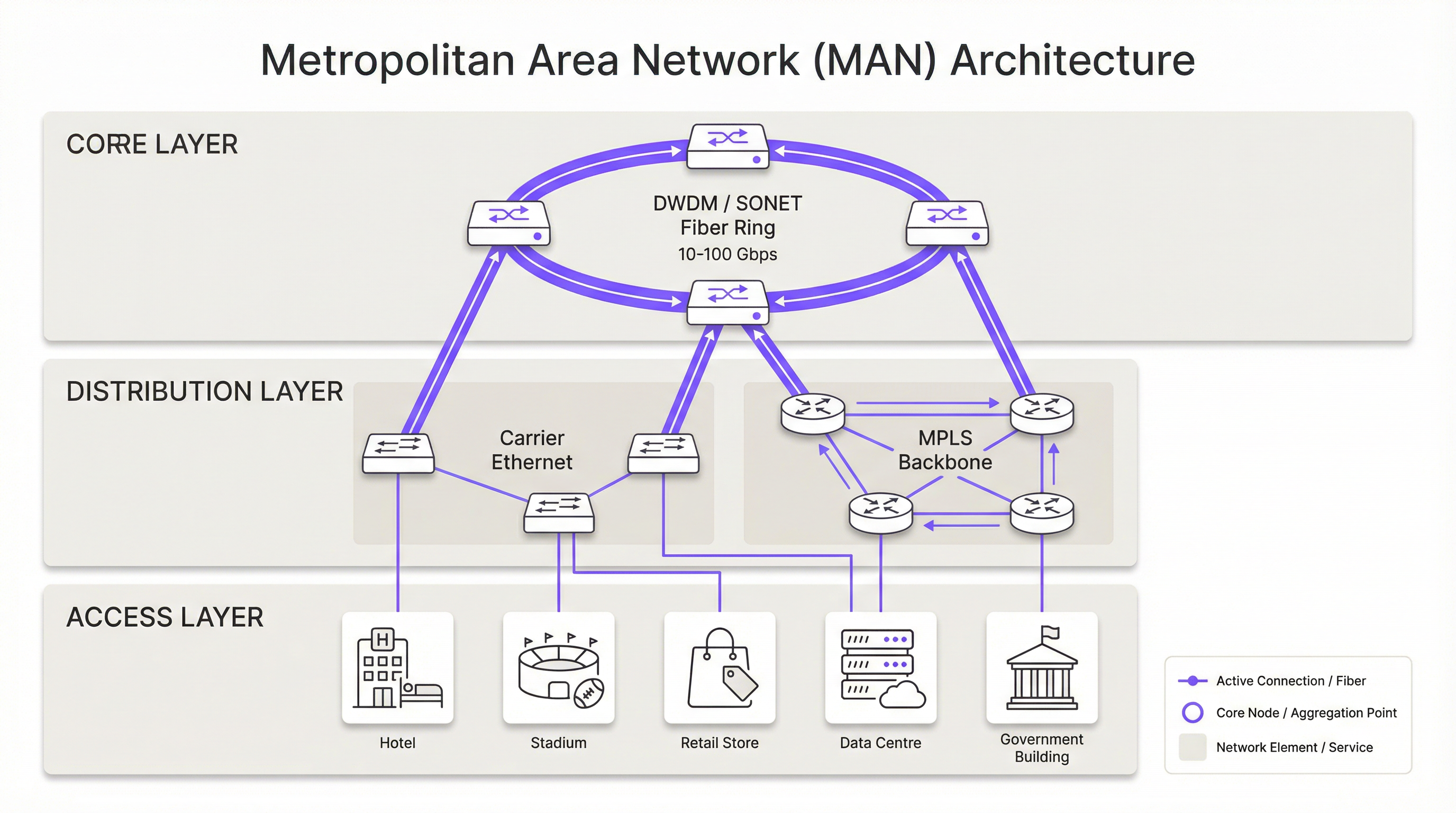
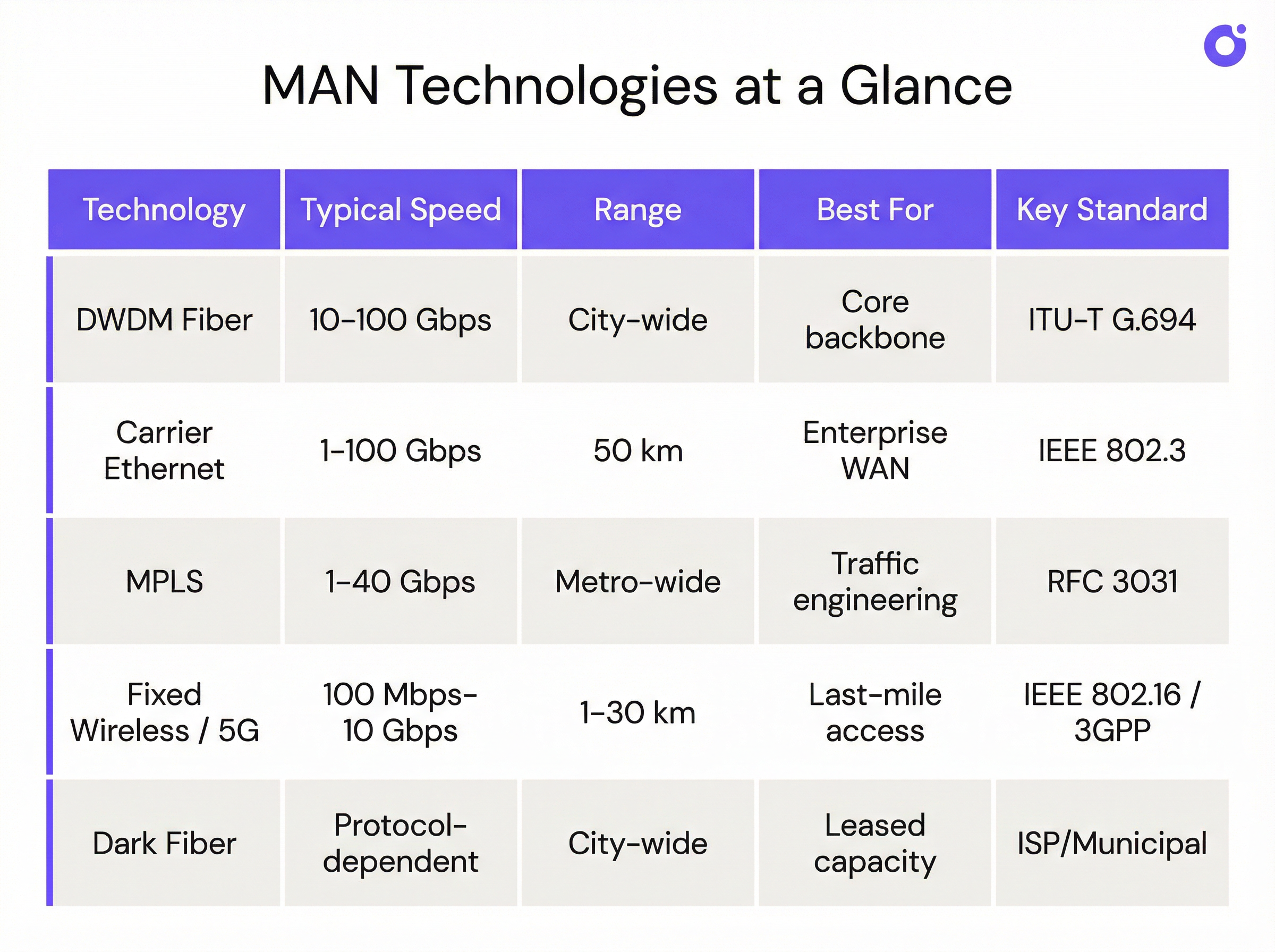
1. Livello Core: È la dorsale ad alta velocità della rete, costruita quasi esclusivamente su un anello in fibra ottica ridondante. Tecnologie come il Dense Wavelength Division Multiplexing (DWDM) e il Synchronous Optical Networking (SONET) consentono flussi di dati multipli su una singola coppia di fibre, con larghezze di banda tipiche che vanno da 10 Gbps a 100 Gbps e oltre. La topologia ad anello, spesso regolata dallo standard IEEE 802.17 Resilient Packet Ring (RPR), garantisce un'elevata disponibilità con tempi di failover inferiori a 50 ms, rendendo il core resiliente ai guasti di singoli nodi o collegamenti.
2. Livello di Distribuzione: Questo livello intermedio aggrega il traffico dal livello di accesso e lo connette al core. Le tecnologie chiave in questo caso includono Carrier Ethernet e Multiprotocol Label Switching (MPLS). L'MPLS è particolarmente cruciale per le MAN di livello enterprise, in quanto consente l'ingegneria del traffico, le garanzie di Quality of Service (QoS) e la creazione di VPN Layer 2 o Layer 3 sicure e private. Ciò consente alle organizzazioni di segmentare il traffico (ad esempio, separando i dati aziendali dal WiFi pubblico per gli ospiti) attraverso l'infrastruttura condivisa.
3. Livello di Accesso: È l'"ultimo miglio" che collega i singoli edifici e le sedi al livello di distribuzione. Sebbene la fibra rimanga il mezzo preferito per le sue prestazioni e affidabilità, questo livello impiega spesso un mix di tecnologie in base ai costi e alla praticità. Il Fixed Wireless Access (FWA) tramite ponti radio a microonde e, sempre più spesso, la tecnologia cellulare 5G forniscono alternative robuste e ad alta velocità laddove la posa della fibra è proibitiva.
Guida all'implementazione
L'implementazione di una MAN è un'impresa significativa che richiede un'attenta pianificazione. Il processo può essere suddiviso in quattro fasi chiave.
Fase 1: Fattibilità e sviluppo del Business Case. Inizia verificando i costi di connettività tra le sedi esistenti e i limiti di prestazione. Identifica i principali driver aziendali per una MAN: stai cercando di migliorare le prestazioni delle applicazioni cloud, centralizzare il backup dei dati o lanciare un nuovo servizio per gli ospiti a livello cittadino? Modella il Total Cost of Ownership (TCO) di una MAN, confrontando un modello di costruzione (leasing di fibra spenta) con un servizio gestito da un operatore. Per la maggior parte delle organizzazioni con più di cinque sedi in un'area metropolitana, un modello di costruzione offre un ROI superiore su un periodo di 7-10 anni.
Fase 2: Selezione della tecnologia e progettazione Vendor-Neutral. Sulla base dei requisiti aziendali, crea un progetto di alto livello. Specifica tecnologie aperte e basate su standard (ad es. Carrier Ethernet, MPLS) per evitare il vendor lock-in. Il progetto deve dettagliare l'architettura a tre livelli, i protocolli di routing proposti (come OSPF e BGP) e un piano di sicurezza completo che includa IEEE 802.1X, segmentazione VLAN e strategie di crittografia come MACsec.
Fase 3: Approvvigionamento e implementazione fisica. Questa fase è spesso la più impegnativa, in quanto comporta la gestione dei permessi di passaggio e delle opere civili per la posa della fibra. Emetti le RFP basate sul tuo progetto vendor-neutral. Quando noleggi fibra spenta, assicurati che il Service Level Agreement (SLA) specifichi le caratteristiche della fibra e il tempo medio di riparazione (MTTR). Per i collegamenti wireless, conduci un'accurata indagine RF per identificare potenziali interferenze.
Fase 4: Collaudo e passaggio di consegne operativo. Una volta installata l'infrastruttura fisica, la rete viene collaudata. Ciò comporta la configurazione di tutti gli elementi di rete, il test dei meccanismi di failover e ridondanza e la convalida delle prestazioni rispetto alle specifiche di progetto. Infine, la rete viene consegnata al team del Network Operations Centre (NOC), dotato degli strumenti di monitoraggio e gestione necessari.
Best Practice
- Progettare per la ridondanza: Una MAN deve essere resiliente. Il core dovrebbe presentare percorsi in fibra diversificati, il livello di distribuzione dovrebbe avere connessioni dual-homed al core e i siti di accesso critici dovrebbero avere un percorso di failover secondario (ad es. fibra primaria, 5G FWA secondario).
- Segmentare il traffico logicamente: Utilizza VLAN (IEEE 802.1Q) e VPN MPLS per creare reti logicamente separate per diversi tipi di traffico (ad es. aziendale, ospiti, IoT, VoIP). Questo è un requisito fondamentale per la sicurezza e la conformità a standard come PCI DSS e GDPR.
- Centralizzare il monitoraggio di rete: Implementa un robusto Network Monitoring System (NMS) che fornisca una visione unificata (single pane of glass) per l'intera MAN. Il sistema dovrebbe monitorare in tempo reale l'utilizzo dei collegamenti, la latenza, la perdita di pacchetti e lo stato dei dispositivi, con avvisi basati sull'intelligenza artificiale per consentire una manutenzione proattiva.
- Dare priorità alla sicurezza: Implementa il controllo degli accessi basato sulle porte utilizzando IEEE 802.1X su tutte le porte cablate. Per i segmenti wireless, rendi obbligatorio WPA3-Enterprise. Crittografa il traffico sensibile in transito utilizzando IPsec o MACsec. Conduci regolarmente valutazioni delle vulnerabilità e penetration test.
Risoluzione dei problemi e mitigazione dei rischi
| Modalità di guasto comune | Strategia di mitigazione | Passaggi per la risoluzione dei problemi |
|---|---|---|
| Taglio della fibra | Utilizza una topologia ad anello ridondante con percorsi fisici diversificati. Assicurati che lo SLA dell'operatore includa un MTTR rigoroso. | Utilizza un Optical Time-Domain Reflectometer (OTDR) per individuare la posizione dell'interruzione. Reindirizza il traffico tramite il percorso secondario. |
| Errore di configurazione | Implementa un rigoroso processo di gestione delle modifiche con peer review. Utilizza strumenti di automazione di rete con convalida pre-implementazione. | Esegui il rollback all'ultima configurazione valida nota. Utilizza strumenti di monitoraggio di rete per correlare il guasto alla modifica recente. |
| Attacco DDoS | Stipula un contratto con un servizio di mitigazione DDoS basato su cloud in grado di ripulire il traffico dannoso prima che raggiunga il perimetro della rete. | Identifica il vettore di attacco e il bersaglio utilizzando l'analisi NetFlow. Coinvolgi il fornitore di mitigazione DDoS per applicare le regole di filtraggio. |
| Interruzione di corrente al nodo | Dota tutti i nodi core e di distribuzione di gruppi di continuità (UPS) e, per i nodi critici, di generatori di backup. | Verifica lo stato dell'alimentazione nel nodo interessato. Monitora i log dell'UPS e del generatore. |
ROI e impatto aziendale
Il calcolo del Return on Investment per una MAN implica molto più del semplice confronto dei costi di connettività. L'impatto aziendale è multiforme. I risparmi diretti sui costi derivano dal consolidamento di molteplici e costose connessioni Internet e linee dedicate in un'unica dorsale più efficiente. I guadagni di produttività si realizzano attraverso una latenza inferiore, che migliora le prestazioni delle applicazioni basate su cloud, del VoIP e delle videoconferenze. Sicurezza e conformità migliorate riducono il rischio di costose violazioni dei dati e sanzioni normative. Infine, una MAN è una piattaforma abilitante per l'innovazione; fornisce le basi scalabili e ad alte prestazioni necessarie per iniziative di smart building, implementazioni IoT su larga scala ed esperienze per gli ospiti di nuova generazione. Durante la creazione del business case, quantifica ciascuno di questi vantaggi per presentare una visione olistica del valore del progetto.

Key Terms & Definitions
Dark Fiber
Fiber optic cable that has been physically installed but is not currently in use. Organisations can lease dark fiber from carriers or municipalities to build their own private networks.
When an IT team decides to build its own MAN instead of buying a managed service, leasing dark fiber is often the most cost-effective way to create the physical backbone, offering maximum control over the network.
Carrier Ethernet
A set of standards-based services defined by the MEF (Metro Ethernet Forum) that deliver Ethernet services over MAN and WAN networks. It provides scalability and reliability comparable to older SONET/SDH technologies.
For network architects, specifying Carrier Ethernet for MAN services ensures interoperability between different vendors and provides a familiar, flexible, and cost-effective transport technology for enterprise connectivity.
MPLS (Multiprotocol Label Switching)
A network routing technique that directs data from one node to the next based on short path labels rather than long network addresses, avoiding complex lookups in a routing table.
CTOs and network architects leverage MPLS to create secure VPNs between sites and to engineer traffic flows, ensuring that high-priority applications like VoIP get the bandwidth and low latency they need, even on a congested network.
DWDM (Dense Wavelength Division Multiplexing)
A fiber-optic technology that increases bandwidth by allowing multiple data streams to be sent simultaneously over a single fiber optic cable, with each stream using a different wavelength (color) of light.
In a MAN core, DWDM is the key to achieving massive scalability. It allows network operators to add capacity to their fiber backbone without the enormous expense of laying more cables.
IEEE 802.1X
An IEEE standard for Port-Based Network Access Control (PNAC). It provides an authentication mechanism to devices wishing to attach to a LAN or WLAN.
For IT security managers, implementing 802.1X is a fundamental step in securing the network edge. It ensures that only authorized and authenticated users and devices can gain access to the wired or wireless network.
Resilient Packet Ring (RPR)
An IEEE 802.17 standard protocol designed for the transport of data traffic over optical fiber ring networks. It provides high-speed data transfer and fast (sub-50ms) recovery from link or node failures.
When designing the core of a MAN, architects specify RPR to build in carrier-grade resiliency, ensuring that a single fiber cut or equipment failure doesn't cause a catastrophic network outage.
PCI DSS
The Payment Card Industry Data Security Standard is a set of security standards designed to ensure that all companies that accept, process, store or transmit credit card information maintain a secure environment.
For any retail or hospitality business, ensuring the MAN segment that carries payment data is compliant with PCI DSS is non-negotiable. This involves strict network segmentation, access control, and monitoring to protect cardholder data.
GDPR (General Data Protection Regulation)
A regulation in EU law on data protection and privacy for all individuals within the European Union and the European Economic Area. It also addresses the transfer of personal data outside the EU and EEA areas.
When providing public or guest WiFi over a MAN, venue operators must ensure their systems comply with GDPR. This involves obtaining explicit user consent, anonymising personal data like MAC addresses for analytics, and managing data retention policies.
Case Studies
A hotel group with 10 properties spread across a major city needs to replace its expensive, slow, and separately managed internet connections at each site. The goal is to improve guest WiFi performance, centralise data backup to a private data centre, and deploy a new VoIP phone system across all locations.
The recommended solution is to deploy a private MAN using leased dark fiber. A 10 Gbps resilient fiber ring would form the core, connecting three regional distribution nodes. Each hotel would connect to its nearest distribution node via a 1 Gbps Carrier Ethernet circuit. MPLS Layer 3 VPNs would be configured to create three separate virtual networks: one for guest WiFi traffic, one for corporate/VoIP traffic, and one for the data backup service. This segmentation ensures that a surge in guest internet usage does not impact the quality of VoIP calls or the performance of critical business systems. IEEE 802.1X would be enforced on the corporate network, and the guest WiFi would be secured with WPA3 and integrated with a cloud-based analytics platform for GDPR compliance.
A 70,000-seat stadium needs to provide high-density WiFi for fans, support broadcast media operations, and connect its own retail and ticketing systems. The existing connectivity is unreliable and cannot handle the load on event days.
The stadium would act as the central hub of a campus-area MAN. The solution involves two diverse 40 Gbps fiber connections from the stadium's data centre to two different carrier hotels in the city, forming a high-availability connection to the internet and cloud services. Within the stadium, a hierarchical network of aggregation and access switches connects over 1,500 high-density WiFi 6E access points. Network segmentation is critical: a VLAN/MPLS segment is created for public fan WiFi, another for broadcast media with guaranteed bandwidth, a third for PCI DSS-compliant retail and ticketing systems, and a fourth for building management and security systems. A dedicated on-site NOC with real-time analytics monitors the network performance, especially during events, to proactively manage load and interference.
Scenario Analysis
Q1. Your organisation is opening a new branch office in a location where fiber is not available for six months, but there is strong 5G coverage. How would you integrate this site into your existing MPLS-based MAN in the interim?
💡 Hint:Consider how SD-WAN can use multiple transport types and how to secure traffic over the public internet.
Show Recommended Approach
The recommended approach is to deploy an SD-WAN appliance at the new branch. The SD-WAN appliance would use the 5G connection as its primary transport path. It would form a secure IPsec tunnel back to the SD-WAN headend in the corporate data centre, allowing the branch office to securely connect to the MPLS MAN. Application-aware routing policies would be configured to prioritise critical traffic over the 5G link. When the fiber circuit becomes available, it can be added as a second transport path, and the SD-WAN can be configured to use it as the primary path, keeping the 5G link as a high-performance backup.
Q2. A large conference centre connected to your MAN is hosting a major tech event. The event organiser wants a private, isolated, high-bandwidth network for their keynote presentations and live streams, completely separate from the public attendee WiFi. How would you provision this?
💡 Hint:Think about logical segmentation. How can you create a dedicated virtual network over the shared physical infrastructure?
Show Recommended Approach
The most robust solution is to provision a dedicated Layer 2 VPN (VPLS) or Layer 3 VPN (VRF) for the event organiser using the MAN's MPLS capabilities. This creates a completely separate virtual network for their traffic from the conference centre back to a dedicated internet breakout or to their own corporate network. A specific VLAN would be configured on the conference centre's switches for the event organiser's use, which would then be mapped to the dedicated MPLS VPN. QoS policies would be applied to guarantee the required bandwidth for their live streaming activities, ensuring it is not impacted by the thousands of attendees using the public WiFi network.
Q3. You are seeing intermittent packet loss and high latency to a retail store that is connected to your MAN via a fixed wireless link. What are the first three things you should investigate?
💡 Hint:Think about the unique failure modes of wireless technologies compared to fiber.
Show Recommended Approach
- RF Interference: Fixed wireless links are susceptible to interference from other wireless sources (e.g., other nearby networks, radar systems). The first step is to use the wireless bridge's management interface or a separate spectrum analyser to check for interference on the operating channel. If interference is detected, changing the channel to a cleaner frequency may resolve the issue. 2. Line of Sight Obstruction: Unlike fiber, wireless links require a clear line of sight between the two antennas. A physical obstruction that has appeared since installation (e.g., a new building, tree growth, a crane) can degrade the signal. A visual inspection, followed by checking the received signal strength indicator (RSSI) against its baseline from installation, is crucial. 3. Weather Conditions: Heavy rain, snow, or fog can attenuate microwave signals, a phenomenon known as "rain fade." Correlate the periods of high latency and packet loss with historical weather data. If the link is not engineered with enough fade margin for the climate, the only solutions are to upgrade to larger antennas or a higher-power radio system.
Key Takeaways
- ✓A MAN connects multiple LANs across a city or large campus, creating a single, unified network.
- ✓Core technologies include fiber optics (DWDM, SONET), Carrier Ethernet, and MPLS for traffic engineering.
- ✓A three-layer architecture (Core, Distribution, Access) is the standard design pattern.
- ✓Leasing dark fiber is often the most cost-effective way to build a private MAN for multi-site organisations.
- ✓Network segmentation using VLANs and MPLS is critical for security and compliance (PCI DSS, GDPR).
- ✓Redundancy through ring topologies and diverse paths is essential for high availability.
- ✓Future trends include deeper integration with 5G for backhaul and the use of SD-WAN as a control overlay.




