

उच्च-घनतेच्या WiFi साठी बँड स्टिअरिंग आणि लोड बॅलेंसिंग
This authoritative technical reference equips IT managers, network architects, and venue operations directors with the knowledge to design, configure, and optimise high-density WiFi networks using band steering and load balancing. It covers the architectural principles behind 2.4 GHz vs. 5 GHz band selection, AP load distribution strategies, and vendor-neutral configuration best practices for demanding environments such as stadiums, hotels, and conference centres. By applying these strategies, organisations can measurably improve wireless throughput, reduce user complaints, and transform their network infrastructure into a strategic business asset.
🎧 Listen to this Guide
View Transcript

कार्यकारी सारांश
उच्च-घनतेचे वायरलेस वातावरण व्यवस्थापित करणाऱ्या संस्थांसाठी, इष्टतम WiFi कार्यप्रदर्शन राखणे हे एक महत्त्वपूर्ण ऑपरेशनल आव्हान आहे. विमानतळ, कॉन्फरन्स सेंटर्स आणि रिटेल हब यांसारख्या ठिकाणी प्रति चौरस मीटर कनेक्ट केलेल्या उपकरणांची संख्या वाढत असताना, पारंपारिक नेटवर्क कॉन्फिगरेशन कमकुवत पडतात, ज्यामुळे खराब वापरकर्ता अनुभव, ड्रॉप झालेले कनेक्शन्स आणि कमी डेटा थ्रूपुट यांसारख्या समस्या निर्माण होतात. हे मार्गदर्शक दोन मुख्य ऑप्टिमायझेशन धोरणांमध्ये तांत्रिक सखोल माहिती प्रदान करून या आव्हानांना थेट सामोरे जाते: बँड स्टिअरिंग आणि लोड बॅलेंसिंग. आम्ही 2.4 GHz आणि 5 GHz फ्रिक्वेन्सी बँड्समध्ये फरक करणाऱ्या आर्किटेक्चरल तत्त्वांचा शोध घेतो आणि ड्युअल-बँड क्लायंट्सना कमी गर्दीच्या, उच्च-क्षमतेच्या 5 GHz स्पेक्ट्रमकडे हुशारीने कसे वळवायचे याचे तपशील देतो. याव्यतिरिक्त, आम्ही ॲक्सेस पॉईंट (AP) लोड बॅलेंसिंग तंत्रांचे विश्लेषण करतो जे उपलब्ध नेटवर्क संसाधनांमध्ये क्लायंट कनेक्शन्स समान रीतीने वितरीत करतात, ज्यामुळे वैयक्तिक APs ला कार्यप्रदर्शनात अडथळा बनण्यापासून प्रतिबंधित केले जाते. येथे वर्णन केलेल्या व्हेंडर-न्यूट्रल सर्वोत्तम पद्धती आणि कॉन्फिगरेशन मार्गदर्शनाची अंमलबजावणी करून, IT व्यवस्थापक आणि नेटवर्क आर्किटेक्ट्स एक उत्कृष्ट, अधिक विश्वासार्ह वायरलेस अनुभव देऊ शकतात, ज्याचा थेट परिणाम ग्राहकांचे समाधान, ऑपरेशनल कार्यक्षमता आणि व्यवसाय ROI वर होतो. हा संदर्भ व्यावहारिक अनुप्रयोगासाठी डिझाइन केला आहे, जो या तिमाहीत तुमच्या नेटवर्क इन्फ्रास्ट्रक्चर धोरणाला माहिती देण्यासाठी ठोस डिप्लॉयमेंट परिस्थिती आणि मोजता येण्याजोगे परिणाम ऑफर करतो.
तांत्रिक सखोल माहिती
फ्रिक्वेन्सी बँड्स समजून घेणे: 2.4 GHz वि. 5 GHz
उच्च-घनतेच्या वातावरणात प्रभावी WiFi व्यवस्थापनाचा पाया 2.4 GHz आणि 5 GHz फ्रिक्वेन्सी बँड्समधील मूलभूत फरक समजून घेण्यात आहे. हे केवळ डेटासाठी दोन मार्ग नाहीत; ते अद्वितीय प्रोपोगेशन वैशिष्ट्यांसह भिन्न RF वातावरण आहेत जे भिन्न वापर प्रकरणे आणि डिप्लॉयमेंट परिस्थितींसाठी त्यांची उपयुक्तता ठरवतात.
| वैशिष्ट्य | 2.4 GHz बँड | 5 GHz बँड |
|---|---|---|
| रेंज (Range) | लांब वेव्हलेंथ, भिंतीतून उत्तम प्रवेश | लहान वेव्हलेंथ, अधिक सहजपणे अडथळा निर्माण होतो |
| व्यत्यय (Interference) | उच्च (मायक्रोवेव्ह, ब्लूटूथ, कॉर्डलेस फोन) | कमी (कमी गर्दी, अधिक चॅनेल्स) |
| चॅनेल्स | 11-14 चॅनेल्स, फक्त 3 नॉन-ओव्हरलॅपिंग | 23+ नॉन-ओव्हरलॅपिंग चॅनेल्स |
| बँडविड्थ | कमी संभाव्य डेटा दर | उच्च संभाव्य डेटा दर (उदा., 802.11ac/ax सह) |
| उपयुक्तता | मूलभूत कनेक्टिव्हिटी, IoT, लेगसी उपकरणे | उच्च-बँडविड्थ ॲप्लिकेशन्स (व्हिडिओ, व्हॉइस), दाट क्षेत्रे |
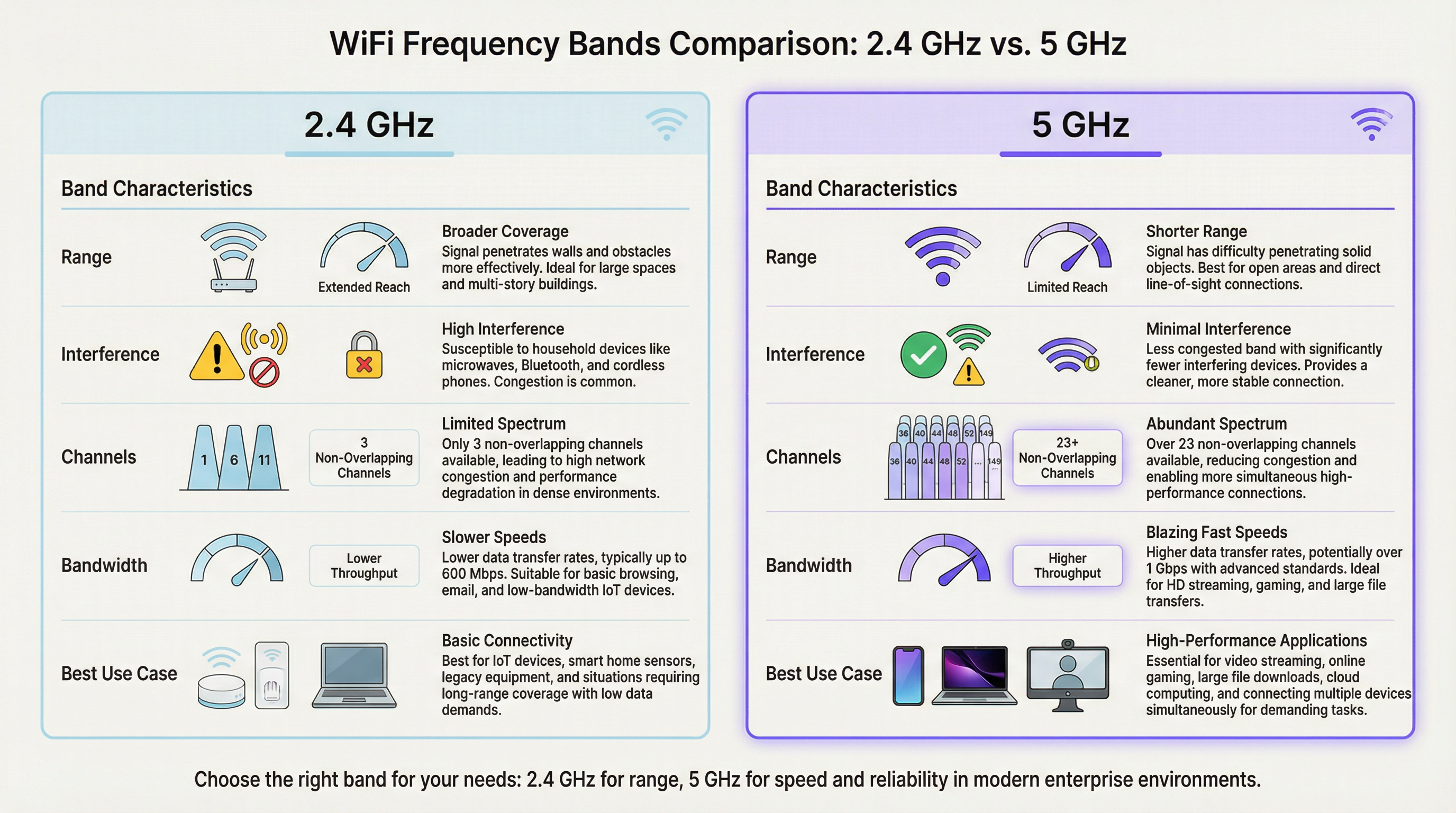
स्टेडियम किंवा लेक्चर हॉलसारख्या उच्च-घनतेच्या सेटिंगमध्ये, 2.4 GHz बँड वेगाने सॅच्युरेट होतो. फक्त तीन नॉन-ओव्हरलॅपिंग चॅनेल्ससह (उत्तर अमेरिकेत 1, 6 आणि 11), को-चॅनेल व्यत्यय हा एक महत्त्वपूर्ण आणि सततचा कार्यप्रदर्शन अवरोधक आहे. एकाच क्षेत्रात एकाच चॅनेलवर चालणारा प्रत्येक अतिरिक्त AP इतरांचे कार्यप्रदर्शन खराब करतो. याउलट, 5 GHz बँड असंख्य नॉन-ओव्हरलॅपिंग चॅनेल्ससह खूप विस्तृत स्पेक्ट्रम ऑफर करतो, ज्यामुळे तो कार्यप्रदर्शनासाठी-गंभीर ॲप्लिकेशन्ससाठी पसंतीचा पर्याय बनतो. बँड स्टिअरिंग WiFi अंमलबजावणीचे प्राथमिक उद्दिष्ट सक्षम क्लायंट उपकरणांना गर्दीच्या 2.4 GHz बँडवरून अधिक स्वच्छ, वेगवान 5 GHz बँडवर सक्रियपणे हलवणे हे आहे, जेणेकरून 2.4 GHz स्पेक्ट्रम IoT सेन्सर्स, लेगसी उपकरणे आणि कव्हरेजच्या काठावर असलेल्या क्लायंट्ससाठी राखून ठेवता येईल.
बँड स्टिअरिंग कसे कार्य करते
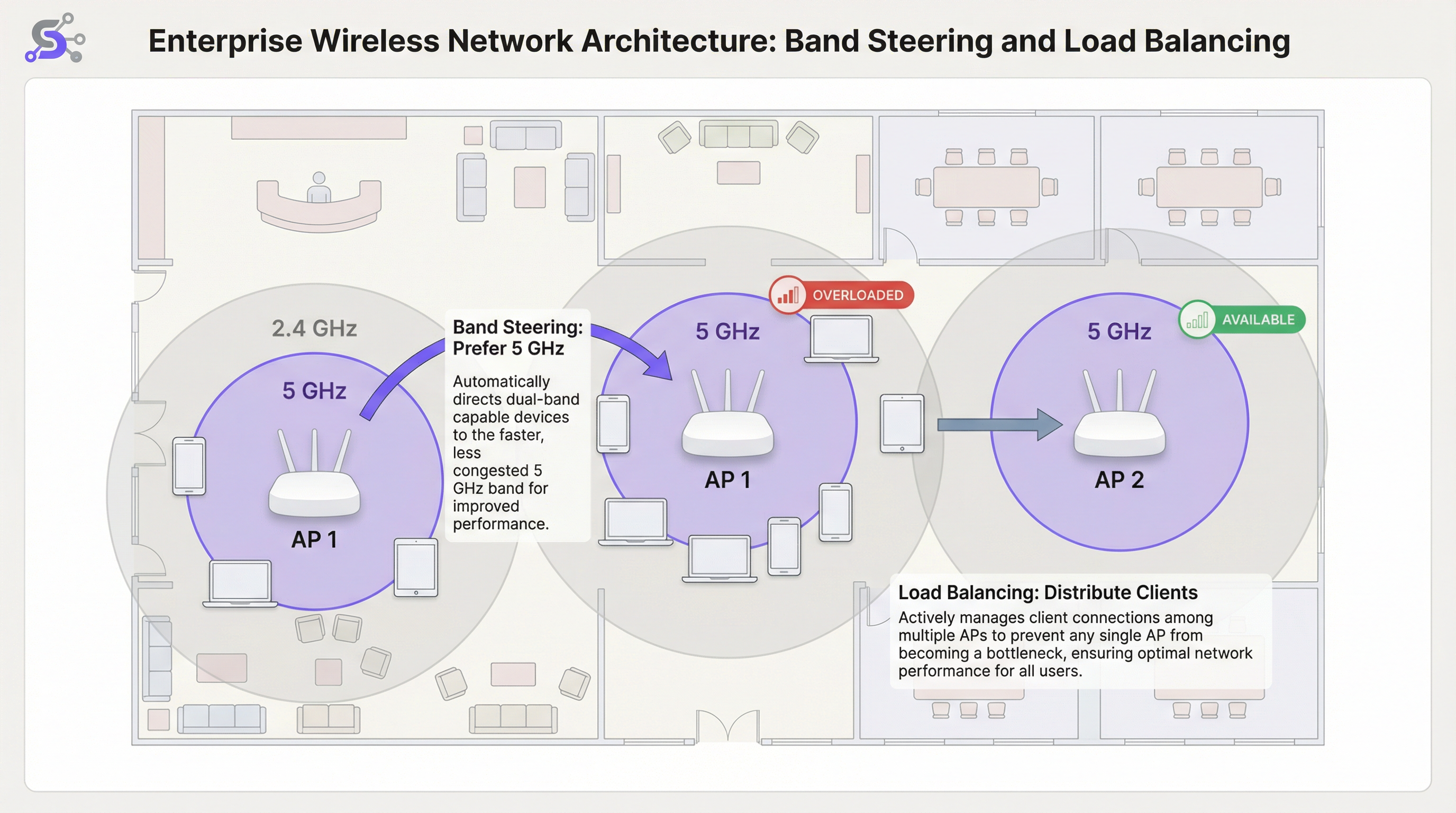
बँड स्टिअरिंग हे औपचारिक IEEE मानक नाही तर एंटरप्राइझ WiFi व्हेंडर्सद्वारे लागू केलेले एक प्रोप्रायटरी तंत्र आहे. जरी विशिष्ट अल्गोरिदम उत्पादकांमध्ये भिन्न असले तरी, सामान्य यंत्रणेमध्ये ॲक्सेस पॉईंट ड्युअल-बँड क्लायंटला 5 GHz रेडिओशी कनेक्ट करण्यासाठी सक्रियपणे प्रोत्साहित करतो किंवा भाग पाडतो. हे सामान्यतः 802.11 मॅनेजमेंट फ्रेम स्तरावर कार्य करणाऱ्या अनेक पद्धतींद्वारे साध्य केले जाते.
पहिली पद्धत डिलेड प्रोब रिस्पॉन्सेस (Delayed Probe Responses) आहे: जेव्हा ड्युअल-बँड क्लायंट एकाच वेळी दोन्ही बँड्सवर प्रोब विनंती पाठवतो, तेव्हा AP जाणीवपूर्वक 2.4 GHz फ्रिक्वेन्सीवरील आपला प्रतिसाद काहीशे मिलिसेकंदांनी विलंबित करू शकतो. क्लायंट, 5 GHz वर जलद प्रतिसाद पाहून, साहजिकच उत्कृष्ट बँडला प्राधान्य देतो आणि कनेक्ट होतो. दुसरी पद्धत प्रोब रिस्पॉन्स सप्रेशन (Probe Response Suppression) आहे: AP ने 5 GHz सक्षम म्हणून ओळखलेल्या क्लायंट्सच्या 2.4 GHz प्रोब विनंत्यांकडे दुर्लक्ष करू शकतो, ज्यामुळे प्रारंभिक शोध टप्प्यात 2.4 GHz नेटवर्क त्यांच्यासाठी अदृश्य होते. तिसरा आणि सर्वात आधुनिक दृष्टीकोन IEEE 802.11v BSS ट्रान्झिशन मॅनेजमेंट आहे: ही मानक फ्रेम AP ला क्लायंटला वेगळ्या BSS (बेसिक सर्व्हिस सेट) मध्ये संक्रमण करण्याची स्पष्टपणे विनंती करण्यास अनुमती देते, या प्रकरणात, त्याच AP वरील 5 GHz रेडिओ. ही एक सहकारी पद्धत आहे जी 802.11v मानकासाठी क्लायंट-साइड सपोर्टवर अवलंबून असते आणि एंटरप्राइझ डिप्लॉयमेंटसाठी हा शिफारस केलेला दृष्टीकोन आहे, कारण तो आक्रमक सप्रेशन तंत्र टाळतो ज्यामुळे नॉन-कंप्लायंट क्लायंट्ससह कनेक्टिव्हिटी समस्या उद्भवू शकतात.
AP लोड बॅलेंसिंग
बँड स्टिअरिंग प्रति-AP आधारावर फ्रिक्वेन्सी बँड निवड ऑप्टिमाइझ करत असताना, WiFi लोड बॅलेंसिंग दिलेल्या क्षेत्रात एकाधिक APs मध्ये क्लायंट्स समान रीतीने वितरीत करण्याच्या व्यापक आव्हानाचे निराकरण करते. व्यस्त विमानतळ टर्मिनल किंवा हॉटेल लॉबीमध्ये, वापरकर्ते एकाच, मध्यवर्ती ठिकाणी असलेल्या AP जवळ एकत्र येणे सामान्य आहे, ज्यामुळे तो ओव्हरलोड होतो तर लगतचे APs कमी वापरलेले राहतात. यामुळे कार्यप्रदर्शनात लक्षणीय तफावत निर्माण होते: ओव्हरलोड झालेल्या AP जवळील वापरकर्त्यांना खराब सेवेचा अनुभव येतो, तर निष्क्रिय APs जवळील वापरकर्त्यांना उपलब्ध इन्फ्रास्ट्रक्चरचा पूर्ण लाभ मिळत नाही. लोड बॅलेंसिंग अल्गोरिदम प्रत्येक AP वर क्लायंट संख्या किंवा रेडिओ वापरासाठी थ्रेशोल्ड सेट करून हे प्रतिबंधित करतात.
जेव्हा एखादा AP त्याच्या कॉन्फिगर केलेल्या लोड थ्रेशोल्डवर पोहोचतो, तेव्हा तो नवीन असोसिएशन विनंत्या नाकारू शकतो. हे नवीन क्लायंट उपकरणाला पुन्हा स्कॅन करण्यासाठी आणि जवळचा, कमी-गर्दीचा AP शोधण्यासाठी प्रोत्साहित करते. अधिक अत्याधुनिक सिस्टीम्स क्लायंटला विशिष्ट पर्यायी AP सक्रियपणे सुचवण्यासाठी 802.11v चा फायदा घेतात, ज्यामुळे संक्रमण अंतिम वापरकर्त्यासाठी अखंड आणि पारदर्शक बनते. सर्वात प्रगत अंमलबजावणी प्रेडिक्टिव्ह अल्गोरिदम वापरतात जे ऐतिहासिक पॅटर्नवर आधारित लोड वाढीचा अंदाज लावतात आणि अडथळा निर्माण होण्यापूर्वी क्लायंट्सचे पुनर्वितरण सुरू करतात.
वायरलेस LAN कंट्रोलरची भूमिका
एंटरप्राइझ डिप्लॉयमेंट्समध्ये, बँड स्टिअरिंग आणि लोड बॅलेंसिंग वैयक्तिक AP स्तरावर व्यवस्थापित केले जात नाहीत तर केंद्रीकृत वायरलेस LAN कंट्रोलर (WLC) किंवा क्लाउड-आधारित व्यवस्थापन प्लॅटफॉर्मद्वारे ऑर्केस्ट्रेट केले जातात. WLC सर्व संबंधित क्लायंट्स, त्यांची सिग्नल स्ट्रेंथ, प्रत्येक AP वरील वर्तमान लोड आणि संपूर्ण साइटवरील RF वातावरणाचे जागतिक दृश्य राखते. ही केंद्रीकृत बुद्धिमत्ताच अत्याधुनिक लोड बॅलेंसिंग शक्य करते: कंट्रोलर केवळ एका AP च्या मर्यादित स्थानिक दृश्यावर नव्हे तर संपूर्ण नेटवर्कच्या रिअल-टाइम डेटावर आधारित नवीन क्लायंटला कुठे पुनर्निर्देशित करायचे याबद्दल माहितीपूर्ण निर्णय घेऊ शकतो.
Cisco Meraki, Aruba Central आणि Juniper Mist द्वारे ऑफर केलेल्या क्लाउड-मॅनेज्ड प्लॅटफॉर्म्स, AI-चालित रेडिओ रिसोर्स मॅनेजमेंट (RRM) समाविष्ट करून ही संकल्पना आणखी वाढवतात. या सिस्टीम्स मॅन्युअल हस्तक्षेपाशिवाय चॅनेल असाइनमेंट्स, ट्रान्समिट पॉवर आणि स्टिअरिंग थ्रेशोल्ड्स डायनॅमिकपणे समायोजित करण्यासाठी RF डेटा, क्लायंट वर्तन आणि ॲप्लिकेशन कार्यप्रदर्शनाचे सतत विश्लेषण करतात. एकाधिक मजले किंवा इमारतींमध्ये डझनभर किंवा शेकडो APs व्यवस्थापित करणाऱ्या मोठ्या स्थळांच्या ऑपरेटरसाठी, ऑटोमेशनचा हा स्तर लक्झरी नसून एक व्यावहारिक ऑपरेशनल आवश्यकता आहे.
6 GHz युगात WiFi 6 आणि बँड स्टिअरिंग
WiFi 6E (IEEE 802.11ax) ची ओळख आणि 6 GHz स्पेक्ट्रम बँडचे नियामक उघडणे हे उच्च-घनतेच्या WiFi आर्किटेक्चरसाठी महत्त्वपूर्ण उत्क्रांती दर्शवते. 6 GHz बँड 1,200 MHz पर्यंत अतिरिक्त स्वच्छ स्पेक्ट्रम ऑफर करतो, ज्यामध्ये युनायटेड स्टेट्स आणि युनायटेड किंगडम सारख्या बाजारपेठांमध्ये 59 नॉन-ओव्हरलॅपिंग 20 MHz चॅनेल्स उपलब्ध आहेत. WiFi 6E-सक्षम APs तैनात करणाऱ्या ठिकाणांसाठी, बँड स्टिअरिंग धोरण थ्री-बँड मॉडेलमध्ये विकसित झाले पाहिजे: लेगसी उपकरणांना 2.4 GHz वर, सक्षम उपकरणांना 5 GHz वर आणि नवीनतम WiFi 6E क्लायंट्सना मूळ 6 GHz बँडवर वळवणे. हा टायर्ड दृष्टीकोन सर्व उपलब्ध स्पेक्ट्रमचा जास्तीत जास्त वापर करतो आणि हे सुनिश्चित करतो की नवीन, उच्च-कार्यक्षमता उपकरणांना जुन्या बँड्समध्ये जमा होणाऱ्या लेगसी व्यत्ययापासून मुक्त, शक्य तितक्या स्वच्छ RF वातावरणाचा फायदा मिळतो.
अंमलबजावणी मार्गदर्शक
पायरी 1: प्री-डिप्लॉयमेंट साइट सर्व्हे
Ekahau Site Survey किंवा iBwave Design सारख्या व्यावसायिक टूल्सचा वापर करून प्रेडिक्टिव्ह साइट सर्व्हे करणे कोणत्याही उच्च-घनतेच्या डिप्लॉयमेंटसाठी अनिवार्य आहे. हे केवळ कव्हरेज सत्यापित करण्याबद्दल नाही तर क्षमता नियोजनाबद्दल आहे. तुमचे ध्येय उच्च उपकरण घनतेचे झोन ओळखणे, भौतिक जागेच्या RF प्रोपोगेशन वैशिष्ट्यांचे मॉडेल तयार करणे आणि को-चॅनेल व्यत्यय कमी करण्यासाठी AP प्लेसमेंट आणि चॅनेल वाटपाची योजना करणे हे आहे. सर्व्हेमध्ये पीक वापर कालावधीत अपेक्षित क्लायंट घनतेचा देखील विचार केला पाहिजे, जे कॉन्फरन्स सेंटरसाठी कीनोट सत्र असू शकते आणि स्टेडियमसाठी किक-ऑफच्या 30-मिनिटांपूर्वीची वेळ असू शकते जेव्हा हजारो चाहते एकाच वेळी कनेक्ट करण्याचा प्रयत्न करत असतात.
पायरी 2: बँड स्टिअरिंग कॉन्फिगरेशन
तुमच्या वायरलेस LAN कंट्रोलर (WLC) किंवा क्लाउड मॅनेजमेंट डॅशबोर्डमध्ये, तुम्हाला बँड स्टिअरिंग किंवा बँड सिलेक्टसाठी सेटिंग मिळेल. मुख्य बँड स्टिअरिंग कॉन्फिगरेशन पॅरामीटर्समध्ये खालील गोष्टींचा समावेश आहे. मोड (Mode): बहुतेक एंटरप्राइझ व्हेंडर्स Prefer 5 GHz, Force 5 GHz किंवा Balance Bands सारखे पर्याय देतात. उच्च-घनतेच्या ठिकाणांसाठी, Prefer 5 GHz हा शिफारस केलेला प्रारंभिक बिंदू आहे. Force खूप आक्रमक असू शकते आणि लेगसी 2.4 GHz-फक्त क्लायंट्सना सेवा नाकारू शकते, ज्यामुळे अनावश्यक सपोर्ट तिकिटे तयार होतात. स्टिअरिंग थ्रेशोल्ड (RSSI): क्लायंटला 5 GHz वर वळवण्यासाठी किमान सिग्नल स्ट्रेंथ सेट करा. एक सामान्य प्रारंभिक मूल्य -65 dBm आहे. जर क्लायंटचा 5 GHz सिग्नल या थ्रेशोल्डपेक्षा कमकुवत असेल, तर व्यत्यय असूनही 2.4 GHz वर खरोखरच चांगला अनुभव मिळू शकतो, विशेषतः जाड भिंती किंवा उच्च फ्रिक्वेन्सी कमी करणाऱ्या महत्त्वपूर्ण बांधकाम साहित्यांसह असलेल्या वातावरणात.
पायरी 3: लोड बॅलेंसिंग कॉन्फिगरेशन
क्लायंट काउंट थ्रेशोल्ड: प्रति AP रेडिओ क्लायंट्सची कमाल संख्या सेट करा. उच्च-घनतेच्या क्षेत्रासाठी, सेवेची गुणवत्ता सुनिश्चित करण्यासाठी हे 25 ते 30 क्लायंट्स इतके कमी असू शकते, जरी AP हार्डवेअर तांत्रिकदृष्ट्या अधिक एकाचवेळी असोसिएशन्सना सपोर्ट करत असले तरीही. युटिलायझेशन थ्रेशोल्ड: रेडिओ वापराच्या आधारावर संतुलन राखणे हा अधिक डायनॅमिक आणि शिफारस केलेला दृष्टीकोन आहे, जो रेडिओ माध्यम ट्रान्समिट किंवा प्राप्त करण्यात व्यस्त असलेल्या वेळेची टक्केवारी म्हणून व्यक्त केला जातो. 60 ते 70 टक्क्यांचा थ्रेशोल्ड ही मोठ्या प्रमाणावर स्वीकारलेली सर्वोत्तम पद्धत आहे, कारण ती कोणत्याही एका AP ला सतत अडथळा बनू न देता बर्स्ट ट्रॅफिकसाठी पुरेशी हेडरूम सोडते.
पायरी 4: प्रमाणित करा आणि निरीक्षण करा
डिप्लॉयमेंटनंतर, सतत निरीक्षण करणे आवश्यक आहे. 5 GHz विरुद्ध 2.4 GHz वरील क्लायंट्सचे गुणोत्तर, प्रत्येक झोनमधील APs मध्ये क्लायंट्सचे वितरण आणि कालांतराने सरासरी क्लायंट डेटा दर ट्रॅक करण्यासाठी तुमचा WLC किंवा क्लाउड मॅनेजमेंट प्लॅटफॉर्म वापरा. सामान्य ऑपरेशनल कालावधीत बेसलाइन स्थापित करा आणि विसंगती ओळखण्यासाठी त्याचा वापर करा. 2.4 GHz असोसिएशन्समध्ये अचानक झालेली वाढ किंवा असमान क्लायंट वितरण अनेकदा कॉन्फिगरेशन ड्रिफ्ट, व्यत्ययाचा नवीन स्त्रोत किंवा एका AP वर हार्डवेअर बिघाड दर्शवते.
सर्वोत्तम पद्धती
सिंगल SSID धोरण: 2.4 GHz आणि 5 GHz दोन्ही बँड्ससाठी एकच SSID वापरा. प्रभावी बँड स्टिअरिंगसाठी ही एक अनिवार्य पूर्वअट आहे, कारण ती क्लायंट आणि नेटवर्कला बॅकग्राउंडमध्ये पारदर्शकपणे सर्वोत्तम बँड निगोशिएट करण्यास अनुमती देते. प्रत्येक बँडसाठी स्वतंत्र SSIDs वापरकर्त्यांना मॅन्युअल निवड करणे आवश्यक करतात, जे स्वयंचलित स्टिअरिंगचा उद्देश विफल करते आणि जेव्हा वापरकर्ते सातत्याने चुकीचा बँड निवडतात तेव्हा सपोर्टचा भार निर्माण करते.
कमी डेटा दर अक्षम करा: धीम्या क्लायंट्सना जास्त एअरटाइम वापरण्यापासून रोखण्यासाठी, दोन्ही बँड्सवर 12 Mbps पेक्षा कमी लेगसी डेटा दर अक्षम करा. हे एअरटाइम फेअरनेस म्हणून ओळखल्या जाणाऱ्या प्रथेद्वारे एकूण सेल कार्यप्रदर्शन सुधारते. स्टेडियम किंवा मोठ्या कॉन्फरन्स हॉलसारख्या अतिशय दाट वातावरणात, किमान दर 24 Mbps पर्यंत वाढवण्याचा सल्ला दिला जातो, कारण यामुळे मॅनेजमेंट फ्रेम्सचा ओव्हरहेड लक्षणीयरीत्या कमी होतो आणि उपलब्ध एअरटाइमचा कार्यक्षमतेने वापर केला जातो याची खात्री होते.
चॅनेल रुंदी: उच्च-घनतेच्या भागात, 5 GHz साठी अरुंद 20 MHz चॅनेल्सला प्राधान्य द्या. जरी 40 MHz किंवा 80 MHz चॅनेल्स वैयक्तिक क्लायंट्ससाठी उच्च पीक गती ऑफर करत असले तरी, ते उपलब्ध नॉन-ओव्हरलॅपिंग चॅनेल्सची एकूण संख्या कमी करतात, ज्यामुळे मल्टी-AP वातावरणात को-चॅनेल व्यत्ययाचा धोका वाढतो. नेटवर्कची एकूण क्षमता, जी सर्व APs मध्ये उपलब्ध एकूण थ्रूपुट म्हणून मोजली जाते, ती कोणत्याही एका क्लायंट कनेक्शनच्या पीक गतीपेक्षा खूप जास्त महत्त्वाची असते.
ट्रान्समिट पॉवर कंट्रोल (TPC): APs ला कमाल ट्रान्समिट पॉवरवर चालवू नका. हे काउंटर-इंट्युटिव्ह आहे परंतु उच्च-घनतेच्या WiFi डिझाइनमधील सर्वात प्रभावी सर्वोत्तम पद्धतींपैकी एक आहे. उच्च पॉवर को-चॅनेल व्यत्यय वाढवते, मोठे ओव्हरलॅपिंग सेल्स तयार करते ज्यामुळे क्लायंट्सना रोम करणे कठीण होते आणि प्रत्यक्षात नेटवर्कची एकूण क्षमता कमी करू शकते. लहान, दाट सेल्स तयार करण्यासाठी स्वयंचलित TPC अल्गोरिदम वापरा किंवा मॅन्युअली पॉवर सेट करा जे एकूण नेटवर्क क्षमता वाढवतात आणि सर्व क्लायंट्ससाठी सिग्नल-टू-इंटरफेरन्स-प्लस-नॉइज रेशो (SINR) सुधारतात.
ट्रबलशूटिंग आणि जोखीम कमी करणे
स्टिकी क्लायंट्स: एंटरप्राइझ WiFi मधील सर्वात सामान्य ऑपरेशनल समस्या म्हणजे स्टिकी क्लायंट जो चांगला पर्याय उपलब्ध असूनही दूरच्या AP शी जोडलेला राहतो. ही क्लायंट-साइड रोमिंग लॉजिक समस्या आहे जी केवळ नेटवर्कद्वारे पूर्णपणे सोडवली जाऊ शकत नाही. आक्रमक लोड बॅलेंसिंग आणि ऑप्टिमाइझ केलेल्या AP पॉवर सेटिंग्ज कव्हरेज ओव्हरलॅप कमी करून आणि क्लायंट्सना अधिक वारंवार रोम करण्यासाठी प्रोत्साहित करून हे कमी करण्यात मदत करू शकतात. 802.11v सोबत 802.11k (नेबर रिपोर्ट्स) आणि 802.11r (फास्ट BSS ट्रान्झिशन) सक्षम केल्याने रोमिंग ट्रायफेक्टा तयार होतो जो क्लायंट्सना उत्तम रोमिंग निर्णय घेण्यासाठी माहिती आणि प्रोत्साहन दोन्ही देतो.
विसंगत क्लायंट्स: काही जुनी किंवा कमी किमतीची क्लायंट उपकरणे बँड स्टिअरिंग रिस्पॉन्स यंत्रणा योग्यरित्या लागू करत नाहीत. वारंवार असोसिएट होण्यात अयशस्वी होणाऱ्या किंवा डीऑथेंटिकेशन इव्हेंट्स निर्माण करणाऱ्या क्लायंट्ससाठी तुमच्या नेटवर्कचे निरीक्षण करा आणि लेगसी उपकरणे व्यवसायासाठी-गंभीर असल्यास त्यांच्यासाठी समर्पित SSID तयार करण्याचा विचार करा. हे प्राथमिक उच्च-कार्यक्षमता नेटवर्कवरील त्यांचा प्रभाव वेगळे करते आणि त्यांच्या खराब रोमिंग वर्तनाला इतर वापरकर्त्यांचा अनुभव खराब करण्यापासून प्रतिबंधित करते.
अति-आक्रमक कॉन्फिगरेशन: अतिशय कठोर लोड बॅलेंसिंग थ्रेशोल्डसह एकत्रित Force 5 GHz धोरणामुळे क्लायंट्स अजिबात कनेक्ट होऊ शकत नाहीत, विशेषतः अशा वातावरणात जेथे 5 GHz सिग्नल बांधकाम साहित्याद्वारे क्षीण होतो. नेहमी नियंत्रित वातावरणात किंवा ऑफ-पीक वेळेत कॉन्फिगरेशन बदलांची चाचणी करा आणि कोणत्याही बदलानंतर असोसिएशन अपयश दर आणि क्लायंट-रिपोर्ट केलेल्या कनेक्टिव्हिटी समस्यांचे बारकाईने निरीक्षण करा.
ROI आणि व्यावसायिक प्रभाव
योग्यरित्या आर्किटेक्ट केलेल्या उच्च-घनतेच्या WiFi नेटवर्कमधील गुंतवणूक सर्व प्रकारच्या ठिकाणांवर महत्त्वपूर्ण आणि मोजता येण्याजोगे परतावे देते. हॉटेलसाठी, विश्वासार्ह उच्च-कार्यक्षमता WiFi सातत्याने अतिथी समाधान स्कोअर आणि ऑनलाइन पुनरावलोकनांमधील शीर्ष घटकांपैकी एक म्हणून उद्धृत केले जाते, जे थेट बुकिंग दर आणि प्रति उपलब्ध खोली महसुलावर प्रभाव पाडते. रिटेल चेनसाठी, हे POS सिस्टीम्स, इन्व्हेंटरी मॅनेजमेंट स्कॅनर्स आणि Purple सारख्या अतिथी WiFi ॲनालिटिक्स प्लॅटफॉर्म्सचे विश्वासार्ह ऑपरेशन सक्षम करते, जे मर्चेंडायझिंग आणि स्टाफिंग निर्णयांची माहिती देणारा ड्वेल टाइम, फूटफॉल पॅटर्न आणि ग्राहक वर्तन डेटा कॅप्चर करण्यासाठी सातत्यपूर्ण कनेक्टिव्हिटीवर अवलंबून असतात.
कॉन्फरन्स आणि इव्हेंट्सच्या ठिकाणी, मोठ्या प्रमाणावर कॉर्पोरेट इव्हेंट्स आकर्षित करण्यासाठी आणि टिकवून ठेवण्यासाठी नेटवर्क गुणवत्ता हा प्राथमिक घटक आहे. कीनोट प्रेझेंटेशन दरम्यान एकच हाय-प्रोफाइल कनेक्टिव्हिटी बिघाड भविष्यातील बुकिंग्स गमावण्यास कारणीभूत ठरू शकतो ज्याचे मूल्य नेटवर्क अपग्रेडच्या खर्चापेक्षा लक्षणीयरीत्या जास्त असते ज्याने ते टाळले असते. यश मोजण्यासाठी मुख्य कार्यप्रदर्शन निर्देशकांमध्ये (KPIs) हे समाविष्ट आहे: वापरकर्ता-रिपोर्ट केलेल्या ट्रबल तिकिटांमध्ये घट; सरासरी क्लायंट डेटा दरांमध्ये वाढ; 5 GHz विरुद्ध 2.4 GHz वरील क्लायंट्सचे उच्च गुणोत्तर, 5 GHz वर 70 ते 80 टक्के ड्युअल-बँड सक्षम क्लायंट्सच्या लक्ष्यासह; आणि दिलेल्या झोनमधील APs मध्ये क्लायंट्सचे समान वितरण, ज्यामध्ये कोणताही एक AP सातत्याने सरासरी लोडच्या 20 टक्क्यांपेक्षा जास्त भार वाहून नेत नाही. या तांत्रिक ऑप्टिमायझेशन्सवर लक्ष केंद्रित करून, संस्था त्यांच्या WiFi ला कमोडिटी युटिलिटीमधून एका धोरणात्मक मालमत्तेत रूपांतरित करू शकतात जे ग्राहकांचा अनुभव वाढवते, डेटा-चालित ऑपरेशन्स सक्षम करते आणि मोजता येण्याजोगे व्यावसायिक परिणाम घडवून आणते.
Key Terms & Definitions
Band Steering
A technique used by WiFi access points to encourage dual-band client devices to connect to the less congested 5 GHz frequency band instead of the 2.4 GHz band, typically by manipulating probe responses or using IEEE 802.11v BSS Transition Management frames.
IT teams implement band steering WiFi configurations to improve overall network performance in areas with many connected devices. It is a foundational feature of any high-density WiFi deployment and is configured at the wireless LAN controller or cloud management layer.
WiFi Load Balancing
A process that distributes client connections evenly across multiple access points in a network to prevent any single AP from becoming overloaded, typically enforced by setting client count or radio utilisation thresholds on the wireless LAN controller.
In a busy area like a conference hall or retail floor, network architects use load balancing to ensure a stable experience for all users. It works in conjunction with band steering: steering handles the frequency band, while load balancing handles the AP selection.
RSSI (Received Signal Strength Indicator)
A measurement of the power level that a client device is receiving from an access point, expressed in decibels-milliwatts (dBm) as a negative value. A value closer to zero (e.g., -40 dBm) indicates a stronger signal than a value further from zero (e.g., -80 dBm).
A network engineer uses RSSI values to determine connection quality and to set thresholds for roaming and band steering decisions. A typical steering threshold is -65 dBm, meaning a client will only be pushed to 5 GHz if its signal on that band is at least this strong.
Co-Channel Interference (CCI)
Performance degradation that occurs when two or more access points in close proximity are operating on the same wireless channel, causing their transmissions to collide and forcing devices to wait before transmitting, which reduces overall throughput.
Proper channel planning is the primary mitigation for CCI. This is a major reason why the 5 GHz band, with its many non-overlapping channels, is preferred for high-density deployments. Poor channel planning is one of the most common causes of underperforming WiFi networks.
Airtime Fairness
A feature that allocates wireless airtime equitably across all connected clients, preventing a slow or distant device from consuming a disproportionate share of the available transmission time and degrading performance for all other users on that AP.
Venue operators enable airtime fairness to guarantee a more consistent level of performance, especially when a mix of old and new devices are connecting to the same network. It is often implemented alongside the disabling of low data rates.
IEEE 802.11v (BSS Transition Management)
An IEEE standard that allows a wireless network to send a request to a client device to transition to a different access point or frequency band, providing a cooperative and more seamless handoff than forceful deauthentication.
Modern enterprise networks leverage 802.11v to make band steering and load balancing more efficient. It is part of the 802.11k/v/r trifecta that underpins intelligent client roaming in enterprise WiFi deployments.
Single SSID
The practice of broadcasting the same network name (SSID) for both the 2.4 GHz and 5 GHz bands on a dual-band access point, presenting one unified network identity to users while the infrastructure manages band selection in the background.
Using a single SSID is a non-negotiable prerequisite for effective band steering. If separate SSIDs exist for each band, the user must manually choose, and the network loses its ability to optimise band allocation automatically.
Sticky Client
A client device that remains associated with a distant access point with a weak signal, even when a closer AP with a stronger signal is available, due to the client's conservative roaming algorithm prioritising connection stability over performance.
IT support teams frequently troubleshoot sticky client issues in enterprise environments. The primary mitigations are optimising AP transmit power to create smaller cells, and enabling 802.11k/v/r to give clients the information and incentive to roam more aggressively.
Microcell Architecture
A high-density WiFi deployment strategy that uses a large number of low-power access points, each covering a small area, rather than a small number of high-power APs covering large areas. This maximises total network capacity by increasing the number of simultaneous, non-interfering transmissions.
Microcell architecture is the standard approach for ultra-high-density venues like stadiums and arenas. It is the WiFi equivalent of the small-cell strategy used in modern cellular networks and is the key to supporting tens of thousands of simultaneous connections.
Case Studies
A 50,000-seat sports stadium is upgrading its WiFi network to support fan engagement apps, mobile ticketing, and cashless payments. The primary challenge is extreme device density during the 3-hour peak of a game. How should they configure band steering and load balancing?
Step 1 - AP Placement: Deploy a high number of low-power APs, with directional antennas focused on specific seating sections (under-seat or handrail mounting). This creates small, manageable microcells, each serving a limited number of seats.
Step 2 - Band Steering: Implement an aggressive Prefer 5 GHz policy. Given the modern smartphones expected at a live event, the vast majority of devices will be dual-band capable. Set a steering RSSI threshold of -67 dBm to strongly encourage 5 GHz connections.
Step 3 - Load Balancing: Configure a strict client count limit of 25 clients per radio. This seems low, but in such a dense RF environment, it is critical to maintain airtime fairness and prevent any single AP from degrading the experience for an entire seating section. Enable 802.11v to assist with steering and load balancing transitions.
Step 4 - Data Rates and Channels: Disable all data rates below 24 Mbps. Use only 20 MHz channel widths on the 5 GHz band to maximise the number of unique channels and minimise interference. Manually plan the channel reuse pattern across the stadium bowl to avoid co-channel interference between adjacent sections.
A historic 200-room hotel with thick masonry walls struggles with WiFi performance. Guests complain about slow speeds and dropped connections. They have modern dual-band APs, but performance is still poor. What is the likely issue and solution?
Step 1 - Problem Analysis: The thick walls cause significant attenuation of the 5 GHz signal. An aggressive band steering policy might be forcing clients onto a weak 5 GHz connection when the more resilient 2.4 GHz signal would actually provide a better experience. This is a classic case where the physical environment overrides standard best practices.
Step 2 - Site Survey: Conduct a physical walkthrough survey to measure signal strength for both bands in representative guest rooms. Pay close attention to the RSSI difference between the 5 GHz and 2.4 GHz signals from the same AP. If 5 GHz is consistently below -70 dBm in rooms, the steering policy needs adjustment.
Step 3 - Configuration Adjustment: Relax the band steering policy. Instead of Prefer 5 GHz, use a Balance Bands setting. Adjust the steering RSSI threshold to be more conservative, for example -60 dBm. This means a client will only be steered to 5 GHz if the signal is genuinely strong enough to deliver a good experience.
Step 4 - AP Power: Ensure Transmit Power Control is enabled and correctly calibrated. The APs in the corridors should be running at a power level that provides adequate coverage inside the rooms without being excessively high and causing interference with adjacent rooms on the same channel.
Scenario Analysis
Q1. You are deploying WiFi in a new multi-floor conference centre. The main keynote hall on the ground floor holds 2,000 attendees, while the upper floors have 20 smaller breakout rooms of 50 people each. How would your channel plan and band steering configuration differ between the two areas?
💡 Hint:Consider the density of APs, the potential for co-channel interference, and the physical separation between areas in each zone.
Show Recommended Approach
In the large, open keynote hall, I would deploy a high number of APs using a meticulous manual channel plan with only 20 MHz channel widths. The goal is to maximise the number of non-overlapping channels (e.g., 36, 40, 44, 48, 149, 153, 157, 161) and create a non-repeating reuse pattern to avoid CCI. Band steering would be set to Prefer 5 GHz with an aggressive RSSI threshold of -65 dBm, and load balancing would be set to a strict 25 clients per radio. On the upper floors, the walls between breakout rooms provide natural RF separation, reducing CCI risk. Here, I could use an automated RRM system and potentially allow 40 MHz channels in some rooms if density is lower. Band steering configuration would remain the same, but load balancing thresholds could be slightly more relaxed, perhaps 35 clients per radio, given the lower absolute density per room.
Q2. A retail chain uses your WiFi network for both guest access and wireless payment terminals (which must be PCI DSS compliant). The payment terminals are 2.4 GHz only. How would you configure the network to ensure the reliability of payments while still offering good performance for guests?
💡 Hint:Consider network segmentation, PCI DSS requirements for network isolation, and how to protect the 2.4 GHz spectrum for critical devices.
Show Recommended Approach
The correct approach is network segmentation with dual SSIDs. First, I would create a hidden SSID with WPA3-Enterprise security using 802.1X authentication, operating exclusively on the 2.4 GHz band and mapped to a dedicated VLAN that is PCI DSS scoped. This isolates payment terminal traffic from all other network traffic, satisfying PCI DSS segmentation requirements. Second, I would create a guest SSID broadcast on both bands with an aggressive Prefer 5 GHz band steering policy. This actively moves guest devices off the 2.4 GHz band, leaving that spectrum as clean as possible for the critical payment terminals. Load balancing would be active on the guest network. The payment terminal SSID would not use load balancing, ensuring terminals always connect to their nearest AP without being redirected.
Q3. A user reports that their laptop keeps disconnecting from the WiFi in the office. You check the controller logs and see the device has a good signal strength (-55 dBm) but is repeatedly being deauthenticated by the AP. What is the most likely cause related to band steering, and what is the remediation?
💡 Hint:Consider what happens when a band steering policy is too aggressive for a specific client device that does not correctly implement 802.11v.
Show Recommended Approach
This is a classic symptom of a client that is not correctly handling the band steering mechanism. The AP is likely sending an 802.11v BSS Transition Management request to move the client to the 5 GHz band. The client, either due to a driver bug or a non-compliant 802.11v implementation, is not responding correctly. The AP, after a timeout, may be sending a deauthentication frame to forcibly disconnect the client, expecting it to re-associate on the 5 GHz band. The remediation has two steps: first, update the client's wireless adapter driver to the latest version. Second, if the problem persists, create a client-specific policy on the WLC to disable band steering for that device's MAC address, or use a vendor feature to add it to a band steering exclusion list. If the problem is widespread across a device model, consider relaxing the overall steering policy from Prefer to Balance for that network zone.
Key Takeaways
- ✓High-density WiFi requires a fundamental shift in mindset from coverage to capacity: the goal is to maximise available airtime, not just signal strength.
- ✓Band steering intelligently pushes dual-band clients to the cleaner, faster 5 GHz band, reducing congestion on the overloaded 2.4 GHz spectrum.
- ✓Load balancing prevents any single Access Point from becoming a performance bottleneck by distributing clients evenly across available infrastructure.
- ✓A single SSID for both bands is a non-negotiable prerequisite for effective band steering: never separate them into distinct network names.
- ✓Disable low data rates (below 12 Mbps) and use narrow 20 MHz channels in dense environments to maximise airtime efficiency and channel reuse.
- ✓Run APs at optimised, not maximum, transmit power to reduce co-channel interference and create smaller, more efficient microcells.
- ✓Measure success by tracking the ratio of 5 GHz clients (target: 70-80%), evenness of client distribution across APs, and reduction in user-reported connectivity issues.




