

MDU Login: बहु-निवासी इमारतींमध्ये WiFi ॲक्सेस सोपे करणे
This technical reference guide provides IT managers, network architects, and CTOs with a definitive framework for deploying and managing WiFi access in Multi-Dwelling Units (MDUs), covering the trade-offs between shared PSK, WPA3-Enterprise 802.1X, and Identity PSK (iPSK) authentication models. It addresses the core operational challenges of RF interference, security segmentation, and resident lifecycle management, and demonstrates how a managed WiFi platform such as Purple transforms connectivity from a cost centre into a measurable revenue asset. Drawing on real-world deployment scenarios and referencing standards including IEEE 802.1X, WPA3, GDPR, and PCI DSS, the guide equips venue operators with the architecture, implementation steps, and ROI metrics needed to make an informed investment decision this quarter.
🎧 Listen to this Guide
View Transcript
कार्यकारी सारांश
बहु-निवासी इमारतींमधील (Multi-Dwelling Units) WiFi आता केवळ एक वेगळेपण राहिलेले नाही — ती एक प्राथमिक गरज बनली आहे. बिल्ड-टू-रेंट अपार्टमेंट्स, विद्यार्थ्यांची निवासस्थाने आणि को-लिव्हिंग स्पेसेसमधील रहिवासी आता मालमत्तेचे मूल्यांकन करताना पार्किंग, जिम ॲक्सेस आणि इन-युनिट लाँड्रीपेक्षा विश्वसनीय इंटरनेट कनेक्टिव्हिटीला अधिक प्राधान्य देतात. ही कनेक्टिव्हिटी प्रदान करण्यासाठी जबाबदार असलेल्या IT आणि ऑपरेशन्स टीम्ससमोरील आव्हान तिप्पट आहे: प्रत्येक डिव्हाइससाठी काम करणारा अखंड MDU login अनुभव प्रदान करणे, शेकडो एकाच वेळी वापरणाऱ्या युजर्ससाठी एंटरप्राइझ-ग्रेड सुरक्षा राखणे आणि ऑन-साइट तंत्रज्ञांच्या फौजेशिवाय नेटवर्क व्यवस्थापित करणे.
पारंपारिक दृष्टिकोन — सामायिक बिल्डिंग पासवर्ड किंवा प्रत्येक फ्लॅटमध्ये कंझ्युमर राउटर्सचा संच — आर्किटेक्चरलदृष्ट्या सदोष आहेत. पहिल्या पद्धतीमुळे एक फ्लॅट, असुरक्षित नेटवर्क तयार होते जिथे रहिवासी एकमेकांचे डिव्हाइसेस पाहू शकतात आणि एक लीक झालेला पासवर्ड संपूर्ण इमारतीला धोक्यात आणतो. दुसऱ्या पद्धतीमुळे रेडिओ फ्रिक्वेन्सी (RF) इंटरफेरन्सची मोठी समस्या आणि व्यवस्थापित न करता येण्याजोगे हार्डवेअर इस्टेट तयार होते. यावरील आधुनिक उपाय म्हणजे Identity PSK (iPSK) वर आधारित मॅनेज्ड WiFi प्लॅटफॉर्म, जो प्रत्येक अपार्टमेंटसाठी खाजगी, युनिक नेटवर्क क्रेडेंशियल प्रदान करतो, Personal Area Networks (PANs) द्वारे लेयर 2 डिव्हाइस आयसोलेशन लागू करतो आणि तुमच्या प्रॉपर्टी मॅनेजमेंट सिस्टीम (PMS) सोबत इंटिग्रेशन करून संपूर्ण रेसिडेंट लाइफसायकल स्वयंचलित करतो. हे मार्गदर्शक त्या सोल्यूशनची रचना, डिप्लॉयमेंट आणि मोजमाप कसे करावे हे स्पष्ट करते.
तांत्रिक सखोल विश्लेषण
तीन MDU Login मॉडेल्स: एक तुलनात्मक विश्लेषण
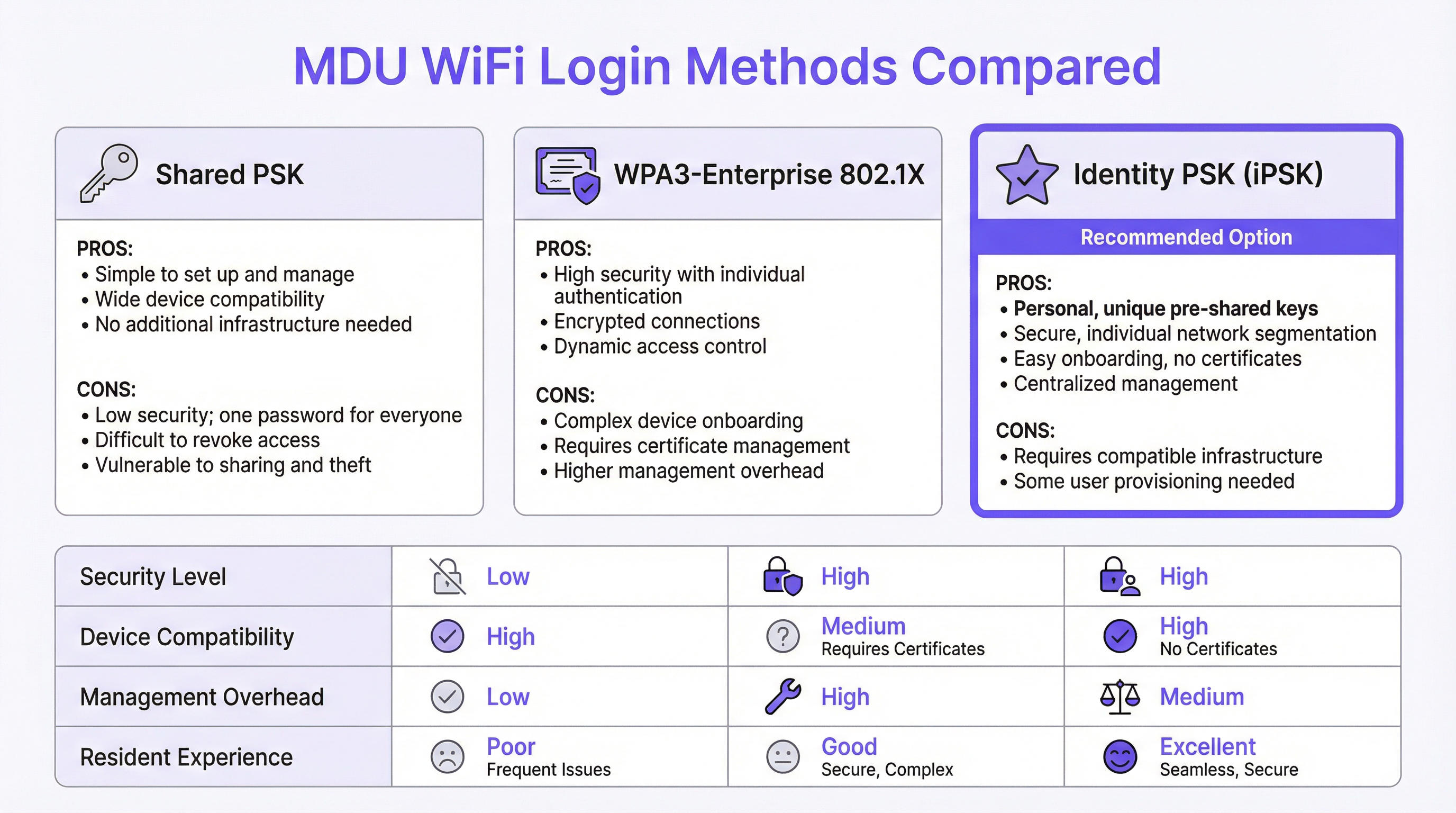
प्रत्येक MDU WiFi डिप्लॉयमेंट तीनपैकी एका ऑथेंटिकेशन पॅराडाइमवर आधारित असते, ज्या प्रत्येकाचे वेगळे सुरक्षा, उपयोगिता आणि ऑपरेशनल परिणाम असतात.
Shared Pre-Shared Key (PSK) हे बहुतांश जुन्या डिप्लॉयमेंट्ससाठी डीफॉल्ट आहे. एकच SSID आणि पासवर्ड सर्व रहिवाशांना वितरित केला जातो, जो सहसा वेलकम पॅकमध्ये दिलेला असतो किंवा बिल्डिंग स्टाफद्वारे तोंडी सांगितला जातो. ऑपरेशनल साधेपणा हाच त्याचा एकमेव गुण आहे. सुरक्षेच्या दृष्टिकोनातून, हे मल्टी-टेनंट वातावरणाशी मूलभूतपणे विसंगत आहे: प्रति-युजर सेगमेंटेशनसाठी कोणतीही यंत्रणा नाही, याचा अर्थ सर्व रहिवाशांचे डिव्हाइसेस एकच ब्रॉडकास्ट डोमेन शेअर करतात. चुकीच्या पद्धतीने कॉन्फिगर केलेले डिव्हाइस किंवा दुर्भावनापूर्ण हेतू असलेला रहिवासी त्यांच्या शेजाऱ्यांच्या नेटवर्कशी जोडलेल्या ॲसेट्सची सहजपणे माहिती मिळवू शकतो. सोडून जाणाऱ्या भाडेकरूचा ॲक्सेस रद्द करण्यासाठी संपूर्ण इमारतीचा पासवर्ड बदलावा लागतो, ज्यामुळे ऑपरेशनल व्यत्यय निर्माण होतो जो बहुतांश ऑपरेटर्स टाळतात — आणि माजी रहिवाशांना अनिश्चित काळासाठी नेटवर्क ॲक्सेस मिळतो.
WPA3-Enterprise with IEEE 802.1X हा कॉर्पोरेट वातावरणातील मानक, सुरक्षा-प्रथम दृष्टिकोन दर्शवतो. प्रत्येक युजर वैयक्तिक क्रेडेंशियल्स किंवा डिजिटल प्रमाणपत्रासह ऑथेंटिकेट करतो, जे RADIUS सर्व्हरद्वारे प्रमाणित केले जाते. हा प्रोटोकॉल प्रति-सेशन एन्क्रिप्शन कीज, मजबूत म्युच्युअल ऑथेंटिकेशन आणि ग्रॅन्युलर ॲक्सेस कंट्रोल पॉलिसीज प्रदान करतो. तथापि, हे एका महत्त्वपूर्ण कारणामुळे निवासी संदर्भासाठी योग्य नाही: स्मार्ट टीव्ही, गेमिंग कन्सोल, व्हॉइस असिस्टंट्स आणि स्मार्ट-होम हब्ससह — कंझ्युमर आणि IoT डिव्हाइसेसचा एक मोठा भाग 802.1X सप्लिकंट्सना सपोर्ट करत नाही. रहिवाशांना प्लेस्टेशन किंवा नेस्ट थर्मोस्टॅटसाठी सर्टिफिकेट प्रोव्हिजनिंग करण्यास भाग पाडल्याने सपोर्ट तिकिटांचे प्रमाण मोठ्या प्रमाणावर वाढते आणि मूळ नेटवर्क गुणवत्ता कशीही असली तरी खराब सेवेची धारणा निर्माण होते.
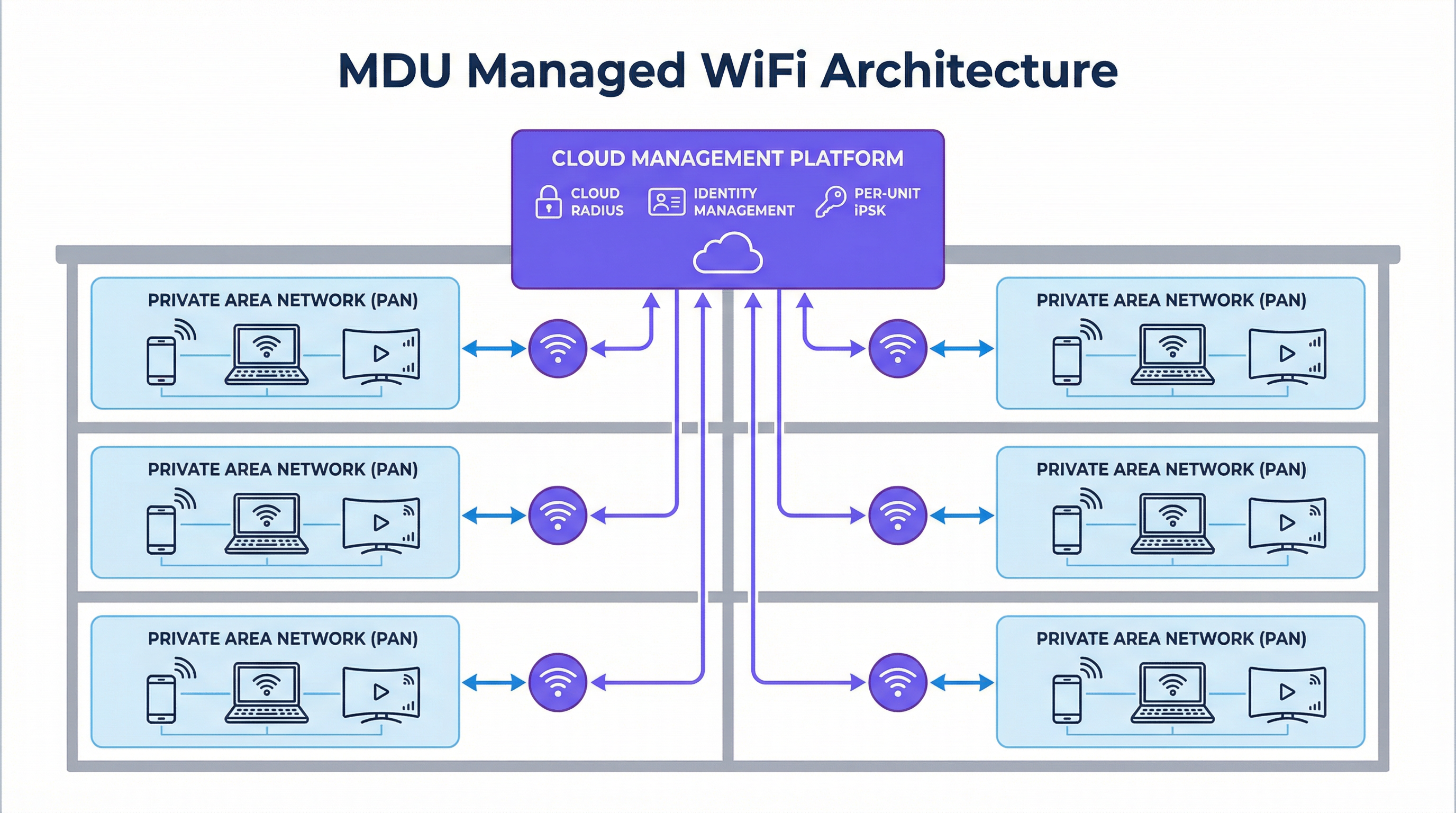
Identity PSK (iPSK) हा तणाव दूर करते. प्रत्येक अपार्टमेंट किंवा रहिवाशाला एक युनिक प्री-शेअर्ड की दिली जाते, जी प्लॅटफॉर्मद्वारे मध्यवर्ती पद्धतीने जनरेट आणि व्यवस्थापित केली जाते. रहिवाशासाठी, हा अनुभव खाजगी होम राउटरशी कनेक्ट होण्यासारखाच असतो: ते पासवर्ड टाकतात आणि ते ऑनलाइन होतात. इन्फ्रास्ट्रक्चरच्या बाजूने, RADIUS सर्व्हर प्रत्येक युनिक की एका विशिष्ट पॉलिसी प्रोफाइलशी मॅप करतो, ज्यामुळे रहिवाशाचे डिव्हाइसेस एका समर्पित Private Area Network (PAN) मध्ये ठेवले जातात — एक लेयर 2-आयसोलेटेड मायक्रो-सेगमेंट जे त्याच फिजिकल इन्फ्रास्ट्रक्चरवरील इतर सर्व रहिवाशांसाठी लॉजिकली अदृश्य असते. प्लॅटफॉर्म PAN मध्ये mDNS रिफ्लेक्शनला सपोर्ट करतो, ज्यामुळे रहिवाशांना कोणत्याही क्रॉस-टेनंट व्हिजिबिलिटीशिवाय त्यांच्या स्वतःच्या क्रोमकास्टवर कास्ट करणे किंवा त्यांच्या स्वतःच्या प्रिंटरवर प्रिंट करणे शक्य होते. हे मॉडेल 100% कंझ्युमर डिव्हाइसेसना सपोर्ट करते, यासाठी कोणत्याही सर्टिफिकेट इन्फ्रास्ट्रक्चरची आवश्यकता नसते आणि ते संपूर्णपणे क्लाउड डॅशबोर्डद्वारे व्यवस्थापित केले जाते.
| वैशिष्ट्य | Shared PSK | WPA3-Enterprise (802.1X) | Identity PSK (iPSK) |
|---|---|---|---|
| सुरक्षा सेगमेंटेशन | काहीही नाही | प्रति-युजर | प्रति-युजर |
| IoT / हेडलेस डिव्हाइस सपोर्ट | पूर्ण | मर्यादित | पूर्ण |
| मॅनेजमेंट ओव्हरहेड | कमी (स्टॅटिक) | जास्त | मध्यम (ऑटोमेटेड) |
| रेसिडेंट ऑनबोर्डिंग फ्रिक्शन | कमी | जास्त | कमी |
| टेनंट ऑफबोर्डिंग | व्यत्यय आणणारे | ग्रॅन्युलर | ग्रॅन्युलर (ऑटोमेटेड) |
| GDPR अलाइनमेंट | खराब | मजबूत | मजबूत |
| MDU साठी शिफारस केलेले | नाही | नाही | होय |
RF आर्किटेक्चर: इंटरफेरन्सची समस्या दूर करणे
दाट MDU मधील RF वातावरण हे एंटरप्राइझ नेटवर्किंगमधील सर्वात आव्हानात्मक वातावरणांपैकी एक आहे. पारंपारिक डिप्लॉयमेंट — प्रति युनिट एक कंझ्युमर राउटर — यामुळे डझनभर किंवा शेकडो स्वतंत्र 2.4 GHz आणि 5 GHz रेडिओ एकाच स्पेक्ट्रमसाठी स्पर्धा करतात. को-चॅनेल इंटरफेरन्समुळे सर्व युजर्सचा थ्रूपुट एकाच वेळी कमी होतो आणि ऑक्युपन्सी वाढल्यास ही समस्या अधिक गंभीर होते. प्रत्येक फ्लॅटमध्ये एक राउटर असलेल्या 200-युनिटच्या इमारतीमध्ये किमान 200 स्पर्धात्मक 2.4 GHz रेडिओ तयार होतात, जे अनेकदा ओव्हरलॅपिंग चॅनेल्सवर काम करतात.
मॅनेज्ड iPSK डिप्लॉयमेंट याला नियोजित, मध्यवर्ती रेडिओ आर्किटेक्चरने बदलते. व्यावसायिक RF साइट सर्व्हेच्या आधारे एंटरप्राइझ-ग्रेड ॲक्सेस पॉइंट्स स्थापित केले जातात, ज्यामध्ये नॉन-ओव्हरलॅपिंग चॅनेल्स, नियंत्रित ट्रान्समिट पॉवर आणि 2.4 GHz, 5 GHz, आणि — WiFi 6E आणि WiFi 7 डिप्लॉयमेंट्समध्ये — 6 GHz बँडवर क्लायंट्सचे इष्टतम वितरण करण्यासाठी बँड स्टीयरिंगचा वापर केला जातो. याचा परिणाम म्हणून को-चॅनेल इंटरफेरन्समध्ये लक्षणीय घट होते आणि प्रति-युजर थ्रूपुटमध्ये मोजता येण्याजोगी सुधारणा होते. महत्त्वाचे म्हणजे, नेटवर्क मध्यवर्ती पद्धतीने व्यवस्थापित केले जात असल्यामुळे, ऑपरेटर वैयक्तिक युनिट्समध्ये इंजिनिअर न पाठवता दूरस्थपणे रेडिओ पॅरामीटर्स ॲडजस्ट करू शकतो, फर्मवेअर अपडेट्स लागू करू शकतो आणि समस्यांचे निदान करू शकतो.
सुरक्षा, कंप्लायन्स आणि नियामक परिदृश्य
तळमजल्यावरील रिटेल, फूड अँड बेव्हरेज किंवा को-वर्किंग स्पेसेसचा समावेश असलेल्या MDU मालमत्तांचे व्यवस्थापन करणाऱ्या ऑपरेटर्ससाठी, कंप्लायन्स आवश्यकता मूलभूत गोपनीयतेच्या पलीकडे जातात. PCI DSS कार्डहोल्डर डेटा वातावरण आणि कोणत्याही सामायिक नेटवर्क इन्फ्रास्ट्रक्चर दरम्यान कठोर नेटवर्क सेगमेंटेशन अनिवार्य करते. निवासी आणि रिटेल ट्रॅफिक एकत्र करणारे फ्लॅट MDU नेटवर्क थेट कंप्लायन्सचा धोका निर्माण करते. प्रति पॉलिसी प्रोफाइल VLAN टॅगिंगसह iPSK, PCI DSS आवश्यकता 1.3 पूर्ण करण्यासाठी आवश्यक असलेली सेगमेंटेशन बाउंड्री प्रदान करते, जे नेटवर्क लेयरवर पेमेंट सिस्टीम्सना निवासी ट्रॅफिकपासून वेगळे करते.
GDPR जबाबदाऱ्यांचा एक वेगळा संच सादर करते. युजर डेटा कॅप्चर करणाऱ्या कोणत्याही नेटवर्कने — ज्यामध्ये MAC ॲड्रेसेस, कनेक्शन टाइमस्टॅम्प्स आणि ब्राउझिंग मेटाडेटा समाविष्ट आहे — ते कायदेशीर आधारावर केले पाहिजे आणि योग्य तांत्रिक सुरक्षा उपाय लागू केले पाहिजेत. कंप्लायंट Captive Portal किंवा ॲप-आधारित ऑनबोर्डिंग फ्लो असलेला मॅनेज्ड WiFi प्लॅटफॉर्म, GDPR च्या कलम 5 आणि 6 अंतर्गत आवश्यक असलेली संमती यंत्रणा आणि डेटा मिनिमायझेशन कंट्रोल्स प्रदान करतो. ऑपरेटर्सनी हे सुनिश्चित केले पाहिजे की त्यांचा निवडलेला प्लॅटफॉर्म डेटा प्रोसेसिंग ॲग्रीमेंट (DPA) प्रदान करतो आणि डेटा स्टोरेजसाठी योग्य अधिकारक्षेत्राच्या सीमांमध्ये कार्य करतो.
अंमलबजावणी मार्गदर्शक
टप्पा 1: डिस्कव्हरी आणि डिझाइन (आठवडे 1-2)
सर्वसमावेशक साइट सर्व्हेने सुरुवात करा. हा पर्याय नाही (हे अनिवार्य आहे). स्पेक्ट्रम ॲनालायझर वापरून फिजिकल वॉकथ्रूद्वारे प्रमाणित केलेले प्रेडिक्टिव्ह RF मॉडेल, डेड झोन्स, इंटरफेरन्सचे स्रोत आणि इष्टतम ॲक्सेस पॉइंट लोकेशन्स ओळखेल. इमारतीच्या बांधकाम साहित्याचे दस्तऐवजीकरण करा — काँक्रीट आणि स्टील टिंबर-फ्रेम बांधकामापेक्षा सिग्नल्स लक्षणीयरीत्या अधिक क्षीण करतात — आणि मायक्रोवेव्ह ओव्हन, DECT फोन्स आणि शेजारील नेटवर्क्ससह सर्व इलेक्ट्रिकल इंटरफेरन्स स्रोतांच्या स्थानांचा नकाशा तयार करा.
डिस्कव्हरी दरम्यान, तुमच्या विद्यमान इन्फ्रास्ट्रक्चरचे ऑडिट करा. तुमचे स्विचिंग इस्टेट 802.1Q VLAN टॅगिंगला सपोर्ट करते का (ट्रॅफिक सेगमेंटेशनसाठी आवश्यक), तुमचा अपलिंक पुरेशी बँडविड्थ हेडरूम प्रदान करतो का (मानक निवासी डिप्लॉयमेंटसाठी प्रति युनिट किमान 25 Mbps आणि प्रीमियम टियर्ससाठी 50-100 Mbps चे नियोजन करा), आणि तुमची प्रॉपर्टी मॅनेजमेंट सिस्टीम स्वयंचलित युजर प्रोव्हिजनिंगसाठी API एक्सपोज करते का ते ओळखा.
टप्पा 2: इन्फ्रास्ट्रक्चर डिप्लॉयमेंट (आठवडे 3-6)
साइट सर्व्हे प्लॅननुसार एंटरप्राइझ-ग्रेड ॲक्सेस पॉइंट्स डिप्लॉय करा. मानक निवासी MDU साठी, दोन ते चार युनिट्समागे एक ॲक्सेस पॉइंट हा एक योग्य सुरुवातीचा टप्पा आहे, जो इमारतीचे बांधकाम आणि युनिट घनतेनुसार ॲडजस्ट केला जातो. सीलिंग किंवा कॉरिडॉरच्या ठिकाणी स्थानिक पॉवर आउटलेट्सची आवश्यकता दूर करण्यासाठी सर्व ॲक्सेस पॉइंट्स PoE+ (IEEE 802.3at) किंवा PoE++ (IEEE 802.3bt) द्वारे पॉवर केलेले असल्याची खात्री करा.
आवश्यक VLANs सह तुमचे स्विचिंग इन्फ्रास्ट्रक्चर कॉन्फिगर करा: किमान एक मॅनेजमेंट VLAN, एक प्रति-रहिवासी डेटा VLAN (किंवा कंट्रोलर लेयरवर PAN एन्फोर्समेंटसह सामायिक VLAN), आणि एक गेस्ट/व्हिजिटर VLAN. तुमचे क्लाउड RADIUS कनेक्शन स्थापित करा आणि कोणत्याही रहिवाशांना ऑनबोर्ड करण्यापूर्वी ऑथेंटिकेशन फ्लोज प्रमाणित करा.
टप्पा 3: आयडेंटिटी इंटिग्रेशन आणि ऑनबोर्डिंग (आठवडे 5-8)
API द्वारे मॅनेज्ड WiFi प्लॅटफॉर्म तुमच्या प्रॉपर्टी मॅनेजमेंट सिस्टीमसोबत इंटिग्रेट करा. ऑटोमेटेड प्रोव्हिजनिंग वर्कफ्लो कॉन्फिगर करा: जेव्हा PMS मध्ये नवीन भाडेकरू तयार केला जातो, तेव्हा प्लॅटफॉर्मने आपोआप एक युनिक iPSK जनरेट केला पाहिजे, तो योग्य पॉलिसी प्रोफाइलशी (VLAN, बँडविड्थ टियर, PAN ग्रुप) जोडला पाहिजे आणि ईमेल किंवा रेसिडेंट ॲपद्वारे रहिवाशाला क्रेडेंशियल्स वितरित केले पाहिजेत. गो-लाइव्ह होण्यापूर्वी संपूर्ण वर्कफ्लोची एंड-टू-एंड चाचणी करा, ज्यामध्ये ऑफबोर्डिंग पाथचाही समावेश असावा — भाडेकरू करार संपुष्टात आल्यावर क्रेडेंशियल रिव्होकेशन त्वरित आणि पूर्ण असले पाहिजे.
हेडलेस IoT डिव्हाइसेस असलेल्या रहिवाशांसाठी, एक सेल्फ-सर्व्हिस पोर्टल किंवा ॲप-आधारित फ्लो प्रदान करा जो त्याच PAN मध्ये दुय्यम डिव्हाइस-विशिष्ट की जनरेट करेल. यामुळे सुरक्षा आर्किटेक्चरशी तडजोड न करता स्मार्ट टीव्ही किंवा गेमिंग कन्सोल नेटवर्कमध्ये सामील होऊ शकतो.
टप्पा 4: गो-लाइव्ह आणि ऑप्टिमायझेशन (आठवडा 8 आणि पुढे)
पूर्ण डिप्लॉयमेंटपूर्वी पायलट फ्लोअर किंवा बिल्डिंगपासून सुरुवात करून टप्प्याटप्प्याने रोलआउट करा. मॅनेजमेंट डॅशबोर्डमध्ये कनेक्शन सक्सेस रेट्स, ऑथेंटिकेशन फेल्युअर्स आणि प्रति-AP क्लायंट काउंट्सचे निरीक्षण करा. लाइव्ह RF डेटाच्या आधारे ट्रान्समिट पॉवर आणि चॅनेल असाइनमेंट्स ॲडजस्ट करा. पहिल्या 30 दिवसांत सपोर्ट तिकीट व्हॉल्यूमसाठी एक बेसलाइन स्थापित करा; योग्यरित्या डिप्लॉय केलेले मॅनेज्ड WiFi सोल्यूशन जुन्या शेअर्ड-PSK डिप्लॉयमेंटच्या तुलनेत कनेक्टिव्हिटी-संबंधित सपोर्ट विनंत्या 70-80% ने कमी करेल.
सर्वोत्तम पद्धती
खालील व्हेंडर-न्यूट्रल शिफारसी मोठ्या प्रमाणावरील MDU WiFi डिप्लॉयमेंट्ससाठी सध्याच्या उद्योग सहमतीचे प्रतिबिंबित करतात.
शक्य असेल तिथे WPA3 लागू करा. WPA3-SAE (Simultaneous Authentication of Equals) WPA2-PSK मध्ये असलेली ऑफलाइन डिक्शनरी अटॅकची असुरक्षितता दूर करते. iPSK डिप्लॉयमेंट्ससाठी, जुन्या डिव्हाइसेससोबत बॅकवर्ड कंपॅटिबिलिटी राखण्यासाठी WPA3 ट्रान्झिशन मोड सक्षम करा आणि डिव्हाइसेस बदलले जात असताना इस्टेटला टप्प्याटप्प्याने WPA3 वर मायग्रेट करा.
802.11r (Fast BSS Transition) आणि 802.11k/v (Radio Resource Management) लागू करा. मोठ्या MDU डिप्लॉयमेंट्समध्ये, रहिवासी कॉमन एरियाज, कॉरिडॉर्स आणि त्यांच्या स्वतःच्या युनिट्समध्ये फिरत असतात. फास्ट रोमिंगशिवाय, एखादे डिव्हाइस जवळचा ॲक्सेस पॉइंट उपलब्ध झाल्यानंतरही बऱ्याच काळासाठी दूरच्या ॲक्सेस पॉइंटशी कनेक्टेड राहू शकते, ज्यामुळे थ्रूपुट कमी होतो. 802.11r सब-100ms रोमिंग हँडऑफ्स सक्षम करते, तर 802.11k आणि 802.11v क्लायंटला नेबर रिपोर्ट्स आणि BSS ट्रान्झिशन मॅनेजमेंट विनंत्या प्रदान करतात ज्यामुळे इंटेलिजेंट रोमिंग निर्णय घेणे सोपे होते.
नेटवर्क लेयरवर IoT ट्रॅफिक वेगळे करा. PAN मध्येही, IoT डिव्हाइसेसना प्रतिबंधित इंटरनेट ॲक्सेस आणि इंट्रा-PAN राउटिंग नसलेल्या समर्पित SSID वर ठेवण्याचा विचार करा. हे तडजोड झालेल्या IoT डिव्हाइसची व्याप्ती (blast radius) मर्यादित करते आणि झिरो-ट्रस्ट नेटवर्क तत्त्वांशी सुसंगत आहे.
दस्तऐवजीकरण केलेली चेंज मॅनेजमेंट प्रक्रिया राखा. MDU नेटवर्क्स हे सतत रहिवासी बदलत असलेले लाइव्ह वातावरण असतात. प्रत्येक कॉन्फिगरेशन बदल — VLAN मॉडिफिकेशन, फर्मवेअर अपडेट, पॉलिसी बदल — स्टेजिंग वातावरणात तपासला गेला पाहिजे आणि प्रमाणित रोलबॅक प्रक्रियेसह निश्चित मेंटेनन्स विंडो दरम्यान रोलआउट केला पाहिजे.
ट्रबलशूटिंग आणि जोखीम निवारण
सामान्य फेल्युअर मोड्स
मोठ्या प्रमाणावरील ऑथेंटिकेशन फेल्युअर्स. प्लॅटफॉर्म अपडेट किंवा इन्फ्रास्ट्रक्चर बदलानंतर जर मोठ्या संख्येने रहिवासी कनेक्ट होऊ शकत नसतील, तर त्याचे सर्वात संभाव्य कारण RADIUS सर्व्हर मिसकॉन्फिगरेशन किंवा क्लाउड RADIUS एंडपॉइंटवरील सर्टिफिकेट एक्स्पायरी असू शकते. RADIUS शेअर्ड सिक्रेट प्रमाणित करा, सर्टिफिकेटच्या वैधतेच्या तारखा तपासा आणि ॲक्सेस पॉइंट्स UDP पोर्ट्स 1812 आणि 1813 वर RADIUS सर्व्हरपर्यंत पोहोचू शकतात याची खात्री करा. क्लाउड-होस्टेड RADIUS आर्किटेक्चर ऑन-प्रिमाइसेस सर्व्हरचा सिंगल-पॉइंट-ऑफ-फेल्युअर धोका दूर करते.
विशिष्ट युनिट्समध्ये इंटरमिटेंट कनेक्टिव्हिटी. वेगळ्या युनिट्समधील सततच्या कनेक्टिव्हिटी समस्या जवळजवळ नेहमीच RF कव्हरेजची समस्या असते, ऑथेंटिकेशनची समस्या नसते. प्रभावित रहिवासी दूरच्या ॲक्सेस पॉइंटशी कनेक्ट होत आहेत का हे ओळखण्यासाठी मॅनेजमेंट प्लॅटफॉर्मच्या प्रति-AP क्लायंट असोसिएशन डेटाचा वापर करा. कव्हरेज गॅप दूर करण्यासाठी ट्रान्समिट पॉवर ॲडजस्ट करा किंवा अतिरिक्त ॲक्सेस पॉइंट डिप्लॉय करा.
IoT डिव्हाइस ऑनबोर्डिंग फेल्युअर्स. योग्य पासवर्ड असूनही कनेक्ट होण्यात अयशस्वी होणारी डिव्हाइसेस सहसा अशा प्रोटोकॉलशी (जसे की 802.1X) निगोशिएट करण्याचा प्रयत्न करत असतात ज्याला SSID सपोर्ट करत नाही, किंवा ते MAC ॲड्रेस फिल्टरद्वारे नाकारले जात असतात. SSID WPA2/WPA3-Personal (Enterprise नाही) साठी कॉन्फिगर केले असल्याची खात्री करा, रेसिडेंट SSID वरील MAC फिल्टरिंग अक्षम करा आणि डिव्हाइसच्या नेटवर्क सेटिंग्ज उपलब्ध नसलेल्या विशिष्ट फ्रिक्वेन्सी बँडवर हार्डकोड केलेल्या नाहीत याची पडताळणी करा.
रेसिडेंट-टू-रेसिडेंट ट्रॅफिक लीकेज. जर रहिवाशांनी शेजाऱ्यांचे डिव्हाइसेस पाहू शकत असल्याची तक्रार केली, तर PAN एन्फोर्समेंट पॉलिसी योग्यरित्या लागू केलेली नाही. योग्य VLAN किंवा ग्रुप पॉलिसी परत करणारे RADIUS ॲट्रिब्युट Access-Accept रिस्पॉन्समध्ये उपस्थित असल्याची पडताळणी करा आणि ॲक्सेस पॉइंट फर्मवेअर प्लॅटफॉर्मद्वारे वापरल्या जाणाऱ्या विशिष्ट PAN एन्फोर्समेंट यंत्रणेला (सहसा व्हेंडर-स्पेसिफिक ॲट्रिब्युट किंवा डायनॅमिक VLAN असाइनमेंट) सपोर्ट करते याची खात्री करा.
Purple टेक्निकल ब्रीफिंग पॉडकास्ट — MDU WiFi लॉगिन स्ट्रॅटेजीज, अंमलबजावणी शिफारसी आणि ROI विश्लेषणावरील संपूर्ण 10-मिनिटांचे कन्सल्टंट ब्रीफिंग ऐका.
ROI आणि व्यावसायिक प्रभाव
गुंतवणुकीचे परिमाणीकरण
मॅनेज्ड MDU WiFi डिप्लॉयमेंटसाठी आर्थिक प्रकरण तीन भिन्न व्हॅल्यू स्ट्रीम्सवर कार्य करते.
ऑपरेशनल खर्चात कपात. कंझ्युमर राउटर्सची जुनी डिप्लॉयमेंट — 200-युनिटच्या इमारतीत प्रति युनिट एक — तीन ते पाच वर्षांचे हार्डवेअर रिप्लेसमेंट सायकल आणि रहिवाशांनी नोंदवलेल्या समस्यांसाठी चालू सपोर्ट खर्च सोबत आणते. मॅनेज्ड WiFi याला सात ते दहा वर्षांच्या लाइफसायकलसह कमी संख्येतील एंटरप्राइझ-ग्रेड ॲक्सेस पॉइंट्स, एकच क्लाउड मॅनेजमेंट सबस्क्रिप्शन आणि लक्षणीयरीत्या कमी झालेल्या सपोर्ट तिकीट व्हॉल्यूममध्ये एकत्रित करते. मॅनेज्ड डिप्लॉयमेंटनंतर ऑपरेटर्स सातत्याने WiFi-संबंधित सपोर्ट विनंत्यांमध्ये 70-80% घट नोंदवतात, ज्याचे थेट रूपांतर कर्मचाऱ्यांचा वेळ आणि थर्ड-पार्टी सपोर्ट खर्च कमी होण्यात होते.
महसूल निर्मिती. iPSK चे आयडेंटिटी-आधारित आर्किटेक्चर टियर्ड सर्व्हिस ऑफरिंग्ज सक्षम करते. सर्व्हिस चार्जमध्ये मानक निवासी टियर समाविष्ट केला जाऊ शकतो, तर प्रीमियम टियर्स — उच्च बँडविड्थ, गेमिंग किंवा व्हिडिओ कॉन्फरन्सिंगसाठी समर्पित QoS — मासिक शुल्कावर पर्यायी अपग्रेड्स म्हणून ऑफर केले जाऊ शकतात. 200-युनिटच्या इमारतीत, £10/महिना प्रीमियम टियरचा 30% अपटेक देखील वार्षिक £7,200 चा अतिरिक्त महसूल निर्माण करतो. मिक्स्ड-युज प्रॉपर्टीज असलेल्या ऑपरेटर्ससाठी, तेच इन्फ्रास्ट्रक्चर रिटेल आणि को-वर्किंग भाडेकरूंना वेगळ्या पॉलिसी प्रोफाइल्सवर सेवा देऊ शकते, ज्या प्रत्येकाचे योग्य SLAs आणि बिलिंग असते.
ॲसेट व्हॅल्यू आणि टेनंट रिटेन्शन. बिल्ड-टू-रेंट क्षेत्रात, टेनंट सॅटिस्फॅक्शन सर्व्हेमध्ये WiFi गुणवत्ता सातत्याने टॉप-तीन घटकांपैकी एक म्हणून नमूद केली जाते. स्पष्टपणे उत्कृष्ट कनेक्टिव्हिटी असलेल्या मालमत्तांना रेंटल प्रीमियम मिळतो आणि तिथे कमी व्हॉइड रेट्स (रिकामे राहण्याचे प्रमाण) अनुभवले जातात. कमी झालेल्या व्हॉइड पिरियड्सचे कॅपिटलाइज्ड मूल्य — £1,500/महिना सरासरी भाड्याने 200-युनिटच्या इमारतीत ऑक्युपन्सीमध्ये एक टक्क्याची सुधारणा देखील — वार्षिक महसुलात £36,000 चे प्रतिनिधित्व करते, हा आकडा मॅनेज्ड WiFi सबस्क्रिप्शनच्या वार्षिक खर्चापेक्षा खूप मोठा आहे.
| व्हॅल्यू स्ट्रीम | 200-युनिट बिल्डिंग (वार्षिक) | आधार |
|---|---|---|
| सपोर्ट खर्चात कपात | £15,000–£25,000 | WiFi सपोर्ट तिकिटांमध्ये 75% घट |
| प्रीमियम टियर महसूल | £7,200+ | £10/महिना दराने 30% अपटेक |
| कमी झालेला व्हॉइड रेट (1% सुधारणा) | £36,000 | £1,500/महिना सरासरी भाडे |
| एकूण सूचक वार्षिक फायदा | £58,200–£68,200 |
हे आकडे सूचक आहेत आणि मार्केट, मालमत्तेचा प्रकार आणि विद्यमान इन्फ्रास्ट्रक्चर बेसलाइननुसार बदलतील. ऑपरेटरचा प्रत्यक्ष खर्च आणि महसूल डेटा वापरून औपचारिक ROI विश्लेषण केले जावे.
Key Terms & Definitions
MDU Login
The authentication mechanism by which residents, guests, or devices in a Multi-Dwelling Unit gain access to the shared WiFi network. MDU login methods range from simple shared passwords to identity-based systems that assign unique credentials per unit or per user.
IT teams encounter this term when scoping a WiFi deployment for apartment buildings, student accommodation, co-living spaces, or extended-stay hotels. The choice of MDU login method determines the security architecture, management overhead, and resident experience of the entire deployment.
Identity PSK (iPSK)
A WiFi authentication method in which each user, device, or unit is assigned a unique pre-shared key. The RADIUS server maps each key to a specific policy profile — including VLAN assignment, bandwidth limits, and PAN group membership — enabling per-user segmentation without requiring 802.1X certificate infrastructure.
iPSK is the recommended authentication model for MDU deployments because it combines the simplicity of a password-based connection (compatible with all consumer devices) with the granular access control and segmentation of an enterprise network. IT architects encounter iPSK as the primary differentiator between basic managed WiFi platforms and enterprise-grade MDU solutions.
Private Area Network (PAN)
A logical network segment that isolates a specific group of devices — typically those belonging to a single resident or apartment — from all other devices on the same physical infrastructure. PANs enforce Layer 2 isolation while enabling intra-group device discovery via mDNS reflection.
PANs are the technical mechanism that delivers the 'private home network' experience in a shared MDU infrastructure. Network architects specify PAN support as a mandatory requirement when evaluating managed WiFi platforms for residential deployments, particularly where IoT device interoperability (Chromecast, AirPlay, smart-home hubs) is a resident expectation.
IEEE 802.1X
An IEEE standard for port-based network access control that provides an authentication framework for devices connecting to a LAN or WLAN. It requires a supplicant (client), an authenticator (access point), and an authentication server (RADIUS), and supports multiple EAP methods including EAP-TLS (certificate-based) and PEAP (username/password).
802.1X is the authentication standard underpinning WPA3-Enterprise deployments. IT teams encounter it when evaluating whether their existing infrastructure can support enterprise WiFi, and when assessing the device compatibility implications of an enterprise-only SSID in a mixed residential/commercial environment.
RADIUS (Remote Authentication Dial-In User Service)
A networking protocol that provides centralised authentication, authorisation, and accounting (AAA) for users connecting to a network. In WiFi deployments, the RADIUS server validates credentials and returns policy attributes (VLAN, bandwidth tier, PAN group) to the access point in the Access-Accept response.
RADIUS is the back-end infrastructure component that makes iPSK and 802.1X authentication possible. IT teams must decide between on-premises RADIUS (higher control, single point of failure) and cloud RADIUS (lower maintenance overhead, high availability). For MDU deployments, cloud RADIUS is strongly preferred to eliminate the operational burden of server maintenance.
WPA3-SAE (Simultaneous Authentication of Equals)
The authentication handshake introduced in WPA3 that replaces the WPA2 4-way handshake for personal (PSK) networks. SAE is resistant to offline dictionary attacks because it does not expose the password hash in the handshake, even if an attacker captures the full exchange.
WPA3-SAE is the current best practice for PSK-based WiFi security. IT teams should specify WPA3 Transition Mode (supporting both WPA2 and WPA3 clients) for new MDU deployments to progressively improve security as older devices are replaced, without creating compatibility issues for existing residents.
RF Site Survey
A systematic assessment of the radio frequency environment in a physical space, used to determine optimal access point placement, channel assignments, and transmit power settings. A site survey includes both a predictive model (using building plans and construction materials) and a physical validation walk using a spectrum analyser.
An RF site survey is the mandatory first step in any MDU WiFi deployment. IT teams and network architects commission site surveys to avoid the most common deployment failure: coverage gaps and co-channel interference caused by suboptimal AP placement. The survey output directly informs the bill of materials and the installation plan.
Co-Channel Interference (CCI)
Signal degradation caused by multiple access points or devices transmitting on the same WiFi channel simultaneously. In dense MDU environments, CCI is the primary cause of throughput degradation and is significantly worsened by the deployment of multiple consumer routers operating on default channel settings.
CCI is the technical explanation for why adding more consumer routers to an MDU makes the network worse, not better. Network architects use CCI analysis — typically visualised as a channel utilisation heatmap — to justify the transition from distributed consumer hardware to a centrally managed enterprise AP deployment with coordinated channel planning.
Property Management System (PMS) Integration
The API-level connection between a managed WiFi platform and the property management software used to administer tenancies, leases, and resident records. PMS integration enables automated WiFi credential provisioning at lease signing and immediate credential revocation at tenancy termination.
PMS integration is the operational feature that separates a scalable MDU WiFi deployment from one that creates ongoing manual management overhead. IT teams should treat PMS integration as a mandatory requirement — not a nice-to-have — when evaluating managed WiFi platforms for deployments of more than 50 units.
mDNS Reflection
A network function that forwards multicast DNS (mDNS) packets between devices within a defined group (such as a PAN), enabling device discovery protocols like Apple Bonjour, Google Cast, and AirPlay to function across VLAN boundaries within the same logical segment.
mDNS reflection is the specific technical capability that enables IoT and smart-home devices to function correctly within a PAN. Without it, a resident's Chromecast or AirPlay-enabled speaker will be invisible to their phone, even if both devices are on the same iPSK. IT architects must verify mDNS reflection support when evaluating managed WiFi platforms for residential deployments.
Case Studies
A 350-unit build-to-rent development in Manchester is preparing to launch. The developer currently plans to install a consumer router in each apartment and provide residents with a building-wide shared WiFi password for common areas. The IT director has been asked to evaluate whether this approach is fit for purpose and, if not, to propose an alternative architecture for the board.
The proposed architecture has three critical failure modes that will manifest within the first quarter of operation. First, the shared password for common areas provides no tenant isolation: residents will be able to enumerate each other's devices in the lobby, gym, and co-working space, creating both a privacy risk and a GDPR exposure. Second, 350 consumer routers operating simultaneously will create severe RF interference across the 2.4 GHz and 5 GHz bands, degrading throughput for all residents and generating a disproportionate volume of support requests. Third, the absence of centralised management means that every connectivity issue requires a physical visit to the affected unit.
The recommended architecture is a managed iPSK deployment using enterprise-grade access points positioned based on a professional RF site survey — approximately 120–140 APs for a building of this density, depending on construction materials. Each apartment is assigned a unique iPSK, delivered automatically via integration with the developer's property management system at the point of lease signing. Common areas are served by the same infrastructure, with residents' PANs extending seamlessly as they move through the building. A dedicated guest SSID with a captive portal provides visitor access without exposing the resident network.
Configuration steps: (1) Commission RF site survey and produce AP placement plan. (2) Deploy structured cabling to all AP locations with PoE+ switching. (3) Configure cloud management platform with per-unit iPSK policy profiles and VLAN assignments. (4) Integrate platform API with the PMS for automated provisioning and offboarding. (5) Configure 802.11r/k/v for seamless roaming across common areas. (6) Deploy resident app for self-service device management and speed tier upgrades. (7) Conduct staged go-live by floor, monitoring authentication success rates and AP client counts.
A 120-room extended-stay hotel in London is experiencing a high volume of WiFi complaints from long-term guests (stays of 30+ days). Investigation reveals that guests are using the same shared hotel WiFi password as transient guests, and several long-term guests have reported that their smart-home devices (Alexa, Chromecast, smart plugs) do not work reliably. The hotel's IT manager needs to design a solution that provides long-term guests with a private, home-like WiFi experience without replacing the existing Cisco Meraki access point infrastructure.
The existing Cisco Meraki infrastructure is fully compatible with an iPSK deployment when combined with a managed WiFi platform such as Purple. The solution does not require hardware replacement; it requires a configuration change at the platform layer and the addition of a cloud RADIUS service.
The architecture separates guests into two distinct profiles. Transient guests (stays under 7 days) continue to use the existing captive portal SSID with a shared PSK, which is appropriate for their use case. Long-term guests (stays of 7+ days) are migrated to a dedicated SSID configured for iPSK authentication. At check-in, the property management system triggers the automatic generation of a unique iPSK for the guest's room, delivered via the hotel's pre-arrival email sequence. The guest enters this key once on their primary device; all subsequent devices in the room connect using the same key and are automatically placed in the same PAN.
For smart-home devices that cannot display a password entry screen, the hotel app generates a QR code that the guest scans with their phone to provision the device directly. The PAN ensures that the guest's Alexa, Chromecast, and smart plugs can communicate with each other but remain completely invisible to other guests on the network. Upon checkout, the iPSK is automatically revoked, and the room's PAN is dissolved.
Configuration steps: (1) Enable RADIUS authentication on the long-stay SSID in Cisco Meraki dashboard. (2) Configure Purple as the cloud RADIUS provider with the Meraki shared secret. (3) Map long-stay guest profiles in the PMS to iPSK policy profiles in Purple. (4) Configure PAN enforcement via dynamic VLAN assignment per iPSK. (5) Enable mDNS reflection within PANs for IoT device discovery. (6) Test full lifecycle: provisioning, device onboarding, mDNS functionality, and revocation.
Scenario Analysis
Q1. A 500-unit mixed-use development includes 450 residential apartments, 30 retail units, and a ground-floor food hall. The developer wants a single managed WiFi platform to serve all tenants. The retail units include a café that processes card payments via a cloud-based POS system. What are the critical network segmentation requirements, and how should the WiFi architecture be structured to meet them?
💡 Hint:Consider the PCI DSS requirement for cardholder data environment isolation and how VLAN tagging per policy profile can satisfy this alongside the residential PAN requirement.
Show Recommended Approach
The critical requirement is strict Layer 3 segmentation between the retail cardholder data environment (CDE) and all other network traffic, as mandated by PCI DSS Requirement 1.3. The architecture should implement at minimum four distinct network segments: (1) a residential iPSK segment with per-unit PANs for the 450 apartments; (2) a retail general-purpose segment for non-payment retail devices; (3) a dedicated CDE segment for POS terminals and payment infrastructure, with no routing to any other segment; and (4) a visitor/guest segment with captive portal access for food hall customers. Each segment is implemented as a separate VLAN, with inter-VLAN routing disabled by default and explicit firewall rules permitting only the specific flows required (e.g., POS terminals to payment gateway over HTTPS). The managed WiFi platform must support dynamic VLAN assignment per iPSK policy profile to enable this segmentation without deploying separate physical SSIDs for each segment. A quarterly PCI DSS scope review should verify that no new devices have been inadvertently placed in the CDE VLAN.
Q2. An IT manager at a 200-unit student accommodation block reports that WiFi performance degrades significantly between 7pm and 11pm each evening, with residents in upper floors experiencing the worst throughput. The current deployment uses a shared PSK and a mix of consumer routers provided by residents and a small number of building-managed access points in corridors. What is the most likely cause, and what is the remediation path?
💡 Hint:Consider the RF environment in a dense residential building during peak usage hours and the impact of uncoordinated consumer router deployments on co-channel interference.
Show Recommended Approach
The most likely cause is severe co-channel interference during peak usage hours. With 200 units, each potentially containing one or more consumer routers operating on default channel settings (typically channel 6 on 2.4 GHz and channel 36 or 40 on 5 GHz), the RF environment becomes saturated as usage peaks in the evening. Upper floors typically experience worse performance because the signal from lower-floor routers propagates upward, increasing the number of competing radios visible to upper-floor devices. The remediation path has two phases: immediate and structural. The immediate mitigation is to conduct an RF spectrum scan to identify the most congested channels and manually configure the building-managed APs to use the least-congested non-overlapping channels (1, 6, 11 on 2.4 GHz; 36, 40, 44, 48 on 5 GHz). The structural remediation is to migrate to a managed iPSK deployment that eliminates resident-owned routers entirely, replacing them with a planned enterprise AP deployment with coordinated channel assignment and transmit power control. This removes the root cause of the interference rather than managing around it.
Q3. A property management company is evaluating two managed WiFi platforms for a 300-unit build-to-rent portfolio. Platform A offers a lower per-unit monthly cost but does not provide a PMS integration API, requiring manual credential management. Platform B costs 40% more per unit but provides full bidirectional API integration with the operator's existing PMS. The finance director is pushing for Platform A on cost grounds. How do you construct the business case for Platform B?
💡 Hint:Quantify the operational cost of manual credential management at scale, including the security risk of delayed offboarding, and compare against the incremental cost of Platform B.
Show Recommended Approach
The business case for Platform B rests on three quantified arguments. First, operational cost: manual credential management for a 300-unit portfolio with typical BTR churn of 30–40% annually means 90–120 manual provisioning and revocation events per year. At a conservative 30 minutes of staff time per event (including error correction and resident communication), this represents 45–60 hours of management time annually, or approximately £1,350–£1,800 at a £30/hour blended rate. The incremental cost of Platform B at 40% more — assuming a base cost of £5/unit/month, the premium is £2/unit/month, or £7,200/year for 300 units — is not offset by staff savings alone. Second, security risk: delayed offboarding creates a quantifiable compliance exposure. Under GDPR, continued network access by a former tenant whose data should have been deleted constitutes a data breach risk. A single ICO investigation or data breach notification event carries costs — legal, reputational, and potential fines — that dwarf the annual platform cost differential. Third, revenue enablement: Platform B's API integration enables automated tiered service upgrades, allowing the operator to offer premium bandwidth tiers as a self-service upsell. Even a 20% uptake of a £5/month premium tier across 300 units generates £3,600/year in incremental revenue. The combined case — staff savings, risk mitigation, and revenue enablement — comfortably justifies the Platform B premium.
Key Takeaways
- ✓Shared PSK is architecturally incompatible with MDU environments of any meaningful scale: it provides no security segmentation, no device isolation, and no granular offboarding capability. It should be treated as a legacy configuration, not a deployment option.
- ✓Identity PSK (iPSK) is the current best-practice authentication model for MDUs, delivering per-unit credential uniqueness, Layer 2 device isolation via Private Area Networks, and full compatibility with IoT and consumer devices — without the certificate complexity of WPA3-Enterprise 802.1X.
- ✓RF interference from uncoordinated consumer router deployments is the primary cause of poor WiFi performance in dense MDUs. Replacing distributed consumer hardware with a planned enterprise AP deployment, guided by a professional site survey, resolves the root cause rather than managing around it.
- ✓PMS integration is not optional at scale. Automated credential provisioning and revocation — triggered directly by tenancy events in the property management system — is the operational mechanism that makes a managed WiFi deployment sustainable for portfolios of 50 units or more.
- ✓Compliance requirements (GDPR, PCI DSS) are best addressed at the network architecture layer, not through policy alone. Per-user segmentation via PANs and VLAN isolation of cardholder data environments are the technical controls that demonstrate compliance to auditors.
- ✓The ROI case for managed MDU WiFi operates across three value streams: operational cost reduction (fewer support tickets, no per-unit hardware), revenue generation (tiered service offerings), and asset value improvement (higher tenant satisfaction, lower void rates). The combined annual benefit for a 200-unit building typically ranges from £58,000 to £68,000.
- ✓WPA3 Transition Mode is the recommended security configuration for new MDU deployments: it enforces WPA3-SAE for capable clients while maintaining backward compatibility for legacy devices, progressively improving the security posture of the estate without creating connectivity disruptions.




