

WiFi कंट्रोलर म्हणजे काय आणि तुम्हाला त्याची आवश्यकता आहे का?
This authoritative guide provides IT leaders and network architects with a practical overview of WiFi controllers, detailing their function, comparing on-premises and cloud-based models, and explaining how they integrate with WiFi intelligence platforms like Purple. It offers actionable insights for deploying scalable, secure, and high-performance wireless networks in enterprise environments such as hospitality, retail, and large venues. By the end, readers will have a clear framework for choosing the right controller architecture and understanding where a platform like Purple adds transformative business value.
🎧 Listen to this Guide
View Transcript
कार्यकारी सारांश
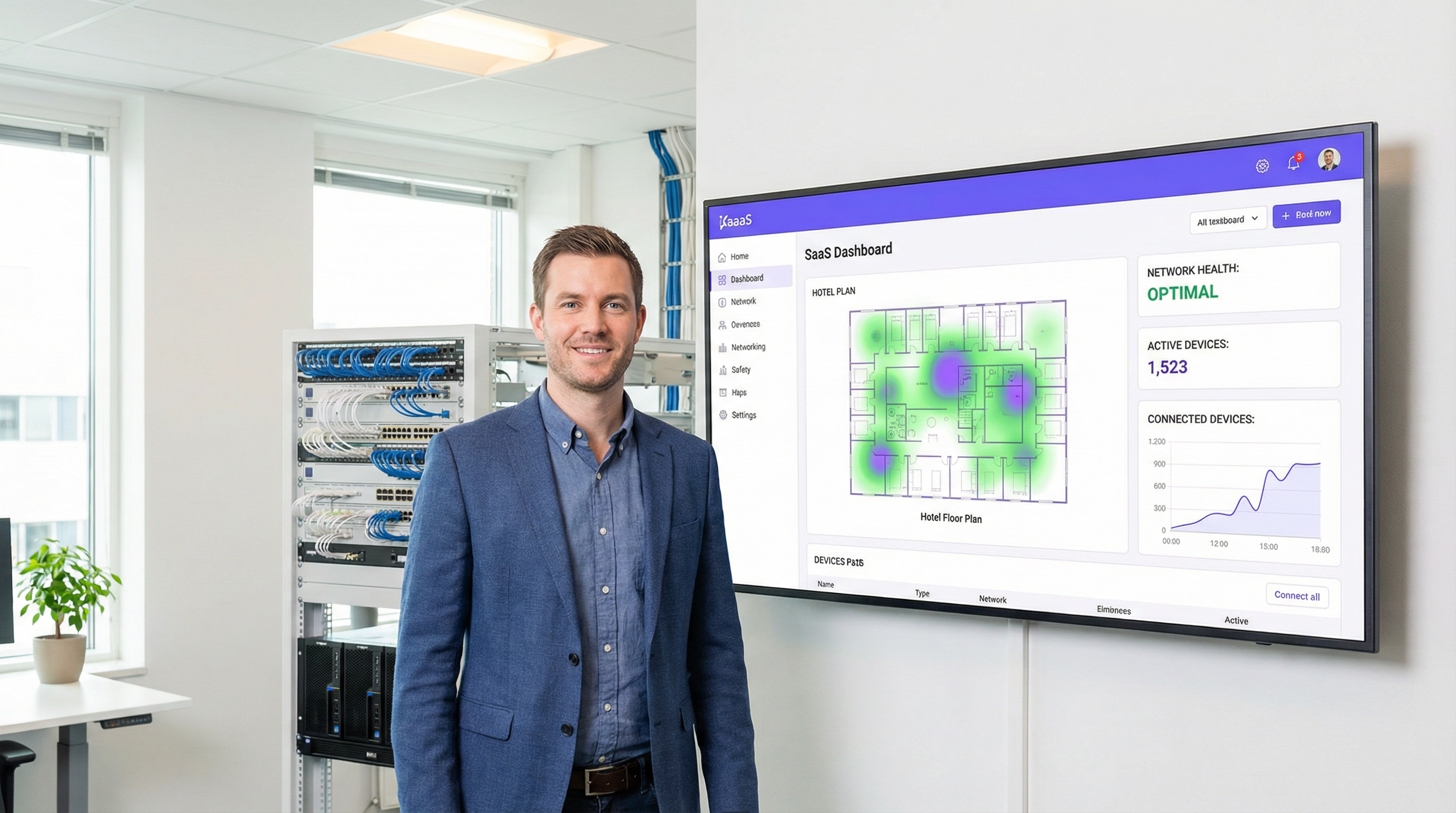
वायरलेस लॅन कंट्रोलर (WLC), किंवा WiFi कंट्रोलर, हा एक केंद्रीकृत नेटवर्क घटक आहे जो एकाच इंटरफेसमधून एकाधिक ॲक्सेस पॉइंट्स (APs) व्यवस्थापित करतो, ज्यामुळे एंटरप्राइझ वायरलेस नेटवर्कवर सातत्यपूर्ण धोरण अंमलबजावणी, सुलभ प्रशासन आणि वर्धित सुरक्षा सुनिश्चित होते. हॉटेल्स, रिटेल चेन्स किंवा स्टेडियम्स यांसारख्या ठिकाणी कनेक्टिव्हिटीवर देखरेख ठेवणाऱ्या आयटी मॅनेजर्स, नेटवर्क आर्किटेक्ट्स आणि CTOs साठी, कंट्रोलर हा या प्रक्रियेचा मेंदू असतो. हे रेडिओ फ्रिक्वेन्सी (RF) व्यवस्थापन, क्लायंट रोमिंग, ऑथेंटिकेशन आणि लोड बॅलेंसिंग यांसारखी महत्त्वपूर्ण कार्ये स्वयंचलित करते — अशी कार्ये जी स्टँडअलोन किंवा 'ऑटोनॉमस' APs सह मोठ्या प्रमाणावर व्यवस्थापित करणे अशक्य आहे.
आज नेतृत्वासमोरील प्राथमिक निर्णय हा कंट्रोलर वापरायचा की नाही हा नसून, कोणते डिप्लॉयमेंट मॉडेल स्वीकारायचे हा आहे: पारंपारिक ऑन-प्रिमाइसेस हार्डवेअर कंट्रोलर की आधुनिक क्लाउड-आधारित सोल्यूशन. ऑन-प्रिमाइसेस कंट्रोलर्स सूक्ष्म नियंत्रण देतात आणि सर्व डेटा प्रोसेसिंग स्थानिक पातळीवर ठेवतात, जी काही विशिष्ट कंप्लायन्स फ्रेमवर्क्सची प्रमुख आवश्यकता असते, परंतु त्यासाठी लक्षणीय भांडवली खर्च (CapEx) आणि विशेष ऑन-साइट तज्ञांची आवश्यकता असते. याउलट, क्लाउड-मॅनेज्ड WiFi व्यवस्थापनाला सबस्क्रिप्शन-आधारित सेवेकडे वळवते, जे उत्कृष्ट स्केलेबिलिटी, मल्टी-साइट डिप्लॉयमेंटसाठी झिरो-टच प्रोव्हिजनिंग आणि कमी ऑपरेशनल ओव्हरहेड ऑफर करते.
Purple एक शक्तिशाली इंटेलिजन्स ओव्हरले म्हणून कार्य करते, जे मूळ नेटवर्क फॅब्रिकमध्ये कोणताही बदल न करता प्रगत गेस्ट WiFi सेवा, ॲनालिटिक्स आणि मार्केटिंग क्षमता प्रदान करण्यासाठी Cisco, Aruba आणि Ruckus सारख्या व्हेंडर्सच्या विद्यमान कंट्रोलर इन्फ्रास्ट्रक्चरसह एकत्रित होते. हे मार्गदर्शक तुम्हाला तुमच्या संस्थेसाठी योग्य धोरण ठरवण्यात मदत करण्यासाठी या आर्किटेक्चर्सची सखोल तांत्रिक माहिती प्रदान करते.
सखोल तांत्रिक माहिती
मुळात, WiFi कंट्रोलर प्रमाणाच्या (स्केलच्या) समस्येचे निराकरण करतो. एकच ॲक्सेस पॉइंट कॉन्फिगर करणे सोपे असते, परंतु दहा, शंभर किंवा हजार APs वैयक्तिकरित्या व्यवस्थापित करणे अशक्य असते. WLC आर्किटेक्चर या व्यवस्थापनाचे केंद्रीकरण करते, आणि एक युनिफाइड, इंटेलिजेंट सिस्टीम तयार करते. हे सामान्यतः कंट्रोल अँड प्रोव्हिजनिंग ऑफ वायरलेस ॲक्सेस पॉइंट्स (CAPWAP) प्रोटोकॉल वापरून साध्य केले जाते, जे RFC 5415 मध्ये परिभाषित केलेले IETF मानक आहे. CAPWAP प्रत्येक AP आणि कंट्रोलर दरम्यान एक सुरक्षित टनेल तयार करते, जे व्यवस्थापन आणि नियंत्रण कार्ये ('कंट्रोल प्लेन') एंड-यूझर डेटा ट्रॅफिकपासून ('डेटा प्लेन') वेगळे करते.
प्रमुख कंट्रोलर कार्ये वायरलेस नेटवर्क व्यवस्थापनाच्या संपूर्ण जीवनचक्राला व्यापतात. केंद्रीकृत AP व्यवस्थापन ही सर्वात मूलभूत भूमिका आहे: कंट्रोलरवरून, ॲडमिनिस्ट्रेटर्स एकाच वेळी सर्व कनेक्ट केलेल्या APs साठी फर्मवेअर अपडेट्स पुश करू शकतात, SSIDs कॉन्फिगर करू शकतात, WPA3-Enterprise सारखी सुरक्षा धोरणे सेट करू शकतात आणि VLANs परिभाषित करू शकतात. डायनॅमिक RF व्यवस्थापन कंट्रोलरला रेडिओ फ्रिक्वेन्सी स्पेक्ट्रमचे सतत निरीक्षण करण्यास अनुमती देते, ज्यामुळे व्यत्यय कमी करण्यासाठी आणि कव्हरेज ऑप्टिमाइझ करण्यासाठी AP चॅनेल असाइनमेंट्स आणि पॉवर लेव्हल्स स्वयंचलितपणे ॲडजस्ट होतात. वापरकर्ते APs दरम्यान फिरत असताना कंट्रोलरद्वारे सुरक्षा की आणि सेशन स्टेट व्यवस्थापित करून सीमलेस क्लायंट रोमिंग सुलभ केले जाते, जे जलद ट्रान्झिशन्ससाठी 802.11k/v/r मानकांचा फायदा घेते. ऑथेंटिकेशन आणि पॉलिसी एन्फोर्समेंट WLC ला मध्यवर्ती गेटकीपर म्हणून कार्य करण्यास अनुमती देते, जे वापरकर्त्याची ओळख आणि डिव्हाइस पोश्चरच्या आधारे नेटवर्क ॲक्सेस देण्यासाठी RADIUS सर्व्हर आणि IEEE 802.1X सह एकत्रित होते, ज्यामुळे मजबूत रोल-बेस्ड ॲक्सेस कंट्रोल सक्षम होते.
ऑन-प्रिमाइसेस वि. क्लाउड-मॅनेज्ड: आर्किटेक्चरल ट्रेड-ऑफ
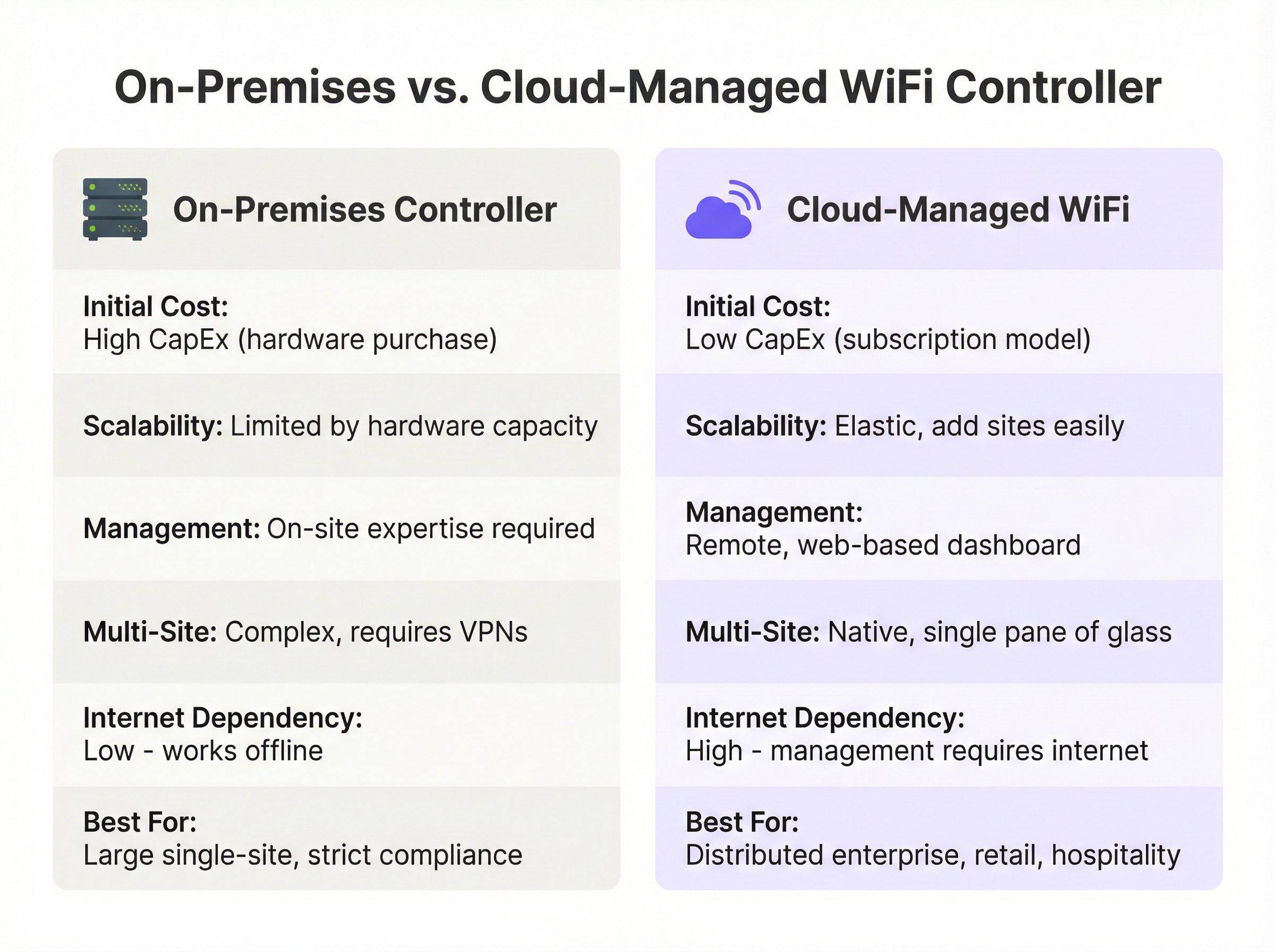
ऑन-प्रिमाइसेस आणि क्लाउड-मॅनेज्ड WLC मधील धोरणात्मक निवडीचे खर्च, स्केलेबिलिटी आणि ऑपरेशन्सवर महत्त्वपूर्ण परिणाम होतात. खालील तक्ता प्रमुख ट्रेड-ऑफ्सचा सारांश देतो.
| वैशिष्ट्य | ऑन-प्रिमाइसेस कंट्रोलर | क्लाउड-मॅनेज्ड WiFi |
|---|---|---|
| डिप्लॉयमेंट मॉडेल | स्थानिक डेटा सेंटरमध्ये फिजिकल किंवा व्हर्च्युअल अप्लायन्स | थर्ड-पार्टी व्हेंडरद्वारे होस्ट केलेले मॅनेजमेंट प्लेन |
| प्रारंभिक खर्च (CapEx) | जास्त — विशिष्ट क्षमता मर्यादांसह हार्डवेअर अप्लायन्सेस | कमी — कोणत्याही ऑन-साइट कंट्रोलर हार्डवेअरची आवश्यकता नाही |
| ऑपरेटिंग खर्च (OpEx) | कमी आवर्ती खर्च, परंतु यामध्ये वीज आणि देखभाल समाविष्ट आहे | वार्षिक सबस्क्रिप्शन लायसन्सद्वारे जास्त आवर्ती खर्च |
| स्केलेबिलिटी | हार्डवेअर क्षमतेनुसार मर्यादित; अपग्रेडसाठी नवीन हार्डवेअर आवश्यक | अत्यंत लवचिक; लायसन्स ॲडजस्टमेंटसह नवीन APs आणि साइट्स जोडल्या जातात |
| मल्टी-साइट व्यवस्थापन | गुंतागुंतीचे; अनेकदा VPNs किंवा समर्पित प्रति-साइट कंट्रोलर्स आवश्यक असतात | सोपे; सिंगल वेब डॅशबोर्ड युनिफाइड ग्लोबल व्ह्यू प्रदान करतो |
| इंटरनेट अवलंबित्व | कमी; इंटरनेट खंडित झाल्यास कोर WiFi सुरू राहते | जास्त; व्यवस्थापन आणि कॉन्फिगरेशनसाठी इंटरनेट आवश्यक |
| कंप्लायन्स आणि डेटा | कठोर डेटा सार्वभौमत्व आवश्यकतांसाठी आदर्श | GDPR आणि PCI DSS कंप्लायन्ससाठी व्हेंडर ड्यु डिलिजन्स आवश्यक |
Purple तुमच्या कंट्रोलरसोबत कसे इंटिग्रेट होते
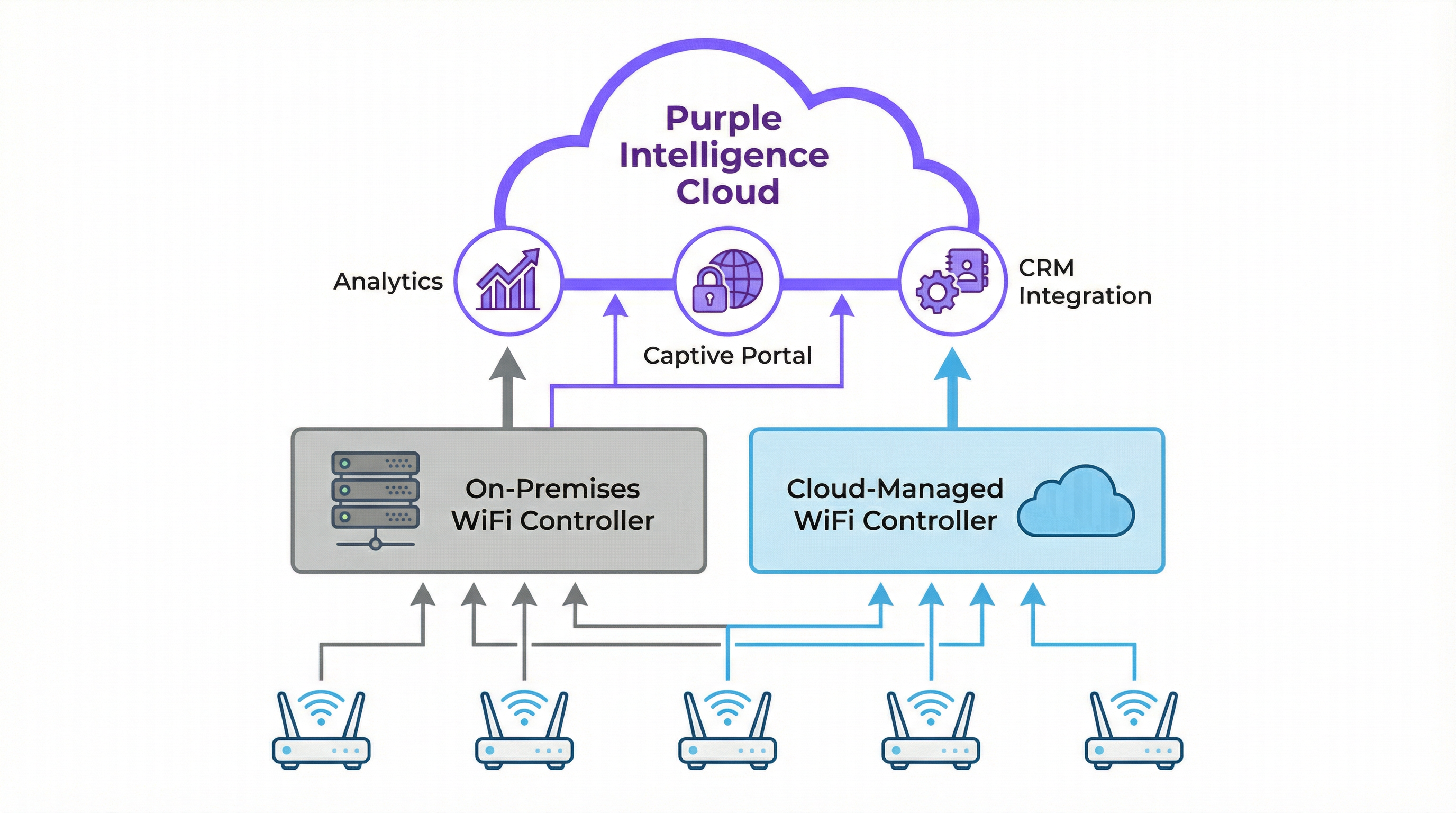
Purple हे एक क्लाउड-आधारित WiFi इंटेलिजन्स प्लॅटफॉर्म आहे जे एक अत्याधुनिक ओव्हरले म्हणून कार्य करते, जे तुमच्या विद्यमान नेटवर्क इन्फ्रास्ट्रक्चरला बदलण्याऐवजी त्याच्या क्षमता वाढवते. हे 200 हून अधिक हार्डवेअर व्हेंडर्सच्या ऑन-प्रिमाइसेस आणि क्लाउड-मॅनेज्ड कंट्रोलर आर्किटेक्चर्स दोन्हीसह अखंडपणे इंटिग्रेट होते.
हे इंटिग्रेशन एका स्पष्ट क्रमाचे अनुसरण करते. प्रथम, सर्व नवीन, अनऑथेंटिकेटेड गेस्ट डिव्हाइसेसना Purple Captive Portal वर रिडायरेक्ट करण्यासाठी WiFi कंट्रोलर कॉन्फिगर केले जाते. त्यानंतर वापरकर्ता सोशल लॉगिन्स, फॉर्म सबमिशन किंवा सीमलेस Passpoint/OpenRoaming प्रोफाइल्स वापरून ब्रँडेड स्प्लॅश पेजद्वारे ऑथेंटिकेट करतो — ही प्रक्रिया GDPR आणि CCPA चे पूर्णपणे पालन करते. यशस्वी ऑथेंटिकेशननंतर, Purple मौल्यवान, ऑप्ट-इन डेमोग्राफिक आणि वर्तणुकीशी संबंधित डेटा कॅप्चर करते, जो ॲनालिटिक्स इंजिनमध्ये फीड होतो आणि तुमच्या CRM सह इंटिग्रेट केला जाऊ शकतो. शेवटी, Purple कंट्रोलरला डिव्हाइसला इंटरनेट ॲक्सेस देण्यासाठी सिग्नल देते, ज्यामध्ये बँडविड्थ मर्यादा, सेशन कालावधी किंवा Purple Shield द्वारे कंटेंट फिल्टरिंग यांसारखी कोणतीही पूर्व-परिभाषित धोरणे लागू केली जातात.
हे मॉडेल संस्थांना मजबूत एंटरप्राइझ-ग्रेड हार्डवेअरमधील त्यांची गुंतवणूक कायम ठेवण्याची अनुमती देते आणि त्याच वेळी शक्तिशाली ॲनालिटिक्स आणि गेस्ट एंगेजमेंट टूल्सची जोड देते जे बिझनेस व्हॅल्यू वाढवतात.
अंमलबजावणी मार्गदर्शक
तुमचे WiFi कंट्रोलर आर्किटेक्चर डिप्लॉय किंवा अपग्रेड करण्यासाठी संरचित दृष्टिकोनाची आवश्यकता असते. हे व्हेंडर-न्यूट्रल मार्गदर्शक यशस्वी अंमलबजावणीसाठी प्रमुख टप्पे स्पष्ट करते.
टप्पा 1: डिस्कव्हरी आणि आवश्यकता संकलन. इमारतीचे साहित्य, वापरकर्त्यांची घनता आणि ॲप्लिकेशन थ्रूपुट आवश्यकता लक्षात घेऊन ॲक्सेस पॉइंट्सची इष्टतम संख्या आणि प्लेसमेंट निश्चित करण्यासाठी फिजिकल किंवा प्रेडिक्टिव RF सर्वेक्षण करा. प्राथमिक युज केसेस दस्तऐवजीकरण करा — गेस्ट ॲक्सेस, अंतर्गत कर्मचारी, पॉइंट-ऑफ-सेल सिस्टीम्स, IoT डिव्हाइसेस — कारण हे सेगमेंटेशन आणि सुरक्षा धोरणे ठरवतील. तुमच्या सध्याच्या नेटवर्क इन्फ्रास्ट्रक्चरची यादी करा आणि रिटेलसाठी PCI DSS आणि EU नागरिकांचा डेटा हाताळण्यासाठी GDPR सह सर्व नियामक आवश्यकता ओळखा.
टप्पा 2: आर्किटेक्चर निवड. ऑन-प्रिमाइसेस आणि क्लाउड-मॅनेज्ड सोल्यूशन्समध्ये निवड करण्यासाठी या मार्गदर्शकातील तुलना तक्ता आणि निर्णय-प्रवाह आकृती वापरा. रिटेल, हॉस्पिटॅलिटी आणि तत्सम क्षेत्रांतील बहुतांश मल्टी-साइट व्यवसायांसाठी, क्लाउड-मॅनेज्ड आर्किटेक्चरची ऑपरेशनल कार्यक्षमता आणि स्केलेबिलिटी एक आकर्षक बिझनेस केस सादर करते.
टप्पा 3: डिप्लॉयमेंट आणि कॉन्फिगरेशन. प्रत्येक युझर ग्रुपसाठी (गेस्ट, कर्मचारी, कॉर्पोरेट, IoT) स्वतंत्र VLANs कॉन्फिगर करा — हा एक महत्त्वपूर्ण सुरक्षा उपाय आहे. क्लाउड-मॅनेज्ड सिस्टीम्ससाठी, झिरो-टच प्रोव्हिजनिंग सक्षम करण्यासाठी डॅशबोर्डमध्ये APs ची पूर्व-नोंदणी करा. सर्व सुरक्षित नेटवर्क्ससाठी IEEE 802.1X सह WPA3-Enterprise लागू करा. गेस्ट नेटवर्कसाठी, क्लायंट आयसोलेशन सक्षम करून एक ओपन SSID कॉन्फिगर करा, ज्यामुळे सर्व ट्रॅफिक Purple Captive Portal द्वारे जाण्यास भाग पडेल. तुमच्या कंट्रोलर सेटिंग्जमध्ये बाह्य ऑथेंटिकेशन स्रोत म्हणून Purple Captive Portal URL कॉन्फिगर करा आणि तुमच्या प्री-ऑथेंटिकेशन ॲक्सेस कंट्रोल लिस्टमध्ये आवश्यक IP पत्ते जोडा.
टप्पा 4: चाचणी आणि प्रमाणीकरण. कव्हरेज सत्यापित करण्यासाठी डिप्लॉयमेंट-नंतरचे RF सर्वेक्षण करा. प्रत्येक युझर ग्रुपसाठी ऑनबोर्डिंग प्रक्रियेची चाचणी घ्या. नेटवर्क परफॉर्मन्स बेंचमार्क्स पूर्ण करत असल्याची खात्री करण्यासाठी iPerf सारख्या टूल्सचा वापर करून थ्रूपुट चाचण्या करा.
सर्वोत्तम पद्धती
नेटवर्क सेगमेंटेशनद्वारे सुरक्षेला प्राधान्य देणे अत्यंत आवश्यक आहे. गेस्ट ट्रॅफिकने कॉर्पोरेट किंवा PCI-कंप्लायंट ट्रॅफिकसोबत कधीही VLAN शेअर करू नये. गेस्ट नेटवर्क्सवर क्लायंट आयसोलेशन सक्षम करणे हे एक महत्त्वपूर्ण WLC वैशिष्ट्य आहे जे वायरलेस क्लायंट्सना एकमेकांशी संवाद साधण्यापासून प्रतिबंधित करते, ज्यामुळे पीअर-टू-पीअर हल्ल्याचे धोके कमी होतात. WLC च्या संयोगाने RADIUS सर्व्हरसह ऑथेंटिकेशन केंद्रीकृत केल्याने वापरकर्ते आणि धोरणांचा एकच, ऑडिट करण्यायोग्य डेटाबेस मिळतो. कंट्रोलर आणि APs या दोन्हींसाठी नियमित फर्मवेअर अपडेट्स आवश्यक आहेत, कारण ही महत्त्वपूर्ण सुरक्षा मालमत्ता आहेत. क्लाउड-मॅनेज्ड सोल्यूशन्स सामान्यतः ही प्रक्रिया स्वयंचलित करतात, जो एक महत्त्वपूर्ण ऑपरेशनल फायदा आहे. शेवटी, कंट्रोलरचा डॅशबोर्ड आणि Purple च्या ॲनालिटिक्सद्वारे सतत निरीक्षण केल्याने IT टीम्सना वापरकर्त्यांवर परिणाम होण्यापूर्वीच परफॉर्मन्स समस्या, रोग (rogue) APs आणि सुरक्षा विसंगती सक्रियपणे ओळखता येतात.
ट्रबलशूटिंग आणि जोखीम निवारण
जेव्हा क्लायंट्स कनेक्ट होऊ शकत नाहीत, तेव्हा पहिली डायग्नोस्टिक पायरी म्हणजे ऑथेंटिकेशन त्रुटींसाठी कंट्रोलर तपासणे: RADIUS सर्व्हर पोहोचण्यायोग्य आहे का, क्लायंट क्रेडेंशियल्स योग्य आहेत का आणि कंट्रोलरच्या प्री-ऑथेंटिकेशन ACLs मध्ये Purple पोर्टल IP पत्ते योग्यरित्या व्हाइटलिस्ट केलेले आहेत का याची पडताळणी करा. खराब वायरलेस परफॉर्मन्स सामान्यतः RF व्यत्यय किंवा ओव्हरलोडेड चॅनेल्स दर्शवतो, ज्याचे निदान कंट्रोलरच्या RF मॅनेजमेंट डॅशबोर्डद्वारे केले जाऊ शकते. उच्च-घनतेच्या क्षेत्रांमध्ये अतिरिक्त APs किंवा चॅनेल असाइनमेंट्सच्या पुनर्मूल्यांकनाची आवश्यकता असू शकते.
ऑन-प्रिमाइसेस डिप्लॉयमेंट्ससाठी, प्राथमिक जोखीम कंट्रोलर हार्डवेअर निकामी होण्याची असते. कंट्रोलर्सना हाय-अव्हेलेबिलिटी (HA) पेअरमध्ये — ॲक्टिव्ह/स्टँडबाय कॉन्फिगरेशन — डिप्लॉय करून आणि कंट्रोलर कॉन्फिगरेशनचे नियमित बॅकअप ठेवून हे कमी केले जाते. क्लाउड-मॅनेज्ड नेटवर्क्ससाठी, इंटरनेट कनेक्टिव्हिटी गमावण्याची जोखीम असते. आउटेज दरम्यान स्थानिक नेटवर्क ॲक्सेस प्रदान करणे सुरू ठेवण्यासाठी APs कॉन्फिगर केले जावेत आणि महत्त्वपूर्ण ऑपरेशनल सेवा क्लाउड मॅनेजमेंट लिंकवर अवलंबून नसाव्यात.
ROI आणि व्यावसायिक प्रभाव
योग्यरित्या आर्किटेक्ट केलेले वायरलेस नेटवर्क हे कॉस्ट सेंटर नाही; ते एक बिझनेस इनेबलर आहे. ROI केवळ साधे इंटरनेट कनेक्शन प्रदान करण्यापलीकडे खूप दूरवर विस्तारतो. केंद्रीकृत व्यवस्थापन IT ओव्हरहेड लक्षणीयरीत्या कमी करते, जसे की McDonald's द्वारे दर्शविले गेले आहे, जिथे Purple च्या ॲनालिटिक्स आणि रिमोट मॅनेजमेंट क्षमतांमुळे IT इंजिनिअरच्या साइट भेटींमध्ये 90% घट झाली, ज्यामध्ये प्रति रेस्टॉरंट दरवर्षी 4 दशलक्ष WiFi लॉगिन्स आणि CRM मध्ये 2.5 दशलक्ष युनिक वापरकर्ते कॅप्चर केले गेले.
जलद, विश्वासार्ह आणि सहज ॲक्सेस करता येणारे WiFi आता हॉस्पिटॅलिटी आणि रिटेलमधील मूलभूत अपेक्षा आहे. कंट्रोलर-मॅनेज्ड रोमिंग आणि Purple पोर्टलद्वारे सोप्या ऑनबोर्डिंगमुळे सुलभ झालेला सीमलेस अनुभव थेट ग्राहकांचे समाधान आणि निष्ठेवर परिणाम करतो. Purple इंटिग्रेट करून, WiFi नेटवर्क फर्स्ट-पार्टी डेटाच्या समृद्ध स्रोतामध्ये रूपांतरित होते, ज्यामुळे व्हेन्यू ऑपरेटर्सना फूटफॉल, ड्वेल टाइम्स आणि अभ्यागतांची वारंवारता मोजता येते. हा डेटा एक मूर्त ROI प्रदान करतो, ज्यामध्ये Purple ग्राहकांना सरासरी 873% ROI मिळतो. कॉन्फरन्स सेंटर्स किंवा हॉटेल्स सारख्या ठिकाणांसाठी, प्रीमियम टायर्ड WiFi ॲक्सेस हा देखील थेट महसुलाचा स्रोत बनू शकतो, जो कंट्रोलर आणि Purple प्लॅटफॉर्मद्वारे सहजपणे व्यवस्थापित आणि स्वयंचलित केला जाऊ शकतो.
Key Terms & Definitions
Wireless LAN Controller (WLC)
A centralized network appliance or cloud service that configures, manages, and monitors wireless access points at scale, handling functions such as RF management, roaming, authentication, and security policy enforcement.
This is the core component for any enterprise-grade WiFi deployment. IT teams use the WLC to avoid having to configure hundreds of APs individually and to ensure a consistent, secure experience across the entire network.
Access Point (AP)
A hardware device that creates a wireless local area network (WLAN) by transmitting and receiving radio signals. In a controller-based architecture, APs are 'lightweight' devices whose intelligence is provided by the central WLC.
These are the physical devices installed in ceilings and walls throughout a venue. In enterprise settings, they are often referred to as 'thin' or 'lightweight' APs because the controller provides their configuration and management logic.
Cloud-Managed WiFi
An architecture where the WLC functionality is hosted in the cloud as a subscription service, allowing for centralized management of geographically distributed APs via a web-based dashboard without any on-site controller hardware.
This is the dominant model for retail, hospitality, and distributed enterprises due to its scalability and operational simplicity. Purple is a cloud-native platform that integrates perfectly with this model.
CAPWAP (Control and Provisioning of Wireless Access Points)
An IETF standard protocol (RFC 5415) that enables a WLC to manage a collection of access points by establishing a secure, encrypted tunnel for control traffic and, optionally, data traffic.
This is the technical underpinning of how controllers and APs communicate. Understanding CAPWAP is essential for troubleshooting connectivity issues between the controller and its managed APs, particularly in complex network topologies.
IEEE 802.1X
An IEEE standard for port-based Network Access Control (PNAC) that provides an authentication framework requiring devices to present valid credentials before being granted access to a LAN or WLAN.
This is the gold standard for securing corporate wireless networks. It requires users to authenticate with unique credentials before being granted access, managed by the WLC in conjunction with a RADIUS server. It is a key requirement for PCI DSS and ISO 27001 compliance.
Captive Portal
A web page displayed to newly connected users of a WiFi network before they are granted broader internet access, typically used for authentication, terms-of-service acceptance, or data capture.
This is Purple's core entry point for guest users. The WLC is configured to redirect all unauthenticated guest devices to the Purple captive portal, which then handles the entire user onboarding journey, from authentication to data capture.
Network Segmentation
The practice of dividing a computer network into distinct subnetworks (VLANs) to improve security, performance, and compliance by preventing unauthorized traffic between segments.
This is a non-negotiable best practice enforced via the WLC. Separating guest traffic from corporate and POS systems is a fundamental security requirement and a compliance obligation under PCI DSS for any organization processing card payments.
PCI DSS (Payment Card Industry Data Security Standard)
A set of security standards mandating that all companies that accept, process, store, or transmit credit card information maintain a secure environment, including strict network segmentation requirements.
For any retail or hospitality client, the WLC and network architecture must be configured to meet PCI DSS requirements. Failure to comply can result in significant fines and the revocation of the ability to process card payments.
Case Studies
A 250-room luxury hotel needs to upgrade its legacy WiFi network to provide seamless, high-performance coverage for guests and staff while enabling marketing to capture guest data for loyalty programs. The hotel has a central server room and a dedicated IT team.
1. Architecture Choice: A hybrid approach is recommended. Deploy on-premises controllers in a high-availability (HA) pair to manage all on-site access points. This ensures maximum performance and resilience for in-room streaming and staff operational systems. 2. Network Segmentation: Create distinct VLANs and SSIDs: 'HotelGuest' (open, with captive portal), 'Staff_Secure' (WPA3-Enterprise with 802.1X), and 'POS_Systems' (WPA3-Enterprise, highly restricted, firewalled from guest VLAN). 3. Purple Integration: Configure the controllers to redirect the 'HotelGuest' SSID to the Purple cloud-based captive portal. The portal handles guest authentication via room number and last name, or social login, and captures opt-in marketing consent. 4. Policy Enforcement: The controller enforces a bandwidth limit of 25 Mbps per guest device, while the Purple platform manages session duration and feeds data directly into the hotel's Salesforce CRM, enabling targeted loyalty campaigns.
A retail chain with 80 stores across the country wants to standardize its in-store guest WiFi experience, centrally manage all networks, and use WiFi analytics to understand customer footfall patterns. Each store has limited on-site technical staff.
1. Architecture Choice: A fully cloud-managed WiFi solution is the clear choice. Equip each store with cloud-managed access points from a single vendor. There is no need for an on-premises controller in any store. 2. Zero-Touch Provisioning: APs are pre-configured in the central cloud dashboard and shipped to each store. The local store manager simply plugs them in — the AP automatically downloads its configuration. 3. Centralized Management: From corporate headquarters, the IT team uses a single web dashboard to monitor all 80 stores, push configuration updates, and manage security policies simultaneously. 4. Purple Integration: The cloud controller is configured globally to use Purple for guest authentication across all stores, ensuring a consistent branded experience. Purple's analytics dashboard provides footfall, dwell time, and loyalty metrics for every store, enabling direct comparison of performance across the estate.
Scenario Analysis
Q1. A large conference center is preparing for a major tech summit expecting 10,000 concurrent users, all requiring high-throughput video streaming. They have a large, expert IT team on-site and a dedicated server room. Which controller architecture should they primarily rely on and why?
💡 Hint:Consider the requirements for latency, throughput, and the value of on-site expertise in a single-location, high-density scenario.
Show Recommended Approach
They should deploy a high-capacity, on-premises controller cluster in a high-availability (active/standby) configuration. For a high-density, single-site event, minimizing latency and maximizing throughput is critical. Routing all traffic through a powerful on-site controller avoids the latency of cloud-based data paths and provides the advanced RF management needed to handle 10,000 concurrent users. The presence of an expert on-site IT team mitigates the management overhead of an on-premises solution. Purple would be integrated as an overlay for guest authentication and analytics.
Q2. A fast-growing coffee shop chain plans to expand from 10 to 50 locations in the next year. They want to offer a consistent, branded guest WiFi experience at all stores and use the data for marketing campaigns. Their corporate IT team consists of just two people. What is the single most critical feature they should look for in a WiFi solution?
💡 Hint:Think about the operational challenge of deploying and managing 50 separate locations with a two-person IT team.
Show Recommended Approach
The most critical feature is zero-touch provisioning via a cloud-based management dashboard. This will allow their small IT team to pre-configure access points in the cloud dashboard and ship them to new stores. The local store manager simply plugs in the AP, and it automatically downloads its configuration — no specialist IT visit required. A cloud architecture is essential for them to scale rapidly and manage all 50 locations from a single interface, ensuring a consistent guest experience and centralized data collection via Purple.
Q3. A hospital needs to provide guest WiFi for patients and visitors while ensuring that patient health records, stored on a separate internal clinical network, remain completely isolated and secure. How should the IT team use a WLC to achieve this, and what specific configuration steps are required?
💡 Hint:Focus on the security and traffic separation capabilities of the WLC, and consider both the technical and compliance dimensions.
Show Recommended Approach
The IT team must use the WLC to implement strict network segmentation. The specific steps are: (1) Create a dedicated 'Guest' SSID on a separate VLAN (e.g., VLAN 100) that is completely firewalled from all internal clinical VLANs. (2) Configure an Access Control List (ACL) on the controller that explicitly denies any traffic originating from VLAN 100 from reaching the internal network segments. (3) Enable 'client isolation' on the guest SSID to prevent guest devices from communicating with each other. (4) Configure the guest SSID to redirect unauthenticated clients to the Purple captive portal for terms-of-service acceptance. This architecture ensures compliance with healthcare data regulations and protects patient data from both external and internal threats.
Key Takeaways
- ✓A WiFi Controller (WLC) centralizes the management of multiple access points, providing the consistency, security, and scalability that enterprise wireless networks demand.
- ✓The primary architectural choice is between on-premises controllers (high control, high CapEx, ideal for single-site or strict compliance environments) and cloud-managed controllers (high scalability, subscription-based, ideal for distributed enterprises).
- ✓Cloud-managed WiFi is the dominant choice for distributed enterprises in retail and hospitality due to zero-touch provisioning, single-pane-of-glass management, and elastic scalability.
- ✓Purple is a cloud-based intelligence platform that acts as an overlay on existing WiFi infrastructure — it does not replace the controller, but enhances it with guest authentication, analytics, and CRM integration.
- ✓Security is non-negotiable: use the WLC to enforce network segmentation (separate VLANs for guests, staff, and POS), enable client isolation on guest networks, and implement WPA3-Enterprise with IEEE 802.1X for secure access.
- ✓The ROI of a modern WiFi architecture is driven by operational efficiency, enhanced customer experience, and the business intelligence derived from WiFi analytics — Purple customers see an average ROI of 873%.
- ✓The core framework: your controller manages the APs; a platform like Purple manages the users — turning connectivity from a cost centre into a source of measurable business value.




