

WiFi रोमिंग आणि हँडऑफ: 802.11r आणि 802.11k स्पष्टीकरण
This guide provides a senior-level technical deep-dive into WiFi roaming protocols — specifically 802.11r (Fast BSS Transition), 802.11k (Neighbor Reports), and 802.11v (BSS Transition Management) — and their combined role in delivering seamless connectivity across enterprise venues. It equips IT managers, network architects, and venue operations directors with the architectural understanding, implementation steps, and business-impact metrics needed to deploy and validate fast roaming in hospitality, retail, events, and public-sector environments. The guide also addresses the critical interaction between roaming and captive portals, a common deployment failure point in guest WiFi networks.
🎧 Listen to this Guide
View Transcript

कार्यकारी सारांश
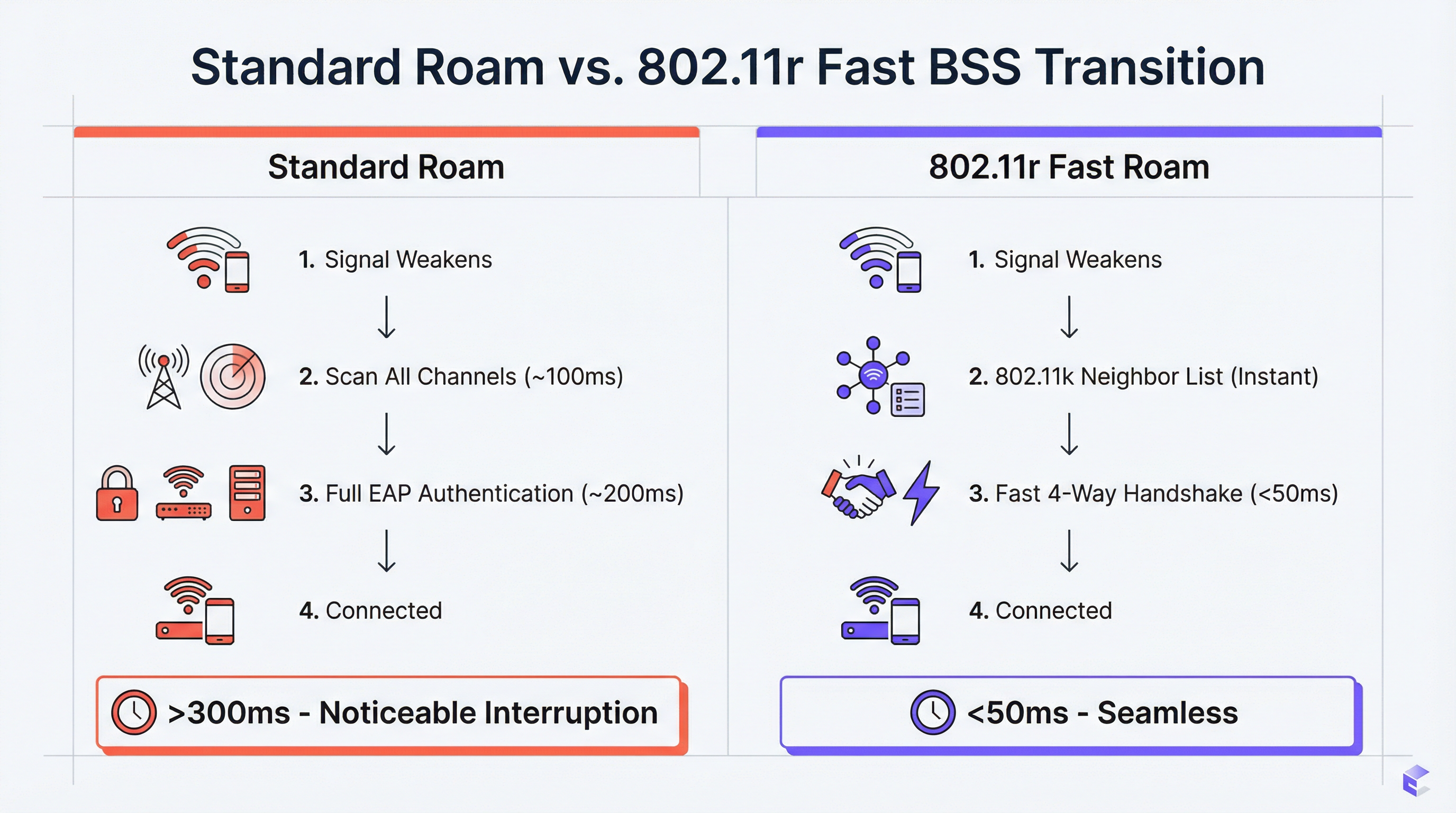
एंटरप्राइझ ठिकाणांसाठी — हॉटेल्स, रिटेल चेन्स, स्टेडियम्स, कॉन्फरन्स सेंटर्स — अखंड WiFi ही एक मुख्य ऑपरेशनल आवश्यकता आहे. जेव्हा वापरकर्ते एखाद्या भौतिक जागेत फिरतात, तेव्हा त्यांच्या उपकरणांनी कनेक्शन न गमावता अॅक्सेस पॉइंट्स (APs) दरम्यान स्विच केले पाहिजे. खराब रोमिंग कामगिरीमुळे VoIP कॉल्स ड्रॉप होतात, व्हिडिओ स्ट्रीम्स थांबतात आणि वापरकर्ते निराश होतात, ज्याचा थेट परिणाम अतिथी समाधान स्कोअर आणि कर्मचारी उत्पादकता मेट्रिक्सवर होतो. यावरील उपाय तीन पूरक IEEE 802.11 सुधारणांमध्ये आहे: 802.11k, 802.11v, आणि 802.11r. एकत्रितपणे, ते एक रोमिंग असिस्टन्स फ्रेमवर्क तयार करतात जे क्लायंट उपकरणांना जलद, अधिक हुशार हँडऑफ निर्णय घेण्याची बुद्धिमत्ता देते आणि नेटवर्कला त्या निर्णयांना सक्रियपणे मार्गदर्शन करण्यासाठी साधने देते. 802.11k संभाव्य APs ची एक क्युरेटेड सूची प्रदान करते, ज्यामुळे वेळखाऊ चॅनेल स्कॅन्सची आवश्यकता दूर होते. 802.11r (फास्ट BSS ट्रान्झिशन) री-ऑथेंटिकेशन हँडशेक 200-300 ms वरून 50 ms च्या खाली संकुचित करते. 802.11v नेटवर्कला लोड-बॅलेंसिंगच्या उद्देशाने क्लायंट्सना सक्रियपणे वळवण्यास सक्षम करते. योग्यरित्या आर्किटेक्ट केलेल्या गेस्ट WiFi प्लॅटफॉर्मसह — या मानकांची योग्य अंमलबजावणी करणे — हा आधुनिक एंटरप्राइझ वातावरणास आवश्यक असलेल्या मोबाइल, उच्च-कार्यक्षमता वायरलेस अनुभवाचा निश्चित मार्ग आहे.
तांत्रिक सखोल माहिती
आव्हान: संथ रोमिंग आणि स्टिकी क्लायंटची समस्या
रोमिंग असिस्टन्स नसलेल्या स्टँडर्ड WiFi डिप्लॉयमेंटमध्ये, कधी रोम करायचे हे ठरवण्यासाठी केवळ क्लायंट उपकरण जबाबदार असते. याचा सामान्य परिणाम असा होतो की उपकरणे त्यांच्या सध्याच्या AP ला इष्टतम वेळेपेक्षा जास्त काळ धरून ठेवतात, अगदी जवळच्या AP कडून लक्षणीयरीत्या मजबूत सिग्नल उपलब्ध असतानाही. ही स्टिकी क्लायंट समस्या आहे, आणि ती एंटरप्राइझ वातावरणात स्थानिक आहे जिथे उपकरणांचे विविध प्रकार — स्मार्टफोन्स, लॅपटॉप्स, IoT सेन्सर्स, हँडहेल्ड स्कॅनर्स — प्रत्येकजण वेगवेगळ्या स्तरांच्या अत्याधुनिकतेसह त्यांचे स्वतःचे रोमिंग अल्गोरिदम लागू करतात.
जेव्हा क्लायंट शेवटी रोम करण्याचा निर्णय घेतो, तेव्हा त्याला नवीन AP सोबत पूर्ण री-ऑथेंटिकेशन सायकल पूर्ण करावी लागते. WPA2-Enterprise किंवा WPA3-Enterprise नेटवर्कमध्ये, यामध्ये क्लायंट, AP आणि बॅक-एंड RADIUS सर्व्हर दरम्यान अनेक EAP (Extensible Authentication Protocol) राउंड ट्रिप्सचा समावेश असतो. या प्रक्रियेस 200-400 मिलिसेकंद लागू शकतात. रिअल-टाइम अॅप्लिकेशन्ससाठी — VoIP, व्हिडिओ कॉन्फरन्सिंग, मोबाइल पॉइंट-ऑफ-सेल — ही लेटन्सी अस्वीकार्य आहे. याचा परिणाम म्हणजे ड्रॉप झालेले कॉल्स, गोठलेल्या व्हिडिओ फ्रेम्स आणि अयशस्वी व्यवहार.
802.11k: रेडिओ रिसोर्स मॅनेजमेंट आणि नेबर रिपोर्ट्स
802.11k सुधारणा रेडिओ रिसोर्स मॅनेजमेंट (RRM) सादर करते, एक फ्रेमवर्क जे APs आणि क्लायंट्सना RF वातावरणाबद्दल माहितीची देवाणघेवाण करण्यास अनुमती देते. सर्वात ऑपरेशनल महत्त्वपूर्ण वैशिष्ट्य म्हणजे नेबर रिपोर्ट. 802.11k-सक्षम AP क्लायंटच्या विनंतीला शेजारील APs च्या संरचित सूचीसह प्रतिसाद देऊ शकतो, ज्यामध्ये त्यांचे BSSIDs, ऑपरेटिंग चॅनेल्स आणि सिग्नल वैशिष्ट्ये समाविष्ट असतात. यामुळे क्लायंटला सर्व उपलब्ध चॅनेल्सवर पॅसिव्ह किंवा अॅक्टिव्ह स्कॅन करण्याची आवश्यकता दूर होते — ही प्रक्रिया स्वतःच मल्टी-बँड नेटवर्कवर 100 ms किंवा त्याहून अधिक वेळ घेऊ शकते.
याचा व्यावहारिक परिणाम असा होतो की AP च्या कव्हरेज झोनच्या काठावर पोहोचणाऱ्या क्लायंटकडे रोम करण्यापूर्वीच हँडऑफ उमेदवारांची रँक केलेली सूची असते. हा निर्णय संथ, अंध शोधाद्वारे न घेता पूर्ण माहितीसह घेतला जातो.
802.11r: फास्ट BSS ट्रान्झिशन (FT)
802.11r हा फास्ट रोमिंगचा आधारस्तंभ आहे. याचा प्राथमिक शोध म्हणजे परिभाषित मोबिलिटी डोमेन मधील APs मध्ये की मटेरियलचे पूर्व-वितरण. जेव्हा एखादा क्लायंट प्रथम 802.11r-सक्षम नेटवर्कवर ऑथेंटिकेट करतो, तेव्हा तो स्टँडर्ड EAP प्रक्रियेद्वारे पेअरवाइज मास्टर की (PMK) स्थापित करतो. FT सक्षम केल्यावर, या की चे डेरिव्हेटिव्ह — PMK-R1 — कंट्रोलर किंवा डिस्ट्रिब्युशन सिस्टीमद्वारे मोबिलिटी डोमेनमधील सर्व APs ला पूर्व-वितरित केले जाते.
जेव्हा क्लायंट नवीन AP वर रोम करतो, तेव्हा पूर्ण EAP एक्सचेंज सुरू करण्याऐवजी, तो प्री-शेअर्ड PMK-R1 वापरून संकुचित 4-वे हँडशेक करतो. यामुळे हँडऑफ ऑथेंटिकेशनची वेळ 50 मिलिसेकंदांच्या खाली कमी होते — हा एक महत्त्वपूर्ण थ्रेशोल्ड आहे ज्याच्या खाली व्हॉइस किंवा व्हिडिओ सत्रादरम्यान एंड युझरला रोम जाणवत नाही.
802.11r दोन ऑपरेशनल मोड्सना सपोर्ट करते. FT ओव्हर-द-एअर मध्ये हँडऑफ दरम्यान क्लायंट थेट लक्ष्यित AP शी संवाद साधतो, जो सोपा आणि बहुतांश डिप्लॉयमेंट्ससाठी शिफारस केलेला दृष्टिकोन आहे. FT ओव्हर-द-DS (डिस्ट्रिब्युशन सिस्टीम) सध्याच्या AP द्वारे वायर्ड नेटवर्कमधून FT फ्रेम्स राउट करते, जे विशिष्ट कंट्रोलर आर्किटेक्चरमध्ये उपयुक्त ठरू शकते परंतु गुंतागुंत वाढवते.
802.11v: BSS ट्रान्झिशन मॅनेजमेंट
जिथे 802.11k रिअॅक्टिव्ह आहे (क्लायंट विचारतो तेव्हा माहिती प्रदान करणे) आणि 802.11r ट्रान्झॅक्शनल आहे (हँडऑफला गती देणे), तिथे 802.11v प्रोअॅक्टिव्ह आहे. हे नेटवर्कला क्लायंट उपकरणांना BSS ट्रान्झिशन मॅनेजमेंट रिक्वेस्ट्स पाठविण्याची अनुमती देते, त्यांना विशिष्ट AP वर रोम करण्याचे सुचवते किंवा निर्देशित करते. लोड बॅलेंसिंगसाठी हे नेटवर्कचे प्राथमिक साधन आहे. जर एखादा AP क्षमतेच्या जवळ पोहोचत असेल, तर कंट्रोलर जवळच्या, कमी लोड असलेल्या AP कडे मजबूत सिग्नल असलेल्या कनेक्टेड क्लायंट्सना ओळखू शकतो आणि त्यांना ट्रान्झिशन रिक्वेस्ट पाठवू शकतो. क्लायंटने याचे पालन करणे बंधनकारक नाही, परंतु चांगल्या प्रकारे लागू केलेले क्लायंट्स (आधुनिक iOS, Android आणि Windows उपकरणे) सामान्यतः या विनंतीचा आदर करतील.
ही प्रोअॅक्टिव्ह स्टिअरिंग क्षमता नेटवर्कला पॅसिव्ह इन्फ्रास्ट्रक्चरमधून संपूर्ण ठिकाणामधील वापरकर्त्याचा अनुभव ऑप्टिमाइझ करण्यासाठी सक्रिय सहभागीमध्ये रूपांतरित करते.
Captive Portal रोमिंगशी कसा संवाद साधतात
गेस्ट WiFi डिप्लॉयमेंट्समधील एक गंभीर आणि वारंवार दुर्लक्षित केलेला अपयशाचा मुद्दा म्हणजे रोमिंग आणि Captive Portal ऑथेंटिकेशनमधील संवाद. जर एखाद्या अतिथीने AP1 वरील Captive Portal द्वारे ऑथेंटिकेट केले आणि नंतर AP2 वर रोम केले, तर एक सामान्य अंमलबजावणी पुन्हा Captive Portal सादर करेल, ज्यामुळे री-ऑथेंटिकेशनची सक्ती होईल. हे एक मूलभूत UX अपयश आहे.
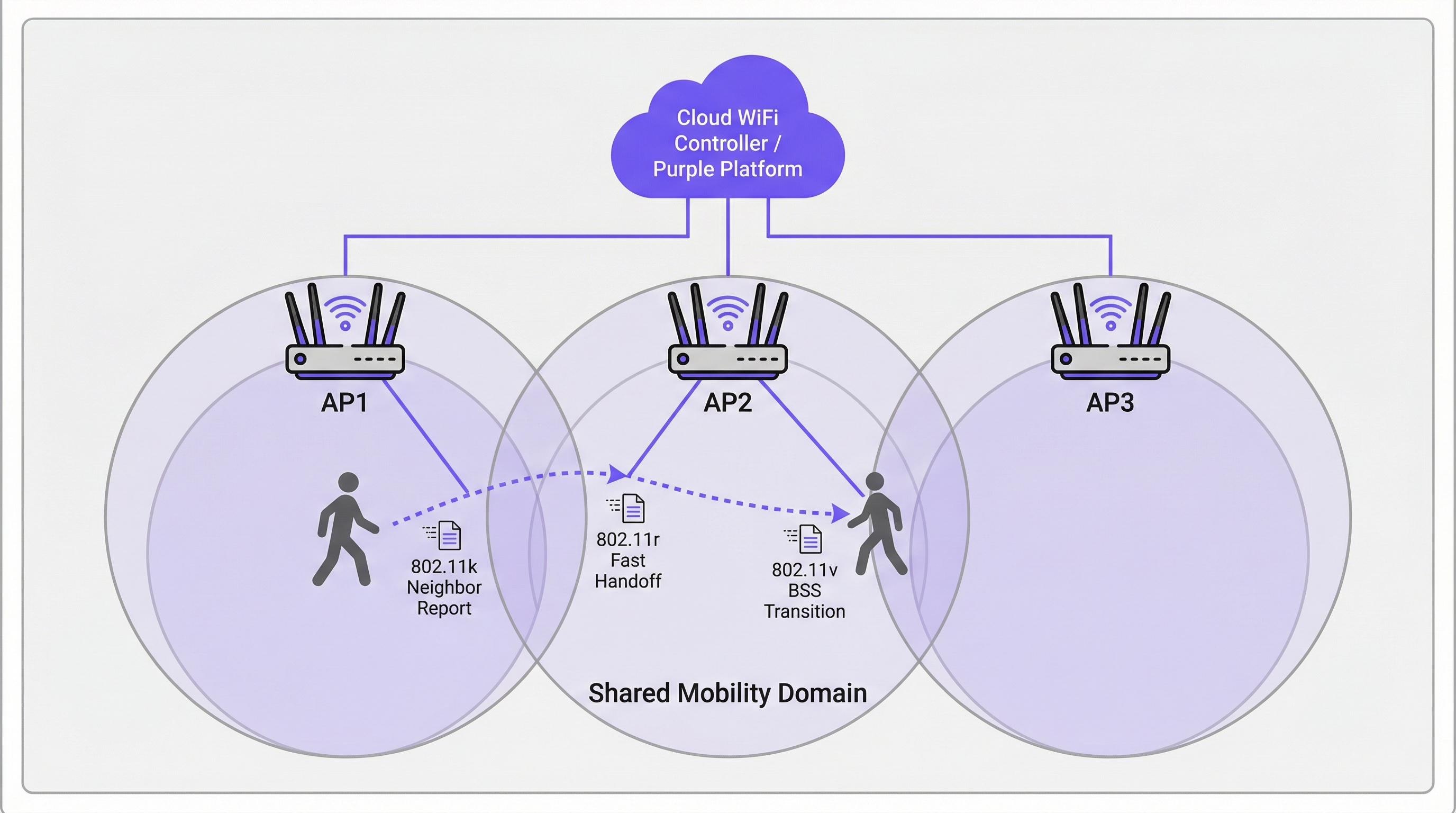
योग्य आर्किटेक्चरल दृष्टिकोन म्हणजे गेस्ट WiFi प्लॅटफॉर्मवर (जसे की Purple) सेशन स्टेट मॅनेजमेंट केंद्रीकृत करणे. एकदा वापरकर्त्याने ऑथेंटिकेट केले की, त्यांचा MAC अॅड्रेस आणि सेशन टोकन मध्यवर्ती ठिकाणी साठवले जातात. जेव्हा ते रोम करतात, तेव्हा नवीन AP मध्यवर्ती प्लॅटफॉर्मला क्वेरी करतो, जो सक्रिय सत्राची पुष्टी करतो आणि आपोआप Captive Portal बायपास करतो. यासाठी गेस्ट WiFi प्लॅटफॉर्म वायरलेस इन्फ्रास्ट्रक्चरशी घट्टपणे इंटिग्रेट असणे आवश्यक आहे — व्हेंडर सोल्यूशन्सचे मूल्यांकन करताना हा एक महत्त्वाचा विचार आहे.
अंमलबजावणी मार्गदर्शक
खालील पायऱ्या कोणत्याही एंटरप्राइझ-ग्रेड वायरलेस इन्फ्रास्ट्रक्चरला लागू होणाऱ्या व्हेंडर-न्यूट्रल डिप्लॉयमेंट फ्रेमवर्कचे प्रतिनिधित्व करतात.
पायरी 1 — हार्डवेअर आणि सॉफ्टवेअर ऑडिट. तुमचे APs, वायरलेस LAN कंट्रोलर (WLC) किंवा क्लाउड मॅनेजमेंट प्लॅटफॉर्म आणि लक्ष्यित क्लायंट उपकरणे हे सर्व 802.11k, 802.11v आणि 802.11r ला सपोर्ट करतात याची पडताळणी करा. आधुनिक एंटरप्राइझ हार्डवेअरवर (Cisco Catalyst, Aruba, Juniper Mist, Ruckus) AP आणि कंट्रोलर सपोर्ट जवळजवळ युनिव्हर्सल आहे. क्लायंट सपोर्ट बदलतो — विशेषतः बारकोड स्कॅनर्स, वैद्यकीय उपकरणे किंवा IoT सेन्सर्स सारख्या विशेष हार्डवेअरसाठी, डिव्हाइस स्पेसिफिकेशन शीट्स तपासा.
पायरी 2 — लक्ष्यित SSID वर मानके सक्षम करा. तुमच्या WLC किंवा क्लाउड डॅशबोर्डमध्ये, SSID कॉन्फिगरेशनवर जा आणि 802.11k (नेबर रिपोर्ट्स), 802.11v (BSS ट्रान्झिशन मॅनेजमेंट) आणि 802.11r (फास्ट BSS ट्रान्झिशन) सक्षम करा. 802.11r साठी, तुमच्या आर्किटेक्चरला विशेषतः ओव्हर-द-DS ची आवश्यकता असल्याशिवाय डीफॉल्ट मोड म्हणून FT ओव्हर-द-एअर निवडा.
पायरी 3 — मोबिलिटी डोमेन कॉन्फिगर करा. एकाच भौतिक रोमिंग क्षेत्रामधील सर्व APs एकाच मोबिलिटी डोमेनला नियुक्त केले आहेत याची खात्री करा. FT की शेअरिंगसाठी ही पूर्वअट आहे. मॅनेजमेंट नेटवर्कमध्ये डोमेनमधील सर्व APs दरम्यान पूर्ण कनेक्टिव्हिटी असल्याची पडताळणी करा.
पायरी 4 — सुरक्षा कॉन्फिगरेशन. 802.11r WPA2/WPA3-Enterprise ऑथेंटिकेशनसह सर्वात मोठा फायदा देते, कारण FT हे जटिल EAP प्रक्रियेला गती देण्यासाठी डिझाइन केलेले आहे. कर्मचारी आणि कॉर्पोरेट नेटवर्क्ससाठी, कामगिरी आणि PCI DSS कंप्लायन्स या दोन्ही दृष्टिकोनातून हे तडजोड न करण्यासारखे आहे. प्री-शेअर्ड की (PSK) सह Captive Portal वापरणाऱ्या गेस्ट नेटवर्क्ससाठी, 802.11r अद्याप फायदा देते परंतु फायदे कमी नाट्यमय असतात.
पायरी 5 — पॅकेट कॅप्चरसह प्रमाणित करा. रोमिंग इव्हेंट्स कॅप्चर करण्यासाठी WiFi अॅनालिसिस टूल (सुसंगत 802.11 अॅडॉप्टरसह Wireshark, किंवा Ekahau किंवा AirMagnet सारखे व्यावसायिक टूल) वापरा. 802.11k नेबर रिपोर्ट एक्सचेंजेस, 802.11v BSS ट्रान्झिशन मॅनेजमेंट फ्रेम्स आणि संक्षिप्त 802.11r FT ऑथेंटिकेशन सिक्वेन्सच्या उपस्थितीची पुष्टी करा. जुन्या AP वरील शेवटच्या डेटा फ्रेमपासून नवीन AP वरील पहिल्या डेटा फ्रेमपर्यंतची वेळ मोजा. तुमचे लक्ष्य सातत्याने 50 ms च्या खाली असले पाहिजे.
पायरी 6 — टप्प्याटप्प्याने प्रॉडक्शन रोलआउट. एकदा टेस्ट SSID वर प्रमाणित झाल्यानंतर, एकाच मजल्यापासून किंवा झोनपासून सुरुवात करून, टप्प्याटप्प्याने प्रॉडक्शन SSIDs वर कॉन्फिगरेशन रोल आउट करा. क्लायंट सुसंगतता समस्यांसाठी निरीक्षण करा आणि संपूर्ण ठिकाणी विस्तार करण्यापूर्वी कोणत्याही विसंगतीची नोंद घ्या.
सर्वोत्तम पद्धती
खालील शिफारसी उद्योग-मानक मार्गदर्शनाचे प्रतिबिंबित करतात आणि व्हेंडर प्लॅटफॉर्म्सवर लागू होतात.
VLAN साठी नाही, तर मोबिलिटी डोमेनसाठी डिझाइन करा. एक सामान्य मिसकॉन्फिगरेशन म्हणजे भौतिक रोमिंग सीमांऐवजी VLAN सीमांसह मोबिलिटी डोमेन परिभाषित करणे. दोन मजल्यांच्या दरम्यान चालणारा वापरकर्ता एकाच मोबिलिटी डोमेनमध्ये असावा, जरी त्यांनी VLAN सीमा ओलांडली तरीही. तुमचे कंट्रोलर आर्किटेक्चर याला सपोर्ट करते याची खात्री करा.
नॉन-कंप्लायंट उपकरणांसाठी लेगसी SSID राखून ठेवा. काही उपकरणांमध्ये सदोष किंवा अनुपस्थित 802.11r अंमलबजावणी असते. त्यांना सामावून घेण्यासाठी नेटवर्क-व्यापी FT अक्षम करण्याऐवजी, लेगसी उपकरणांसाठी FT शिवाय दुय्यम SSID राखून ठेवा. हे 'रेस टू द बॉटम' टाळते जिथे संपूर्ण नेटवर्कच्या क्षमता सर्वात जुन्या उपकरणाद्वारे मर्यादित केल्या जातात.
सुरक्षा मानकांशी संरेखित करा. रिटेल वातावरणासाठी, तुमचे वायरलेस सुरक्षा कॉन्फिगरेशन PCI DSS 4.0 आवश्यकतांशी संरेखित असल्याची खात्री करा, विशेषतः नेटवर्क सेगमेंटेशन आणि एन्क्रिप्शनच्या बाबतीत. वैयक्तिक डेटा हाताळणाऱ्या सार्वजनिक-क्षेत्र आणि हॉस्पिटॅलिटी डिप्लॉयमेंट्ससाठी, तुमच्या गेस्ट WiFi डेटा पद्धती GDPR आणि संबंधित राष्ट्रीय डेटा संरक्षण कायद्यांचे पालन करतात याची खात्री करा. WPA3-Enterprise, जिथे सपोर्टेड आहे, तिथे सर्वात मजबूत सुरक्षा स्थिती प्रदान करते.
तुमच्या मोबिलिटी डोमेन टोपोलॉजीचे दस्तऐवजीकरण करा. कोणते APs कोणत्या मोबिलिटी डोमेनशी संबंधित आहेत याची अद्ययावत नोंद ठेवा. ट्रबलशूटिंगसाठी आणि इन्फ्रास्ट्रक्चर विस्तारादरम्यान नवीन APs ऑनबोर्ड करण्यासाठी हे आवश्यक आहे.
ट्रबलशूटिंग आणि जोखीम निवारण
| लक्षण | संभाव्य कारण | शिफारस केलेली कृती |
|---|---|---|
| 802.11r सक्षम केल्यानंतर उपकरण कनेक्ट होऊ शकत नाही | क्लायंटमध्ये सदोष FT अंमलबजावणी आहे | SSID वर FT अक्षम करा किंवा प्रभावित उपकरणासाठी FT शिवाय लेगसी SSID तयार करा |
| 802.11r असूनही रोम वेळा अद्याप >100 ms आहेत | APs एकाच मोबिलिटी डोमेनमध्ये नाहीत | कंट्रोलरवरील मोबिलिटी डोमेन कॉन्फिगरेशनची पडताळणी करा; APs मधील मॅनेजमेंट नेटवर्क कनेक्टिव्हिटी तपासा |
| प्रत्येक रोमनंतर अतिथीला Captive Portal दिसते | सेशन स्टेट केंद्रीकृत नाही | गेस्ट WiFi प्लॅटफॉर्म सर्व APs वर मध्यवर्तीरित्या MAC अॅड्रेसेस आणि सेशन टोकन्स ट्रॅक करत असल्याची खात्री करा |
| स्टिकी क्लायंट्स 802.11v स्टिअरिंगला प्रतिसाद देत नाहीत | क्लायंट 802.11v ला सपोर्ट करत नाही किंवा दुर्लक्ष करतो | कव्हरेज ओव्हरलॅप कमी करण्यासाठी AP ट्रान्समिट पॉवर अॅडजस्ट करा, ज्यामुळे क्लायंटला मजबूत RSSI थ्रेशोल्डवर रोम करण्यास भाग पाडले जाईल |
| उच्च-घनतेच्या भागात अधूनमधून डिस्कनेक्शन्स | दोन APs मध्ये रोमिंग लूप | 802.11v ट्रान्झिशन थ्रेशोल्ड्स अॅडजस्ट करा; AP प्लेसमेंट जास्त कव्हरेज ओव्हरलॅप कमी करेल याची खात्री करा |
ROI आणि व्यावसायिक प्रभाव
योग्यरित्या कॉन्फिगर केलेल्या रोमिंग नेटवर्कमध्ये गुंतवणूक करण्यासाठी व्यावसायिक प्रकरण सरळ आहे. हॉस्पिटॅलिटी मध्ये, अखंड WiFi चा थेट संबंध अतिथी समाधान स्कोअरशी असतो. ज्या अतिथीचा Teams कॉल कॉरिडॉरमध्ये ड्रॉप होतो, तो हॉटेलच्या WiFi ला खराब रेटिंग देईल, मग रूममधील कनेक्शनचा हेडलाइन वेग कितीही असो. रिटेल साठी, विश्वसनीय हँडहेल्ड स्कॅनर कनेक्टिव्हिटी थेट इन्व्हेंटरी अचूकता आणि कर्मचारी कार्यक्षमतेत रूपांतरित होते — स्कॅनर डिस्कनेक्शन्स दूर करणारी 200-स्टोअरची चेन दरवर्षी महत्त्वपूर्ण कामगार तास वाचवू शकते. कॉन्फरन्स आणि इव्हेंट्स साठी, फ्लॅगशिप इव्हेंट दरम्यान खराब कनेक्टिव्हिटी अनुभवाची प्रतिष्ठेची किंमत इन्फ्रास्ट्रक्चर गुंतवणुकीच्या किंमतीपेक्षा खूप जास्त असू शकते.
यशस्वी रोमिंग डिप्लॉयमेंटसाठी मोजता येण्याजोगे KPIs आहेत: सरासरी रोमिंग इव्हेंट कालावधी (लक्ष्य: <50 ms), प्रति तास VoIP कॉल ड्रॉप्सची संख्या (लक्ष्य: शून्य), आणि गेस्ट WiFi समाधान स्कोअर (पोस्ट-व्हिजिट सर्वेक्षणांद्वारे ट्रॅक केलेले). 802.11k, 802.11v आणि 802.11r सह चांगल्या प्रकारे कॉन्फिगर केलेल्या नेटवर्कने डिप्लॉयमेंटच्या पहिल्या महिन्याभरात या तिन्ही मेट्रिक्समध्ये मोजता येण्याजोग्या सुधारणा दिल्या पाहिजेत.
Key Terms & Definitions
BSS (Basic Service Set)
A fundamental building block of a WiFi network, consisting of one Access Point and all the client devices associated with it. Each BSS is identified by a unique BSSID (the AP's MAC address).
When discussing roaming, a client transitions from the BSS of its current AP to the BSS of a new AP. 'Fast BSS Transition' (802.11r) is literally a faster mechanism for executing this switch.
SSID (Service Set Identifier)
The human-readable name of a WiFi network — the name users see and select on their devices. An SSID can be broadcast by multiple APs simultaneously to create a single logical network across a large area.
For roaming to function, all APs in the roaming area must broadcast the same SSID. Users should experience a single, continuous network, not a series of separate networks named 'Hotel_WiFi_Floor1', 'Hotel_WiFi_Floor2', etc.
WPA2/WPA3-Enterprise
A WiFi security standard that authenticates each user or device individually using a RADIUS server and the EAP protocol, rather than a shared password. It is the required security method for corporate and PCI DSS-compliant networks.
802.11r provides the greatest performance benefit in Enterprise networks, as it is the complex, multi-step EAP authentication process that FT is specifically designed to accelerate.
RADIUS (Remote Authentication Dial-In User Service)
A networking protocol that provides centralised Authentication, Authorisation, and Accounting (AAA) for network access. In a WiFi context, the AP acts as a RADIUS client, forwarding user credentials to the RADIUS server for validation.
In a standard WPA2-Enterprise roam, the client must complete a full EAP exchange with the RADIUS server for every new AP. 802.11r eliminates this requirement by pre-distributing key material, so the RADIUS server is only consulted during the initial authentication.
Pairwise Master Key (PMK)
The top-level cryptographic key in the WPA2/WPA3 security hierarchy, derived during the initial EAP authentication process between the client and the RADIUS server.
802.11r works by deriving a hierarchy of keys from the PMK. A derivative key (PMK-R1) is pre-distributed to APs in the Mobility Domain, allowing a roaming client to perform a fast handshake without re-deriving the PMK from scratch.
Mobility Domain
A set of APs, managed by the same controller or cloud platform, that are configured to share Fast Transition key material and allow seamless 802.11r roaming between them.
This is the foundational configuration element for 802.11r. If two APs are not in the same Mobility Domain, a client roaming between them will fall back to a full, slow re-authentication. Correctly defining Mobility Domain boundaries is the most critical implementation step.
Sticky Client
A wireless client device that fails to roam to a nearby AP with a significantly stronger signal, instead maintaining its association with a distant AP with a weak signal, resulting in degraded throughput and increased latency.
This is the primary user-experience problem that 802.11k and 802.11v are designed to address. 802.11k gives the client better information; 802.11v gives the network the ability to actively encourage the client to move.
Captive Portal
A web page that intercepts a user's initial HTTP request and redirects them to an authentication or registration page before granting full network access. Widely used in hospitality, retail, and public WiFi deployments.
A poorly architected captive portal will re-present itself every time a user roams to a new AP, breaking the seamless experience. The solution is centralised session management on the guest WiFi platform, which recognises authenticated users by their MAC address across all APs.
EAP (Extensible Authentication Protocol)
An authentication framework used in WPA2/WPA3-Enterprise networks. It supports multiple authentication methods (EAP-TLS, PEAP, EAP-TTLS) and involves a multi-step exchange between the client, the AP, and a RADIUS server.
The EAP exchange is the primary source of latency in a standard WiFi roam. 802.11r is specifically designed to bypass the need to repeat this exchange on every roam, replacing it with a much faster 4-way handshake.
Case Studies
A 500-room luxury hotel is experiencing guest complaints of dropped WiFi calls and poor connectivity in hallways and common areas. Their infrastructure consists of enterprise-grade APs from a major vendor, but roaming assistance is not configured. How would you design and implement a solution?
Phase 1 — Baseline Assessment. Conduct a site survey to confirm RF coverage and identify roaming boundaries. Use a WiFi analyser to benchmark current roaming performance. Capture packet traces in the problem corridors to measure actual handoff times. Expect to find values of 200–400 ms, confirming the slow re-authentication hypothesis.
Phase 2 — Pilot Configuration. On the hotel's Wireless LAN Controller, create a test SSID (e.g., 'HotelGuest_FT_Test'). Enable 802.11k (Neighbor Reports), 802.11v (BSS Transition Management), and 802.11r (Fast BSS Transition, over-the-Air mode) on this SSID. Set security to WPA2-Enterprise, integrating with the hotel's existing RADIUS infrastructure. Assign all APs in the pilot zone to the same Mobility Domain.
Phase 3 — Validation. Using a modern smartphone (iOS 14+ or Android 10+), connect to the test SSID and initiate a VoIP call. Walk through the previously identified problem areas. The call should remain clear and uninterrupted. Capture packets to confirm handoff times are now consistently below 50 ms.
Phase 4 — Production Rollout. Apply the configuration to the primary guest and staff SSIDs in a phased rollout, floor by floor. Monitor for client compatibility issues. Communicate the changes to the IT team and set up alerting on the management platform for any roaming anomalies.
A large retail chain wants to deploy handheld inventory scanners across its 200 stores. The scanners must maintain a persistent, low-latency connection to the central inventory management system as employees move throughout stockrooms and sales floors. What are the critical WiFi configuration requirements, and what are the key risks?
Step 1 — Device Procurement Requirement. The absolute first step is to mandate 802.11r, 802.11k, and 802.11v support as a non-negotiable requirement in the scanner procurement specification. This must be confirmed against the manufacturer's data sheet, not assumed. Failure to do this at the procurement stage is the single most common cause of project failure in IoT and specialist device deployments.
Step 2 — Dedicated SSID Architecture. Create a dedicated, hidden SSID for the scanners. This network should be configured for WPA2/WPA3-Enterprise with certificate-based authentication (EAP-TLS) using device certificates provisioned during the scanner build process. This eliminates password management overhead and provides a strong, auditable security posture aligned with PCI DSS requirements for retail networks.
Step 3 — Enable Fast Roaming. On the dedicated SSID, enable 802.11k, 802.11v, and 802.11r. Define a Mobility Domain that encompasses all APs in each store.
Step 4 — QoS Configuration. Implement Quality of Service (QoS) policies to prioritise scanner traffic (DSCP marking) over less critical traffic such as the guest WiFi network. This ensures inventory data is always given network precedence during periods of congestion.
Step 5 — Centralised Management and Monitoring. Deploy a cloud management platform that provides a single-pane-of-glass view across all 200 stores. Configure alerting for roaming failures and AP health events. This allows the central IT team to identify and remediate issues without dispatching on-site engineers.
Scenario Analysis
Q1. You are designing the WiFi for a new conference centre. The main auditorium will host 2,000 concurrent users during keynote sessions, while 20 breakout rooms need reliable connectivity for video conferencing. The AV team will be using wireless microphone systems and tablet-based presentation controllers. Which roaming standard is the single most critical to enable on the AV and staff SSID, and why?
💡 Hint:Consider the latency tolerance of the applications being used by the AV team and presenters.
Show Recommended Approach
802.11r (Fast BSS Transition) is the most critical standard for the AV and staff SSID. The AV team and presenters are running latency-sensitive, real-time applications — wireless microphone control, tablet presentation software, and video feeds — where any interruption is immediately visible to the audience. 802.11k and 802.11v are important supporting standards that help the client make better roaming decisions, but the raw speed of the handoff (the domain of 802.11r) is the primary determinant of whether a roam is noticeable. The target is consistently under 50 ms. For the general attendee SSID, all three standards should be enabled, but 802.11v's load-balancing capability becomes particularly valuable for managing 2,000 concurrent users across the auditorium's AP array.
Q2. A hotel guest complains that their WiFi is slow in their room, despite showing full signal bars on their device. A quick check on the controller shows the guest is connected to an AP two floors below them at a high RSSI, rather than the AP directly above their room. What is the technical term for this condition, and which standard is designed to address it?
💡 Hint:The problem is not signal strength — the device has a strong signal. The problem is which AP it has chosen to associate with.
Show Recommended Approach
This is the classic sticky client problem. The guest's device has associated with a distant AP that happens to have a strong signal (perhaps due to building geometry or AP placement) and is refusing to roam to the closer, more appropriate AP. The standard designed to address this is 802.11v (BSS Transition Management). With 802.11v enabled, the network controller can detect this suboptimal association — the guest is connected to an AP two floors away when a perfectly capable AP is directly above them — and send a BSS Transition Management Request to the client, suggesting it roam to the more appropriate AP. A well-implemented client (modern iOS, Android, Windows) will honour this request.
Q3. An IT administrator enables 802.11r on a hospital's staff WiFi network. Within hours, the helpdesk receives calls from nurses whose older mobile clinical workstations can no longer connect to the network at all. The workstations are running a legacy operating system and were purchased five years ago. What is the most likely cause, and what is the safest remediation strategy that does not require disabling 802.11r for all users?
💡 Hint:The problem is specific to the older devices. The solution should be targeted at those devices, not the entire network.
Show Recommended Approach
The most likely cause is that the legacy clinical workstations have a buggy or absent implementation of 802.11r. Some older devices fail to correctly negotiate the FT capability during the association process, resulting in a connection failure rather than a graceful fallback to standard authentication. The safest remediation strategy is SSID segmentation. Create a secondary staff SSID (e.g., 'ClinicalStaff_Legacy') with 802.11r disabled but 802.11k and 802.11v still enabled. Configure the legacy workstations to connect to this SSID. The primary staff SSID retains 802.11r for all modern devices. This approach avoids a 'race to the bottom' where the entire network's capabilities are constrained by the oldest device, while ensuring the legacy workstations remain operational. The long-term recommendation is to include 802.11r support as a mandatory requirement in the next device refresh cycle.
Key Takeaways
- ✓Seamless WiFi roaming is a critical operational requirement for enterprise venues — poor handoff performance directly impacts guest satisfaction and staff productivity.
- ✓802.11k eliminates slow channel scanning by providing client devices with a curated Neighbor Report of candidate APs before they need to roam.
- ✓802.11r (Fast BSS Transition) is the most impactful standard, reducing AP handoff authentication time from 200–400 ms to under 50 ms by pre-distributing cryptographic key material across the Mobility Domain.
- ✓802.11v enables the network to proactively steer sticky clients to better APs for load balancing, transforming the network from a passive infrastructure into an active participant in optimising user experience.
- ✓Client device compatibility is the most common deployment risk — always verify 802.11r/k/v support against device specification sheets at the procurement stage, not after purchase.
- ✓Captive portals must be backed by centralised session management to prevent re-authentication on every roam — this is a platform architecture requirement, not just a configuration setting.
- ✓Validate every deployment with packet captures measuring actual handoff duration; the target benchmark is consistently under 50 milliseconds.




