

Autenticação 802.1X: Protegendo o Acesso à Rede em Dispositivos Modernos
This guide provides a comprehensive, actionable overview of IEEE 802.1X authentication for senior IT professionals and network architects. It details the critical steps for securing network access across diverse enterprise environments, focusing on practical, vendor-neutral deployment guidance to mitigate risk, ensure compliance, and deliver a seamless, secure user experience.
🎧 Listen to this Guide
View Transcript
Resumo Executivo
Este guia fornece uma visão geral abrangente e prática da autenticação IEEE 802.1X para profissionais seniores de TI e arquitetos de rede. Ele detalha as etapas críticas para proteger o acesso à rede em diversos ambientes corporativos — de hotelaria e varejo a locais públicos de grande escala. Fomos além da teoria acadêmica para oferecer orientações práticas e independentes de fornecedor para implantação, focadas na mitigação de riscos, garantia de conformidade com padrões como PCI DSS e GDPR, e na entrega de uma experiência de usuário contínua e segura em dispositivos modernos, incluindo iOS e Android. Ao aproveitar o 802.1X, as organizações podem substituir chaves pré-compartilhadas vulneráveis por um controle de acesso robusto e baseado em identidade, garantindo que apenas dispositivos autorizados e confiáveis possam se conectar aos recursos da rede corporativa. Este documento serve como uma referência estratégica para planejar e executar uma implementação bem-sucedida do 802.1X, abrangendo arquitetura, seleção de métodos EAP, gerenciamento de certificados e análise de ROI para ajudar você a tomar decisões informadas que aprimorem sua postura de segurança e apoiem os objetivos de negócios.
Análise Técnica Aprofundada
O padrão IEEE 802.1X define um mecanismo de controle de acesso à rede baseado em porta (PNAC) para fornecer acesso autenticado à rede para redes Ethernet e sem fio 802.11. Ele representa uma mudança fundamental em relação aos protocolos de segurança legados, que frequentemente dependiam de uma única senha compartilhada (Pre-Shared Key ou PSK) para todos os usuários. Uma estrutura 802.1X autentica o usuário ou dispositivo antes que um endereço IP seja atribuído e o acesso à rede seja concedido, criando um poderoso limite de segurança no ponto de entrada.
A arquitetura é composta por três componentes principais:
- Suplicante (Supplicant): O dispositivo cliente que busca se conectar à rede (por exemplo, um laptop, smartphone ou dispositivo IoT). O suplicante é o software no dispositivo cliente que fornece credenciais ao autenticador.
- Autenticador (Authenticator): O dispositivo de rede que controla o acesso à rede, normalmente um ponto de acesso sem fio (AP) ou um switch. O autenticador atua como um intermediário, repassando mensagens de autenticação entre o suplicante e o servidor de autenticação.
- Servidor de Autenticação (AS): O servidor centralizado que valida as credenciais do suplicante e toma a decisão final sobre conceder ou negar o acesso. Em quase todas as implantações corporativas, essa função é desempenhada por um servidor RADIUS (Remote Authentication Dial-In User Service).
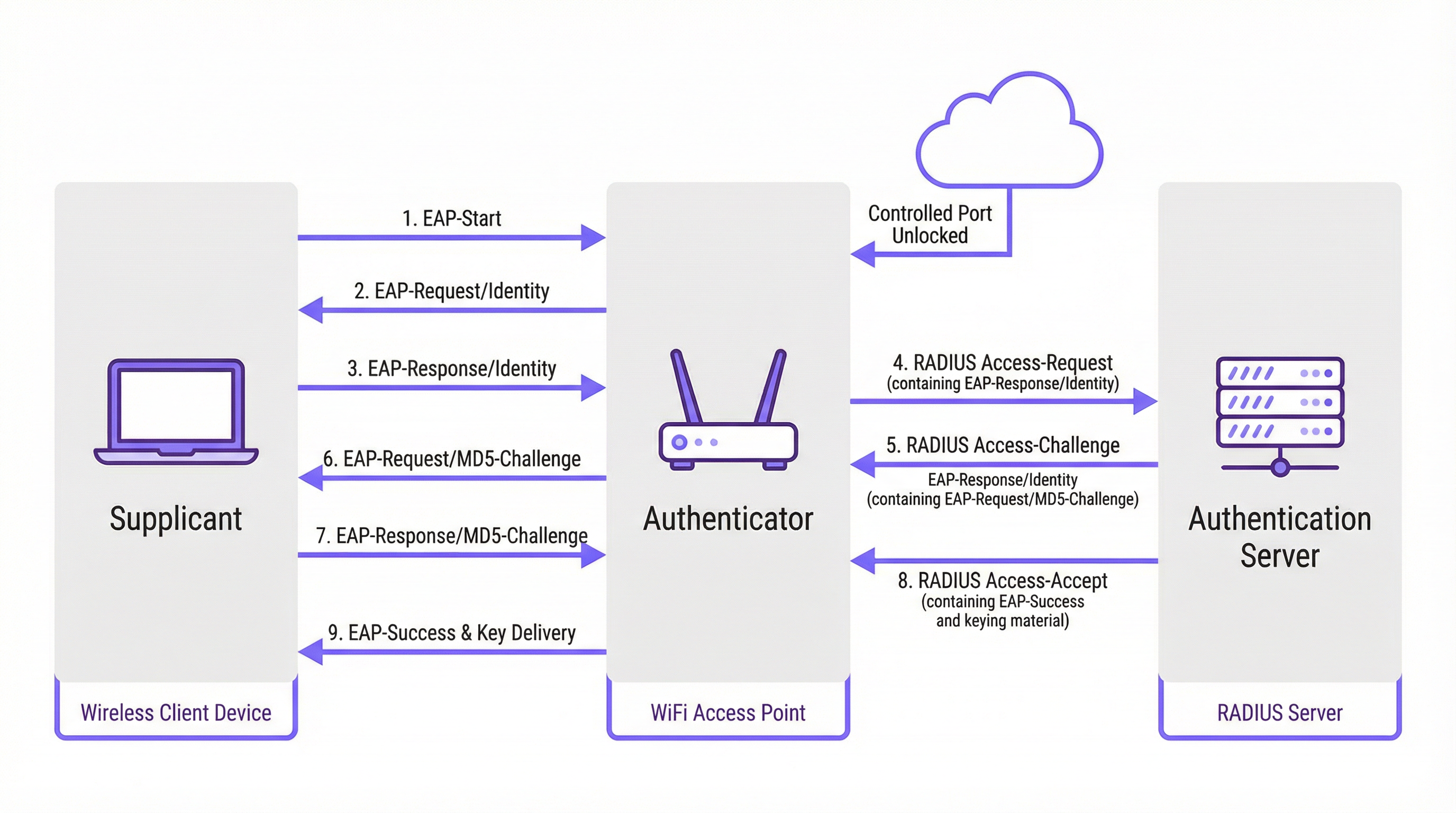
O processo de autenticação segue uma troca de mensagens estruturada orquestrada pelo Extensible Authentication Protocol (EAP). O EAP é uma estrutura flexível que suporta vários métodos de autenticação (tipos de EAP), permitindo que as organizações escolham aquele que melhor se adapta aos seus requisitos de segurança e infraestrutura existente.
Comparação de Métodos EAP
A escolha do método EAP correto é uma decisão crítica de implantação. Os principais métodos usados em redes corporativas modernas são EAP-TLS, PEAP e EAP-TTLS.
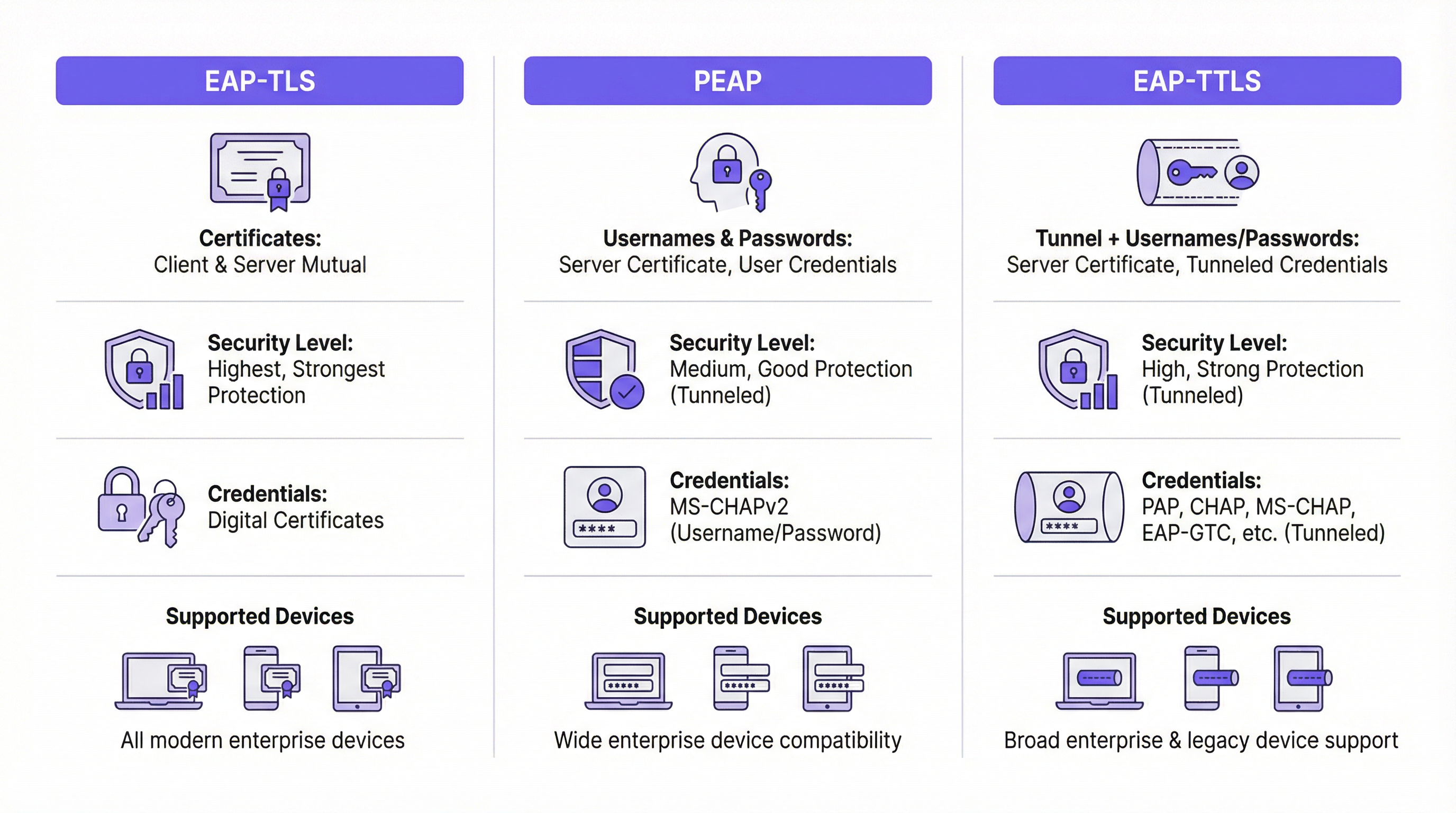
| Recurso | EAP-TLS (Transport Layer Security) | PEAP (Protected EAP) | EAP-TTLS (Tunneled TLS) |
|---|---|---|---|
| Nível de Segurança | Mais Alto. Fornece autenticação mútua baseada em certificado. | Alto. Criptografa a troca de credenciais dentro de um túnel TLS. | Alto. Semelhante ao PEAP, criptografa a troca de credenciais. |
| Credenciais | Certificados Digitais de Cliente e Servidor | Certificado de Servidor, Credenciais de Usuário (ex.: Nome de Usuário/Senha) | Certificado de Servidor, Credenciais de Usuário (opções mais flexíveis) |
| Complexidade | Alta. Requer uma Infraestrutura de Chave Pública (PKI) para gerenciar certificados para todos os dispositivos. | Média. Aproveita as credenciais de diretório existentes (ex.: Active Directory). | Média. Semelhante ao PEAP, mas oferece maior flexibilidade para protocolos de autenticação. |
| Caso de Uso | Dispositivos corporativos onde a implantação de certificados pode ser automatizada via MDM. Ambientes de alta segurança. | BYOD e ambientes corporativos onde a autenticação por nome de usuário/senha é preferida. | Ambientes diversos com uma mistura de sistemas operacionais clientes (ex.: macOS, Linux). |
O EAP-TLS é amplamente considerado o padrão ouro para a segurança 802.1X. Ele exige que tanto o cliente quanto o servidor tenham um certificado digital, permitindo a autenticação mútua. Isso elimina o risco de ataques baseados em senha, mas introduz a sobrecarga de implantar e gerenciar um certificado em cada dispositivo cliente.
O PEAP é o tipo de EAP mais comum em ambientes corporativos. Ele simplifica a implantação exigindo apenas um certificado no servidor de autenticação. O cliente verifica a identidade do servidor e, em seguida, cria um túnel TLS criptografado. Dentro desse túnel, o cliente se autentica usando métodos menos complexos, normalmente MS-CHAPv2 (nome de usuário e senha). Embora seguro, ainda é vulnerável a ataques de phishing se os usuários forem enganados para se conectar a um AP malicioso com um certificado de servidor de aparência válida.
O EAP-TTLS é funcionalmente semelhante ao PEAP, mas oferece mais flexibilidade. Ele também cria um túnel TLS, mas permite uma gama mais ampla de protocolos de autenticação internos, como PAP, CHAP ou EAP-MD5, tornando-o uma escolha versátil para ambientes com sistemas legados ou diversos tipos de clientes.
Guia de Implantação
Uma implantação bem-sucedida do 802.1X requer planejamento cuidadoso e execução em fases. As etapas a seguir fornecem um roteiro independente de fornecedor.
Fase 1: Infraestrutura e Planejamento
- Selecione seu Servidor RADIUS: Escolha um servidor RADIUS que se alinhe à sua infraestrutura existente. O Network Policy Server (NPS) da Microsoft é uma escolha comum para ambientes centrados no Windows, enquanto opções de código aberto como o FreeRADIUS são altamente flexíveis. Os serviços RADIUS baseados em nuvem também estão se tornando cada vez mais populares por sua escalabilidade e redução da sobrecarga de gerenciamento.
- Escolha seu Método EAP: Com base na comparação acima, selecione o método EAP que melhor equilibra seus requisitos de segurança, base de usuários e capacidades administrativas. Para a maioria dos ambientes corporativos, o PEAP oferece um forte equilíbrio. Para implantações de alta segurança, o EAP-TLS é o caminho recomendado.
- Planeje sua Estratégia de Certificados: Esta é a etapa mais crítica. Para PEAP ou EAP-TTLS, você precisará de um certificado de servidor para o seu servidor RADIUS. Este certificado DEVE ser emitido por uma Autoridade Certificadora (CA) pública confiável. O uso de um certificado autoassinado resultará em avisos de segurança em todos os dispositivos clientes, prejudicando a confiança do usuário e a segurança.
Fase 2: Configuração
- Configure o Servidor RADIUS: Instale e configure o servidor RADIUS escolhido. Isso envolve:
- Instalar o certificado do servidor.
- Definir os clientes RADIUS (seus pontos de acesso e switches).
- Criar Políticas de Solicitação de Conexão para processar as solicitações recebidas.
- Criar Políticas de Rede que definem as condições, restrições e configurações para autenticação. Por exemplo, uma política pode estabelecer que apenas membros de um grupo específico do Active Directory têm permissão para se conectar.
- Configure o Autenticador (APs Sem Fio/Switches):
- Configure sua controladora de LAN sem fio ou pontos de acesso individuais com o endereço IP do seu servidor RADIUS e o segredo compartilhado.
- Crie uma nova WLAN/SSID dedicada ao 802.1X. Não tente executar o 802.1X em uma rede aberta ou PSK existente.
- Certifique-se de que o SSID esteja configurado para WPA2-Enterprise ou WPA3-Enterprise.
Fase 3: Integração e Implantação de Clientes
- Dispositivos Corporativos: Use uma solução de Gerenciamento de Dispositivos Móveis (MDM) ou Política de Grupo (GPO) para configurar automaticamente os dispositivos de propriedade da empresa. O MDM/GPO pode enviar o perfil da rede sem fio, incluindo o SSID, tipo de EAP e quaisquer certificados de CA necessários, para o dispositivo. Isso proporciona uma experiência zero-touch para o usuário final.
- BYOD (Bring Your Own Device): A integração de dispositivos pessoais é mais complexa. A melhor prática é usar uma solução de integração dedicada. Essas soluções fornecem um SSID de "integração" aberto e temporário. Quando um usuário se conecta, ele é redirecionado para um Captive Portal onde pode se autenticar e baixar um utilitário de configuração ou perfil que configura automaticamente seu dispositivo para a rede 802.1X segura.
Melhores Práticas
- Segmente sua Rede: Use a atribuição dinâmica de VLAN com base em atributos RADIUS. Isso permite que você coloque diferentes grupos de usuários (ex.: funcionários, prestadores de serviços, convidados) em VLANs diferentes com políticas de acesso distintas, mesmo quando eles se conectam ao mesmo SSID.
- Sempre Use um Certificado Publicamente Confiável: A importância de usar um certificado público no seu servidor RADIUS não pode ser exagerada. É a base da confiança do cliente e evita ataques man-in-the-middle.
- Monitore e Registre: Monitore ativamente os logs de autenticação RADIUS. Isso é inestimável para solucionar problemas de conexão e para auditoria de segurança. Tentativas de autenticação falhas podem ser um indicador inicial de um ataque em potencial.
- Prefira WPA3-Enterprise: Onde houver suporte pelo seu hardware e clientes, o WPA3-Enterprise oferece aprimoramentos de segurança significativos em relação ao WPA2-Enterprise, incluindo Protected Management Frames (PMF) para evitar ataques de desautenticação.
Solução de Problemas e Mitigação de Riscos
| Problema Comum | Causa | Estratégia de Mitigação |
|---|---|---|
| Falha na Conexão | Incompatibilidade nos tipos de EAP entre cliente e servidor. Segredo compartilhado RADIUS incorreto. Firewall bloqueando portas RADIUS (UDP 1812/1813). | Verifique as configurações de EAP no cliente e no servidor. Verifique novamente o segredo compartilhado no AP e no servidor RADIUS. Certifique-se de que os firewalls permitam o tráfego RADIUS. |
| Avisos de Certificado | O servidor RADIUS está usando um certificado autoassinado ou não confiável. | Substitua o certificado autoassinado por um de uma CA pública confiável (ex.: DigiCert, Sectigo). |
| Conexões Lentas | O servidor RADIUS está subprovisionado ou tem alta latência para o serviço de diretório. | Monitore o desempenho do servidor RADIUS. Garanta conectividade de baixa latência entre o servidor RADIUS e os controladores de domínio. |
| Phishing/APs Maliciosos | Os usuários são enganados para se conectar a um AP malicioso transmitindo o mesmo SSID. | Use EAP-TLS para eliminar senhas. Para PEAP/EAP-TTLS, certifique-se de que os clientes estejam configurados para validar o certificado e o nome do servidor. |
ROI e Impacto nos Negócios
Embora a implementação do 802.1X exija um investimento inicial de tempo e recursos, o retorno sobre o investimento (ROI) é significativo, particularmente para locais de grande escala.
- Postura de Segurança Aprimorada: Ao mudar de uma única senha compartilhada para credenciais exclusivas por usuário ou por dispositivo, você reduz drasticamente o risco de acesso não autorizado. Este é um passo crítico na mitigação de violações de dados.
- Conformidade: Para organizações sujeitas ao PCI DSS, GDPR ou HIPAA, o 802.1X é um controle fundamental para demonstrar que você implementou fortes medidas de controle de acesso. O custo de uma auditoria reprovada ou de uma penalidade de conformidade supera em muito o custo de implantação.
- Eficiência Operacional: Automatizar a integração e usar VLANs dinâmicas reduz a carga administrativa das equipes de TI. Novos funcionários podem receber acesso automaticamente com base em seu grupo de diretório, e o acesso é revogado instantaneamente quando eles são removidos.
- Experiência do Usuário Aprimorada: Quando implantado corretamente com integração automatizada, o 802.1X fornece uma experiência de conexão contínua e segura. Os usuários simplesmente ligam seu dispositivo e ele se conecta sem exigir que insiram uma senha novamente. Esta é uma melhoria significativa em relação a Captive Portals ou PSKs complexas.
Key Terms & Definitions
RADIUS
Remote Authentication Dial-In User Service. A networking protocol that provides centralized Authentication, Authorization, and Accounting (AAA) management for users and devices that attempt to access a network service.
In an 802.1X context, the RADIUS server is the 'brain' of the operation. It's the server that checks the user's or device's credentials and tells the access point whether to grant or deny access. IT teams will spend most of their time configuring policies on the RADIUS server.
EAP
Extensible Authentication Protocol. An authentication framework, not a specific authentication mechanism. It provides a standardized way for clients and servers to negotiate an authentication method.
EAP is the language spoken between the client device, the access point, and the RADIUS server. Understanding that EAP is a framework helps explain why there are so many different 'types' of 802.1X (EAP-TLS, PEAP, etc.). The choice of EAP type is the most important decision in an 802.1X deployment.
Supplicant
The software on a client device (like a laptop or smartphone) that is responsible for responding to the authenticator's requests for credentials.
The supplicant is built into modern operating systems like Windows, macOS, iOS, and Android. IT teams rarely interact with the supplicant directly, but they configure it via network profiles, telling it which EAP type to use and which server to trust.
Authenticator
The network device that acts as a gatekeeper, blocking or allowing traffic from the supplicant. In a wireless network, this is the access point (AP).
The authenticator doesn't make the authentication decision itself. It's a middleman that simply passes EAP messages between the supplicant and the authentication server. Its primary job is to enforce the decision made by the RADIUS server.
PKI
Public Key Infrastructure. A set of roles, policies, hardware, software, and procedures needed to create, manage, distribute, use, store, and revoke digital certificates.
A PKI is essential for deploying EAP-TLS, the most secure form of 802.1X. While the term sounds intimidating, a basic PKI can be set up using Microsoft Active Directory Certificate Services or a cloud-based service. It's the foundation for a certificate-based security model.
MDM
Mobile Device Management. Software that allows IT administrators to control, secure, and enforce policies on smartphones, tablets, and other endpoints.
MDM is the key to a scalable and seamless 802.1X deployment for corporate-owned devices. IT teams use the MDM to automatically push the WiFi profile and client certificate to devices, meaning users can connect securely with zero manual configuration.
Dynamic VLAN Assignment
A feature that allows the RADIUS server to assign a user or device to a specific VLAN based on their identity or group membership.
This is a powerful tool for network segmentation. Instead of having multiple SSIDs for different user groups, you can have one secure SSID. The RADIUS server then places employees in the corporate VLAN, guests in the guest VLAN, and IoT devices in their own isolated VLAN, all based on the credentials they present.
WPA3-Enterprise
The latest generation of Wi-Fi security for enterprise networks, building on WPA2-Enterprise by adding stronger encryption and protection against de-authentication attacks.
When procuring new network hardware, IT managers should ensure it supports WPA3-Enterprise. It provides a significant security uplift over its predecessor and is a key component of a modern, secure wireless infrastructure. It's the 'Enterprise' version that integrates with 802.1X.
Case Studies
A 500-room luxury hotel needs to provide secure WiFi for staff (on corporate-issued tablets) and a separate, seamless experience for guests. The hotel must comply with PCI DSS due to its payment systems.
Staff Network: Implement an 802.1X EAP-TLS network. Deploy a RADIUS server and an internal Certificate Authority (or use a cloud PKI service). Use an MDM to automatically provision the corporate tablets with client certificates and the WPA2/WPA3-Enterprise network profile. This provides the highest level of security for devices handling sensitive operational data. Guest Network: Implement a separate SSID using a captive portal with a straightforward, time-limited voucher or social login. This network should be completely isolated from the staff and PCI networks using VLANs and firewall rules. This approach balances high security for corporate assets with ease of use for transient guests.
A large retail chain with 200 stores needs to secure its in-store network, which is used by Point-of-Sale (POS) terminals, employee-used handheld inventory scanners, and a guest WiFi network.
POS & Inventory Scanners: Deploy a single, hidden SSID using 802.1X EAP-TLS. Since these are corporate-controlled devices, certificates can be pre-loaded before deployment. Use MAC Authentication Bypass (MAB) as a fallback for legacy devices that may not support 802.1X, but this should be an exception. Assign this network to a secure, firewalled VLAN that only allows traffic to the payment processor and inventory management servers. Guest WiFi: Deploy a separate, public-facing SSID with a branded captive portal that requires acceptance of terms and conditions. This network must be completely isolated from the secure store network.
Scenario Analysis
Q1. Your CFO is concerned about the cost of a commercial certificate for the RADIUS server and suggests using a self-signed certificate from your internal Windows CA. How do you respond?
💡 Hint:Consider the user experience and the security implications of a client not being able to automatically trust the server.
Show Recommended Approach
A self-signed certificate will cause a security warning on every single device that connects to the network for the first time. This trains users to ignore security warnings, which is a significant security risk. A publicly trusted certificate is automatically recognized by all modern devices, providing a seamless connection experience and ensuring that clients can verify they are connecting to the legitimate server, which is crucial for preventing man-in-the-middle attacks. The annual cost of a public certificate is a small price to pay for the enhanced security and improved user experience.
Q2. A conference centre wants to use 802.1X for event attendees. They have thousands of new users each week. Is EAP-TLS a viable option? Why or why not?
💡 Hint:Think about the lifecycle of a guest user and the administrative overhead of certificate management.
Show Recommended Approach
EAP-TLS is likely not a viable option for this scenario. The primary challenge is the administrative overhead of provisioning a unique digital certificate for thousands of transient users each week. The process of generating, distributing, and then revoking these certificates would be operationally complex and costly. A better approach would be to use a simpler authentication method for guests, such as a captive portal with voucher codes or social login, while reserving 802.1X for staff and permanent infrastructure.
Q3. You are deploying a PEAP-MS-CHAPv2 network. A user reports that they can connect from their Windows laptop but not from their personal Android phone. What is the most likely cause of this issue?
💡 Hint:Consider how different operating systems handle certificate validation and network profiles.
Show Recommended Approach
The most likely cause is that the Android phone has not been configured to properly trust the RADIUS server's certificate. While a Windows laptop joined to a domain might automatically trust the certificate (if the root CA is pushed via Group Policy), a personal Android device needs to be manually configured. The user likely needs to install the root CA certificate on their phone and/or explicitly configure the network profile to validate the server certificate and specify the correct domain name. This highlights the importance of a clear and simple onboarding process for BYOD users.
Key Takeaways
- ✓802.1X provides port-based network access control, authenticating users or devices before granting network access.
- ✓The core components are the Supplicant (client), Authenticator (AP/switch), and Authentication Server (RADIUS).
- ✓EAP-TLS is the most secure method, using mutual certificate authentication, but has higher administrative overhead.
- ✓PEAP and EAP-TTLS are widely used, balancing strong security with easier deployment by using server-side certificates and user credentials.
- ✓Always use a publicly trusted certificate for your RADIUS server to avoid security warnings and prevent man-in-the-middle attacks.
- ✓Automate client configuration using MDM for corporate devices and a dedicated onboarding portal for BYOD.
- ✓Use dynamic VLAN assignment to segment users and devices into different network zones based on their identity and permissions.




