

Integração do Juniper Mist com o Purple WiFi
This guide provides a comprehensive technical reference for integrating Juniper Mist's AI-driven wireless platform with Purple's enterprise guest WiFi and analytics solution. It covers the full integration architecture — from the Mist external captive portal and REST API authorisation flow through to PurpleConnex Passpoint and RadSec configuration for seamless repeat-visitor connectivity. Venue operators and IT teams will find actionable deployment guidance, real-world implementation scenarios, and a clear framework for measuring the business impact of a Mist-Purple deployment.
🎧 Listen to this Guide
View Transcript

Resumo Executivo
A integração do Juniper Mist WiFi com a Purple representa uma das combinações mais eficientes disponíveis hoje para operadores de espaços corporativos. A plataforma sem fio nativa em nuvem e orientada por IA da Mist oferece a confiabilidade de infraestrutura e a inteligência operacional exigidas pelos arquitetos de rede, enquanto a camada de Captive Portal, analytics e automação de marketing da Purple transforma essa infraestrutura em um ativo de negócios mensurável. A integração opera por meio do mecanismo de redirecionamento de portal externo da Mist, protegido por um API Secret por WLAN, e é complementada por uma solução de WiFi segura baseada em Passpoint — PurpleConnex — para conectividade sem atrito de visitantes recorrentes usando WPA2/WPA3-Enterprise e RadSec. Para líderes de TI que avaliam essa implantação, os principais pontos de decisão são: implementar apenas a integração básica do Captive Portal ou também implantar o PurpleConnex para visitantes recorrentes; como estruturar o walled garden; e como aproveitar o analytics da Purple para entregar um ROI mensurável. Este guia aborda os três pontos em profundidade, com especificações de configuração, exemplos práticos de ambientes de hospitalidade e varejo, e uma estrutura clara de solução de problemas.
Análise Técnica Aprofundada
A integração do Juniper Mist e da Purple é construída sobre uma separação clara de responsabilidades. A Mist gerencia o ambiente de radiofrequência, o gerenciamento de access points e a camada de aplicação de políticas. A Purple gerencia a experiência do visitante, a captura de dados e a camada de analytics e engajamento. As duas plataformas se comunicam por meio de um contrato de API bem definido, que é seguro e simples de configurar.
Arquitetura de Integração
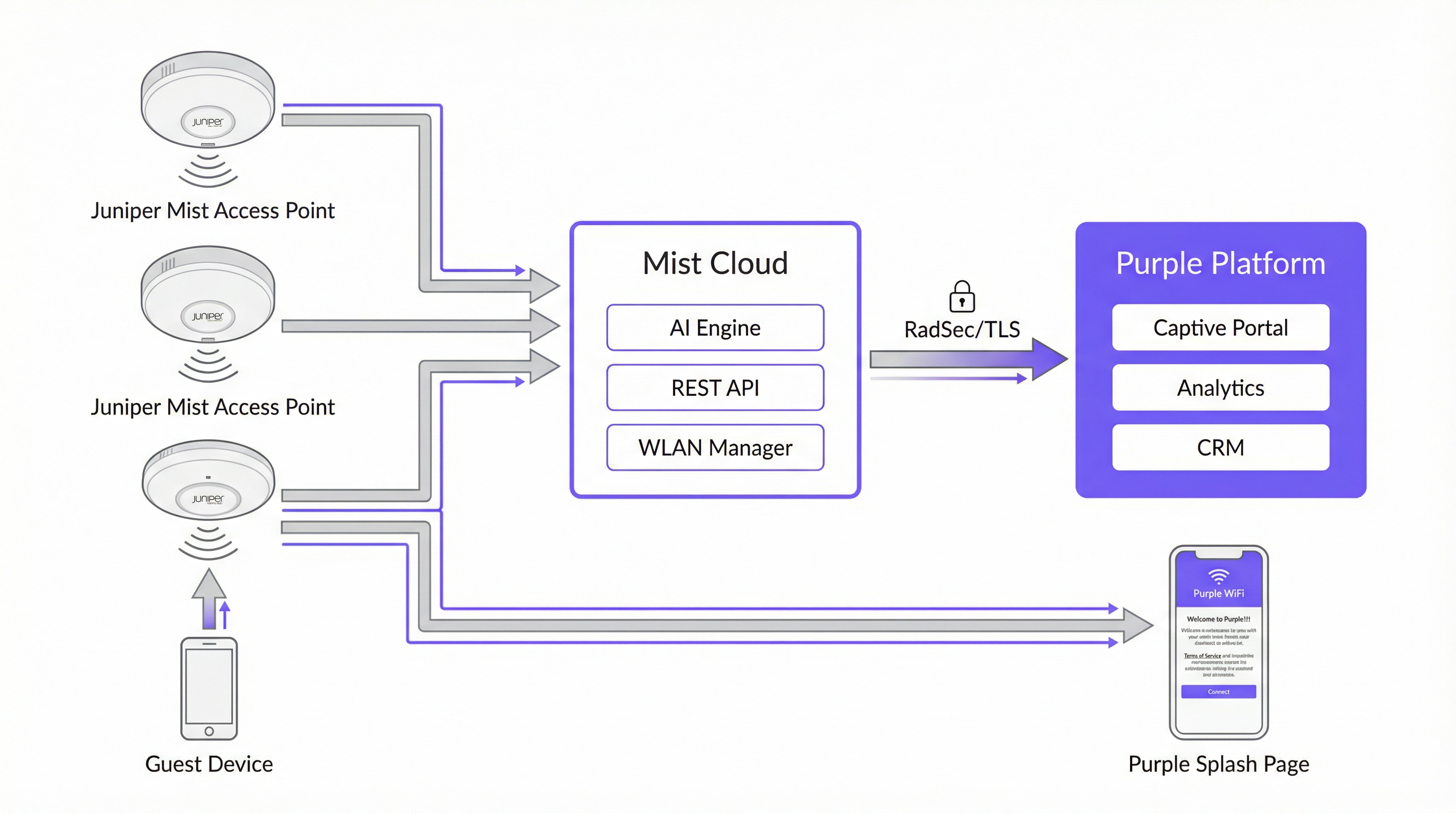
A tabela abaixo resume a função de cada componente na integração.
| Componente | Função |
|---|---|
| Juniper Mist Access Points | Fornecem cobertura sem fio; aplicam políticas de WLAN; redirecionam visitantes não autenticados para o Captive Portal da Purple via HTTP 302. |
| Juniper Mist Cloud | Plataforma de gerenciamento centralizado em nuvem. Hospeda a configuração da WLAN, RRM orientado por IA, SLEs de Wi-Fi Assurance e a REST API usada para autorização de dispositivos de visitantes. |
| Plataforma Purple | Hospeda o Captive Portal externo; captura e armazena dados de visitantes em conformidade com as normas; fornece painéis de analytics, integração com CRM e automação de marketing. |
| Mist API Secret | Uma chave criptográfica por WLAN (HMAC-SHA1) que protege o handshake de autorização entre a Purple e a Mist Cloud. |
| PurpleConnex (Passpoint) | Uma segunda WLAN usando WPA2/WPA3-Enterprise e Passpoint para fornecer conectividade automática e segura para visitantes recorrentes sem exigir reautenticação no portal. |
| RadSec (RFC 6614) | RADIUS sobre TLS. Protege o tráfego de autenticação entre a Mist Cloud e os servidores RADIUS da Purple para a WLAN PurpleConnex. |
O Fluxo de Autenticação do Captive Portal
Quando o dispositivo de um visitante se associa ao SSID de visitantes, a Mist verifica se o endereço MAC do dispositivo foi autorizado anteriormente. Caso não tenha sido, a Mist intercepta a primeira solicitação HTTP do visitante e emite um redirecionamento 302 para a URL do portal da Purple. Esse redirecionamento anexa vários parâmetros que a Purple exige para concluir o ciclo de autorização:
| Parâmetro | Descrição | Obrigatório? |
|---|---|---|
wlan_id |
UUID do objeto WLAN na Mist | Sim |
ap_mac |
Endereço MAC do access point em serviço | Sim |
client_mac |
Endereço MAC do dispositivo do visitante | Sim |
url |
A URL original solicitada pelo visitante | Não |
ap_name |
Nome legível do AP | Não |
site_name |
Nome legível do local | Não |
Assim que o visitante preenche o formulário de login no portal da Purple, a Purple constrói uma solicitação de autorização assinada para o backend da Mist em portal.mist.com/authorize. Essa solicitação inclui uma assinatura HMAC-SHA1 calculada usando o API Secret da WLAN, um token codificado em base64 contendo o wlan_id, ap_mac, client_mac e a duração da sessão, além de um carimbo de data/hora de expiração. A Mist valida a assinatura e, se válida, autoriza o dispositivo do visitante a acessar a internet.
Nota arquitetônica importante: O Juniper Mist não suporta autenticação ou accounting RADIUS para o fluxo do Captive Portal. Isso significa que os relatórios de contagem de usuários em tempo real e certas métricas de sessão de rede no painel da Mist não refletirão as sessões do Captive Portal. A própria plataforma de analytics da Purple fornece relatórios de sessão abrangentes e deve ser usada como a fonte primária de inteligência do WiFi para visitantes.
PurpleConnex: Passpoint e RadSec
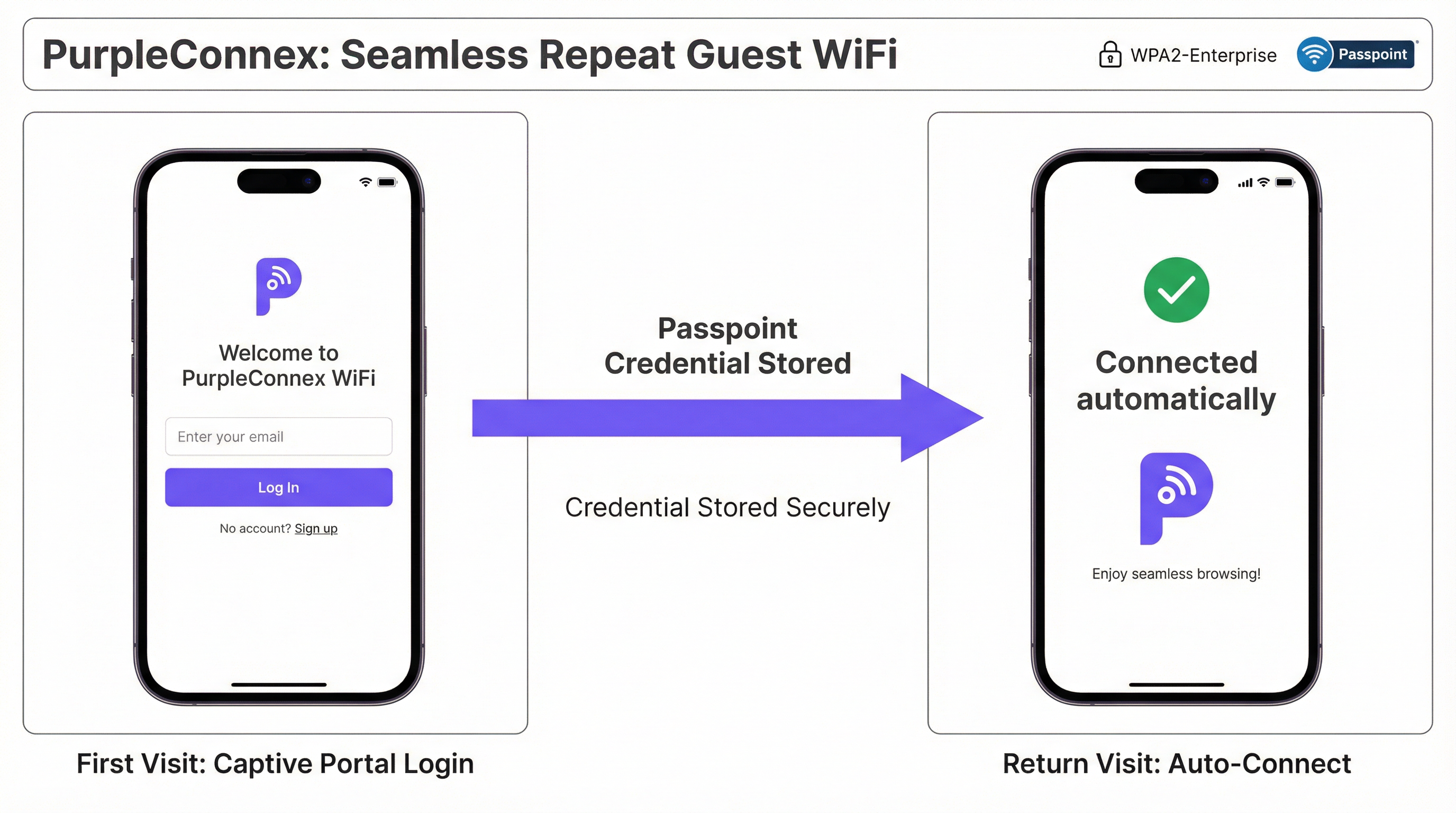
Para locais com uma proporção significativa de visitantes recorrentes — hotéis, campi corporativos, redes de varejo —, a solução PurpleConnex elimina a necessidade de autenticação repetida no portal. Após o primeiro login do visitante por meio do Captive Portal, a Purple provisiona um perfil Passpoint (Hotspot 2.0) no dispositivo do visitante. Em todas as visitas subsequentes, o dispositivo seleciona automaticamente o SSID PurpleConnex e se autentica silenciosamente usando WPA2-Enterprise (ou WPA3-Enterprise em APs compatíveis com 6 GHz) via EAP-TTLS nos servidores RadSec da Purple.
A configuração do RadSec na Mist requer duas entradas de servidor — rad1-secure.purple.ai e rad2-secure.purple.ai, ambas na porta 2083 — e a instalação do certificado RadSec da Purple nas Configurações de Organização da Mist. O Identificador NAS deve ser definido como MIST-{{DEVICE_MAC}} para garantir que a Purple possa identificar corretamente o access point autenticador.
Guia de Implementação
As etapas a seguir pressupõem acesso administrativo tanto ao painel da Juniper Mist Cloud (manage.mist.com) quanto ao portal da Purple. Para implantações em vários locais, as etapas de 1 a 3 devem ser executadas em um Modelo de Organização da Mist (Organisation Template) em vez de no nível do local.
Fase 1: Configuração da WLAN de Visitantes (Mist)
Etapa 1. Faça login em manage.mist.com e navegue até Network > WLANs. Clique em Add WLAN.
Etapa 2. Configure a WLAN com os seguintes parâmetros:
| Configuração | Valor |
|---|---|
| SSID | Guest WiFi (ou o nome de sua preferência) |
| Status da WLAN | Habilitado |
| Tipo de Segurança | Acesso Aberto |
| Portal de Visitantes | Encaminhar para um portal externo |
| URL do Portal | Fornecida pela Purple (URL de acesso do seu local) |
| Hostnames Permitidos | Todos os domínios da Purple — consulte a Lista de Permissões de Domínio do Walled Garden da Purple |
| Ignorar portal em caso de exceção | Deixe desmarcado (recomendado) |
Etapa 3. Clique em Save (Salvar). Reabra a WLAN e localize o API Secret. Copie este valor.
Fase 2: Configuração do Local na Purple
Etapa 4. Faça login no portal da Purple e navegue até as configurações do seu local.
Etapa 5. Cole o API Secret da Mist no campo Mist API secret.
Etapa 6. Confirme se a URL do Portal na WLAN da Mist corresponde à URL de acesso mostrada nas configurações do local na Purple.
Fase 3: Configuração da WLAN PurpleConnex (Passpoint) (Opcional, mas Recomendado)
Etapa 7. No painel da Mist, crie uma segunda WLAN com as seguintes configurações:
| Configuração | Valor |
|---|---|
| SSID | PurpleConnex |
| Tipo de Segurança | WPA2 Enterprise (802.1X) |
| Passpoint | Habilitado |
| Operadores | OpenRoaming-Settlement-Free |
| Nome do Local | O nome do seu local |
| Nome de Domínio | securewifi.purple.ai |
| ID do Consórcio de Roaming | 5A03BA0000, 004096 |
| Nome do Realm NAI | securewifi.purple.ai |
| Tipo de EAP do Realm NAI | TTLS |
| Tipo de Servidor de Autenticação | RadSec |
| Servidor de Autenticação 1 | rad1-secure.purple.ai, Porta 2083 |
| Servidor de Autenticação 2 | rad2-secure.purple.ai, Porta 2083 |
| Identificador NAS | MIST-{{DEVICE_MAC}} |
| Portal de Visitantes | Sem portal (acesso direto à internet) |
Etapa 8. Navegue até Organisation Settings (Configurações da Organização) e faça o upload do certificado RadSec da Purple em RadSec Certificates.
Melhores Práticas
Use Modelos de Organização para Implantações em Vários Locais. Para qualquer implantação que abranja mais de um local, configure ambas as WLANs em um Modelo de Organização (Organisation Template) da Mist. Isso garante a consistência da configuração em toda a infraestrutura e permite que as alterações sejam enviadas a todos os locais simultaneamente. Uma rede de varejo que gerencia cinquenta lojas, por exemplo, pode atualizar a URL do portal de visitantes ou as entradas do walled garden uma vez e fazer com que a alteração se propague para todos os locais em minutos.
Mantenha um Walled Garden Completo e Atualizado. O walled garden é a fonte mais comum de falhas de integração. Um walled garden incompleto significa que visitantes não autenticados não conseguem acessar o Captive Portal, resultando em uma experiência de WiFi interrompida. Mantenha uma lista atualizada de todos os domínios obrigatórios da Purple, domínios de provedores de login social e quaisquer outros recursos dos quais o portal dependa. Revise esta lista sempre que adicionar novos métodos de autenticação ao portal.
Planeje Dois SSIDs desde o Primeiro Dia. Implante tanto o SSID aberto do Guest WiFi quanto o SSID do PurpleConnex Passpoint desde o início, mesmo que a adoção do Passpoint seja inicialmente baixa. À medida que a base instalada de dispositivos compatíveis com Passpoint cresce — e está crescendo rapidamente, com a maioria dos dispositivos iOS e Android modernos suportando o padrão —, a experiência contínua para visitantes recorrentes se tornará cada vez mais valiosa.
Alinhe-se aos Roadmaps do IEEE 802.1X e WPA3. Para qualquer nova implantação da Mist, particularmente aquelas que incorporam bandas de rádio de 6 GHz, planeje o WPA3-Enterprise no SSID PurpleConnex. O WPA3 é obrigatório em redes de 6 GHz e fornece criptografia significativamente mais forte por meio de seu modo de segurança de 192 bits. Isso também posiciona a implantação para conformidade de longo prazo com os padrões de segurança em evolução.
Integre a Purple ao seu CRM. Os dados dos visitantes capturados por meio do Captive Portal têm um valor significativo além do gerenciamento de WiFi. Conectar a Purple ao seu CRM — seja Salesforce, HubSpot ou um PMS específico de hospitalidade — cria um perfil de cliente unificado que pode impulsionar marketing personalizado, integração de programas de fidelidade e melhoria no atendimento ao visitante.
Solução de Problemas e Mitigação de Riscos
| Sintoma | Causa Provável | Resolução |
|---|---|---|
| O visitante não é redirecionado para o Captive Portal | URL do Portal incorreta na WLAN da Mist, ou a WLAN não está configurada para "Forward to external portal" | Verifique a URL do Portal e a configuração do Portal de Visitantes na configuração da WLAN da Mist. |
| A página do Captive Portal não carrega | Walled garden incompleto — os domínios da Purple estão bloqueados para usuários não autenticados | Adicione todos os domínios obrigatórios da Purple e domínios de provedores de login social à lista de Hostnames Permitidos da WLAN da Mist. |
| O visitante conclui o login, mas não recebe acesso à internet | API Secret incorreto nas configurações do local na Purple, ou firewall bloqueando o tráfego para portal.mist.com |
Verifique o API Secret e as regras de firewall. Certifique-se de que portal.mist.com (ou o equivalente regional) esteja acessível a partir da Mist Cloud. |
| O SSID PurpleConnex não aparece nos dispositivos dos visitantes | Passpoint não habilitado na WLAN, ou o dispositivo não possui um perfil Passpoint provisionado | Confirme se o Passpoint está habilitado nas configurações da WLAN da Mist. Verifique se o visitante se autenticou anteriormente por meio do Captive Portal e se o perfil Passpoint foi provisionado. |
| Falhas de autenticação RadSec para o PurpleConnex | Certificado RadSec ausente ou incorreto, ou endereços/porta de servidor incorretos | Faça o upload novamente do certificado RadSec a partir da documentação de suporte da Purple. Verifique os endereços do servidor e a porta 2083. |
| Relatórios de contagem de usuários em tempo real indisponíveis na Mist | Comportamento esperado — a Mist não suporta accounting RADIUS para sessões do Captive Portal | Use o painel de analytics da Purple para relatórios de sessão de visitantes. Esta é a fonte de dados correta e pretendida para esta integração. |
ROI e Impacto nos Negócios

O business case para uma implantação do Juniper Mist e da Purple vai muito além da conectividade. A integração cria uma infraestrutura de coleta de dados e engajamento que entrega retornos mensuráveis em várias dimensões.
Engajamento de Visitantes e Automação de Marketing. Todo visitante que se autentica por meio do Captive Portal da Purple se torna um contato conhecido. As ferramentas de automação de marketing da Purple permitem que os operadores do local enviem comunicações direcionadas e baseadas em consentimento — pesquisas pós-visita, ofertas promocionais, notificações de eventos — que impulsionam visitas recorrentes e aumentam o gasto médio. Para uma rede de hotéis, isso se traduz diretamente em melhores taxas de reservas diretas e menor dependência de comissões de OTAs.
Inteligência Operacional. O analytics de tráfego de pessoas da Purple fornece às equipes de operações do local dados granulares sobre o comportamento dos visitantes: quais áreas de um local atraem o maior tempo de permanência, como os padrões de tráfego mudam por hora do dia e dia da semana, e como as taxas de visitantes recorrentes evoluem ao longo do tempo. Essa inteligência orienta decisões de equipe, otimização de layout de loja e planejamento de eventos.
Geração de Receita. Para locais como aeroportos, centros de conferências e estádios, os recursos de largura de banda em níveis da Purple permitem a monetização do acesso WiFi premium. Um operador de aeroporto relatou um ROI de 842% após implementar o modelo de acesso em níveis da Purple, demonstrando o significativo potencial de receita de uma implantação de WiFi para visitantes bem configurada.
Mitigação de Riscos de Conformidade. Uma violação do GDPR ou da CCPA acarreta riscos financeiros e de reputação substanciais. O gerenciamento de consentimento integrado da Purple, as ferramentas de direitos dos titulares de dados e a arquitetura de processamento de dados em conformidade reduzem significativamente esse risco, fornecendo uma postura de conformidade defensável que satisfaz tanto as equipes jurídicas quanto os encarregados de proteção de dados.
Este guia é mantido pela equipe de Conteúdo Técnico da Purple. Para obter os detalhes de configuração mais recentes, consulte o Portal de Suporte da Purple e a Documentação do Juniper Mist.
Key Terms & Definitions
Captive Portal
A web page presented to newly connected WiFi users before they are granted broader network access. It is the primary mechanism for guest authentication, data capture, and terms-of-service acceptance in a guest WiFi deployment.
In the Mist-Purple integration, the captive portal is hosted by Purple and is triggered by a Mist HTTP 302 redirect. IT teams configure the Portal URL in the Mist WLAN settings and the API Secret in Purple to link the two platforms.
Walled Garden
A restricted set of hostnames and IP ranges that unauthenticated users on a captive portal network are permitted to access before completing the login process. The walled garden must include the portal itself and all resources it depends on.
Network engineers must configure the Allowed Hostnames list in the Mist WLAN settings to include all Purple domains and any social login provider domains. An incomplete walled garden is the most common cause of captive portal failures.
API Secret (Mist)
A per-WLAN cryptographic key automatically generated by Mist when a Guest WLAN with an external portal is created. It is used as the HMAC-SHA1 signing key for the authorisation requests that Purple sends to the Mist backend to grant guest devices internet access.
The API Secret must be copied from the Mist WLAN configuration and pasted into the Purple venue settings. It is the trust anchor for the entire integration and should be treated as a sensitive credential.
Passpoint (Hotspot 2.0)
An IEEE 802.11u-based standard that enables mobile devices to automatically discover, select, and connect to WiFi networks using pre-provisioned credentials, without requiring user interaction or portal authentication.
PurpleConnex uses Passpoint to provide a seamless, automatic connection experience for repeat guests. After an initial captive portal login, a Passpoint profile is provisioned to the guest's device, enabling silent authentication on all future visits.
RadSec (RADIUS over TLS)
A protocol defined in RFC 6614 that secures RADIUS authentication and accounting traffic by tunnelling it over a TLS connection. It replaces the traditional UDP-based RADIUS transport, which is vulnerable to interception and replay attacks.
The PurpleConnex WLAN uses RadSec to secure authentication traffic between the Mist Cloud and Purple's RADIUS servers. Network engineers must configure the RadSec server addresses, port (2083), and certificate in the Mist WLAN and Organisation Settings.
IEEE 802.1X
An IEEE standard for port-based Network Access Control that provides an authentication framework for devices connecting to a LAN or WLAN. It requires each user or device to authenticate with unique credentials before gaining network access.
The PurpleConnex WLAN uses WPA2/WPA3-Enterprise with 802.1X to provide strong, per-user authentication for repeat guests. This is the same authentication framework used in corporate enterprise networks and is significantly more secure than pre-shared key (PSK) authentication.
Mist AI (Wi-Fi Assurance)
Juniper Mist's cloud-based machine learning engine that continuously analyses wireless network telemetry to optimise radio resource management, predict and resolve connectivity issues, and provide service level experience (SLE) metrics for each user session.
While Mist AI operates independently of the Purple integration, it is a key reason why Mist is selected as the infrastructure platform for enterprise guest WiFi deployments. Its proactive fault detection and automated RRM reduce the operational burden on IT teams and improve the reliability of the guest WiFi experience.
GDPR (General Data Protection Regulation)
EU Regulation 2016/679, which governs the collection, processing, and storage of personal data of individuals in the European Union and European Economic Area. It requires explicit, informed consent for data collection and grants individuals rights over their personal data.
Any guest WiFi deployment that collects personal data — including email addresses, names, or device identifiers — from EU residents must comply with GDPR. Purple's platform provides built-in consent management tools, data subject rights workflows, and compliant data processing agreements to support GDPR compliance.
OpenRoaming
A Wireless Broadband Alliance (WBA) initiative that enables seamless, automatic WiFi roaming across participating networks globally, using Passpoint technology and a federated identity framework. The Settlement-Free tier allows users to roam without per-session charges.
The PurpleConnex WLAN is configured with the OpenRoaming-Settlement-Free operator profile, which enables devices with OpenRoaming credentials from other providers to connect automatically to the PurpleConnex SSID. This extends the seamless connectivity benefit beyond Purple's own user base.
NAS Identifier
A RADIUS attribute (Attribute 32) that identifies the Network Access Server — in this context, the Mist access point — to the RADIUS server. It is used by the RADIUS server to apply per-AP policies and to log authentication events with AP-level granularity.
In the PurpleConnex WLAN configuration, the NAS Identifier is set to MIST-{{DEVICE_MAC}}, where {{DEVICE_MAC}} is a Mist variable that is replaced with the MAC address of the authenticating AP at runtime. This allows Purple's RADIUS servers to identify the specific AP handling each authentication request.
Case Studies
A 200-room four-star hotel wants to provide a seamless WiFi experience for guests. The general manager requires that first-time guests see a branded captive portal, that repeat guests connect automatically without a login prompt, and that the marketing team can send post-stay email campaigns to guests who have consented. How would you configure the Juniper Mist and Purple integration to meet these requirements?
The solution requires a dual-SSID architecture. First, create a 'Guest WiFi' WLAN in the Mist dashboard with Open Access security and the Guest Portal set to 'Forward to an external portal', using the Purple portal URL. Configure the walled garden with all required Purple domains. Retrieve the Mist API Secret and enter it into the Purple venue settings. In Purple, configure the captive portal with the hotel's branding, a simple email-and-name form, and explicit marketing consent checkboxes that comply with GDPR Article 7. Second, create a 'PurpleConnex' WLAN with WPA2-Enterprise, Passpoint enabled, and the RadSec server details from Purple. Upload Purple's RadSec certificate to the Mist Organisation Settings. After a guest's first login through the captive portal, Purple automatically provisions a Passpoint profile to their device. On all subsequent visits, the device silently connects to PurpleConnex. The marketing team can then use Purple's CRM integration to push consented guest email addresses into the hotel's email marketing platform for post-stay campaigns.
A retail chain with 75 stores across the UK and Ireland wants to deploy guest WiFi to understand foot traffic patterns, measure the impact of store layout changes on dwell time, and send targeted promotions to opted-in customers. The IT team has a small central team and cannot manage per-site configurations individually. How should the Mist and Purple deployment be structured?
The deployment should be built around Mist's Organisation Templates for centralised management. Create a single WLAN template containing both the 'Guest WiFi' (open, captive portal) and 'PurpleConnex' (WPA2-Enterprise, Passpoint) WLANs, and apply this template to all 75 sites. This ensures that any configuration change — such as updating the walled garden or rotating the API Secret — propagates to all sites simultaneously without manual intervention. In Purple, create a location hierarchy that mirrors the retail estate: group stores by region or country to enable segmented analytics. Configure Purple's foot traffic analytics to track dwell time by zone within each store, using the AP placement data from Mist to map signal coverage to physical store areas. Integrate Purple with the retailer's existing marketing platform via Purple's API or native CRM connectors. Use Purple's campaign tools to send geo-targeted promotions — for example, a discount notification to customers who have been in the store for more than 15 minutes without making a purchase.
Scenario Analysis
Q1. A 500-seat conference centre is deploying a Mist and Purple guest WiFi solution. The events team wants to offer a free basic tier (2 Mbps per device) and a paid premium tier (20 Mbps per device) for delegates who need reliable video conferencing. The IT team has two network engineers and cannot manage per-event configurations manually. How would you structure the deployment to meet these requirements?
💡 Hint:Consider how Purple's tiered bandwidth feature works alongside Mist's WLAN configuration, and how Mist Organisation Templates reduce operational overhead.
Show Recommended Approach
Deploy a single 'Guest WiFi' SSID configured in a Mist Organisation Template with the Purple captive portal redirect. In Purple, configure two access tiers: a free tier with a 2 Mbps per-device bandwidth cap and a paid premium tier at 20 Mbps, with a payment gateway integrated into the portal for premium access purchases. The captive portal should clearly present both options to connecting guests. Use Purple's event management features to create event-specific portal pages that can be activated by the events team without IT involvement, reducing the operational burden on the two-engineer team. For the PurpleConnex Passpoint SSID, configure it to automatically grant premium-tier bandwidth to returning guests who have previously purchased a premium pass, using Purple's CRM data to identify them.
Q2. A hotel group's IT security team has raised a concern that the Open Access guest SSID creates a risk of guest-to-guest traffic interception. The network architect needs to address this concern without removing the captive portal functionality. What Mist configuration options are available, and how do they interact with the Purple integration?
💡 Hint:Consider Mist's client isolation features and how they apply to an Open Access WLAN. Also consider the role of WPA3 OWE (Opportunistic Wireless Encryption).
Show Recommended Approach
There are two primary mitigations. First, enable client isolation on the Guest WiFi WLAN in Mist. This prevents guest devices from communicating directly with each other at the Layer 2 level, eliminating the risk of ARP spoofing and direct traffic interception between guests on the same SSID. This setting does not affect the captive portal redirect or the Purple authorisation flow. Second, for deployments on APs that support it, consider enabling WPA3 OWE (Opportunistic Wireless Encryption) on the guest SSID. OWE provides per-session encryption for open networks without requiring a password, protecting guest traffic from passive eavesdropping. OWE is transparent to the captive portal flow — Mist still redirects unauthenticated devices to Purple regardless of the encryption mode. Note that OWE requires client device support, which is now widespread on modern iOS and Android devices but may not be universal across all guest devices.
Q3. After deploying the Mist-Purple integration at a 30-store retail chain, the IT team reports that approximately 15% of guests are completing the captive portal login but not receiving internet access. The remaining 85% are connecting successfully. What is the most likely cause, and what is the diagnostic approach?
💡 Hint:Think about what could cause the Mist authorisation API call from Purple to fail for a subset of users. Consider timing, firewall rules, and the API Secret.
Show Recommended Approach
The most likely cause is a race condition or timeout in the Purple-to-Mist authorisation API call, potentially caused by firewall rules at specific stores blocking outbound HTTPS traffic to portal.mist.com, or by network latency causing the authorisation request to expire before Mist processes it. The diagnostic approach is: (1) Check Purple's server-side logs for authorisation API call failures — Purple's support team can provide these. Look for HTTP error codes (401 Unauthorized suggests an API Secret mismatch; 504 Gateway Timeout suggests a connectivity issue). (2) Identify whether the failures are concentrated at specific stores, which would point to a per-site firewall or routing issue rather than a platform-wide problem. (3) Verify that the API Secret in Purple matches the API Secret in the Mist WLAN for the affected stores — if Organisation Templates were not used consistently, there may be mismatches. (4) Check that the correct regional Mist portal endpoint is being used — Mist API endpoints vary by region (US, EU, APAC), and using the wrong endpoint will cause authorisation failures.
Q4. A public-sector organisation — a local council — wants to deploy free guest WiFi across 12 libraries using Mist and Purple. Their data protection officer has specified that no personal data may be collected without explicit, granular consent, and that the organisation must be able to demonstrate compliance with a subject access request within 30 days. How should the Purple captive portal be configured to meet these requirements?
💡 Hint:Focus on GDPR Articles 7 (consent), 15 (right of access), and 17 (right to erasure). Consider how Purple's compliance features map to these requirements.
Show Recommended Approach
Configure the Purple captive portal with the following GDPR-compliant settings: (1) Use a simple, unbundled consent mechanism — present separate, opt-in checkboxes for each data processing purpose (e.g., 'I consent to my email being used for service notifications' and 'I consent to my usage data being used for analytics'). Pre-ticked boxes are not valid consent under GDPR Article 7. (2) Link to a clear, plain-English privacy notice that identifies the council as the data controller, lists the categories of data collected, and explains the legal basis for processing. (3) Configure Purple to capture only the minimum data necessary — for a public-sector library, this may be as simple as a device identifier and session timestamp, with no personal data required for basic access. (4) Enable Purple's data subject rights tools, which allow the DPO to respond to subject access requests by exporting all data associated with a specific email address or device, and to process erasure requests within the statutory 30-day window. (5) Ensure that a Data Processing Agreement (DPA) is in place between the council and Purple, as Purple processes personal data on behalf of the council as a data processor under GDPR Article 28.
Key Takeaways
- ✓The Juniper Mist and Purple integration uses Mist's external captive portal redirect and a per-WLAN API Secret to securely authenticate guest devices and capture visitor data through Purple's hosted portal.
- ✓A dual-SSID architecture — an open Guest WiFi SSID for first-time visitors and a WPA2/WPA3-Enterprise PurpleConnex SSID for repeat guests — is the industry best practice for balancing accessibility, security, and user experience.
- ✓The walled garden configuration in Mist is the most common source of integration failures; always ensure all Purple domains and social login provider domains are included in the Allowed Hostnames list before going live.
- ✓For multi-site deployments, Mist Organisation Templates are essential — they enable consistent configuration across the entire estate and allow changes to propagate to all sites simultaneously, dramatically reducing operational overhead.
- ✓Juniper Mist does not support RADIUS accounting for captive portal sessions; use Purple's analytics platform as the primary source of guest session reporting and business intelligence.
- ✓Purple's GDPR and CCPA compliance tools — including granular consent management, data subject rights workflows, and Data Processing Agreements — are critical for any deployment that collects personal data from EU or California residents.
- ✓The ROI of a Mist-Purple deployment extends beyond connectivity: guest data analytics, marketing automation, CRM integration, and tiered bandwidth monetisation can deliver measurable returns that far exceed the cost of the infrastructure.




