

Randomização de Endereços MAC: Uma Análise Aprofundada sobre a Melhoria da Privacidade e seu Impacto no Gerenciamento de Redes
This guide provides a comprehensive technical overview of MAC address randomization, a critical privacy feature now default on iOS, Android, and Windows devices. It details the direct impact on enterprise WiFi network management — from broken MAC-based authentication and inflated analytics to security monitoring gaps — and offers actionable, identity-driven strategies for IT leaders in hospitality, retail, stadiums, and public-sector organisations to adapt their infrastructure. By shifting from hardware-based to credential-based network management, organisations can simultaneously enhance security, achieve privacy compliance, and unlock richer customer insights.
🎧 Listen to this Guide
View Transcript

Resumo Executivo
A randomização de endereços MAC é uma tecnologia de aprimoramento de privacidade agora habilitada por padrão no iOS 14+, Android 10+ e Windows 10, projetada para evitar o rastreamento de longo prazo de dispositivos em redes WiFi. Ao transmitir um endereço de hardware temporário e randomizado em vez do identificador permanente atribuído de fábrica, os dispositivos modernos protegem a privacidade do usuário à custa da interrupção dos fluxos de trabalho legados de gerenciamento de rede. Para operadores corporativos nos setores de hospitalidade, varejo, eventos e setor público, isso cria três desafios operacionais imediatos: sistemas de controle de acesso baseados em MAC falham em reconhecer dispositivos que retornam; logs de monitoramento de segurança tornam-se mais difíceis de interpretar à medida que os dispositivos mudam de identidade; e plataformas de análise de WiFi relatam contagens de visitantes únicos severamente infladas, tornando os dados de fluxo de pessoas e tempo de permanência não confiáveis. A resposta estratégica não é combater essa tecnologia, mas adotar uma arquitetura mais sofisticada e centrada na identidade. A implantação do IEEE 802.1X com WPA3-Enterprise para redes corporativas e de Captive Portals modernos com integração de identidade para redes de visitantes resolve todos os três desafios simultaneamente. Este guia fornece a profundidade técnica e a orientação prática de implementação necessárias para planejar e executar essa transição neste trimestre.
Análise Técnica Aprofundada
Compreender a randomização de endereços MAC exige uma visão clara de seu propósito, mecânica e dos padrões que regem sua implementação. Seu objetivo principal é reduzir a capacidade dos observadores de rede de construir um perfil de longo prazo dos movimentos e hábitos de um usuário, vinculando sua atividade a um identificador de dispositivo único e persistente.
A Mecânica da Randomização
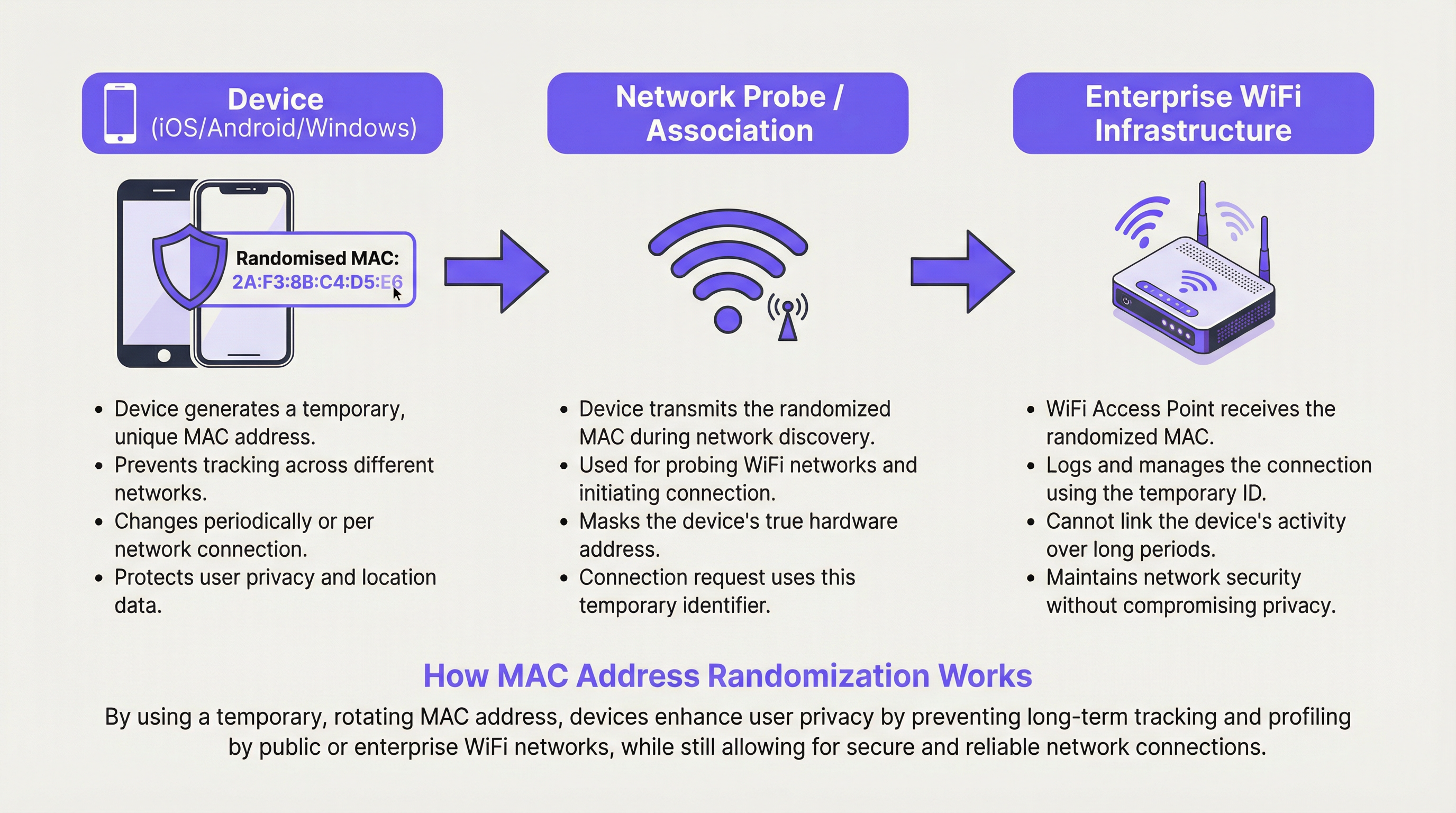
O sistema operacional de um dispositivo gera um endereço MAC randomizado em um de dois cenários: para verificar redes próximas (solicitações de sondagem ou probe requests) ou para se conectar a uma rede específica (associação). A implementação varia entre os sistemas operacionais, mas o princípio geral é consistente em todas as principais plataformas.
Durante a descoberta de rede, o dispositivo envia solicitações de sondagem usando um endereço temporário. Quando decide se conectar a uma rede, pode usar um novo endereço randomizado específico para essa conexão. A frequência de mudança é uma variável fundamental. Implementações modernas — incluindo iOS 14+ e Android 10+ — criam um endereço MAC randomizado único e persistente para cada rede WiFi salva (SSID). O dispositivo usará consistentemente o mesmo endereço randomizado para uma determinada rede em conexões repetidas, mas um endereço randomizado completamente diferente para qualquer outra rede. Isso proporciona uma experiência de conexão estável em redes confiáveis, ao mesmo tempo em que evita a correlação entre diferentes locais.
A implicação crítica para os administradores de rede é que, embora um dispositivo possa parecer estável em um único local ao longo do tempo, não há garantia de permanência. A rotação de endereços pode ser acionada por uma redefinição do dispositivo, exclusão de um perfil de rede ou atualização do sistema operacional. Qualquer sistema que trate um endereço MAC como um identificador permanente e confiável está operando sob uma premissa falsa.
Tipos de Randomização de Endereços MAC
Existem duas formas principais de randomização de endereços MAC que os arquitetos de rede devem entender. A Randomização de Solicitação de Sondagem (Probe Request Randomization) foi a implementação inicial, na qual os dispositivos usam um MAC aleatório apenas ao verificar redes, mas revelam seu MAC real ao se conectar. Isso ainda protege a privacidade de dispositivos que não se conectam, mas é menos eficaz quando uma conexão é estabelecida. A Randomização de Associação (Association Randomization) é a abordagem mais robusta e agora padrão, na qual um MAC randomizado é usado para a conexão real a um ponto de acesso. Esta é a forma que tem o impacto mais significativo no gerenciamento de redes corporativas, pois afeta todos os dispositivos conectados.
A distinção entre a randomização por SSID e por conexão também é operacionalmente importante. A randomização por SSID (o padrão atual do iOS e Android) significa que o mesmo endereço aleatório é reutilizado para o mesmo nome de rede, proporcionando certa estabilidade. A randomização por conexão, que algumas configurações focadas em privacidade ou versões futuras de sistemas operacionais podem adotar, geraria um novo endereço a cada conexão, tornando qualquer forma de continuidade de sessão impossível sem uma camada de identidade.
Implementação Específica por Sistema Operacional
| Sistema Operacional | Comportamento Padrão | Caminho de Gerenciamento | Notas |
|---|---|---|---|
| iOS 14+ | Habilitado por padrão por SSID | Ajustes > Wi-Fi > (i) > Endereço Wi-Fi Privado | Um MAC randomizado único é gerado para cada rede. Rotaciona se não for conectado por um período. |
| Android 10+ | Habilitado por padrão por SSID | Configurações > Rede > Wi-Fi > Avançado > Privacidade | O comportamento pode variar de acordo com o fabricante do dispositivo (OEM). |
| Windows 10/11 | Desabilitado por padrão | Configurações > Rede > Wi-Fi > Gerenciar redes conhecidas > Propriedades | Pode ser definido como Ativado, Desativado ou Alterar Diariamente por rede. |
| macOS (Ventura+) | Habilitado por padrão por SSID | Configurações do Sistema > Wi-Fi > Detalhes > Rotacionar endereço Wi-Fi | Alinha-se com o comportamento do iOS. |
Guia de Implementação
A adaptação à randomização de endereços MAC é um processo estruturado. As etapas a seguir fornecem uma estrutura de implantação neutra em relação a fornecedores para ambientes corporativos.
Passo 1: Conduza uma Auditoria de Dependência de MAC. Antes de fazer qualquer alteração, identifique todos os sistemas em seu ambiente que usam um endereço MAC como identificador principal. Isso inclui regras de firewall, reservas de DHCP, listas de controle de acesso (ACLs), ferramentas de monitoramento de rede e plataformas de análise. Documente cada dependência e classifique-a como um controle de segurança, uma ferramenta operacional ou uma entrada de análise. Esta auditoria forma a base do seu roteiro de remediação.
Passo 2: Desative os Controles de Segurança Baseados em MAC. Qualquer regra de segurança que conceda ou negue acesso com base exclusivamente em um endereço MAC deve ser substituída. Isso não é opcional; é um imperativo de segurança. Endereços MAC não são um fator de autenticação confiável. Substitua essas regras pela autenticação IEEE 802.1X, que exige que os dispositivos apresentem credenciais verificáveis a um servidor RADIUS. Este é o único método que fornece segurança e resiliência à randomização de MAC.
Passo 3: Implante o WPA3-Enterprise. Certifique-se de que sua infraestrutura sem fio suporte WPA3. A maioria dos pontos de acesso fabricados após 2020 é compatível com WPA3, mas verifique se o firmware está atualizado. O WPA3-Enterprise fornece Autenticação Simultânea de Iguais (SAE) e, em seu modo de 192 bits, atende aos requisitos de segurança de ambientes sensíveis, incluindo aqueles sujeitos ao PCI DSS e estruturas de segurança do setor público.
Passo 4: Modernize o Portal da sua Rede de Visitantes. Substitua qualquer splash page simples por um Captive Portal orientado por identidade. O portal deve oferecer, no mínimo, uma das seguintes opções: registro de e-mail com verificação, login social (OAuth), integração com programa de fidelidade ou um código de acesso pré-compartilhado. Cada um deles fornece um identificador de usuário estável que persiste em sessões e alterações de endereço do dispositivo. Certifique-se de que o portal e suas práticas de coleta de dados sejam totalmente compatíveis com a GDPR, com mecanismos de consentimento explícito.
Passo 5: Atualize sua Plataforma de Análise. Envolva seu fornecedor de análise de WiFi e pergunte diretamente como a plataforma lida com a randomização de MAC. Uma plataforma moderna deve se concentrar em análises baseadas em sessão, fluxos de usuários autenticados e agrupamento probabilístico de dispositivos, em vez de contagens brutas de endereços MAC. Estabeleça novas métricas de linha de base para a contagem de visitantes que levem em conta a mudança na metodologia.
Melhores Práticas
As seguintes melhores práticas refletem os padrões atuais do setor e as orientações neutras em relação a fornecedores para a operação de WiFi corporativo na era da randomização de endereços MAC.
Adote uma Arquitetura Centrada na Identidade (Identity-First). O princípio fundamental é tratar a identidade do usuário e do dispositivo como uma afirmação baseada em credenciais, não como uma observação de hardware. Toda decisão de acesso, evento de análise e entrada de log de segurança deve estar ancorada a uma identidade verificada, sempre que possível. Isso se alinha aos princípios do Zero Trust Network Access (ZTNA), que assumem que nenhum dispositivo é inerentemente confiável apenas por seus atributos de hardware.
Implemente 802.1X com Autenticação Baseada em Certificado para Dispositivos Gerenciados. Para dispositivos de propriedade corporativa, implante certificados de dispositivo por meio de sua plataforma de Gerenciamento de Dispositivos Móveis (MDM). Isso permite que o dispositivo se autentique na rede de forma automática e segura usando um certificado, proporcionando uma experiência de usuário perfeita e mantendo uma forte segurança. Esta é a implementação mais robusta do 802.1X e é recomendada para ambientes sujeitos a estruturas de conformidade.
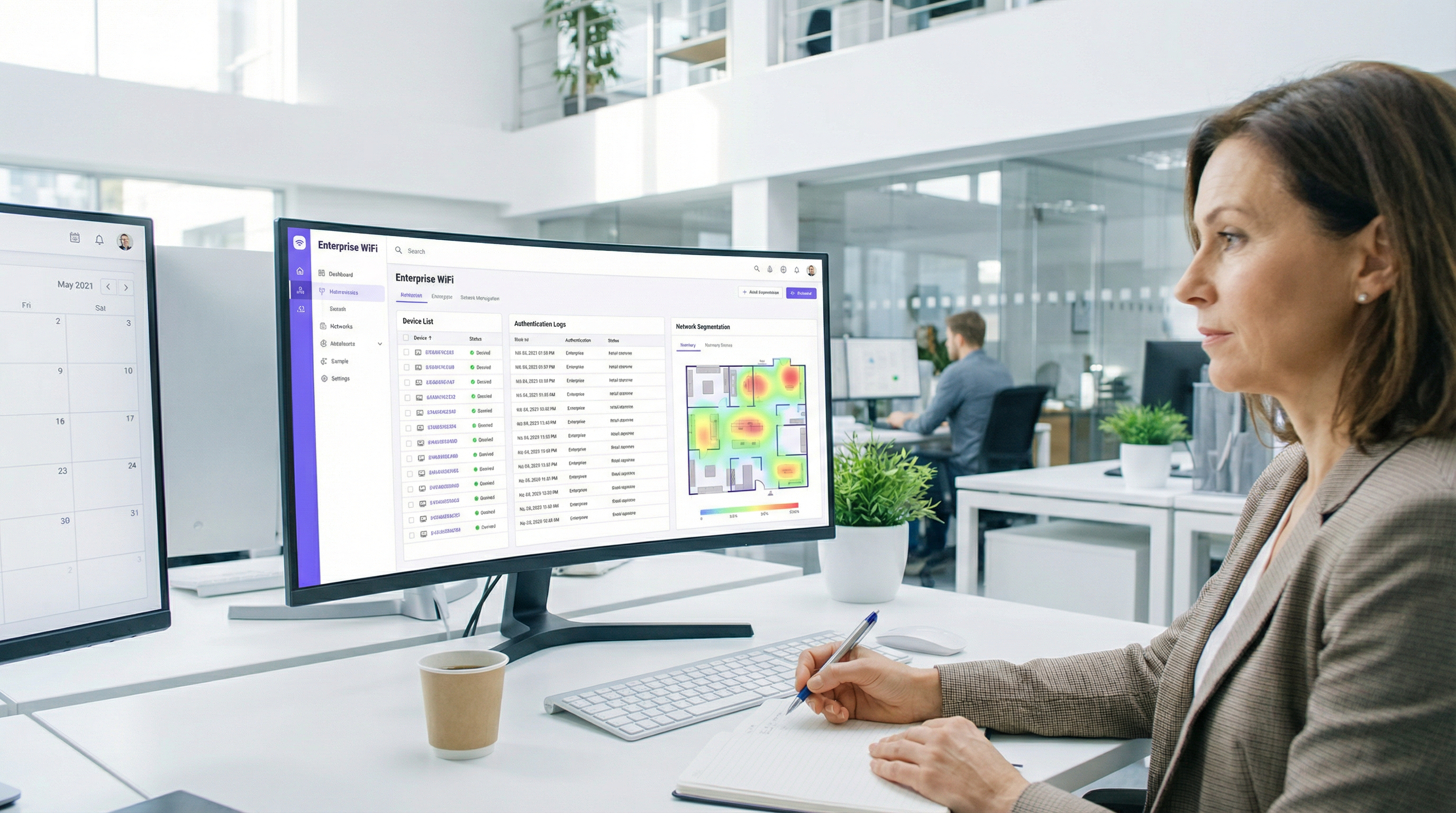
Use a Atribuição de VLAN via RADIUS para Segmentação de Rede. Em vez de usar ACLs baseadas em MAC para segmentação, configure seu servidor RADIUS para atribuir dispositivos a VLANs específicas com base em sua identidade autenticada. Um usuário visitante obtém a VLAN de visitantes; um dispositivo corporativo obtém a VLAN corporativa; um terminal de PDV obtém a VLAN de pagamento. Isso é dinâmico, escalável e imune à randomização de MAC.
Alinhe-se com a GDPR e os Princípios de Minimização de Dados. Sob a GDPR, um endereço MAC que pode ser vinculado a um indivíduo é considerado dado pessoal. A mudança para o gerenciamento baseado em identidade, onde a coleta de dados é explícita e baseada em consentimento, não é apenas uma melhoria técnica — é uma melhoria de conformidade. Certifique-se de que suas políticas de retenção de dados para logs de rede e dados de análise sejam revisadas à luz desses princípios.
Solução de Problemas e Mitigação de Riscos
A seguir estão os modos de falha mais comuns encontrados durante e após a transição do gerenciamento de rede baseado em MAC.
Modo de Falha 1: Dispositivos repetidamente bloqueados ou forçados a se reautenticar. A causa raiz é quase sempre uma ACL baseada em MAC residual ou um sistema de segurança que não foi totalmente migrado. Conduza uma revisão completa de todas as políticas de firewall e acesso à rede. Use sua plataforma de gerenciamento de rede para identificar quaisquer regras que façam referência a endereços MAC específicos e substitua-as por equivalentes baseados em identidade.
Modo de Falha 2: Os dados de análise mostram um pico massivo de dispositivos únicos. Este é o resultado direto de uma plataforma de análise que usa endereços MAC como o identificador único principal. A mitigação imediata é sinalizar todos os dados históricos coletados antes da auditoria como não confiáveis para contagens absolutas. Daqui para frente, estabeleça novas linhas de base usando sua plataforma de análise atualizada e ciente da identidade. Concentre os relatórios em tendências e métricas de usuários autenticados, em vez de contagens brutas de dispositivos.
Modo de Falha 3: Problemas de roaming em grandes locais. Em ambientes com muitos pontos de acesso, um dispositivo pode alterar seu endereço MAC randomizado ao fazer roaming de um ponto de acesso (BSSID) para outro, especialmente se o dispositivo tratar cada BSSID como uma rede distinta. Isso pode causar quedas de sessão e solicitações de reautenticação. A mitigação é garantir que sua infraestrutura sem fio use o 802.11r adequado (Fast BSS Transition) e que todos os pontos de acesso sob o mesmo SSID sejam configurados como um único domínio de mobilidade, minimizando os gatilhos para a rotação de endereços.
Modo de Falha 4: Esgotamento do pool de DHCP. Em ambientes onde as concessões de DHCP (leases) são longas e o pool é pequeno, um alto volume de dispositivos se conectando com novos MACs randomizados pode esgotar os endereços IP disponíveis. Mitigue isso revisando e encurtando os tempos de concessão de DHCP para redes de visitantes e garantindo que seu pool de DHCP seja dimensionado adequadamente para picos de conexões simultâneas, em vez de dispositivos únicos ao longo do tempo.
ROI e Impacto nos Negócios
A adaptação à randomização de endereços MAC é um investimento com um retorno claro e mensurável em várias dimensões.
ROI de Segurança. Substituir a lista de permissões (whitelisting) de MAC pela autenticação 802.1X elimina uma classe de vulnerabilidade que é frequentemente explorada. O MAC spoofing — onde um invasor clona um endereço MAC sabidamente bom para contornar os controles de acesso — é trivialmente fácil e amplamente documentado. Mudar para a autenticação baseada em credenciais remove totalmente esse vetor de ataque. O custo de uma única violação de rede, incluindo resposta a incidentes, notificação regulatória e danos à reputação, excede em muito o custo de uma atualização da infraestrutura de rede.
ROI de Conformidade. Para organizações sujeitas à GDPR, PCI DSS ou estruturas de segurança do setor público, a mudança para o gerenciamento de rede baseado em identidade apoia diretamente os objetivos de conformidade. O princípio de minimização de dados da GDPR é atendido coletando apenas os dados de que você precisa, com consentimento explícito. O PCI DSS exige uma segmentação de rede robusta que não pode ser alcançada de forma confiável com controles baseados em MAC. Evitar uma única multa significativa sob qualquer uma das estruturas fornece uma justificativa financeira convincente para o investimento.
ROI de Análise e Receita. A transição para um portal de visitantes orientado por identidade cria um canal direto para o engajamento do cliente e a coleta de dados. Organizações que implementaram portais WiFi integrados à fidelidade relatam melhorias mensuráveis no crescimento da lista de e-mails, taxas de visitas repetidas e na precisão da análise da jornada do cliente. Para uma rede de varejo ou grupo hoteleiro, a capacidade de identificar e engajar com precisão os clientes que retornam por meio de um canal de dados consentido tem implicações diretas na receita. A mudança do rastreamento de dispositivos anônimos para o engajamento de clientes conhecidos é uma melhoria fundamental na qualidade dos dados e na capacidade de inteligência de negócios.
Key Terms & Definitions
MAC Address (Media Access Control Address)
A unique, 48-bit hardware identifier assigned to a network interface controller (NIC) by the manufacturer. It is used as a network address for communications within a network segment and is structured as six pairs of hexadecimal digits (e.g., 00:1A:2B:3C:4D:5E).
Traditionally used by IT teams as a stable, unique identifier for devices on a WiFi network. Its reliability as a persistent identifier has been fundamentally undermined by MAC randomization, making it unsuitable as a primary key for security, access control, or analytics.
MAC Address Randomization
A privacy feature implemented in modern operating systems (iOS 14+, Android 10+, Windows 10+) where the device temporarily replaces its real, factory-assigned MAC address with a randomly generated one when connecting to or scanning for WiFi networks.
The central challenge for enterprise network managers. It prevents tracking of a device across different WiFi networks and over time, but disrupts legacy systems that depend on a stable MAC address for authentication, logging, and analytics.
IEEE 802.1X
An IEEE standard for port-based Network Access Control (PNAC). It provides an authentication mechanism requiring devices to present verifiable credentials to a RADIUS server before being granted access to a LAN or WLAN.
The gold-standard replacement for MAC-based access control. By authenticating the user or device via credentials rather than hardware attributes, it provides security that is entirely immune to MAC randomization. Essential for any enterprise network refresh.
WPA3-Enterprise
The latest generation of WiFi security protocol for enterprise environments, building on IEEE 802.1X. It offers enhanced encryption (up to 192-bit in its highest security mode) and protection against offline dictionary attacks and key reinstallation attacks.
The recommended security standard for corporate WiFi networks. Deploying WPA3-Enterprise alongside 802.1X is the definitive technical response to the security challenges posed by MAC randomization.
RADIUS (Remote Authentication Dial-In User Service)
A networking protocol that provides centralised Authentication, Authorisation, and Accounting (AAA) management for users who connect and use a network service.
The server-side component of an 802.1X deployment. When a device attempts to connect, the access point forwards the authentication request to the RADIUS server, which validates the credential and instructs the access point to grant or deny access — and optionally assign the device to a specific VLAN.
Captive Portal
A web page that a user of a public-access network is required to view and interact with before network access is granted. Portals are used for authentication, terms of service acceptance, payment, or marketing data collection.
For guest networks, the captive portal is the primary mechanism for establishing user identity in a post-MAC-randomization environment. A well-designed portal with a loyalty or social login integration provides a stable user identifier that replaces the MAC address for analytics and session management.
SSID (Service Set Identifier)
The public name of a WiFi network, broadcast by access points and visible to devices scanning for available connections.
Modern devices generate a unique, persistent randomized MAC address for each different SSID they connect to. This means a device will appear with a different MAC address on your 'Corporate' network versus your 'Guest' network, a critical detail for network segmentation and analytics.
GDPR (General Data Protection Regulation)
EU Regulation 2016/679, which governs the processing of personal data of individuals within the European Union. It requires a lawful basis for data processing, mandates data minimisation, and grants individuals rights over their data.
A static MAC address that can be linked to an individual is considered personal data under GDPR. Network managers must ensure that any system collecting or processing MAC addresses — or the new identity-based alternatives — has a documented lawful basis and appropriate data retention policies.
Zero Trust Network Access (ZTNA)
A security framework that requires all users and devices to be authenticated, authorised, and continuously validated before being granted access to applications and data, regardless of whether they are inside or outside the network perimeter.
MAC randomization is, in a sense, forcing enterprise networks toward Zero Trust principles by removing the ability to implicitly trust a device based on its hardware address. Adopting a ZTNA framework provides a coherent strategic context for the technical changes required.
Case Studies
A 200-room luxury hotel wants to provide a seamless, 'just-works' WiFi experience for returning guests, allowing them to connect automatically without a portal on subsequent visits. Their current system relies on MAC whitelisting for registered guests, which is now failing due to MAC randomization, generating a high volume of front-desk support calls.
The recommended solution is to deploy a WPA3-Enterprise network with 802.1X authentication, integrated with the hotel's Property Management System (PMS).
Infrastructure Upgrade: Verify all access points are WPA3-Enterprise certified and update firmware. Deploy or upgrade a RADIUS server (e.g., FreeRADIUS, Cisco ISE, or a cloud-hosted equivalent).
PMS Integration: Configure the PMS to automatically generate a unique, time-limited WiFi credential (username and a strong random password) for each guest at check-in. This credential is tied to their reservation and expires at check-out.
Guest Onboarding: At first connection, the guest is directed to a simple, branded captive portal where they enter their room number and last name to retrieve their credential. The device is then configured to trust the network's certificate and save the 802.1X profile.
Seamless Re-connection: On all subsequent connections during their stay — whether returning to the room, moving through the lobby, or using the restaurant WiFi — the device uses its saved 802.1X profile to authenticate seamlessly and securely in the background, with no user interaction required. The randomized MAC address is entirely irrelevant, as authentication is based on the credential.
Loyalty Integration (Phase 2): For returning guests across multiple stays, integrate the portal with the hotel's loyalty programme. Loyalty members can authenticate with their loyalty credentials, enabling the hotel to recognise them as returning guests and offer personalised welcome experiences.
A large retail chain with 150 stores uses WiFi analytics to measure footfall, dwell time in different departments, and queue lengths at checkout to optimise staffing and store layout. Since iOS 14 rolled out, their analytics platform is reporting inaccurate data, showing apparent unique visitor counts that are three to four times higher than actual footfall, and 'returning visitor' rates have dropped to near zero.
The retailer should transition to a multi-layered analytics strategy that de-emphasises MAC addresses as the primary identifier.
Upgrade Analytics Platform: Engage the current analytics vendor to understand their roadmap for MAC randomization. If the platform does not have a credible solution, evaluate alternatives that are designed for the post-randomization era. Modern platforms focus on session-based analysis and use probabilistic algorithms to estimate unique visitors, clearly distinguishing between 'devices seen' and 'estimated unique visitors'.
Implement an Identity Layer: Redesign the guest WiFi portal to offer a compelling reason for customers to log in. Options include a discount voucher on first login, access to a store loyalty account, or entry into a prize draw. Each login provides a stable identifier (email address, loyalty ID) that can be used to accurately track repeat visits across sessions and dates.
Augment with Non-WiFi Sensors: Deploy privacy-respecting IR beam counters or video analytics (people-counting only, no facial recognition) at store entrances and key department thresholds. This provides a ground-truth for absolute footfall counts, which can be used to calibrate and validate the WiFi analytics data.
Redefine KPIs: Work with the analytics team to redefine the key performance indicators. Shift from 'unique devices' to 'authenticated sessions', 'loyalty member visits', and 'estimated footfall' (from sensor data). Establish new baselines from the point of the platform upgrade and treat all historical MAC-based data as directionally useful but not absolutely accurate.
Scenario Analysis
Q1. You are the network architect for a multi-site conference centre. An event organiser wants to offer tiered WiFi access: a free, basic service for all attendees, and a paid, high-speed service for VIPs. Your current system uses MAC-based firewall rules to assign bandwidth tiers. How would you design a new solution that is resilient to MAC randomization and can scale across multiple simultaneous events?
💡 Hint:Consider how you can differentiate users at the point of authentication using a credential or payment token, and how RADIUS can dynamically assign network policies based on that identity.
Show Recommended Approach
The recommended design uses a single SSID with a captive portal that routes users to different authentication paths, with RADIUS handling dynamic policy assignment. The portal presents two options: 'Free Access' and 'VIP/Paid Access'. For the free tier, users accept terms and conditions and optionally provide an email address. The portal authenticates them to the RADIUS server, which assigns them to a VLAN with a bandwidth policy capped at, for example, 5 Mbps. For the VIP tier, users either enter a pre-purchased access code (distributed with their VIP ticket) or complete a payment via an integrated gateway. Upon successful validation, the RADIUS server assigns them to a separate VLAN with a high-speed policy. This design is entirely credential-driven, scales to any number of simultaneous events by issuing different access codes per event, and is completely immune to MAC randomization because no access decision is based on the device's hardware address.
Q2. A stadium is experiencing widespread connectivity complaints during a major event. The network logs show thousands of 802.11 authentication failures from devices with MAC addresses not present in the access control list. The security policy, implemented five years ago, blocks any MAC address not seen on the network in the previous 90 days. What is the root cause, what is the immediate remediation, and what is the long-term architectural fix?
💡 Hint:Consider the behaviour of devices belonging to fans who attend infrequently, and the fundamental incompatibility between time-based MAC whitelisting and address randomization.
Show Recommended Approach
Root cause: The 90-day MAC whitelist is fundamentally incompatible with MAC address randomization. A fan who attended a match more than 90 days ago will connect with a new randomized MAC address. The security system sees this as an unknown device and blocks it. For a stadium with infrequent events, the vast majority of fans will fall outside the 90-day window, causing mass authentication failures. Immediate remediation: Disable the MAC-based ACL immediately. It is causing a denial-of-service for legitimate users and providing negligible security value, as MAC spoofing trivially bypasses it. Replace it with an open network or a simple captive portal with terms-of-service acceptance to restore connectivity for the event. Long-term fix: Design a proper guest network architecture. For a public venue like a stadium, a captive portal with social login or ticketing system integration is the appropriate solution. This provides a user identity, enables analytics, and supports future loyalty and engagement programmes, without any dependence on MAC addresses.
Q3. Your retail chain's marketing team wants to run a 'welcome back' campaign, offering a personalised discount to customers who have visited a store more than three times in the past month. They want to deliver this offer via the guest WiFi portal. Explain why a MAC-address-based tracking system will fail to deliver this, and design an alternative technical architecture that will work reliably.
💡 Hint:Focus on what constitutes a reliable, persistent customer identifier versus a mutable hardware attribute, and how the captive portal can bridge the gap between an anonymous device and a known customer.
Show Recommended Approach
A MAC-based system will fail because the device's randomized MAC address will likely differ between visits, making each visit appear to be from a new, unknown device. It would be impossible to build a reliable visit history or identify returning customers. The alternative architecture is an identity-based loyalty WiFi programme. Implementation: 1) Customers register once via the captive portal, providing an email address or phone number, or linking their existing loyalty account. 2) On each subsequent visit, they log in to the WiFi using their loyalty credentials (a simple username/password or a one-tap social login). 3) The system records a 'visit event' against the stable loyalty ID, not the MAC address. 4) When the visit count for a specific loyalty ID reaches three within a rolling 30-day window, the portal's post-authentication landing page automatically displays the personalised discount offer. This architecture is accurate, consent-based, GDPR-compliant, and provides the marketing team with a rich, reliable dataset for campaign analysis and customer journey mapping.
Key Takeaways
- ✓MAC address randomization is the default setting on virtually all modern smartphones and laptops, making it the baseline assumption for any enterprise WiFi deployment.
- ✓Legacy MAC-based security controls (whitelists, ACLs) are now both ineffective and operationally disruptive — they must be replaced with IEEE 802.1X and WPA3-Enterprise.
- ✓WiFi analytics platforms that use MAC addresses as unique identifiers will report severely inflated visitor counts and near-zero returning visitor rates — a platform upgrade or reconfiguration is essential.
- ✓The strategic response is to shift from identity-by-hardware to identity-by-credential: authenticate users, not devices.
- ✓Modern captive portals with loyalty, social, or email login integrations provide a stable user identifier that is more accurate, more valuable, and more GDPR-compliant than MAC tracking.
- ✓Adapting to MAC randomization is not just a technical fix — it is an opportunity to build a more secure, compliant, and customer-centric network architecture.
- ✓Conduct a MAC dependency audit this quarter: identify every system that relies on a static MAC address and classify it for immediate replacement or upgrade.




