

Metropolitan Area Networks (MANs): Uma Análise Profunda sobre Tecnologias, Aplicações e Tendências Futuras
This guide provides a comprehensive technical reference on Metropolitan Area Networks (MANs) for IT leaders and network architects. It covers core technologies, deployment strategies, and business considerations for implementing high-performance, city-scale networks. The content is tailored for decision-makers in hospitality, retail, events, and public-sector organisations.
🎧 Listen to this Guide
View Transcript

Resumo Executivo
Uma Metropolitan Area Network (MAN) é um componente de infraestrutura crítico para qualquer organização que opere em vários locais dentro de uma única região geográfica. Ao interconectar Local Area Networks (LANs) distribuídas, uma MAN cria uma malha de rede unificada e de alto desempenho que reduz a latência, diminui os custos de largura de banda entre locais e permite gerenciamento e segurança centralizados. Para CTOs e diretores de TI em redes de hotéis, franquias de varejo e locais de grande escala, uma MAN bem arquitetada é a base para oferecer uma experiência conectada consistente e de alta qualidade, suportando aplicações em nuvem com uso intensivo de dados e escalando para demandas futuras como IoT e 5G. Este guia fornece uma análise técnica profunda e neutra em relação a fornecedores sobre a arquitetura de MAN, modelos de implantação e melhores práticas operacionais. Ele vai além da teoria acadêmica para oferecer orientações práticas para planejar, implementar e otimizar uma MAN, a fim de impulsionar valor de negócios mensurável, aprimorar a postura de segurança e garantir um retorno sobre o investimento positivo.
Análise Técnica Profunda
Uma MAN preenche a lacuna entre a rede local e a rede de longa distância, geralmente abrangendo uma área geográfica de 5 a 50 quilômetros. Sua função principal é fornecer conectividade de alta velocidade e baixa latência entre locais distintos, como escritórios corporativos, data centers e locais públicos. A arquitetura é tipicamente hierárquica, compreendendo três camadas distintas.
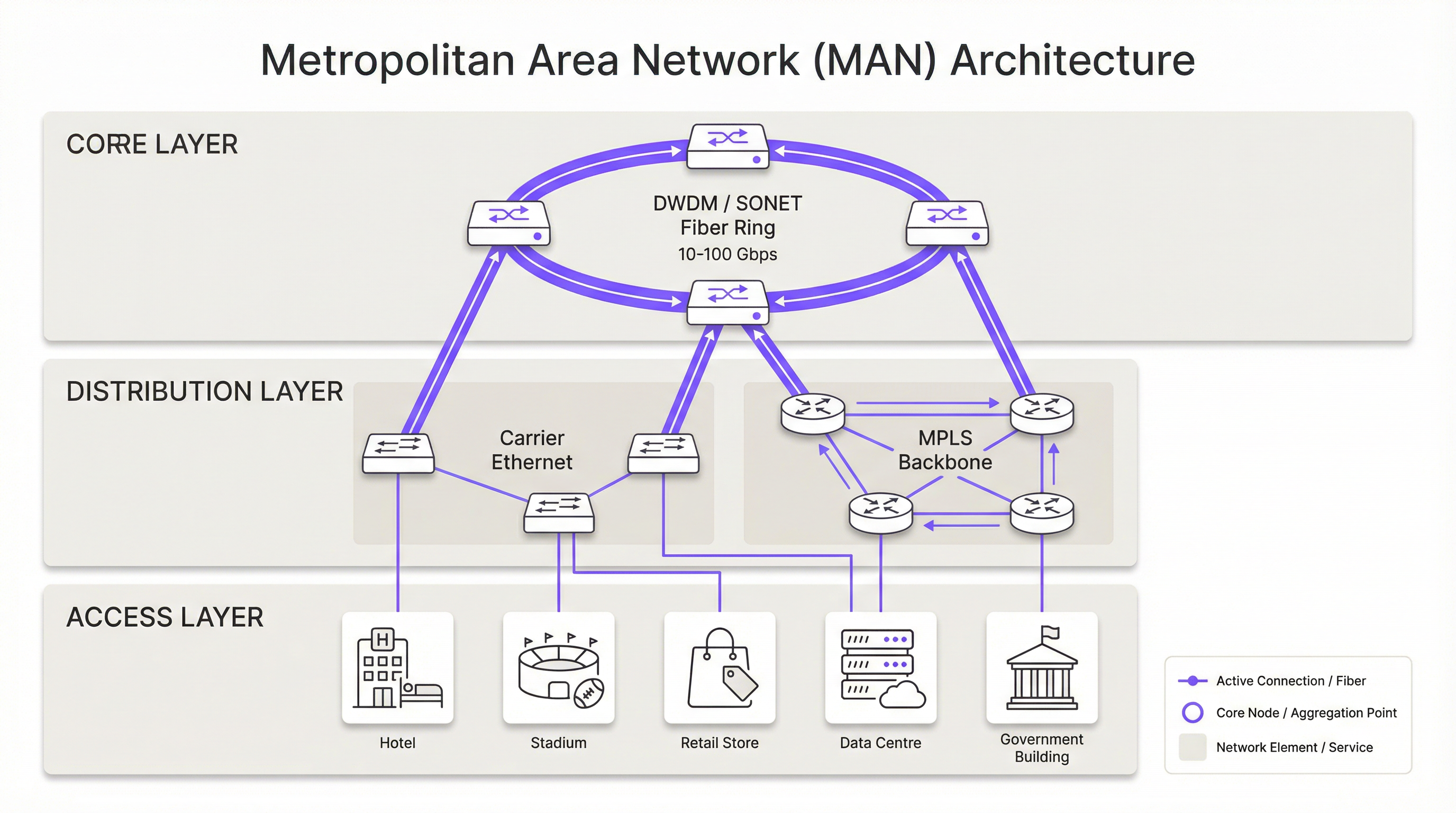
1. Camada Core (Núcleo): Este é o backbone de alta velocidade da rede, construído quase exclusivamente em um anel de fibra óptica redundante. Tecnologias como Dense Wavelength Division Multiplexing (DWDM) e Synchronous Optical Networking (SONET) permitem múltiplos fluxos de dados sobre um único par de fibras, com larguras de banda típicas variando de 10 Gbps a 100 Gbps e além. A topologia em anel, frequentemente regida pelo padrão IEEE 802.17 Resilient Packet Ring (RPR), garante alta disponibilidade com tempos de failover inferiores a 50 ms, tornando o núcleo resiliente a falhas de nó único ou de link.
2. Camada de Distribuição: Esta camada intermediária agrega o tráfego da camada de acesso e o conecta ao núcleo. As principais tecnologias aqui incluem Carrier Ethernet e Multiprotocol Label Switching (MPLS). O MPLS é particularmente crucial para MANs de nível corporativo, pois permite engenharia de tráfego, garantias de Qualidade de Serviço (QoS) e a criação de VPNs seguras e privadas de Camada 2 ou Camada 3. Isso permite que as organizações segmente o tráfego — por exemplo, separando dados corporativos do WiFi público para visitantes — em toda a infraestrutura compartilhada.
3. Camada de Acesso: Esta é a "última milha" que conecta edifícios e locais individuais à camada de distribuição. Embora a fibra continue sendo o meio preferido por seu desempenho e confiabilidade, esta camada frequentemente emprega uma mistura de tecnologias com base em custo e praticidade. O Fixed Wireless Access (FWA) usando links de micro-ondas e, cada vez mais, a tecnologia celular 5G fornecem alternativas robustas e de alta velocidade onde a instalação de fibra é proibitiva.
Guia de Implantação
A implantação de uma MAN é um empreendimento significativo que requer planejamento cuidadoso. O processo pode ser dividido em quatro fases principais.
Fase 1: Viabilidade e Desenvolvimento do Business Case. Comece auditando seus custos de conectividade entre locais e limitações de desempenho existentes. Identifique os principais impulsionadores de negócios para uma MAN — você está procurando melhorar o desempenho de aplicações em nuvem, centralizar o backup de dados ou lançar um novo serviço para visitantes em toda a cidade? Modele o Custo Total de Propriedade (TCO) de uma MAN, comparando um modelo de construção (locação de fibra apagada) com um serviço gerenciado de uma operadora. Para a maioria das organizações com mais de cinco locais em uma área metropolitana, um modelo de construção oferece um ROI superior em um período de 7 a 10 anos.
Fase 2: Seleção de Tecnologia e Design Neutro em Relação a Fornecedores. Com base em seus requisitos de negócios, crie um design de alto nível. Especifique tecnologias abertas e baseadas em padrões (por exemplo, Carrier Ethernet, MPLS) para evitar a dependência de fornecedores (vendor lock-in). Seu design deve detalhar a arquitetura de três camadas, os protocolos de roteamento propostos (como OSPF e BGP) e um plano de segurança abrangente incorporando IEEE 802.1X, segmentação de VLAN e estratégias de criptografia como MACsec.
Fase 3: Aquisição e Implantação Física. Esta fase costuma ser a mais desafiadora, pois envolve a navegação por licenças de passagem e obras civis para a implantação de fibra. Emita RFPs com base em seu design neutro em relação a fornecedores. Ao alugar fibra apagada, certifique-se de que o Acordo de Nível de Serviço (SLA) especifique as características da fibra e o tempo médio de reparo (MTTR). Para links sem fio, conduza uma pesquisa de RF minuciosa para identificar possíveis interferências.
Fase 4: Comissionamento e Entrega Operacional. Uma vez que a infraestrutura física esteja instalada, a rede é comissionada. Isso envolve a configuração de todos os elementos da rede, testes de mecanismos de failover e redundância, e validação do desempenho em relação às especificações do design. Por fim, a rede é entregue à equipe do Centro de Operações de Rede (NOC), equipada com as ferramentas de monitoramento e gerenciamento necessárias.
Melhores Práticas
- Projete para Redundância: Uma MAN deve ser resiliente. O núcleo deve apresentar caminhos de fibra diversos, a camada de distribuição deve ter conexões dual-homed para o núcleo, e os locais de acesso críticos devem ter um caminho de failover secundário (por exemplo, fibra como primário, 5G FWA como secundário).
- Segmente o Tráfego Logicamente: Use VLANs (IEEE 802.1Q) e VPNs MPLS para criar redes logicamente separadas para diferentes tipos de tráfego (por exemplo, corporativo, visitantes, IoT, VoIP). Este é um requisito fundamental para segurança e conformidade com padrões como PCI DSS e GDPR.
- Centralize o Monitoramento da Rede: Implante um Sistema de Monitoramento de Rede (NMS) robusto que forneça um painel único para toda a MAN. O sistema deve monitorar a utilização do link, latência, perda de pacotes e a integridade dos dispositivos em tempo real, com alertas baseados em IA para permitir manutenção proativa.
- Priorize a Segurança: Implemente o controle de acesso baseado em porta usando IEEE 802.1X em todas as portas com fio. Para segmentos sem fio, exija WPA3-Enterprise. Criptografe o tráfego sensível em trânsito usando IPsec ou MACsec. Realize regularmente avaliações de vulnerabilidade e testes de penetração.
Solução de Problemas e Mitigação de Riscos
| Modo de Falha Comum | Estratégia de Mitigação | Passos para Solução de Problemas |
|---|---|---|
| Corte de Fibra | Use uma topologia em anel redundante com caminhos físicos diversos. Certifique-se de que o SLA da operadora inclua um MTTR rigoroso. | Use um Reflectômetro Óptico no Domínio do Tempo (OTDR) para identificar a localização da ruptura. Redirecione o tráfego pelo caminho secundário. |
| Erro de Configuração | Implemente um processo rigoroso de gerenciamento de mudanças com revisão por pares. Use ferramentas de automação de rede com validação pré-implantação. | Reverta para a última configuração válida conhecida. Use ferramentas de monitoramento de rede para correlacionar a falha com a mudança recente. |
| Ataque DDoS | Contrate um serviço de mitigação de DDoS baseado em nuvem que possa limpar o tráfego malicioso antes que ele atinja a borda da sua rede. | Identifique o vetor de ataque e o alvo usando análise de NetFlow. Acione o provedor de mitigação de DDoS para aplicar regras de filtragem. |
| Queda de Energia no Nó | Equipe todos os nós de núcleo e distribuição com fontes de alimentação ininterrupta (UPS) e, para nós críticos, geradores de backup. | Verifique o status de energia no nó afetado. Monitore os logs do UPS e do gerador. |
ROI e Impacto nos Negócios
Calcular o Retorno sobre o Investimento para uma MAN envolve mais do que apenas comparar custos de conectividade. O impacto nos negócios é multifacetado. Economias diretas de custos vêm da consolidação de várias conexões de internet caras e linhas dedicadas em um único backbone mais eficiente. Ganhos de produtividade são alcançados por meio de menor latência, o que melhora o desempenho de aplicações baseadas em nuvem, VoIP e videoconferência. Segurança e conformidade aprimoradas reduzem o risco de violações de dados dispendiosas e multas regulatórias. Por fim, uma MAN é uma plataforma habilitadora para inovação; ela fornece a base escalável e de alto desempenho necessária para iniciativas de edifícios inteligentes, implantações de IoT em larga escala e experiências de visitantes de próxima geração. Ao construir o business case, quantifique cada um desses benefícios para apresentar uma visão holística do valor do projeto.

Key Terms & Definitions
Dark Fiber
Fiber optic cable that has been physically installed but is not currently in use. Organisations can lease dark fiber from carriers or municipalities to build their own private networks.
When an IT team decides to build its own MAN instead of buying a managed service, leasing dark fiber is often the most cost-effective way to create the physical backbone, offering maximum control over the network.
Carrier Ethernet
A set of standards-based services defined by the MEF (Metro Ethernet Forum) that deliver Ethernet services over MAN and WAN networks. It provides scalability and reliability comparable to older SONET/SDH technologies.
For network architects, specifying Carrier Ethernet for MAN services ensures interoperability between different vendors and provides a familiar, flexible, and cost-effective transport technology for enterprise connectivity.
MPLS (Multiprotocol Label Switching)
A network routing technique that directs data from one node to the next based on short path labels rather than long network addresses, avoiding complex lookups in a routing table.
CTOs and network architects leverage MPLS to create secure VPNs between sites and to engineer traffic flows, ensuring that high-priority applications like VoIP get the bandwidth and low latency they need, even on a congested network.
DWDM (Dense Wavelength Division Multiplexing)
A fiber-optic technology that increases bandwidth by allowing multiple data streams to be sent simultaneously over a single fiber optic cable, with each stream using a different wavelength (color) of light.
In a MAN core, DWDM is the key to achieving massive scalability. It allows network operators to add capacity to their fiber backbone without the enormous expense of laying more cables.
IEEE 802.1X
An IEEE standard for Port-Based Network Access Control (PNAC). It provides an authentication mechanism to devices wishing to attach to a LAN or WLAN.
For IT security managers, implementing 802.1X is a fundamental step in securing the network edge. It ensures that only authorized and authenticated users and devices can gain access to the wired or wireless network.
Resilient Packet Ring (RPR)
An IEEE 802.17 standard protocol designed for the transport of data traffic over optical fiber ring networks. It provides high-speed data transfer and fast (sub-50ms) recovery from link or node failures.
When designing the core of a MAN, architects specify RPR to build in carrier-grade resiliency, ensuring that a single fiber cut or equipment failure doesn't cause a catastrophic network outage.
PCI DSS
The Payment Card Industry Data Security Standard is a set of security standards designed to ensure that all companies that accept, process, store or transmit credit card information maintain a secure environment.
For any retail or hospitality business, ensuring the MAN segment that carries payment data is compliant with PCI DSS is non-negotiable. This involves strict network segmentation, access control, and monitoring to protect cardholder data.
GDPR (General Data Protection Regulation)
A regulation in EU law on data protection and privacy for all individuals within the European Union and the European Economic Area. It also addresses the transfer of personal data outside the EU and EEA areas.
When providing public or guest WiFi over a MAN, venue operators must ensure their systems comply with GDPR. This involves obtaining explicit user consent, anonymising personal data like MAC addresses for analytics, and managing data retention policies.
Case Studies
A hotel group with 10 properties spread across a major city needs to replace its expensive, slow, and separately managed internet connections at each site. The goal is to improve guest WiFi performance, centralise data backup to a private data centre, and deploy a new VoIP phone system across all locations.
The recommended solution is to deploy a private MAN using leased dark fiber. A 10 Gbps resilient fiber ring would form the core, connecting three regional distribution nodes. Each hotel would connect to its nearest distribution node via a 1 Gbps Carrier Ethernet circuit. MPLS Layer 3 VPNs would be configured to create three separate virtual networks: one for guest WiFi traffic, one for corporate/VoIP traffic, and one for the data backup service. This segmentation ensures that a surge in guest internet usage does not impact the quality of VoIP calls or the performance of critical business systems. IEEE 802.1X would be enforced on the corporate network, and the guest WiFi would be secured with WPA3 and integrated with a cloud-based analytics platform for GDPR compliance.
A 70,000-seat stadium needs to provide high-density WiFi for fans, support broadcast media operations, and connect its own retail and ticketing systems. The existing connectivity is unreliable and cannot handle the load on event days.
The stadium would act as the central hub of a campus-area MAN. The solution involves two diverse 40 Gbps fiber connections from the stadium's data centre to two different carrier hotels in the city, forming a high-availability connection to the internet and cloud services. Within the stadium, a hierarchical network of aggregation and access switches connects over 1,500 high-density WiFi 6E access points. Network segmentation is critical: a VLAN/MPLS segment is created for public fan WiFi, another for broadcast media with guaranteed bandwidth, a third for PCI DSS-compliant retail and ticketing systems, and a fourth for building management and security systems. A dedicated on-site NOC with real-time analytics monitors the network performance, especially during events, to proactively manage load and interference.
Scenario Analysis
Q1. Your organisation is opening a new branch office in a location where fiber is not available for six months, but there is strong 5G coverage. How would you integrate this site into your existing MPLS-based MAN in the interim?
💡 Hint:Consider how SD-WAN can use multiple transport types and how to secure traffic over the public internet.
Show Recommended Approach
The recommended approach is to deploy an SD-WAN appliance at the new branch. The SD-WAN appliance would use the 5G connection as its primary transport path. It would form a secure IPsec tunnel back to the SD-WAN headend in the corporate data centre, allowing the branch office to securely connect to the MPLS MAN. Application-aware routing policies would be configured to prioritise critical traffic over the 5G link. When the fiber circuit becomes available, it can be added as a second transport path, and the SD-WAN can be configured to use it as the primary path, keeping the 5G link as a high-performance backup.
Q2. A large conference centre connected to your MAN is hosting a major tech event. The event organiser wants a private, isolated, high-bandwidth network for their keynote presentations and live streams, completely separate from the public attendee WiFi. How would you provision this?
💡 Hint:Think about logical segmentation. How can you create a dedicated virtual network over the shared physical infrastructure?
Show Recommended Approach
The most robust solution is to provision a dedicated Layer 2 VPN (VPLS) or Layer 3 VPN (VRF) for the event organiser using the MAN's MPLS capabilities. This creates a completely separate virtual network for their traffic from the conference centre back to a dedicated internet breakout or to their own corporate network. A specific VLAN would be configured on the conference centre's switches for the event organiser's use, which would then be mapped to the dedicated MPLS VPN. QoS policies would be applied to guarantee the required bandwidth for their live streaming activities, ensuring it is not impacted by the thousands of attendees using the public WiFi network.
Q3. You are seeing intermittent packet loss and high latency to a retail store that is connected to your MAN via a fixed wireless link. What are the first three things you should investigate?
💡 Hint:Think about the unique failure modes of wireless technologies compared to fiber.
Show Recommended Approach
- RF Interference: Fixed wireless links are susceptible to interference from other wireless sources (e.g., other nearby networks, radar systems). The first step is to use the wireless bridge's management interface or a separate spectrum analyser to check for interference on the operating channel. If interference is detected, changing the channel to a cleaner frequency may resolve the issue. 2. Line of Sight Obstruction: Unlike fiber, wireless links require a clear line of sight between the two antennas. A physical obstruction that has appeared since installation (e.g., a new building, tree growth, a crane) can degrade the signal. A visual inspection, followed by checking the received signal strength indicator (RSSI) against its baseline from installation, is crucial. 3. Weather Conditions: Heavy rain, snow, or fog can attenuate microwave signals, a phenomenon known as "rain fade." Correlate the periods of high latency and packet loss with historical weather data. If the link is not engineered with enough fade margin for the climate, the only solutions are to upgrade to larger antennas or a higher-power radio system.
Key Takeaways
- ✓A MAN connects multiple LANs across a city or large campus, creating a single, unified network.
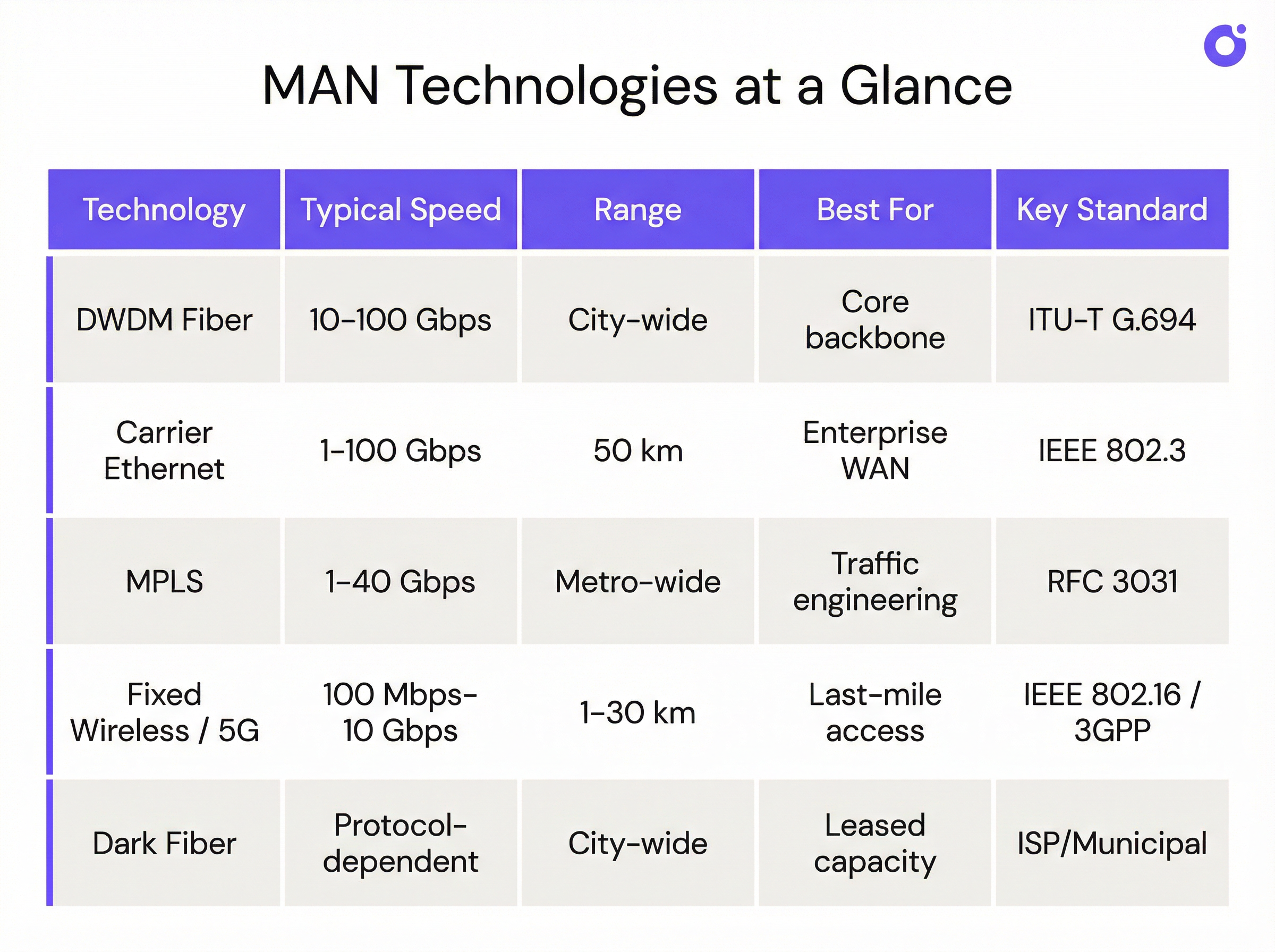
- ✓Core technologies include fiber optics (DWDM, SONET), Carrier Ethernet, and MPLS for traffic engineering.
- ✓A three-layer architecture (Core, Distribution, Access) is the standard design pattern.
- ✓Leasing dark fiber is often the most cost-effective way to build a private MAN for multi-site organisations.
- ✓Network segmentation using VLANs and MPLS is critical for security and compliance (PCI DSS, GDPR).
- ✓Redundancy through ring topologies and diverse paths is essential for high availability.
- ✓Future trends include deeper integration with 5G for backhaul and the use of SD-WAN as a control overlay.




