

Webhooks vs API Polling para Dados de WiFi: Qual Utilizar?
This guide provides a definitive technical comparison between webhooks and API polling for retrieving WiFi intelligence data. It offers actionable guidance for IT managers, architects, and developers to help them select the optimal data integration pattern for real-time responsiveness, operational efficiency, and scalable deployments in enterprise environments.
🎧 Listen to this Guide
View Transcript

Resumo Executivo
Para líderes de TI e operadores de estabelecimentos, o método escolhido para extrair dados de uma plataforma de inteligência de WiFi como a Purple é uma decisão arquitetônica fundamental com consequências operacionais significativas. Os dois padrões principais, API polling e webhooks, oferecem um forte trade-off entre a simplicidade de implementação e o desempenho em tempo real. O API polling, um modelo pull iniciado pelo cliente, consulta repetidamente uma API em busca de novos dados em intervalos fixos. Embora seja simples de implementar, consome muitos recursos, introduz latência de dados inerente e tem baixa escalabilidade. Em contrapartida, os webhooks empregam um modelo push orientado a eventos e iniciado pelo servidor. Eles entregam payloads de dados a um endpoint predefinido no instante em que um evento específico ocorre — como um visitante se conectando à rede. Essa abordagem fornece dados verdadeiramente em tempo real, garante alta eficiência de recursos e oferece escalabilidade superior. Para qualquer aplicação que exija engajamento contextual imediato — desde o acionamento de automação de marketing até o envio de alertas operacionais — os webhooks são a escolha arquitetônica superior. Este guia fornece uma análise técnica aprofundada de ambos os padrões, oferece orientações de implementação independentes de fornecedor e apresenta estudos de caso do mundo real para ajudar arquitetos e desenvolvedores a tomarem uma decisão informada que se alinhe aos seus objetivos de negócios para ROI, throughput e mitigação de riscos.
Análise Técnica Aprofundada
Compreender as diferenças fundamentais entre API polling e webhooks é fundamental para projetar sistemas robustos e eficientes que aproveitam os dados de WiFi. Esta seção explora a arquitetura, as características de desempenho e as implicações de segurança de cada padrão.
O que é API Polling?
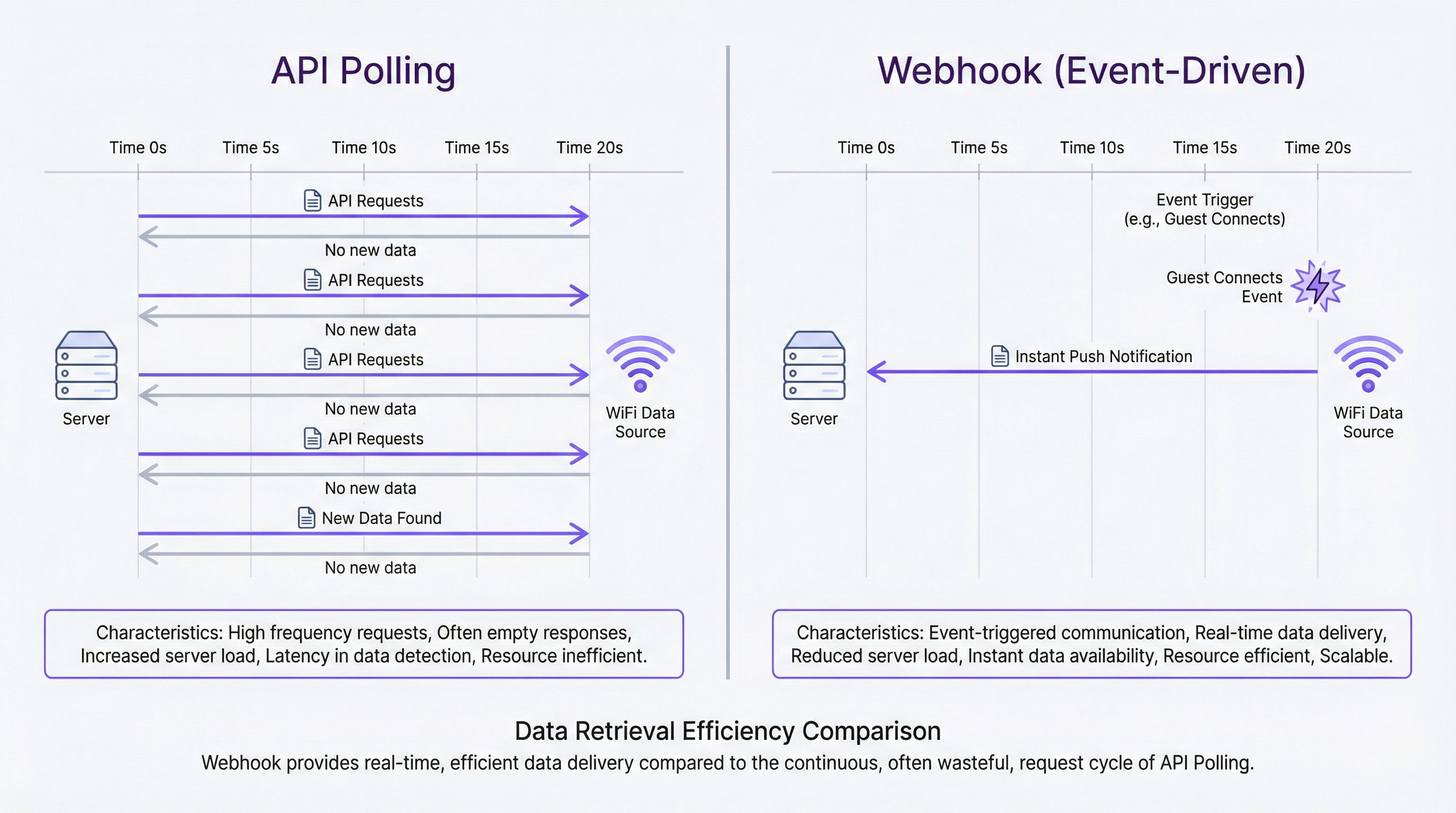
O API polling é um mecanismo síncrono baseado em pull, onde uma aplicação cliente faz solicitações HTTP repetidas a uma API de servidor em uma frequência predeterminada para verificar se há novos dados. Ele opera em um ciclo simples de solicitação-resposta: o cliente pergunta "Há alguma informação nova?" e o servidor responde.
Características:
- Iniciado pelo Cliente: O cliente é responsável por iniciar toda a comunicação.
- Intervalo Fixo: As solicitações são feitas em intervalos regulares (por exemplo, a cada 60 segundos).
- Síncrono: O cliente aguarda uma resposta antes de prosseguir ou fazer a próxima solicitação.
Vantagens:
- Simplicidade: A implementação costuma ser direta, exigindo apenas um script simples ou uma tarefa agendada para fazer solicitações HTTP GET.
- Carga Previsível: A carga no sistema cliente é consistente e fácil de prever.
Desvantagens:
- Ineficiência: A grande maioria das consultas não retorna novos dados, consumindo largura de banda e ciclos de processamento desnecessários tanto no lado do cliente quanto do servidor. Esta é uma fonte significativa de desperdício em implantações de grande escala.
- Latência: Os dados nunca são verdadeiramente em tempo real. O "frescor" dos dados é, na melhor das hipóteses, limitado pelo intervalo de polling. Para um intervalo de 5 minutos, os dados podem ter até 4 minutos e 59 segundos de atraso, o que é inaceitável para aplicações sensíveis ao tempo.
- Problemas de Escalabilidade: À medida que o número de clientes ou a frequência de polling aumenta, a carga na API do servidor cresce linearmente, podendo levar à degradação do desempenho ou à limitação de taxa (rate-limiting).
O que são Webhooks?
Os webhooks são um mecanismo assíncrono baseado em push para comunicação servidor a servidor. Em vez de o cliente solicitar dados repetidamente, o servidor envia automaticamente — ou faz o push — de um payload de dados para uma URL de cliente designada (o "endpoint do webhook") assim que um evento específico ocorre. Isso é frequentemente chamado de "API reversa" ou arquitetura orientada a eventos.
Características:
- Iniciado pelo Servidor (Orientado a Eventos): A comunicação é acionada por um evento no servidor (por exemplo,
guest_connects,user_leaves_venue). - Tempo Real: Os dados são entregues quase instantaneamente após a ocorrência do evento.
- Assíncrono: O cliente recebe os dados passivamente, sem precisar iniciar uma solicitação.
Vantagens:
- Eficiência: A comunicação só acontece quando há novos dados para compartilhar, eliminando solicitações desperdiçadas e reduzindo drasticamente a carga na rede e no servidor.
- Dados em Tempo Real: Os webhooks são o padrão do setor para alcançar a entrega de dados em tempo real, permitindo ações imediatas e fluxos de trabalho contextuais.
- Escalabilidade: A arquitetura é altamente escalável, pois o servidor só gasta recursos quando um evento é acionado, em vez de lidar continuamente com consultas de milhares de clientes.
Desvantagens:
- Complexidade de Implementação: A configuração inicial é mais trabalhosa. Requer a criação de um endpoint HTTP estável e publicamente acessível no lado do cliente para receber as solicitações POST de entrada do servidor.
- Gerenciamento de Confiabilidade: A aplicação cliente deve ser projetada para lidar com os dados recebidos de forma confiável, incluindo o gerenciamento de possíveis tempos de inatividade e picos de processamento.
Comparação Arquitetônica
| Recurso | API Polling | Webhooks (Orientado a Eventos) |
|---|---|---|
| Fluxo de Dados | Pull (Iniciado pelo cliente) | Push (Iniciado pelo servidor) |
| Frescor dos Dados | Atrasado (pelo intervalo de polling) | Tempo Real |
| Eficiência | Baixa (muitas solicitações vazias) | Alta (comunicação apenas no evento) |
| Carga no Servidor | Alta e constante | Baixa e esporádica (no evento) |
| Carga no Cliente | Alta (solicitações constantes) | Baixa (escuta passivamente) |
| Escalabilidade | Ruim | Excelente |
| Implementação | Configuração inicial simples | Requer um endpoint público |
Considerações de Segurança
Ambos os padrões exigem medidas de segurança robustas, especialmente ao lidar com informações de identificação pessoal (PII) sujeitas a regulamentações como a GDPR. [1]
Para Webhooks: A segurança é fundamental. O endpoint receptor DEVE ser protegido usando HTTPS (criptografia TLS) para proteger os dados em trânsito. Além disso, para evitar ataques de spoofing, onde um agente mal-intencionado envia dados falsos para o seu endpoint, os payloads devem ser verificados. A plataforma da Purple, alinhada com as melhores práticas do setor, inclui uma assinatura exclusiva no cabeçalho HTTP
X-Purple-Signaturede cada solicitação de webhook. Essa assinatura é um hash (HMAC-SHA256) do corpo do payload, criado usando uma chave secreta compartilhada entre a sua aplicação e a Purple. Seu endpoint deve calcular o mesmo hash e verificar se ele corresponde à assinatura no cabeçalho antes de processar os dados. Isso garante que os dados sejam autênticos (da Purple) e não tenham sido adulterados.Para API Polling: A principal preocupação de segurança é o gerenciamento da chave da API. Essa chave deve ser armazenada com segurança e nunca exposta no código do lado do cliente. Toda a comunicação da API também deve ocorrer via HTTPS. O acesso deve ser registrado e monitorado em busca de atividades anômalas que possam indicar uma chave comprometida.
Guia de Implementação
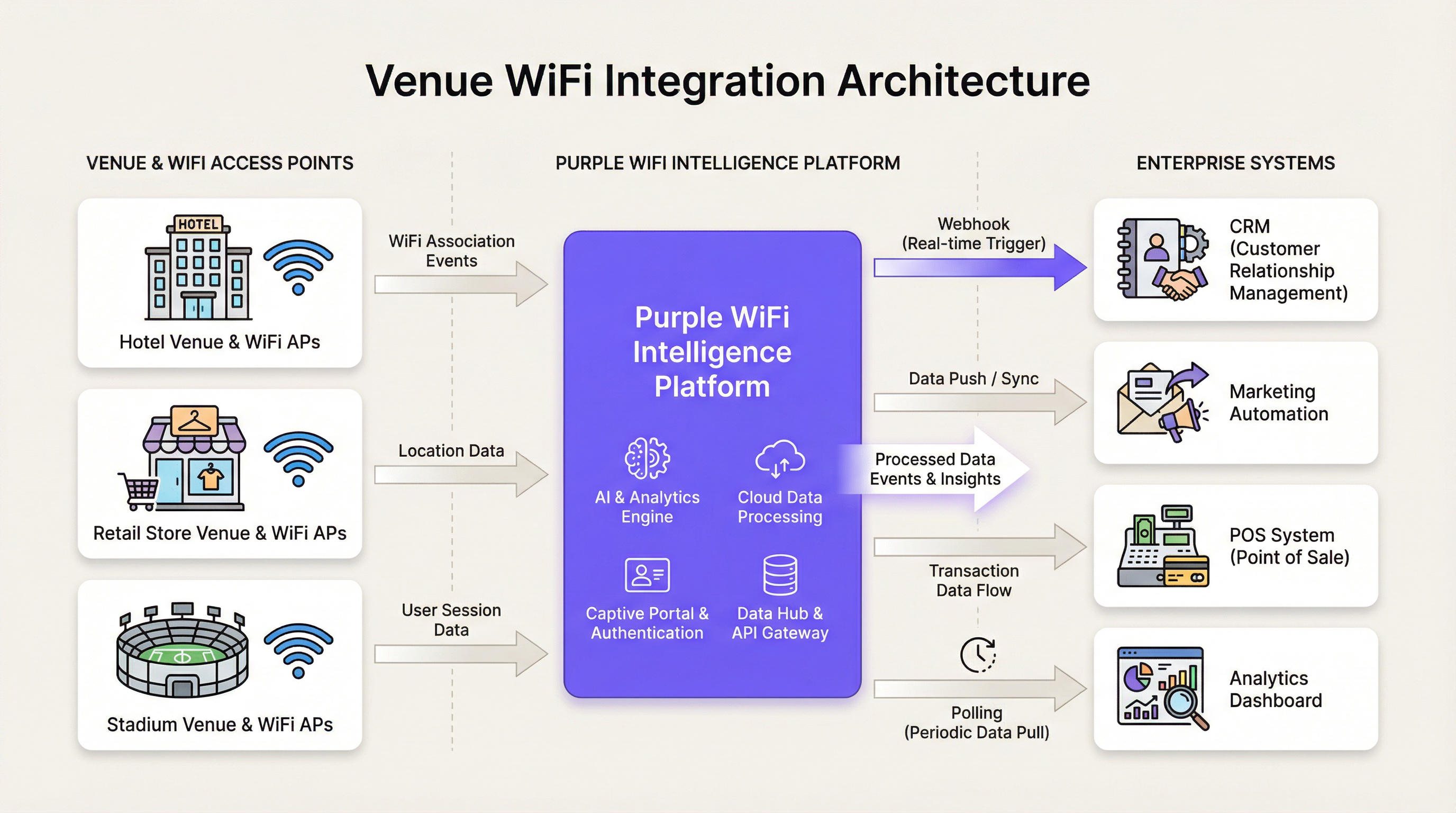
A escolha do padrão correto depende inteiramente dos requisitos de negócios da integração. Uma abordagem mista é comum em arquiteturas corporativas complexas.
Quando Utilizar API Polling
Apesar de suas ineficiências, o API polling é uma escolha viável para casos de uso específicos e não críticos:
- Relatórios em Lote: Geração de relatórios noturnos ou semanais sobre o uso agregado de WiFi, onde um atraso de dados de várias horas é aceitável.
- Dashboards Internos: Preenchimento de um dashboard interno não crítico com dados de tendências que não exigem precisão segundo a segundo.
- Sistemas Legados: Integração com sistemas mais antigos que não podem expor um endpoint público para receber webhooks.
- Restrições de Infraestrutura: Em ambientes de alta segurança onde o tráfego de entrada de serviços externos é fortemente restrito por políticas.
Quando Utilizar Webhooks
Os webhooks são a escolha definitiva para qualquer aplicação moderna em tempo real. Utilize-os sempre que uma resposta imediata e automatizada a um evento de WiFi puder criar valor de negócio.
- Marketing em Tempo Real: Acionamento de um e-mail de boas-vindas, SMS com um voucher ou uma notificação push para um aplicativo de fidelidade no momento em que um visitante se conecta ao WiFi em um hotel ou loja de varejo.
- Alertas Operacionais: Envio de um alerta instantâneo para a equipe via Slack ou um aplicativo dedicado quando um evento específico ocorre, como a chegada de um visitante VIP, a superação de um limite de tempo de permanência em uma zona específica ou a queda de hardware de rede.
- Integração de CRM: Criação ou atualização instantânea de um registro de cliente em um CRM como Salesforce ou HubSpot quando um novo visitante se registra no Captive Portal.
- Operações do Estabelecimento: Uso de dados de densidade de dispositivos em tempo real para gerenciar o fluxo de multidões em um estádio, ajustar o HVAC em um centro de conferências ou enviar a equipe de limpeza para áreas de alto tráfego.
Implementando os Webhooks da Purple: Um Guia Conceitual
- Crie Seu Endpoint: Desenvolva uma URL pública e estável em seu servidor que possa aceitar solicitações HTTP POST. Pode ser uma função serverless (por exemplo, AWS Lambda, Google Cloud Function) ou uma rota dedicada em sua aplicação web.
- Registre o Endpoint na Purple: No portal da Purple, navegue até a seção de webhooks e adicione a URL do seu endpoint. Você receberá uma chave secreta para verificação de assinatura.
- Processe os Dados Recebidos: Quando um evento ocorrer, a Purple enviará um payload JSON para o seu endpoint. Seu endpoint deve ser programado para:
a. Confirmar o Recebimento Imediatamente: Responda com um código de status
200 OKo mais rápido possível para informar à Purple que os dados foram recebidos. Isso evita timeouts e novas tentativas. b. Verificar a Assinatura: Antes de processar, calcule a assinatura HMAC-SHA256 do corpo da solicitação bruta usando sua chave secreta e compare-a com o valor no cabeçalhoX-Purple-Signature. Se não corresponderem, descarte a solicitação. c. Processar de Forma Assíncrona: Transfira a lógica de negócios real (por exemplo, enviar um e-mail, atualizar um banco de dados) para uma fila de trabalhos em segundo plano (por exemplo, RabbitMQ, Redis Queue). Isso garante que seu endpoint permaneça responsivo e possa lidar com altos volumes de eventos sem ser bloqueado.
Melhores Práticas
Aderir às melhores práticas padrão do setor é essencial para construir integrações confiáveis e seguras.
Melhores Práticas para Webhooks
- Idempotência: Projete sua lógica de processamento para lidar com eventos duplicados de forma elegante. Problemas de rede às vezes podem levar à entrega de um webhook mais de uma vez. Um sistema idempotente garante que o processamento do mesmo evento várias vezes não resulte em dados ou ações duplicadas.
- Processamento Assíncrono: Nunca execute lógicas complexas ou demoradas diretamente no manipulador de solicitações. Confirme o recebimento e coloque na fila.
- Validação de Payload: Sempre verifique a assinatura do webhook. Esta é uma etapa crítica de segurança.
- Monitoramento e Logging: Implemente um logging abrangente para rastrear os webhooks recebidos e o resultado de seu processamento. Configure o monitoramento para alertá-lo se o seu endpoint falhar ou os tempos de resposta degradarem.
- Falha Elegante e Novas Tentativas: Embora o sistema da Purple inclua um mecanismo de nova tentativa, seu próprio sistema deve ser resiliente a falhas em serviços downstream (por exemplo, um banco de dados ou uma API de terceiros temporariamente indisponível).
Melhores Práticas para API Polling
- Escolha uma Frequência Apropriada: Não faça consultas com mais frequência do que o necessário. O excesso de consultas oferece retornos decrescentes e aumenta o risco de limitação de taxa. Respeite o cabeçalho
Retry-Afterse receber uma resposta429 Too Many Requests. - Use Solicitações Condicionais: Onde houver suporte, use cabeçalhos como
If-Modified-SinceouETagpara evitar o download de dados que não foram alterados. - Implemente uma Estratégia de Backoff: Se uma chamada de API falhar, implemente uma estratégia de backoff exponencial para novas tentativas, a fim de evitar a sobrecarga do servidor.
- Proteja as Chaves de API: Armazene as chaves de API com segurança usando um serviço de gerenciamento de segredos. Nunca as codifique diretamente em sua aplicação ou as envie para o controle de versão.
Solução de Problemas e Mitigação de Riscos
- Modo de Falha Comum (Webhooks): Tempo de Inatividade do Endpoint. Se o seu endpoint ficar inativo, você perderá eventos. Mitigação: Use uma arquitetura de alta disponibilidade para o seu endpoint (por exemplo, funções serverless, servidores com balanceamento de carga). Confie no mecanismo de nova tentativa integrado da Purple para interrupções curtas e implemente um monitoramento robusto para ser alertado sobre o tempo de inatividade imediatamente.
- Modo de Falha Comum (Webhooks): Picos de Processamento. Uma explosão repentina de eventos (por exemplo, uma grande multidão se conectando no início de um evento) pode sobrecarregar sua fila de processamento. Mitigação: Certifique-se de que sua infraestrutura de processamento em segundo plano possa ser dimensionada automaticamente para lidar com picos de demanda.
- Modo de Falha Comum (API Polling): Limitação de Taxa. Consultas agressivas levarão à limitação de taxa da sua aplicação, cortando efetivamente o seu fluxo de dados. Mitigação: Faça consultas em um intervalo razoável e respeitoso e implemente uma estratégia de backoff exponencial.
- Modo de Falha Comum (Ambos): Dados Inválidos. Uma alteração no formato dos dados ou um valor inesperado pode quebrar sua lógica de processamento. Mitigação: Implemente práticas de programação defensiva. Valide os dados recebidos em relação a um esquema e lide com os erros de validação de forma elegante, registrando-os para investigação sem travar todo o processo.
ROI e Impacto nos Negócios
A escolha entre webhooks e polling tem um impacto direto no Custo Total de Propriedade (TCO) e no Retorno sobre o Investimento (ROI).
- Análise de Custo-Benefício: Embora o polling possa ter um custo de desenvolvimento inicial ligeiramente menor, seus custos operacionais são significativamente maiores devido ao desperdício de recursos do servidor e largura de banda. Os webhooks, com sua eficiência orientada a eventos, levam a um TCO muito menor em escala. O custo de infraestrutura para lidar com milhões de consultas vazias por dia supera em muito o custo de desenvolver um endpoint de webhook confiável.
- Medindo o Sucesso: O sucesso de uma integração de dados em tempo real é medido pelo seu impacto nos negócios. Para um hotel, isso pode ser um aumento de 15% nos pedidos de serviço de quarto impulsionados por ofertas de boas-vindas acionadas por webhook. Para um varejista, pode ser um aumento mensurável no lifetime value do cliente para VIPs que recebem atendimento personalizado na loja. Para um estabelecimento, pode ser uma redução nos incidentes operacionais devido ao gerenciamento proativo de multidões.
- Resultados Esperados: A implantação de uma arquitetura baseada em webhooks posiciona sua organização para ser mais ágil e responsiva. Ela move suas operações de uma postura reativa (analisando o que aconteceu ontem) para uma postura proativa e em tempo real (agindo sobre o que está acontecendo agora). Essa capacidade é um diferencial fundamental na entrega de experiências superiores ao cliente e na obtenção de excelência operacional.
Referências
[1] Regulamento Geral sobre a Proteção de Dados (GDPR). (2016). Jornal Oficial da União Europeia. https://eur-lex.europa.eu/eli/reg/2016/679/oj
Key Terms & Definitions
Webhook
A mechanism for enabling server-to-server communication in real-time. It allows a server to automatically push data to a client as soon as an event occurs, rather than the client repeatedly polling for it.
IT teams use webhooks to receive instant notifications from platforms like Purple, enabling event-driven workflows such as sending a welcome email the moment a guest connects to WiFi.
API Polling
A data retrieval method where a client application makes requests to a server at a fixed interval to check for new data. It is a client-initiated "pull" model.
A developer might use API polling to update an internal dashboard with new WiFi analytics every 15 minutes, where real-time data is not a critical business requirement.
Endpoint
A publicly accessible URL on a client's server that is designed to receive and process incoming data from a webhook.
When configuring a webhook in Purple, the network architect must provide a stable and secure endpoint URL where the platform should send event data.
Payload
The actual data, typically formatted as JSON, that is sent from the server to the webhook endpoint when an event is triggered.
For a `guest_connects` event, the payload would contain information about the guest, their device, and the location, which a marketing automation tool can then use for personalization.
Idempotency
A principle in computing where an operation, if performed multiple times, has the same effect as if it were performed only once. In the context of webhooks, it means processing a duplicate event will not result in duplicate outcomes.
To achieve idempotency, a developer ensures their endpoint checks if an event ID has already been processed before taking action, preventing a single WiFi connection from triggering two welcome emails.
Asynchronous Processing
A processing model where a task is executed in the background, separate from the main application thread. For webhooks, it means acknowledging the request instantly and then handling the payload in a separate queue.
An IT team implements asynchronous processing to ensure their webhook endpoint can handle thousands of simultaneous WiFi connection events during a stadium concert without timing out.
HMAC (Hash-based Message Authentication Code)
A cryptographic hash that uses a secret key to verify both the data integrity and the authenticity of a message.
For compliance with data security standards like PCI DSS, a network architect must ensure their webhook endpoint validates the HMAC signature on all incoming payloads to prevent fraudulent data injection.
Rate Limiting
An API management technique used to control the amount of incoming traffic to a server. If a client exceeds a certain number of requests in a given time frame, the server will temporarily block them.
An operations director finds their hourly analytics report is failing because their aggressive API polling strategy caused the Purple platform to enforce rate limiting. They must adjust their polling interval to be less frequent.
Case Studies
A 500-room airport hotel wants to automatically send a welcome email with a restaurant voucher to guests the moment they first connect to the hotel WiFi. The goal is to drive dinner reservations on the day of arrival. The hotel uses Salesforce Marketing Cloud.
This is a classic real-time engagement scenario, making webhooks the only viable solution.
- Create a Journey API Endpoint in Salesforce: Within Salesforce Marketing Cloud, create a new Journey with an API Event as the entry source. This will provide a unique URL and API key that can accept incoming events.
- Configure the Webhook in Purple: In the Purple portal, create a new webhook for the
guest_connectsevent. Paste the Salesforce Journey URL as the destination. - Set the Payload Format: Configure the webhook payload to send the necessary guest data (e.g.,
first_name,email,location) in the JSON format expected by the Salesforce Journey API. - Secure the Webhook: Ensure the endpoint URL uses HTTPS. While Salesforce's endpoint is inherently secure, it's crucial to add the Purple webhook secret to your Salesforce configuration for signature validation if possible, or build a lightweight middleware (like an AWS Lambda function) to perform validation before forwarding the request to Salesforce.
- Activate the Journey: Once a test event is successfully received, activate the Journey in Salesforce. Now, when a guest connects to the WiFi, Purple will instantly fire the webhook, injecting the guest into the Salesforce Journey, which then immediately dispatches the personalized welcome email.
A national retail chain with 200 stores needs to populate a central analytics dashboard with hourly footfall data for each store. The dashboard is used by the corporate strategy team to analyze trends over weeks and months. Real-time data is not a requirement.
In this scenario, the requirement is for periodic, aggregate data, not real-time events. Therefore, API polling is a suitable and pragmatic choice.
- Identify the Correct API Endpoint: Use the Purple API documentation to find the endpoint that provides historical location analytics data, filterable by venue and time period.
- Develop a Polling Script: Create a server-side script (e.g., a Python script running on a cron job) that will execute once per hour.
- Implement the Polling Logic: The script will iterate through the list of 200 store IDs. For each store, it will make an HTTP GET request to the analytics API endpoint, requesting the visitor count for the previous 60-minute window.
- Store the Data: The script will then parse the JSON responses and write the aggregated data (timestamp, store_id, visitor_count) into the central analytics database that powers the dashboard.
- Handle Errors and Retries: The script must include error handling for API failures or network issues, implementing an exponential backoff strategy to retry failed requests without overwhelming the API.
Scenario Analysis
Q1. A large shopping mall wants to display a live counter of the number of connected devices on a public dashboard in the main atrium. The display needs to be updated as accurately as possible. Which integration pattern should the development team use and why?
💡 Hint:Consider the requirement for "live" and "accurate" data. What is the tolerance for delay?
Show Recommended Approach
The team must use webhooks. The requirement for a "live" counter means that data latency is a critical factor. Webhooks for device_connected and device_disconnected events would allow the dashboard to increment and decrement the counter in true real-time. Using API polling would result in a counter that only updates periodically (e.g., every minute), which would not feel "live" and could be visibly out of sync with the actual crowd flow.
Q2. An IT compliance officer needs to generate a quarterly report detailing all WiFi authentication methods used across the organization's 50 sites to ensure compliance with IEEE 802.1X standards. The report is generated manually by an analyst. Which pattern should be used to gather this data?
💡 Hint:Focus on the time-sensitivity of the task. Is this an operational task or an analytical one?
Show Recommended Approach
API polling is the most appropriate pattern. The task is analytical, not operational, and has a very low time-sensitivity (quarterly). A script can be run once per quarter to poll the Purple API for all authentication events over the last 90 days. This is a simple, efficient way to gather a large historical dataset for a one-off analysis. Using webhooks would be inappropriate as it would involve storing millions of real-time events for months, which is unnecessarily complex for this requirement.
Q3. A stadium's mobile app has a feature that allows fans to order food directly to their seats. The operations team wants to use WiFi location data to disable this feature for fans seated in sections where the food service is at capacity. The decision to disable a section must be made instantly. When designing the integration, what is the most critical security practice the developers must implement?
💡 Hint:The system involves real-time operational control based on incoming data. What is the primary threat to such a system?
Show Recommended Approach
The most critical security practice is mandatory signature validation on the webhook endpoint. Because the webhook triggers a direct operational action (disabling a service), the system is a prime target for a spoofing attack. A malicious actor could send a fraudulent webhook payload to the endpoint, pretending to be from Purple, and shut down the ordering service for the entire stadium. By validating the X-Purple-Signature using the shared secret, the endpoint can guarantee that the request is authentic and its data can be trusted before taking action. While HTTPS and asynchronous processing are also crucial, signature validation is the key defense against data-driven attacks in this real-time operational context.
Key Takeaways
- ✓Webhooks provide real-time, event-driven data, while API polling is delayed by the polling interval.
- ✓Use webhooks for time-sensitive actions like marketing automation, operational alerts, and instant CRM updates.
- ✓Use API polling for non-critical, batch-oriented tasks like nightly reports or trend analysis dashboards.
- ✓Webhooks are significantly more efficient and scalable, leading to a lower Total Cost of Ownership (TCO).
- ✓Securing your webhook endpoint with HTTPS and signature validation is a non-negotiable best practice.
- ✓Always process webhook payloads asynchronously to ensure your endpoint is resilient and responsive.
- ✓The choice is a strategic architectural decision: choose webhooks for real-time responsiveness and operational agility.




