

Captura de Dados WiFi: Um Guia Abrangente sobre Privacidade, Conformidade e Melhores Práticas
This guide provides IT leaders with a comprehensive technical reference for implementing WiFi data capture solutions. It focuses on navigating the complex landscape of privacy, legal compliance (GDPR, CCPA), and data ethics, offering actionable best practices for venue operators in hospitality, retail, and large public spaces.
🎧 Listen to this Guide
View Transcript

Resumo Executivo
Para a empresa moderna, entender o espaço físico é tão crítico quanto entender o digital. A captura de dados WiFi surgiu como uma ferramenta poderosa para operadores de locais obterem insights profundos e acionáveis sobre o comportamento dos visitantes, fluxo de pessoas e utilização espacial. Ao analisar as solicitações de sondagem (probe requests) emitidas passivamente por dispositivos habilitados para WiFi, as organizações podem desbloquear inteligência transformadora para otimizar layouts, melhorar a experiência do cliente e aumentar a eficiência operacional. No entanto, essa capacidade traz obrigações legais e éticas significativas. Reguladores globalmente, sob estruturas como GDPR e CCPA, classificam identificadores de dispositivos, como endereços MAC, como dados pessoais. Consequentemente, sua coleta e processamento estão sujeitos a regras rigorosas em relação a consentimento, anonimização e governança de dados. Este guia serve como uma referência prática e confiável para CTOs, gerentes de TI e arquitetos de rede. Ele vai além da teoria acadêmica para fornecer estratégias neutras em relação a fornecedores e prontas para implantação de um programa de análise de WiFi que não seja apenas poderoso, mas também seguro, em conformidade e respeitoso com a privacidade do usuário. Exploraremos a arquitetura técnica, delinearemos metodologias de implementação robustas e forneceremos melhores práticas claras e acionáveis para mitigar riscos e maximizar o ROI.
Análise Técnica Aprofundada
A base da análise de WiFi reside na captura de quadros de gerenciamento 802.11, especificamente solicitações de sondagem. Todo dispositivo habilitado para WiFi (smartphone, laptop, tablet) transmite periodicamente essas solicitações para descobrir redes sem fio próximas. Cada quadro contém várias informações importantes, mas a mais crítica para a análise é o endereço de Controle de Acesso ao Meio (MAC) do dispositivo — um identificador de hardware exclusivo. Ao implantar sensores ou configurar pontos de acesso existentes para escutar esses quadros, um sistema pode detectar a presença, localização e movimento de dispositivos dentro de um espaço físico.
Métodos de Captura de Dados:
- Captura Passiva: Este método envolve sensores que escutam passivamente as solicitações de sondagem sem exigir que os usuários se conectem à rede. Ele fornece uma visão ampla de todos os dispositivos em uma área, oferecendo dados ricos sobre o fluxo total de pessoas e padrões de movimento. No entanto, como não há interação direta com o usuário, obter consentimento explícito é um desafio, tornando a anonimização robusta e imediata fundamental.
- Captura Ativa (Captive Portal): Este método exige que o usuário se conecte ativamente à rede WiFi de visitantes do local. O processo de conexão é mediado por um Captive Portal, que apresenta uma página de login ou splash page. Este é o mecanismo padrão do setor para obter o consentimento explícito e informado do usuário antes que qualquer dado seja processado. Embora capture apenas dados de usuários conectados, ele fornece uma base legal muito mais forte para o processamento de dados e permite análises mais ricas e vinculadas à identidade se o usuário se autenticar.
O Imperativo da Anonimização: Sob a GDPR, um endereço MAC é considerado dado pessoal. Portanto, não pode ser armazenado em seu formato bruto. A melhor prática é aplicar um hash criptográfico unidirecional (por exemplo, SHA-256) combinado com um salt rotativo imediatamente após a captura. Esse processo, conhecido como pseudonimização, transforma o endereço MAC em um identificador único e irreversível que não pode ser rastreado até o dispositivo original. Esse ID anonimizado pode então ser usado para análises, como o cálculo de visitas repetidas, sem armazenar dados pessoais.
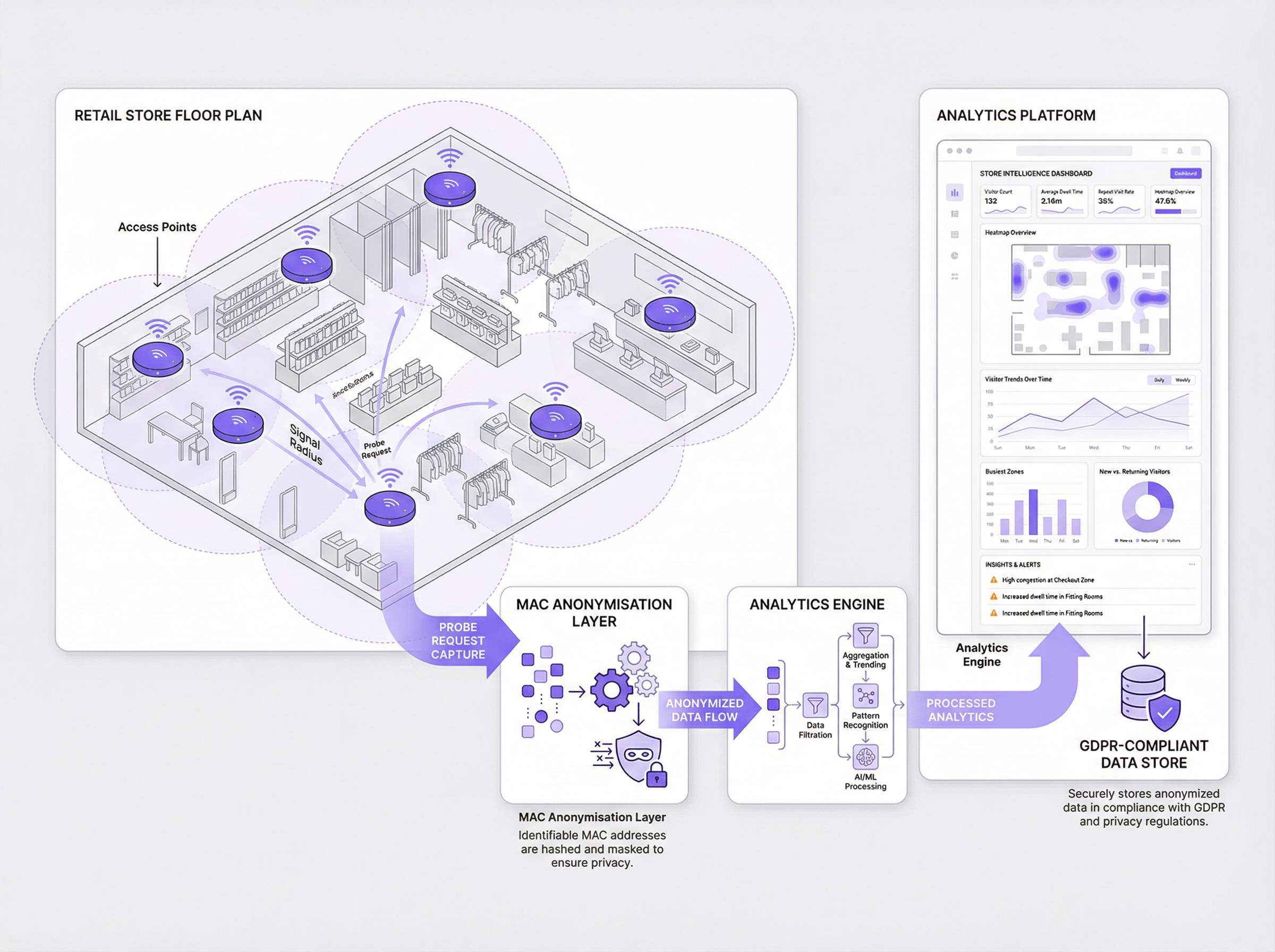
Impacto da Randomização de Endereço MAC: Sistemas operacionais móveis modernos (iOS 14+ e Android 10+) implementaram a randomização de endereço MAC para melhorar a privacidade do usuário. Esses dispositivos transmitem um endereço MAC diferente e randomizado para cada nova rede WiFi que sondam. Embora seja um recurso a favor da privacidade, ele apresenta um desafio significativo para plataformas de análise tradicionais, pois um único dispositivo pode aparecer como vários visitantes únicos. Mecanismos de análise sofisticados, como os da Purple, empregam algoritmos avançados para identificar e reconciliar inteligentemente esses endereços randomizados, garantindo a precisão das métricas de visitantes. Esta é uma capacidade técnica crítica para qualquer implantação moderna de análise de WiFi.
Guia de Implementação
A implantação de uma solução de captura de dados WiFi em conformidade requer uma abordagem estruturada e em vários estágios, baseada no princípio de 'Privacy by Design' (Privacidade desde a Concepção).
Passo 1: Avaliação da Infraestrutura Comece auditando sua infraestrutura WiFi existente. Pontos de acesso modernos de nível corporativo de fornecedores como Cisco, Meraki, Aruba e Ruckus geralmente possuem recursos integrados para transmitir quadros de gerenciamento para um servidor de análise. Determine se o seu hardware suporta isso ou se são necessários sensores dedicados. Garanta uma cobertura adequada em todas as áreas onde você pretende capturar dados.
Passo 2: Defina sua Política de Dados e Mecanismo de Consentimento Este é o passo mais crítico para a conformidade. Trabalhe com suas equipes jurídica e de conformidade para definir:
- Quais dados você coletará: Seja específico (por exemplo, "
Key Terms & Definitions
MAC Address (Media Access Control)
A unique, 48-bit hardware number that identifies each device on a network. Under GDPR, it is considered Personal Identifiable Information (PII).
This is the core piece of data captured by WiFi analytics. IT teams must ensure it is never stored in its raw format and is anonymized immediately upon capture.
Probe Request
An 802.11 management frame sent by a WiFi-enabled device to discover nearby wireless networks.
These are the signals that WiFi analytics systems listen for. Understanding the volume and signal strength of probe requests allows the system to determine footfall and location.
Captive Portal
A web page that a user must view and interact with before being granted access to a public WiFi network.
This is the primary and most effective mechanism for an IT team to obtain explicit, informed consent from users before collecting and processing their data for analytics purposes.
Pseudonymization (Hashing)
The process of replacing a data identifier (like a MAC address) with a pseudonym (a cryptographic hash). It is a reversible process if the key is known, but one-way hashing makes it irreversible.
This is the critical technical process for making WiFi data compliant. A raw MAC address is PII; a hashed MAC address is an anonymized data point that can be used for analysis.
MAC Address Randomization
A privacy feature in modern mobile operating systems (iOS, Android) where the device uses a fake, temporary MAC address when searching for networks.
IT teams must be aware that this feature can severely skew analytics data. A modern analytics platform is required to correctly interpret these randomized addresses and avoid overcounting visitors.
GDPR (General Data Protection Regulation)
A comprehensive data protection law in the European Union that governs the processing of personal data.
This is the key regulation governing WiFi data capture in Europe. Any organisation with a European presence or that serves European citizens must ensure their analytics deployment is fully GDPR-compliant.
Data Controller
The entity that determines the purposes and means of processing personal data.
When a venue deploys WiFi analytics, the venue owner (e.g., the retail chain, the hotel) is the Data Controller and is legally responsible for ensuring compliance.
Dwell Time
A metric that measures the average amount of time visitors spend in a specific, defined area.
This is one of the most valuable business insights from WiFi analytics. It helps operations directors understand engagement, identify bottlenecks, and measure the success of marketing displays or layout changes.
Case Studies
A 50-store retail chain wants to understand customer behaviour in their flagship stores to inform a nationwide redesign. They need to measure dwell times in different departments, identify popular paths, and understand repeat visitor frequency, all while ensuring strict GDPR compliance.
- Infrastructure: Deploy a Purple-compatible WiFi analytics solution using their existing Meraki MR access points. Configure the Meraki dashboard to stream analytics data to the Purple cloud.
- Consent: Implement a branded captive portal for the guest WiFi network. The portal will feature a single, clear opt-in checkbox: "I agree to allow Purple to analyse my anonymized visit data to help improve the store layout and experience. This data is fully anonymized and will not be used for marketing." A link to the full privacy policy is provided.
- Anonymization: Configure the system to use Purple's patented Cryptographic Anonymization, which hashes the MAC address at the moment of capture. This ensures no PII is ever stored.
- Analysis: Use the Purple dashboard to create zones for each department (e.g., Menswear, Womenswear, Checkout). Track anonymized visitor flow between these zones and measure average dwell times. Use the repeat visitor metric to understand customer loyalty.
- Action: After 90 days, the data reveals that the Menswear department has high traffic but low dwell time. The chain redesigns the department layout to be more open and improves product displays. They then measure the impact of these changes over the next 90 days.
A large conference centre with multiple exhibition halls hosts a variety of third-party events. They want to offer event organisers data on attendee flow and booth popularity, but they are concerned about the privacy implications of tracking attendees across different, unrelated events.
- Data Segregation: The key is to treat each event as a separate entity. The WiFi analytics platform must be configured to use a different rotating salt for its hashing algorithm for each event. This means an anonymized ID from Event A will not be the same as the anonymized ID for the same device at Event B.
- Organiser Portals: Provide each event organiser with a separate, sandboxed view of the analytics data for their event only. They should not have access to historical data from other events or raw data of any kind.
- Consent per Event: The captive portal for each event must be unique and clearly state which organiser is the data controller for that event. Attendees must provide consent for each event they attend.
- Reporting: The platform can then generate reports on footfall, hall traffic, and booth dwell times for each specific event. This data can be sold to organisers as a premium service.
- Data Purge: Implement a strict data retention policy to purge all data associated with an event 30 days after the event concludes.
Scenario Analysis
Q1. A stadium is deploying a new WiFi analytics system to manage crowd flow on match days. Their legal team is concerned about storing location data. What is the most important technical control to implement regarding location?
💡 Hint:Think about the principle of data minimisation.
Show Recommended Approach
The most important control is to not store raw or fine-grained location data (e.g., X-Y coordinates). Instead, the stadium should be divided into large, pre-defined zones (e.g., "North Stand, Level 1", "West Entrance Gate"). The system should only record which zone a device is in, not its precise location within that zone. This minimises the sensitivity of the location data while still providing the necessary operational insights for crowd management.
Q2. A shopping mall uses a third-party to manage its guest WiFi. The third-party offers a 'free' analytics package. What is the number one question the mall's CTO should ask the third-party vendor?
💡 Hint:Who is the Data Controller and what are their responsibilities?
Show Recommended Approach
The CTO must ask: "Where and how is the MAC address anonymized?" They need to get a specific, technical answer. If the vendor cannot confirm that the MAC address is hashed with a salt, on-premise, before it is sent to their cloud, it is a major compliance red flag. The mall, as the Data Controller, is ultimately liable for any data breach or non-compliance, even if it is caused by their vendor.
Q3. A user logs into your guest WiFi and consents to analytics. They later submit a 'Right to be Forgotten' request under GDPR. You have stored their data as a hashed, anonymized ID. What is your technical obligation?
💡 Hint:How does pseudonymization relate to a user's rights?
Show Recommended Approach
Even though the data is pseudonymized, it is still linked to a specific individual, and the user's rights still apply. The analytics platform must have a mechanism to process these requests. When the user made the request, they would have provided an identifier (e.g., the email they used to log in). The platform needs a secure, audited process to look up the anonymized IDs associated with that user account and permanently delete them from the analytics database. Simply saying 'the data is anonymous' is not a compliant response.
Key Takeaways
- ✓WiFi data capture offers powerful insights but carries significant privacy obligations.
- ✓A MAC address is personal data under GDPR; it must be anonymized at the point of capture.
- ✓Explicit user consent via a captive portal is the best practice for compliance.
- ✓Modern analytics platforms are essential to handle challenges like MAC address randomization.
- ✓Adopt a 'Privacy by Design' approach, building compliance into your architecture from day one.
- ✓Transparency with users is not just a legal requirement; it is crucial for building trust.
- ✓Regularly audit your system and policies to ensure ongoing compliance and risk mitigation.




