

Direcionamento de Banda e Balanceamento de Carga para WiFi de Alta Densidade
This authoritative technical reference equips IT managers, network architects, and venue operations directors with the knowledge to design, configure, and optimise high-density WiFi networks using band steering and load balancing. It covers the architectural principles behind 2.4 GHz vs. 5 GHz band selection, AP load distribution strategies, and vendor-neutral configuration best practices for demanding environments such as stadiums, hotels, and conference centres. By applying these strategies, organisations can measurably improve wireless throughput, reduce user complaints, and transform their network infrastructure into a strategic business asset.
🎧 Listen to this Guide
View Transcript

Resumo Executivo
Para as organizações que gerem ambientes sem fios de alta densidade, manter o desempenho ideal do WiFi é um desafio operacional crítico. À medida que o número de dispositivos ligados por metro quadrado aumenta em locais como aeroportos, centros de conferências e centros comerciais, as configurações de rede convencionais falham, resultando numa má experiência do utilizador, quebras de ligação e redução da taxa de transferência de dados. Este guia aborda estes desafios de frente, fornecendo uma análise técnica aprofundada de duas estratégias centrais de otimização: direcionamento de banda (band steering) e balanceamento de carga (load balancing). Exploramos os princípios arquitetónicos que diferenciam as bandas de frequência de 2,4 GHz e 5 GHz e detalhamos como direcionar de forma inteligente os clientes de banda dupla para o espetro de 5 GHz, menos congestionado e de maior capacidade. Além disso, analisamos as técnicas de balanceamento de carga dos pontos de acesso (AP) que distribuem as ligações dos clientes de forma uniforme pelos recursos de rede disponíveis, evitando que APs individuais se tornem estrangulamentos de desempenho. Ao implementar as melhores práticas independentes de fornecedor e as orientações de configuração aqui descritas, os gestores de TI e arquitetos de rede podem proporcionar uma experiência sem fios superior e mais fiável, com impacto direto na satisfação do cliente, na eficiência operacional e no ROI do negócio. Esta referência foi concebida para aplicação prática, oferecendo cenários de implementação concretos e resultados mensuráveis para informar a sua estratégia de infraestrutura de rede neste trimestre.
Análise Técnica Aprofundada
Compreender as Bandas de Frequência: 2,4 GHz vs. 5 GHz
A base de uma gestão eficaz de WiFi em ambientes de alta densidade reside na compreensão das diferenças fundamentais entre as bandas de frequência de 2,4 GHz e 5 GHz. Estas não são meramente duas vias para dados; são ambientes de RF distintos com características de propagação únicas que ditam a sua adequação a diferentes casos de uso e cenários de implementação.
| Funcionalidade | Banda de 2,4 GHz | Banda de 5 GHz |
|---|---|---|
| Alcance | Comprimento de onda maior, melhor penetração em paredes | Comprimento de onda menor, mais facilmente obstruído |
| Interferência | Elevada (Micro-ondas, Bluetooth, telefones sem fios) | Baixa (Menos congestionada, mais canais) |
| Canais | 11-14 canais, apenas 3 não sobrepostos | 23+ canais não sobrepostos |
| Largura de banda | Taxas de dados potenciais mais baixas | Taxas de dados potenciais mais elevadas (ex., com 802.11ac/ax) |
| Adequação | Conectividade básica, IoT, dispositivos legados | Aplicações de elevada largura de banda (vídeo, voz), áreas densas |
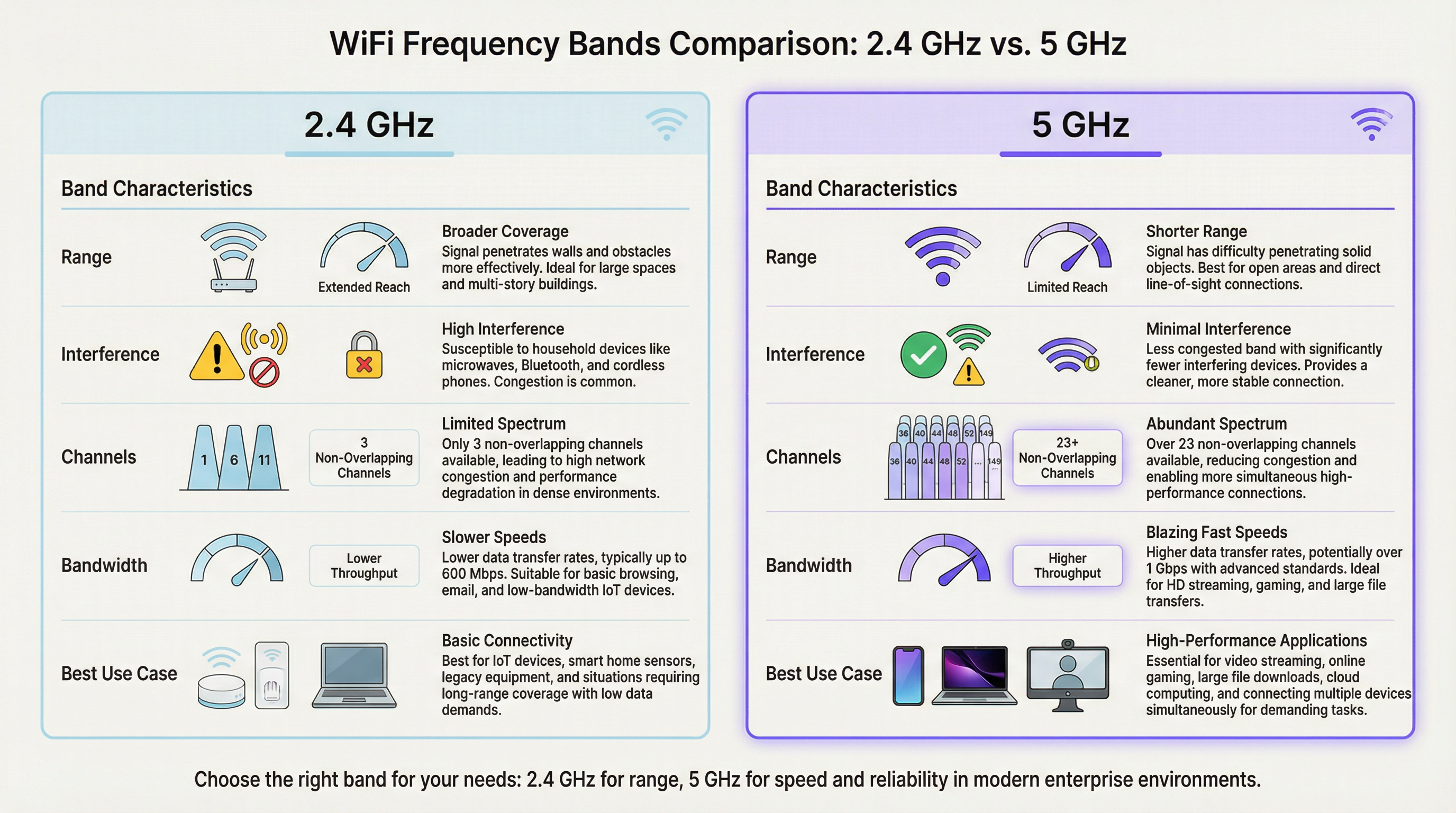
Num ambiente de alta densidade, como um estádio ou um auditório, a banda de 2,4 GHz fica rapidamente saturada. Com apenas três canais não sobrepostos (1, 6 e 11 na América do Norte), a interferência cocanal é um inibidor de desempenho significativo e persistente. Cada AP adicional a operar no mesmo canal na mesma área degrada o desempenho de todos os outros. A banda de 5 GHz, por outro lado, oferece um espetro muito mais amplo com inúmeros canais não sobrepostos, tornando-a a escolha preferencial para aplicações de desempenho crítico. O principal objetivo das implementações de direcionamento de banda WiFi é mover proativamente os dispositivos clientes compatíveis da banda congestionada de 2,4 GHz para a banda mais limpa e rápida de 5 GHz, reservando o espetro de 2,4 GHz para sensores IoT, dispositivos legados e clientes no limite da cobertura.
Como Funciona o Direcionamento de Banda
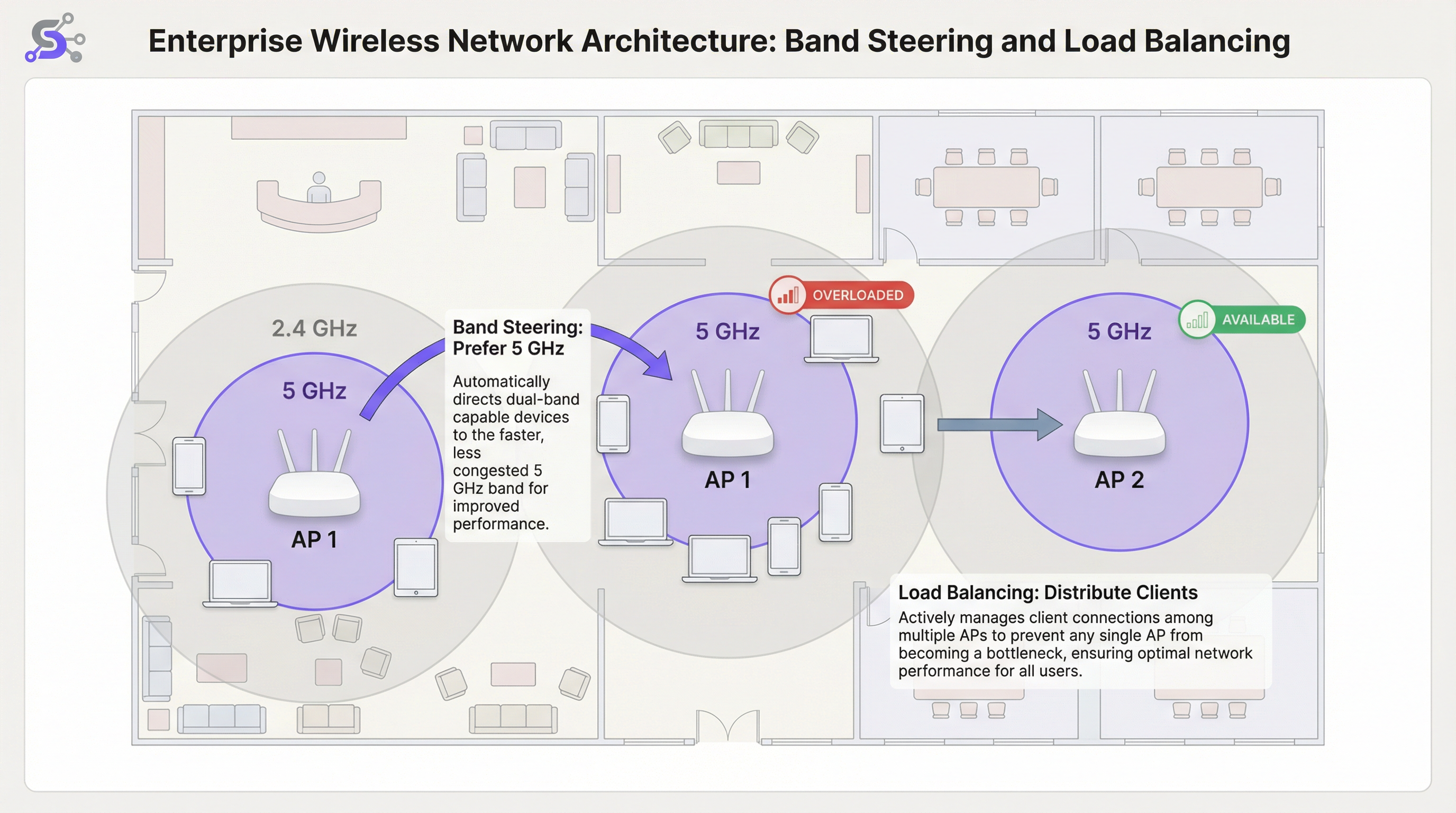
O direcionamento de banda não é uma norma IEEE formal, mas sim uma técnica proprietária implementada por fornecedores de WiFi empresarial. Embora os algoritmos específicos variem entre fabricantes, o mecanismo geral envolve o Ponto de Acesso a incentivar ou obrigar ativamente um cliente de banda dupla a ligar-se ao rádio de 5 GHz. Isto é normalmente alcançado através de vários métodos que operam ao nível das tramas de gestão 802.11.
O primeiro é o Atraso nas Respostas de Sonda (Delayed Probe Responses): quando um cliente de banda dupla envia um pedido de sonda em ambas as bandas simultaneamente, o AP pode atrasar intencionalmente a sua resposta na frequência de 2,4 GHz em várias centenas de milissegundos. O cliente, ao ver uma resposta mais rápida nos 5 GHz, prefere naturalmente e liga-se à banda superior. O segundo é a Supressão de Respostas de Sonda (Probe Response Suppression): o AP pode ignorar os pedidos de sonda de 2,4 GHz de clientes que identificou como compatíveis com 5 GHz, tornando efetivamente a rede de 2,4 GHz invisível para eles durante a fase de descoberta inicial. A terceira abordagem, e a mais moderna, é a Gestão de Transição BSS IEEE 802.11v: esta trama padrão permite que o AP solicite explicitamente que um cliente transite para um BSS (Basic Service Set) diferente, neste caso, o rádio de 5 GHz no mesmo AP. Este é um método cooperativo que depende do suporte do lado do cliente para a norma 802.11v e é a abordagem recomendada para implementações empresariais, uma vez que evita as técnicas de supressão agressivas que podem causar problemas de conectividade com clientes não compatíveis.
Balanceamento de Carga de AP
Enquanto o direcionamento de banda otimiza a seleção da banda de frequência por AP, o balanceamento de carga WiFi aborda o desafio mais amplo de distribuir os clientes de forma uniforme por vários APs numa determinada área. Num terminal de aeroporto movimentado ou no átrio de um hotel, é comum os utilizadores congregarem-se perto de um único AP com localização central, sobrecarregando-o enquanto os APs adjacentes permanecem subutilizados. Isto cria uma disparidade de desempenho significativa: os utilizadores perto do AP sobrecarregado experienciam um serviço degradado, enquanto os utilizadores perto de APs inativos não estão a tirar o máximo partido da infraestrutura disponível. Os algoritmos de balanceamento de carga evitam isto ao definir limites para a contagem de clientes ou utilização de rádio em cada AP.
Quando um AP atinge o seu limite de carga configurado, pode recusar novos pedidos de associação. Isto incentiva o novo dispositivo cliente a analisar novamente e a descobrir um AP próximo e menos congestionado. Sistemas mais sofisticados tiram partido do 802.11v para sugerir proativamente um AP alternativo específico ao cliente, tornando a transição contínua e transparente para o utilizador final. As implementações mais avançadas utilizam algoritmos preditivos que antecipam aumentos de carga com base em padrões históricos e começam a redistribuir os clientes antes que se forme um estrangulamento.
O Papel do Controlador de LAN Sem Fios (WLC)
Nas implementações empresariais, o direcionamento de banda e o balanceamento de carga não são geridos ao nível do AP individual, mas sim orquestrados por um Controlador de LAN Sem Fios (WLC) centralizado ou por uma plataforma de gestão baseada na cloud. O WLC mantém uma visão global de todos os clientes associados, das forças dos seus sinais, da carga atual em cada AP e do ambiente de RF em todo o local. Esta inteligência centralizada é o que torna possível um balanceamento de carga sofisticado: o controlador pode tomar decisões informadas sobre para onde redirecionar um novo cliente com base em dados em tempo real de toda a rede, e não apenas na visão local limitada de um único AP.
As plataformas geridas na cloud, como as oferecidas pela Cisco Meraki, Aruba Central e Juniper Mist, expandem ainda mais este conceito ao incorporar a gestão de recursos de rádio (RRM) impulsionada por IA. Estes sistemas analisam continuamente os dados de RF, o comportamento dos clientes e o desempenho das aplicações para ajustar dinamicamente as atribuições de canais, a potência de transmissão e os limites de direcionamento sem intervenção manual. Para os operadores de grandes recintos que gerem dezenas ou centenas de APs em vários pisos ou edifícios, este nível de automatização não é um luxo, mas uma necessidade operacional prática.
WiFi 6 e Direcionamento de Banda na Era dos 6 GHz
A introdução do WiFi 6E (IEEE 802.11ax) e a abertura regulamentar da banda de espetro de 6 GHz representam uma evolução significativa para a arquitetura WiFi de alta densidade. A banda de 6 GHz oferece até 1200 MHz de espetro limpo adicional, com 59 canais não sobrepostos de 20 MHz disponíveis em mercados como os Estados Unidos e o Reino Unido. Para os locais que implementam APs compatíveis com WiFi 6E, a estratégia de direcionamento de banda deve evoluir para um modelo de três bandas: direcionar os dispositivos legados para 2,4 GHz, os dispositivos compatíveis para 5 GHz e os mais recentes clientes WiFi 6E para a imaculada banda de 6 GHz. Esta abordagem em camadas maximiza a utilização de todo o espetro disponível e garante que os dispositivos mais recentes e de maior desempenho beneficiam do ambiente de RF mais limpo possível, livre da interferência legada que se acumula nas bandas mais antigas.
Guia de Implementação
Passo 1: Estudo do Local Pré-Implementação (Site Survey)
Um estudo preditivo do local utilizando ferramentas profissionais como o Ekahau Site Survey ou o iBwave Design é inegociável para qualquer implementação de alta densidade. Não se trata apenas de verificar a cobertura, mas sim de planear a capacidade. O seu objetivo é identificar zonas de elevada densidade de dispositivos, modelar as características de propagação de RF do espaço físico e planear a colocação dos APs e a alocação de canais para minimizar a interferência cocanal. O estudo também deve ter em conta a densidade esperada de clientes durante os períodos de pico de utilização, que para um centro de conferências pode ser uma sessão principal e para um estádio é a janela de 30 minutos antes do início do jogo, quando dezenas de milhares de adeptos tentam ligar-se simultaneamente.
Passo 2: Configuração do Direcionamento de Banda
No seu controlador de LAN sem fios (WLC) ou painel de gestão na cloud, encontrará uma definição para Direcionamento de Banda (Band Steering) ou Seleção de Banda (Band Select). Os principais parâmetros de configuração do direcionamento de banda incluem os seguintes. Modo: a maioria dos fornecedores empresariais oferece opções como Preferir 5 GHz, Forçar 5 GHz ou Balancear Bandas. Para locais de alta densidade, Preferir 5 GHz é o ponto de partida recomendado. Forçar pode ser demasiado agressivo e pode negar o serviço a clientes legados apenas de 2,4 GHz, gerando pedidos de suporte desnecessários. Limite de Direcionamento (RSSI): defina uma força de sinal mínima para que um cliente seja direcionado para os 5 GHz. Um valor inicial típico é -65 dBm. Se o sinal de 5 GHz do cliente for mais fraco do que este limite, poderá ter uma melhor experiência nos 2,4 GHz, apesar da interferência, particularmente em ambientes com paredes espessas ou materiais de construção significativos que atenuam a frequência mais elevada.
Passo 3: Configuração do Balanceamento de Carga
Limite de Contagem de Clientes: defina um número máximo de clientes por rádio de AP. Para uma área de alta densidade, este valor pode ser tão baixo quanto 25 a 30 clientes para garantir a qualidade do serviço, mesmo que o hardware do AP suporte tecnicamente mais associações simultâneas. Limite de Utilização: uma abordagem mais dinâmica e recomendada é balancear com base na utilização do rádio, expressa como a percentagem de tempo em que o meio de rádio está ocupado a transmitir ou a receber. Um limite de 60 a 70 por cento é uma melhor prática amplamente aceite, uma vez que deixa margem suficiente para tráfego em rajada sem permitir que qualquer AP individual se torne um estrangulamento sustentado.
Passo 4: Validar e Monitorizar
Após a implementação, a monitorização contínua é essencial. Utilize o seu WLC ou plataforma de gestão na cloud para monitorizar o rácio de clientes em 5 GHz versus 2,4 GHz, a distribuição de clientes pelos APs em cada zona e as taxas médias de dados dos clientes ao longo do tempo. Estabeleça uma linha de base durante um período operacional normal e utilize-a para identificar anomalias. Um aumento súbito nas associações de 2,4 GHz ou uma distribuição irregular de clientes indica frequentemente um desvio na configuração, uma nova fonte de interferência ou uma falha de hardware num dos APs.
Melhores Práticas
Estratégia de SSID Único: utilize um único SSID para ambas as bandas de 2,4 GHz e 5 GHz. Este é um pré-requisito inegociável para um direcionamento de banda eficaz, uma vez que permite ao cliente e à rede negociar a melhor banda de forma transparente em segundo plano. SSIDs separados para cada banda exigem que os utilizadores façam uma escolha manual, o que anula o propósito do direcionamento automatizado e cria uma sobrecarga de suporte quando os utilizadores escolhem consistentemente a banda errada.
Desativar Taxas de Dados Baixas: para evitar que clientes lentos consumam tempo de transmissão (airtime) excessivo, desative as taxas de dados legadas inferiores a 12 Mbps em ambas as bandas. Isto melhora o desempenho geral da célula através de uma prática conhecida como equidade de tempo de transmissão (airtime fairness). Em ambientes muito densos, como estádios ou grandes salas de conferências, é aconselhável aumentar a taxa mínima para 24 Mbps, uma vez que reduz significativamente a sobrecarga das tramas de gestão e garante que o tempo de transmissão disponível é utilizado de forma eficiente.
Largura de Canal: em áreas de alta densidade, prefira canais mais estreitos de 20 MHz para os 5 GHz. Embora os canais de 40 MHz ou 80 MHz ofereçam velocidades de pico mais elevadas para clientes individuais, reduzem o número total de canais não sobrepostos disponíveis, aumentando o risco de interferência cocanal num ambiente com vários APs. A capacidade agregada da rede, medida como a taxa de transferência total disponível em todos os APs, é muito mais importante do que a velocidade de pico de qualquer ligação de cliente individual.
Controlo de Potência de Transmissão (TPC): não opere os APs na potência de transmissão máxima. Isto é contraintuitivo, mas é uma das melhores práticas com maior impacto na conceção de WiFi de alta densidade. A potência elevada aumenta a interferência cocanal, cria grandes células sobrepostas que dificultam o roaming dos clientes e pode, na verdade, reduzir a capacidade total da rede. Utilize algoritmos TPC automatizados ou defina manualmente a potência para criar células mais pequenas e densas que aumentam a capacidade geral da rede e melhoram a relação sinal-interferência-mais-ruído (SINR) para todos os clientes.
Resolução de Problemas e Mitigação de Riscos
Clientes "Pegajosos" (Sticky Clients): o problema operacional mais comum no WiFi empresarial é o cliente "pegajoso" que permanece associado a um AP distante, apesar de estar disponível uma opção melhor. Este é um problema de lógica de roaming do lado do cliente que não pode ser totalmente resolvido apenas pela rede. Um balanceamento de carga agressivo e definições de potência de AP otimizadas podem ajudar a mitigar esta situação, reduzindo a sobreposição de cobertura e incentivando os clientes a fazer roaming com mais frequência. Ativar o 802.11k (relatórios de vizinhos) e o 802.11r (transição rápida de BSS) em conjunto com o 802.11v cria a trifeta de roaming que dá aos clientes tanto a informação como o incentivo para tomarem melhores decisões de roaming.
Clientes Incompatíveis: alguns dispositivos clientes mais antigos ou de baixo custo não implementam corretamente os mecanismos de resposta ao direcionamento de banda. Monitorize a sua rede em busca de clientes que falham repetidamente a associação ou que geram eventos de desautenticação, e considere criar um SSID dedicado para dispositivos legados se estes forem críticos para o negócio. Isto isola o seu impacto na rede principal de alto desempenho e evita que o seu mau comportamento de roaming degrade a experiência de outros utilizadores.
Configuração Demasiado Agressiva: uma política de Forçar 5 GHz combinada com um limite de balanceamento de carga muito rigoroso pode resultar na incapacidade total de ligação dos clientes, particularmente em ambientes onde o sinal de 5 GHz é atenuado por materiais de construção. Teste sempre as alterações de configuração num ambiente controlado ou fora das horas de ponta, e monitorize de perto as taxas de falha de associação e os problemas de conectividade reportados pelos clientes após qualquer alteração.
ROI e Impacto no Negócio
O investimento numa rede WiFi de alta densidade devidamente arquitetada produz retornos significativos e mensuráveis em todos os tipos de recintos. Para um hotel, um WiFi fiável e de alto desempenho é consistentemente citado como um dos principais fatores nas pontuações de satisfação dos hóspedes e nas avaliações online, influenciando diretamente as taxas de reserva e a receita por quarto disponível. Para uma cadeia de retalho, permite o funcionamento fiável de sistemas POS, leitores de gestão de inventário e plataformas de análise de WiFi para convidados, como a Purple, que dependem de conectividade consistente para captar o tempo de permanência, padrões de tráfego pedonal e dados de comportamento do cliente que informam as decisões de merchandising e de pessoal.
Num local de conferências e eventos, a qualidade da rede é um fator primordial para atrair e reter eventos corporativos de grande escala. Uma única falha de conectividade de alto nível durante uma apresentação principal pode resultar na perda de reservas futuras com um valor significativamente superior ao custo da atualização da rede que a teria evitado. Os principais indicadores de desempenho para medir o sucesso incluem: uma redução nos pedidos de assistência reportados pelos utilizadores; um aumento nas taxas médias de dados dos clientes; um rácio mais elevado de clientes em 5 GHz versus 2,4 GHz, com um objetivo de 70 a 80 por cento de clientes com capacidade de banda dupla em 5 GHz; e uma distribuição uniforme de clientes pelos APs numa determinada zona, sem que nenhum AP suporte consistentemente mais de 20 por cento acima da carga média. Ao concentrarem-se nestas otimizações técnicas, as organizações podem transformar o seu WiFi de um serviço básico num ativo estratégico que melhora a experiência do cliente, permite operações baseadas em dados e impulsiona resultados de negócio mensuráveis.
Key Terms & Definitions
Band Steering
A technique used by WiFi access points to encourage dual-band client devices to connect to the less congested 5 GHz frequency band instead of the 2.4 GHz band, typically by manipulating probe responses or using IEEE 802.11v BSS Transition Management frames.
IT teams implement band steering WiFi configurations to improve overall network performance in areas with many connected devices. It is a foundational feature of any high-density WiFi deployment and is configured at the wireless LAN controller or cloud management layer.
WiFi Load Balancing
A process that distributes client connections evenly across multiple access points in a network to prevent any single AP from becoming overloaded, typically enforced by setting client count or radio utilisation thresholds on the wireless LAN controller.
In a busy area like a conference hall or retail floor, network architects use load balancing to ensure a stable experience for all users. It works in conjunction with band steering: steering handles the frequency band, while load balancing handles the AP selection.
RSSI (Received Signal Strength Indicator)
A measurement of the power level that a client device is receiving from an access point, expressed in decibels-milliwatts (dBm) as a negative value. A value closer to zero (e.g., -40 dBm) indicates a stronger signal than a value further from zero (e.g., -80 dBm).
A network engineer uses RSSI values to determine connection quality and to set thresholds for roaming and band steering decisions. A typical steering threshold is -65 dBm, meaning a client will only be pushed to 5 GHz if its signal on that band is at least this strong.
Co-Channel Interference (CCI)
Performance degradation that occurs when two or more access points in close proximity are operating on the same wireless channel, causing their transmissions to collide and forcing devices to wait before transmitting, which reduces overall throughput.
Proper channel planning is the primary mitigation for CCI. This is a major reason why the 5 GHz band, with its many non-overlapping channels, is preferred for high-density deployments. Poor channel planning is one of the most common causes of underperforming WiFi networks.
Airtime Fairness
A feature that allocates wireless airtime equitably across all connected clients, preventing a slow or distant device from consuming a disproportionate share of the available transmission time and degrading performance for all other users on that AP.
Venue operators enable airtime fairness to guarantee a more consistent level of performance, especially when a mix of old and new devices are connecting to the same network. It is often implemented alongside the disabling of low data rates.
IEEE 802.11v (BSS Transition Management)
An IEEE standard that allows a wireless network to send a request to a client device to transition to a different access point or frequency band, providing a cooperative and more seamless handoff than forceful deauthentication.
Modern enterprise networks leverage 802.11v to make band steering and load balancing more efficient. It is part of the 802.11k/v/r trifecta that underpins intelligent client roaming in enterprise WiFi deployments.
Single SSID
The practice of broadcasting the same network name (SSID) for both the 2.4 GHz and 5 GHz bands on a dual-band access point, presenting one unified network identity to users while the infrastructure manages band selection in the background.
Using a single SSID is a non-negotiable prerequisite for effective band steering. If separate SSIDs exist for each band, the user must manually choose, and the network loses its ability to optimise band allocation automatically.
Sticky Client
A client device that remains associated with a distant access point with a weak signal, even when a closer AP with a stronger signal is available, due to the client's conservative roaming algorithm prioritising connection stability over performance.
IT support teams frequently troubleshoot sticky client issues in enterprise environments. The primary mitigations are optimising AP transmit power to create smaller cells, and enabling 802.11k/v/r to give clients the information and incentive to roam more aggressively.
Microcell Architecture
A high-density WiFi deployment strategy that uses a large number of low-power access points, each covering a small area, rather than a small number of high-power APs covering large areas. This maximises total network capacity by increasing the number of simultaneous, non-interfering transmissions.
Microcell architecture is the standard approach for ultra-high-density venues like stadiums and arenas. It is the WiFi equivalent of the small-cell strategy used in modern cellular networks and is the key to supporting tens of thousands of simultaneous connections.
Case Studies
A 50,000-seat sports stadium is upgrading its WiFi network to support fan engagement apps, mobile ticketing, and cashless payments. The primary challenge is extreme device density during the 3-hour peak of a game. How should they configure band steering and load balancing?
Step 1 - AP Placement: Deploy a high number of low-power APs, with directional antennas focused on specific seating sections (under-seat or handrail mounting). This creates small, manageable microcells, each serving a limited number of seats.
Step 2 - Band Steering: Implement an aggressive Prefer 5 GHz policy. Given the modern smartphones expected at a live event, the vast majority of devices will be dual-band capable. Set a steering RSSI threshold of -67 dBm to strongly encourage 5 GHz connections.
Step 3 - Load Balancing: Configure a strict client count limit of 25 clients per radio. This seems low, but in such a dense RF environment, it is critical to maintain airtime fairness and prevent any single AP from degrading the experience for an entire seating section. Enable 802.11v to assist with steering and load balancing transitions.
Step 4 - Data Rates and Channels: Disable all data rates below 24 Mbps. Use only 20 MHz channel widths on the 5 GHz band to maximise the number of unique channels and minimise interference. Manually plan the channel reuse pattern across the stadium bowl to avoid co-channel interference between adjacent sections.
A historic 200-room hotel with thick masonry walls struggles with WiFi performance. Guests complain about slow speeds and dropped connections. They have modern dual-band APs, but performance is still poor. What is the likely issue and solution?
Step 1 - Problem Analysis: The thick walls cause significant attenuation of the 5 GHz signal. An aggressive band steering policy might be forcing clients onto a weak 5 GHz connection when the more resilient 2.4 GHz signal would actually provide a better experience. This is a classic case where the physical environment overrides standard best practices.
Step 2 - Site Survey: Conduct a physical walkthrough survey to measure signal strength for both bands in representative guest rooms. Pay close attention to the RSSI difference between the 5 GHz and 2.4 GHz signals from the same AP. If 5 GHz is consistently below -70 dBm in rooms, the steering policy needs adjustment.
Step 3 - Configuration Adjustment: Relax the band steering policy. Instead of Prefer 5 GHz, use a Balance Bands setting. Adjust the steering RSSI threshold to be more conservative, for example -60 dBm. This means a client will only be steered to 5 GHz if the signal is genuinely strong enough to deliver a good experience.
Step 4 - AP Power: Ensure Transmit Power Control is enabled and correctly calibrated. The APs in the corridors should be running at a power level that provides adequate coverage inside the rooms without being excessively high and causing interference with adjacent rooms on the same channel.
Scenario Analysis
Q1. You are deploying WiFi in a new multi-floor conference centre. The main keynote hall on the ground floor holds 2,000 attendees, while the upper floors have 20 smaller breakout rooms of 50 people each. How would your channel plan and band steering configuration differ between the two areas?
💡 Hint:Consider the density of APs, the potential for co-channel interference, and the physical separation between areas in each zone.
Show Recommended Approach
In the large, open keynote hall, I would deploy a high number of APs using a meticulous manual channel plan with only 20 MHz channel widths. The goal is to maximise the number of non-overlapping channels (e.g., 36, 40, 44, 48, 149, 153, 157, 161) and create a non-repeating reuse pattern to avoid CCI. Band steering would be set to Prefer 5 GHz with an aggressive RSSI threshold of -65 dBm, and load balancing would be set to a strict 25 clients per radio. On the upper floors, the walls between breakout rooms provide natural RF separation, reducing CCI risk. Here, I could use an automated RRM system and potentially allow 40 MHz channels in some rooms if density is lower. Band steering configuration would remain the same, but load balancing thresholds could be slightly more relaxed, perhaps 35 clients per radio, given the lower absolute density per room.
Q2. A retail chain uses your WiFi network for both guest access and wireless payment terminals (which must be PCI DSS compliant). The payment terminals are 2.4 GHz only. How would you configure the network to ensure the reliability of payments while still offering good performance for guests?
💡 Hint:Consider network segmentation, PCI DSS requirements for network isolation, and how to protect the 2.4 GHz spectrum for critical devices.
Show Recommended Approach
The correct approach is network segmentation with dual SSIDs. First, I would create a hidden SSID with WPA3-Enterprise security using 802.1X authentication, operating exclusively on the 2.4 GHz band and mapped to a dedicated VLAN that is PCI DSS scoped. This isolates payment terminal traffic from all other network traffic, satisfying PCI DSS segmentation requirements. Second, I would create a guest SSID broadcast on both bands with an aggressive Prefer 5 GHz band steering policy. This actively moves guest devices off the 2.4 GHz band, leaving that spectrum as clean as possible for the critical payment terminals. Load balancing would be active on the guest network. The payment terminal SSID would not use load balancing, ensuring terminals always connect to their nearest AP without being redirected.
Q3. A user reports that their laptop keeps disconnecting from the WiFi in the office. You check the controller logs and see the device has a good signal strength (-55 dBm) but is repeatedly being deauthenticated by the AP. What is the most likely cause related to band steering, and what is the remediation?
💡 Hint:Consider what happens when a band steering policy is too aggressive for a specific client device that does not correctly implement 802.11v.
Show Recommended Approach
This is a classic symptom of a client that is not correctly handling the band steering mechanism. The AP is likely sending an 802.11v BSS Transition Management request to move the client to the 5 GHz band. The client, either due to a driver bug or a non-compliant 802.11v implementation, is not responding correctly. The AP, after a timeout, may be sending a deauthentication frame to forcibly disconnect the client, expecting it to re-associate on the 5 GHz band. The remediation has two steps: first, update the client's wireless adapter driver to the latest version. Second, if the problem persists, create a client-specific policy on the WLC to disable band steering for that device's MAC address, or use a vendor feature to add it to a band steering exclusion list. If the problem is widespread across a device model, consider relaxing the overall steering policy from Prefer to Balance for that network zone.
Key Takeaways
- ✓High-density WiFi requires a fundamental shift in mindset from coverage to capacity: the goal is to maximise available airtime, not just signal strength.
- ✓Band steering intelligently pushes dual-band clients to the cleaner, faster 5 GHz band, reducing congestion on the overloaded 2.4 GHz spectrum.
- ✓Load balancing prevents any single Access Point from becoming a performance bottleneck by distributing clients evenly across available infrastructure.
- ✓A single SSID for both bands is a non-negotiable prerequisite for effective band steering: never separate them into distinct network names.
- ✓Disable low data rates (below 12 Mbps) and use narrow 20 MHz channels in dense environments to maximise airtime efficiency and channel reuse.
- ✓Run APs at optimised, not maximum, transmit power to reduce co-channel interference and create smaller, more efficient microcells.
- ✓Measure success by tracking the ratio of 5 GHz clients (target: 70-80%), evenness of client distribution across APs, and reduction in user-reported connectivity issues.




