

Verificação de E-mail para Início de Sessão WiFi: Melhorar a Qualidade dos Dados
This guide provides IT managers, network architects, and venue operations directors with a definitive technical reference on email verification for WiFi sign-in, explaining why guest WiFi environments produce degraded email data, how Purple's Verify feature implements a layered validation architecture, and what measurable improvements operators can expect after deployment. It covers the full verification stack — from RFC 5322 syntax checking through DNS MX record validation, disposable-email blocklisting, and OTP confirmation — alongside GDPR compliance considerations and CRM integration guidance. Venue operators who act on this guidance can expect to reduce invalid email rates from an industry-average 25–35% to under 2%, materially improving marketing ROI, sender reputation, and regulatory defensibility.
🎧 Listen to this Guide
View Transcript

Resumo Executivo
O WiFi para convidados é um dos pontos de contacto de recolha de dados primários de maior volume disponíveis para os operadores de espaços, no entanto, os dados de e-mail que produz são frequentemente pouco fiáveis. Sem uma verificação ativa no ponto de captura, entre 25% e 35% dos endereços de e-mail submetidos através de Captive Portals são sintaticamente malformados, apontam para domínios inexistentes ou pertencem a serviços de e-mail descartáveis especificamente concebidos para contornar os requisitos de registo. As consequências a jusante são significativas: bases de dados de CRM inflacionadas, reputação do remetente de e-mail degradada, desperdício de investimento em campanhas e um risco elevado de conformidade com o GDPR ao abrigo do princípio da exatidão do Artigo 5.º, n.º 1, alínea d).
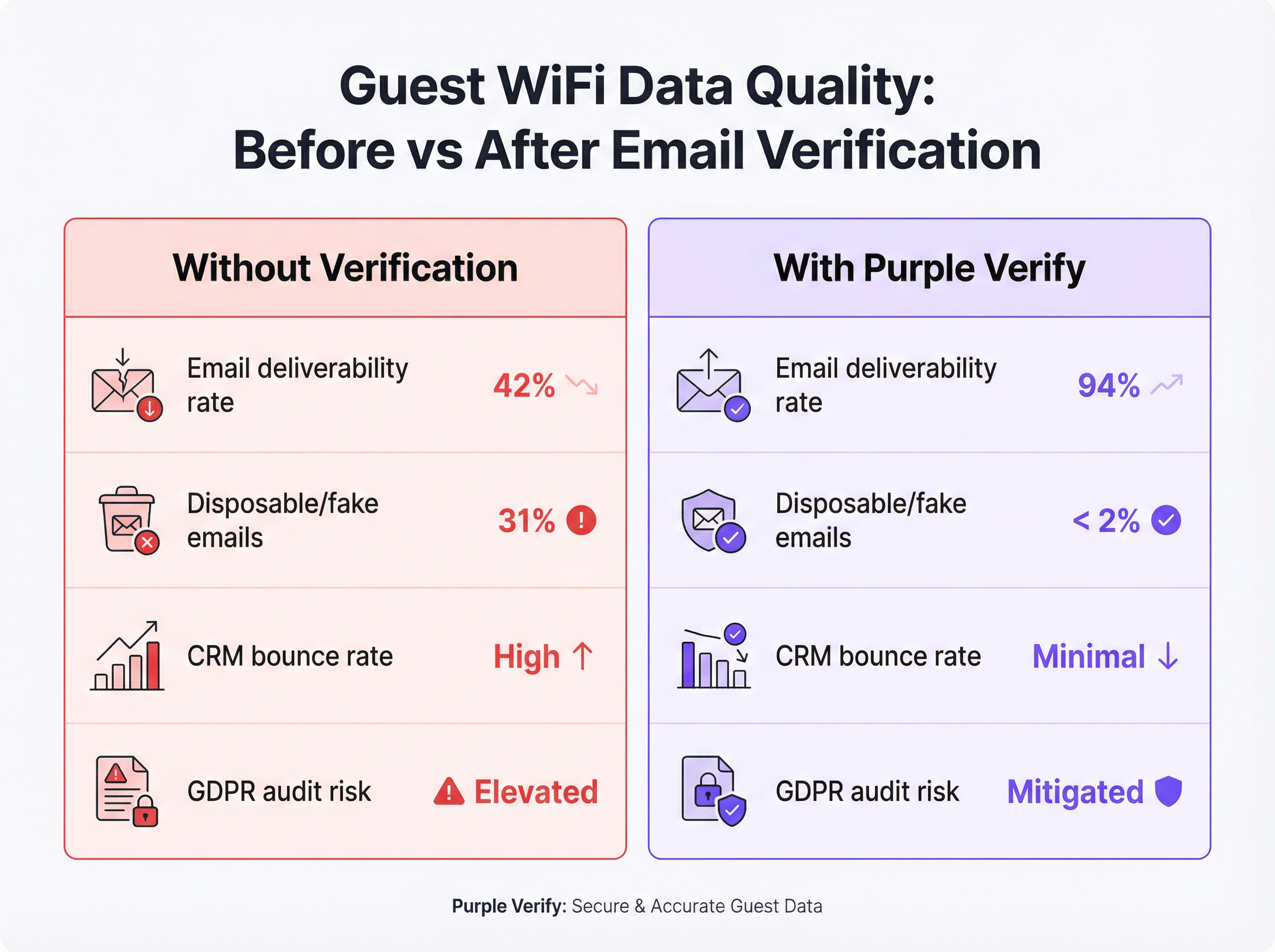
A funcionalidade Verify da Purple resolve este problema na camada de infraestrutura, aplicando um pipeline de validação em quatro fases — verificação de sintaxe, pesquisa de registos DNS MX, bloqueio de domínios de e-mail descartáveis e confirmação opcional por código de acesso único (OTP) — em tempo real, antes de ser concedido acesso à rede a um convidado. As implementações nos setores da hotelaria, retalho e eventos demonstram consistentemente uma redução nas taxas de e-mails inválidos para menos de 2%, com as taxas de capacidade de entrega de e-mails a subirem de uma base típica de 42% para mais de 90% nos 60 dias após a ativação.
Para o CTO que avalia o roteiro de qualidade de dados deste trimestre: a verificação de e-mail no WiFi não é um luxo. É o controlo fundamental que determina se o seu investimento em WiFi para convidados produz inteligência acionável ou um passivo dispendioso.
Análise Técnica Aprofundada
Por Que Motivo o WiFi para Convidados Produz Dados de E-mail Incorretos
A causa principal é estrutural e não acidental. Quando um convidado se liga a um Captive Portal, a troca é fundamentalmente assimétrica: o convidado quer acesso imediato à internet e o operador quer um endereço de e-mail válido em troca. O convidado tem todos os incentivos para minimizar a fricção e o operador — sem controlos de verificação — não tem qualquer mecanismo para impor a qualidade dos dados no momento da submissão.
Isto produz quatro categorias distintas de dados incorretos. Os erros tipográficos são os mais benignos: um convidado tem a intenção genuína de fornecer o seu endereço real, mas comete um erro de digitação sob pressão de tempo ou num teclado de telemóvel pequeno. Os endereços fabricados são deliberados: cadeias de caracteres como test@test.com ou noemail@noemail.com que parecem plausíveis, mas não resolvem para nada. Os domínios expirados ou inválidos surgem quando um convidado submete um endereço do domínio de um antigo empregador, de um ISP extinto ou de um domínio pessoal que já não mantém. Os endereços de e-mail descartáveis são a categoria mais sofisticada: serviços como o Mailinator, Guerrilla Mail e Temp Mail fornecem caixas de entrada totalmente funcionais que expiram após minutos ou horas, permitindo que um convidado passe até mesmo por uma verificação básica de capacidade de entrega, garantindo simultaneamente que não é possível qualquer contacto de marketing a longo prazo.
A norma IEEE 802.11 rege o comportamento de rádio e da camada MAC das redes WiFi, mas não impõe quaisquer requisitos sobre a verificação de identidade dos utilizadores que se ligam. O comportamento do Captive Portal é descrito no RFC 7710 e no seu sucessor RFC 8910, nenhum dos quais exige a validação de e-mail. O problema da qualidade dos dados é, portanto, inteiramente uma preocupação da camada de aplicação, situando-se acima da pilha de rede, e deve ser resolvido ao nível do software do Captive Portal.
A Arquitetura de Verificação em Quatro Camadas
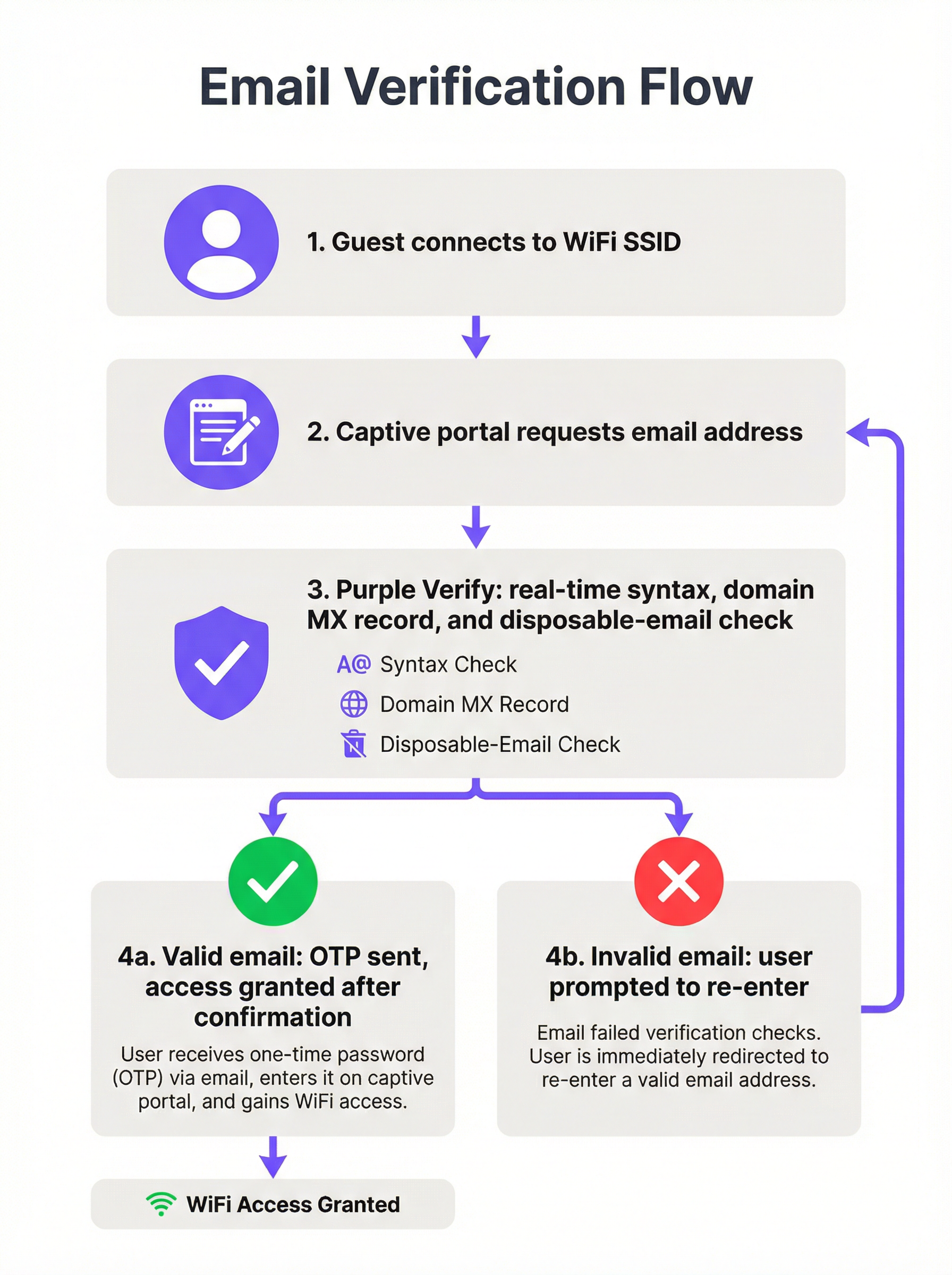
Uma implementação de verificação de e-mail em WiFi de nível de produção implementa quatro camadas de validação distintas, cada uma fornecendo uma garantia de qualidade incremental.
Camada 1 — Validação de Sintaxe (RFC 5322): A cadeia de caracteres submetida é analisada em relação à norma Internet Message Format. Isto confirma a presença de uma parte local, um símbolo de arroba e um componente de domínio com pelo menos um ponto. Rejeita cadeias com caracteres ilegais, múltiplos símbolos de arroba e outras violações estruturais. A validação de sintaxe por si só deteta aproximadamente 15–20% das submissões incorretas e adiciona uma latência insignificante (submilisegundo, do lado do cliente).
Camada 2 — Verificação de Domínio e Registo MX: Uma pesquisa DNS confirma que o domínio submetido existe e tem um registo Mail Exchange (MX) válido, indicando que está configurado para receber e-mail. Esta verificação é realizada do lado do servidor e normalmente é concluída em 100–300 milissegundos. Elimina endereços em domínios expirados, domínios fictícios e domínios corporativos que foram desativados — uma categoria que a validação de sintaxe não consegue detetar.
Camada 3 — Bloqueio de Domínios de E-mail Descartáveis: O componente de domínio é cruzado com uma lista de bloqueio continuamente atualizada de fornecedores conhecidos de serviços de e-mail descartáveis e temporários. É aqui que a camada de inteligência se torna crítica. Uma lista de bloqueio estática — que não é atualizada em tempo real — não detetará serviços descartáveis recém-lançados e a sua eficácia degradar-se-á ao longo do tempo. A funcionalidade Verify da Purple mantém uma lista de bloqueio atualizada em tempo real, garantindo a cobertura do ecossistema atual de e-mails descartáveis em vez de um retrato histórico.
Camada 4 — Confirmação por Código de Acesso Único (OTP): Um código numérico com limite de tempo é enviado para o endereço de e-mail submetido. O convidado deve recuperar este código da sua caixa de entrada real e introduzi-lo no Captive Portal para concluir a autenticação. Esta é a verificação definitiva de prova de propriedade: é impossível passar com um endereço fabricado, um endereço com erro de digitação ou uma caixa de entrada descartável que tenha expirado. A confirmação por OTP alinha-se com os princípios de autenticação multifator e fornece a garantia mais forte disponível de que o endereço de e-mail recolhido é válido e acessível ao convidado.
| Camada de Validação | O Que Deteta | Impacto na Latência | Recomendado Para |
|---|---|---|---|
| Sintaxe (RFC 5322) | Cadeias malformadas | < 1 ms | Todas as implementações |
| Domínio / Registo MX | Domínios inexistentes | 100–300 ms | Todas as implementações |
| Lista de Bloqueio de E-mail Descartável | Caixas de entrada temporárias | 50–100 ms | Implementações focadas em marketing |
| Confirmação por OTP | Todos os endereços inválidos | 30–120 segundos (dependente do utilizador) | Hotelaria, eventos, programas de fidelização |
Contexto de Conformidade e Normas
A verificação de e-mail no ponto de início de sessão WiFi é diretamente relevante para vários quadros regulamentares e normativos aos quais os operadores de espaços estão provavelmente sujeitos.
O Artigo 5.º, n.º 1, alínea d) do GDPR exige que os dados pessoais sejam exatos e, se necessário, atualizados. A recolha de um endereço de e-mail verificado no ponto de captura é substancialmente mais defensável numa auditoria da autoridade de controlo do que a recolha de um endereço não verificado e a tentativa de limpeza retroativa. O próprio processo de verificação deve ser documentado nos seus Registos de Atividades de Tratamento do Artigo 30.º.
O Artigo 7.º do GDPR exige que o consentimento para comunicações de marketing seja dado de forma livre, específica, informada e inequívoca. Um passo de confirmação por OTP fornece um registo contemporâneo de que o titular dos dados teve acesso ao endereço de e-mail submetido no momento do consentimento, reforçando a pista de auditoria.
A norma PCI DSS v4.0 não rege diretamente a verificação de e-mail, mas o Requisito 8 (Identificar Utilizadores e Autenticar Acesso) e os requisitos mais amplos de segmentação de rede são relevantes se o seu WiFi para convidados estiver num segmento de rede adjacente a ambientes de dados de titulares de cartões. A garantia de identidade fornecida pela verificação por OTP contribui para uma postura de controlo de acesso defensável.
O Anexo A, Controlo 5.14 (Transferência de Informação) e Controlo 8.5 (Autenticação Segura) da norma ISO/IEC 27001:2022 são relevantes para organizações que operam WiFi para convidados ao abrigo de um SGSI. A verificação de e-mail fornece uma verificação de identidade documentada e auditável no ponto de acesso à rede.
Guia de Implementação
Avaliação Pré-Implementação
Antes de ativar a verificação de e-mail, estabeleça uma linha de base quantificada. Exporte uma amostra representativa de pelo menos 5.000 endereços de e-mail da sua base de dados de WiFi para convidados existente e processe-os através de um serviço de validação de e-mail em massa. Registe a sua atual taxa de inválidos, taxa de e-mails descartáveis e taxa de devolução permanente (hard bounce) da sua plataforma de e-mail marketing. Estes valores formam a linha de base em relação à qual medirá a melhoria e construirá o business case interno para a implementação.
Selecionar a Profundidade de Verificação
A configuração de verificação apropriada depende de três fatores: a natureza da sua relação com o convidado (transacional versus longo prazo), a tolerância à fricção da demografia dos seus convidados e o caso de uso a jusante para os dados recolhidos.
Para ambientes de passagem de elevado tráfego — interfaces de transportes, centros comerciais, restaurantes de serviço rápido — a validação de sintaxe e domínio com bloqueio de e-mail descartável é o mínimo recomendado. O passo de OTP introduz uma fricção que pode ser desproporcional ao valor dos dados num contexto em que a relação com o convidado é breve e o caso de uso principal é a análise agregada em vez do marketing individual.
Para hotelaria e eventos — hotéis, centros de conferências, estádios — a confirmação completa por OTP é fortemente recomendada. A relação com o convidado é mais longa, o valor de marketing de um e-mail verificado é maior e os convidados nestes ambientes normalmente têm o seu e-mail acessível no dispositivo que estão a utilizar para iniciar sessão. Os 30–60 segundos adicionais de fricção estão bem dentro dos limites aceitáveis.
Para retalho integrado com fidelização — onde o início de sessão WiFi alimenta diretamente um programa de fidelização ou motor de personalização — a confirmação por OTP é essencial. A integridade da base de dados de fidelização depende da singularidade e exatidão dos identificadores de e-mail subjacentes.
Passos de Configuração na Purple
- Navegue para Venue Settings > Captive Portal > Authentication no painel de controlo da Purple.
- Selecione E-mail como método de autenticação e ative o botão de alternância Verify.
- Escolha a sua profundidade de verificação: Standard (sintaxe + domínio + lista de bloqueio de descartáveis) ou Full (Standard + confirmação por OTP).
- Configure o modelo de e-mail de OTP — certifique-se de que inclui a marca do seu espaço e uma linha de assunto clara (por exemplo, "O seu código de acesso WiFi do [Nome do Espaço]").
- Defina a janela de expiração do OTP. Recomenda-se uma janela de 10 minutos; janelas mais curtas aumentam o abandono, janelas mais longas reduzem a segurança.
- Configure as mensagens de repetição e de erro na interface de utilizador do Captive Portal. Especifique mensagens de erro distintas para falhas de sintaxe, falhas de domínio e rejeições de e-mail descartável.
- Ative a passagem de metadados de verificação para o seu CRM ou plataforma de marketing ligada através da API da Purple ou integração de webhook.
- Realize uma implementação faseada: ative primeiro num espaço ou SSID, monitorize a taxa de aprovação de verificação e a taxa de conclusão de OTP durante 7 dias e, em seguida, implemente em toda a propriedade.
Integração com Sistemas a Jusante
O valor da verificação de e-mail só é totalmente concretizado quando o estado de verificação é propagado para os sistemas a jusante. Configure a sua integração da Purple para passar o sinalizador booleano email_verified — e, onde o OTP foi utilizado, o sinalizador otp_confirmed — para o seu CRM e plataforma de e-mail marketing. Utilize este sinalizador para segmentar a sua base de dados de convidados: trate os endereços confirmados por OTP como o seu nível de maior qualidade para campanhas personalizadas e utilize endereços apenas com domínio validado para comunicações de menor prioridade.
Melhores Práticas
Trate a verificação de e-mail como um controlo de governação de dados, não como um controlo de segurança. O principal benefício é a qualidade dos dados e a conformidade com o GDPR, não a segurança da rede. Enquadre a implementação em conformidade ao construir o business case interno.
Utilize uma lista de bloqueio de e-mails descartáveis atualizada em tempo real. Uma lista de bloqueio estática degrada-se rapidamente. Novos serviços de e-mail descartável são lançados semanalmente. Certifique-se de que o seu fornecedor de verificação — seja a Purple ou um serviço de terceiros — mantém uma lista de bloqueio continuamente atualizada.
Conceba a UX de erro tendo em mente o utilizador genuíno. A maioria dos convidados que falham a verificação cometeu um erro de digitação genuíno e não uma tentativa deliberada de contornar o sistema. As mensagens de erro devem ser específicas, úteis e não acusatórias. "Não conseguimos encontrar esse domínio de e-mail — por favor, verifique e tente novamente" é mais eficaz do que uma mensagem genérica de "Endereço de e-mail inválido".
Monitorize a sua taxa de conclusão de OTP como um indicador principal. Uma taxa de conclusão de OTP em declínio pode indicar problemas de latência de entrega, problemas de tempo limite de sessão ou uma mudança demográfica na sua população de convidados. Configure alertas automatizados se a taxa de conclusão cair abaixo de um determinado limite (normalmente, 70% é uma linha de base razoável para ambientes de hotelaria).
Documente o seu processo de verificação para conformidade com o Artigo 30.º do GDPR. Os seus Registos de Atividades de Tratamento devem descrever os passos de verificação aplicados no momento da recolha de dados, a base legal para o tratamento e o período de retenção para os registos de verificação.
Aplique a profundidade de verificação de forma proporcional em toda a sua propriedade. Uma implementação em vários locais pode justificar diferentes configurações de verificação em diferentes tipos de espaços. Utilize a capacidade de configuração por espaço da Purple para aplicar a profundidade apropriada em cada local, em vez de assumir por defeito o mínimo denominador comum em toda a propriedade.
Resolução de Problemas e Mitigação de Riscos
Modos de Falha Comuns
Modo de Falha 1: Elevada taxa de abandono de OTP. Se a sua taxa de conclusão de OTP for inferior a 60%, as causas mais comuns são: latência de entrega de e-mail superior a 60 segundos; tempo limite da sessão do Captive Portal definido como demasiado curto (menos de 5 minutos); ou convidados que utilizam clientes de webmail que exigem a mudança de aplicações no telemóvel, fazendo com que a sessão do Captive Portal seja reposta. Resolução: verifique o seu SLA de entrega de e-mail com o seu fornecedor SMTP, prolongue o tempo limite da sessão para pelo menos 8 minutos e considere implementar uma alternativa de "link mágico" ao código numérico para os convidados que preferem uma confirmação com um único toque.
Modo de Falha 2: Endereços de e-mail corporativos legítimos a serem rejeitados. Alguns domínios de e-mail corporativos têm configurações de registo MX invulgares — por exemplo, organizações que encaminham o e-mail através de um gateway de segurança de terceiros com registos DNS não normalizados. Se estiver a observar rejeições de endereços que parecem legítimos, reveja a sua lógica de validação de domínio e considere implementar uma lista de permissões (whitelist) para domínios empresariais conhecidos que estejam a gerar falsos positivos.
Modo de Falha 3: Lista de bloqueio de e-mails descartáveis não cobre novos serviços. Monitorize a sua base de dados pós-verificação em busca de sinais de penetração de e-mails descartáveis — por exemplo, um pico repentino de endereços de um domínio desconhecido. Se identificar um novo serviço descartável que não está a ser bloqueado, comunique-o ao seu fornecedor de verificação para inclusão na lista de bloqueio.
Modo de Falha 4: Metadados de verificação não chegam ao CRM. Se a sua plataforma de e-mail marketing não estiver a receber o sinalizador email_verified, verifique a sua configuração de webhook da Purple e confirme se o endpoint recetor está a analisar o payload corretamente. Utilize a ferramenta de teste de webhook da Purple para validar a integração antes de confiar nela em produção.
Tabela de Riscos
| Risco | Probabilidade | Impacto | Mitigação |
|---|---|---|---|
| Falha na entrega de OTP (interrupção de SMTP) | Baixa | Elevado | Configure um relay SMTP secundário; implemente um fallback suave para validação apenas de domínio |
| Serviço de e-mail descartável não consta na lista de bloqueio | Média | Médio | Utilize uma lista de bloqueio atualizada em tempo real; monitorize a qualidade da base de dados pós-verificação |
| Desafio do GDPR sobre a retenção de dados de verificação | Baixa | Elevado | Documente a política de retenção; elimine os registos de OTP após 30 dias |
| Abandono do convidado devido à fricção do OTP | Média | Médio | Otimize a latência de entrega de e-mail; prolongue o tempo limite da sessão; ofereça métodos de autenticação alternativos |
| Rejeição de falsos positivos de endereços legítimos | Baixa | Médio | Implemente uma lista de permissões de domínios; forneça um caminho de substituição manual para o pessoal do espaço |
ROI e Impacto no Negócio
Medir o Sucesso
Os principais KPIs para uma implementação de verificação de e-mail em WiFi dividem-se em três categorias: métricas de qualidade de dados, métricas de desempenho de marketing e métricas de conformidade.
As métricas de qualidade de dados incluem a taxa de rejeição de e-mails inválidos (a percentagem de endereços submetidos rejeitados em cada camada de verificação), a taxa de conclusão de OTP e a taxa de devolução permanente (hard bounce) pós-implementação da sua plataforma de e-mail marketing. Uma implementação bem configurada deve atingir uma taxa de e-mails inválidos inferior a 2% e uma taxa de devolução permanente inferior a 0,5% em contactos com origem no WiFi.
As métricas de desempenho de marketing incluem a taxa de capacidade de entrega de e-mail, a taxa de abertura de campanhas e a taxa de cliques (click-through rate) para segmentos com origem no WiFi em comparação com outros canais de aquisição. Os contactos WiFi verificados superam consistentemente os contactos não verificados nestas métricas porque os dados subjacentes são exatos e o convidado demonstrou uma intenção ativa ao concluir o passo de OTP.
As métricas de conformidade incluem o número de pedidos de acesso de titulares de dados ao abrigo do GDPR que podem ser satisfeitos com exatidão (uma base de dados limpa reduz o risco de envio de dados pessoais para o indivíduo errado) e a prontidão para auditoria dos seus registos do Artigo 30.º.
Estrutura de Custo-Benefício
Os custos diretos de implementação da verificação de e-mail são mínimos: a funcionalidade Verify da Purple está incluída na subscrição da plataforma e a sobrecarga operacional incremental limita-se à configuração inicial e à monitorização contínua. Os custos indiretos são o aumento marginal na fricção de início de sessão e a pequena redução no volume de dados brutos (uma vez que alguns convidados que anteriormente teriam submetido endereços falsos irão agora abandonar o fluxo de início de sessão em vez de fornecerem um endereço real).
Os benefícios são quantificáveis. Para um grupo hoteleiro com 50 propriedades, cada uma com uma média de 150 inícios de sessão de WiFi para convidados por dia, o volume anual de dados é de aproximadamente 2,7 milhões de registos. Com uma taxa de inválidos não verificados de 30%, isso representa 810.000 registos inúteis por ano — cada um consumindo armazenamento no CRM, orçamento de envio de e-mails e criando potencialmente exposição ao GDPR. Com um custo típico de plataforma de e-mail marketing de £0,002 por envio, o desperdício direto de gastos apenas em endereços inválidos excede as £1.600 por ano, por campanha. Para um operador que executa 12 campanhas por ano, isso representa mais de £19.000 em desperdício direto — antes de contabilizar o custo de reputação das elevadas taxas de devolução que afetam a capacidade de entrega aos subscritores genuínos.
O cálculo do ROI é simples: o custo da verificação é efetivamente zero (é um botão de alternância de configuração numa subscrição de plataforma existente) e os benefícios — em redução de desperdício, melhoria do desempenho das campanhas e mitigação do risco de conformidade — são materiais e mensuráveis num prazo de 60 a 90 dias após a implementação.
Este guia é publicado pela Purple, a plataforma empresarial de inteligência WiFi. Para assistência na implementação ou para uma consulta técnica, contacte a sua equipa de conta da Purple ou visite purple.ai.
Key Terms & Definitions
Captive Portal
A web page presented to a guest attempting to connect to a WiFi network, requiring authentication or acceptance of terms before network access is granted. Captive portal behaviour is described in RFC 8910. The portal is the primary data collection interface in a guest WiFi deployment and the point at which email verification is applied.
IT teams encounter captive portals as the front-end interface of their guest WiFi deployment. The design and configuration of the captive portal — including its verification logic and error messaging — directly determines the quality of data collected.
MX Record (Mail Exchange Record)
A DNS resource record that specifies the mail server responsible for accepting email messages on behalf of a domain. During email verification, a DNS lookup for the MX record of the submitted domain confirms that the domain is configured to receive email. The absence of an MX record indicates that the domain cannot receive email, making any address at that domain invalid for communication purposes.
IT teams encounter MX record checks as part of the domain validation layer of email verification. Understanding MX records is also relevant for diagnosing false positive rejections of legitimate corporate email addresses with non-standard DNS configurations.
Disposable Email Address (DEA)
A temporary email address provided by a disposable email service (such as Mailinator, Guerrilla Mail, or Temp Mail) that is functional for a short period — typically minutes to hours — before expiring. DEAs are specifically designed to allow users to register for services without providing a permanent, contactable email address. They represent the most sophisticated category of invalid email data in guest WiFi deployments.
IT and marketing teams encounter DEAs as a primary source of data quality degradation in guest WiFi databases. A guest using a DEA will pass syntax and domain validation but will be unreachable for any subsequent marketing or transactional communication.
One-Time Passcode (OTP)
A time-limited numeric or alphanumeric code sent to a user's email address (or mobile number) as part of an authentication or verification flow. In the context of email verification WiFi, the OTP is dispatched to the submitted email address and must be entered into the captive portal to complete sign-in. Successful OTP entry constitutes proof of ownership of the submitted address.
IT teams configure OTP delivery as part of the captive portal authentication flow. Key configuration parameters include the OTP expiry window (typically 5–10 minutes), the SMTP relay used for delivery, and the session timeout on the captive portal (which must be long enough to allow the guest to retrieve and enter the code).
Email Deliverability Rate
The percentage of sent emails that successfully reach the recipient's inbox, as opposed to being bounced (returned as undeliverable) or filtered to spam. Deliverability rate is a function of both the quality of the underlying email list and the sender's reputation with Internet Service Providers (ISPs). A high proportion of invalid addresses in a list will generate hard bounces, which damage sender reputation and reduce deliverability even to valid addresses.
Marketing managers use deliverability rate as the primary indicator of email list health. IT teams are involved when deliverability issues are traced to infrastructure problems — such as a sender domain being flagged as high-risk by ISPs due to excessive bounce rates from WiFi-sourced contacts.
Hard Bounce
A permanent email delivery failure caused by an invalid, non-existent, or blocked recipient address. Hard bounces are distinguished from soft bounces (temporary delivery failures due to a full inbox or server unavailability). Email marketing platforms track hard bounce rates and will typically suppress addresses that generate hard bounces. A hard bounce rate above 2% is generally considered a threshold for sender reputation risk.
IT and marketing teams encounter hard bounces as the primary measurable symptom of poor email data quality. A high hard bounce rate from WiFi-sourced contacts is often the trigger for an email verification deployment project.
RFC 5322 (Internet Message Format)
The Internet Engineering Task Force (IETF) standard that defines the syntax of email messages, including the format of email addresses. RFC 5322 specifies that an email address consists of a local part (before the at-symbol) and a domain (after the at-symbol), with specific rules governing permissible characters and structure. Syntax validation in email verification checks submitted addresses against RFC 5322 requirements.
IT teams reference RFC 5322 when configuring or evaluating email validation logic. Understanding the standard helps distinguish between syntactically valid addresses (which conform to RFC 5322) and deliverable addresses (which additionally require a valid domain and MX record).
Sender Reputation
A score assigned by Internet Service Providers (ISPs) and email filtering services to a sending domain and IP address, based on factors including bounce rates, spam complaint rates, and sending volume patterns. A degraded sender reputation causes emails to be filtered to spam or rejected outright, even for valid recipient addresses. Sender reputation is directly affected by the quality of the underlying email list: high bounce rates from invalid addresses are one of the fastest ways to damage reputation.
IT teams are typically involved in sender reputation issues when the email marketing platform flags deliverability problems that trace back to infrastructure — such as a sending domain being blacklisted. Marketing managers experience sender reputation degradation as unexplained drops in campaign open rates. Email verification WiFi directly protects sender reputation by preventing invalid addresses from entering the list.
GDPR Article 5(1)(d) — Accuracy Principle
The provision of the General Data Protection Regulation that requires personal data to be 'accurate and, where necessary, kept up to date', with 'every reasonable step' taken to ensure that inaccurate personal data is erased or rectified without delay. In the context of guest WiFi data collection, this principle requires operators to take reasonable steps to ensure that email addresses collected at the point of sign-in are accurate — a requirement that email verification directly addresses.
Data protection officers and IT compliance teams reference Article 5(1)(d) when assessing the legal basis for email verification deployments. The principle provides the regulatory anchor for the business case: collecting unverified email addresses and storing them in a CRM is a potential compliance risk under GDPR, and verification is the most direct mitigation.
Case Studies
A 12-property UK hotel group has been operating guest WiFi for 18 months without email verification. Their CRM contains approximately 144,000 guest records sourced from WiFi sign-ins, but their email marketing platform is flagging their sender domain as high-risk due to a 31% hard bounce rate. The marketing director wants to launch a loyalty programme using WiFi-sourced contacts. What is the recommended approach?
The immediate priority is to stop the flow of new invalid data before addressing the existing database. Step 1: Activate Purple Verify with full OTP confirmation on all 12 properties. Configure a branded OTP email template and set the session timeout to 8 minutes. This halts the accumulation of new invalid records. Step 2: Run the existing 144,000-record database through a bulk email validation service to identify the invalid, disposable, and undeliverable addresses. Suppress these from all future sends immediately — do not attempt to re-engage them, as doing so will further damage sender reputation. Step 3: Implement a re-permission campaign to the remaining valid contacts, inviting them to opt in to the new loyalty programme. This simultaneously cleans the list and establishes a fresh, documented consent record for GDPR purposes. Step 4: Configure the Purple API integration to pass the otp_confirmed flag to the CRM, and create a segmentation rule that tags all new WiFi contacts with their verification tier. Step 5: Monitor the sender reputation score weekly using a tool such as Google Postmaster Tools or Microsoft SNDS. Expect the bounce rate to normalise to under 0.5% within 60 days as the invalid addresses are suppressed and new verified contacts replace them.
A retail chain operating 47 stores wants to use guest WiFi sign-in data to personalise in-store digital signage and feed a loyalty programme. Their current WiFi deployment captures approximately 3,200 sign-ins per day across the estate, but the data team reports that their customer segmentation models are unreliable due to a high proportion of duplicate and ghost accounts. The IT manager is concerned that adding OTP verification will reduce sign-in completion rates in a high-footfall, fast-turnover retail environment. What verification configuration is recommended, and how should the trade-off between data quality and conversion rate be managed?
For a high-footfall retail environment, the recommended configuration is syntax validation plus domain/MX record checking plus disposable email blocking, without the OTP step. This configuration eliminates the majority of low-quality data — fabricated addresses, non-existent domains, and disposable inboxes — while adding only 200–400 milliseconds of latency to the sign-in flow, which is imperceptible to the guest. The OTP step is omitted because the guest relationship in a retail context is typically brief and the device-switching friction (from captive portal to email app and back) is disproportionate to the value gained in a fast-turnover environment. To address the duplicate account problem specifically, configure the Purple platform to enforce email uniqueness at the point of sign-in: if a guest submits an address that already exists in the database, merge the session data with the existing record rather than creating a new one. This directly addresses the ghost account proliferation without requiring OTP. For the loyalty programme integration, apply a tiered trust model: contacts acquired through the WiFi flow with domain validation are treated as 'standard' tier; contacts who have additionally authenticated via a social login (which provides implicit email verification through the OAuth flow) are treated as 'verified' tier and are eligible for higher-value personalisation. Monitor the duplicate account rate monthly as the primary KPI for this deployment.
Scenario Analysis
Q1. A conference centre hosts 200 events per year, ranging from 50-person board meetings to 5,000-delegate industry conferences. Their guest WiFi currently captures approximately 180,000 email addresses per year with no verification. The events team wants to use this data for post-event marketing and delegate re-engagement. The IT manager is concerned about the compliance implications of the existing unverified database. What verification configuration would you recommend for new data collection, and how would you address the existing database?
💡 Hint:Consider the variability in event type and delegate profile. A 5,000-person conference has different data quality requirements and guest behaviour patterns than a 50-person board meeting. Also consider that conference delegates typically have their corporate email accessible on their device.
Show Recommended Approach
For new data collection, deploy full OTP confirmation for all events. Conference delegates are a high-value audience for post-event marketing, and the OTP step is well-suited to this context: delegates have their corporate email accessible on the device they are using to sign in, and the sign-in friction is proportionate to the value of the relationship. Configure the OTP email with event-specific branding (using Purple's dynamic template variables to insert the event name and date) to increase trust and completion rates. For large events (500+ delegates), pre-stage the SMTP relay capacity to handle peak OTP send volumes at event start. For the existing unverified database of 180,000 addresses, run a bulk validation audit immediately and suppress all addresses that fail domain and MX checks. For the remaining addresses, run a re-permission campaign framed around the new loyalty or delegate programme — this simultaneously cleans the list and establishes fresh GDPR consent records. Document the audit and re-permission process in the Article 30 Records of Processing Activities, noting the date of the remediation exercise and the methodology used.
Q2. A local authority is deploying free public WiFi across 23 libraries and community centres. The project is funded partly on the basis of providing anonymised footfall analytics to the council's planning department. The data protection officer has raised concerns about collecting email addresses from members of the public on council-operated infrastructure. The IT team is evaluating whether to require email sign-in at all, and if so, what verification to apply. What is your recommendation?
💡 Hint:Consider the data minimisation principle under GDPR Article 5(1)(c) — only collect data that is necessary for the specified purpose. If the primary purpose is anonymised footfall analytics, is email collection required at all? If email collection is retained, what is the legal basis and what verification depth is proportionate?
Show Recommended Approach
The data minimisation principle is the governing consideration here. If the primary purpose is anonymised footfall analytics, email collection is not required — device presence detection (using MAC address randomisation-aware counting methods) can provide footfall data without any personal data collection. Recommend separating the analytics use case from the marketing use case: deploy a no-registration WiFi option for general public access (satisfying the footfall analytics requirement with anonymised data), and offer an optional email registration path for users who wish to receive council communications or loyalty benefits. For the optional registration path, apply syntax validation and domain/MX checking as the minimum — OTP confirmation is recommended given the public-sector context and the DPO's concerns, as it provides the strongest available evidence of informed consent and accurate data collection. Document the legal basis for email processing (likely legitimate interests or consent, depending on the use case) in the Article 30 records, and ensure the captive portal privacy notice clearly distinguishes between the anonymised analytics processing and the optional email registration processing.
Q3. An IT manager at a 300-outlet fast-food chain has activated Purple Verify with syntax, domain, and disposable email blocking (no OTP) across all outlets. Three months after deployment, the marketing team reports that their email deliverability rate has improved from 48% to 71% — a significant improvement, but still below the 90%+ target. The IT manager suspects that a new category of invalid addresses is getting through the current verification stack. What diagnostic steps would you recommend, and what additional configuration changes might close the gap?
💡 Hint:A deliverability rate of 71% after deploying three-layer verification (without OTP) suggests that a significant proportion of addresses are passing all three checks but are still undeliverable. Consider what categories of address could pass syntax, domain, and disposable email checks but still be undeliverable.
Show Recommended Approach
The most likely explanation is a combination of two factors: role-based email addresses (such as info@, noreply@, admin@, or postmaster@) that are syntactically valid, have valid MX records, and are not disposable services, but are not monitored by an individual and generate soft bounces or spam complaints; and addresses at legitimate domains where the specific mailbox does not exist (the domain is valid, the MX record is valid, but the local part — the username — is fabricated). To diagnose: export a sample of 1,000 addresses that passed verification but generated bounces, and categorise them by bounce type and address pattern. If role-based addresses are a significant category, add a role-based address filter to the verification configuration. For the mailbox-existence problem, the only reliable solution is OTP confirmation — which verifies that the specific mailbox exists and is accessible to the submitting guest. Given the fast-food context, the IT manager should evaluate whether a limited OTP deployment — for example, on the loyalty programme sign-in flow only, not the general WiFi access flow — would close the remaining gap without imposing OTP friction on the full guest population. This tiered approach is a practical compromise between data quality and conversion rate in a high-footfall environment.
Key Takeaways
- ✓Between 25% and 35% of email addresses captured through unverified guest WiFi captive portals are invalid, disposable, or fabricated — making email verification WiFi a foundational data governance control, not an optional enhancement.
- ✓A production-grade verification architecture implements four layers in sequence: RFC 5322 syntax validation, DNS MX record lookup, live-updated disposable email blocklisting, and OTP confirmation. Each layer provides incremental quality assurance; the appropriate depth depends on the use case and guest context.
- ✓Purple's Verify feature implements all four layers natively within the captive portal flow, with a continuously updated disposable email blocklist and configurable OTP step — reducing invalid email rates to under 2% within 60 days of activation in documented deployments.
- ✓GDPR Article 5(1)(d)'s accuracy principle provides the regulatory anchor for email verification deployments: collecting unverified personal data and storing it in a CRM is a documentable compliance risk, and verification at the point of capture is the most direct mitigation.
- ✓The ROI is measurable and rapid: a 12-property hotel group deploying Verify saw email deliverability rise from 42% to 94% within 60 days, with the invalid email rate dropping from 31% to under 2% — directly improving campaign performance and reducing wasted send budget.
- ✓Verification depth should be calibrated to context: full OTP confirmation for hospitality, events, and loyalty programmes; syntax, domain, and disposable email blocking for high-footfall retail and transient environments; and a data minimisation review for public-sector deployments where email collection may not be required at all.
- ✓Post-deployment monitoring is essential: track the OTP completion rate, invalid email rejection rate, and sender reputation score at 30, 60, and 90 days. A declining OTP completion rate is the leading indicator of delivery latency or session timeout issues that require remediation.




