

Configuração de VLAN para Redes WiFi
This guide provides a technical deep-dive into VLAN configuration for enterprise WiFi networks, offering actionable guidance for IT leaders and network architects. It covers VLAN fundamentals, SSID-to-VLAN mapping, implementation best practices, and the business impact of proper network segmentation for security, performance, and compliance in venues like hotels, retail chains, and stadiums.
🎧 Listen to this Guide
View Transcript

Resumo Executivo
Para qualquer empresa moderna que opere uma rede WiFi de grande escala — seja uma cadeia de retalho com várias localizações, um vasto complexo hoteleiro ou um estádio de alta densidade —, a segmentação de rede já não é uma recomendação; é um requisito fundamental para a segurança, desempenho e eficiência operacional. As Redes Locais Virtuais (VLANs) fornecem o mecanismo principal para alcançar esta segmentação de forma escalável e económica. Ao particionar logicamente uma única infraestrutura de rede física em múltiplos domínios de difusão (broadcast) isolados, as VLANs permitem que as equipas de TI apliquem políticas de segurança distintas, giram o tráfego e melhorem a experiência do utilizador em diferentes grupos de utilizadores e tipos de dispositivos. Por exemplo, o tráfego de WiFi de convidados pode ser completamente isolado de recursos corporativos sensíveis, como sistemas de Ponto de Venda (POS) ou servidores internos, mitigando diretamente o risco e simplificando a conformidade com normas como o PCI DSS e o GDPR. Este guia serve como uma referência técnica autorizada para arquitetos de rede e gestores de TI, fornecendo uma estrutura prática para conceber, implementar e gerir uma arquitetura de VLAN robusta para implementações de WiFi empresariais. Vai além da teoria académica para oferecer orientações acionáveis e independentes de fornecedores, baseadas em cenários do mundo real e nas melhores práticas da indústria, focando-se na correlação direta entre a configuração adequada de VLANs e resultados de negócio mensuráveis, tais como a melhoria da capacidade de transferência (throughput) da rede, o reforço da postura de segurança e uma maior agilidade operacional.
Análise Técnica Aprofundada
Na sua essência, uma VLAN é um agrupamento lógico de dispositivos de rede que comunicam como se estivessem na mesma LAN física, independentemente da sua localização física. A tecnologia que sustenta isto é a norma IEEE 802.1Q, que define um sistema de etiquetagem (tagging) de VLAN. Quando uma trama Ethernet viaja através de uma ligação de rede configurada como um "trunk" (tronco), uma etiqueta de 4 bytes é inserida no cabeçalho da trama. Esta etiqueta contém um Identificador de VLAN (VID), um número de 12 bits que identifica de forma única a VLAN à qual a trama pertence (permitindo até 4.094 VLANs). Os switches de rede utilizam este VID para tomar decisões de reencaminhamento, garantindo que as tramas de uma VLAN específica são entregues apenas a portas pertencentes a essa mesma VLAN ou a outras portas trunk.
Mapeamento de SSID para VLAN
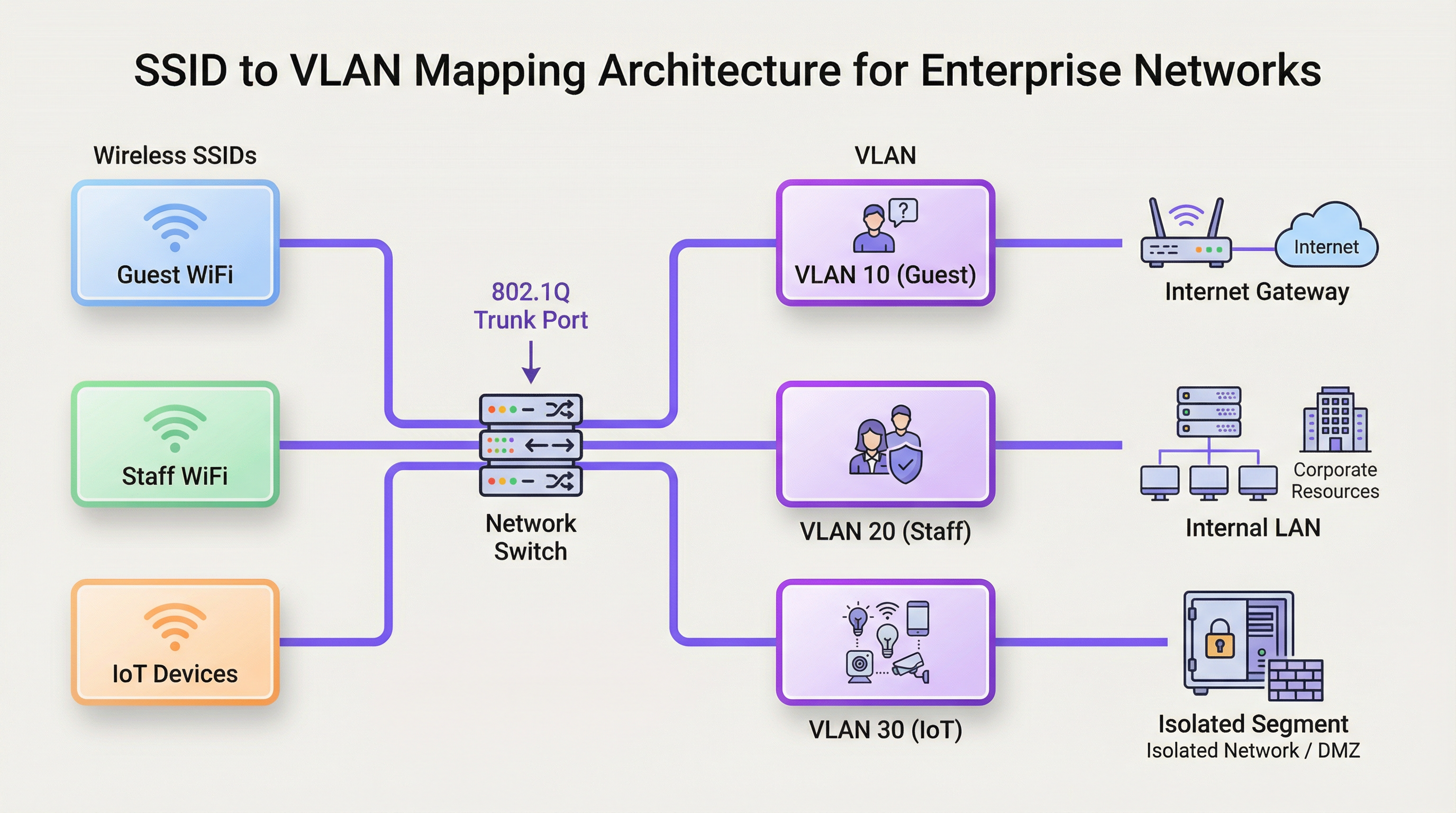
A aplicação mais comum de VLANs num contexto de WiFi é o mapeamento de um Service Set Identifier (SSID) específico — o nome público de uma rede WiFi — para uma VLAN dedicada. Isto cria uma ponte contínua entre os segmentos de rede sem fios e com fios. Por exemplo:
- SSID:
Guest-WiFi-> VLAN 10 (Apenas acesso à Internet, isolamento de clientes ativado) - SSID:
Staff-Internal-> VLAN 20 (Acesso a servidores corporativos, impressoras e aplicações internas) - SSID:
POS-Terminals-> VLAN 30 (Altamente restrito, acesso apenas a gateways de processamento de pagamentos, em conformidade com o PCI DSS) - SSID:
IoT-Devices-> VLAN 40 (Segmento isolado para gestão de edifícios, AVAC e câmaras de segurança)
Esta arquitetura é concretizada através da configuração dos Pontos de Acesso (APs) sem fios e dos switches de rede. Os APs são configurados para etiquetar o tráfego sem fios de cada SSID com o VID correspondente. As portas do switch ligadas a estes APs são configuradas como portas trunk, permitindo-lhes transportar tráfego para múltiplas VLANs em simultâneo. Quando o tráfego etiquetado chega ao switch, este reencaminha-o com base no VID, garantindo que permanece isolado dentro do seu domínio de difusão designado.
Domínios de Difusão e Desempenho da Rede
Sem VLANs, uma grande rede é um único domínio de difusão. Cada trama de difusão (por exemplo, de um pedido ARP) é enviada para todos os dispositivos na rede. Num ambiente de alta densidade com centenas ou milhares de dispositivos, este tráfego de difusão pode criar um congestionamento de rede significativo, um fenómeno conhecido como "tempestade de difusão" (broadcast storm), que degrada severamente o desempenho para todos os utilizadores. Ao segmentar a rede em VLANs mais pequenas, as difusões ficam confinadas à sua respetiva VLAN. Um pedido ARP na VLAN do WiFi de convidados, por exemplo, não será visto pelos dispositivos na VLAN de funcionários, reduzindo drasticamente a sobrecarga e melhorando a capacidade de transferência e a estabilidade geral da rede.
Guia de Implementação
A implementação de uma estratégia de VLAN requer um planeamento cuidadoso e a configuração de hardware de rede essencial. O objetivo é criar uma arquitetura resiliente e escalável que esteja alinhada com os requisitos operacionais e de segurança da organização.
Requisitos de Hardware
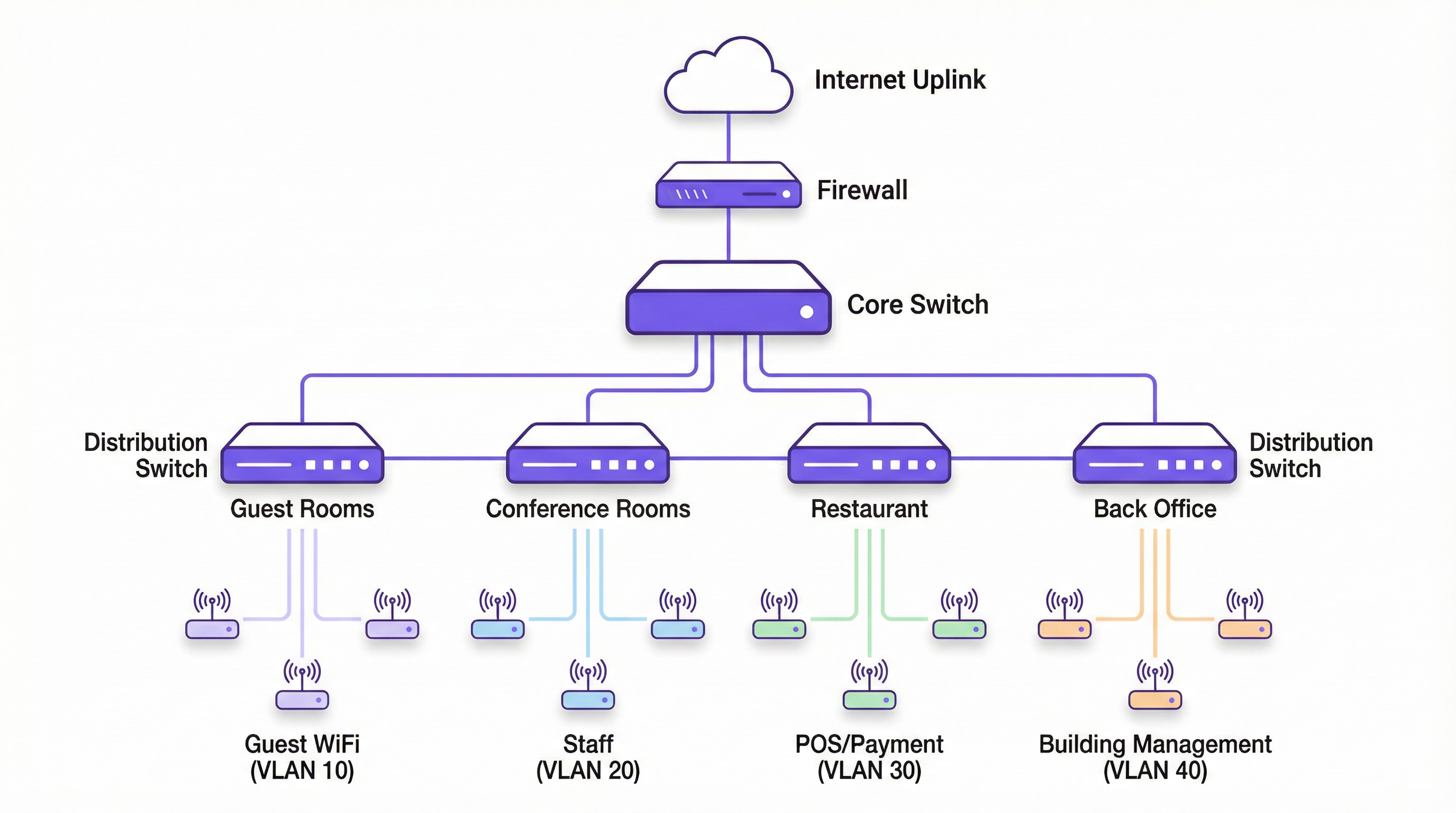
- Switches Compatíveis com VLAN: O núcleo de qualquer implementação de VLAN é o switch de rede. Todos os switches no caminho de dados devem ser switches "geridos" ou "inteligentes" que suportem a norma IEEE 802.1Q. Os switches não geridos não conseguem processar etiquetas de VLAN e irão descartar as tramas etiquetadas ou remover as etiquetas, quebrando a segmentação.
- Pontos de Acesso Sem Fios Compatíveis com VLAN: São necessários APs de nível empresarial. Estes APs devem suportar múltiplos SSIDs e ter a capacidade de etiquetar o tráfego de cada SSID com um ID de VLAN específico.
- Router / Switch de Camada 3: Uma vez que as VLANs criam redes logicamente separadas, é necessário um dispositivo capaz de efetuar o encaminhamento entre elas caso seja exigida alguma comunicação inter-VLAN (por exemplo, permitir que os dispositivos dos funcionários acedam a uma impressora numa VLAN diferente). Esta função é tipicamente desempenhada por um router central ou um switch de Camada 3. As Listas de Controlo de Acesso (ACLs) são configuradas neste dispositivo para controlar rigorosamente qual o tráfego que tem permissão para cruzar as fronteiras da VLAN.
Passos de Configuração Independentes de Fornecedores
- Defina o Seu Esquema de VLAN: Planeie as suas VLANs com base em grupos de utilizadores, níveis de confiança e tipos de tráfego. Atribua um nome e um VID único a cada uma (por exemplo, VLAN 10 - Convidados, VLAN 20 - Funcionários, VLAN 30 - PCI, VLAN 40 - IoT). Crucialmente, não utilize a VLAN 1, a VLAN predefinida, para qualquer tráfego de produção. É um risco de segurança comum.
- Configure as VLANs nos Switches: Aceda à interface de gestão dos seus switches e crie as VLANs definidas. Isto envolve tipicamente dar a cada VLAN um nome e o seu VID correspondente.
- Configure as Portas Trunk: Identifique as portas do switch que se irão ligar aos seus APs e a outros switches. Configure estas portas como portas "trunk" e especifique quais as VLANs que têm permissão para atravessar o trunk. Por motivos de segurança, permita apenas as VLANs necessárias, e não todas.
- Configure as Portas de Acesso: Para as portas que se ligam a dispositivos finais que não são compatíveis com VLAN (como um PC de secretária), configure-as como portas de "acesso" e atribua-as a uma única VLAN não etiquetada.
- Configure os APs: No seu controlador sem fios ou interface de gestão de APs, crie os seus SSIDs. Para cada SSID, atribua-o ao ID de VLAN correspondente. Este é o passo que etiqueta o tráfego sem fios.
- Configure o Encaminhamento Inter-VLAN: No seu router ou switch de Camada 3, crie uma interface virtual para cada VLAN e atribua-lhe um endereço IP. Este endereço servirá como gateway predefinido para todos os dispositivos dentro dessa VLAN. Implemente ACLs para definir as regras para o tráfego que flui entre as VLANs.
Melhores Práticas
- Isole o Tráfego de Alto Risco: Coloque sempre as redes de convidados, dispositivos IoT e sistemas sujeitos a conformidade (como o PCI DSS) nas suas próprias VLANs dedicadas e altamente restritas.
- Utilize uma VLAN de Gestão Dedicada: Os dispositivos de infraestrutura de rede (switches, APs, controladores) devem residir na sua própria VLAN de gestão isolada para os proteger do tráfego dos utilizadores finais e de potenciais ataques.
- Implemente o 802.1X para Atribuição Dinâmica de VLAN: Para uma maior segurança, utilize a norma IEEE 802.1X com um servidor RADIUS. Isto permite a atribuição dinâmica de VLAN por utilizador ou por dispositivo após uma autenticação bem-sucedida, em vez de depender exclusivamente do SSID a que se ligam.
- Remova VLANs Não Utilizadas dos Trunks: Por motivos de desempenho e segurança, configure as portas trunk para permitir apenas as VLANs que são ativamente necessárias nessa ligação. Isto evita que tráfego de difusão desnecessário se propague pela rede.
- Alinhe-se com as Normas de Segurança: Certifique-se de que a sua arquitetura de VLAN suporta a conformidade com os regulamentos relevantes. Por exemplo, o Requisito 1.2.1 do PCI DSS exige a segmentação do ambiente de dados do titular do cartão do resto da rede.
Resolução de Problemas e Mitigação de Riscos
- Problema: Os dispositivos não obtêm um endereço IP.
- Causa: Frequentemente, não está configurado um âmbito DHCP para a nova VLAN, ou o router/switch L3 não está configurado corretamente para retransmitir pedidos DHCP.
- Mitigação: Certifique-se de que um servidor DHCP tem um âmbito para a sub-rede de cada VLAN e que um endereço IP auxiliar (IP helper-address) está configurado na interface da VLAN no seu router.
- Problema: Os dispositivos conseguem ligar-se ao WiFi, mas não têm acesso à rede.
- Causa: Uma incompatibilidade de etiquetagem de VLAN entre o AP e a porta trunk do switch, ou a VLAN não está a ser permitida numa ligação trunk algures no caminho.
- Mitigação: Verifique sistematicamente a configuração da porta trunk em cada switch no caminho desde o AP até ao router central.
- Risco: Salto de VLAN (VLAN Hopping).
- Causa: Um atacante numa VLAN de menor segurança tenta obter acesso a uma de maior segurança. Isto pode ser feito através de técnicas como a falsificação de switch (switch spoofing) ou a dupla etiquetagem (double tagging).
- Mitigação: Utilize as melhores práticas de segurança modernas: desative o Dynamic Trunking Protocol (DTP) nos switches, configure manualmente as portas trunk e certifique-se de que a sua VLAN nativa nos trunks é uma VLAN dedicada e não utilizada, e não a VLAN 1.
ROI e Impacto no Negócio
O investimento na conceção e implementação de uma arquitetura de VLAN adequada gera retornos significativos. O principal ROI reside na mitigação de riscos. Uma única violação numa rede indevidamente segmentada pode expor toda a organização, levando a danos financeiros e de reputação catastróficos. Ao isolar sistemas críticos, a superfície de ataque é drasticamente reduzida. Além disso, as melhorias de desempenho resultantes da redução do tráfego de difusão conduzem a uma melhor experiência de utilizador tanto para convidados como para funcionários, o que se pode traduzir numa maior satisfação do cliente num hotel ou numa maior produtividade dos colaboradores num escritório. Por fim, uma rede segmentada e bem documentada simplifica a gestão e a resolução de problemas, reduzindo a sobrecarga operacional e permitindo que as equipas de TI respondam a problemas e implementem novos serviços de forma mais eficiente.
Key Terms & Definitions
VLAN (Virtual Local Area Network)
A logical grouping of devices on one or more physical LANs that are configured to communicate as if they were attached to the same wire, when in fact they are located on a number of different LAN segments.
IT teams use VLANs to segment a network for security and performance reasons, such as separating guest WiFi traffic from internal corporate traffic without needing separate physical hardware for each.
IEEE 802.1Q
The networking standard that defines how VLAN information is inserted into Ethernet frames. It specifies the use of a "tag" in the frame header to identify the VLAN membership.
This is the core technology that makes VLANs work across multiple switches from different vendors. When a switch is "802.1Q compliant," it means it can understand and process these VLAN tags.
SSID (Service Set Identifier)
The public name of a wireless local area network (WLAN) that is broadcast into the air by access points. It is the name you see when you search for WiFi networks on your device.
In a VLAN deployment, IT teams map each SSID to a specific VLAN to automatically segment users based on the WiFi network they connect to (e.g., `Guest-WiFi` SSID maps to the Guest VLAN).
Trunk Port
A port on a network switch configured to carry traffic for multiple VLANs simultaneously. It uses the 802.1Q tagging standard to differentiate between the traffic of different VLANs.
Trunk ports are essential for connecting switches to each other and for connecting switches to VLAN-aware access points. They are the multi-lane highways of a VLAN architecture.
Access Port
A port on a network switch that carries traffic for only one VLAN. It is configured to connect to end-user devices like computers or printers that are not VLAN-aware.
This is the most common port configuration. When a device is plugged into an access port, it becomes a member of that port's assigned VLAN without needing any special configuration on the device itself.
Network Segmentation
The practice of splitting a computer network into smaller, isolated subnetworks or segments. Each segment acts as its own small network, and traffic between segments is controlled.
VLANs are the primary tool for achieving network segmentation. This is a critical security practice for reducing the attack surface and a performance tool for limiting broadcast traffic.
Broadcast Domain
A logical division of a computer network in which all nodes can reach each other by broadcast at the data link layer. A broadcast frame sent from one device will be received by all other devices in the same broadcast domain.
By default, a switched network is one large broadcast domain. VLANs break up the network into multiple, smaller broadcast domains, which improves performance by reducing unnecessary broadcast traffic.
RADIUS (Remote Authentication Dial-In User Service)
A client/server protocol that provides centralized Authentication, Authorization, and Accounting (AAA) management for users who connect to a network service.
In advanced WiFi deployments, a RADIUS server is used with 802.1X to authenticate users. Based on the user's credentials, the RADIUS server can tell the switch or AP to dynamically assign the user to a specific VLAN, providing a very high level of security and flexibility.
Case Studies
A 200-room luxury hotel needs to replace its aging WiFi network. They require secure, high-performance internet for guests, a separate network for corporate staff, a PCI-compliant network for payment systems at the front desk and restaurant, and a network for building management systems (HVAC, smart locks).
- VLAN Planning: Define four primary VLANs: VLAN 10 (Guests), VLAN 20 (Staff), VLAN 30 (PCI-DSS), and VLAN 40 (Building Management). Also, define VLAN 99 for network management.
- IP Addressing: Assign a unique /24 subnet to each VLAN (e.g., 10.10.10.0/24 for Guests, 10.10.20.0/24 for Staff).
- Hardware Configuration: Deploy managed 802.1Q-capable switches. Configure switch-to-switch ports and AP-connected ports as 802.1Q trunks, allowing VLANs 10, 20, 30, 40, and 99.
- SSID Mapping: Configure four SSIDs on the enterprise APs:
Hotel-Guest-WiFi-> VLAN 10,Hotel-Staff-> VLAN 20 (using WPA3-Enterprise with 802.1X),Hotel-POS-> VLAN 30 (hidden SSID), andHotel-IoT-> VLAN 40. - Routing & Security: Use a Layer 3 core switch for inter-VLAN routing. Create strict ACLs: VLAN 10 can only route to the internet. VLAN 30 can only communicate with the payment gateway IP address. VLAN 20 can access internal servers but not VLAN 30. VLAN 40 is completely isolated.
A retail chain with 50 stores wants to provide free guest WiFi while ensuring the security of their in-store POS systems and inventory scanners, which are also wireless.
- Standardised VLAN Template: Create a corporate-wide VLAN template to be deployed at each store: VLAN 110 (Guest WiFi), VLAN 120 (Corporate/Staff), VLAN 130 (POS), VLAN 140 (Inventory Scanners). Using higher VLAN numbers avoids conflicts with default setups.
- Centralised Management: Use a cloud-managed wireless and switching solution (like Purple's platform) to push the standardised configuration to all 50 stores.
- SSID Configuration:
Retail-Guest-> VLAN 110 (with client isolation and a captive portal for marketing).Retail-Staff-> VLAN 120 (WPA3-Enterprise).Retail-POS-> VLAN 130 (hidden SSID, MAC filtering).Retail-Inventory-> VLAN 140 (WPA3-Enterprise). - Firewall Policy: The on-site firewall at each store acts as the router. It is configured with rules to ensure VLAN 110 is internet-only. VLAN 130 traffic is restricted to the payment processor. VLAN 120 and 140 can communicate with the central corporate data centre over a VPN but are blocked from accessing the guest or POS VLANs directly.
Scenario Analysis
Q1. A conference centre is hosting a major tech event with 5,000 attendees, 200 event staff, and a dedicated press corps. How would you structure the VLANs and SSIDs to ensure a secure and performant network experience for all groups?
💡 Hint:Consider the different bandwidth, access, and security requirements for each group. Think about traffic density and potential interference.
Show Recommended Approach
- VLANs: Create at least three primary VLANs: VLAN 100 (Attendees), VLAN 200 (Staff), VLAN 300 (Press).
- SSIDs:
Event-Guest(VLAN 100) with a captive portal for registration and aggressive bandwidth limiting.Event-Staff(VLAN 200) with WPA3-Enterprise and access to production servers.Event-Press(VLAN 300) with higher bandwidth allocation and less restrictive filtering to allow for media uploads. - Network Design: Use a high-density AP deployment. Isolate the VLANs and implement strict inter-VLAN routing rules. The Attendee VLAN should be internet-only with client isolation enabled to prevent peer-to-peer attacks.
Q2. Your organisation has implemented VLANs, but users on the Staff VLAN (VLAN 20) are complaining of slow performance. The Guest VLAN (VLAN 10) seems unaffected. What are the first three things you would investigate?
💡 Hint:Think about the path traffic takes and what could cause congestion specific to one VLAN.
Show Recommended Approach
- Broadcast Traffic: Check for a broadcast storm within VLAN 20. A misconfigured device or a network loop affecting only that VLAN could be flooding it with traffic. Use a packet analyser to inspect traffic on a VLAN 20 access port.
- Uplink Saturation: Check the utilisation of the trunk links carrying VLAN 20 traffic. It's possible that staff activities (e.g., large file transfers to a server) are saturating the uplink, while guest traffic (mostly internet-bound) uses a different path or is shaped differently.
- DHCP/DNS Issues: Verify that the DHCP server for the VLAN 20 subnet is responsive and has available leases. Check the DNS servers assigned to VLAN 20 clients for latency or resolution failures. A problem with these core services can manifest as slow network performance.
Q3. A new security audit requires that all payment terminals be on a network segment that is completely isolated and compliant with PCI DSS. The terminals are currently connected to the same switches as regular staff computers. What is the most cost-effective way to achieve this?
💡 Hint:How can you achieve logical isolation without buying an entire new set of physical hardware?
Show Recommended Approach
The most cost-effective solution is to create a new, dedicated PCI VLAN (e.g., VLAN 30). Assign the switch ports connected to the payment terminals as access ports for VLAN 30. Then, at the router or Layer 3 switch, create a strict firewall rule (ACL) that only allows traffic from the VLAN 30 subnet to communicate with the specific IP addresses of the payment processor, and block all other traffic, including all inter-VLAN traffic. This logically isolates the terminals on the existing hardware, meeting the core requirement of PCI DSS segmentation without capital expenditure on new switches.
Key Takeaways
- ✓VLANs logically segment a physical network into multiple isolated broadcast domains.
- ✓Map SSIDs to specific VLANs to automatically enforce security policies for different user groups (e.g., Guest vs. Staff).
- ✓Use 802.1Q compliant switches and APs to implement a VLAN architecture.
- ✓Isolating guest, corporate, and sensitive (e.g., PCI) traffic into separate VLANs is critical for security and compliance.
- ✓VLANs improve network performance by reducing the size of broadcast domains and mitigating broadcast storms.
- ✓Always use a dedicated, unused VLAN for management and for the native VLAN on trunk ports; avoid using the default VLAN 1.
- ✓For maximum security, combine VLANs with 802.1X and a RADIUS server for dynamic, per-user VLAN assignment.




