When your Wi-Fi performance tanks, running a channels scan is the single most effective tool in your arsenal for figuring out why and how to fix it. It’s like getting an x-ray of your wireless environment, showing you exactly how crowded the airwaves are. With that intel, you can move your network to a quieter channel for a faster, more stable connection.
It's amazing how often this simple step solves those mystery slowdowns and connection drops.
Why a Wi-Fi Channels Scan Is Your Best Defence Against Bad Wi-Fi

Ever shelled out for super-fast internet, only to get stuck with painfully slow Wi-Fi? More often than not, the bottleneck isn't your provider—it's the chaos in your local wireless environment. Your network is in a constant battle for airtime with dozens of other devices, creating a digital traffic jam that can grind your connection to a halt.
Think of Wi-Fi channels as lanes on a motorway. When too many networks try to cram into the same lane, everything slows down. This is the daily reality in most modern venues, from hotels and shops to busy office buildings. A Wi-Fi channels scan is your personal traffic report, giving you a clear view of which lanes are gridlocked and which are wide open.
Understanding Wireless Congestion
The two main culprits behind poor performance are co-channel interference and adjacent-channel interference. Co-channel interference is what happens when multiple access points (APs) are all shouting on the same channel, forcing them to take turns transmitting data.
Adjacent-channel interference is arguably worse. This occurs when signals from nearby, overlapping channels bleed into each other, creating a wall of noise that corrupts data packets and forces re-transmissions.
This gets especially messy in the 2.4 GHz band. With only three channels (1, 6, and 11) that don't actually overlap, your scan will likely reveal a dogpile of neighbouring networks all fighting over the same sliver of spectrum.
A proper Wi-Fi scan shifts your entire strategy from reactive troubleshooting to proactive network management. Instead of just guessing why performance is awful, you get hard data to make smart decisions that directly improve connectivity.
The Business Impact of a Clean RF Environment
For any business today, solid wireless is non-negotiable. Slow Wi-Fi creates a ripple effect of problems that impact customer happiness and operational efficiency.
When guests in a hotel or café struggle with constant disconnections, you can bet it'll show up in their reviews. If your staff can't reliably use their point-of-sale systems or internal apps, productivity takes a nosedive. We dig deeper into these issues in our guide on why your Wi-Fi keeps disconnecting.
By regularly running a channels scan, you gather the intelligence needed to properly optimise your network. This data-driven approach means you can:
- Boost Guest Satisfaction: Deliver a seamless and fast connection that genuinely improves the visitor experience.
- Improve Staff Productivity: Ensure the critical business applications your team relies on run smoothly, without frustrating interruptions.
- Increase Network Reliability: Minimise downtime and dramatically cut down on the number of support tickets related to poor Wi-Fi.
Choosing the Right Tools for Your WiFi Scan
Once you understand why a WiFi channel scan is so vital, the next job is picking the right tool. The market is packed with options, from free, built-in utilities to powerful, professional-grade analysers. Your final choice will probably hinge on your operating system, how technical you want to get, and just how deep you need to dig into the data.
Generally, these tools fall into two camps: basic scanners and advanced analysers. Think of basic scanners as a quick peek over the fence to see which neighbours are home. Advanced tools, on the other hand, give you the full architectural blueprint, showing you everything from signal strength and noise levels to historical performance data.
Built-in Utilities vs Dedicated Analysers
Most operating systems come with some kind of native wireless scanning feature. macOS, for example, has a surprisingly good tool called Wireless Diagnostics, although it's a bit tucked away. While these built-in options are handy for a quick spot-check, they usually don't have the detailed graphs or in-depth metrics you need for serious troubleshooting.
That’s where dedicated third-party apps come into their own. Tools like NetSpot, inSSIDer, or WiFi Analyzer Pro are built from the ground up for network analysis. They turn complex data into easy-to-read graphs, making it much simpler to spot channel overlap and pinpoint the strongest, quietest channels available. For anything beyond a quick check on your home network, a dedicated tool is nearly always the way to go.
The right tool doesn't just show you data; it tells you a story about your wireless environment. A good analyser turns abstract numbers into a clear visual map, instantly revealing interference problems that would otherwise be invisible.
Take a look at the screenshot from NetSpot below. A dedicated tool can visualise the signal strength of all surrounding networks on a single graph, instantly showing you which channels are congested.
This kind of visual makes it immediately obvious that the channels in the lower 2.4 GHz range are completely saturated, giving a network administrator a clear nudge to explore less crowded options.
Top Tool Recommendations by Platform
Picking the best software often just comes down to what device you have in your hand. The features and even the permissions given to these apps can change dramatically between Windows, macOS, and mobile operating systems.
Here’s a quick rundown of my go-to tools for the most common platforms:
- For Windows: You can get some basic info from the command line, but it’s not practical for real analysis. NetSpot and inSSIDer are two of the best graphical tools out there, giving you crystal-clear visuals of channel usage and signal strength.
- For macOS: The built-in Wireless Diagnostics utility is a brilliant starting point. To find it, just hold the
Optionkey and click the Wi-Fi icon in your menu bar. If you need more firepower, NetSpot also has a great macOS version. - For Android: The open-source nature of Android allows for some truly excellent Wi-Fi scanning apps. WiFi Analyzer has been a favourite for years, offering real-time graphs of channel congestion that are incredibly useful on the go.
- For iOS: Apple's security restrictions mean that iPhone and iPad apps have very limited access to Wi-Fi data. You can enable Apple's own AirPort Utility app to do a basic scan, but it’s a world away from the detail you can get on Android.
When you're choosing, think about what you’re trying to do. Are you just trying to find a better channel for your home router, or are you mapping out a complex deployment of the best wireless access points for a huge venue? Your goal dictates the level of detail you'll need.
To make things a bit simpler, I’ve put together a quick comparison of some of the most popular options.
Comparison of Top WiFi Scanning Tools by Platform
Select the best WiFi scanning tool for your needs based on operating system, technical requirements, and key features.
At the end of the day, the best tool is the one that gives you information you can actually act on. For most business and enterprise scenarios, investing in a paid or freemium tool like NetSpot is worth it. The depth it provides is what you need to make genuinely informed decisions and properly optimise a wireless network.
How to Perform a Wi-Fi Channels Scan on Any Device
Right, let's get our hands dirty. With the right know-how and a couple of decent tools, running a Wi-Fi channel scan is pretty straightforward. The exact clicks and taps change a bit depending on what device you're using, so we'll walk through the most common platforms without getting bogged down in rigid, numbered steps.
Before you start, the main decision is simply figuring out which tool is right for your operating system and what you need to achieve.
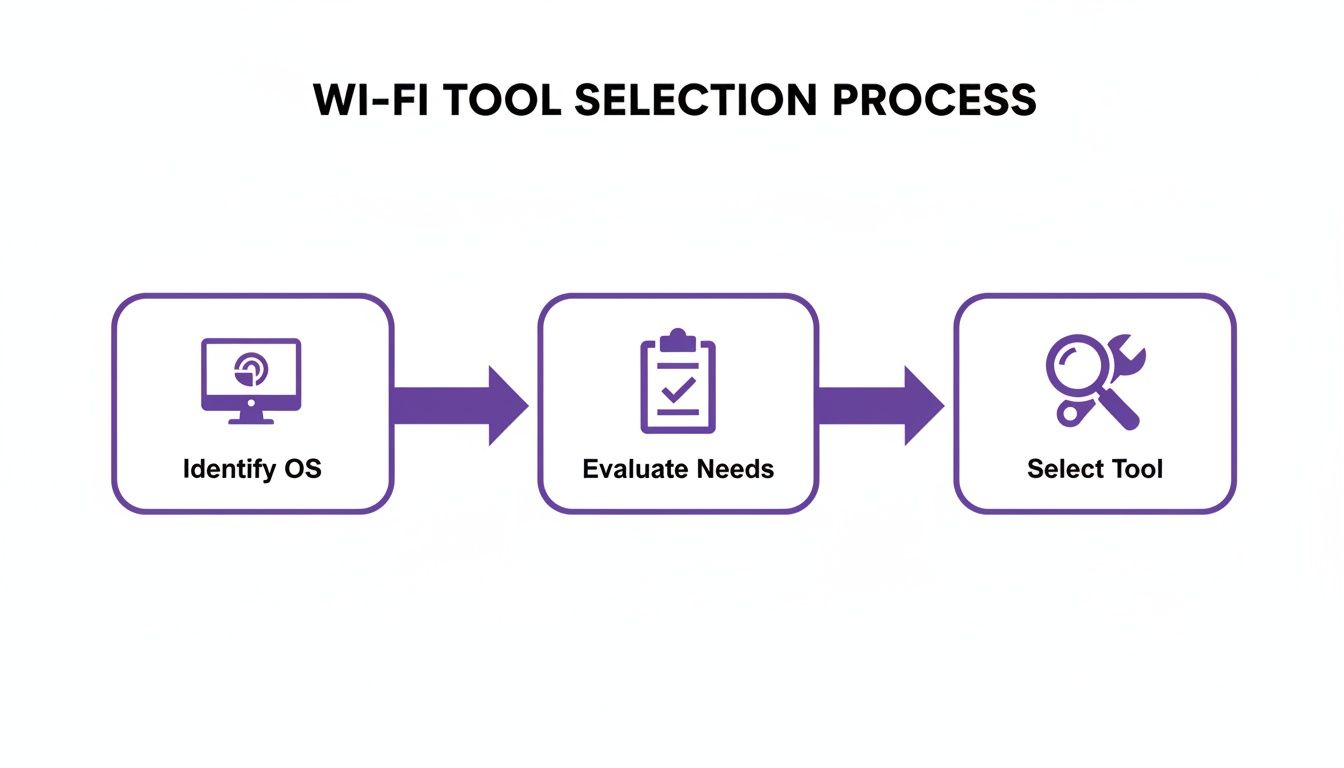
As you can see, it all starts with your platform. That single choice dictates the tools you have at your disposal before you can even think about what you want to analyse.
Scanning on macOS with Wireless Diagnostics
Apple's macOS has a brilliant, if slightly buried, utility that’s perfect for a detailed channel scan. It's called Wireless Diagnostics, and it gives you a look under the bonnet that the standard Wi-Fi menu just can't match.
Getting to it is easy. Just hold down the Option key and click the Wi-Fi symbol in your top menu bar. You'll immediately notice a much more detailed dropdown. From there, select "Open Wireless Diagnostics". A new window will pop up asking to run diagnostics, but you can ignore that for now. Instead, head up to the "Window" menu at the very top of your screen and choose "Scan".
This opens up the Scan window, which is where the real work happens. You'll get a live list of every Wi-Fi network your Mac can see, packed with crucial info like their RSSI (signal strength), noise level, BSSID (the access point's unique MAC address), and—most importantly—the channel it's broadcasting on.
This is where you start looking for patterns. See a dozen networks all crammed onto channel 6 in the 2.4 GHz band? That's a classic sign of co-channel interference. Try sorting the list by channel to quickly spot which frequencies are least crowded.
Using Third-Party Tools on Windows
Unlike macOS, Windows doesn't really have a built-in graphical tool for this sort of in-depth scanning. While you can wrestle some basic info out of the command line, it's not a practical way to visualise the RF environment. For any real troubleshooting on a Windows machine, you’ll need to grab a third-party app.
I usually recommend tools like NetSpot or inSSIDer. Once installed, these programmes lay out the wireless landscape in a really intuitive, graphical way. You'll often get two main views: a network list, much like the macOS tool, and a real-time graph plotting out channel usage.
That channel graph is incredibly useful. It visually maps every nearby network, showing its signal strength and channel width. It makes spotting congestion dead simple. For example, you might see several strong networks bleeding over channels 3, 4, and 5, creating a real mess of adjacent-channel interference. Your job is to find a channel where there's minimal overlap from other strong signals.
Mobile Scanning with Android Apps
Android's more open nature makes it a fantastic platform for doing this kind of analysis on the move. An app like WiFi Analyzer puts a powerful scanner right in your pocket. Once you install it from the Play Store and give it the location permissions it needs, you'll get instant access to some really handy visualisations.
The Channel Graph is usually the most valuable view. It shows all the local networks as coloured arcs, with the height of the arc representing signal strength. If you see a bunch of high peaks all sitting on the same channel number, you've just found a major point of congestion.
This is especially powerful for doing a proper physical site survey. You can walk around a building, phone in hand, and see exactly how the wireless environment changes from one room to the next. That mobility is a massive advantage for sniffing out localised interference that a laptop sitting at a desk would completely miss.
Remember, the whole point of a mobile scan is to see the RF environment from a user's perspective. What you detect in the reception area might be totally different from the experience in a back office or a meeting room.
On the other side of the fence, Apple's tight security policies on iOS prevent apps from accessing the low-level Wi-Fi data needed for a proper scan. While the AirPort Utility app offers a very basic scan, it just doesn't have the detail for any serious analysis. For real network troubleshooting, you'll need an Android device, a Mac, or a Windows laptop.
Scanning in Enterprise Environments
For larger organisations, walking around with a laptop or phone is just not an efficient way to manage a network. Enterprise-grade kit from vendors like Meraki, Aruba, and Ruckus comes with sophisticated RF scanning capabilities built right in, giving you a centralised, birds-eye view of your entire wireless space.
These systems use features often called Radio Resource Management (RRM) or Adaptive Radio Management (ARM). Your access points can either dedicate one of their radios to constantly scan the airwaves or perform quick, periodic off-channel scans without disrupting connected clients.
All that data gets fed back into a central dashboard. As a network administrator, you can look at heatmaps showing channel usage across your entire floor plan, get automatic alerts for high-interference areas, and dig into historical RF performance data.
This approach gives you two massive advantages:
- Automation: The system can intelligently and automatically adjust channel plans and power levels based on real-time scan data. This optimises performance on the fly without anyone needing to lift a finger.
- Scale: It provides a holistic view of the RF environment across hundreds or even thousands of access points—something that would be impossible to replicate with individual device scans.
By making the most of these built-in tools, you can shift from reactive troubleshooting to a proactive, data-driven strategy for keeping your wireless network healthy and performing at its best.
Decoding Your Scan Results to Defeat Interference
Running a Wi-Fi channel scan is the easy part. The real skill is turning that raw data—all those numbers and graphs—into practical changes that actually improve your network's performance. Once you’ve got the results on your screen, you can finally start getting to the bottom of your Wi-Fi headaches.
Your scan results will throw a few key metrics at you, but the two you absolutely need to know are RSSI (Received Signal Strength Indication) and SNR (Signal-to-Noise Ratio). Nailing these is fundamental to making any sense of the data.
Interpreting Signal Strength and Noise
RSSI is simply a measure of how well your device can hear a specific access point. It's measured in negative decibels milliwatts (dBm), which can be a bit counterintuitive—numbers closer to zero are stronger. Think of it like this: -45 dBm is a fantastic signal, but by the time you get to -85 dBm, the connection is practically unusable.
But a strong signal isn't the whole story. You also have to account for the background chatter from other devices. That's where SNR comes in. It measures your Wi-Fi signal's strength relative to all that ambient noise. The higher the SNR, the cleaner and more reliable your connection will be.
Key Takeaway: For a stable and fast Wi-Fi experience, you should be aiming for an RSSI of -67 dBm or better and an SNR of 25 dB or higher. Anything below these thresholds is a recipe for slow speeds, dropouts, and frustrated users.
Spotting Wi-Fi Interference Visually
Most of the time, the problems you'll find with a channel scan are co-channel and adjacent-channel interference. Thankfully, a good scanning tool will generate a graph that makes spotting these issues dead simple.
- Co-channel interference is what happens when too many networks are trying to use the exact same channel. On your graph, this looks like several overlapping peaks all piled on top of a single channel number (e.g., three strong networks all fighting over channel 6).
- Adjacent-channel interference occurs when networks on nearby, overlapping channels bleed into each other. This is a classic problem on the 2.4 GHz band and often appears as a wide, messy blob of signals crowding channels 2, 3, and 4, for example.
When you see this kind of congestion, the fix is to find a quieter channel. Your scan will show you the gaps—the channels with the fewest competing networks or only very weak, distant signals. For more specific guidance, check out our detailed article on choosing the best Wi-Fi channels on 5 GHz.
Distinguishing Non-Wi-Fi Interference
Sometimes, the culprit isn't another Wi-Fi network at all. Plenty of common devices generate radio frequency (RF) noise that can wreak havoc, especially on the crowded 2.4 GHz band. We call this non-Wi-Fi interference.
Common sources of this interference include:
- Microwave ovens (a notorious offender)
- Cordless phones
- Bluetooth devices
- Wireless security cameras
- Poorly shielded cables
A standard Wi-Fi scanner won't always pick up this kind of interference directly, but you can definitely infer its presence. If your scan shows a clear channel but users still complain about poor performance and the SNR is low, non-Wi-Fi interference is a prime suspect. While advanced tools called spectrum analysers can actually visualise this noise, for most of us, it's a process of elimination.
For example, if a café's Wi-Fi drops out for 90 seconds every time someone in the kitchen nukes a burrito, you've probably found your culprit. As you analyse scan results, it helps to understand how different technologies are designed for things like optimised coverage and reduced interference, as this provides insight into broader RF management strategies.
By learning to read the story your Wi-Fi scan is telling, you can stop guessing, accurately diagnose problems, make informed channel changes, and build a much more resilient and high-performing wireless network for everyone.
Strategic Channel Planning for Optimal Performance

Alright, you've done the groundwork and have the raw data from your Wi-Fi channel scan. Now it's time to turn that intel into a smart, robust channel plan that dodges interference and delivers a rock-solid connection for your users.
The real art here is understanding the unique personality of each Wi-Fi band—the crowded 2.4 GHz, the spacious 5 GHz, and the brand-new 6 GHz superhighway. A great channel plan isn't about finding one perfect channel; it's about putting the right traffic in the right lane based on your specific environment.
Navigating the Crowded 2.4 GHz Band
The 2.4 GHz band is the original workhorse of Wi-Fi, but let's be honest, it's showing its age. This band is incredibly congested, and not just with your neighbours' Wi-Fi. It’s a chaotic mess of signals from Bluetooth headsets, cordless phones, and even the office microwave. Your scan results almost certainly paint a picture of a chaotic signal pile-up.
Because of the way its channels are structured, only three of them don't bleed over into each other: 1, 6, and 11.
Pro Tip: In any professional network, you should only ever use channels 1, 6, and 11. Period. Using anything in between, like channel 3 or 8, guarantees you'll be causing and receiving adjacent-channel interference, which drags down performance for everyone nearby.
Your scan data will tell you which of these three channels has the least competition in a particular spot. For a building with multiple access points, you'll create a staggered plan, making sure adjacent APs are on different channels in a repeating pattern (e.g., 1, 6, 11, 1, 6, 11...).
Leveraging the Wider 5 GHz Band
This is where things get much better. The 5 GHz band is a massive step up, offering heaps more channels and much wider lanes for data. The best part? All standard 5 GHz channels are non-overlapping, which immediately gives you far more room to manoeuvre around interference. This is where most of your high-performance devices should live.
Your channel scan will help you pinpoint the quietest spots here, too. A key strategic decision in the 5 GHz band involves using Dynamic Frequency Selection (DFS) channels. These are chunks of spectrum normally reserved for radar systems (like weather and military), but Wi-Fi can use them opportunistically as long as no radar is detected.
- The upside of DFS: Using these channels can unlock a huge amount of clean, empty spectrum. This is a godsend in dense environments like conference centres or stadiums.
- The downside of DFS: If an AP detects a radar signal, it's required by law to immediately abandon the channel. This can cause a brief, but noticeable, service interruption for any connected clients.
For most venues, the benefit of escaping the noise on the common channels makes enabling DFS a very smart move.
Embracing the 6 GHz Superhighway
The newest addition to the family, the 6 GHz band (the engine behind Wi-Fi 6E and Wi-Fi 7), is a genuine game-changer. Think of it as a brand-new, ten-lane motorway built right next to the congested old A-roads of 2.4 and 5 GHz. It offers a massive stretch of pristine spectrum, completely free from decades of legacy interference.
In the UK, the intense pressure on the old bands has made 6 GHz the critical frontier for future-proofing networks. In fact, a staggering 65% of industry experts now see 6 GHz availability as 'important' or 'critical' to their business, all thanks to the explosion of connected devices. This extra space is vital because it supports massive 320 MHz wide channels—perfect for the high-throughput, low-latency apps that modern venues demand. You can explore the full market analysis to see its implications for future connectivity.
Because it's so new, your Wi-Fi scan will likely show the 6 GHz band as a beautiful, empty expanse. This makes channel planning incredibly simple: just pick a wide channel and let your high-performance devices fly.
So, here's a practical workflow for building your channel plan:
- Prioritise 6 GHz: Steer all your compatible, high-performance devices straight to the 6 GHz band. Give them the premium experience they were built for.
- Optimise 5 GHz: Use your scan data to place APs on the quietest non-DFS and DFS channels. This will be the workhorse for the bulk of your network traffic.
- Use 2.4 GHz Sparingly: Relegate this band to legacy clients or simple, low-bandwidth IoT gadgets. And remember: stick religiously to channels 1, 6, and 11.
Following this tiered approach ensures you’re playing to the strengths of each band, creating a network that’s not just fast, but resilient and ready for the future.
Putting Scan Data to Work in Your Daily Operations
A Wi-Fi channel scan isn't just an emergency tool for when things go wrong. Think of it less as a fire extinguisher and more as a foundational part of your network's health routine. Making scanning a repeatable, strategic part of your daily workflow is what separates a reactive network team from a proactive one.
The real magic happens when you feed this data into your enterprise-grade systems. Modern network hardware from vendors like Meraki, Aruba, and Mist isn't just broadcasting a signal; it's listening, too. These platforms have powerful features like Radio Resource Management (RRM) or Adaptive Radio Management (ARM).
Essentially, these systems act as an automated network engineer. They use real-time scan data from your access points to intelligently adjust channel assignments and power levels on the fly, keeping your RF environment in peak condition without you having to lift a finger. This kind of automation is a lifesaver in dynamic spaces like hotels or retail centres, where interference patterns can change by the hour.
From Clean Airwaves to Business Outcomes
A well-optimised wireless environment has a direct, measurable impact on your business. When your network is stable and the airwaves are clean, the benefits ripple outwards, going far beyond just faster browsing speeds for your guests.
- Sharper Analytics: In a retail setting, clean Wi-Fi means more precise footfall tracking and location analytics. This gives you a much clearer, more reliable picture of customer behaviour in your venue.
- A Better Guest Experience: For visitors, a smooth connection means a hassle-free login and a better overall impression. No one remembers the Wi-Fi that just worked, but everyone remembers the one that didn't.
- Smoother Operations: For your staff, it means those crucial tools—point-of-sale systems, inventory scanners, and communication apps—work without frustrating glitches that slow everyone down.
This is especially critical as UK broadband infrastructure continues its rapid modernisation. With full fibre deployment now reaching 78% of UK homes, people's expectations for fast, reliable connectivity everywhere have soared. And for administrators rolling out advanced security like passwordless authentication, this robust backbone makes certificate-grade access far more reliable, moving away from older, less secure systems. You can explore more expert predictions for Wi-Fi in 2026 here.
Ultimately, a regular Wi-Fi channel scan provides the foundational data for a smarter, more resilient network. It's the first step in a data-driven approach that delivers a tangible return by ensuring your wireless infrastructure actively supports—rather than hinders—your business goals.
By moving beyond occasional firefighting and embedding scanning into your core operations, you turn your network from a potential headache into a reliable asset that enhances every digital interaction within your space.
A robust, secure, and seamless Wi-Fi experience is no longer a luxury—it's a core business requirement. Purple provides an identity-based networking platform that replaces insecure passwords with zero-trust, passwordless access for guests and staff alike. Discover how to transform your network into a powerful tool for analytics, security, and engagement today.